Plasmon decay and non-equilibrium steady states in Josephson junction chains
Pith reviewed 2026-05-15 14:53 UTC · model grok-4.3
The pith
Two-into-two plasmon scattering sets the decay rate in Josephson junction chains and produces a drive-induced crossover to a new non-equilibrium steady state.
A machine-rendered reading of the paper's core claim, the machinery that carries it, and where it could break.
Core claim
The central claim is that multi-mode interactions in long Josephson junction chains cause plasmon decay primarily through two-into-two scattering; this process is dominated by non-resonant contributions in equilibrium, but resonant scattering is amplified by external driving, leading to observable signatures in the distribution function and linewidth and ultimately to a crossover into a qualitatively different non-equilibrium steady state.
What carries the argument
Two-into-two mode scattering as the leading relaxation process that classifies allowed channels and supplies explicit temperature and frequency scalings for the decay rate.
If this is right
- Equilibrium linewidth is set by non-resonant two-into-two processes whose temperature and frequency scalings are analytically known.
- Weak resonant driving selectively enhances particular scattering channels and imprints on the steady-state occupation numbers.
- Strong driving produces a crossover to a non-equilibrium steady state whose coherence properties differ qualitatively from the weakly driven case.
- Microwave spectroscopy of individual chain modes can directly reveal the crossover by monitoring linewidth and photon statistics.
Where Pith is reading between the lines
- The predicted crossover may allow experimental tuning of effective dissipation rates in circuit-QED devices without changing temperature or geometry.
- Similar two-into-two scattering mechanisms could be examined in other nonlinear wave systems such as photonic lattices or acoustic resonators to test the generality of the reported scalings.
- If the crossover steady state supports longer coherence times, it could be explored as a platform for studying driven many-body physics in superconducting circuits.
Load-bearing premise
Two-into-two mode scattering remains the dominant relaxation mechanism in both equilibrium and driven regimes for the experimentally relevant parameters.
What would settle it
A measurement that tracks the mode distribution function and linewidth while ramping the drive amplitude on a selected mode pair and checks whether a sharp change in scaling or functional form appears at the predicted crossover point.
Figures





read the original abstract
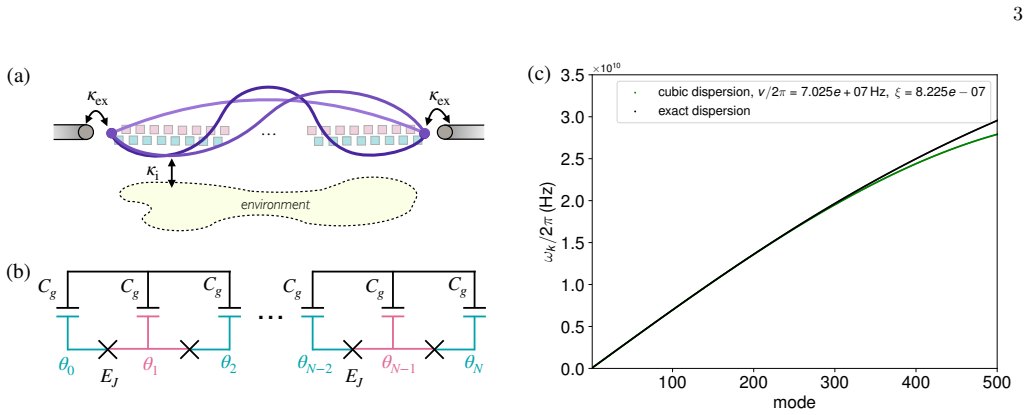
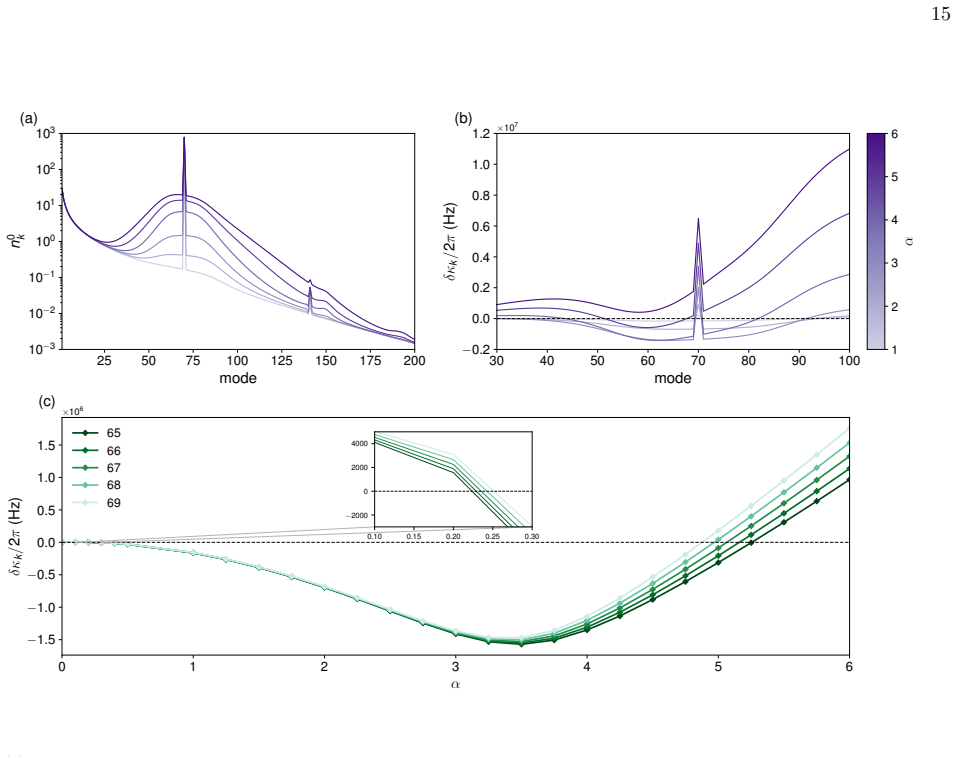
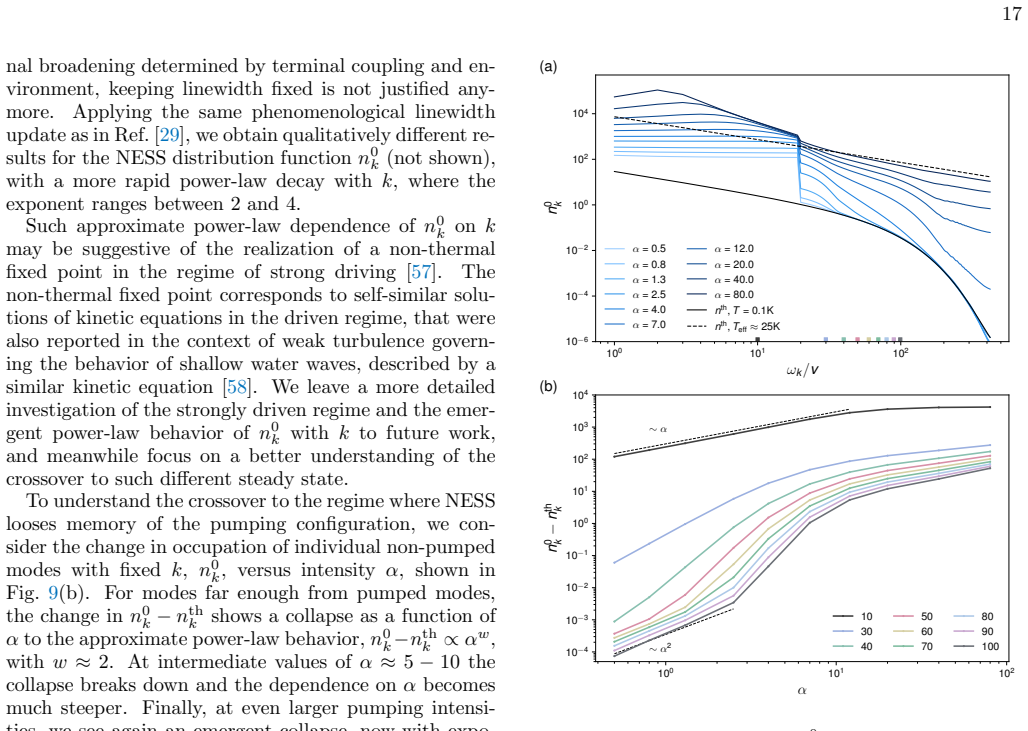
Josephson junction (JJ) chains combine the coherence of superconductivity with the controllability of microwave-frequency circuits, making them a powerful platform for circuit quantum electrodynamics. In this work we consider a long JJ chain that effectively realizes a multi-mode cavity with nonlinear dispersion and additional multi-mode interactions. Individual modes appearing due to the finite size of the chain can be experimentally probed via microwave spectroscopy, both in equilibrium and in driven far-from-equilibrium settings. We study the role of multi-mode interactions in degrading internal coherence -- observable as excess linewidth -- in both equilibrium and driven regimes. Focusing on two-into-two mode scattering as the leading relaxation process, we classify the relevant scattering processes and derive their expected temperature- and frequency-scaling under equilibrium conditions. For experimentally relevant parameters, we show that the equilibrium decay rate is dominated by non-resonant processes, however weakly driving a particular set of modes out of equilibrium enhances resonant scattering, leading to observable signatures in the distribution function and linewidth. Finally, in the strong non-equilibrium regime we report a crossover to a qualitatively different non-equilibrium steady state.
Editorial analysis
A structured set of objections, weighed in public.
Referee Report
Summary. The manuscript studies plasmon decay and non-equilibrium steady states in long Josephson junction chains, modeled as multi-mode cavities with nonlinear dispersion and multi-mode interactions. Focusing on two-into-two scattering as the dominant relaxation channel, it classifies processes, derives temperature- and frequency-dependent scalings for equilibrium decay rates, shows that non-resonant processes dominate for experimentally relevant parameters, demonstrates that weak driving enhances resonant scattering with signatures in the distribution function and linewidth, and reports a crossover to a qualitatively different non-equilibrium steady state in the strong-drive regime.
Significance. If the central claims hold, the work provides a useful framework for understanding coherence degradation via multi-mode interactions in JJ chains, a platform central to circuit QED. The derived scalings and the reported crossover to a distinct NESS offer concrete, testable predictions for microwave spectroscopy experiments. The emphasis on distinguishing resonant versus non-resonant channels under drive is a strength, as is the focus on parameters accessible in current devices.
major comments (2)
- [strong non-equilibrium regime] The crossover to a qualitatively different NESS in the strong non-equilibrium regime rests on the assumption that two-into-two mode scattering remains the leading relaxation process once a subset of modes is strongly driven. The abstract states that equilibrium decay is dominated by non-resonant processes and that weak drive enhances resonant scattering, yet provides no explicit bound (e.g., drive amplitude relative to nonlinearity strength or mode spacing) demonstrating that higher-order processes such as three-wave mixing or parametric instabilities stay negligible when the distribution function deviates far from thermal. This justification is load-bearing for the headline claim and must be supplied with a concrete estimate or inequality.
- [equilibrium conditions] The statement that 'for experimentally relevant parameters, the equilibrium decay rate is dominated by non-resonant processes' requires the specific parameter values (e.g., chain length, Josephson energy, capacitance) and the quantitative ratio of resonant to non-resonant rates to be shown explicitly, either in the main text or a supplementary section, so that the dominance can be verified independently.
minor comments (2)
- Clarify in the text how the distribution function and linewidth are extracted from the scattering rates (e.g., via a kinetic equation or master equation) and whether any approximations beyond the two-into-two truncation are used.
- [scattering processes] Ensure that all two-into-two scattering channels are enumerated with their selection rules or matrix-element expressions for reproducibility.
Simulated Author's Rebuttal
We thank the referee for their careful reading of our manuscript and for the constructive comments. We address each major comment below and plan to incorporate revisions to clarify the points raised.
read point-by-point responses
-
Referee: [strong non-equilibrium regime] The crossover to a qualitatively different NESS in the strong non-equilibrium regime rests on the assumption that two-into-two mode scattering remains the leading relaxation process once a subset of modes is strongly driven. The abstract states that equilibrium decay is dominated by non-resonant processes and that weak drive enhances resonant scattering, yet provides no explicit bound (e.g., drive amplitude relative to nonlinearity strength or mode spacing) demonstrating that higher-order processes such as three-wave mixing or parametric instabilities stay negligible when the distribution function deviates far from thermal. This justification is load-bearing for the headline claim and must be supplied with a concrete estimate or inequality.
Authors: We agree that an explicit bound is necessary to support the strong-drive claim. In the revised manuscript we will add a supplementary section deriving the condition for two-into-two dominance: specifically, we show that the three-wave mixing rate remains subdominant when the drive-induced occupation satisfies n_drive * (lambda / Delta omega) << 1, where lambda is the nonlinearity strength and Delta omega the typical mode spacing. For the experimentally relevant parameters used in the paper (lambda / omega ~ 0.01 and drive amplitudes up to the onset of the reported NESS crossover), this inequality holds by more than an order of magnitude, with a brief numerical check confirming parametric instabilities are not triggered. This addition will make the assumption explicit without altering the central results. revision: yes
-
Referee: [equilibrium conditions] The statement that 'for experimentally relevant parameters, the equilibrium decay rate is dominated by non-resonant processes' requires the specific parameter values (e.g., chain length, Josephson energy, capacitance) and the quantitative ratio of resonant to non-resonant rates to be shown explicitly, either in the main text or a supplementary section, so that the dominance can be verified independently.
Authors: We thank the referee for this request. The revised manuscript will include a new paragraph (or short supplementary note) listing the concrete parameters: chain length N = 100 junctions, Josephson energy E_J / h = 12 GHz, charging energy E_C / h = 0.25 GHz, and stray capacitance C_s = 0.5 fF, yielding mode frequencies between 2 and 8 GHz. We will also report the explicit ratio of non-resonant to resonant decay rates, which evaluates to approximately 80 at T = 20 mK for the lowest modes, obtained from the phase-space integrals derived in the text. This will allow independent verification while leaving the scaling arguments unchanged. revision: yes
Circularity Check
No significant circularity; derivation follows from perturbative scattering classification
full rationale
The paper classifies two-into-two scattering processes from the nonlinear multi-mode Hamiltonian and derives temperature/frequency scalings for equilibrium decay rates under explicit assumptions. The reported crossover in the strong non-equilibrium regime follows from solving the resulting kinetic equations for the distribution function once resonant channels are enhanced by drive. No equation reduces to a self-definition, no fitted parameter is relabeled as a prediction, and no load-bearing premise rests solely on self-citation. The derivation chain remains self-contained against the stated interaction Hamiltonian and perturbative truncation.
Axiom & Free-Parameter Ledger
axioms (2)
- domain assumption Two-into-two mode scattering is the leading relaxation process
- domain assumption The chain realizes a multi-mode cavity with nonlinear dispersion and multi-mode interactions
Reference graph
Works this paper leans on
-
[1]
Large momentum transfer The off-shell contributions to large momentum transfer decay processes are estimated from Eq. (35), by restrict- ing the sum overpto positive valuesp∈(1, T /v) and restoring the Lorentzian form of the density of states. To give an analytical estimate, we consider a decay- ing modekwith energy much larger than tempera- ture. Also, w...
-
[2]
Small momentum transfer To understand the discrepancy between the full contri- bution to the intrinsic scattering rate,δκ k, and the con- tribution from large momentum transfer processes con- sidered above,δκ (i) k , we consider now small momentum transfer processes(ii)from Fig. 3(b). To estimate ana- lytically their contribution, as above we restrict to ...
work page 2000
-
[3]
= 0, withp, q 1, q2 ≷0. Among the possible sign combinations, p, q1, q2 >0 orp, q 1 <0, q 2 >0 orp <0, q 1, q2 >0, only the last one admits exact solution in principle, but it is subjected to a condition overξandk, which is not fulfilled within our range of mode numbers and for typical values ofξ. To further numerically support our claim that 1→3 process ...
-
[4]
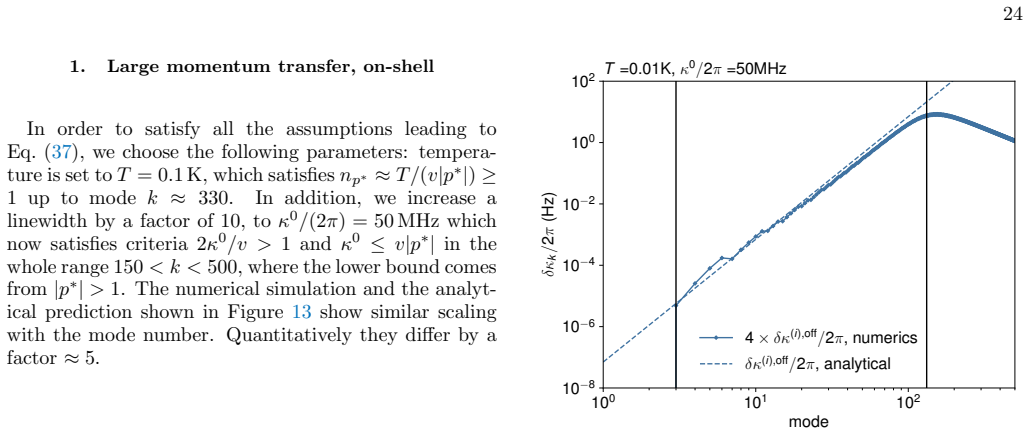
Large momentum transfer, on-shell In order to satisfy all the assumptions leading to Eq. (37), we choose the following parameters: tempera- ture is set toT= 0.1 K, which satisfiesn p∗ ≈T /(v|p ∗|)≥ 1 up to modek≈330. In addition, we increase a linewidth by a factor of 10, toκ 0/(2π) = 50 MHz which now satisfies criteria 2κ 0/v >1 andκ 0 ≤v|p ∗|in the whol...
-
[5]
Our analytical expression is derived in the rangeT /v≪ k≪ 3 p 8κ0/(3vξ)
Large momentum transfer, off-shell For comparing the excess linewidth from large mo- mentum transfer off-shell processes, we use even lower temperatureT= 0.01 K, and cut off sums atp=T /v. Our analytical expression is derived in the rangeT /v≪ k≪ 3 p 8κ0/(3vξ). Forκ 0/(2π) = 50 MHz, this gives 3≪k≪132. In Fig. 14 we compare numerical simula- tion with the...
-
[6]
Small momentum transfer, off-shell Finally, to compare the estimate and numerical sim- ulation for small momentum transfer off-shell processes, in Fig. 15, we useT= 0.1 K and even smallerκ 0/(2π) = 1 MHz, and we consider only decay to the nearest modes, δmax = 1 in Eq. (42). For sufficiently largek, the approx- imation forδ γ(∆ω) presented in the main tex...
-
[7]
A. J. Leggett, Progress of Theoretical Physics Supple- ment69, 80 (1980)
work page 1980
-
[8]
A. J. Leggett, Phys. Rev. B30, 1208 (1984)
work page 1984
-
[9]
O. G. Turutanov, Low Temperature Physics51, 1522 (2025)
work page 2025
-
[10]
M. H. Devoret, J. M. Martinis, and J. Clarke, Phys. Rev. Lett.55, 1908 (1985)
work page 1908
- [11]
- [12]
-
[13]
A. R. Matanin, K. I. Gerasimov, E. S. Moiseev, N. S. Smirnov, A. I. Ivanov, E. I. Malevannaya, V. I. Polozov, E. V. Zikiy, A. A. Samoilov, I. A. Rodionov, and S. A. Moiseev, Phys. Rev. Appl.19, 034011 (2023)
work page 2023
-
[14]
R. Naik, N. Leung, S. Chakram, P. Groszkowski, Y. Lu, N. Earnest, D. C. McKay, J. Koch, and D. I. Schuster, Nature Communications8, 1904 (2017)
work page 1904
-
[15]
J. Koch, T. M. Yu, J. Gambetta, A. A. Houck, D. I. Schuster, J. Majer, A. Blais, M. H. Devoret, S. M. Girvin, and R. J. Schoelkopf, Phys. Rev. A76, 042319 (2007)
work page 2007
-
[16]
I. M. Pop, K. Geerlings, G. Catelani, R. J. Schoelkopf, L. I. Glazman, and M. H. Devoret, Nature508, 369 (2014)
work page 2014
-
[17]
V. E. Manucharyan, J. Koch, L. I. Glazman, and M. H. Devoret, Science326, 113 (2009)
work page 2009
-
[18]
N. A. Masluk, I. M. Pop, A. Kamal, Z. K. Minev, and M. H. Devoret, Phys. Rev. Lett.109, 137002 (2012)
work page 2012
-
[19]
E. Chow, P. Delsing, and D. B. Haviland, Phys. Rev. Lett.81, 204 (1998)
work page 1998
- [20]
-
[21]
S. Mukhopadhyay, J. Senior, J. Saez-Mollejo, D. Puglia, M. Zemlicka, J. M. Fink, and A. P. Higginbotham, Na- ture Physics19, 1630 (2023)
work page 2023
-
[22]
A. van Otterlo, K.-H. Wagenblast, R. Fazio, and G. Sch¨ on, Phys. Rev. B48, 3316 (1993)
work page 1993
-
[23]
B. J. P. Pernack, M. V. Fistul, and I. M. Eremin, Phys. Rev. B110, 184502 (2024)
work page 2024
- [24]
-
[25]
G. Rastelli, I. M. Pop, and F. W. J. Hekking, Phys. Rev. B87, 174513 (2013)
work page 2013
-
[26]
I. M. Pop, I. Protopopov, F. Lecocq, Z. Peng, B. Pan- netier, O. Buisson, and W. Guichard, Nature Physics6, 589 (2010)
work page 2010
-
[27]
A. Erg¨ ul, J. Lidmar, J. Johansson, Y. Azizo˘ glu, D. Scha- effer, and D. B. Haviland, New Journal of Physics15, 095014 (2013)
work page 2013
-
[28]
A. Erg¨ ul, T. Weißl, J. Johansson, J. Lidmar, and D. B. Haviland, Scientific Reports7, 11447 (2017)
work page 2017
-
[29]
B. J. van Wees, H. S. J. van der Zant, and J. E. Mooij, Phys. Rev. B35, 7291 (1987)
work page 1987
-
[30]
P. Chandra, L. B. Ioffe, and D. Sherrington, Phys. Rev. Lett.75, 713 (1995)
work page 1995
- [31]
- [32]
-
[33]
A. Burshtein, R. Kuzmin, V. E. Manucharyan, and M. Goldstein, Phys. Rev. Lett.126, 137701 (2021)
work page 2021
- [34]
-
[35]
A. V. Bubis, L. Vigliotti, M. Serbyn, and A. P. Higgin- botham, Science Advances12, eady7222 (2026)
work page 2026
-
[36]
M. Aspelmeyer, T. J. Kippenberg, and F. Marquardt, Reviews of Modern Physics86, 1391 (2014)
work page 2014
-
[37]
J. Lin, K. A. Matveev, and M. Pustilnik, Phys. Rev. Lett. 110, 016401 (2013)
work page 2013
-
[38]
M. Bard, I. V. Protopopov, and A. D. Mirlin, Phys. Rev. B98, 224513 (2018)
work page 2018
-
[39]
N. Crescini, S. Cailleaux, W. Guichard, C. Naud, O. Buisson, K. W. Murch, and N. Roch, Nature Physics 19, 851 (2023)
work page 2023
- [40]
-
[41]
J. Bourassa, F. Beaudoin, J. M. Gambetta, and A. Blais, Phys. Rev. A86, 013814 (2012)
work page 2012
-
[42]
A. Imamo¯ glu, H. Schmidt, G. Woods, and M. Deutsch, Phys. Rev. Lett.79, 1467 (1997)
work page 1997
-
[43]
S. I. Mukhin and M. V. Fistul, Superconductor Science and Technology26, 084003 (2013)
work page 2013
- [44]
-
[45]
D. M. Basko, F. Pfeiffer, P. Adamus, M. Holzmann, and F. W. J. Hekking, Phys. Rev. B101, 024518 (2020)
work page 2020
-
[46]
P. R. Muppalla,Josephson junction array resonators in the mesoscopic regime: design, characterization and ap- plication, Ph.D. thesis, Leopold-Franzens University of Innsbruck (2020)
work page 2020
-
[47]
B. I. Halperin, G. Refael, and E. Demler, International Journal of Modern Physics B24, 4039 (2010)
work page 2010
- [48]
-
[49]
M. Bard, I. V. Protopopov, I. V. Gornyi, A. Shnirman, and A. D. Mirlin, Phys. Rev. B96, 064514 (2017)
work page 2017
- [50]
-
[51]
A. Imambekov, T. L. Schmidt, and L. I. Glazman, Rev. Mod. Phys.84, 1253 (2012)
work page 2012
- [52]
- [53]
-
[54]
S. Apostolov, D. E. Liu, Z. Maizelis, and A. Levchenko, Phys. Rev. B88, 045435 (2013). 26
work page 2013
-
[55]
I. V. Protopopov, D. B. Gutman, and A. D. Mirlin, Phys. Rev. B90, 125113 (2014)
work page 2014
-
[56]
M. Bard, I. V. Protopopov, and A. D. Mirlin, Phys. Rev. B100, 115153 (2019)
work page 2019
-
[57]
S. Bhattacharyya, J. F. Rodriguez-Nieva, and E. Demler, Phys. Rev. Lett.125, 230601 (2020)
work page 2020
- [58]
- [59]
-
[60]
A. Bahuleyan, V. R. Thakar, V. I. Gokul, S. P. Dinesh, B. P. Venkatesh, and S. A. Rangwala, Opt. Continuum 4, 888 (2025)
work page 2025
- [61]
- [62]
- [63]
-
[64]
Nazarenko,Wave Turbulence(Springer Berlin, Heidel- berg, 2011)
S. Nazarenko,Wave Turbulence(Springer Berlin, Heidel- berg, 2011)
work page 2011
-
[65]
A. A. Houck, H. E. T¨ ureci, and J. Koch, Nature Physics 8, 292 (2012)
work page 2012
discussion (0)
Sign in with ORCID, Apple, or X to comment. Anyone can read and Pith papers without signing in.