REVIEW 4 major objections 5 minor 3 cited by
Fuzzy dark matter mass from eight dwarf spheroidals is bimodal: a ~1e-20 eV branch and a ~1e-22 eV branch that appears only when core-halo scatter is included.
Reviewed by Pith at T0; open to challenge. T0 means a machine referee read the full paper against a public rubric. the ladder, T0–T4 →
T0 review · deepseek-v4-flash
2026-08-03 02:32 UTC pith:H57BAY54
load-bearing objection The low-mass FDM window is interesting but rests on an ad hoc CHR ensemble; the paper needs a same-pipeline baseline before that claim is taken seriously. the 4 major comments →
Fuzzy Dark Matter and the Impact of Core--Halo Diversity on Its Particle Mass Constraints
The pith
A machine-rendered reading of the paper's core claim, the machinery that carries it, and where it could break.
Core claim
The paper claims that the fuzzy dark matter particle mass inferred from eight dwarf spheroidals is bimodal. Combining posteriors yields log10(m_psi/eV) = -21.82 (+0.35/-0.26) and -19.79 (+0.60/-0.53) at 68% credible intervals. The low-mass window becomes prominent only when the core-halo mass relation is treated as an ensemble of 500 realizations within the scatter of simulations. The two solutions arise because the soliton density profile falls steeply (rho ~ r^-16) beyond the core radius, so the model avoids configurations where many stars sit in the transition region. The paper argues that one-to-one core-halo constraints were artificially restrictive.
What carries the argument
The analysis uses a two-component halo model: a soliton core embedded in an NFW envelope, matched at a transition radius. The core-halo relation is represented by 500 realizations of its parameters drawn uniformly within simulation scatter. Stellar kinematics are modeled with Jeans equations through fourth order, using kurtosis to break the mass-anisotropy degeneracy. The steep soliton falloff creates the two configurations, and the core-halo scatter lets the small-mass window survive.
Load-bearing premise
The low-mass window relies on treating 500 core-halo realizations, drawn uniformly within the scatter band of existing simulations, as an equal-weight ensemble; if the true distribution of halo properties is non-uniform or narrower, the low-mass solution may be an artifact.
What would settle it
Recompute the posterior with a fully probabilistic, empirically weighted core-halo relation from a larger simulation suite; if the low-mass peak disappears or the 68% interval no longer includes log10(m_psi/eV) around -21.8, the central claim fails. Alternatively, a dwarf spheroidal with kinematic tracers extending well beyond its half-light radius and a steeply falling velocity dispersion without a large flat core would rule out the low-mass branch.
If this is right
- Earlier constraints from one-to-one core-halo relations are not robust; including scatter opens a lower mass window around 1e-22 eV.
- The high-mass window near 1e-20 eV remains broadly compatible with other astrophysical bounds, while the low-mass window is closer to the edge of some constraints.
- The bimodality is a statistical feature, not evidence of two physical populations; future data are needed to decide.
- Fourth-order velocity moments sharpen the separation, showing kurtosis carries real constraining power.
- Extending stellar samples beyond current radial coverage should distinguish the branches because the low-mass branch requires a core radius large enough to enclose most tracers.
Where Pith is reading between the lines
- Beyond the paper: if the true core-halo scatter is non-uniform or narrower, the low-mass window could shift or vanish; a fully probabilistic treatment would test this.
- Applying the same ensemble to ultrafaint dwarfs would either sharpen or resolve the tension with dwarf spheroidals.
- The correlation between inferred core radius and median stellar radius suggests selecting dwarfs with the most extended stellar distributions to exclude the large-core branch.
- Quoting a single fuzzy dark matter mass from a single core-halo relation may be misleading; constraints should be reported as a function of the assumed scatter.
Editorial analysis
A structured set of objections, weighed in public.
Referee Report
Summary. The paper infers the fuzzy dark matter particle mass m_ψ from the line-of-sight kinematics of eight Milky Way dwarf spheroidals. The halo model is a soliton core matched to an NFW envelope, and the analysis uses both second- and fourth-order Jeans equations with unbinned, kernel-based likelihoods. The distinctive new ingredient is an ensemble of N_CHR = 500 realizations of the generalized core–halo mass relation of Chan et al. (2022), intended to capture intrinsic scatter in the Mc–M200 relation. The main result is a bimodal posterior for m_ψ, with log10(m_ψ/eV) ≈ -21.8 and ≈ -19.8 at 68% credibility, and the claim that the low-mass window appears only when core–halo diversity is included. The paper also compiles and compares against external constraints from CMB, Lyman-α, superradiance, satellite abundances, and stellar-stream/UFD heating analyses.
Significance. If the central claim is correct, it would substantially alter the interpretation of dwarf-galaxy kinematic constraints on FDM: it would show that previously reported lower bounds based on a one-to-one Schive et al. (2014) CHR are artificially restrictive, and that a second, lower-mass window around 10^-21.8 eV remains consistent with dSph kinematics once realistic CHR scatter is included. The paper is careful in several respects: it uses unbinned stellar velocities (avoiding binning information loss), includes fourth-order velocity moments through kurtosis with flexible kernels, and explicitly discusses systematic modeling uncertainties and external probes. The methodology is standard and the numerical machinery appears straightforward. However, the paper's new physical conclusion depends entirely on how the CHR ensemble is constructed and weighted, and that construction is not currently demonstrated to be robust. The comparison with previous work is also not controlled, so the attribution of the low-mass window to CHR diversity rather than to the simultaneous introduction of fourth-order moments is not established.
major comments (4)
- [§2.2, Eqs. (12)–(14)] The load-bearing ingredient is the N_CHR = 500 ensemble of (ξ, μ, η) realizations, drawn to 'uniformly populate the log10(Mc)–log10(M200) plane within the scatter reported by Chan et al. (2022)' and then used as an equal-weight ensemble. This is not a posterior marginalization over the true CHR distribution. Uniform sampling over the quoted asymmetric intervals overweights tails and underweights the correlated region where most simulated halos reside; the manuscript itself concedes that a fully probabilistic treatment would be more realistic but does not implement one. Because the low-mass peak appears only under this ensemble, the central claim is not yet robust. Please provide sensitivity tests: e.g., Gaussian or log-normal weighting of the Chan et al. scatter, varying N_CHR, expanding/contracting the scatter, and a hierarchical treatment that samples CHR parameters jointly with the ot
- [§5, Hayashi et al. (2021) comparison] The paper states that including CHR diversity 'leads to a qualitatively different posterior structure' and that the low-mass window becomes prominent only with CHR diversity. The only quantitative comparison offered is with Hayashi et al. (2021), which differs in two major respects: it uses a one-to-one Schive CHR and only second-order velocity moments. The present paper also introduces fourth-order moments and kernel-based likelihoods. Without a same-pipeline baseline that fixes the Schive CHR while keeping the fourth-order moments, unbinned likelihood, data set, and priors identical, the attribution to CHR diversity is not demonstrated. Please run and report the fixed-CHR control case under the same code, or explicitly separate the effects of the two changes.
- [Eqs. (16)–(17), §3] The concentration–mass likelihood used for log10(L_c200) depends on the subhalo position parameter x_sub through Eq. (16), yet x_sub is not listed among the free parameters, given a prior, or specified as a fixed value. Because M200 is a free parameter and M200 enters the CHR in Eq. (12), this unspecified input can affect which m_ψ windows are allowed. Please state the assumed value/distribution of x_sub and test sensitivity to it; also justify the adopted σ_c200 = 0.13.
- [Abstract vs. §4/§6] The abstract reports log10(m_ψ/eV) = -19.72^{+0.64}_{-0.56} and -21.81^{+0.39}_{-0.26}, while Section 4 and Section 6 report -19.79^{+0.60}_{-0.53} and -21.82^{+0.35}_{-0.26}. These are quoted as the same 68% credible intervals but differ. Please correct the inconsistency and ensure all quoted intervals correspond to the same posterior definition.
minor comments (5)
- [Eq. (14)] The kernel function fs(w) is used in the likelihood but never defined. Please give the explicit normalized uniform and Laplacian forms and state the criterion for choosing between them (κlos < 3 vs > 3) precisely, including how the transition is handled when κlos is close to 3.
- [§3, parameter list] The text says 'the full model contains five free parameters' but does not list the CHR parameters (ξ, μ, η) among them. Clarify whether each MCMC run uses a fixed CHR realization, whether the likelihood is averaged over the 500 realizations, or whether CHR parameters are sampled hierarchically. This is essential for reproducibility.
- [§3, MCMC convergence] Convergence is assessed only by visual inspection. Please provide quantitative convergence diagnostics (e.g., Gelman–Rubin R-hat or effective sample size) for the reported posteriors, especially since the posterior is multimodal and the chains are short (5000 samples, 2000 burn-in).
- [§5, combined posterior] The statement that the combined constraints are derived by 'directly combining' the eight individual posteriors is vague. Specify whether this is a product of likelihoods, a union of credible intervals, or another procedure, since this affects the meaning of the final ranges.
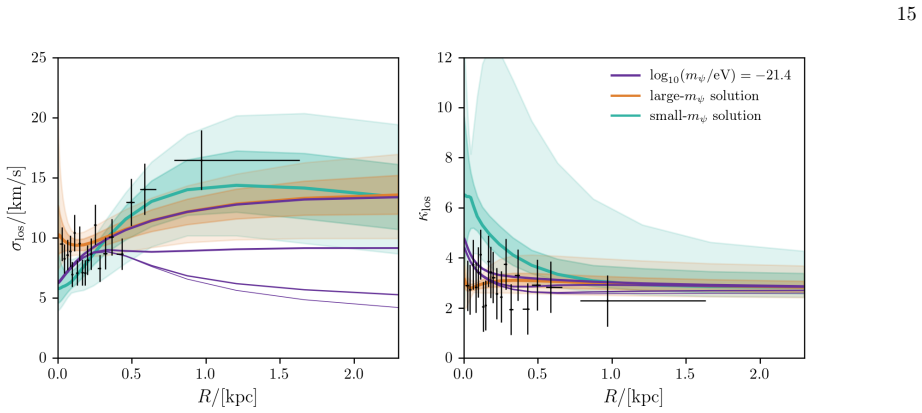
- [General] There are minor typographical issues, e.g., 'Navaro–Frenk–White' in Section 2 and 's implyc' in Section 2. Also, the color coding in Figure 3 is described in the caption but no color bar is visible in the provided text; please ensure the figure is legible in the final version.
Circularity Check
No circularity: the inference is conditioned on external simulation-calibrated inputs, and the CHR ensemble is an acknowledged prior choice, not a fitted prediction.
full rationale
The derivation chain is not circular. The soliton profile, core–soliton scaling, generalized core–halo relation, and concentration–mass relation are imported from external simulations and empirical fits (Schive et al. 2014a,b; Chan et al. 2022; Moliné et al. 2017), not derived from the dSph kinematics being analyzed. The posterior for mψ is obtained from unbinned stellar velocity data through the Jeans equations, so the kinematic data carry independent information. The N_CHR=500 realization ensemble is a fixed equal-weight prior motivated by CHR scatter; the paper explicitly concedes that 'a fully probabilistic treatment of the core–halo mass distribution would be more realistic' but uses the uniform ensemble because of limited simulated halos. This is a sensitivity/prior-robustness limitation, not a hidden fit: the CHR parameters are not adjusted to the stellar data, and the low-mass window is not equivalent by construction to the prior, since it emerges only through the likelihood evaluated against the kinematics. The self-citations to Chan et al. (2022) and Wardana et al. (2025) provide external, simulation/standard-method support rather than an unverified uniqueness claim. No equation reduces to another by definition, and no fitted parameter is renamed as a prediction. Therefore no specific circular step can be exhibited.
Axiom & Free-Parameter Ledger
free parameters (7)
- β (velocity anisotropy) =
Table 2, e.g. -log10(1-β) ≈ -0.14 to 0.15
- mψ (FDM particle mass) =
Bimodal posterior, Table 2
- M200 (halo mass) =
log10(M200/Msun) ≈ 8.5-9.4, Table 2
- ϵ (transition density ratio) =
rt/rc ≈ 2.6-3.3, Table 2
- rs (NFW scale radius) =
log10(rs/kpc) ≈ -0.1 to 0.3, Table 2
- CHR parameters (ξ, μ, η) =
ξ=8.00e6 Msun, log10(μ/Msun)=-5.73, η=0.515 (from Chan et al. 2022)
- N_CHR (number of CHR realizations) =
500
axioms (9)
- domain assumption Dynamical equilibrium and spherical symmetry for dSph stellar systems
- domain assumption Constant stellar velocity anisotropy, β(r)=β
- domain assumption Plummer stellar density profile
- domain assumption Empirical soliton profile of Schive et al., Eq. (7), accurately describes FDM halo centers
- domain assumption Soliton and NFW components are matched by density continuity only at rt
- domain assumption The CDM subhalo concentration–mass relation, Eq. (16), applies to FDM halos
- domain assumption Binary stars contribute negligibly to the velocity dispersion of the selected dSphs
- ad hoc to paper Uniform sampling of N_CHR=500 CHR realizations is an adequate representation of core–halo diversity
- domain assumption The soliton core is stationary and centered on the galaxy
read the original abstract
We investigate how diversity in the core--halo mass relation and the inclusion of higher-order velocity moments affect constraints on the fuzzy dark matter particle mass ($m_\psi$) inferred from the internal kinematics of dwarf galaxies. Using stellar line-of-sight velocities and projected positions for eight Milky Way dwarf spheroidal galaxies, we model their dark matter halos as solitonic cores embedded within outer Navarro--Frenk--White envelopes. We apply both second- and fourth-order Jeans analyses to derive the posterior distribution of $m_\psi$. Our results show that there are two ranges of $m_\psi$ consistent with the observed kinematics: $\log_{10}(m_\psi/\mathrm{eV}) = -19.72^{+0.64}_{-0.56}$, and a narrower low-mass window $\log_{10}(m_\psi/\mathrm{eV}) = -21.81^{+0.39}_{-0.26}$, both within the 68\% credible intervals. The latter becomes prominent only when core--halo diversity is taken into account, which highlights the sensitivity of the inferred fuzzy dark matter particle mass constraints to our understanding of the core--halo relation. Future observations, providing larger stellar samples and more precise kinematic measurements, will be essential for clarifying the allowed parameter space of fuzzy dark matter.
Figures



Forward citations
Cited by 3 Pith papers
-
Variability in Supermassive Black-Hole Accretion Rates in Fuzzy Dark Matter Cores due to Black-Hole Wandering
Numerical simulations find that black-hole wandering in FDM soliton cores produces intermittent accretion, limiting durable boosts except for ~10^7 solar mass seeds in low-sound-speed gas.
-
Lyman-$\alpha$ forest constraints on pure and mixed fuzzy dark matter
Lyman-alpha forest data yield m_FDM > 1.9e-21 eV (95% CL) for pure FDM and f_FDM upper limits of 0.07-0.65 for mixed FDM at log10(m_FDM/eV) = -23 to -21.
-
Dwarf Galaxy Constraints on Interacting Fermionic Dark Matter
MCMC fits of degenerate fermionic dark matter models to eight classical dwarf spheroidal galaxies constrain fermion masses to 100-300 eV and show current data do not strongly favor interacting over non-interacting equ...
Reference graph
Works this paper leans on
-
[1]
Ando, S., Ferreira, E. G. M., & Horigome, S. 2026,
2026
-
[2]
Arroyo-Polonio, J. M., Battaglia, G., Thomas, G. F., et al. 2023, A&A, 677, A95, doi: 10.1051/0004-6361/202346843 Bañares-Hernández, A., Read, J. I., & Júlio, M. P. 2025, arXiv e-prints, arXiv:2509.24103, doi: 10.48550/arXiv.2509.24103
-
[3]
Banik, N., Bovy, J., Bertone, G., Erkal, D., & de Boer, T. J. L. 2021, JCAP, 2021, 043, doi: 10.1088/1475-7516/2021/10/043
-
[4]
2013, NewAR, 57, 52, doi: 10.1016/j.newar.2013.05.003
Battaglia, G., Helmi, A., & Breddels, M. 2013, NewAR, 57, 52, doi: 10.1016/j.newar.2013.05.003
-
[5]
2022, Nature Astronomy, 6, 659, doi: 10.1038/s41550-022-01638-7
Battaglia, G., & Nipoti, C. 2022, Nature Astronomy, 6, 659, doi: 10.1038/s41550-022-01638-7
-
[6]
Bellazzini, M., Gennari, N., & Ferraro, F. R. 2005, MNRAS, 360, 185, doi: 10.1111/j.1365-2966.2005.09027.x
arXiv 2005
-
[7]
Bellazzini, M., Gennari, N., Ferraro, F. R., & Sollima, A. 2004, Monthly Notices of the Royal Astronomical Society, 354, 708, doi: 10.1111/j.1365-2966.2004.08226.x
arXiv 2004
-
[8]
C., Hütsi, G., Raidal, M., & Veermäe, H
Benito, M., Criado, J. C., Hütsi, G., Raidal, M., & Veermäe, H. 2020, PhRvD, 101, 103023, doi: 10.1103/PhysRevD.101.103023
-
[9]
1998, Galactic Astronomy (Princeton University Press)
Binney, J., & Merrifield, M. 1998, Galactic Astronomy (Princeton University Press)
1998
-
[10]
2008, Galactic Dynamics: Second Edition (Princeton University Press)
Binney, J., & Tremaine, S. 2008, Galactic Dynamics: Second Edition (Princeton University Press)
2008
-
[11]
Sasselov, D. D., & Bakos, G. Á. 2004, The Astronomical Journal, 127, 861, doi: 10.1086/381073
-
[12]
Bullock, J. S., & Boylan-Kolchin, M. 2017, Annual Review of Astronomy and Astrophysics, 55, 343, doi: 10.1146/annurev-astro-091916-055313
-
[13]
2002, The Astronomical Journal, 123, 3199, doi: 10.1086/340702
Carrera, R., Aparicio, A., Martínez-Delgado, D., & Alonso-García, J. 2002, The Astronomical Journal, 123, 3199, doi: 10.1086/340702
doi:10.1086/340702 2002
-
[14]
2022, MNRAS, 511, 943, doi: 10.1093/mnras/stac063
Chiba, M. 2022, MNRAS, 511, 943, doi: 10.1093/mnras/stac063
-
[15]
2017, MNRAS, 468, 1338, doi: 10.1093/mnras/stx449
Chen, S.-R., Schive, H.-Y., & Chiueh, T. 2017, MNRAS, 468, 1338, doi: 10.1093/mnras/stx449
-
[16]
2022, Physical Review D, 106, 063517, doi: 10.1103/PhysRevD.106.063517
Dalal, N., & Kravtsov, A. 2022, Physical Review D, 106, 063517, doi: 10.1103/PhysRevD.106.063517
-
[17]
Davoudiasl, H., & Denton, P. B. 2019, PhRvL, 123, 021102, doi: 10.1103/PhysRevLett.123.021102 de Martino, I. 2023, PhRvD, 108, 123044, doi: 10.1103/PhysRevD.108.123044 Dutta Chowdhury, D., van den Bosch, F. C., Robles, V. H., et al. 2021, ApJ, 916, 27, doi: 10.3847/1538-4357/ac043f
-
[18]
Eberhardt, A., & Ferreira, E. G. M. 2025, arXiv e-prints, arXiv:2507.00705, doi: 10.48550/arXiv.2507.00705
-
[19]
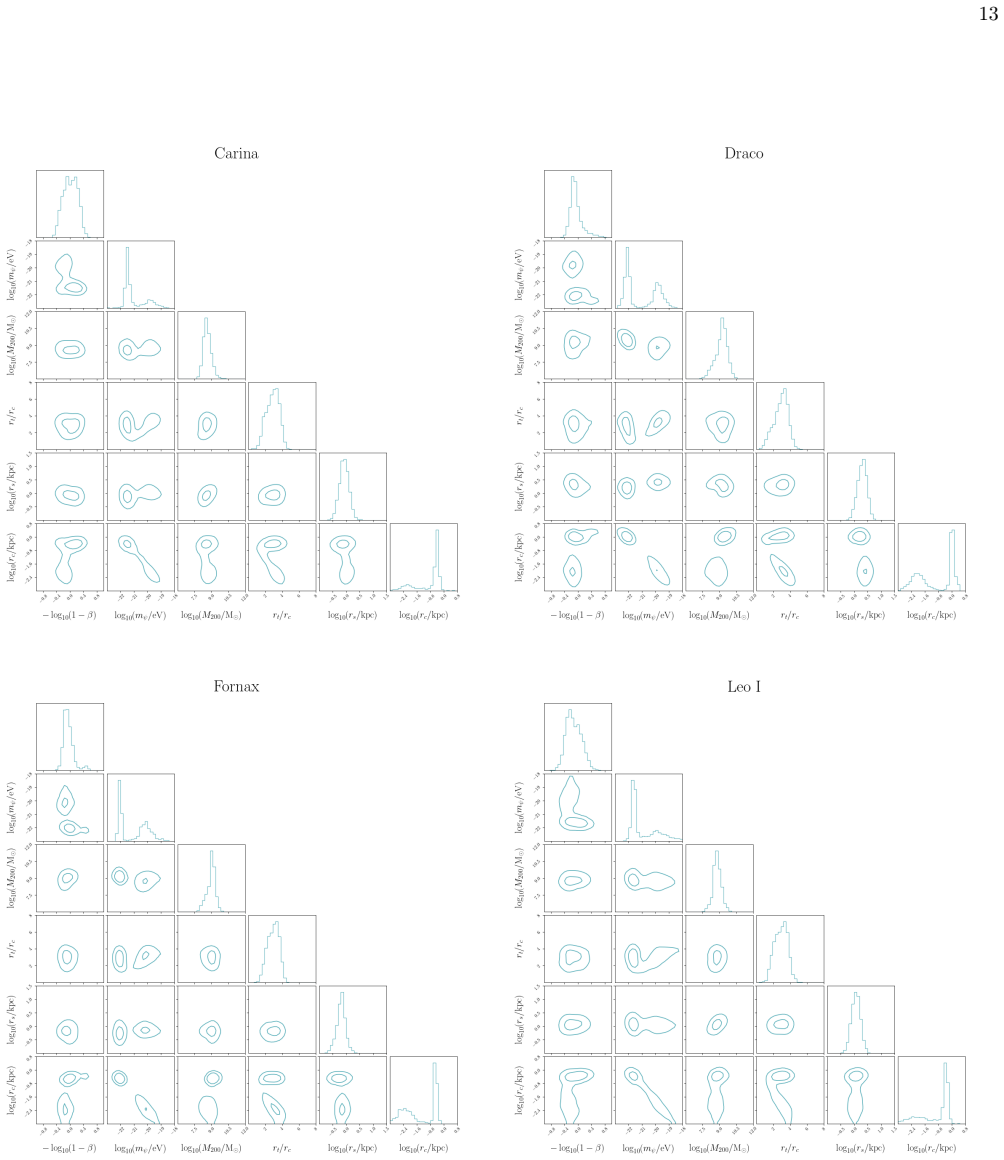
Eberhardt, A., Gosenca, M., & Hui, L. 2025, arXiv e-prints, arXiv:2510.17079, doi: 10.48550/arXiv.2510.17079 13 Figure 5.The posterior distributions of the model parameters for Carina, Draco, Fornax, and Leo I. Althoughrc is not treated as a free parameter in the model, it is included here for reference. 14 Figure 6.The same as Figure 5, but for Leo II, S...
-
[20]
2016, The Astrophysical Journal, 830, 126, doi: 10.3847/0004-637X/830/2/126
Fabrizio, M., Bono, G., Nonino, M., et al. 2016, The Astrophysical Journal, 830, 126, doi: 10.3847/0004-637X/830/2/126
-
[21]
Ferreira, E. G. M. 2021, Astronomy & Astrophysics Review, 29, 7, doi: 10.1007/s00159-021-00135-6
-
[22]
Genina, A., Read, J. I., Frenk, C. S., et al. 2020, MNRAS, 498, 144, doi: 10.1093/mnras/staa2352
-
[23]
Goldstein, I. S., Koushiappas, S. M., & Walker, M. G. 2022, PhRvD, 106, 063010, doi: 10.1103/PhysRevD.106.063010 González-Morales, A. X., Marsh, D. J. E., Peñarrubia, J., & Ureña-López, L. A. 2017, MNRAS, 472, 1346, doi: 10.1093/mnras/stx1941
-
[24]
Hastings, W. K. 1970, Biometrika, 57, 97, doi: 10.1093/biomet/57.1.97
-
[25]
Hayashi, K., Ferreira, E. G. M., & Chan, H. Y. J. 2021, ApJL, 912, L3, doi: 10.3847/2041-8213/abf501
-
[26]
2020, MNRAS, 491, 615, doi: 10.1093/mnras/stz2950 Hložek, R., Marsh, D
Hayashi, K., & Obata, I. 2020, MNRAS, 491, 615, doi: 10.1093/mnras/stz2950 Hložek, R., Marsh, D. J. E., & Grin, D. 2018, Monthly Notices of the Royal Astronomical Society, 476, 3063, doi: 10.1093/mnras/sty271
-
[27]
Hlozek, R., Grin, D., Marsh, D. J. E., & Ferreira, P. G. 2015, Physical Review D, 91, 103512, doi: 10.1103/PhysRevD.91.103512
-
[28]
2000, Physical Review Letters, 85, 1158, doi: 10.1103/PhysRevLett.85.1158
Hu, W., Barkana, R., & Gruzinov, A. 2000, Physical Review Letters, 85, 1158, doi: 10.1103/PhysRevLett.85.1158
-
[29]
2021, ARA&A, 59, 247, doi: 10.1146/annurev-astro-120920-010024
Hui, L. 2021, ARA&A, 59, 247, doi: 10.1146/annurev-astro-120920-010024
-
[30]
Hui, L., Ostriker, J. P., Tremaine, S., & Witten, E. 2017, PhRvD, 95, 043541, doi: 10.1103/PhysRevD.95.043541
-
[31]
Hunter, J. D. 2007, Computing in Science and Engineering, 9, 90, doi: 10.1109/MCSE.2007.55 Iršič, V., Viel, M., Haehnelt, M. G., Bolton, J. S., &
-
[32]
Becker, G. D. 2017, PhRvL, 119, 031302, doi: 10.1103/PhysRevLett.119.031302
-
[33]
Ishiyama, T., Prada, F., Klypin, A. A., et al. 2021, MNRAS, 506, 4210, doi: 10.1093/mnras/stab1755
-
[34]
2024, PhRvD, 110, 023519, doi: 10.1103/PhysRevD.110.023519
Kawai, H., Kamada, A., Kamada, K., & Yoshida, N. 2024, PhRvD, 110, 023519, doi: 10.1103/PhysRevD.110.023519
-
[35]
N., Boylan-Kolchin, M., Cohen, J
Kirby, E. N., Boylan-Kolchin, M., Cohen, J. G., et al. 2013, ApJ, 770, 16, doi: 10.1088/0004-637X/770/1/16
-
[36]
Kirby, E. N., Cohen, J. G., Simon, J. D., et al. 2017, ApJ, 838, 83, doi: 10.3847/1538-4357/aa6570
-
[37]
Koch, A., Kleyna, J. T., Wilkinson, M. I., et al. 2007, The Astronomical Journal, 134, 566, doi: 10.1086/519380
-
[38]
2022, MNRAS, 517, 1867, doi: 10.1093/mnras/stac2677
Laroche, A., Gilman, D., Li, X., Bovy, J., & Du, X. 2022, MNRAS, 517, 1867, doi: 10.1093/mnras/stac2677
-
[39]
Lee, M. G., Yuk, I.-S., Park, H. S., Harris, J., & Zaritsky, D. 2009, The Astrophysical Journal, 703, 692, doi: 10.1088/0004-637X/703/1/692
-
[40]
2025, PhRvL, 135, 061002, doi: 10.1103/9dqj-q6mt Łokas, E
Liao, P.-Y., Su, G.-M., Schive, H.-Y., et al. 2025, PhRvL, 135, 061002, doi: 10.1103/9dqj-q6mt Łokas, E. L. 2002, MNRAS, 333, 697, doi: 10.1046/j.1365-8711.2002.05457.x Macciò, A. V., Paduroiu, S., Anderhalden, D., Schneider, A., & Moore, B. 2012, MNRAS, 424, 1105, doi: 10.1111/j.1365-2966.2012.21284.x María Arroyo-Polonio, J., Battaglia, G., & Thomas, G....
arXiv 2025
-
[41]
Marsh, D. J. E., & Niemeyer, J. C. 2019, PhRvL, 123, 051103, doi: 10.1103/PhysRevLett.123.051103
-
[42]
Mateo, M., Olszewski, E. W., & Walker, M. G. 2008, The Astrophysical Journal, 675, 201, doi: 10.1086/522326
doi:10.1086/522326 2008
-
[43]
2025, arXiv e-prints, arXiv:2509.02781, doi: 10.48550/arXiv.2509.02781
May, S., Dalal, N., & Kravtsov, A. 2025, arXiv e-prints, arXiv:2509.02781, doi: 10.48550/arXiv.2509.02781
-
[44]
2021, MNRAS, 506, 2603, doi: 10.1093/mnras/stab1764
May, S., & Springel, V. 2021, MNRAS, 506, 2603, doi: 10.1093/mnras/stab1764
-
[45]
McConnachie, A. W. 2012, The Astronomical Journal, 144, 4, doi: 10.1088/0004-6256/144/1/4
-
[46]
McConnachie, A. W., & Côté, P. 2010, ApJL, 722, L209, doi: 10.1088/2041-8205/722/2/L209
-
[47]
R., & Kent, S
Merrifield, M. R., & Kent, S. M. 1990, in Bulletin of the American Astronomical Society, Vol. 22, 744
1990
-
[48]
Teller, A. H., & Teller, E. 1953, JChPh, 21, 1087, doi: 10.1063/1.1699114
-
[49]
Mina, M., Mota, D. F., & Winther, H. A. 2022, A&A, 662, A29, doi: 10.1051/0004-6361/202038876
-
[50]
Minor, Q. E. 2013, ApJ, 779, 116, doi: 10.1088/0004-637X/779/2/116
-
[51]
Mocz, P., Vogelsberger, M., Robles, V. H., et al. 2017, MNRAS, 471, 4559, doi: 10.1093/mnras/stx1887 Moliné, Á., Sánchez-Conde, M. A., Palomares-Ruiz, S., &
-
[52]
2017, MNRAS, 466, 4974, doi: 10.1093/mnras/stx026 Muñoz, R
Prada, F. 2017, MNRAS, 466, 4974, doi: 10.1093/mnras/stx026 Muñoz, R. R., Côté, P., Santana, F. A., et al. 2018, The Astrophysical Journal, 860, 66, doi: 10.3847/1538-4357/aac16b
-
[53]
O., Drlica-Wagner, A., Bechtol, K., et al
Nadler, E. O., Drlica-Wagner, A., Bechtol, K., et al. 2021, PhRvL, 126, 091101, doi: 10.1103/PhysRevLett.126.091101
-
[54]
Navarro, J. F., Frenk, C. S., & White, S. D. M. 1997, The Astrophysical Journal, 490, 493, doi: 10.1086/304888
doi:10.1086/304888 1997
-
[55]
2021, MNRAS, 501, 1539, doi: 10.1093/mnras/staa3772
Nori, M., & Baldi, M. 2021, MNRAS, 501, 1539, doi: 10.1093/mnras/staa3772
-
[56]
2022, ApJ, 939, 3, doi: 10.3847/1538-4357/ac9303 Pietrzyński, G., Górski, M., Gieren, W., et al
Pianta, C., Capuzzo-Dolcetta, R., & Carraro, G. 2022, ApJ, 939, 3, doi: 10.3847/1538-4357/ac9303 Pietrzyński, G., Górski, M., Gieren, W., et al. 2009, AJ, 138, 459, doi: 10.1088/0004-6256/138/2/459 Pietrzyński, G., Gieren, W., Szewczyk, O., et al. 2008, The Astronomical Journal, 135, 1993, doi: 10.1088/0004-6256/135/6/1993
-
[57]
Plummer, H. C. 1911, MNRAS, 71, 460, doi: 10.1093/mnras/71.5.460
-
[59]
Read, J. I., Mamon, G. A., Vasiliev, E., et al. 2021, MNRAS, 501, 978, doi: 10.1093/mnras/staa3663
-
[60]
Robles, V. H., & Matos, T. 2012, MNRAS, 422, 282, doi: 10.1111/j.1365-2966.2012.20603.x
arXiv 2012
-
[61]
Robles, V. H., Zagorac, J. L., & Padmanabhan, N. 2024, MNRAS, 532, 1980, doi: 10.1093/mnras/stae1544
-
[62]
Rogers, K. K., & Peiris, H. V. 2021, Physical Review Letters, 126, 071302, doi: 10.1103/PhysRevLett.126.071302
-
[63]
Safarzadeh, M., & Spergel, D. N. 2020, ApJ, 893, 21, doi: 10.3847/1538-4357/ab7db2
-
[64]
Sanders, J. L., & Evans, N. W. 2020, MNRAS, 499, 5806, doi: 10.1093/mnras/staa2860
-
[65]
2014a, Nature Physics, 10, 496, doi: 10.1038/nphys2996
Schive, H.-Y., Chiueh, T., & Broadhurst, T. 2014a, Nature Physics, 10, 496, doi: 10.1038/nphys2996
-
[66]
2020, PhRvL, 124, 201301, doi: 10.1103/PhysRevLett.124.201301
Schive, H.-Y., Chiueh, T., & Broadhurst, T. 2020, PhRvL, 124, 201301, doi: 10.1103/PhysRevLett.124.201301
-
[67]
2014b, PhRvL, 113, 261302, doi: 10.1103/PhysRevLett.113.261302
Schive, H.-Y., Liao, M.-H., Woo, T.-P., et al. 2014b, PhRvL, 113, 261302, doi: 10.1103/PhysRevLett.113.261302
-
[68]
Schwabe, B., Niemeyer, J. C., & Engels, J. F. 2016, Physical Review D, 94, 043513, doi: 10.1103/PhysRevD.94.043513
-
[69]
Spencer, M. E., Mateo, M., Olszewski, E. W., et al. 2018, The Astronomical Journal, 156, 257, doi: 10.3847/1538-3881/aae3e4
-
[70]
Spencer, M. E., Mateo, M., Walker, M. G., & Olszewski, E. W. 2017, ApJ, 836, 202, doi: 10.3847/1538-4357/836/2/202
-
[71]
Stott, M. J., & Marsh, D. J. E. 2018, PhRvD, 98, 083006, doi: 10.1103/PhysRevD.98.083006
-
[72]
Takada, M., Ellis, R. S., Chiba, M., et al. 2014, Publications of the Astronomical Society of Japan, 66, R1, doi: 10.1093/pasj/pst019
-
[73]
2016, in Society of Photo-Optical Instrumentation Engineers (SPIE) Conference Series, Vol
Tamura, N., Takato, N., Shimono, A., et al. 2016, in Society of Photo-Optical Instrumentation Engineers (SPIE) Conference Series, Vol. 9908, Ground-based and Airborne Instrumentation for Astronomy VI, ed. C. J
2016
- [74]
-
[75]
Toguz, F., Kawata, D., Seabroke, G., & Read, J. I. 2022, MNRAS, 511, 1757, doi: 10.1093/mnras/stac057
-
[76]
2025, JCAP, 2025, 080, doi: 10.1088/1475-7516/2025/11/080 Van Der Walt, S., Colbert, S
Totani, T. 2025, JCAP, 2025, 080, doi: 10.1088/1475-7516/2025/11/080 Van Der Walt, S., Colbert, S. C., & Varoquaux, G. 2011, Computing in Science and Engineering, 13, 22, doi: 10.1109/MCSE.2011.37
-
[77]
Veltmaat, J., Niemeyer, J. C., & Schwabe, B. 2018, PhRvD, 98, 043509, doi: 10.1103/PhysRevD.98.043509
-
[78]
Virtanen, P., Gommers, R., Oliphant, T. E., et al. 2020, Nature Medicine, 17, 261, doi: 10.1038/s41592-019-0686-2 17
-
[79]
Walker, M. G., Mateo, M., & Olszewski, E. W. 2009a, The Astronomical Journal, 137, 3100, doi: 10.1088/0004-6256/137/2/3100
-
[80]
2009b, The Astronomical Journal, 137, 3109, doi: 10.1088/0004-6256/137/2/3109
Woodroofe, M. 2009b, The Astronomical Journal, 137, 3109, doi: 10.1088/0004-6256/137/2/3109
-
[81]
G., Olszewski, E
Walker, M. G., Olszewski, E. W., & Mateo, M. 2015, VizieR Online Data Catalog, J/MNRAS/448/2717
2015
discussion (0)
Sign in with ORCID, Apple, or X to comment. Anyone can read and Pith papers without signing in.