Recognition: 2 theorem links
· Lean TheoremShadows of quintessence black holes: spherical accretion, photon trajectories, and geodesic observers
Pith reviewed 2026-05-15 14:13 UTC · model grok-4.3
The pith
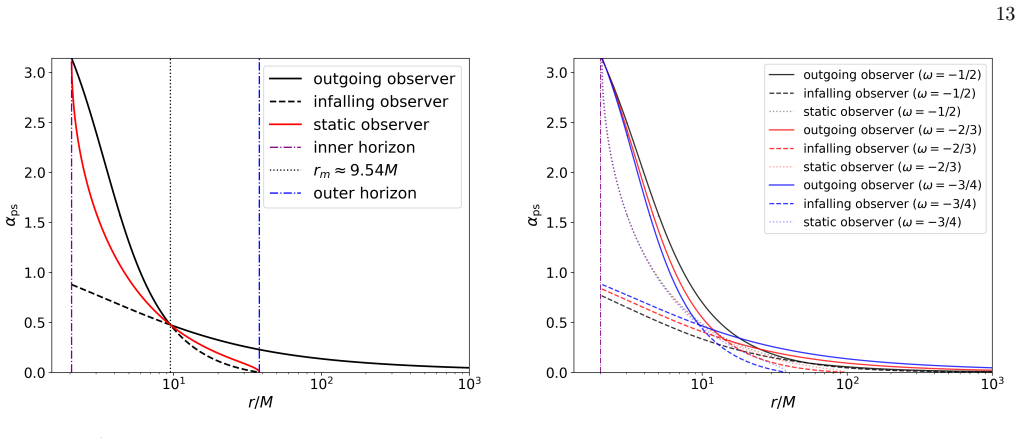
In quintessence black holes, freely infalling observers measure smaller shadow angular radii than static ones at the same location, while outgoing observers measure larger ones.
A machine-rendered reading of the paper's core claim, the machinery that carries it, and where it could break.
Core claim
Although the photon-sphere radius and critical impact parameter are invariant features of the spacetime, the observed angular size of the shadow depends sensitively on the observer’s motion and location. Freely infalling observers systematically record smaller angular radii than static observers at the same coordinate radius, while freely outgoing observers record larger radii, consistent with aberration. In contrast to the Schwarzschild case, the impact parameter alone does not fully determine the observed angular structure. When the model is fitted to the Event Horizon Telescope image of M87*, more negative equations of state produce stronger upper limits on the quintessence parameter, and
What carries the argument
Geodesic observers (freely infalling or outgoing) whose four-velocity alters the apparent angular size of the photon-sphere shadow via relativistic aberration in non-asymptotically flat quintessence spacetimes.
If this is right
- The angular radius of the shadow is smaller for infalling observers and larger for outgoing observers at fixed coordinate radius.
- The impact parameter by itself is insufficient to characterize the observed angular structure of the shadow.
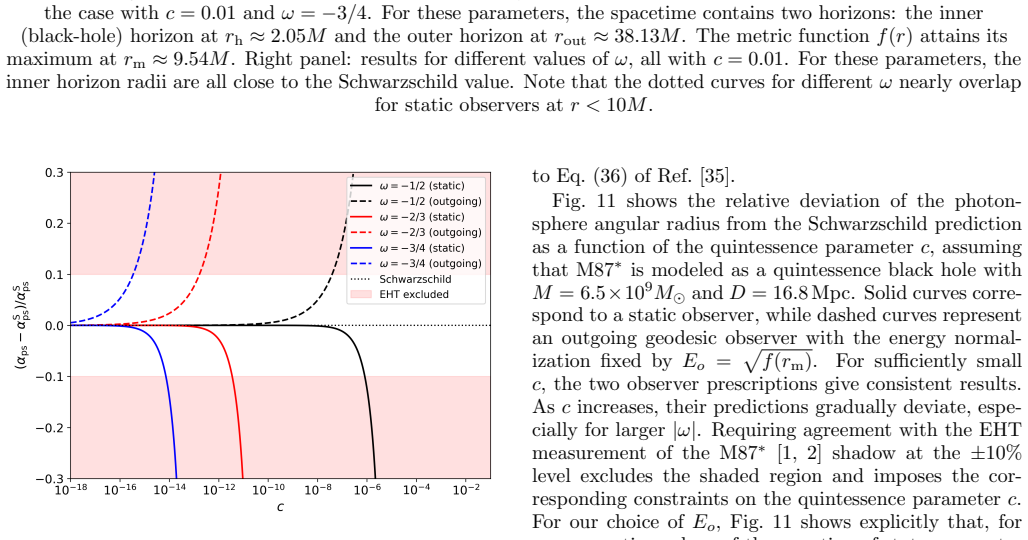
- More negative equations of state produce stronger constraints on the quintessence parameter from M87* data, independent of the chosen observer prescription.
- Analytical expressions are provided for the event horizon, photon-sphere radius, ISCO, and critical impact parameter as functions of the quintessence parameter.
Where Pith is reading between the lines
- Future very-long-baseline interferometry arrays could exploit the observer-motion dependence to distinguish quintessence models from other modifications that preserve asymptotic flatness.
- The same observer-velocity effect would appear in any non-asymptotically flat spacetime, suggesting that shadow analyses of black holes in de Sitter or other cosmological backgrounds should also specify the observer’s four-velocity.
- If accretion flows deviate from perfect spherical symmetry, the reported difference between infalling and static observers may be amplified or reduced, providing a testable signature in polarized intensity maps.
Load-bearing premise
The perturbative expansion used to obtain analytic expressions for the horizon, photon sphere, and critical impact parameter remains valid for the relevant range of the quintessence parameter, and the accretion flow is assumed to be purely spherical and steady-state.
What would settle it
A high-resolution measurement of the M87* shadow angular radius that is inconsistent with the predicted difference between static and infalling observer prescriptions for any value of the quintessence parameter.
Figures




read the original abstract
The presence of a quintessence-like field can influence the black hole shadow through three primary mechanisms: the dynamics of accretion flows, the trajectories of photons, and the motion of observers. Unlike standard shadow analyses that assume a static observer at spatial infinity, the non-asymptotically flat nature of quintessence-corrected spacetimes motivates the consideration of freely falling (geodesic) observers. Using a perturbative approach, we derive analytical expressions for the event-horizon location, photon-sphere radius, innermost stable circular orbit, and critical impact parameter. We compute the observed intensity profiles for both static and infalling spherical accretion flows. We find that, although the photon-sphere radius and the critical impact parameter are invariant properties of the spacetime, the apparent angular size of the shadow depends sensitively on the observer's motion and location. Freely infalling observers systematically measure smaller angular radii than static observers at the same radius, whereas freely outgoing observers measure larger ones, in agreement with relativistic aberration. In contrast to the Schwarzschild case, the impact parameter alone is insufficient to characterize the observed angular structure in non-asymptotically flat spacetimes. Applying our results to the Event Horizon Telescope observation of M87$^\ast$, we show that more negative equations of state lead to stronger constraints on the quintessence parameter, largely independent of the observer prescription. Our analysis highlights the importance of carefully specifying the observer in shadow studies of non-asymptotically flat black-hole spacetimes.
Editorial analysis
A structured set of objections, weighed in public.
Referee Report
Summary. The paper analyzes shadows of quintessence black holes using a perturbative approach to derive analytical expressions for the event horizon, photon-sphere radius, ISCO, and critical impact parameter. It computes observed intensity profiles for static and infalling spherical accretion flows, shows that geodesic observer motion alters the apparent shadow angular size via relativistic aberration, and applies the results to EHT M87* data to constrain the quintessence parameter, finding stronger bounds for more negative equations of state that are largely independent of observer choice.
Significance. If the perturbative regime holds for quintessence strengths that shift the shadow by amounts comparable to EHT uncertainties, the work usefully demonstrates the necessity of specifying observer motion in non-asymptotically flat spacetimes and supplies concrete, observer-robust constraints on the quintessence equation of state from existing shadow observations.
major comments (1)
- [perturbative derivations of r_h, r_ph, b_crit and § on M87* application] The perturbative expansions for r_ph, b_crit and related quantities (used throughout the intensity calculations and M87* constraints) are not accompanied by an explicit validity check or error estimate for the parameter values that produce ~10% shadow-size deviations. Because the central claim of observer-independent constraints rests on these analytic forms, their accuracy in the relevant regime must be demonstrated, for example by direct numerical root-finding of the effective potential or by reporting the size of higher-order terms.
minor comments (2)
- [Introduction and §3] Notation for the quintessence parameter and equation-of-state w should be introduced once with a clear definition and then used consistently; occasional redefinitions in later sections obscure the comparison between static and infalling cases.
- [figures showing intensity vs. impact parameter] Figure captions for the intensity profiles should explicitly state the radial location and four-velocity of each observer so that the aberration effect can be reproduced without returning to the text.
Simulated Author's Rebuttal
We thank the referee for the detailed and constructive report. The single major comment concerns the lack of explicit validation for our perturbative expansions in the regime relevant to the M87* constraints. We address this point directly below and will incorporate the requested checks in the revised manuscript.
read point-by-point responses
-
Referee: [perturbative derivations of r_h, r_ph, b_crit and § on M87* application] The perturbative expansions for r_ph, b_crit and related quantities (used throughout the intensity calculations and M87* constraints) are not accompanied by an explicit validity check or error estimate for the parameter values that produce ~10% shadow-size deviations. Because the central claim of observer-independent constraints rests on these analytic forms, their accuracy in the relevant regime must be demonstrated, for example by direct numerical root-finding of the effective potential or by reporting the size of higher-order terms.
Authors: We agree that an explicit accuracy assessment strengthens the paper. In the revised manuscript we will add a dedicated subsection (or appendix) that directly compares the perturbative expressions for r_ph, b_crit, and the critical impact parameter against numerical root-finding of the effective-potential equation for the precise range of the quintessence parameter that produces ~10% shadow-size shifts. We will report the relative truncation errors (including the magnitude of the next-order terms) and show that they remain well below the EHT uncertainty level for the values used in the M87* analysis. This numerical validation will be performed for both the static and infalling observer cases to confirm that the observer-independent nature of the resulting constraints is not an artifact of the perturbative truncation. revision: yes
Circularity Check
Derivations from modified metric and geodesic equations remain independent of final M87* constraints
full rationale
The paper starts from the quintessence-corrected metric and applies standard geodesic equations to obtain perturbative analytic forms for r_h, r_ph, and b_crit. Observer-dependent angular radii are then computed via relativistic aberration applied to the critical impact parameter. M87* constraints follow from direct numerical comparison of these shadow sizes to EHT data, without any refitting of the quintessence parameter inside the derivation itself. No self-definitional loops, fitted inputs renamed as predictions, or load-bearing self-citations appear in the chain. The perturbative assumption is stated as an explicit limitation rather than smuggled in via citation.
Axiom & Free-Parameter Ledger
free parameters (2)
- quintessence parameter
- equation of state w
axioms (2)
- domain assumption General relativity coupled to a quintessence scalar field yielding a specific non-asymptotically flat metric
- domain assumption Spherical, steady-state accretion flow with given emissivity profile
invented entities (1)
-
quintessence field
no independent evidence
Forward citations
Cited by 4 Pith papers
-
Energy conditions in static, spherically symmetric spacetimes and effective geometries
A logarithmic correction to Schwarzschild in static spherical symmetry obeys all classical energy conditions and serves as an effective exterior for horizon-bearing and horizonless compact objects.
-
Photon Spheres and shadow of modified black-hole entropies
Modified black hole entropies alter photon sphere radii and shadow sizes, with parameters constrained by Event Horizon Telescope observations of Sgr A*.
-
Photon Spheres and shadow of modified black-hole entropies
Corrected black hole entropies produce distinct shifts in photon sphere radius and shadow size that are constrained by Event Horizon Telescope data on Sagittarius A*.
-
Photon Spheres and shadow of modified black-hole entropies
Entropy corrections to black holes produce modified metrics whose photon-sphere and shadow sizes can be constrained by Sgr A* observations.
Reference graph
Works this paper leans on
-
[1]
First M87 Event Horizon Telescope Results. I. The Shadow of the Supermassive Black Hole
For simplicity, we have suppressed dimensional considerations in the above expressions. Since the combi- nationc/r 3ω+1 is dimensionless, the radial coordinate in this term should, strictly speaking, be divided by a char- acteristic length scaler d. In other words, the expression implicitly takes the form c r3ω+1 d r3ω+1 ,(5) which renderscdimensionless. ...
work page internal anchor Pith review Pith/arXiv arXiv 2019
-
[2]
S. Vagnozzi et al.,Horizon-scale tests of gravity theories and fundamental physics from the Event Horizon Telescope image of Sagittarius A,Class. Quant. Grav. 40(2023) 165007 [2205.07787]
-
[3]
Black Hole Shadows, Photon Rings, and Lensing Rings
S.E. Gralla, D.E. Holz and R.M. Wald,Black Hole Shadows, Photon Rings, and Lensing Rings,Phys. Rev. D100(2019) 024018 [1906.00873]
work page internal anchor Pith review Pith/arXiv arXiv 2019
- [4]
-
[5]
G.S. Bisnovatyi-Kogan, O.Y. Tsupko and V. Perlick, Shadow of a black hole at local and cosmological distances,PoSMUL TIF2019(2019) 009 [1910.10514]
-
[6]
Wang,Shadows and rings of a de Sitter–Schwarzschild black hole,Eur
Z.-L. Wang,Shadows and rings of a de Sitter–Schwarzschild black hole,Eur. Phys. J. Plus138 (2023) 1131 [2307.12361]
-
[7]
Z. Chang and Q.-H. Zhu,Black hole shadow in the view of freely falling observers,JCAP06(2020) 055 [1911.02190]
-
[8]
Y. Meng, X.-J. Wang, Y.-Z. Li and X.-M. Kuang, Effects of hair on the image of a rotating black hole illuminated by a thin accretion disk,Eur. Phys. J. C85 (2025) 627 [2501.02496]
- [9]
- [10]
- [11]
- [12]
- [13]
-
[14]
V.V. Kiselev,Quintessence and black holes,Class. Quant. Grav.20(2003) 1187 [gr-qc/0210040]
work page internal anchor Pith review Pith/arXiv arXiv 2003
-
[15]
Quintessence, Cosmic Coincidence, and the Cosmological Constant
I. Zlatev, L.-M. Wang and P.J. Steinhardt, Quintessence, cosmic coincidence, and the cosmological constant,Phys. Rev. Lett.82(1999) 896 [astro-ph/9807002]
work page internal anchor Pith review Pith/arXiv arXiv 1999
-
[16]
S. Tsujikawa,Quintessence: A Review,Class. Quant. Grav.30(2013) 214003 [1304.1961]
work page internal anchor Pith review Pith/arXiv arXiv 2013
-
[17]
The Cosmological Constant Problem and Quintessence
V. Sahni,The Cosmological constant problem and quintessence,Class. Quant. Grav.19(2002) 3435 [astro-ph/0202076]
work page internal anchor Pith review Pith/arXiv arXiv 2002
-
[18]
Visser,The Kiselev black hole is neither perfect fluid, nor is it quintessence,Class
M. Visser,The Kiselev black hole is neither perfect fluid, nor is it quintessence,Class. Quant. Grav.37 (2020) 045001 [1908.11058]
-
[19]
Schwarzschild black hole surrounded by quintessence: Null geodesics
S. Fernando,Schwarzschild black hole surrounded by quintessence: Null geodesics,Gen. Rel. Grav.44(2012) 1857 [1202.1502]
work page internal anchor Pith review Pith/arXiv arXiv 2012
-
[20]
Y. Zhang and Y.X. Gui,Quasinormal modes of a Schwarzschild black hole surrounded by quintessence, Class. Quant. Grav.23(2006) 6141 [gr-qc/0612009]
work page internal anchor Pith review Pith/arXiv arXiv 2006
-
[21]
B.B. Thomas, M. Saleh and T.C. Kofane, Thermodynamics and phase transition of the Reissner-Nordstroem black hole surrounded by quintessence,Gen. Rel. Grav.44(2012) 2181 [1604.06207]
work page internal anchor Pith review Pith/arXiv arXiv 2012
-
[22]
K. Ghaderi and B. Malakolkalami,Thermodynamics of the Schwarzschild and the Reissner–Nordstr¨ om black holes with quintessence,Nucl. Phys. B903(2016) 10
work page 2016
-
[23]
Quasinormal modes of a black hole surrounded by quintessence
S.-b. Chen and J.-l. Jing,Quasinormal modes of a black hole surrounded by quintessence,Class. Quant. Grav. 22(2005) 4651 [gr-qc/0511085]
work page internal anchor Pith review Pith/arXiv arXiv 2005
-
[24]
X.-X. Zeng and H.-Q. Zhang,Influence of quintessence dark energy on the shadow of black hole,Eur. Phys. J. C80(2020) 1058 [2007.06333]
- [25]
- [26]
-
[27]
G. Mustafa, F. Atamurotov, I. Hussain, S. Shaymatov and A. ¨Ovg¨ un,Shadows and gravitational weak lensing by the Schwarzschild black hole in the string cloud background with quintessential field*,Chin. Phys. C46 (2022) 125107 [2207.07608]
-
[28]
F. Atamurotov, I. Hussain, G. Mustafa and K. Jusufi, Shadow and quasinormal modes of the Kerr–Newman–Kiselev–Letelier black hole,Eur. Phys. J. C82(2022) 831 [2209.01652]
-
[29]
Singh,Shadows of quintessential dark energy black holes in the domain of outer communication,Phys
B.P. Singh,Shadows of quintessential dark energy black holes in the domain of outer communication,Phys. Dark Univ.42(2023) 101279 [2301.00956]
-
[30]
B. Hamil, B.C. L¨ utf¨ uo˘ glu and L. Dahbi, Quantum-corrected Schwarzschild AdS black hole surrounded by quintessence: Thermodynamics and shadows,Mod. Phys. Lett. A39(2024) 2450161 [2307.16287]
- [31]
-
[32]
McVittie,The mass-particle in an expanding universe,Mon
G.C. McVittie,The mass-particle in an expanding universe,Mon. Not. Roy. Astron. Soc.93(1933) 325
work page 1933
-
[33]
Black hole shadow in an expanding universe with a cosmological constant
V. Perlick, O.Y. Tsupko and G.S. Bisnovatyi-Kogan, Black hole shadow in an expanding universe with a cosmological constant,Phys. Rev. D97(2018) 104062 [1804.04898]
work page internal anchor Pith review Pith/arXiv arXiv 2018
-
[34]
Z.-L. Wang and E. Battista,Dynamical features and shadows of quantum Schwarzschild black hole in effective field theories of gravity,Eur. Phys. J. C85 (2025) 304 [2501.14516]
-
[35]
Wald,General Relativity, Chicago Univ
R.M. Wald,General Relativity, Chicago Univ. Pr., Chicago, USA (1984), 10.7208/chicago/9780226870373.001.0001
-
[36]
S.M. Carroll,Spacetime and Geometry: An Introduction to General Relativity, Cambridge University Press (7, 2019), 10.1017/9781108770385
-
[37]
Wang,Exploring the role of accretion disk geometry in shaping black hole shadows,Phys
Z.-L. Wang,Exploring the role of accretion disk geometry in shaping black hole shadows,Phys. Rev. D 112(2025) 064052 [2506.21148]
-
[38]
R. Narayan, M.D. Johnson and C.F. Gammie,The Shadow of a Spherically Accreting Black Hole, Astrophys. J. Lett.885(2019) L33 [1910.02957]
-
[39]
D. Mihalas and B. Weibel Mihalas,Foundations of radiation hydrodynamics,New York: Oxford University Press(1984)
work page 1984
-
[40]
Rotating black hole solutions with quintessential energy
B. Toshmatov, Z. Stuchl´ ık and B. Ahmedov,Rotating black hole solutions with quintessential energy,Eur. Phys. J. Plus132(2017) 98 [1512.01498]
work page internal anchor Pith review Pith/arXiv arXiv 2017
-
[41]
Shadow of the rotating black hole with quintessential energy in the presence of the plasma
A. Abdujabbarov, B. Toshmatov, Z. Stuchl´ ık and B. Ahmedov,Shadow of the rotating black hole with quintessential energy in the presence of plasma,Int. J. Mod. Phys. D26(2016) 1750051 [1512.05206]
work page internal anchor Pith review Pith/arXiv arXiv 2016
-
[42]
Rotating black hole and quintessence
S.G. Ghosh,Rotating black hole and quintessence,Eur. Phys. J. C76(2016) 222 [1512.05476]
work page internal anchor Pith review Pith/arXiv arXiv 2016
-
[43]
This equilibrium is unstable, but the local inertial interpretation remains valid for our purpose
discussion (0)
Sign in with ORCID, Apple, or X to comment. Anyone can read and Pith papers without signing in.