REVIEW 3 major objections 6 minor 3 cited by
The Virgo Overdensity and Hercules-Aquila Cloud were created by the LMC's tidal alignment of highly eccentric GSE orbits within the last ~1 Gyr, not by the ancient GSE merger geometry.
Reviewed by Pith at T0; open to challenge. T0 means a machine referee read the full paper against a public rubric. the ladder, T0–T4 →
T0 review · deepseek-v4-flash
2026-08-02 18:22 UTC pith:F7OSGJMN
load-bearing objection A real advance in LMC perturbation modelling, but the abstract's 'created by' claim overreaches; the simulations show the LMC can create VOD/HAC-like overdensities from an initially axisymmetric halo, not that the observed ones necessarily originate that way. the 3 major comments →
GSE vs. LMC: reshaping of radially biased stellar haloes by satellites
The pith
A machine-rendered reading of the paper's core claim, the machinery that carries it, and where it could break.
Core claim
The paper's central claim is that the well-known Virgo Overdensity (VOD) and Hercules-Aquila Cloud (HAC) — previously read as surviving geometry of the GSE merger — are instead produced by the dynamical alignment of highly eccentric orbits by the Large Magellanic Cloud. The authors construct an analytic model in which the LMC's tidal torque drives the apocentric angle of near-radial orbits like a pendulum, with stable alignment at apocenters pointing along the satellite's orbital plane; the criterion for libration shows that orbits with e≳0.95 — which include a large fraction of GSE stars — are trapped, on a timescale of order 1 Gyr. Test-particle simulations of an initially axisymmetric GSE
What carries the argument
The central mechanism is a pendulum equation for the apocentric angle ψ of a highly eccentric orbit under the LMC's tidal torque: ψ̈ ≈ (3/8) Ω²_sat ⟨R²⟩ (b^{1/2} a^{3/2})^{-1} sin 2ψ, where Ω²_sat = Gm_LMC sin(2θ_sat)/r³_sat encodes the satellite's mass and position. Stable equilibria at ψ = ±π/2 mean orbits librate toward apocenters aligned with the satellite's orbital plane; the libration condition k²_min < 1 shows that only orbits with eccentricity e ≳ 0.95 are trapped at low energy. This analytic prediction is tested with orbit-superposition construction (equilibrium models assembled from a library of orbits) of haloes with varying anisotropy β ∈ [0.5, 0.9], evolved as massless test part
Load-bearing premise
The simulation assumes the stellar halo was already a perfect, axisymmetric, equilibrium sphere immediately before the LMC's infall (~3.9 Gyr ago) and that it reacts as massless test particles in a rigid Milky Way + LMC potential — if the real GSE halo was already triaxial or tilted, or if the live dark matter halo deforms in response to the LMC, the proposed overdensities' strength, orientation, and timing would change.
What would settle it
Measure the orbital poles and ages of stars in the VOD and HAC: the model predicts their apocenters cluster along the LMC's past orbital plane with a ~1 Gyr alignment timescale. Finding that the stars align instead with the GSE merger plane, or that the overdensity contains stars substantially older than ~2 Gyr, would falsify the LMC-alignment origin; likewise, an astrometric survey that does not see the predicted quadrupole pattern in median L_z near the Sun (R<10 kpc) among high-eccentricity stars would rule the mechanism out.
If this is right
- If the paper is correct, the VOD and HAC are ~1 Gyr old transient features, so they should not be used to infer the geometry of the ancient GSE merger or to argue for a long-lived tilted dark matter halo.
- Equilibrium models of the GSE debris — including orbit-superposition models — must be corrected for the LMC's perturbation, otherwise inferred Milky Way masses and halo shapes will be biased.
- The predicted quadrupole pattern in median angular momentum L_z, present even at R<10 kpc among high-eccentricity stars, offers a new observable for constraining the Milky Way–LMC interaction.
- The strong β-dependence means the LMC spatially fractionates halo components: a β=0.9 population doubles its density contrast relative to a β=0.5 population in two sky regions tied to the LMC's past orbit.
- The LMC alone cannot fully reproduce the observed GSE triaxiality (the simulated intermediate-to-long axis ratio stays ~0.9, above the observed ~0.55), so some initial triaxiality or tilt of the pre-LMC halo may still be required.
Where Pith is reading between the lines
- By the same mechanism the authors note for the dark matter halo, a radially anisotropic dark matter halo would be reshaped by the LMC, changing the potential that governs the LMC's own orbit; a live-N-body simulation including self-gravity could reveal whether this feedback strengthens or suppresses the overdensity signal.
- A sharp, testable extension: the model predicts the VOD/HAC overdensities should extend beyond 25 kpc and be accompanied by a matching feature near the Eridanus-Phoenix overdensity — a blind prediction that upcoming wide-area surveys can check.
- If the HAC and VOD are LMC-made, the 'Virgo Radial Merger' interpretation of the VOD as a distinct recent accretion event becomes unnecessary; a clean chemical and age comparison of VOD stars with GSE stars would distinguish the two scenarios.
Editorial analysis
A structured set of objections, weighed in public.
Referee Report
Summary. The paper studies the response of highly radially anisotropic stellar haloes (beta up to 0.9, appropriate for Gaia Sausage-Enceladus debris) to the gravitational perturbation of the LMC. It develops an analytic pendulum-like model predicting that orbits with e>0.95 and low angular momentum are azimuthally aligned by the LMC tidal field on ~0.3-1 Gyr timescales, and it tests this with test-particle simulations of initially axisymmetric GSE-like haloes in a rigid Milky Way + LMC potential. The fiducial beta=0.9 simulation becomes triaxial (axis ratios ~1:0.89:0.77), tilts by ~13 degrees, and develops on-sky density contrasts of ~30-40% in the Virgo Overdensity and Hercules-Aquila Cloud regions. The authors propose that the HAC and VOD are not necessarily fossil relics of GSE merger geometry but are LMC-induced dynamical alignments, and that previous equilibrium GSE models need LMC corrections.
Significance. If correct, the paper would substantially revise the interpretation of two well-known inner-halo substructures: the VOD and HAC would be ~1 Gyr-old transient alignments rather than preserved merger geometry, and equilibrium models of the GSE would need to incorporate a much stronger LMC perturbation than previously considered. The paper has genuine strengths: the analytic model is explicit and tractable, the alignment criterion is derived rather than fitted, the simulations are designed to test the analytic prediction, the anisotropy dependence is explored systematically, and the code is publicly available. The predicted anisotropy-dependent 'fractionation' and the quadrupole pattern in median L_z are falsifiable observational signatures. The main weakness is that the central causal claim rests on the assumption that the pre-infall stellar halo was axisymmetric and disc-aligned; the paper itself provides evidence that this assumption may fail, and the alternative triaxial initial condition is not tested.
major comments (3)
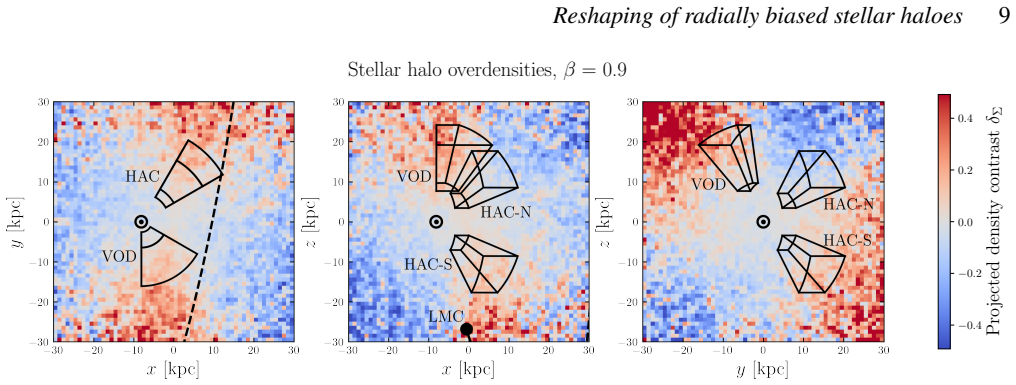
- [Section 3.3 and Section 4.1; Eqs. (44)-(45)] The abstract and conclusion (v) state that the HAC and VOD 'were created by the dynamical alignment of highly eccentric orbits by the LMC.' This causal interpretation rests entirely on the initial condition imposed in Section 3.3: the GSE halo is 'initially axisymmetric and aligned with the Galactic plane' at t=-3.9 Gyr. Because the overdensity contrast is defined relative to the azimuthally averaged, z-symmetric density (Eqs. 44-45), the simulated VOD/HAC features are generated by the LMC by construction. However, Section 4.1 itself shows that the final axis ratio p~0.89 is far rounder than the observed fits (p~0.55 for Lane et al. 2023; outside the 1-sigma band of Han et al. 2022a) and concludes that 'the initial shape may have needed to be triaxial to explain the current configuration.' If the pre-infall GSE was already triaxial and tilted, its apocentric-angle distribution was not un
- [Section 3.3 and final paragraph of Section 5] The simulations are test-particle integrations in rigid Milky Way and LMC potentials; stellar halo self-gravity and the live response of the dark matter halo are neglected. The final discussion paragraph acknowledges that the Milky Way's potential will deform in response to the LMC and that this 'may affect the strength or geometry of the HAC and VOD features.' This is not a minor technicality: the quantitative predictions in Figs. 8-9 (30-40% overdensities) and Fig. 5 (tilt ~13 degrees) are quoted as concrete numbers. A live dark matter halo with high radial anisotropy could respond in a similar way, changing orbital frequencies and the amplitude/orientation of the alignment effect. I would like to see either a quantitative estimate of this systematic uncertainty (e.g. one comparison simulation with a live halo) or a clear statement that the quoted amplitudes are order-of-magnitude pred
- [Section 4.2 and Table 1] The identification of the simulated overdensities with the VOD and HAC is based on sky-position and distance overlap with the Table 1 boxes. The comparison is qualitative: no observational selection function, background contamination, or true observed density map is included, and the simulation produces HAC-N as weak or underdense while the observed HAC is detected primarily in HAC-S. The claimed 30-40% contrast is compared to one literature estimate (Bonaca et al. 2012) but is not fitted or assessed for significance. A more quantitative comparison, or at least an explicit estimate of the expected contrast in the actual survey footprints, would significantly strengthen the claim that the simulated features explain the observed substructures.
minor comments (6)
- [Section 3.2] Typo: 'neglibible' should be 'negligible'.
- [Section 5 (v)] Typos: 'unnmixed' should be 'unmixed'.
- [Section 2] The analytic model treats only in-plane orbits and assumes constant inclination, as stated. It would be helpful to state explicitly in the text that the e>0.95 criterion is derived in the plane and that the 3D vertical response (tilt) is a simulation result, not an analytic prediction.
- [Fig. 5] In the bottom-left panel, it would be clearer to mark the 1-sigma uncertainty ellipses for the Lane et al. (2023) and Han et al. (2022a) long-axis measurements, since the main text says Lane et al.'s tilt is consistent with zero.
- [Section 4.2 / Fig. 9] The HAC-N contrast is often negative in the distance bins. This is consistent with the authors' statement that HAC-N is difficult to form with the LMC, but it would be worth stating explicitly in the main text that the model predicts an underdensity in HAC-N, which can be checked against future data.
- [Section 4.1 / Fig. 5] The axis ratio p in Fig. 5 is defined by the inertia tensor over 6<r/kpc<60, while the initial q in Eq. (42) is the density flattening parameter. The statement in conclusion (ii) that the ratio changes from 'approximately 1:1:0.77' should clarify which definition is used.
Circularity Check
No significant circularity: LMC-alignment prediction is externally parameterized; VOD/HAC coincidence is not fitted.
full rationale
The central derivation is not circular. The analytic model (Section 2) derives the pendulum alignment criterion, Eq. (28) k^2_min<1, using the isochrone potential with M=2.35e11 Msun, b=3 kpc (following Dillamore et al. 2024) and LMC parameters m=1.5e11 Msun, r_sat=50 kpc, theta_sat=237 deg from external measurements (Vasiliev et al. 2021; Pietrzynski et al. 2019; van der Marel et al. 2002). The e>0.95 threshold is a derived condition, not fitted to VOD/HAC (Fig. 2). The simulations use beta=0.9 constrained by independent GSE kinematics (Lancaster et al. 2019; Iorio & Belokurov 2021; Bird et al. 2021), and the VOD/HAC regions (Table 1) are defined a priori from Perottoni et al. (2022), not from the simulation output. The overdensity definition (Eqs. 44-45) is relative to the azimuthal average of the final density, so in a simulation that starts from an exactly axisymmetric halo the LMC is by construction the only source of asymmetry; however, the paper's substantive claim is the spatial coincidence of the induced overdensities with VOD/HAC and the beta-dependence, neither of which is tuned. Self-citations to Dillamore & Sanders (2025) and Dillamore et al. (2024) provide the Schwarzschild construction method and potential parameters, but are not load-bearing for the causal claim; beta=0.9 is independently cited. The paper itself flags the key assumption and limitations: Section 3.3 notes 'the stellar halo was unlikely to be in perfect equilibrium before the LMC's infall'; Section 4.1 concedes 'the initial shape may have needed to be triaxial to explain the current configuration'; and the final discussion acknowledges that a deforming MW potential 'may affect the strength or geometry of the HAC and VOD features.' These are robustness/correctness caveats, not circular steps: the simulation demonstrates that the LMC can create such overdensities from a smooth axisymmetric halo, but does not by itself prove the observed VOD/HAC were created this way. The paper's language ('We propose', 'may be at least partially responsible') is appropriately hedged. Minor self-citation justifies score 2 rather than 0, but no circularity is present.
Axiom & Free-Parameter Ledger
free parameters (4)
- Halo anisotropy beta =
0.9 (fiducial); grid 0.5-0.9
- LMC total mass M_LMC =
1.5e11 M_sun
- Stellar halo density profile (r_b1=11.85 kpc, r_b2=28.33 kpc, slopes 1.70/3.09/4.58, q*=0.73) =
Taken from Han et al. (2022a) fit to GSE
- Milky Way potential parameters (bulge, disc, halo masses and scale lengths) =
Fiducial Vasiliev (2023) potential
axioms (5)
- domain assumption At t0 approximately -3.9 Gyr the stellar halo is a perfect axisymmetric equilibrium aligned with the Galactic disc.
- domain assumption Stars are test particles; stellar halo self-gravity and live dark-matter response are neglected.
- domain assumption The LMC past orbit is computed with Chandrasekhar dynamical friction in a rigid Milky Way potential.
- standard math The analytic model uses the linear tidal approximation |r| << r_sat and takes orbital inclination as constant.
- domain assumption The GSE has beta approximately 0.9 within 25 kpc, as reported by cited observational studies.
read the original abstract
Perturbations from the Large Magellanic Cloud (LMC) of the Milky Way's stellar and dark matter haloes are well-established. However, studies have generally not considered the high radial anisotropy of the Milky Way's inner halo caused by the accreted debris of Gaia Sausage-Enceladus (GSE). We run a series of test particle simulations of stellar haloes being perturbed by the LMC, with different halo velocity anisotropies $\beta\in[0.5,0.9]$. The LMC causes these initially axisymmetric haloes to become approximately triaxial. Their major axes are aligned with its orbital plane and tilted by up to $\sim14^\circ$ with respect to a fixed Galactic disc. These effects become much more dramatic as $\beta$ increases, causing the halo to fractionate spatially according to anisotropy. This confirms the expectations of an analytical model, which predicts that orbits with eccentricities $e\gtrsim0.95$ should azimuthally align with the tidal field of the LMC. The reshaping of the $\beta=0.9$ halo creates strong overdensities of $\sim40\%$ at heliocentric distances as close as 15 kpc. These coincide with the well-known Virgo Overdensity (VOD) and Hercules-Aquila Cloud (HAC), which have previously been associated with the GSE. We propose that the HAC and VOD were created by the dynamical alignment of highly eccentric orbits by the LMC, and are not necessarily relics of the GSE merger geometry. We conclude that previous works have significantly underestimated perturbations from the LMC in the inner stellar halo by not considering sufficiently high velocity anisotropy. This effect should be corrected for when constructing equilibrium models of the GSE debris.
Figures




Forward citations
Cited by 3 Pith papers
-
Disentangling the Morphology of Palomar~5: Effects of the Bar, Spiral Arms, LMC, and Halo Flattening
Direct N-body simulations of Palomar 5 show that no single Milky Way potential model—with or without a bar, flattened halo, LMC, or decelerating bar—reproduces all observed stream properties.
-
Galactic Amnesia: The Information Washout of the Milky Way Merger History
Mutual information analysis of TNG50 simulations shows gravitational potential and total energy retain merger mass and infall time information longest, while radial velocity loses it within ~5 Gyr, with washout depend...
-
The DECam MAGIC Survey $-$ Mapping the Ancient Galaxy in CaHK: Overview and Summary of Early Science
The MAGIC survey provides photometric metallicities for RGB stars over ~3000 deg² using CaHK narrow-band imaging plus DELVE g,r,i data, recovering 13/14 known ultra-faint dwarfs and confirming a distant Reticulum II member.
Reference graph
Works this paper leans on
-
[1]
Balbinot E., Helmi A., 2021, @doi [ ] 10.1051/0004-6361/202141015 , https://ui.adsabs.harvard.edu/abs/2021A&A...654A..15B 654, A15
-
[2]
Belokurov V., et al., 2007, @doi [ ] 10.1086/513144 , https://ui.adsabs.harvard.edu/abs/2007ApJ...657L..89B 657, L89
-
[3]
Belokurov V., Sanders J. L., Fattahi A., Smith M. C., Deason A. J., Evans N. W., Grand R. J. J., 2020, @doi [ ] 10.1093/mnras/staa876 , https://ui.adsabs.harvard.edu/abs/2020MNRAS.494.3880B 494, 3880
-
[4]
Belokurov V., Vasiliev E., Deason A. J., Koposov S. E., Fattahi A., Dillamore A. M., Davies E. Y., Grand R. J. J., 2023, @doi [ ] 10.1093/mnras/stac3436 , https://ui.adsabs.harvard.edu/abs/2023MNRAS.518.6200B 518, 6200
-
[5]
Binney J., Tremaine S., 2008, Galactic Dynamics: Second Edition
2008
-
[6]
Bird S. A., Xue X.-X., Liu C., Shen J., Flynn C., Yang C., Zhao G., Tian H.-J., 2021, @doi [ ] 10.3847/1538-4357/abfa9e , https://ui.adsabs.harvard.edu/abs/2021ApJ...919...66B 919, 66
-
[7]
Bonaca A., et al., 2012, @doi [ ] 10.1088/0004-6256/143/5/105 , https://ui.adsabs.harvard.edu/abs/2012AJ....143..105B 143, 105
-
[8]
Bonaca A., et al., 2020, @doi [ ] 10.3847/2041-8213/ab9caa , https://ui.adsabs.harvard.edu/abs/2020ApJ...897L..18B 897, L18
-
[9]
Boubert D., Belokurov V., Erkal D., Iorio G., 2019, @doi [ ] 10.1093/mnras/sty3014 , https://ui.adsabs.harvard.edu/abs/2019MNRAS.482.4562B 482, 4562
-
[10]
Brooks R. A. N., Sanders J. L., Chandra V., Garavito-Camargo N., Dillamore A. M., Price-Whelan A. M., Ting Y.-S., 2025, @doi [arXiv e-prints] 10.48550/arXiv.2510.04735 , https://ui.adsabs.harvard.edu/abs/2025arXiv251004735B p. arXiv:2510.04735
-
[11]
Brooks R. A. N., Sanders J. L., Dillamore A. M., Garavito-Camargo N., Price-Whelan A. M., 2026, @doi [ ] 10.1093/mnras/staf2111 , https://ui.adsabs.harvard.edu/abs/2026MNRAS.545f2111B 545, staf2111
-
[12]
Bystr \"o m A., et al., 2025, @doi [ ] 10.1093/mnras/staf1219 , https://ui.adsabs.harvard.edu/abs/2025MNRAS.542..560B 542, 560
-
[13]
Chandra V., et al., 2025, @doi [ ] 10.3847/1538-4357/addab6 , https://ui.adsabs.harvard.edu/abs/2025ApJ...988..156C 988, 156
-
[14]
Chandrasekhar S., 1943, @doi [ ] 10.1086/144517 , https://ui.adsabs.harvard.edu/abs/1943ApJ....97..255C 97, 255
doi:10.1086/144517 1943
-
[15]
P., Garavito-Camargo N., Besla G., Zaritsky D., Bonaca A., Johnson B
Conroy C., Naidu R. P., Garavito-Camargo N., Besla G., Zaritsky D., Bonaca A., Johnson B. D., 2021, @doi [ ] 10.1038/s41586-021-03385-7 , https://ui.adsabs.harvard.edu/abs/2021Natur.592..534C 592, 534
-
[16]
Correa Magnus L., Vasiliev E., 2022, @doi [ ] 10.1093/mnras/stab3726 , https://ui.adsabs.harvard.edu/abs/2022MNRAS.511.2610C 511, 2610
-
[17]
Deason A. J., Belokurov V., 2024, @doi [ ] 10.1016/j.newar.2024.101706 , https://ui.adsabs.harvard.edu/abs/2024NewAR..9901706D 99, 101706
arXiv 2024
-
[18]
Dillamore A. M., Sanders J. L., 2025, @doi [arXiv e-prints] 10.48550/arXiv.2510.00095 , https://ui.adsabs.harvard.edu/abs/2025arXiv251000095D p. arXiv:2510.00095
-
[19]
Dillamore A. M., Belokurov V., Evans N. W., 2024, @doi [ ] 10.1093/mnras/stae1789 , https://ui.adsabs.harvard.edu/abs/2024MNRAS.532.4389D 532, 4389
-
[20]
Donlon II T., Newberg H. J., Weiss J., Amy P., Thompson J., 2019, @doi [ ] 10.3847/1538-4357/ab4f72 , https://ui.adsabs.harvard.edu/abs/2019ApJ...886...76D 886, 76
-
[21]
Erkal D., et al., 2019, @doi [ ] 10.1093/mnras/stz1371 , https://ui.adsabs.harvard.edu/abs/2019MNRAS.487.2685E 487, 2685
-
[22]
Erkal D., Belokurov V. A., Parkin D. L., 2020, @doi [ ] 10.1093/mnras/staa2840 , https://ui.adsabs.harvard.edu/abs/2020MNRAS.498.5574E 498, 5574
-
[23]
Erkal D., et al., 2021, @doi [ ] 10.1093/mnras/stab1828 , https://ui.adsabs.harvard.edu/abs/2021MNRAS.506.2677E 506, 2677
-
[24]
Foote H. R., et al., 2023, @doi [ ] 10.3847/1538-4357/ace533 , https://ui.adsabs.harvard.edu/abs/2023ApJ...954..163F 954, 163
-
[25]
Gaia Collaboration et al., 2016, @doi [ ] 10.1051/0004-6361/201629272 , https://ui.adsabs.harvard.edu/abs/2016A&A...595A...1G 595, A1
-
[26]
Gaia Collaboration et al., 2021, @doi [ ] 10.1051/0004-6361/202039588 , https://ui.adsabs.harvard.edu/abs/2021A&A...649A...7G 649, A7
-
[27]
Garavito-Camargo N., Besla G., Laporte C. F. P., Johnston K. V., G \'o mez F. A., Watkins L. L., 2019, @doi [ ] 10.3847/1538-4357/ab32eb , https://ui.adsabs.harvard.edu/abs/2019ApJ...884...51G 884, 51
-
[28]
Garavito-Camargo N., Besla G., Laporte C. F. P., Price-Whelan A. M., Cunningham E. C., Johnston K. V., Weinberg M., G \'o mez F. A., 2021, @doi [ ] 10.3847/1538-4357/ac0b44 , https://ui.adsabs.harvard.edu/abs/2021ApJ...919..109G 919, 109
-
[29]
Gibbons S. L. J., Belokurov V., Evans N. W., 2017, @doi [ ] 10.1093/mnras/stw2328 , https://ui.adsabs.harvard.edu/abs/2017MNRAS.464..794G 464, 794
-
[30]
Grillmair C. J., Carlin J. L., 2016, in Newberg H. J., Carlin J. L., eds, Astrophysics and Space Science Library Vol. 420, Tidal Streams in the Local Group and Beyond. p. 87 ( @eprint arXiv 1603.08936 ), @doi 10.1007/978-3-319-19336-6_4
Pith/arXiv arXiv 2016
-
[31]
Han J. J., et al., 2022a, @doi [ ] 10.3847/1538-3881/ac97e9 , https://ui.adsabs.harvard.edu/abs/2022AJ....164..249H 164, 249
-
[32]
Han J. J., et al., 2022b, @doi [ ] 10.3847/1538-4357/ac795f , https://ui.adsabs.harvard.edu/abs/2022ApJ...934...14H 934, 14
-
[33]
Han J. J., Semenov V., Conroy C., Hernquist L., 2023, @doi [ ] 10.3847/2041-8213/ad0641 , https://ui.adsabs.harvard.edu/abs/2023ApJ...957L..24H 957, L24
-
[34]
Henon M., 1959, Annales d'Astrophysique, https://ui.adsabs.harvard.edu/abs/1959AnAp...22..126H 22, 126
1959
-
[35]
Iorio G., Belokurov V., 2019, @doi [ ] 10.1093/mnras/sty2806 , https://ui.adsabs.harvard.edu/abs/2019MNRAS.482.3868I 482, 3868
-
[36]
Iorio G., Belokurov V., 2021, @doi [ ] 10.1093/mnras/stab005 , https://ui.adsabs.harvard.edu/abs/2021MNRAS.502.5686I 502, 5686
-
[37]
Koposov S. E., et al., 2023, @doi [ ] 10.1093/mnras/stad551 , https://ui.adsabs.harvard.edu/abs/2023MNRAS.521.4936K 521, 4936
-
[38]
Lancaster L., Koposov S. E., Belokurov V., Evans N. W., Deason A. J., 2019, @doi [ ] 10.1093/mnras/stz853 , https://ui.adsabs.harvard.edu/abs/2019MNRAS.486..378L 486, 378
-
[39]
Lane J. M. M., Bovy J., Mackereth J. T., 2023, @doi [ ] 10.1093/mnras/stad2834 , https://ui.adsabs.harvard.edu/abs/2023MNRAS.526.1209L 526, 1209
-
[40]
Law D. R., Majewski S. R., 2010, @doi [ ] 10.1088/0004-637X/714/1/229 , https://ui.adsabs.harvard.edu/abs/2010ApJ...714..229L 714, 229
-
[41]
Li T. S., et al., 2016, @doi [ ] 10.3847/0004-637X/817/2/135 , https://ui.adsabs.harvard.edu/abs/2016ApJ...817..135L 817, 135
-
[42]
Li S., et al., 2025, arXiv e-prints, https://ui.adsabs.harvard.edu/abs/2025arXiv251201350L p. arXiv:2512.01350
arXiv 2025
-
[43]
Lilleengen S., et al., 2023, @doi [ ] 10.1093/mnras/stac3108 , https://ui.adsabs.harvard.edu/abs/2023MNRAS.518..774L 518, 774
-
[44]
Lucey M., Mateu C., Price-Whelan A., Hogg D., Rix H.-W., Sanderson R., 2025, @doi [arXiv e-prints] 10.48550/arXiv.2510.03221 , https://ui.adsabs.harvard.edu/abs/2025arXiv251003221L p. arXiv:2510.03221
-
[45]
Lynden-Bell D., 1963, The Observatory, https://ui.adsabs.harvard.edu/abs/1963Obs....83...23L 83, 23
1963
-
[46]
Mackereth J. T., Bovy J., 2020, @doi [ ] 10.1093/mnras/staa047 , https://ui.adsabs.harvard.edu/abs/2020MNRAS.492.3631M 492, 3631
-
[47]
McMillan P. J., 2017, @doi [ ] 10.1093/mnras/stw2759 , https://ui.adsabs.harvard.edu/abs/2017MNRAS.465...76M 465, 76
-
[48]
Naidu R. P., et al., 2021, @doi [ ] 10.3847/1538-4357/ac2d2d , https://ui.adsabs.harvard.edu/abs/2021ApJ...923...92N 923, 92
-
[49]
Navarro J. F., Frenk C. S., White S. D. M., 1997, @doi [ ] 10.1086/304888 , https://ui.adsabs.harvard.edu/abs/1997ApJ...490..493N 490, 493
doi:10.1086/304888 1997
-
[50]
Newberg H. J., et al., 2002, @doi [ ] 10.1086/338983 , https://ui.adsabs.harvard.edu/abs/2002ApJ...569..245N 569, 245
doi:10.1086/338983 2002
-
[51]
Pe \ n arrubia J., G \'o mez F. A., Besla G., Erkal D., Ma Y.-Z., 2016, @doi [ ] 10.1093/mnrasl/slv160 , https://ui.adsabs.harvard.edu/abs/2016MNRAS.456L..54P 456, L54
-
[52]
Perottoni H. D., Limberg G., Amarante J. A. S., Rossi S., Queiroz A. B. A., Santucci R. M., P \'e rez-Villegas A., Chiappini C., 2022, @doi [ ] 10.3847/2041-8213/ac88d6 , https://ui.adsabs.harvard.edu/abs/2022ApJ...936L...2P 936, L2
-
[53]
Petersen M. S., Pe \ n arrubia J., 2020, @doi [ ] 10.1093/mnrasl/slaa029 , https://ui.adsabs.harvard.edu/abs/2020MNRAS.494L..11P 494, L11
-
[54]
Pietrzy \'n ski G., et al., 2019, @doi [ ] 10.1038/s41586-019-0999-4 , https://ui.adsabs.harvard.edu/abs/2019Natur.567..200P 567, 200
-
[55]
Read J. I., Erkal D., 2019, @doi [ ] 10.1093/mnras/stz1320 , https://ui.adsabs.harvard.edu/abs/2019MNRAS.487.5799R 487, 5799
-
[56]
Rozier S., Famaey B., Siebert A., Monari G., Pichon C., Ibata R., 2022, @doi [ ] 10.3847/1538-4357/ac7139 , https://ui.adsabs.harvard.edu/abs/2022ApJ...933..113R 933, 113
-
[57]
Schwarzschild M., 1979, @doi [ ] 10.1086/157282 , https://ui.adsabs.harvard.edu/abs/1979ApJ...232..236S 232, 236
doi:10.1086/157282 1979
-
[58]
Sesar B., et al., 2010, @doi [ ] 10.1088/0004-637X/708/1/717 , https://ui.adsabs.harvard.edu/abs/2010ApJ...708..717S 708, 717
-
[59]
Shipp N., et al., 2021, @doi [ ] 10.3847/1538-4357/ac2e93 , https://ui.adsabs.harvard.edu/abs/2021ApJ...923..149S 923, 149
-
[60]
T., Belokurov V., Irwin M., Koposov S
Simion I. T., Belokurov V., Irwin M., Koposov S. E., 2014, @doi [ ] 10.1093/mnras/stu133 , https://ui.adsabs.harvard.edu/abs/2014MNRAS.440..161S 440, 161
-
[61]
Simion I. T., Belokurov V., Koposov S. E., 2019, @doi [ ] 10.1093/mnras/sty2744 , https://ui.adsabs.harvard.edu/abs/2019MNRAS.482..921S 482, 921
-
[62]
Vasiliev E., 2019, @doi [ ] 10.1093/mnras/sty2672 , https://ui.adsabs.harvard.edu/abs/2019MNRAS.482.1525V 482, 1525
-
[63]
Vasiliev E., 2023, @doi [Galaxies] 10.3390/galaxies11020059 , https://ui.adsabs.harvard.edu/abs/2023Galax..11...59V 11, 59
-
[64]
Vasiliev E., 2024, @doi [ ] 10.1093/mnras/stad2612 , https://ui.adsabs.harvard.edu/abs/2024MNRAS.527..437V 527, 437
-
[65]
Vasiliev E., Belokurov V., 2020, @doi [ ] 10.1093/mnras/staa2114 , https://ui.adsabs.harvard.edu/abs/2020MNRAS.497.4162V 497, 4162
-
[66]
Vasiliev E., Belokurov V., Erkal D., 2021, @doi [ ] 10.1093/mnras/staa3673 , https://ui.adsabs.harvard.edu/abs/2021MNRAS.501.2279V 501, 2279
-
[67]
Vivas A. K., et al., 2001, @doi [ ] 10.1086/320915 , https://ui.adsabs.harvard.edu/abs/2001ApJ...554L..33V 554, L33
-
[68]
Weinberg M. D., 1989, @doi [ ] 10.1093/mnras/239.2.549 , https://ui.adsabs.harvard.edu/abs/1989MNRAS.239..549W 239, 549
-
[69]
Yaaqib R., Petersen M. S., Pe \ n arrubia J., 2024, @doi [ ] 10.1093/mnras/stae1363 , https://ui.adsabs.harvard.edu/abs/2024MNRAS.531.3524Y 531, 3524
-
[70]
Yan H. H., Shi W. B., Chen Y. Q., Zhao J. K., Zhao G., 2023, @doi [ ] 10.1051/0004-6361/202346249 , https://ui.adsabs.harvard.edu/abs/2023A&A...674A..78Y 674, A78
-
[71]
Ye D., Du C., Deng M., Liao J., Huang Y., Shi J., Ma J., 2024, @doi [ ] 10.1093/mnras/stae1655 , https://ui.adsabs.harvard.edu/abs/2024MNRAS.532.2584Y 532, 2584
-
[72]
van der Marel R. P., Kallivayalil N., 2014, @doi [ ] 10.1088/0004-637X/781/2/121 , https://ui.adsabs.harvard.edu/abs/2014ApJ...781..121V 781, 121
-
[73]
van der Marel R. P., Alves D. R., Hardy E., Suntzeff N. B., 2002, @doi [ ] 10.1086/343775 , https://ui.adsabs.harvard.edu/abs/2002AJ....124.2639V 124, 2639
doi:10.1086/343775 2002
-
[74]
write newline
" write newline "" before.all 'output.state := FUNCTION fin.entry write newline FUNCTION new.block output.state before.all = 'skip after.block 'output.state := if FUNCTION new.sentence output.state after.block = 'skip output.state before.all = 'skip after.sentence 'output.state := if if FUNCTION not #0 #1 if FUNCTION and 'skip pop #0 if FUNCTION or pop #1...
discussion (0)
Sign in with ORCID, Apple, or X to comment. Anyone can read and Pith papers without signing in.