Recognition: 2 theorem links
· Lean TheoremExplicit Block Encodings of Discrete Laplacians with Mixed Boundary Conditions
Pith reviewed 2026-05-15 11:37 UTC · model grok-4.3
The pith
Block encodings now support discrete Laplacians with mixed boundary conditions per axis.
A machine-rendered reading of the paper's core claim, the machinery that carries it, and where it could break.
Core claim
We present a unified framework for efficiently block encoding finite-difference discretizations of the Laplacian that supports Dirichlet, periodic, and Neumann boundary conditions in arbitrary spatial dimensions. Our construction allows different boundary conditions and grid sizes to be specified independently along each coordinate axis, enabling mixed-boundary and anisotropic discretizations within a single modular circuit architecture. We provide analytical gate-complexity estimates and perform circuit-level benchmarks after transpilation to an IBM hardware gate set. Across one-, two-, and three-dimensional examples, the resulting circuits exhibit substantially lower gate counts and higher
What carries the argument
A modular circuit architecture that composes one-dimensional discrete-Laplacian block encodings along each axis while inserting boundary-specific adjustments through selective additions of shifted identity blocks.
If this is right
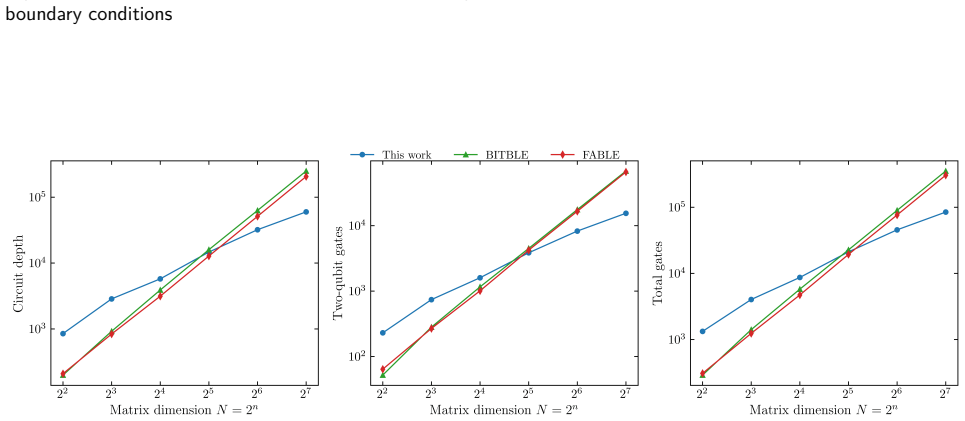
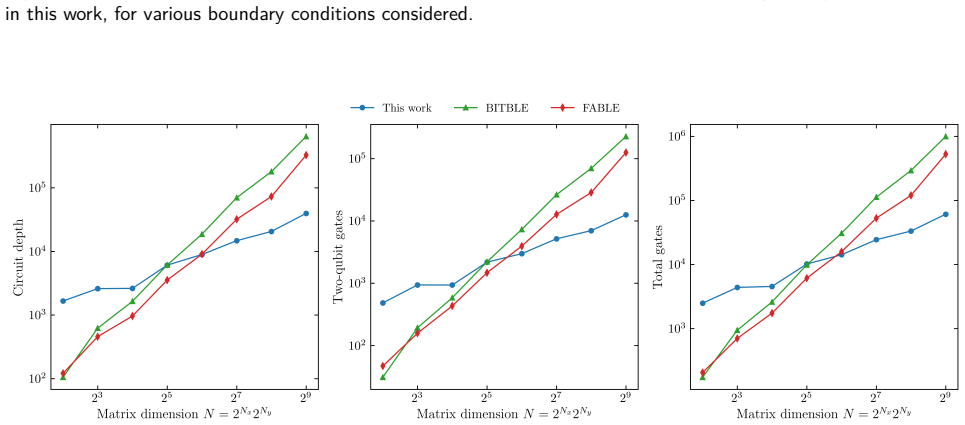
- Gate counts drop substantially for 1D, 2D, and 3D Laplacians relative to generic block-encoding techniques.
- Success probabilities increase on hardware simulation for the same accuracy target.
- Anisotropic grids and mixed boundaries are handled by the same circuit skeleton without redesign.
- Analytical complexity expressions scale with dimension count and local grid size.
Where Pith is reading between the lines
- The same modular blocks could be reused inside larger quantum PDE solvers that alternate between different boundary types over time.
- Combining these encodings with product-formula time evolution would yield circuits for the heat or wave equation on irregular domains.
- Numerical tests on grids larger than those benchmarked would show whether the reported depth advantage persists under realistic noise.
Load-bearing premise
The analytical gate counts remain favorable once the circuit is fully transpiled and that the underlying finite-difference stencil stays accurate enough for the target applications.
What would settle it
Transpile the 3D mixed-boundary construction to the IBM gate set for a 16-point grid per axis and compare measured success probability against the paper's reported benchmark value.
Figures








read the original abstract
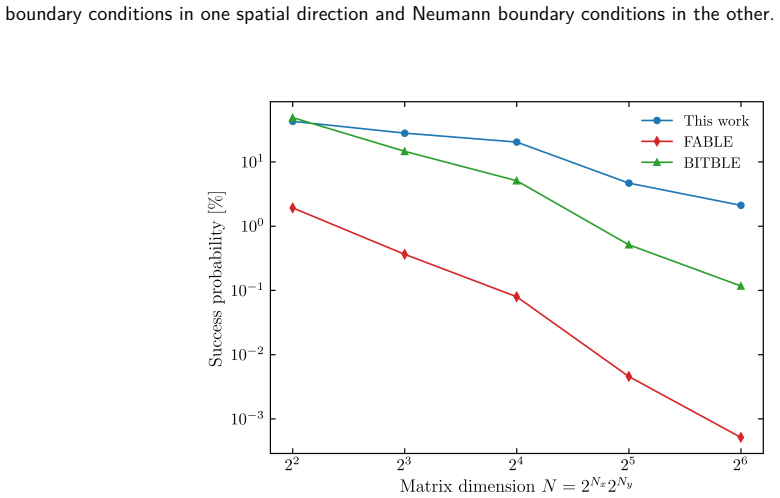
Discrete Laplacian operators arise ubiquitously in scientific computing and frequently appear in quantum algorithms for tasks such as linear algebra, Hamiltonian simulation, and partial differential equations. Block encoding provides the standard method for accessing matrix data within quantum circuits. Efficient implementations of such algorithms require efficient block encodings of the discretized operator. While several general-purpose techniques exist for block encoding arbitrary matrices, they usually require deep quantum circuits. Moreover, existing efficient constructions that exploit Laplacian structure are limited in scope, typically assuming fixed boundary conditions or uniform grid resolutions. In this work, we present a unified framework for efficiently block encoding finite-difference discretizations of the Laplacian that supports Dirichlet, periodic, and Neumann boundary conditions in arbitrary spatial dimensions. Our construction allows different boundary conditions and grid sizes to be specified independently along each coordinate axis, enabling mixed-boundary and anisotropic discretizations within a single modular circuit architecture. We provide analytical gate-complexity estimates and perform circuit-level benchmarks after transpilation to an IBM hardware gate set. Across one-, two-, and three-dimensional examples, the resulting circuits exhibit substantially lower gate counts and higher success probabilities when compared to certain existing approaches.
Editorial analysis
A structured set of objections, weighed in public.
Referee Report
Summary. The paper presents a unified framework for explicitly block-encoding finite-difference discretizations of the Laplacian that supports Dirichlet, periodic, and Neumann boundary conditions in arbitrary dimensions. The construction decomposes the multi-dimensional operator as a sum of Kronecker products of independent 1D finite-difference operators, each block-encoded according to its own boundary condition and grid size, enabling mixed-boundary and anisotropic discretizations within a single modular circuit architecture. Analytical gate-complexity estimates are provided along with post-transpilation benchmarks on an IBM hardware gate set showing lower gate counts and higher success probabilities than certain existing approaches.
Significance. If the central construction holds, the result would provide a practical modular primitive for quantum algorithms involving PDEs, Hamiltonian simulation, and linear systems, extending existing block-encoding techniques to flexible boundary conditions and grid resolutions without requiring global adjustments or additional cross terms. The tensor-product structure and reported circuit metrics represent a concrete advance in making such discretizations implementable on near-term hardware.
major comments (2)
- [Abstract and construction overview] The abstract and construction summary indicate that analytical gate counts are derived from LCU or product-formula techniques applied to the sum of Kronecker products, but the manuscript does not appear to include a full step-by-step derivation of the block-encoding unitary or the precise scaling with dimension and grid size; this makes it difficult to verify the claimed parameter-free nature of the estimates.
- [Numerical benchmarks section] Benchmarks are reported after transpilation, but without explicit error-bar details or the exact baseline circuits used for comparison, it is unclear whether the reported reduction in gate count and improvement in success probability is robust across different grid sizes or merely holds for the specific 1D/2D/3D examples shown.
minor comments (2)
- [Section 2] Notation for the 1D operators and their boundary-condition-specific block encodings should be introduced with explicit matrix forms or circuit diagrams in an early section to improve readability for readers unfamiliar with the LCU decomposition.
- [Analytical estimates] The manuscript would benefit from a short table summarizing the gate-complexity scaling for each boundary-condition type (Dirichlet, Neumann, periodic) as a function of grid size n.
Simulated Author's Rebuttal
We thank the referee for the positive assessment and recommendation for minor revision. The comments highlight opportunities to improve clarity in the construction and benchmarks, which we will address in the revised manuscript.
read point-by-point responses
-
Referee: [Abstract and construction overview] The abstract and construction summary indicate that analytical gate counts are derived from LCU or product-formula techniques applied to the sum of Kronecker products, but the manuscript does not appear to include a full step-by-step derivation of the block-encoding unitary or the precise scaling with dimension and grid size; this makes it difficult to verify the claimed parameter-free nature of the estimates.
Authors: We agree that additional detail would aid verification. The 1D block encodings and their Kronecker-sum combination via LCU are derived in Section 3, but we will expand this section in the revision to include an explicit step-by-step construction of the overall unitary, together with the closed-form gate-complexity scaling in dimension d and grid size N that confirms the parameter-free estimates. revision: yes
-
Referee: [Numerical benchmarks section] Benchmarks are reported after transpilation, but without explicit error-bar details or the exact baseline circuits used for comparison, it is unclear whether the reported reduction in gate count and improvement in success probability is robust across different grid sizes or merely holds for the specific 1D/2D/3D examples shown.
Authors: The reported benchmarks use representative 1D/2D/3D grids with mixed boundary conditions. In the revision we will add error bars obtained from repeated transpilation runs, explicitly document the baseline circuits, and include results for a broader range of grid sizes to demonstrate that the observed improvements hold more generally. revision: yes
Circularity Check
Minor self-citation not load-bearing; derivation self-contained
full rationale
The central construction decomposes the multi-dimensional discrete Laplacian as a sum of Kronecker products of independent 1D finite-difference operators, each block-encoded according to its own boundary condition and grid size. This tensor-product structure directly supports the claimed modularity for mixed BCs and anisotropic grids without requiring additional cross terms or global adjustments. The provided analytical gate counts and post-transpilation benchmarks are consistent with standard LCU or product-formula techniques for such sums; no internal contradiction appears in the derivation or the reported circuit metrics. Self-citations to prior block-encoding primitives exist but are not load-bearing for the explicit constructions presented.
Axiom & Free-Parameter Ledger
axioms (1)
- standard math Standard properties of block encodings and finite-difference discretizations hold
Lean theorems connected to this paper
-
IndisputableMonolith/Foundation/AlexanderDuality.leanalexander_duality_circle_linking unclear?
unclearRelation between the paper passage and the cited Recognition theorem.
The discrete Laplacian in D dimensions is obtained by summing one-dimensional Laplacians... Kronecker-sum structure (Eq. 2)
-
IndisputableMonolith/Cost/FunctionalEquation.leanwashburn_uniqueness_aczel unclear?
unclearRelation between the paper passage and the cited Recognition theorem.
scaled one-dimensional Laplacians... Jcost not mentioned
What do these tags mean?
- matches
- The paper's claim is directly supported by a theorem in the formal canon.
- supports
- The theorem supports part of the paper's argument, but the paper may add assumptions or extra steps.
- extends
- The paper goes beyond the formal theorem; the theorem is a base layer rather than the whole result.
- uses
- The paper appears to rely on the theorem as machinery.
- contradicts
- The paper's claim conflicts with a theorem or certificate in the canon.
- unclear
- Pith found a possible connection, but the passage is too broad, indirect, or ambiguous to say the theorem truly supports the claim.
Forward citations
Cited by 1 Pith paper
-
Block-encodings as programming abstractions: The Eclipse Qrisp BlockEncoding Interface
The Eclipse Qrisp BlockEncoding interface provides high-level programming abstractions for block-encodings, enabling easier implementation of quantum algorithms such as QSVT, matrix inversion, and Hamiltonian simulation.
Reference graph
Works this paper leans on
-
[1]
Numerical solution of partial differential equations: Finite difference methods
G. D. Smith. “Numerical solution of partial differential equations: Finite difference methods”. Oxford Applied Mathematics and Computing Science Series. Clarendon Press. Oxford (1993). 3 edition
work page 1993
-
[2]
Krylov subspace methods for linear systems
Tomohiro Sogabe. “Krylov subspace methods for linear systems”. Volume 60 of Springer Series in Computational Mathematics. Springer Nature. Singapore (2022)
work page 2022
-
[3]
Quantum computation and quantum information
Michael A. Nielsen and Isaac L. Chuang. “Quantum computation and quantum information”. Cambridge University Press. Cambridge (2010). 17
work page 2010
-
[4]
Quantum linear system solvers: A survey of algorithms and applications
Mauro E. S. Morales, Lirandë Pira, Philipp Schleich, Kelvin Koor, Pedro C. S. Costa, Dong An, Alán Aspuru-Guzik, Lin Lin, Patrick Rebentrost, and Dominic W. Berry. “Quantum linear system solvers: A survey of algorithms and applications” (2025). arXiv:2411.02522
-
[5]
Optimal hamiltonian simulation by quantum signal processing
Guang Hao Low and Isaac L. Chuang. “Optimal hamiltonian simulation by quantum signal processing”. Phys. Rev. Lett.118, 010501 (2017)
work page 2017
-
[6]
András Gilyén, Yuan Su, Guang Hao Low, and Nathan Wiebe. “Quantum singular value transfor- mation and beyond: exponential improvements for quantum matrix arithmetics”. In Proceedings of the 51st Annual ACM SIGACT Symposium on Theory of Computing. Page 193–204. STOC ’19. ACM (2019)
work page 2019
-
[7]
FABLE: Fast approximate quantum circuits for block- encodings
Daan Camps and Roel Van Beeumen. “FABLE: Fast approximate quantum circuits for block- encodings” (2022). arXiv:2205.00081
-
[8]
Quantum resources required to block-encode a matrix of classical data
B. David Clader, Alexander M. Dalzell, Nikitas Stamatopoulos, Grant Salton, Mario Berta, and William J. Zeng. “Quantum resources required to block-encode a matrix of classical data”. IEEE Transactions on Quantum Engineering3, 1–23 (2022)
work page 2022
-
[9]
Hamiltonian simulation using linear combinations of unitary operations
Andrew M. Childs and Nathan Wiebe. “Hamiltonian simulation using linear combinations of unitary operations”. Quantum Info. Comput.12, 901–924 (2012)
work page 2012
-
[10]
Binary tree block encoding of classical matrix
Zexian Li, Xiao-Ming Zhang, Chunlin Yang, and Guofeng Zhang. “Binary tree block encoding of classical matrix”. IEEE Transactions on Quantum Engineering7, 1–18 (2026)
work page 2026
-
[11]
Efficient block- encodings require structure
Parker Kuklinski, Benjamin Rempfer, Justin Elenewski, and Kevin Obenland. “Efficient block- encodings require structure” (2025). arXiv:2509.19667
-
[12]
Hamiltonian simulation by qubitization
Guang Hao Low and Isaac L. Chuang. “Hamiltonian simulation by qubitization”. Quantum3, 163 (2019)
work page 2019
-
[13]
Explicit quantum circuits for block encodings of certain sparse matrices
Daan Camps, Lin Lin, Roel Van Beeumen, and Chao Yang. “Explicit quantum circuits for block encodings of certain sparse matrices” (2023). arXiv:2203.10236
-
[14]
Block-encoding structured matrices for data input in quantum computing
Christoph Sünderhauf, Earl Campbell, and Joan Camps. “Block-encoding structured matrices for data input in quantum computing”. Quantum8, 1226 (2024)
work page 2024
-
[15]
Efficient and explicit block encoding of finite difference discretizations of the laplacian
Andreas Sturm and Niclas Schillo. “Efficient and explicit block encoding of finite difference discretizations of the laplacian” (2025). arXiv:2509.02429
-
[16]
Ali Javadi-Abhari, Matthew Treinish, Kevin Krsulich, Christopher J. Wood, Jake Lishman, Julien Gacon, Simon Martiel, Paul D. Nation, Lev S. Bishop, Andrew W. Cross, Blake R. Johnson, and Jay M. Gambetta. “Quantum computing with qiskit” (2024). arXiv:2405.08810
work page internal anchor Pith review Pith/arXiv arXiv 2024
-
[17]
TDC28. “laplacian_beqc”.https://github.com/TDC28/laplacian_beqc(2025). GitHub repos- itory
work page 2025
-
[18]
Creating superpositions that correspond to efficiently integrable probability distributions
Lov Grover and Terry Rudolph. “Creating superpositions that correspond to efficiently integrable probability distributions” (2002). arXiv:quant-ph/0208112
work page internal anchor Pith review Pith/arXiv arXiv 2002
-
[19]
Rise of conditionally clean ancillae for efficient quantum circuit constructions
Tanuj Khattar and Craig Gidney. “Rise of conditionally clean ancillae for efficient quantum circuit constructions”. Quantum9, 1752 (2025)
work page 2025
-
[20]
Elementary gates for quantum computation
Adriano Barenco, Charles H. Bennett, Richard Cleve, David P. DiVincenzo, Norman Margo- lus, Peter Shor, Tycho Sleator, John A. Smolin, and Harald Weinfurter. “Elementary gates for quantum computation”. Phys. Rev. A52, 3457–3467 (1995)
work page 1995
-
[21]
Efficient implementation of multicontrolled quantum gates
Ben Zindorf and Sougato Bose. “Efficient implementation of multicontrolled quantum gates”. Phys. Rev. Appl.24, 044030 (2025)
work page 2025
-
[22]
Quantum circuits of T-depth one
Peter Selinger. “Quantum circuits of T-depth one”. Phys. Rev. A87, 042302 (2013)
work page 2013
-
[23]
Constructing large controlled NOTs
Craig Gidney. “Constructing large controlled NOTs”.https://algassert.com/circuits/2015/ 06/05/Constructing-Large-Controlled-Nots.html(2015). Blog post. 18
work page 2015
-
[24]
Dmitri Maslov. “Advantages of using relative-phase toffoli gates with an application to multiple control toffoli optimization”. Phys. Rev. A93, 022311 (2016)
work page 2016
-
[25]
Quantum networks for elementary arithmetic operations
Vlatko Vedral, Adriano Barenco, and Artur Ekert. “Quantum networks for elementary arithmetic operations”. Phys. Rev. A54, 147–153 (1996)
work page 1996
-
[26]
Halving the cost of quantum addition
Craig Gidney. “Halving the cost of quantum addition”. Quantum2, 74 (2018)
work page 2018
-
[27]
A logarithmic-depth quantum carry-lookahead adder
Thomas G. Draper, Samuel A. Kutin, Eric M. Rains, and Krysta M. Svore. “A logarithmic-depth quantum carry-lookahead adder” (2004). arXiv:quant-ph/0406142
work page internal anchor Pith review Pith/arXiv arXiv 2004
-
[28]
Trading T gates for dirty qubits in state preparation and unitary synthesis
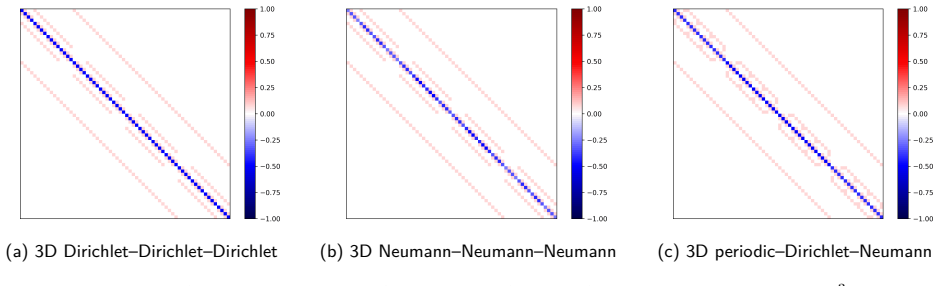
Guang Hao Low, Vadym Kliuchnikov, and Luke Schaeffer. “Trading T gates for dirty qubits in state preparation and unitary synthesis”. Quantum8, 1375 (2024). 19 Appendix A Structure of Discrete Laplacian Matrices In this appendix we visualize the structure of the discrete Laplacian operators considered throughout the paper. Rather than constructing the matr...
work page 2024
discussion (0)
Sign in with ORCID, Apple, or X to comment. Anyone can read and Pith papers without signing in.