Recognition: 2 theorem links
· Lean TheoremInflation with the standard and Randall-Sundrum model in the Two-time Physics
Pith reviewed 2026-05-15 10:35 UTC · model grok-4.3
The pith
A scalar potential from two-time physics produces higher tensor-to-scalar ratios in the Randall-Sundrum II model that agree with BICEP2 and Planck data.
A machine-rendered reading of the paper's core claim, the machinery that carries it, and where it could break.
Core claim
The central claim is that the potential V(φ)=M^4 φ^{2n-2}(φ^{2n}+m^{2n})^{1/n-1} supports slow-roll inflation in both four dimensions and the Randall-Sundrum II framework. In the RSII model the tensor-to-scalar ratio is systematically higher than its four-dimensional counterpart and remains consistent with BICEP2 and Planck constraints, which in turn fixes the five-dimensional Planck scale M_5 to the range [1-2]×10^{16} GeV. The same potential permits significantly lower values of the exponent n than other common inflationary potentials while preserving agreement with experiment.
What carries the argument
The shaft-like scalar potential V(φ) = M⁴ φ^{2n-2} (φ^{2n} + m^{2n})^{1/n-1} that reduces to the warm-inflation form for n=3; it supplies the energy density whose slow-roll evolution determines the scalar and tensor perturbation spectra in both 4D and RSII geometries.
If this is right
- The tensor-to-scalar ratio is always larger in RSII than in 4D for the same potential parameters.
- Planck data constrain the five-dimensional Planck scale to lie between 1 and 2 × 10^{16} GeV.
- Lower scalar-field exponents become compatible with observations compared with other potentials.
- The potential can be used interchangeably for standard and brane-world inflation calculations.
Where Pith is reading between the lines
- If the potential truly descends from two-time physics, analogous forms could be tested in other extra-dimensional models such as warped throats or large extra dimensions.
- Future CMB experiments measuring the tensor-to-scalar ratio to higher precision could distinguish the RSII prediction from pure 4D inflation.
- Allowing smaller exponents may ease the initial-condition fine-tuning required for sufficient inflation.
- Reheating dynamics after inflation might differ between the two frameworks and produce observable signatures in the post-inflationary era.
Load-bearing premise
The potential is taken to arise directly from the Higgs-dilaton term in two-time physics, and the standard slow-roll approximations hold without extra corrections coming from the brane geometry or the two-time structure.
What would settle it
An observation showing the tensor-to-scalar ratio to be smaller in a brane-world cosmology than in four dimensions, or a best-fit five-dimensional Planck mass lying well outside the 10^{16} GeV window, would falsify the central prediction.
Figures



read the original abstract
We propose a scalar inflationary potential as $V(\phi)=M^4\phi^{2n-2}(\phi^{2n}+m^{2n})^{1/n-1}$. This potential is similar to the shaft inflation one. The potential may come from the Higgs-dilaton potential in the Two-time (2T) physics, especially in the case where $n=3$, this potential is reduced to the warm inflationary potential. The slow-roll scenario is recomputed in the 4-dimension (4D) and Randall-Sundrum II (RSII) frameworks. The tensor-to-scalar ratio in RSII is always higher than in 4D and is in good agreement with the experimental data of BICEP2 and Planck. When compared with Planck data we estimate $M_5$ to be around $[1-2]\times 10^{16}$ GeV. Furthermore, the potential allows much lower scalar field exponents than other potentials, which results in high agreement with experimental data.
Editorial analysis
A structured set of objections, weighed in public.
Referee Report
Summary. The paper proposes the scalar potential V(φ)=M⁴ φ^{2n-2} (φ^{2n} + m^{2n})^{1/n-1}, which may originate from the Higgs-dilaton sector of two-time physics (reducing to a warm inflation form for n=3). It recomputes the slow-roll parameters in both 4D cosmology and the Randall-Sundrum II braneworld, reporting that the tensor-to-scalar ratio r is systematically higher in RSII than in 4D, lies in good agreement with BICEP2 and Planck constraints, and yields an estimate M5 ≈ [1-2]×10^{16} GeV when matched to Planck data. The potential is further claimed to permit lower scalar-field exponents while preserving observational consistency.
Significance. If the 2T origin of the potential can be rigorously derived and the slow-roll analysis shown to hold without extra corrections from the 2T framework or brane geometry, the work would supply a concrete link between two-time physics and braneworld inflation, with the distinctive prediction that r_RSII > r_4D. The numerical agreement with current data and the M5 range would then constitute a falsifiable output rather than a post-hoc fit.
major comments (3)
- [Abstract] Abstract: The potential is introduced only with the phrase 'may come from' the Higgs-dilaton potential in 2T physics; no explicit reduction from the 2T action, no reference to the relevant 2T Lagrangian, and no demonstration that the given functional form follows from the 2T Higgs-dilaton sector are supplied. This omission removes the principal novelty claim from the manuscript.
- [Abstract] Abstract: The reported agreement with BICEP2/Planck data and the quoted M5 range [1-2]×10^{16} GeV are obtained by direct matching of the model parameters to the same observational data set. Consequently the 'agreement' is achieved by construction rather than constituting an independent prediction of the 2T or RSII framework.
- [Abstract] Abstract: No explicit expressions for the slow-roll parameters ε, η, the spectral index ns, or the tensor-to-scalar ratio r are displayed, nor are any error bars, exclusion criteria, or comparison plots provided, despite the strong claims of observational consistency.
Simulated Author's Rebuttal
We thank the referee for the careful reading and constructive comments. We address each major point below and have revised the manuscript to improve clarity and presentation where possible.
read point-by-point responses
-
Referee: [Abstract] Abstract: The potential is introduced only with the phrase 'may come from' the Higgs-dilaton potential in 2T physics; no explicit reduction from the 2T action, no reference to the relevant 2T Lagrangian, and no demonstration that the given functional form follows from the 2T Higgs-dilaton sector are supplied. This omission removes the principal novelty claim from the manuscript.
Authors: We agree that the link to 2T physics is presented as a motivation rather than a full derivation. The functional form is proposed based on the Higgs-dilaton sector in two-time physics, with the explicit note that n=3 recovers the warm inflation potential. We will revise the abstract and introduction to include additional references to the 2T literature and clarify the scope of the claim. The main contribution remains the slow-roll analysis and RSII predictions. revision: partial
-
Referee: [Abstract] Abstract: The reported agreement with BICEP2/Planck data and the quoted M5 range [1-2]×10^{16} GeV are obtained by direct matching of the model parameters to the same observational data set. Consequently the 'agreement' is achieved by construction rather than constituting an independent prediction of the 2T or RSII framework.
Authors: We acknowledge that M5 and other parameters are fixed by matching the scalar amplitude to Planck data. However, the model yields a robust, parameter-independent prediction that r is systematically larger in RSII than in 4D due to the modified Friedmann equation. This distinction is a genuine output of the framework and can be confronted with future data. We will revise the text to emphasize this predictive feature. revision: partial
-
Referee: [Abstract] Abstract: No explicit expressions for the slow-roll parameters ε, η, the spectral index ns, or the tensor-to-scalar ratio r are displayed, nor are any error bars, exclusion criteria, or comparison plots provided, despite the strong claims of observational consistency.
Authors: We thank the referee for this observation. The revised manuscript will display the explicit formulas for ε, η, ns and r in both 4D and RSII. We will also add figures with model predictions, Planck/BICEP2 error bars, and allowed parameter regions. revision: yes
- Explicit derivation of the proposed potential directly from the 2T Higgs-dilaton action, which is not supplied in the manuscript.
Circularity Check
M5 fitted post-hoc to Planck data to claim agreement; potential origin only stated as 'may come from' without derivation
specific steps
-
fitted input called prediction
[Abstract]
"When compared with Planck data we estimate M_5 to be around [1-2]×10^{16} GeV. ... the tensor-to-scalar ratio in RSII is always higher than in 4D and is in good agreement with the experimental data of BICEP2 and Planck."
M5 is determined by direct comparison to the same Planck dataset used to assert agreement; once M5 is chosen to reproduce the observed amplitude, the claim of agreement with that amplitude is true by construction rather than a prediction.
-
other
[Abstract]
"We propose a scalar inflationary potential as V(φ)=M^4 φ^{2n-2}(φ^{2n}+m^{2n})^{1/n-1}. ... The potential may come from the Higgs-dilaton potential in the Two-time (2T) physics"
The functional form is introduced by fiat and only conjecturally linked to 2T physics; no reduction from the 2T action to this V(φ) is supplied, so the 2T label does not constrain or derive the subsequent slow-roll results.
full rationale
The paper proposes V(φ) without deriving its form from the 2T Higgs-dilaton action (only the phrase 'may come from' appears). Slow-roll parameters are then computed in 4D and RSII, after which M5 is adjusted to match Planck data and the model is declared in 'good agreement'. This makes the reported agreement and M5 value a direct consequence of the fit rather than an independent output of the 2T framework. The r_RSII > r_4D relation follows from the standard RSII high-energy Friedmann equation once the potential is inserted, but the numerical success is forced by the data-tuned M5. No self-citations or uniqueness theorems are invoked, so circularity is partial and localized to the fitting step.
Axiom & Free-Parameter Ledger
free parameters (4)
- M
- m
- n
- M5
axioms (2)
- domain assumption Slow-roll approximation is valid throughout the inflationary phase
- ad hoc to paper The given potential derives from the Higgs-dilaton sector of two-time physics
Lean theorems connected to this paper
-
IndisputableMonolith/Foundation/AlexanderDuality.leanalexander_duality_circle_linking unclear?
unclearRelation between the paper passage and the cited Recognition theorem.
We propose a scalar inflationary potential as V(ϕ)=M⁴ϕ^{2n−2}(ϕ^{2n}+m^{2n})^{1/n−1}. ... The slow-roll scenario is recomputed in the 4-dimension (4D) and Randall-Sundrum II (RSII) frameworks. ... we estimate M5 to be around [1−2]×10^{16} GeV.
-
IndisputableMonolith/Cost/FunctionalEquation.leanwashburn_uniqueness_aczel unclear?
unclearRelation between the paper passage and the cited Recognition theorem.
The potential may come from the Higgs-dilaton potential in the Two-time (2T) physics
What do these tags mean?
- matches
- The paper's claim is directly supported by a theorem in the formal canon.
- supports
- The theorem supports part of the paper's argument, but the paper may add assumptions or extra steps.
- extends
- The paper goes beyond the formal theorem; the theorem is a base layer rather than the whole result.
- uses
- The paper appears to rely on the theorem as machinery.
- contradicts
- The paper's claim conflicts with a theorem or certificate in the canon.
- unclear
- Pith found a possible connection, but the passage is too broad, indirect, or ambiguous to say the theorem truly supports the claim.
Reference graph
Works this paper leans on
-
[1]
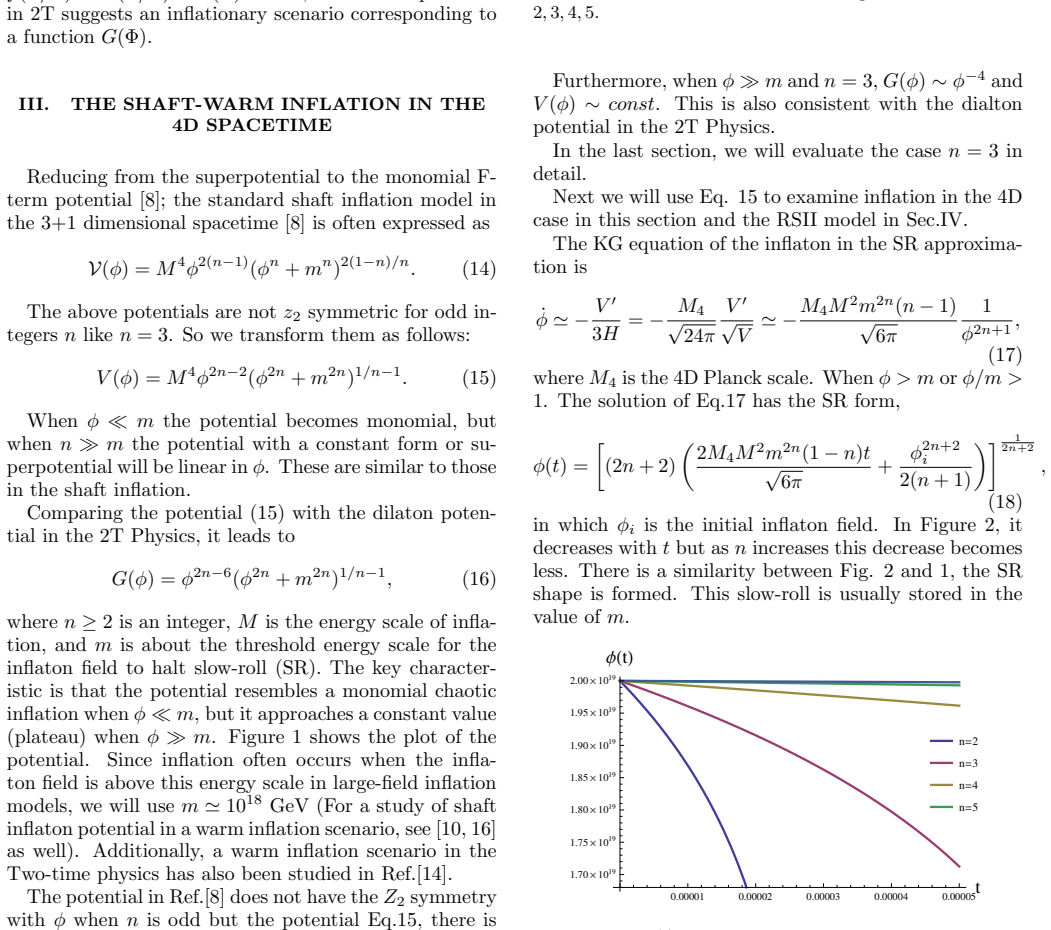
In Figure 2, it decreases withtbut asnincreases this decrease becomes less
The solution of Eq.17 has the SR form, ϕ(t) = (2n+ 2) 2M4M 2m2n(1−n)t√ 6π + ϕ2n+2 i 2(n+ 1) 1 2n+2 , (18) in whichϕ i is the initial inflaton field. In Figure 2, it decreases withtbut asnincreases this decrease becomes less. There is a similarity between Fig. 2 and 1, the SR shape is formed. This slow-roll is usually stored in the value ofm. 0.00001 0.000...
-
[2]
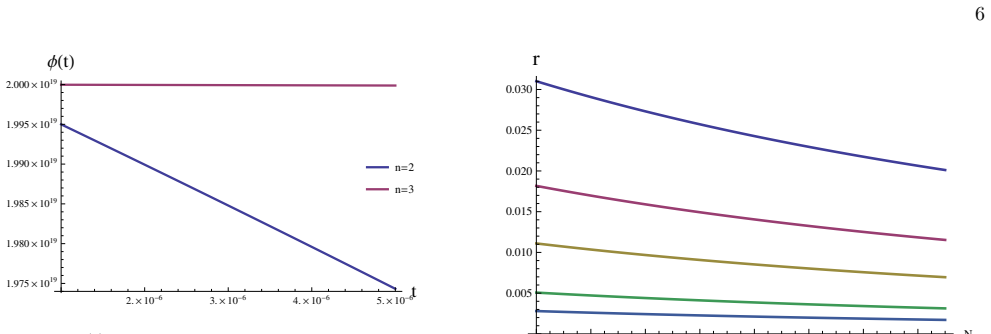
and in RSII model (Eq. 33). They all have similar shapes according totas shown in Figures 2 and 3. There is a similarity between Figure 2 and 3, butϕ(t) in Figure 3 shows a significant difference betweenn= 2 andn= 3 compared to Figure 2. This is also clearly shown in Figure 8. In Figure 4, the lines with differentNvalues are quite similar, so N only affec...
-
[3]
/Multiply 10/Minus 6 3. /Multiply 10/Minus 6 4. /Multiply 10/Minus 6 5. /Multiply 10/Minus 6t 1.975 /Multiply 1019 1.980 /Multiply 1019 1.985 /Multiply 1019 1.990 /Multiply 1019 1.995 /Multiply 1019 2.000 /Multiply 1019 Φ/LParen1t/RParen1 n/Equal 2 n/Equal 3 FIG. 3. Theϕ(t) field in the RSII model withn= 2,3,M≃ 1015 GeV,M 4 ≃10 19 GeV,m≃10 18 GeV, andϕ i ...
-
[4]
We can approximate as follows:n s = 0.006N. In Figs. 6 and 5,rdecreases slightly asn s increases. Whenn >4, the values ofrare quite close to each other, whereas forn <4,rchanges significantly asnincreases. In particular, whennincreases from 2 to 3,rchanges very strongly. This is different from the shaft inflation. rin RSII model is about 100 times larger ...
-
[5]
7, with justn= 2,3 the resultrmatches the experimental data very well
From Fig. 7, with justn= 2,3 the resultrmatches the experimental data very well. In Figures 5, 6, and 7, the largernis, the closer the lines are to each other. In other words, a clear hierarchy of values for the quantities (r, ns) only occurs with small n. 7 In most models, the largernis, the smallerrbecomes, althoughncannot be much larger than 2. In our ...
-
[6]
Guth,Inflationary universe: A possible solution to the horizon and flatness problems, Phys
Alan H. Guth,Inflationary universe: A possible solution to the horizon and flatness problems, Phys. Rev. D23, 347 (1981)
work page 1981
-
[7]
P.A.R.Adeet al.(BICEP/Keck Collaboration),Improved Constraints on Primordial Gravitational Waves using Planck, WMAP, and BICEP/Keck Observations through the 2018 Observing Season, Phys. Rev. Lett.127, 151301 (2021)
work page 2018
-
[8]
1, Cambridge Uni- versity Press (1998)
Joseph Polchinski,String theory, Vol. 1, Cambridge Uni- versity Press (1998)
work page 1998
-
[9]
Ngo Phuc Duc Loc,Inflation with a class of concave in- flaton potentials in Randall–Sundrum model, Eur. Phys. J. C80, 768 (2020)
work page 2020
-
[10]
Lisa Randall and Raman Sundrum,Large Mass Hierar- chy from a Small Extra Dimension, Phys. Rev. Lett.83, 3370 (1999)
work page 1999
-
[11]
Lisa Randall and Raman Sundrum,An Alternative to Compactification, Phys. Rev. Lett.83, 4690 (1999)
work page 1999
-
[12]
Juan Maldacena and Alexey Milekhin,Humanly traversable wormholes, Phys. Rev. D103, 066007 (2021)
work page 2021
-
[13]
Konstantinos Dimopoulos,Shaft inflation, Phys. Lett. B 735, 75 (2014)
work page 2014
-
[14]
Konstantinos Dimopoulos,Shaft Inflation and the Planck satellite observations, arXiv:1510.06593
work page internal anchor Pith review Pith/arXiv arXiv
-
[15]
Ngo Phuc Duc Loc,Shaft inflation in Randall-Sundrum model,JCAP02020, (2023)
work page 2023
-
[16]
Itzhak Bars ,”The Standard Model of Particles and Forces in the Framework of 2T-physics”, Phys.Rev.D74 085019, 2006
work page 2006
-
[17]
I. Bars, C. Deliduman, and D. Minic,Supersymmetric two-time physics, Phys. Rev. D59, 125004 (1999)
work page 1999
-
[18]
Itzhak Bars,Two-time physics in field theory, Phys. Rev. D62, 046007 (2000)
work page 2000
-
[19]
High En- ergy Phys.2022, 5313952 (2022)
Vo Quoc Phong and Ngo Phuc Duc Loc, Adv. High En- ergy Phys.2022, 5313952 (2022)
work page 2022
-
[20]
Vo Quoc Phong, Quach Ai Mi, Nguyen Xuan Vinh, Sphaleron and gravitational wave with the Higgs-Dilaton potential in the Standard Model Two-Time Physics, Nucl. Phys. B1017, 116964 (2025)
work page 2025
-
[21]
Abdul Jawad, Amara Ilyas, Shamaila Rani,Warm mod- ified Chaplygin gas shaft inflation, Eur. Phys. J. C77, 131 (2017)
work page 2017
-
[22]
Roy Maartens, David Wands, Bruce A. Bassett, and Imo- gen P. C. Heard,Chaotic inflation on the brane, Phys. Rev. D62, 041301(R) (2000)
work page 2000
-
[23]
Planck 2015 results. XX. Constraints on inflation
P.A.R. Ade et al. [Planck Collaboration], arXiv:1502.02114
work page internal anchor Pith review Pith/arXiv arXiv
-
[24]
James E. Lidsey, Reza Tavakol,Running of the Scalar Spectral Index and Observational Signatures of Inflation, Phys. Lett. B575, 157 (2003)
work page 2003
-
[25]
Gia Dvali, Gregory Gabadadze, Massimo Porrati,4D Gravity on a Brane in 5D Minkowski Space, Phys. Lett. B485, 208 (2000)
work page 2000
-
[26]
Itzhak Bars,Gravity in 2T-Physics, Phys.Rev.D77, 125027 (2008)
work page 2008
-
[27]
Itzhak Bars,Two-time physics with gravitational and gauge field backgrounds,Phys.Rev. D62, 085015 (2000)
work page 2000
discussion (0)
Sign in with ORCID, Apple, or X to comment. Anyone can read and Pith papers without signing in.