Recognition: 2 theorem links
· Lean TheoremApproximate Models for Gravitational Memory
Pith reviewed 2026-05-15 10:09 UTC · model grok-4.3
The pith
Large-distance approximation accurately describes particle motion in Pöschl-Teller gravitational waves
A machine-rendered reading of the paper's core claim, the machinery that carries it, and where it could break.
Core claim
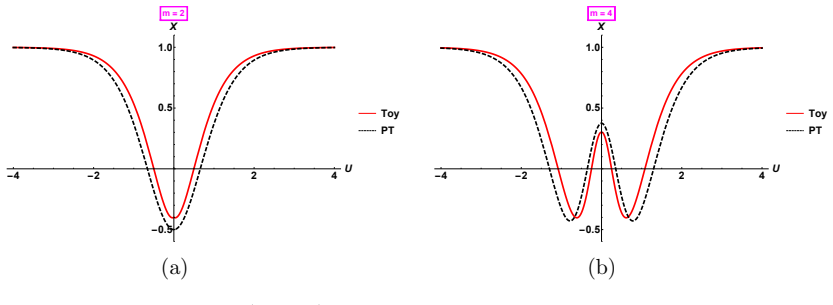
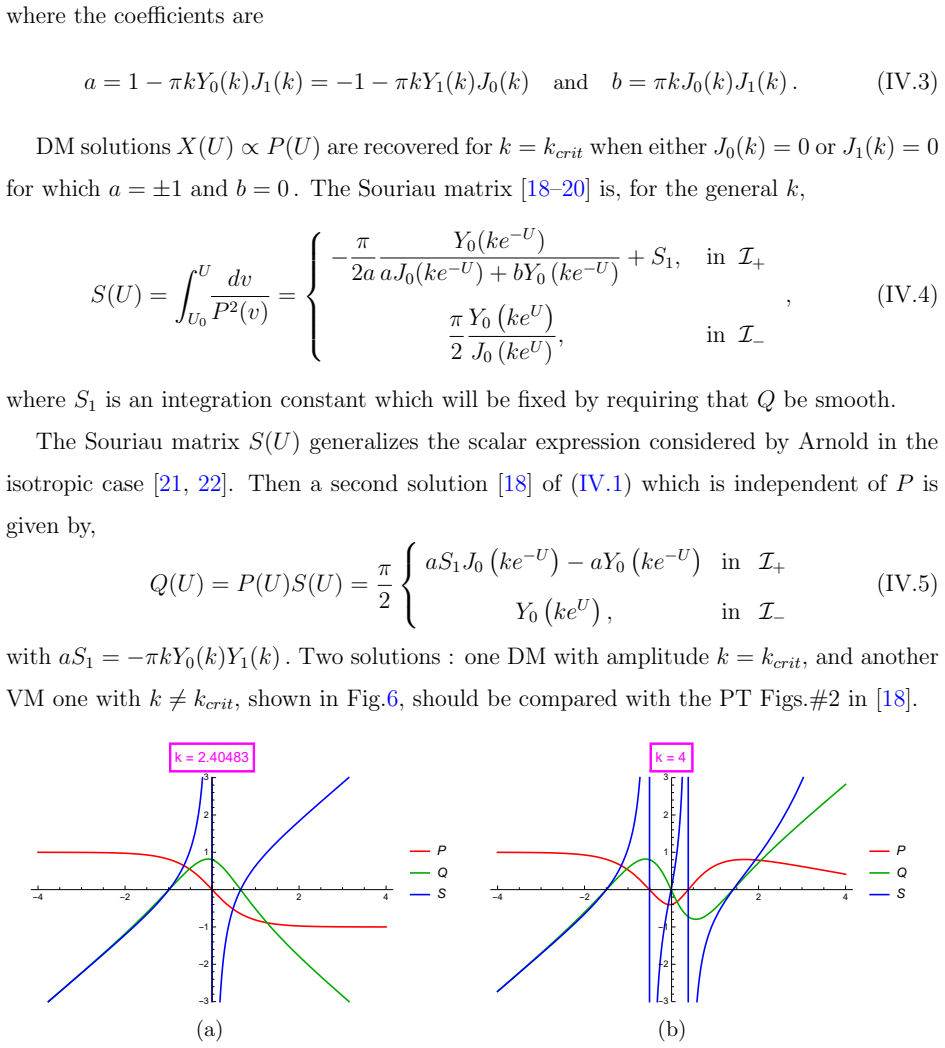
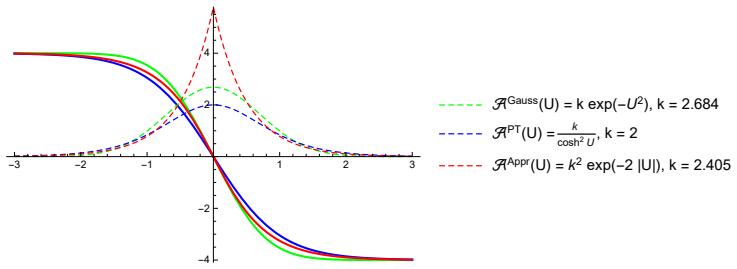
The large-distance approximation of a sandwich gravitational wave by a continuous but not necessarily smooth profile provides a surprisingly good analytic description of particle motion in a gravitational wave with Pöschl-Teller profile. The role of the 2nd solution of the Sturm-Liouville equation is highlighted. Similar results hold for Gaussian and square profiles. Our approximate models are consistent with Carroll symmetry.
What carries the argument
Large-distance approximation of sandwich gravitational waves by continuous profiles, using the second solution of the Sturm-Liouville equation to capture memory displacement
If this is right
- The approximation supplies explicit analytic trajectories for particles in Pöschl-Teller waves.
- The same method yields comparable accuracy for Gaussian and square wave profiles.
- The resulting models automatically respect Carroll symmetry.
- The second Sturm-Liouville solution is required to obtain the correct memory displacement.
Where Pith is reading between the lines
- Simpler analytic models of this kind could reduce computational cost when estimating memory effects in gravitational-wave data analysis pipelines.
- The approach might generalize to other exactly solvable potentials and reveal common patterns across different wave shapes.
- Direct comparison against full numerical relativity simulations of finite-duration waves would map the approximation's practical range.
Load-bearing premise
The large-distance limit remains accurate for the chosen continuous profiles without needing corrections from the wave's finite duration or lack of smoothness.
What would settle it
Numerical integration of exact geodesic equations for a Pöschl-Teller wave profile compared against the analytic trajectories predicted by the large-distance continuous approximation.
Figures





read the original abstract
The large-distance approximation of a sandwich gravitational wave by a continuos but not necessarily smooth profile provides us with a surprisingly good analytic description of particle motion in a gravitational wave with P\"oschl-Teller profile. The role of the 2nd solution of the Sturm-Liouville equation is highlighted. Similar results hold for Gaussian and square profiles. Our approximate models are consistent with Carroll symmetry.
Editorial analysis
A structured set of objections, weighed in public.
Referee Report
Summary. The manuscript claims that large-distance approximations of sandwich gravitational waves by continuous (possibly non-smooth) profiles yield a surprisingly good analytic description of particle motion for Pöschl-Teller, Gaussian, and square wave profiles. It highlights the role of the second Sturm-Liouville solution in capturing the memory displacement and states that the models are consistent with Carroll symmetry.
Significance. If the unquantified approximation accuracy holds under explicit checks, the work supplies analytic tools for gravitational memory that could simplify geodesic calculations in specific wave backgrounds and provide cross-checks via Carroll symmetry.
major comments (3)
- [Abstract and §3] Abstract and §3 (Pöschl-Teller case): the claim of a 'surprisingly good' match to exact particle motion is unsupported by any quantitative error measures, relative-error tables, or direct comparison plots between the approximate analytic solution and numerical integration of the geodesic equation.
- [§2] §2 (derivation of the large-distance limit): no explicit asymptotic remainder estimate or error bound is given showing that corrections from finite wave duration and profile non-smoothness remain negligible uniformly in the chosen parameter regimes.
- [§4] §4 (Sturm-Liouville analysis): the assertion that the second solution alone captures the memory displacement requires a concrete demonstration that no additional finite-duration corrections arise, as this is the load-bearing step for the central claim.
minor comments (2)
- [Abstract] Abstract: 'continuos' is a typo and should read 'continuous'.
- [Figures] Figure captions and axis labels should explicitly state whether the plotted trajectories are approximate or exact so that the 'surprisingly good' visual agreement can be assessed quantitatively.
Simulated Author's Rebuttal
We thank the referee for the careful reading of our manuscript and the constructive comments. We address each of the major comments below and will incorporate revisions to strengthen the quantitative support for our claims.
read point-by-point responses
-
Referee: [Abstract and §3] Abstract and §3 (Pöschl-Teller case): the claim of a 'surprisingly good' match to exact particle motion is unsupported by any quantitative error measures, relative-error tables, or direct comparison plots between the approximate analytic solution and numerical integration of the geodesic equation.
Authors: We agree that providing quantitative error measures would better support the claim of a 'surprisingly good' match. In the revised manuscript, we will add direct comparison plots of the approximate analytic particle trajectories against numerical solutions of the geodesic equation for the Pöschl-Teller profile. We will also include tables of relative errors and maximum deviations over the parameter ranges considered, to quantify the accuracy of the approximation. revision: yes
-
Referee: [§2] §2 (derivation of the large-distance limit): no explicit asymptotic remainder estimate or error bound is given showing that corrections from finite wave duration and profile non-smoothness remain negligible uniformly in the chosen parameter regimes.
Authors: We acknowledge that an explicit asymptotic remainder estimate is not provided in the current version. The large-distance limit is taken by letting the observer distance tend to infinity while keeping the wave profile fixed. In the revision, we will include a brief analysis of the error terms, showing that the leading corrections from finite duration scale as 1/r where r is the distance, and discuss the uniformity in the parameter regimes used for the Pöschl-Teller, Gaussian, and square profiles. revision: yes
-
Referee: [§4] §4 (Sturm-Liouville analysis): the assertion that the second solution alone captures the memory displacement requires a concrete demonstration that no additional finite-duration corrections arise, as this is the load-bearing step for the central claim.
Authors: The central claim relies on the fact that in the large-distance approximation, the memory displacement is encoded in the second independent solution of the Sturm-Liouville problem, while the first solution contributes to the transient oscillatory behavior. To provide the requested concrete demonstration, we will add a subsection or appendix showing the explicit computation of the memory effect from the full numerical geodesic integration and comparing it to the contribution from the second solution alone, verifying that finite-duration corrections are negligible in the large-distance regime. revision: yes
Circularity Check
No significant circularity in the derivation chain
full rationale
The paper constructs approximate analytic models for geodesic motion and memory displacement in sandwich gravitational waves by replacing the exact profile with a large-distance continuous (possibly non-smooth) surrogate and solving the resulting Sturm-Liouville equation. The second independent solution is used to extract the memory shift; this step follows directly from the standard theory of linear second-order ODEs and does not presuppose the final displacement value. Consistency with Carroll symmetry is presented as an a-posteriori check rather than an input assumption. No parameters are fitted to data and then relabeled as predictions, no self-citation supplies a uniqueness theorem that forces the result, and the central claim (accuracy of the large-distance approximation) is not definitionally equivalent to its own inputs. The derivation therefore remains self-contained against external benchmarks.
Axiom & Free-Parameter Ledger
axioms (1)
- domain assumption The particle motion in a sandwich gravitational wave is governed by a Sturm-Liouville equation whose second solution encodes the memory effect.
Reference graph
Works this paper leans on
-
[1]
argued instead in favour of theDisplacement Effect(DM), suggesting that the particles would merely be displaced. Their statement could be tested by studying numerically, and in some cases also analytically, various wave profiles as a Gaussian [4, 5] or P¨ oschl - Teller , their derivatives [6–9], or the Scarf [10, 11] potentials, and even for a simple squ...
-
[2]
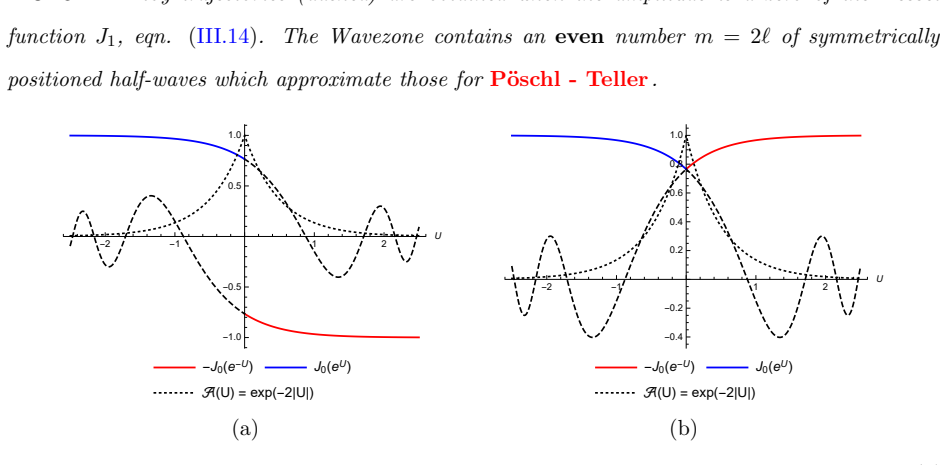
When the wave number is odd, J0(k) = 0,i.e.,k=k 2ℓ+1 = 2.4,5.5,8.7, . . .(III.9) then the trajectory is continuous for arbitraryα 1, α 2 : the two branches are joined at X(0) = 0. However the slopes must be equal also, X ′ −(0) =X ′ +(0),(III.10) which then requiresα 1 =−α 2 ≡ −α. The trajectory is obtained by glueing theU <0 andU >0 branches antisymmetri...
-
[3]
DM trajectories with no displacement
There is yet another possibility withJ 0(k)̸= 0 : whenα 1 =α 2 ≡αthen the first fitting conditionX −(0) =X +(0) =J 0(k) is satisfied foranyamplitudek. However the trajectory must be also smooth, X ′ −(k) =−(αk)J 1(k) =X ′ +(k) = +(αk)J 1(k),(III.13) upon usingJ ′ 0 =−J 1. Thuskmust be a root ofJ 1, J1(k) = 0,i.e.,k=k (2ℓ) = 3.8,7.0,10.1, . . .(III.14) In ...
-
[4]
Gravitational-wave bursts with memory and experimental prospects,
V. B. Braginsky and K. S. Thorne, “Gravitational-wave bursts with memory and experimental prospects,” Nature327(1987), 123-125 doi:10.1038/327123a0
-
[5]
Exact solutions of the gravitational field equations,
J. Ehlers and W. Kundt, “Exact solutions of the gravitational field equations,” (1962)
work page 1962
-
[6]
Radiation of gravitational waves by a cluster of superdense stars,
Ya. B. Zel’dovich and A. G. Polnarev, “Radiation of gravitational waves by a cluster of superdense stars,” Astron. Zh.51, 30 (1974) [Sov. Astron.1817 (1974)]
work page 1974
-
[7]
Soft Gravitons & the Memory Effect for Plane Gravitational Waves
P. M. Zhang, C. Duval, G. W. Gibbons and P. A. Horvathy, “Soft gravitons and the memory effect for plane gravitational waves,” Phys. Rev. D96(2017) no.6, 064013 doi:10.1103/PhysRevD.96.064013 [arXiv:1705.01378 [gr-qc]]
work page internal anchor Pith review Pith/arXiv arXiv doi:10.1103/physrevd.96.064013 2017
-
[8]
Memory effect & Carroll symmetry, 50 years later,
M. Elbistan, P. M. Zhang and P. A. Horvathy, “Memory effect & Carroll symmetry, 50 years later,” Annals Phys.459(2023), 169535 doi:10.1016/j.aop.2023.169535
-
[9]
Bemerkungen zur Quantenmechanik des anharmonischen Oszilla- tors,
G. P¨ oschl and E. Teller, “Bemerkungen zur Quantenmechanik des anharmonischen Oszilla- tors,” Z. Phys.83(1933), 143-151 doi:10.1007/BF01331132
-
[10]
Geodesic congruences in exact plane wave spacetimes and the memory effect,
I. Chakraborty and S. Kar, “Geodesic congruences in exact plane wave spacetimes and the memory effect,” Phys. Rev. D101(2020) no.6, 064022 doi:10.1103/PhysRevD.101.064022 [arXiv:1901.11236 [gr-qc]]
-
[11]
Displacement within velocity effect in gravitational wave memory,
P. M. Zhang and P. A. Horvathy, “Displacement within velocity effect in gravitational wave memory,” Annals of Physics470(2024) 169784 [arXiv:2405.12928 [gr-qc]]
-
[12]
Displacement memory for flyby,
P. M. Zhang, Q. L. Zhao, J. Balog and P. A. Horvathy, “Displacement memory for flyby,” Annals Phys.473(2025), 169890 doi:10.1016/j.aop.2024.169890 [arXiv:2407.10787 [gr-qc]]. 15
-
[13]
New Soluble Energy Band Problem
F. L. Scarf, “New Soluble Energy Band Problem”, Phys. Rev.112, 1137-1140 (1958) doi:10.1103/PhysRev.112.1137
-
[14]
Flyby-induced displacement: analytic solu- tion,
P. M. Zhang, Z. K. Silagadze and P. A. Horvathy, “Flyby-induced displacement: analytic solu- tion,” Phys. Lett. B868(2025), 139687 doi:10.1016/j.physletb.2025.139687 [arXiv:2502.01326 [gr-qc]]
-
[15]
A simple analytic example of the gravitational wave mem- ory effect,
I. Chakraborty and S. Kar, “A simple analytic example of the gravitational wave mem- ory effect,” Eur. Phys. J. Plus137(2022) no.4, 418 doi:10.1140/epjp/s13360-022-02593-y [arXiv:2202.10661 [gr-qc]]
-
[16]
Gravitational wave mem- ory: Further examples,
Q. L. Zhao, P. M. Zhang, M. Elbistan and P. A. Horvathy, “Gravitational wave mem- ory: Further examples,” Int. J. Geom. Meth. Mod. Phys.23(2026) no.06, 2540019 doi:10.1142/S0219887825400195 [arXiv:2412.02705 [gr-qc]]
-
[17]
Displacement versus velocity memory effects from a gravitational plane wave,
J. Ben Achour and J. P. Uzan, “Displacement versus velocity memory effects from a gravitational plane wave,” JCAP08(2024), 004 doi:10.1088/1475-7516/2024/08/004 [arXiv:2406.07106 [gr-qc]]
-
[18]
P. M. Zhang, M. Elbistan, and P. Horvathy, “Carroll Memory”. Extended version of lectures given online at SYSU University Zhuhai, (China) to be published in Physics Reports
-
[19]
Exact solutions of Einstein’s field equa- tions,
D. Kramer, H. Stephani, M. McCallum, E. Herlt, “Exact solutions of Einstein’s field equa- tions,” Cambridge Univ. Press (1980)
work page 1980
-
[20]
Gravitational waves and conformal time transfor- mations,
P. Zhang, Q. Zhao and P. A. Horvathy, “Gravitational waves and conformal time transfor- mations,” Annals Phys.440(2022), 168833 doi:10.1016/j.aop.2022.168833 [arXiv:2112.09589 [gr-qc]]
-
[21]
Globally defined Carroll symmetry of gravitational waves,
M. Elbistan, P. M. Zhang and P. Horvathy, “Globally defined Carroll symmetry of gravitational waves,” [arXiv:2510.16762 [gr-qc]]. Nucl. Phys. B1024(2026), 117354 doi:10.1016/j.nuclphysb.2026.117354 [arXiv:2510.16762 [gr-qc]]
-
[22]
Carroll symmetry of plane gravitational waves
C. Duval, G. W. Gibbons, P. A. Horvathy and P. M. Zhang, “Carroll symmetry of plane grav- itational waves,” Class. Quant. Grav.34(2017) no.17, 175003 doi:10.1088/1361-6382/aa7f62 [arXiv:1702.08284 [gr-qc]]
work page internal anchor Pith review Pith/arXiv arXiv doi:10.1088/1361-6382/aa7f62 2017
-
[23]
Ondes et radiations gravitationnelles,
J-M. Souriau, “Ondes et radiations gravitationnelles,” Colloques Internationaux du CNRS No 220, pp. 243-256. Paris (1973)
work page 1973
-
[24]
V. I. Arnold,Dopolnitelnye glavy teorii obyknovennykh differentsialnykh uravnenii. Moskva: Nauka (1978) 16
work page 1978
-
[25]
Arnold tranformation for P¨ oschl - Teller ,
Z. Silagadze “Arnold tranformation for P¨ oschl - Teller ,” (private communication)
-
[26]
Une nouvelle limite non-relativiste du groupe de Poincar´ e,
J. M. L´ evy-Leblond, “Une nouvelle limite non-relativiste du groupe de Poincar´ e,” Ann. Inst. H Poincar´ e3(1965) 1
work page 1965
-
[27]
Sturm–Liouville and Carroll: at the heart of the memory effect,
P. M. Zhang, M. Elbistan, G. W. Gibbons and P. A. Horvathy, “Sturm–Liouville and Carroll: at the heart of the memory effect,” Gen. Rel. Grav.50(2018) no.9, 107 doi:10.1007/s10714- 018-2430-0 [arXiv:1803.09640 [gr-qc]]
-
[28]
Screw-symmetric gravitational waves: a double copy of the vortex
A. Ilderton, “Screw-symmetric gravitational waves: a double copy of the vortex,” Phys. Lett. B782(2018) 22 doi:10.1016/j.physletb.2018.04.069 [arXiv:1804.07290 [gr-qc]]
work page internal anchor Pith review Pith/arXiv arXiv doi:10.1016/j.physletb.2018.04.069 2018
-
[29]
Niederer’s transformation, time-dependent oscillators and polarized gravitational waves,
K. Andrzejewski and S. Prencel, “Niederer’s transformation, time-dependent oscillators and polarized gravitational waves,” doi:10.1088/1361-6382/ab2394 [arXiv:1810.06541 [gr-qc]]
-
[30]
Memory effect, conformal symmetry and gravitational plane waves
K. Andrzejewski and S. Prencel, “Memory effect, conformal symmetry and gravita- tional plane waves,” Phys. Lett. B782(2018), 421-426 doi:10.1016/j.physletb.2018.05.072 [arXiv:1804.10979 [gr-qc]]
work page internal anchor Pith review Pith/arXiv arXiv doi:10.1016/j.physletb.2018.05.072 2018
-
[31]
Scaling and conformal symmetries for plane gravitational waves,
P. M. Zhang, M. Cariglia, M. Elbistan and P. A. Horvathy, “Scaling and conformal symmetries for plane gravitational waves,” J. Math. Phys.61(2020) no.2, 022502 doi:10.1063/1.5136078 [arXiv:1905.08661 [gr-qc]]
-
[32]
Memory effect for generalized modes in pp-waves spacetime,
F. L. Carneiro, H. P. de Carvalho, M. P. Lobo and L. A. Cabral, “Memory effect for generalized modes in pp-waves spacetime,” [arXiv:2603.27042 [gr-qc]]
-
[33]
Displacement memory effect from super- symmetry,
E. Catak, M. Elbistan and M. Mullahasanoglu, “Displacement memory effect from super- symmetry,” Eur. Phys. J. Plus140(2025) no.6, 540 doi:10.1140/epjp/s13360-025-06516-5 [arXiv:2504.05043 [gr-qc]]
-
[34]
Decay criteria for asymptotic freedom in plane gravitational waves
Rong-Gen Cai, Qi-Liang Zhao, and Li-Ming Cao, “Decay criteria for asymptotic freedom in plane gravitational waves”. (in preparation)
-
[35]
Displacement memory in regular black hole spacetimes,
R. Acharyya and S. Kar, “Displacement memory in regular black hole spacetimes,” [arXiv:2602.15523 [gr-qc]]
-
[36]
Alexander Kamenshchik, Alessio Marrani, Federica Muscolino, “Two Times for Freudenthal” arXiv:2603.13067 [hep-th]
-
[37]
(Gravitational Wave) Memory of Starobinsky in a Time Crystal (Condensate)
Aurindam Mondal, Subir Ghosh, “(Gravitational Wave) Memory of Starobinsky in a Time Crystal (Condensate)”, arXiv:2509.21959 17
discussion (0)
Sign in with ORCID, Apple, or X to comment. Anyone can read and Pith papers without signing in.