Decoherence and the Reemergence of Coherence From a Superconducting "Horizon''
Pith reviewed 2026-05-15 09:40 UTC · model grok-4.3
The pith
In a superconducting model of a black hole horizon, weak coupling decoheres an interferometer via Andreev reflection but stronger coupling restores coherence through resonant tunneling.
A machine-rendered reading of the paper's core claim, the machinery that carries it, and where it could break.
Core claim
At absolute zero and weak tunnel coupling the interferometer's scattering states are decohered by Andreev reflection, a direct analogue of the DSW decoherence caused by a black-hole horizon. When the coupling strength is raised, resonant tunneling through Andreev bound states restores coherence, implying that transmission mediated by virtual Hawking radiation can reestablish coherence for an interferometer placed within a few Compton wavelengths of a real black-hole event horizon.
What carries the argument
Tunnel coupling of one arm of an Aharonov-Bohm interferometer to a superconductor, where Andreev bound states form at strong coupling and enable resonant transmission that revives coherence.
If this is right
- Weak coupling produces decoherence whose magnitude tracks the strength of Andreev reflection, mirroring the universal effect of a horizon.
- Increasing coupling populates Andreev bound states that mediate resonant transmission and thereby restore visibility of the Aharonov-Bohm interference.
- The same virtual-process mechanism would, if the analogy holds, allow coherence to reappear within a few Compton wavelengths of a real black-hole horizon.
- The effect is predicted to be observable at zero temperature in existing superconducting hybrid devices.
Where Pith is reading between the lines
- The result suggests that laboratory superconducting circuits could be tuned to simulate both the decohering and recohering regimes near horizons, offering a controllable testbed for quantum-gravity-inspired effects.
- If the reemergence survives finite temperature or disorder, it could guide searches for coherence-preserving channels in strong gravitational fields.
- The same bound-state mechanism might apply to other horizon analogues, such as sonic or optical black holes, provided a resonant transmission channel can be engineered.
Load-bearing premise
The superconducting tunnel-junction model reproduces the essential decoherence and recoherence physics of a gravitational horizon without extra condensed-matter effects that have no counterpart near a black hole.
What would settle it
A measurement showing that coherence remains suppressed at all coupling strengths, or that the predicted reemergence window disappears when the superconductor gap or interface transparency is varied, would falsify the claim.
Figures


read the original abstract
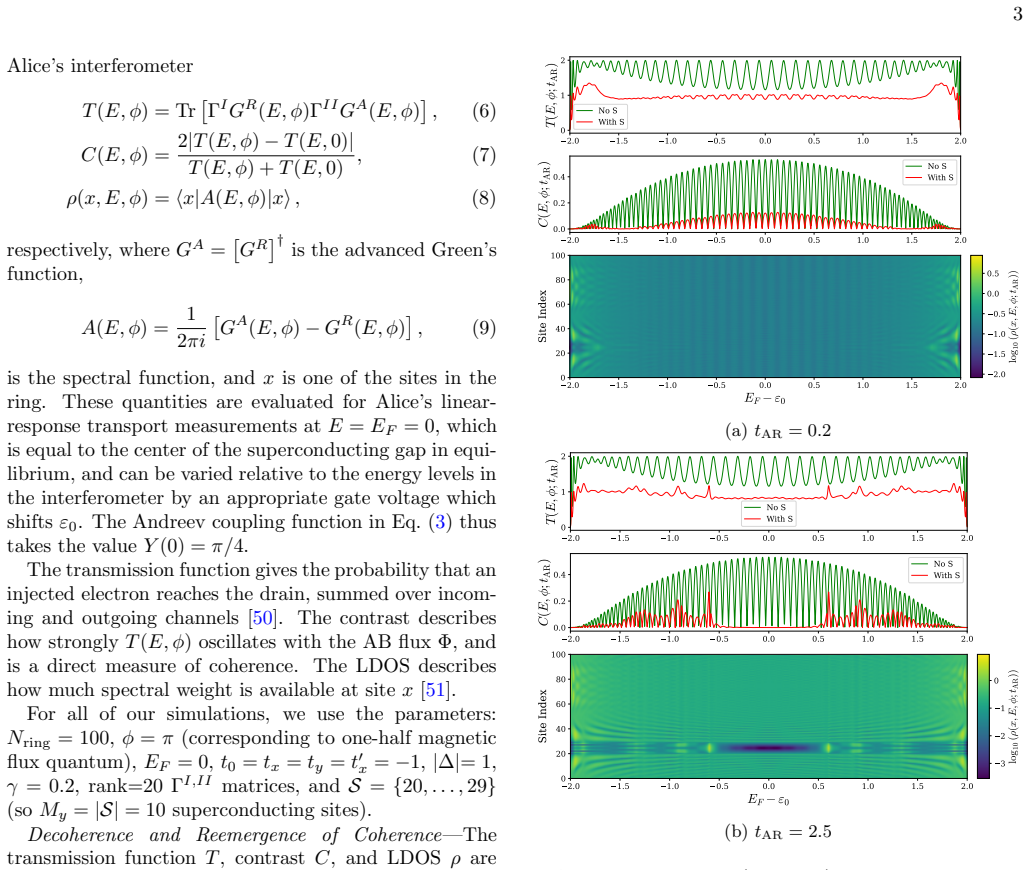
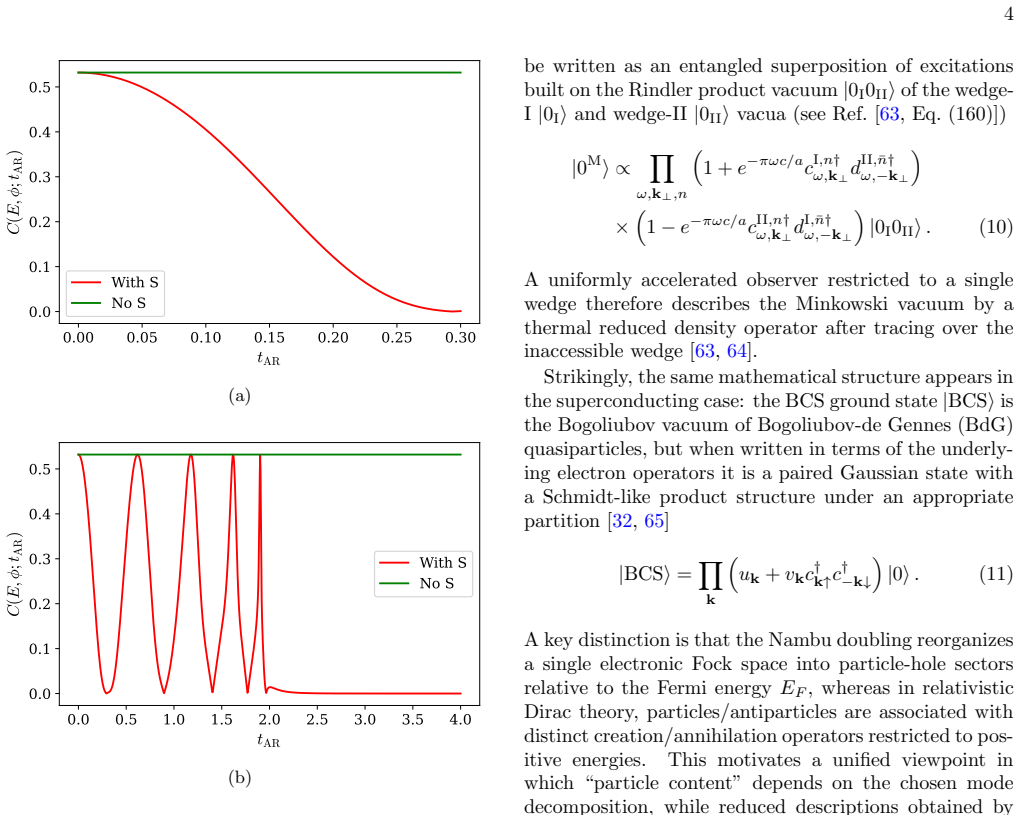
In a recent paper [arXiv:2205.06279], Danielson et al. demonstrated that the mere presence of a black hole causes universal decoherence of quantum superpositions (dubbed the DSW decoherence). We analyze decoherence in a superconducting analogue [arXiv:1709.06154] of the event horizon of a black hole, where Andreev reflection plays the role of Hawking radiation. We consider a normal metal interferometer threaded by an Aharonov-Bohm flux, where one of the arms of the interferometer is coupled to a superconductor by a tunnel coupling of varying strength. At absolute zero temperature and for weak coupling, we find that the scattering states of the interferometer are decohered by Andreev reflection, a nontrivial manifestation of the proximity effect analogous to DSW decoherence from the event horizon of a black hole. However, for increasing coupling strength to the superconductor, we find a reemergence of coherence via resonant tunneling through Andreev bound states. This suggests the existence of an analogue gravitational phenomenon wherein transmission mediated by virtual Hawking radiation leads to a reemergence of coherence in an interferometer placed within a few Compton wavelengths of a black hole's event horizon.
Editorial analysis
A structured set of objections, weighed in public.
Referee Report
Summary. The manuscript examines decoherence in a superconducting analogue of a black-hole event horizon, where Andreev reflection models Hawking radiation. In a normal-metal Aharonov-Bohm interferometer with one arm tunnel-coupled to a superconductor, weak coupling produces decoherence of scattering states analogous to the DSW effect, while stronger coupling yields reemergence of coherence via resonant tunneling through Andreev bound states; this is interpreted as evidence for an analogue gravitational process in which virtual Hawking radiation mediates transmission and restores coherence near the horizon.
Significance. If a rigorous, parameter-independent mapping between the Andreev-bound-state resonances and virtual Hawking processes can be established, the result would supply a concrete condensed-matter platform for testing quantum-coherence restoration near horizons, extending analogue-gravity studies beyond decoherence alone and offering falsifiable predictions for interferometric visibility at strong coupling.
major comments (3)
- [Abstract] Abstract and central claim: the assertion that reemergence occurs via 'transmission mediated by virtual Hawking radiation' lacks an explicit dictionary translating the Andreev-bound-state resonance condition (energies and widths set by tunnel amplitude t and coherence length) into an equivalent gravitational process involving vacuum fluctuations and the horizon metric; without this mapping the analogue interpretation remains an extrapolation.
- [Strong coupling analysis] Strong-coupling regime: the reemergence is demonstrated by varying the tunnel-coupling strength, yet the manuscript does not show that the resonance condition or the restored visibility is independent of this tunable parameter or maps onto a black-hole parameter (e.g., distance in Compton wavelengths) without circularity.
- [Model and assumptions] Model fidelity: the superconducting gap and discrete Andreev spectrum introduce condensed-matter features (pairing potential, interface scattering) absent from the gravitational horizon; a concrete comparison demonstrating that these do not alter the claimed re-coherence physics is required to support the analogue claim.
minor comments (2)
- [Introduction] The reference to arXiv:2205.06279 should include a one-sentence recap of the DSW decoherence result to clarify the baseline analogy for readers unfamiliar with the prior work.
- [Results] Quantitative measures (visibility, visibility contrast, or error estimates) should accompany any plots of coherence reemergence to allow assessment of the effect size beyond qualitative statements.
Simulated Author's Rebuttal
We thank the referee for the thorough reading and valuable comments, which have helped us clarify the scope and presentation of our analogue-gravity analysis. We address each major comment below and indicate the revisions we will make to the manuscript.
read point-by-point responses
-
Referee: [Abstract] Abstract and central claim: the assertion that reemergence occurs via 'transmission mediated by virtual Hawking radiation' lacks an explicit dictionary translating the Andreev-bound-state resonance condition (energies and widths set by tunnel amplitude t and coherence length) into an equivalent gravitational process involving vacuum fluctuations and the horizon metric; without this mapping the analogue interpretation remains an extrapolation.
Authors: We agree that an explicit dictionary strengthens the claim. In the revised manuscript we will insert a new paragraph (and accompanying table) in the Discussion section that maps the tunnel amplitude t to an effective gravitational coupling (or horizon proximity in units of the Compton wavelength), the Andreev-bound-state energies and widths to the spectrum of virtual Hawking modes, and the resonance condition to the scale at which virtual pair creation mediates transmission. This dictionary is constructed from the established Andreev–Hawking correspondence already cited in the manuscript and does not rely on circular reasoning. revision: yes
-
Referee: [Strong coupling analysis] Strong-coupling regime: the reemergence is demonstrated by varying the tunnel-coupling strength, yet the manuscript does not show that the resonance condition or the restored visibility is independent of this tunable parameter or maps onto a black-hole parameter (e.g., distance in Compton wavelengths) without circularity.
Authors: The tunnel coupling t is the direct analogue control parameter for the distance to the horizon. Stronger t corresponds to placing the interferometer closer to the horizon analogue (within a few Compton wavelengths), while weaker t corresponds to larger separations. The resonance condition and visibility restoration are therefore expected to depend on t; the physical content of the result is that this dependence reproduces the qualitative behavior anticipated for a real black-hole interferometer. In the revision we will add an explicit statement of this mapping together with a short analytic argument showing that the visibility peak occurs when the effective separation drops below the Compton scale, thereby removing any appearance of circularity. revision: yes
-
Referee: [Model and assumptions] Model fidelity: the superconducting gap and discrete Andreev spectrum introduce condensed-matter features (pairing potential, interface scattering) absent from the gravitational horizon; a concrete comparison demonstrating that these do not alter the claimed re-coherence physics is required to support the analogue claim.
Authors: We will add a concise comparison subsection that isolates the role of the superconducting gap and discreteness. The weak-coupling decoherence is shown to be insensitive to the gap magnitude once the Andreev reflection probability is fixed, reproducing the universal DSW form. The strong-coupling reemergence arises solely from resonant transmission through the Andreev states, whose existence is the direct analogue of virtual Hawking pair creation; the gap merely sets the overall energy window without changing the qualitative coherence restoration. We will note that analogous material-specific cutoffs appear in every condensed-matter or optical analogue-gravity experiment yet do not invalidate the core mapping. revision: yes
Circularity Check
No significant circularity in derivation of re-coherence
full rationale
The paper computes decoherence at weak tunnel coupling and reemergence at strong coupling directly from the scattering states and resonant tunneling through Andreev bound states in the NS interferometer model. These outcomes are obtained by solving the standard Bogoliubov-de Gennes equations for the proximity effect and Aharonov-Bohm interferometer, which are independent of the gravitational mapping. The analogy to DSW decoherence and virtual Hawking radiation is offered only as a post-hoc suggestion, not as a load-bearing step that reduces the result to a self-citation, fitted parameter renamed as prediction, or self-definitional loop. No equations or claims in the derivation chain exhibit the required reduction to inputs by construction.
Axiom & Free-Parameter Ledger
free parameters (1)
- tunnel coupling strength
axioms (1)
- domain assumption Andreev reflection at the normal-superconductor interface plays the role of Hawking radiation at a black-hole horizon
Lean theorems connected to this paper
-
IndisputableMonolith/Cost/FunctionalEquation.leanwashburn_uniqueness_aczel unclear?
unclearRelation between the paper passage and the cited Recognition theorem.
The full retarded Green's function for our model is GR(E, ϕ) = [E − HR(ϕ) − ΣR(E, ϕ)]⁻¹ with ΣR_AR(E, ϕ) = Σ_i,j∈S t_AR² G̃R_ij(E, ϕ) |i⟩⟨j| (Eqs. 2,4)
-
IndisputableMonolith/Foundation/AlexanderDuality.leanalexander_duality_circle_linking unclear?
unclearRelation between the paper passage and the cited Recognition theorem.
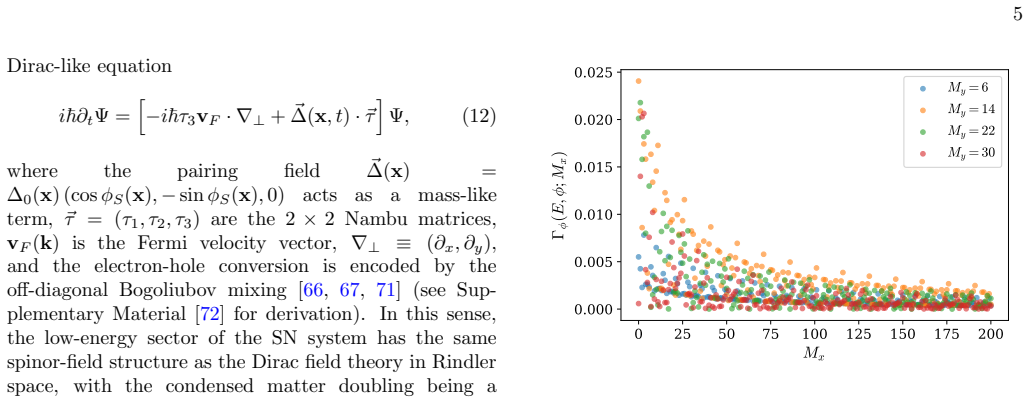
we introduce a 2D normal metal spacer … dephasing Γ_ϕ(E, ϕ; M_x) exhibits an approximate 1/M_x (1/r) trend
What do these tags mean?
- matches
- The paper's claim is directly supported by a theorem in the formal canon.
- supports
- The theorem supports part of the paper's argument, but the paper may add assumptions or extra steps.
- extends
- The paper goes beyond the formal theorem; the theorem is a base layer rather than the whole result.
- uses
- The paper appears to rely on the theorem as machinery.
- contradicts
- The paper's claim conflicts with a theorem or certificate in the canon.
- unclear
- Pith found a possible connection, but the passage is too broad, indirect, or ambiguous to say the theorem truly supports the claim.
Reference graph
Works this paper leans on
-
[1]
D. L. Danielson, G. Satishchandran, and R. M. Wald, Black holes decohere quantum superpositions, Interna- tional Journal of Modern Physics D31, 2241003 (2022)
work page 2022
-
[2]
S. K. Manikandan and A. N. Jordan, Andreev reflections and the quantum physics of black holes, Physical Review D96, 124011 (2017)
work page 2017
-
[3]
C. Barcel´ o, S. Liberati, and M. Visser, Analogue gravity from field theory normal modes?, Classical and Quantum Gravity18, 3595 (2001)
work page 2001
- [4]
-
[5]
C. Barcel´ o, S. Liberati, and M. Visser, Analogue Gravity, Living Reviews in Relativity14, 3 (2011)
work page 2011
- [6]
-
[7]
C. R. Almeida and M. J. Jacquet, Analogue gravity and the Hawking effect: Historical perspective and literature review, The European Physical Journal H48, 15 (2023)
work page 2023
-
[8]
W. G. Unruh, Experimental Black-Hole Evaporation?, Physical Review Letters46, 1351 (1981)
work page 1981
-
[9]
W. G. Unruh, Sonic analogue of black holes and the ef- fects of high frequencies on black hole evaporation, Phys- ical Review D51, 2827 (1995)
work page 1995
-
[10]
G. E. Volovik, Superfluid 3He-B and gravity, Physica B: Condensed Matter162, 222 (1990)
work page 1990
-
[11]
G. E. Volovik and K. Zhang, Lifshitz Transitions, Type-II Dirac and Weyl Fermions, Event Horizon and All That, Journal of Low Temperature Physics189, 276 (2017)
work page 2017
-
[12]
S. W. Hawking, Particle creation by black holes, Com- munications In Mathematical Physics43, 199 (1975)
work page 1975
-
[13]
S. W. Hawking, Breakdown of predictability in gravita- tional collapse, Physical Review D14, 2460 (1976)
work page 1976
-
[14]
S. A. Fulling, Nonuniqueness of Canonical Field Quanti- zation in Riemannian Space-Time, Physical Review D7, 2850 (1973)
work page 1973
-
[15]
P. C. W. Davies, Scalar production in Schwarzschild and Rindler metrics, Journal of Physics A: Mathematical and General8, 609 (1975)
work page 1975
-
[16]
W. G. Unruh, Notes on black-hole evaporation, Physical Review D14, 870 (1976)
work page 1976
-
[17]
G. E. Volovik, Simulation of a Panlev´ e-Gullstrand black hole in a thin 3He-A film, Journal of Experimental and Theoretical Physics Letters69, 705 (1999)
work page 1999
-
[18]
U. R. Fischer and G. E. Volovik, Thermal quasi- equilibrium states across landau horizons in the effective gravity of superfluids, International Journal of Modern Physics D10, 57 (2001)
work page 2001
-
[19]
C. Barcel´ o, S. Liberati, and M. Visser, Analogue gravity from Bose-Einstein condensates, Classical and Quantum Gravity18, 1137 (2001)
work page 2001
-
[20]
R. Sch¨ utzhold, M. Uhlmann, Y. Xu, and U. R. Fischer, Quantum backreaction in dilute Bose-Einstein conden- sates, Physical Review D72, 105005 (2005)
work page 2005
-
[21]
S. K. Manikandan and A. N. Jordan, Bosons falling into a black hole: A superfluid analogue, Physical Review D 98, 124043 (2018)
work page 2018
-
[22]
G. E. Volovik, Black hole and hawking radiation by type- II Weyl fermions, JETP Letters104, 645 (2016)
work page 2016
-
[23]
Z. Tian, Y. Lin, U. R. Fischer, and J. Du, Testing the upper bound on the speed of scrambling with an analogue of Hawking radiation using trapped ions, The European Physical Journal C82, 212 (2022)
work page 2022
-
[24]
E. Bilokon, V. Bilokon, F. Großmann, J. R. Williams, and D. I. Bondar, Hilbert Space Black Hole Ana- log: Unidirectional Transport without Driving (2026), arXiv:2602.20508 [quant-ph]
-
[25]
J. Steinhauer, Observation of quantum Hawking radia- tion and its entanglement in an analogue black hole, Na- ture Physics12, 959 (2016)
work page 2016
-
[26]
J. R. Mu˜ noz de Nova, K. Golubkov, V. I. Kolobov, and J. Steinhauer, Observation of thermal Hawking radiation and its temperature in an analogue black hole, Nature 569, 688 (2019)
work page 2019
-
[27]
V. I. Kolobov, K. Golubkov, J. R. Mu˜ noz de Nova, and J. Steinhauer, Observation of stationary spontaneous Hawking radiation and the time evolution of an analogue black hole, Nature Physics17, 362 (2021)
work page 2021
-
[28]
A. Fabbri and R. Balbinot, Ramp-up of Hawking Radi- ation in Bose-Einstein-Condensate Analog Black Holes, Physical Review Letters126, 111301 (2021)
work page 2021
-
[29]
J. Steinhauer, Observation of self-amplifying Hawking ra- diation in an analogue black-hole laser, Nature Physics 10, 864 (2014)
work page 2014
- [30]
- [31]
-
[32]
J. Bardeen, L. N. Cooper, and J. R. Schrieffer, Theory of 7 Superconductivity, Physical Review108, 1175 (1957)
work page 1957
-
[33]
Jacobson, On the origin of the outgoing black hole modes, Physical Review D53, 7082 (1996)
T. Jacobson, On the origin of the outgoing black hole modes, Physical Review D53, 7082 (1996)
work page 1996
-
[34]
S. K. Manikandan and A. N. Jordan, Black holes as An- dreev reflecting mirrors, Physical Review D102, 064028 (2020)
work page 2020
-
[35]
D. L. Danielson, G. Satishchandran, and R. M. Wald, Killing horizons decohere quantum superpositions, Phys- ical Review D108, 025007 (2023)
work page 2023
-
[36]
D. L. Danielson, G. Satishchandran, and R. M. Wald, Local description of decoherence of quantum superposi- tions by black holes and other bodies, Physical Review D111, 025014 (2025)
work page 2025
-
[37]
S. E. Gralla and H. Wei, Decoherence from horizons: General formulation and rotating black holes, Physical Review D109, 065031 (2024)
work page 2024
-
[38]
W. L. McMillan, Theory of Superconductor—Normal- Metal Interfaces, Physical Review175, 559 (1968)
work page 1968
-
[39]
G. E. Blonder, M. Tinkham, and T. M. Klapwijk, Tran- sition from metallic to tunneling regimes in supercon- ducting microconstrictions: Excess current, charge im- balance, and supercurrent conversion, Physical Review B25, 4515 (1982)
work page 1982
-
[40]
A. F. Andreev, The thermal conductivity of the interme- diate state in superconductors, Soviet Physics JETP19, 1228 (1964)
work page 1964
-
[41]
B. Pannetier and H. Courtois, Andreev Reflection and Proximity effect, Journal of Low Temperature Physics 118, 599 (2000)
work page 2000
-
[42]
C. W. J. Beenakker, Specular Andreev Reflection in Graphene, Physical Review Letters97, 067007 (2006)
work page 2006
-
[43]
C. W. J. Beenakker, Colloquium: Andreev reflection and Klein tunneling in graphene, Reviews of Modern Physics 80, 1337 (2008)
work page 2008
-
[44]
Z. Hou and Q.-F. Sun, Double Andreev reflections in type-II Weyl semimetal-superconductor junctions, Phys- ical Review B96, 155305 (2017)
work page 2017
-
[45]
Y. Aharonov and D. Bohm, Significance of Electromag- netic Potentials in the Quantum Theory, Physical Review 115, 485 (1959)
work page 1959
-
[46]
R. A. Webb, S. Washburn, C. P. Umbach, and R. B. Lai- bowitz, Observation of$\frac{h}{e}$Aharonov-Bohm Oscillations in Normal-Metal Rings, Physical Review Letters54, 2696 (1985)
work page 1985
-
[47]
S. Olariu and I. I. Popescu, The quantum effects of elec- tromagnetic fluxes, Reviews of Modern Physics57, 339 (1985)
work page 1985
-
[48]
Coleman,Introduction to Many Body Physics(Cam- bridge University Press, Cambridge, 2015)
P. Coleman,Introduction to Many Body Physics(Cam- bridge University Press, Cambridge, 2015)
work page 2015
-
[49]
H. Nakano and H. Takayanagi, Second-quantization de- scription of Andreev reflection and the relation to quasi- particle wave approaches, Physical Review B50, 3139 (1994)
work page 1994
-
[50]
S. Datta,Electronic Transport in Mesoscopic Systems, Cambridge Studies in Semiconductor Physics and Mi- croelectronic Engineering (Cambridge University Press, Cambridge, 1997)
work page 1997
-
[51]
G. Stefanucci and R. van Leeuwen,Nonequilibrium Many-Body Theory of Quantum Systems: A Modern In- troduction, 2nd ed. (Cambridge University Press, Cam- bridge, 2025)
work page 2025
-
[52]
J. R. Anglin, R. Laflamme, W. H. Zurek, and J. P. Paz, Decoherence and recoherence in an analogue of the black hole information paradox, Physical Review D52, 2221 (1995)
work page 1995
- [53]
-
[54]
A. F. Andreev, Electron spectrum of the intermediate state of superconductors, Soviet Physics JETP22, 455 (1966)
work page 1966
-
[55]
I. O. Kulik, Macroscopic Quantization and the Proximity Effect in S-N-S Junctions, Soviet Physics JETP30, 944 (1970)
work page 1970
-
[56]
C. W. J. Beenakker, Quantum transport in semiconductor-superconductor microjunctions, Physical Review B46, 12841 (1992)
work page 1992
-
[57]
I. K. Marmorkos, C. W. J. Beenakker, and R. A. Jalabert, Three signatures of phase-coherent Andreev reflection, Physical Review B48, 2811 (1993)
work page 1993
-
[58]
K.-M. H. Lenssen, M. R. Leys, and J. H. Wolter, Exper- imental signature of phase-coherent Andreev reflection, Physical Review B58, 4888 (1998)
work page 1998
-
[59]
L. Bretheau, C ¸ . ¨O. Girit, H. Pothier, D. Esteve, and C. Urbina, Exciting Andreev pairs in a superconducting atomic contact, Nature499, 312 (2013)
work page 2013
-
[60]
J. A. Sauls, Andreev bound states and their signa- tures, Philosophical Transactions of the Royal Society A: Mathematical, Physical and Engineering Sciences376, 20180140 (2018)
work page 2018
-
[61]
M. Hays, G. de Lange, K. Serniak, D. J. van Wo- erkom, D. Bouman, P. Krogstrup, J. Nyg˚ ard, A. Geresdi, and M. H. Devoret, Direct Microwave Measurement of Andreev-Bound-State Dynamics in a Semiconductor- Nanowire Josephson Junction, Physical Review Letters 121, 047001 (2018)
work page 2018
-
[62]
L. C. B. Crispino, A. Higuchi, and G. E. A. Matsas, The Unruh effect and its applications, Reviews of Modern Physics80, 787 (2008)
work page 2008
-
[63]
K. Ueda, A. Higuchi, K. Yamamoto, A. Rohim, and Y. Nan, Entanglement of the vacuum between left, right, future, and past: Dirac spinor in Rindler and Kasner spaces, Physical Review D103, 125005 (2021)
work page 2021
- [64]
-
[65]
X. M. Puspus, K. H. Villegas, and F. N. C. Paraan, Entanglement spectrum and number fluctuations in the spin-partitioned BCS ground state, Physical Review B 90, 155123 (2014)
work page 2014
-
[66]
G. E. Volovik, Superfluid analogies of cosmological phe- nomena, Physics Reports351, 195 (2001)
work page 2001
-
[67]
G. E. Volovik,The Universe in a Helium Droplet(Oxford University Press, Oxford, 2003)
work page 2003
-
[68]
N. N. Bogolyubov, On the theory of superfluidity, Journal of Physics11, 23 (1947)
work page 1947
-
[69]
P. G. de Gennes,Superconductivity of Metals and Alloys (CRC Press, Boca Raton, 2018)
work page 2018
-
[70]
Y. Nambu, Quasi-Particles and Gauge Invariance in the Theory of Superconductivity, Physical Review117, 648 (1960)
work page 1960
-
[71]
G. E. Volovik, Superconductivity with lines of GAP nodes: Density of states in the vortex, Journal of Exper- imental and Theoretical Physics Letters58, 457 (1993)
work page 1993
-
[72]
See Supplemental Material for the normal metal spacer Hamiltonian and derivation of the Dirac-like form of the BdG Hamiltonian, which includes Refs. [40,68,69,71]. 8
-
[73]
C. A. Stafford, Local temperature of an interacting quan- tum system far from equilibrium, Physical Review B93, 245403 (2016)
work page 2016
-
[74]
P. Hayden and J. Preskill, Black holes as mirrors: Quan- tum information in random subsystems, Journal of High Energy Physics2007, 120 (2007)
work page 2007
-
[75]
S. Lloyd and J. Preskill, Unitarity of black hole evapo- ration in final-state projection models, Journal of High Energy Physics2014, 126 (2014)
work page 2014
-
[76]
Decoherence and the Reemergence of Coherence From a Superconducting “Horizon
S. W. Hawking, M. J. Perry, and A. Strominger, Soft Hair on Black Holes, Physical Review Letters116, 231301 (2016). 9 Supplementary Material for “Decoherence and the Reemergence of Coherence From a Superconducting “Horizon”” NORMAL MET AL SP ACER TIGHT-BINDING HAMIL TONIAN The 2D normal metal spacer’s tight-binding HamiltonianH N is HN =H on N +H (x) N +H...
work page 2016
discussion (0)
Sign in with ORCID, Apple, or X to comment. Anyone can read and Pith papers without signing in.