Recognition: 2 theorem links
· Lean TheoremComplex Wannier centers and drifting Wannier functions in non-Hermitian Hamiltonians
Pith reviewed 2026-05-15 09:39 UTC · model grok-4.3
The pith
Complex Wannier centers from nonunitary Wilson loops predict filling anomalies and whether edge modes gain or lose energy in non-Hermitian systems.
A machine-rendered reading of the paper's core claim, the machinery that carries it, and where it could break.
Core claim
In non-Hermitian Hamiltonians with line gaps, nonunitary Wilson loops possess gauge-invariant eigenvalues that define complex Wannier centers. These centers carry physical content because the corresponding Wannier functions break reciprocity: an imaginary part in the center produces an effective momentum offset and therefore directional drift of the wave-packet centroid. When the Hamiltonian is pseudo-Hermitian, the projected metric operator supplies a Krein signature that restricts the centers to be real or to form complex-conjugate pairs. The Krein structure of the Wilson loop then establishes a bulk-boundary correspondence: the configuration of the centers determines whether the occupied,
What carries the argument
Complex Wannier centers, defined as the gauge-invariant eigenvalues of nonunitary Wilson loops under biorthonormal quantum mechanics, whose imaginary parts encode directional drift of the associated Wannier functions.
If this is right
- Symmetries in pseudo-Hermitian systems force complex Wannier centers to be real or to appear in conjugate pairs, fixed by the Krein signatures of the projected metric.
- The Krein structure of the Wilson loop determines the presence of a filling anomaly in the occupied bands.
- The same Krein structure decides whether the resulting edge modes experience net gain or net loss.
- A specific lattice implementation is proposed that makes these predictions experimentally testable.
Where Pith is reading between the lines
- The directional drift implied by imaginary centers should appear in time-resolved wave-packet measurements, offering a direct dynamical signature.
- The framework may generalize to other non-Hermitian topological markers that also become nonunitary.
- The same Krein-signature logic could constrain complex centers in PT-symmetric or other symmetry classes not treated here.
Load-bearing premise
That the eigenvalues of nonunitary Wilson loops can be interpreted directly as physically meaningful complex Wannier centers whose imaginary parts produce observable directional drift, relying on biorthonormal quantum mechanics without additional verification.
What would settle it
A numerical or experimental check, in a concrete lattice model, of whether the predicted directional drift of a wave packet matches the imaginary part of the computed complex Wannier center, and whether the observed filling anomaly and edge-mode gain or loss follow the Krein signatures of the Wilson loop.
Figures



read the original abstract
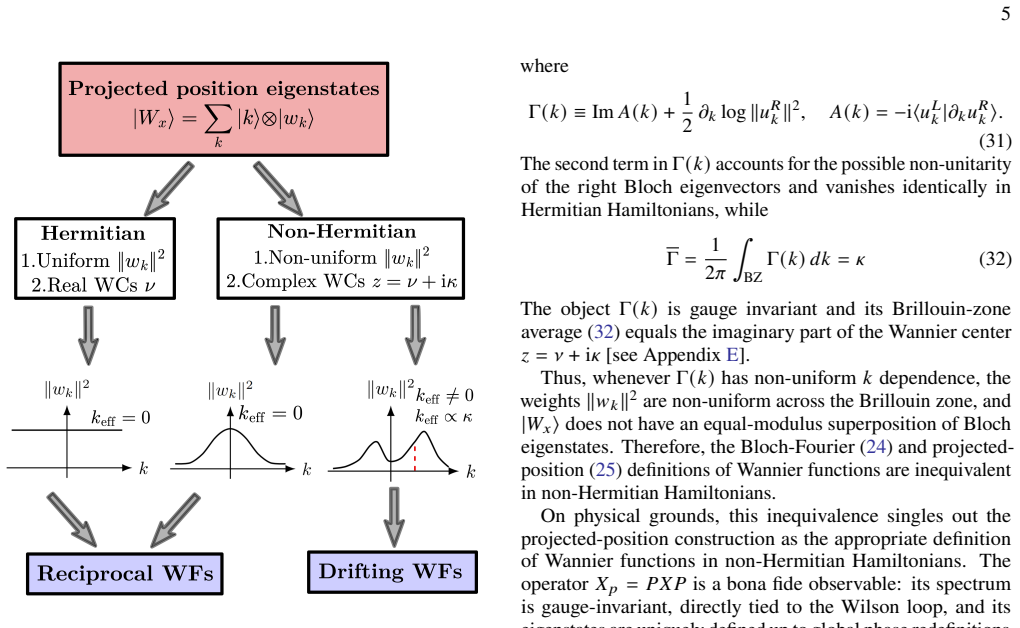
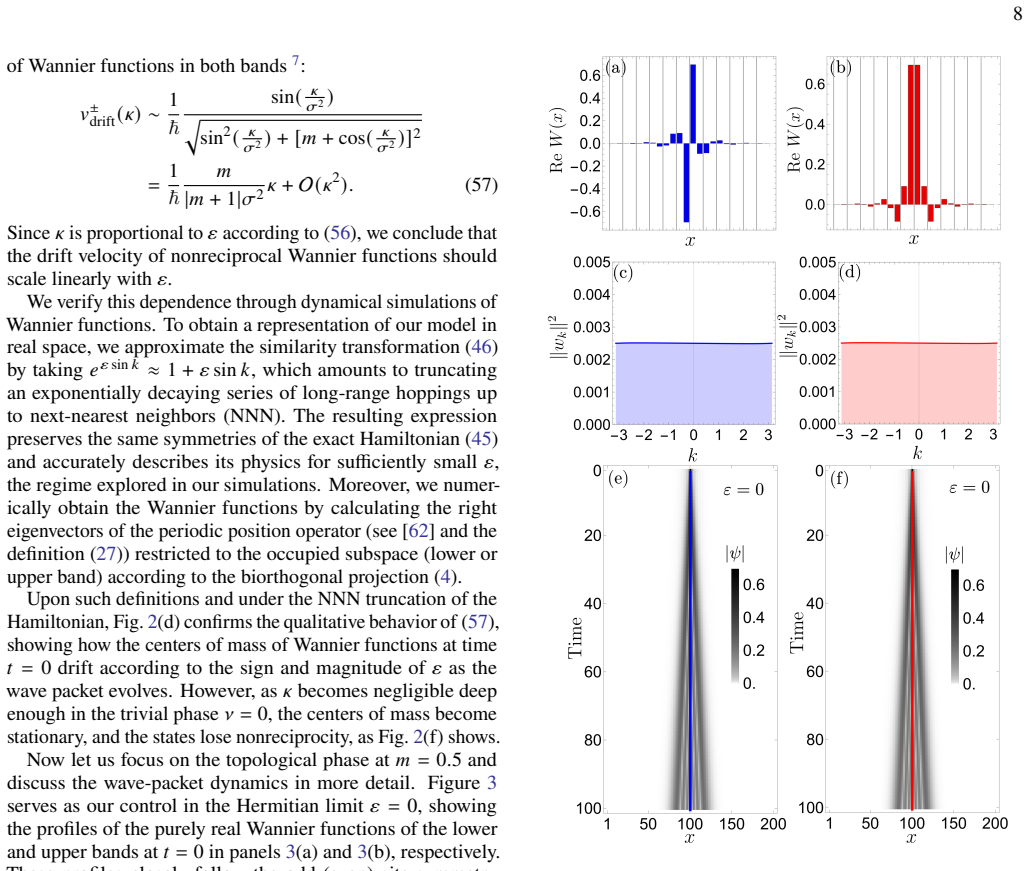
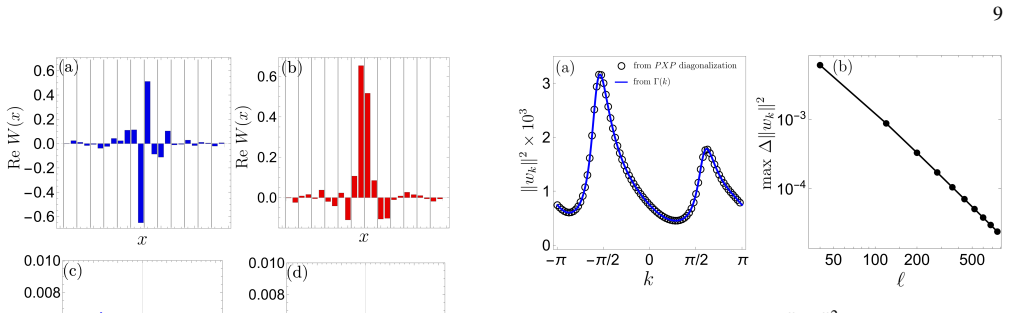
The extension of topological band theory to non-Hermitian Hamiltonians with line energy gaps remains largely unexplored, despite early indications of rich underlying physics. In these systems, Wilson loops, the objects characterizing polarization, become nonunitary. Yet, the physical consequences of this nonunitarity have remained unclear. Using biorthonormal quantum mechanics, we introduce the concept of complex Wannier centers, defined from the gauge-invariant eigenvalues of nonunitary Wilson loops. Complex Wannier centers acquire physical meaning through the breaking of reciprocity in their associated Wannier functions. When the centroid of a Wannier function shifts into the complex plane, it acquires an effective momentum offset that produces directional drift over time. We analyze how symmetries constrain complex Wannier centers and identify symmetry-protected Wannier configurations in pseudo-Hermitian Hamiltonians, where the centers are either real or form complex-conjugate pairs, as determined by conserved "Krein signatures" of the projected metric operator of pseudo-Hermiticity. We further show that the Krein structure of the Wilson loop can establish a bulk-boundary correspondence: in a system with anticommuting pseudo-Hermitian metric and (pseudo) inversion symmetries, the behavior of complex Wannier centers predicts the existence of a filling anomaly in the occupied bands and whether the resulting edge modes experience gain or loss. Finally, we propose an implementation of this system that enables experimental tests of our predictions.
Editorial analysis
A structured set of objections, weighed in public.
Referee Report
Summary. The manuscript extends topological band theory to non-Hermitian Hamiltonians possessing line gaps by defining complex Wannier centers from the gauge-invariant eigenvalues of nonunitary Wilson loops within biorthonormal quantum mechanics. These centers are argued to acquire physical content through reciprocity breaking in the associated Wannier functions, producing directional drift. In pseudo-Hermitian systems, Krein signatures of the projected metric operator constrain the centers to be real or to appear in complex-conjugate pairs. The Krein structure is further claimed to furnish a bulk-boundary correspondence that predicts the existence of a filling anomaly together with the gain or loss character of the resulting edge modes. An experimental realization is proposed.
Significance. If the derivations are completed rigorously, the work supplies a concrete dictionary between nonunitary Wilson-loop data and observable edge-mode properties in non-Hermitian systems, extending the polarization-anomaly paradigm beyond Hermitian settings and offering testable predictions for directional drift and gain/loss imbalance.
major comments (1)
- [Bulk-boundary correspondence (section developing the Krein-structure argument)] The bulk-boundary correspondence asserted in the final paragraph of the abstract (and developed in the main text) requires an explicit derivation showing how the Krein signatures (real eigenvalues versus complex-conjugate pairs) of the nonunitary Wilson-loop eigenvalues translate, via the biorthonormal projector and the pseudo-Hermitian metric operator, into a concrete boundary condition such as a jump in the integrated density of states or a specific pairing of left/right eigenvectors. Without this step the prediction of filling anomaly and edge-mode gain/loss remains an assertion rather than a theorem.
minor comments (1)
- [Abstract] The abstract is information-dense; a brief sentence separating the definition of complex Wannier centers from the bulk-boundary claim would improve readability.
Simulated Author's Rebuttal
We thank the referee for their careful reading and constructive feedback on our manuscript. We address the single major comment below and will revise the manuscript accordingly to strengthen the presentation.
read point-by-point responses
-
Referee: [Bulk-boundary correspondence (section developing the Krein-structure argument)] The bulk-boundary correspondence asserted in the final paragraph of the abstract (and developed in the main text) requires an explicit derivation showing how the Krein signatures (real eigenvalues versus complex-conjugate pairs) of the nonunitary Wilson-loop eigenvalues translate, via the biorthonormal projector and the pseudo-Hermitian metric operator, into a concrete boundary condition such as a jump in the integrated density of states or a specific pairing of left/right eigenvectors. Without this step the prediction of filling anomaly and edge-mode gain/loss remains an assertion rather than a theorem.
Authors: We agree that the link between Krein signatures and boundary observables can be made fully explicit. In the revised manuscript we will insert a new subsection that derives the correspondence step by step: (i) we start from the gauge-invariant eigenvalues of the nonunitary Wilson loop and their Krein signatures under the projected metric operator; (ii) we apply the biorthonormal projector to these eigenvalues and show how real centers versus complex-conjugate pairs produce a discontinuity in the integrated density of states when the system is terminated; (iii) we demonstrate that the same signatures enforce a specific pairing of left and right eigenvectors at the edge, directly determining the gain or loss character of the resulting modes. This derivation will be carried out for the anticommuting pseudo-Hermitian metric plus (pseudo)inversion symmetry case highlighted in the abstract. We believe the added steps convert the correspondence from an outline into a self-contained argument. revision: yes
Circularity Check
No significant circularity: definitions and symmetry analysis remain independent of target predictions.
full rationale
The paper introduces complex Wannier centers explicitly as the gauge-invariant eigenvalues of nonunitary Wilson loops and then derives their physical interpretation and symmetry constraints from biorthonormal quantum mechanics and the pseudo-Hermitian metric. The bulk-boundary claim is presented as a consequence of these definitions plus the anticommuting symmetries, without any reduction of the predicted filling anomaly or edge-mode gain/loss back to a fitted parameter or self-referential definition. No self-citation chain is load-bearing for the central result, and no ansatz is smuggled in. The derivation chain is therefore self-contained against external benchmarks.
Axiom & Free-Parameter Ledger
axioms (2)
- domain assumption Biorthonormal quantum mechanics provides the correct inner product for defining physical quantities in non-Hermitian systems
- domain assumption Non-Hermitian Hamiltonians with line gaps admit well-defined nonunitary Wilson loops
invented entities (1)
-
Complex Wannier centers
no independent evidence
Lean theorems connected to this paper
-
IndisputableMonolith/Cost/FunctionalEquation.leanwashburn_uniqueness_aczel unclear?
unclearRelation between the paper passage and the cited Recognition theorem.
Complex Wannier centers defined from gauge-invariant eigenvalues of nonunitary Wilson loops; Krein signatures of the projected metric operator of pseudo-Hermiticity
-
IndisputableMonolith/Foundation/AlexanderDuality.leanalexander_duality_circle_linking unclear?
unclearRelation between the paper passage and the cited Recognition theorem.
Krein collisions and bulk-boundary correspondence via anticommuting pseudo-Hermitian metric and (pseudo) inversion symmetries
What do these tags mean?
- matches
- The paper's claim is directly supported by a theorem in the formal canon.
- supports
- The theorem supports part of the paper's argument, but the paper may add assumptions or extra steps.
- extends
- The paper goes beyond the formal theorem; the theorem is a base layer rather than the whole result.
- uses
- The paper appears to rely on the theorem as machinery.
- contradicts
- The paper's claim conflicts with a theorem or certificate in the canon.
- unclear
- Pith found a possible connection, but the passage is too broad, indirect, or ambiguous to say the theorem truly supports the claim.
Reference graph
Works this paper leans on
-
[1]
Commuting symmetries If the IS ans pIS symmetry operators commute, the object 𝜂≡𝐼 𝑐 𝐼𝑠 (96) is a Hermitian and involutory operator, 𝜂† =(𝐼 𝑠 𝐼𝑐)† =(𝐼 𝑐)†𝐼 † 𝑠 =𝐼 𝑐 𝐼𝑠 =𝐼 𝑠 𝐼𝑐 =𝜂, 𝜂2 =𝐼 𝑠 𝐼𝑐 𝐼𝑠 𝐼𝑐 =𝐼 𝑠 𝐼2 𝑐 𝐼𝑠 =I 𝑁 , which, according to (95), implements pseudo-Hermiticity: ℎ(𝑘) † =𝜂 ℎ(𝑘)𝜂 −1.(97) We therefore obtain a set {𝐼 𝑠, 𝐼𝑐, 𝜂} of mutually commuting...
-
[2]
Anticommuting symmetries If the IS and pIS symmetry operators anticommute, then the operator 𝜂 defined in (96) is anti-Hermitian and squares to minus one, 𝜂† =(𝐼 𝑠 𝐼𝑐)† =(𝐼 𝑐)†𝐼 † 𝑠 =𝐼 𝑐 𝐼𝑠 =−𝐼 𝑠 𝐼𝑐 =−𝜂, 𝜂2 =𝐼 𝑠 𝐼𝑐 𝐼𝑠 𝐼𝑐 =−𝐼 𝑠 𝐼2 𝑐 𝐼𝑠 =−I 𝑁 . We therefore introduce ˜𝜂≡i𝜂=i𝐼 𝑠 𝐼𝑐,(100) whichanticommuteswith 𝐼𝑠 and 𝐼𝑐, satisfies ˜𝜂† =˜𝜂 and ˜𝜂2 =I 𝑁 , and i...
-
[3]
W. D. Heiss, The physics of exceptional points, Journal of Physics A45, 444016 (2012)
work page 2012
-
[4]
K. Ding, C. Fang, and G. Ma, Non-hermitian topology and exceptional-point geometries, Nature Reviews Physics4, 745–760 (2022)
work page 2022
-
[5]
E. J. Bergholtz, J. C. Budich, and F. K. Kunst, Exceptional topology of non-hermitian systems, Rev. Mod. Phys.93, 015005 (2021)
work page 2021
-
[6]
K. Kawabata, T. Bessho, and M. Sato, Classification of excep- tional points and non-hermitian topological semimetals, Phys. Rev. Lett.123, 066405 (2019)
work page 2019
-
[7]
J. L. K. K¨onig, K. Yang, J. C. Budich, and E. J. Bergholtz, Braid- protected topological band structures with unpaired exceptional points, Phys. Rev. Res.5, L042010
-
[8]
H. Shen, B. Zhen, and L. Fu, Topological band theory for non- hermitian hamiltonians, Phys. Rev. Lett.120, 146402
- [9]
-
[10]
Xiong, Why does bulk boundary correspondence fail in some non-hermitian topological models, J
Y. Xiong, Why does bulk boundary correspondence fail in some non-hermitian topological models, J. Phys. Commun.2, 035043 (2018)
work page 2018
-
[11]
F. Song, S. Yao, and Z. Wang, Non-hermitian skin effect and chiral damping in open quantum systems, Phys. Rev. Lett.123, 170401 (2019)
work page 2019
-
[12]
D. S. Borgnia, A. J. Kruchkov, and R.-J. Slager, Non-hermitian boundary modes and topology, Phys. Rev. Lett.124, 056802 (2020)
work page 2020
- [13]
-
[14]
K. Zhang, Z. Yang, and C. Fang, Universal non-hermitian skin effect in two and higher dimensions, Nature Communications 13, 10.1038/s41467-022-30161-6 (2022)
- [15]
-
[16]
Z. Yang, K. Zhang, C. Fang, and J. Hu, Non-hermitian bulk- boundary correspondence and auxiliary generalized brillouin zone theory, Phys. Rev. Lett.125, 226402 (2020)
work page 2020
-
[17]
K. Yokomizo and S. Murakami, Non-bloch band theory of non- hermitian systems, Phys. Rev. Lett.123, 066404 (2019)
work page 2019
- [18]
-
[19]
R. Okugawa, R. Takahashi, and K. Yokomizo, Non-hermitian band topology with generalized inversion symmetry, Phys. Rev. B103, 205205 (2021)
work page 2021
-
[20]
P. M. Vecsei, M. M. Denner, T. Neupert, and F. Schindler, Symmetry indicators for inversion-symmetric non-hermitian topological band structures, Phys. Rev. B103, L201114 (2021)
work page 2021
-
[21]
F. Schindler, K. Gu, B. Lian, and K. Kawabata, Hermitian bulk – non-hermitian boundary correspondence, PRX Quantum4, 030315
-
[22]
K. Shiozaki and S. Ono, Symmetry indicator in non-hermitian systems, Phys. Rev. B104, 035424 (2021)
work page 2021
-
[23]
Y. Wang, Classifying order-two spatial symmetries in non- hermitian hamiltonians: Point-gapped az and az † classes (2024), arXiv:2411.03410 [cond-mat.mes-hall]
-
[24]
Y. Wang and W. A. Benalcazar, Higher-order topological knots and nonreciprocal dynamics in non-hermitian lattices (2024), arXiv:2412.05809 [cond-mat.mes-hall]
- [25]
-
[26]
A. Altland and M. R. Zirnbauer, Nonstandard symmetry classes in mesoscopic normal-superconducting hybrid structures, Physical Review B55, 1142 (1997)
work page 1997
-
[27]
K. Kawabata, K. Shiozaki, M. Ueda, and M. Sato, Symmetry and topology in non-hermitian physics, Phys. Rev. X9, 041015
-
[28]
A. Mostafazadeh, Pseudo-hermitian representation of quantum mechanics, International Journal of Geometric Methods in Mod- ern Physics07, 1191–1306 (2010)
work page 2010
-
[29]
A. Mostafazadeh, Pseudo-hermiticity versus pt symmetry: The necessary condition for the reality of the spectrum of a non- hermitian hamiltonian, Journal of Mathematical Physics43, 205 (2002)
work page 2002
-
[30]
A. Mostafazadeh, Pseudo-hermiticity versus pt-symmetry ii: A complete characterizatio n of non-hermitian hamiltonians with a real spectrum, arXiv preprint math-ph/0110016 (2001)
work page internal anchor Pith review Pith/arXiv arXiv 2001
-
[31]
A. Mostafazadeh, Pseudo-hermiticity versus pt-symmetry iii: Equivalence of pseudo-hermiticity and the presence of antilinear symmetries, Journal of Mathematical Physics43, 3944 (2002)
work page 2002
-
[32]
C. M. Bender and S. Boettcher, Real spectra in non-hermitian hamiltonians having 𝑝𝑡 symmetry, Phys. Rev. Lett.80, 5243 (1998)
work page 1998
-
[33]
C. M. Bender, Pt-symmetric quantum theory, Journal of Physics: Conference Series631, 012002 (2015)
work page 2015
-
[34]
T. Curtright and L. Mezincescu, Biorthogonal quantum systems, Journal of Mathematical Physics48, 10.1063/1.2196243 (2007)
-
[35]
A. K. Pati, Entanglement in non-hermitian quantum theory, Pramana73, 485–498 (2009)
work page 2009
-
[36]
F. K. Kunst, E. Edvardsson, J. C. Budich, and E. J. Bergholtz, Biorthogonal bulk-boundary correspondence in non-hermitian systems, Phys. Rev. Lett.121, 026808 (2018)
work page 2018
-
[37]
D. C. Brody, Biorthogonal quantum mechanics, Journal of Physics A: Mathematical and Theoretical47, 035305 (2013)
work page 2013
- [38]
-
[39]
E. Edvardsson, J. L. K. K¨onig, and M. St˚alhammar, Biorthogonal renormalization (2023), arXiv:2212.06004 [quant-ph]
-
[40]
J. Garrison and E. Wright, Complex geometrical phases for dissipative systems, Physics Letters A128, 177 (1988)
work page 1988
-
[41]
R. Hayward and F. Biancalana, Complex berry phase dynamics in PT -symmetric coupled waveguides, Phys. Rev. A98, 053833 (2018)
work page 2018
-
[42]
S.-D. Liang and G.-Y. Huang, Topological invariance and global berry phase in non-hermitian systems, Phys. Rev. A87, 012118 (2013)
work page 2013
-
[43]
S. Longhi and L. Feng, Complex berry phase and imperfect non- 18 hermitian phase transitions, Phys. Rev. B107, 085122 (2023)
work page 2023
- [44]
-
[45]
Y. Singhal, E. Martello, S. Agrawal, T. Ozawa, H. Price, and B. Gadway, Measuring the adiabatic non-hermitian berry phase in feedback-coupled oscillators, Phys. Rev. Res.5, L032026 (2023)
work page 2023
-
[46]
W. A. Benalcazar, B. A. Bernevig, and T. L. Hughes, Electric multipole moments, topological multipole moment pumping, and chiral hinge states in crystalline insulators, Phys. Rev. B96, 245115 (2017)
work page 2017
- [47]
-
[48]
L. Fidkowski, T. S. Jackson, and I. Klich, Model characterization of gapless edge modes of topological insulators using interme- diate brillouin-zone functions, Phys. Rev. Lett.107, 036601 (2011)
work page 2011
- [49]
-
[50]
D. Vanderbilt,Berry Phases in Electronic Structure Theory: Electric Polarization, Orbital Magnetization and Topological Insulators(Cambridge University Press, 2018)
work page 2018
-
[51]
R. Yu, X. L. Qi, A. Bernevig, Z. Fang, and X. Dai, Equivalent expression of 𝑧2 topological invariant for band insulators using the non-abelian berry connection, Phys. Rev. B84, 075119 (2011)
work page 2011
-
[52]
A. Alexandradinata, X. Dai, and B. A. Bernevig, Wilson-loop characterization of inversion-symmetric topological insulators, Phys. Rev. B89, 155114 (2014)
work page 2014
-
[53]
A. Geyer and D. E. Pelinovsky,Stability of nonlinear waves in Hamiltonian dynamical systems, Vol. 288 (American Mathemat- ical Society, 2025)
work page 2025
-
[54]
A. Chernyavsky and D. E. Pelinovsky, Krein signature for insta- bility of pt-symmetric states, Physica D: Nonlinear Phenomena 371, 48 (2018)
work page 2018
- [55]
-
[56]
S. Masuda and M. Nakamura, Relationship between the electronic polarization and the winding number in non-hermitian systems, Journal of the Physical Society of Japan91, 043701 (2022)
work page 2022
-
[57]
E. Edvardsson, F. K. Kunst, T. Yoshida, and E. J. Bergholtz, Phase transitions and generalized biorthogonal polarization in non-hermitian systems, Phys. Rev. Res.2, 043046 (2020)
work page 2020
-
[58]
J. Hu, C. A. Perroni, G. De Filippis, S. Zhuang, L. Marrucci, and F. Cardano, Electric polarization and its quantization in one- dimensional non-hermitian chains, Phys. Rev. B107, L121101 (2023)
work page 2023
-
[59]
C. Ortega-Taberner, L. Rødland, and M. Hermanns, Polarization and entanglement spectrum in non-hermitian systems, Phys. Rev. B105, 075103 (2022)
work page 2022
-
[60]
M. L. N. Chen, L. J. Jiang, S. Zhang, R. Zhao, Z. Lan, and W. E. I. Sha, Comparative study of hermitian and non-hermitian topological dielectric photonic crystals, Phys. Rev. A104, 033501 (2021)
work page 2021
-
[61]
G. H. Wannier, The structure of electronic excitation levels in insulating crystals, Phys. Rev.52, 191 (1937)
work page 1937
-
[62]
Blount, Formalisms of band theory (Academic Press, 1962) pp
E. Blount, Formalisms of band theory (Academic Press, 1962) pp. 305–373
work page 1962
-
[63]
S. Kivelson, Wannier functions in one-dimensional disordered systems: Application to fractionally charged solitons, Phys. Rev. B26, 4269 (1982)
work page 1982
-
[64]
Resta, Quantum-mechanical position operator in extended systems, Phys
R. Resta, Quantum-mechanical position operator in extended systems, Phys. Rev. Lett.80, 1800 (1998)
work page 1998
-
[65]
A. Mostafazadeh, Pseudounitary operators and pseudounitary quantum dynamics, Journal of mathematical physics45, 932 (2004)
work page 2004
-
[66]
F. Schindler, V. B. Bulchandani, and W. A. Benalcazar, Nonlinear breathers with crystalline symmetries, Phys. Rev. B111, 064312 (2025)
work page 2025
-
[67]
M. J. Rice and E. J. Mele, Elementary excitations of a linearly conjugated diatomic polymer, Phys. Rev. Lett.49, 1455 (1982)
work page 1982
-
[68]
W. A. Benalcazar, T. Li, and T. L. Hughes, Quantization of frac- tional corner charge in 𝑐𝑛-symmetric higher-order topological crystalline insulators, Phys. Rev. B99, 245151 (2019)
work page 2019
-
[69]
J. Noh, J. Schulz, W. Benalcazar, and C. J¨org, Orbital frontiers: harnessing higher modes in photonic simulators, Nanophotonics 14, 4273 (2025)
work page 2025
- [70]
-
[71]
P. F. de Castro and W. A. Benalcazar, Solitons with self-induced topological nonreciprocity, Phys. Rev. B112, L121107 (2025)
work page 2025
-
[72]
L.-J. Lang, S.-L. Zhu, and Y. D. Chong, Non-hermitian topologi- cal end breathers, Phys. Rev. B104, L020303 (2021)
work page 2021
-
[73]
M. Ezawa, Dynamical nonlinear higher-order non-hermitian skin effects and topological trap-skin phase, Phys. Rev. B105, 125421 (2022)
work page 2022
-
[74]
Yuce, Nonlinear non-hermitian skin effect, Physics Letters A 408, 127484 (2021)
C. Yuce, Nonlinear non-hermitian skin effect, Physics Letters A 408, 127484 (2021)
work page 2021
-
[75]
B. Many Manda and V. Achilleos, Insensitive edge solitons in a non-hermitian topological lattice, Phys. Rev. B110, L180302 (2024)
work page 2024
-
[76]
B. Many Manda, R. Carretero-Gonz´alez, P. G. Kevrekidis, and V. Achilleos, Skin modes in a nonlinear hatano-nelson model, Phys. Rev. B109, 094308 (2024)
work page 2024
-
[77]
J. Veenstra, O. Gamayun, X. Guo, A. Sarvi, C. V. Meinersen, and C. Coulais, Non-reciprocal topological solitons in active metamaterials, Nature627, 528 (2024). 19 Appendix A: Construction of a biorthonormal basis Let 𝐻 be a diagonalizable non-Hermitian operator acting on a Hilbert space H of dimension 𝐷 and let {|𝜓 𝑅 𝑗 ⟩} where 𝑗=1, . . . , 𝐷be its right ...
work page 2024
-
[78]
Wilson line elements and Wilson loops The biorthogonal Wilson line element connecting neighbor- ing momenta is 𝐺 𝑘 ≡𝐺 𝑘+Δ,𝑘 =𝐿 † 𝑘+Δ 𝑅𝑘,(B5) where Δ =2𝜋/ℓ for a discretization of the Brillouin zone intoℓ points. Under the gauge transformation (B2), 𝐺 𝑘 transforms as 𝐺 𝑘 →𝐺 ′ 𝑘 =𝐿 ′† 𝑘+Δ 𝑅′ 𝑘 =(𝑈 −1 𝑘+Δ)𝐺 𝑘 𝑈𝑘,(B6) i.e., it is gauge-covariant. The biorthog...
-
[79]
Gauge dependence of the Berry connection In the continuum limit, the Wilson line element may be written as 𝐺 𝑘 =I−𝑖Δ𝐴(𝑘) + O (Δ 2), where 𝐴(𝑘)=−𝑖𝐿 † 𝑘 𝜕𝑘 𝑅𝑘 is the biorthogonal Berry connection. Under Eq. (B2), one finds the standard non-Abelian transformation law 𝐴(𝑘) →𝐴 ′ (𝑘)=𝑈 −1 𝑘 𝐴(𝑘)𝑈 𝑘 −𝑖𝑈 −1 𝑘 𝜕𝑘𝑈𝑘 .(B10) Hence, 𝐴(𝑘) is gauge dependent pointwise, ...
-
[80]
The periodic (unitary) position operator in the crystal- momentum basis acts as a discrete shift, 𝑋= ∑︁ 𝑘 |𝑘+Δ⟩ ⟨𝑘| ⊗I 𝑁 ,Δ = 2𝜋 ℓ ,(E3) where𝑘+Δis understood modulo the Brillouin zone. Since 𝑃|𝑊 𝑥⟩=|𝑊 𝑥⟩, we may expand the Wannier function in the (right) Bloch basis as |𝑊𝑥⟩= ∑︁ 𝑘 |𝑘⟩ ⊗ |𝑤 𝑘⟩ = ∑︁ 𝑘 |𝑘⟩ ⊗𝑎 𝑘 |𝑢 𝑅 𝑘 ⟩,(E4) where |𝑤 𝑘⟩ is the orbital conten...
discussion (0)
Sign in with ORCID, Apple, or X to comment. Anyone can read and Pith papers without signing in.