Mass Inventory of the Solar System Beyond the Sun: A Systematic Compilation with Uncertainty Budget
Pith reviewed 2026-05-15 08:51 UTC · model grok-4.3
The pith
The Solar System excluding the Sun has a total mass of 462 Earth masses, dominated by the giant planets at 96.2 percent.
A machine-rendered reading of the paper's core claim, the machinery that carries it, and where it could break.
Core claim
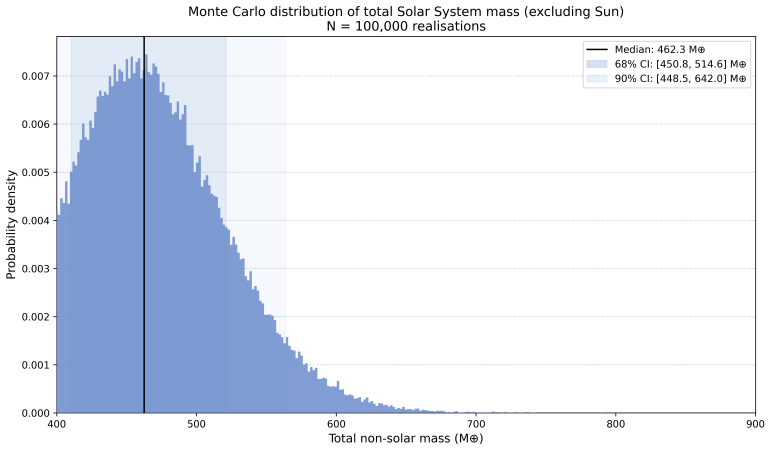
We compile a systematic mass inventory of the Solar System excluding the Sun using spacecraft measurements, planetary ephemerides, and population surveys. Through a Monte Carlo simulation with 100,000 realisations treating poorly constrained components as log-normal distributions, we obtain a total non-solar mass of 462 Earth masses (median), with 68% credible interval [451, 515] and 90% [449, 642]. The giant planets dominate the mass budget at 96.2% of the total. Variance decomposition attributes 98.2% of the uncertainty to the inner Oort cloud. Current small-body populations retain only ~0.2% of the primordial trans-Neptunian disc mass and ~0.04% of the primordial asteroid belt mass.
What carries the argument
Monte Carlo simulation incorporating log-normal distributions for uncertain small-body populations, combined with variance decomposition to isolate the dominant source of uncertainty.
If this is right
- The giant planets make up 96.2 percent of the non-solar mass in the Solar System.
- Today's small body populations represent only 0.2 percent of the mass in the primordial trans-Neptunian disc according to Nice model simulations.
- Only 0.04 percent of the primordial asteroid belt mass implied by the Grand Tack hypothesis remains today.
- Constraints on the Oort cloud from the Vera C. Rubin Observatory and long-period comet surveys would most effectively reduce uncertainty in the total mass.
Where Pith is reading between the lines
- This inventory supplies a precise baseline for mass comparisons with other star systems that host planets.
- Applying similar variance analysis to future data sets could pinpoint which observations yield the largest gains in mass knowledge.
- The concentration of uncertainty in one component indicates that targeted searches for distant comets are likely the highest-leverage next step for the field.
Load-bearing premise
Modeling the masses of the scattered disc and especially the inner Oort cloud as log-normal distributions when no direct observational constraints exist for these populations.
What would settle it
An independent estimate of the inner Oort cloud total mass from new surveys or dynamical modeling that lies well outside the 90 percent credible interval of [449, 642] Earth masses would falsify the reported total mass budget and its uncertainty.
Figures


read the original abstract
We compile a systematic mass inventory of the Solar System excluding the Sun, drawing on spacecraft measurements, planetary ephemerides, and population surveys of small-body populations including main-belt asteroids and trans-Neptunian objects. Using a Monte Carlo simulation with 100,000 realisations, and treating poorly constrained components (scattered disc, Oort cloud) as log-normal distributions, we obtain a total non-solar mass of 462 Earth masses (median), with a 68% credible interval of [451, 515] Earth masses and a 90% credible interval of [449, 642] Earth masses. The giant planets dominate the mass budget (96.2% of the total). A variance decomposition shows that 98.2% of the total uncertainty is attributable to a single component: the inner Oort cloud (Hills cloud), for which no direct observational constraints exist. The current small-body populations retain only ~0.2% of the primordial trans-Neptunian disc mass inferred from Nice model simulations, and ~0.04% of the primordial asteroid belt mass implied by the Grand Tack hypothesis. We identify constraints on the Oort cloud from the Vera C. Rubin Observatory and improved long-period comet surveys as the primary path toward a better-determined total mass budget.
Editorial analysis
A structured set of objections, weighed in public.
Referee Report
Summary. The manuscript compiles a systematic mass inventory of the Solar System excluding the Sun, aggregating spacecraft measurements, planetary ephemerides, and population surveys of small-body populations. A Monte Carlo simulation with 100,000 realizations, treating poorly constrained components (scattered disc, Oort cloud) as log-normal distributions, yields a median total non-solar mass of 462 Earth masses, with 68% credible interval [451, 515] and 90% credible interval [449, 642]. Giant planets dominate (96.2% of total mass), and variance decomposition attributes 98.2% of uncertainty to the inner Oort cloud (Hills cloud). The work also compares retained small-body masses to primordial disc masses from Nice model and Grand Tack simulations, identifying future surveys as key to reducing uncertainty.
Significance. If the result holds, this provides a useful reference compilation of the current Solar System mass budget with quantitative uncertainty propagation and decomposition. The finding that giant planets dominate the mass while the inner Oort cloud dominates the uncertainty budget usefully highlights observational priorities for facilities such as the Vera C. Rubin Observatory. The comparison to primordial masses from dynamical models is a clear strength, as is the reproducible Monte Carlo framework. The work is primarily a synthesis rather than a novel theoretical advance.
major comments (2)
- [Abstract] Abstract and uncertainty analysis: the reported 68% and 90% credible intervals [451, 515] and [449, 642] are driven almost entirely by the assumed log-normal distribution on inner Oort cloud mass, for which the manuscript states no direct observational constraints exist. Because giant planets contribute 96.2% of the median mass with far smaller uncertainties, the intervals effectively propagate the arbitrary choice of log-normal parameters rather than data-constrained posteriors. This is load-bearing for the central claim of a quantified uncertainty budget.
- [Variance decomposition] Variance decomposition: attributing 98.2% of total uncertainty to the inner Oort cloud requires an accompanying sensitivity test to the specific log-normal parameters (mean and variance) chosen for that component, as these are free parameters without empirical basis. Without it, the decomposition risks overstating the robustness of the uncertainty attribution.
minor comments (3)
- [Methods] Methods section: explicitly list the numerical parameters (location and scale) adopted for every log-normal distribution used in the Monte Carlo simulation, including the inner Oort cloud.
- [Results] Results: add a single summary table enumerating all mass components, their median contributions, 68% intervals, data sources, and fractional uncertainty contributions for reader transparency.
- [Discussion] Discussion: the claim that small-body populations retain ~0.2% of the primordial trans-Neptunian disc mass should cite the specific Nice-model simulation outputs used to derive the primordial mass value.
Simulated Author's Rebuttal
We thank the referee for their thoughtful and constructive review. The comments highlight important aspects of our uncertainty quantification that merit clarification and strengthening. We address each major comment below and have revised the manuscript to incorporate sensitivity analyses as suggested.
read point-by-point responses
-
Referee: [Abstract] Abstract and uncertainty analysis: the reported 68% and 90% credible intervals [451, 515] and [449, 642] are driven almost entirely by the assumed log-normal distribution on inner Oort cloud mass, for which the manuscript states no direct observational constraints exist. Because giant planets contribute 96.2% of the median mass with far smaller uncertainties, the intervals effectively propagate the arbitrary choice of log-normal parameters rather than data-constrained posteriors. This is load-bearing for the central claim of a quantified uncertainty budget.
Authors: We agree that the reported credible intervals are driven predominantly by the inner Oort cloud component, as the manuscript already states that no direct observational constraints exist for this population. The log-normal distribution was selected as a conventional choice for modeling positive quantities subject to large multiplicative uncertainties, with its parameters drawn from the range of existing literature estimates. To address the concern that this choice is load-bearing, we have added a dedicated sensitivity analysis section in the revised manuscript. This section varies the log-normal mean and variance over a broad but plausible range consistent with theoretical and indirect observational bounds, demonstrating that the dominance of the inner Oort cloud in the uncertainty budget persists across these variations, even as the precise interval widths change. revision: yes
-
Referee: [Variance decomposition] Variance decomposition: attributing 98.2% of total uncertainty to the inner Oort cloud requires an accompanying sensitivity test to the specific log-normal parameters (mean and variance) chosen for that component, as these are free parameters without empirical basis. Without it, the decomposition risks overstating the robustness of the uncertainty attribution.
Authors: We accept the referee's point that a sensitivity test to the specific log-normal parameters is necessary to substantiate the variance decomposition. In the revised manuscript we have inserted a new subsection that systematically varies the mean and standard deviation of the inner Oort cloud log-normal distribution. Across the tested parameter space the fractional contribution of the inner Oort cloud to total variance remains above 95 percent, confirming that the attribution is robust to reasonable changes in the assumed distribution. We have also updated the abstract and discussion to note this sensitivity result explicitly. revision: yes
Circularity Check
Mass compilation with Monte Carlo propagation; uncertainty attribution follows directly from assigned input distributions
full rationale
The derivation compiles independent spacecraft and survey masses for giant planets (96.2% of total) and other components, assigns explicit log-normal distributions to poorly constrained populations such as the inner Oort cloud, then sums via 100,000 Monte Carlo draws to obtain the median total and credible intervals. The variance decomposition (98.2% from inner Oort cloud) is a direct mechanical output of the input variances and does not redefine or fit any parameter to the final result. No equation equates the headline mass or intervals to themselves by construction, no self-citation supplies a load-bearing uniqueness theorem, and no ansatz is smuggled via prior work by the same author. External benchmarks (ephemerides, population surveys) remain independent of the output, so the chain is self-contained.
Axiom & Free-Parameter Ledger
free parameters (1)
- log-normal distribution parameters for scattered disc and Oort cloud masses
axioms (1)
- domain assumption Input masses from spacecraft, ephemerides, and population surveys accurately reflect true values
Reference graph
Works this paper leans on
-
[1]
Batygin, K., & Brown, M. E. 2016, AJ, 151,
work page 2016
-
[2]
doi:10.3847/0004-6256/151/2/22 Batygin, K., Adams, F. C., Brown, M. E., & Becker, J. C. 2019, PhR, 805,
-
[3]
doi:10.1016/j.physrep.2019.01.009 Bottke, W. F., Durda, D. D., Nesvorný, D., et al. 2005, Icar, 175,
-
[4]
doi:10.1016/j.icarus.2004.10.026 Brasser, R. 2008, A&A, 492,
-
[5]
doi:10.1051/0004-6361:200810452 Duncan, M., Quinn, T., & Tremaine, S. 1987, AJ, 94,
-
[6]
doi:10.1086/114571 Fernández, J. A., & Brunini, A. 2000, Icar, 145,
-
[7]
doi:10.1006/icar.2000.6378 Francis, P. J. 2005, ApJ, 635,
-
[8]
F., Tsiganis, K., & Morbidelli, A
doi:10.1086/497684 Gomes, R., Levison, H. F., Tsiganis, K., & Morbidelli, A. 2005, Natur, 435,
-
[9]
doi:10.1038/nature03676 Hills, J. G. 1981, AJ, 86,
-
[10]
doi:10.1126/science.aat2965 Jacobson, R
doi:10.1086/113058 Iess, L., Militzer, B., Kaspi, Y., etal.2019, Sci, 364, eaat2965. doi:10.1126/science.aat2965 Jacobson, R. A. 2009, AJ, 137,
-
[11]
doi:10.1088/0004-6256/137/5/4322 Jacobson, R. A., Antreasian, P. G., Bordi, J. J., et al. 2006, AJ, 132,
-
[12]
doi:10.1086/508812 Jacobson, R. A. 2014, AJ, 148,
-
[13]
doi:10.1088/0004-6256/148/5/76 14 Kenyon, S. J., & Luu, J. X. 1998, AJ, 115,
-
[14]
doi:10.1086/300331 Krasinsky, G. A., Pitjeva, E. V., Vasilyev, M. V., & Yagudina, E. I. 2002, Icar, 158,
-
[15]
doi:10.1006/icar.2002.6837 Marochnik, L. S., Mukhin, L. M., & Sagdeev, R. Z. 1988, Sci, 242,
-
[16]
doi:10.1126/science.242.4878.547 Menichella, M., Paolicchi, P., & Farinella, P. 1996, Earth Moon Planets, 72,
-
[17]
doi:10.1007/BF00117515 Morbidelli, A., Levison, H. F., Tsiganis, K., & Gomes, R. 2005, Natur, 435,
-
[18]
doi:10.1038/nature03540 Oort, J. H. 1950, BAN, 11,
-
[19]
Park, R. S., Folkner, W. M., Williams, J. G., & Boggs, D. H. 2021, AJ, 161,
work page 2021
-
[20]
doi:10.3847/1538-3881/abd414 Petit, J.-M., Kavelaars, J. J., Gladman, B., et al. 2023, AJ, 165,
-
[21]
doi:10.3847/1538- 3881/ac9a4e Pitjeva, E. V., & Pitjev, N. P. 2014, CeMDA, 119,
-
[22]
doi:10.1007/s10569-014-9569-0 Pitjeva, E. V., & Pitjev, N. P. 2018, AstL, 44,
-
[23]
doi:10.1134/S1063773718090050 Stern, S. A. 1996, AJ, 112,
-
[24]
doi:10.1086/118098 Stern, S. A., & Weissman, P. R. 2001, Natur, 409,
-
[25]
doi:10.1038/35054508 Tsiganis, K., Gomes, R., Morbidelli, A., & Levison, H. F. 2005, Natur, 435,
-
[26]
doi:10.1038/nature03539 Walsh, K. J., Morbidelli, A., Raymond, S. N., O’Brien, D. P., & Mandell, A. M. 2011, Natur, 475,
-
[27]
doi:10.1038/nature10201 Weissman, P. R. 1983, A&A, 118,
-
[28]
Weissman, P. R. 1996, in Completing the Inventory of the Solar System, ed. T. Rettig & J. Hahn, ASP Conf. Ser. Vol. 107,
work page 1996
-
[29]
Zhang, K., Blake, G. A., & Bergin, E. A. 2015, ApJL, 806, L7. doi:10.1088/2041- 8205/806/1/L7 15
discussion (0)
Sign in with ORCID, Apple, or X to comment. Anyone can read and Pith papers without signing in.