Simulations of a 2 x 1.5D coded aperture camera for X-ray astronomy
Pith reviewed 2026-05-15 08:42 UTC · model grok-4.3
The pith
Simulations show that two perpendicular 1.5D coded aperture cameras can locate and measure fluxes of X-ray transients such as novae and gamma-ray bursts.
A machine-rendered reading of the paper's core claim, the machinery that carries it, and where it could break.
Core claim
Simulations of the 2 x 1.5D coded aperture system demonstrate that IROS combined with cross correlation recovers the point-source configuration of the observed sky while the maximum likelihood method yields the most accurate source fluxes, with the fine resolution direction reaching roughly 5 arcmin and the coarse direction 5 degrees.
What carries the argument
The 1.5D coded aperture camera that uses a one-dimensional mask to produce fine angular resolution in one sky direction and coarse resolution in the perpendicular direction.
Load-bearing premise
The simulations assume that detector responses and front-end/back-end electronics processing can be modeled accurately enough that the synthetic data faithfully represent real on-orbit performance.
What would settle it
On-orbit data from a deployed WFM or similar coded-aperture instrument showing source localization or flux errors substantially larger than those obtained in the simulations.
Figures




read the original abstract
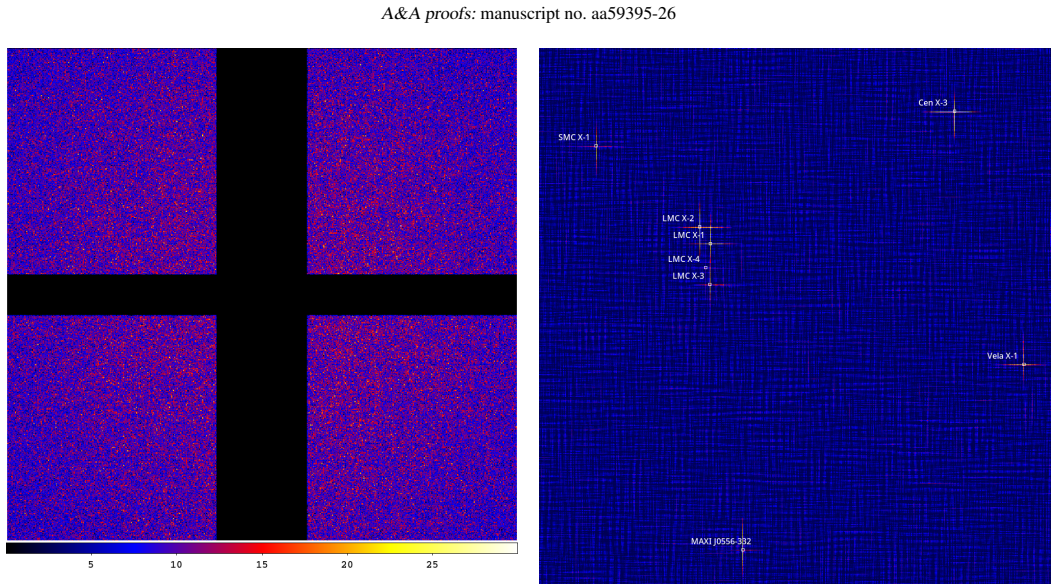
The concept of two perpendicular one-dimensional coded aperture cameras, necessitated by the imaging capability of the detector, finds its application in the design of the Wide Field Monitor (WFM). This instrument has the future goal to monitor the variable X-ray sky for transient activity. Characteristic of each camera is a fine angular resolution in one direction (typically 5 arcmin) and a coarse one in the other (5 degrees). The coarse perpendicular resolution makes the camera so-called '1.5D'. The WFM has been studied for a number of space-borne X-ray observatory concepts: LOFT, eXTP, Strobe-X, ARCO and now LEM-X. We here report on a study of two decoding algorithms for this instrument and its imaging performance. Detector responses to the X-ray sky are simulated, including the signal processing by the front-end and back-end electronics. The decoding algorithms are the iterative removal of sources (IROS), in combination with cross correlation, and the maximum likelihood method (MLM). IROS is most suited for the determination of the point source configuration of the observed sky and MLM for the optimum determination of the source fluxes. (..) the WFM is a high performance monitoring instrument with straightforward and proven technology that enables the identification of new cosmic X-ray sources, for instance X-ray novae, gamma-ray bursts and electromagnetic counterparts to gravitational wave events from merging compact objects, and the detection of unusual and interesting behavior of persistent cosmic X-ray sources, such as accretion disk state changes.
Editorial analysis
A structured set of objections, weighed in public.
Referee Report
Summary. The paper presents end-to-end simulations of a 2x1.5D coded aperture camera for the Wide Field Monitor (WFM) instrument concept, including detector responses and front-end/back-end electronics processing. It evaluates two standard decoding algorithms—IROS (with cross-correlation) for source configuration and MLM for flux estimation—on synthetic data, reporting ~5 arcmin localization in the fine axis and concluding that the WFM is a high-performance, straightforward monitoring instrument for transients such as X-ray novae, GRBs, and GW counterparts.
Significance. If the simulations accurately capture on-orbit performance, the work provides concrete support for the 2x1.5D WFM design in missions such as LEM-X. The forward-simulation approach combined with published algorithms (IROS, MLM) offers a reproducible framework for assessing imaging performance in one fine and one coarse axis, strengthening the case for this proven-technology concept in transient astronomy.
major comments (2)
- [Simulation methods] Simulation methods (as described in the abstract and methods): The performance claims for source localization, flux recovery, and transient detection rest on the assumption that the synthetic detector responses and electronics faithfully reproduce real conditions. No validation against laboratory prototypes, prior missions (LOFT/eXTP), or sensitivity tests to mismatches in background, mask alignment, or energy response is reported; any such mismatch would directly degrade the reported accuracies and undermine the 'proven technology' assertion.
- [Results on decoding algorithms] Results on decoding performance: While IROS is positioned for point-source configuration and MLM for optimum fluxes, the manuscript does not provide quantitative robustness metrics (e.g., recovery fractions, bias under varying background levels, or cross-checks between the two algorithms) that would allow independent assessment of whether the ~5 arcmin fine-axis resolution holds under realistic mismatches.
minor comments (1)
- [Abstract] Abstract: The phrasing 'two perpendicular one-dimensional coded aperture cameras' and the title's '2 x 1.5D' should be aligned for consistency; a brief parenthetical definition of the 1.5D terminology would aid readers.
Simulated Author's Rebuttal
We thank the referee for the constructive and detailed comments on our manuscript. We address each major comment below, indicating the revisions we will make to strengthen the presentation of our simulation results.
read point-by-point responses
-
Referee: [Simulation methods] Simulation methods (as described in the abstract and methods): The performance claims for source localization, flux recovery, and transient detection rest on the assumption that the synthetic detector responses and electronics faithfully reproduce real conditions. No validation against laboratory prototypes, prior missions (LOFT/eXTP), or sensitivity tests to mismatches in background, mask alignment, or energy response is reported; any such mismatch would directly degrade the reported accuracies and undermine the 'proven technology' assertion.
Authors: We agree that explicit discussion of model validation and sensitivity to mismatches is needed. The detector response and electronics models are taken from the detailed simulations and laboratory calibrations performed for the LOFT and eXTP mission studies (cited in the manuscript). In the revised manuscript we will add a dedicated subsection in the methods that (i) summarizes the heritage and prior validation of these models and (ii) presents a new sensitivity analysis quantifying the effect of plausible mismatches in background rate, mask alignment, and energy response on the reported 5-arcmin localization and flux recovery. This is a partial revision because a full end-to-end laboratory campaign with flight-like hardware lies outside the scope of the present simulation paper. revision: partial
-
Referee: [Results on decoding algorithms] Results on decoding performance: While IROS is positioned for point-source configuration and MLM for optimum fluxes, the manuscript does not provide quantitative robustness metrics (e.g., recovery fractions, bias under varying background levels, or cross-checks between the two algorithms) that would allow independent assessment of whether the ~5 arcmin fine-axis resolution holds under realistic mismatches.
Authors: We accept the referee's request for additional quantitative robustness metrics. In the revised manuscript we will include new simulation results that report (i) source recovery fractions as a function of background level, (ii) flux bias and localization scatter for both IROS and MLM, and (iii) direct cross-comparison of the two algorithms on the same data sets. These metrics will be presented in an expanded results section and will confirm that the 5-arcmin fine-axis performance remains stable under the range of background conditions expected for the WFM. revision: yes
Circularity Check
Forward simulation of detector responses with published decoding algorithms shows no circularity
full rationale
The paper generates synthetic detector data via forward modeling of a physical instrument (including front-end/back-end electronics) and then applies established, externally published decoding methods (IROS with cross-correlation and MLM). No central result reduces by construction to a fitted parameter or self-defined quantity from the same data; the cited prior instrument concepts and algorithms function as independent external inputs. This matches the default expectation of no significant circularity.
Axiom & Free-Parameter Ledger
free parameters (2)
- angular resolution (fine axis)
- angular resolution (coarse axis)
axioms (2)
- standard math Detector counts follow Poisson statistics after electronics processing
- domain assumption Mask pattern and detector geometry are perfectly known
Lean theorems connected to this paper
-
IndisputableMonolith/Foundation/RealityFromDistinctionreality_from_one_distinction unclear?
unclearRelation between the paper passage and the cited Recognition theorem.
Detector responses to the X-ray sky are simulated, including the signal processing by the front-end and back-end electronics. The decoding algorithms are the iterative removal of sources (IROS)... and the maximum likelihood method (MLM).
What do these tags mean?
- matches
- The paper's claim is directly supported by a theorem in the formal canon.
- supports
- The theorem supports part of the paper's argument, but the paper may add assumptions or extra steps.
- extends
- The paper goes beyond the formal theorem; the theorem is a base layer rather than the whole result.
- uses
- The paper appears to rely on the theorem as machinery.
- contradicts
- The paper's claim conflicts with a theorem or certificate in the canon.
- unclear
- Pith found a possible connection, but the passage is too broad, indirect, or ambiguous to say the theorem truly supports the claim.
Reference graph
Works this paper leans on
-
[1]
A., Ackermann, M., Ajello, M., et al
Abdo, A. A., Ackermann, M., Ajello, M., et al. 2009, ApJS, 183, 46
work page 2009
-
[2]
Ables, J. G. 1968, PASA, 1, 172
work page 1968
- [3]
-
[4]
Arnaud, K. A. 1996, in Astronomical Society of the Pacific Conference Series, V ol. 101, Astronomical Data Analysis Software and Systems V , ed. G. H. Jacoby & J. Barnes, 17
work page 1996
-
[5]
Barthelmy, S. D., Barbier, L. M., Cummings, J. R., et al. 2005, Space Sci. Rev., 120, 143
work page 2005
-
[6]
Baumert, L. D. 1971, Cyclic Difference Sets
work page 1971
- [7]
-
[8]
2014, in Society of Photo-Optical Instrumentation Engineers (SPIE) Conference Series, V ol
Brandt, S., Hernanz, M., Alvarez, L., et al. 2014, in Society of Photo-Optical Instrumentation Engineers (SPIE) Conference Series, V ol. 9144, Space Tele- scopes and Instrumentation 2014: Ultraviolet to Gamma Ray, ed. T. Taka- hashi, J.-W. A. den Herder, & M. Bautz, 91442V
work page 2014
-
[9]
1974, Journal of Applied Physics, 45, 1806
Brown, C. 1974, Journal of Applied Physics, 45, 1806
work page 1974
-
[10]
2012, in Society of Photo-Optical Instrumentation Engineers (SPIE) Conference Series, V ol
Campana, R., Feroci, M., Del Monte, E., et al. 2012, in Society of Photo-Optical Instrumentation Engineers (SPIE) Conference Series, V ol. 8443, Space Tele- scopes and Instrumentation 2012: Ultraviolet to Gamma Ray, ed. T. Taka- hashi, S. S. Murray, & J.-W. A. den Herder, 84435O
work page 2012
-
[11]
2011, Nuclear Instruments and Meth- ods in Physics Research A, 633, 22
Campana, R., Zampa, G., Feroci, M., et al. 2011, Nuclear Instruments and Meth- ods in Physics Research A, 633, 22
work page 2011
-
[12]
B., Di Cocco, G., Natalucci, L., & Spizzichino, A
Caroli, E., Stephen, J. B., Di Cocco, G., Natalucci, L., & Spizzichino, A. 1987, Space Sci. Rev., 45, 349
work page 1987
-
[13]
2024, in Society of Photo- Optical Instrumentation Engineers (SPIE) Conference Series, V ol
Ceraudo, F., Evangelista, Y ., Hernanz, M., et al. 2024, in Society of Photo- Optical Instrumentation Engineers (SPIE) Conference Series, V ol. 13093, Space Telescopes and Instrumentation 2024: Ultraviolet to Gamma Ray, ed. J.-W. A. den Herder, S. Nikzad, & K. Nakazawa, 130936T de Boer, H., Bennett, K., Bloemen, H., et al. 1992, in Data Analysis in Astron...
work page 2024
-
[14]
Dicke, R. H. 1968, ApJ, 153, L101
work page 1968
-
[15]
2012, in Society of Photo- Optical Instrumentation Engineers (SPIE) Conference Series, V ol
Donnarumma, I., Evangelista, Y ., Campana, R., et al. 2012, in Society of Photo- Optical Instrumentation Engineers (SPIE) Conference Series, V ol. 8443, Space Telescopes and Instrumentation 2012: Ultraviolet to Gamma Ray, ed. T. Takahashi, S. S. Murray, & J.-W. A. den Herder, 84435Q
work page 2012
-
[16]
Eadie, W. T., Drijard, D., & James, F. E. 1971, Statistical methods in experimen- tal physics, 231
work page 1971
-
[17]
2010, PhD thesis, Universitá Degli Studi Di Roma ’La Sapienza’
Evangelista, Y . 2010, PhD thesis, Universitá Degli Studi Di Roma ’La Sapienza’
work page 2010
-
[18]
Falcone, A. D., Colosimo, J. M., Wages, M., et al. 2024, in Society of Photo- Optical Instrumentation Engineers (SPIE) Conference Series, V ol. 13093, Space Telescopes and Instrumentation 2024: Ultraviolet to Gamma Ray, ed. J.-W. A. den Herder, S. Nikzad, & K. Nakazawa, 1309317
work page 2024
-
[19]
Fenimore, E. E. & Cannon, T. M. 1978, Appl. Opt., 17, 337
work page 1978
-
[20]
Fenimore, E. E. & Cannon, T. M. 1981, Appl. Opt., 20, 1858
work page 1981
- [21]
-
[22]
2012, Experimental Astronomy, 34, 415
Feroci, M., Stella, L., van der Klis, M., et al. 2012, Experimental Astronomy, 34, 415
work page 2012
-
[23]
2024, in Society of Photo-Optical In- strumentation Engineers (SPIE) Conference Series, V ol
Givaudan, A., Bégoc, S., Bertoli, W., et al. 2024, in Society of Photo-Optical In- strumentation Engineers (SPIE) Conference Series, V ol. 13093, Space Tele- scopes and Instrumentation 2024: Ultraviolet to Gamma Ray, ed. J.-W. A. den
work page 2024
- [24]
- [25]
-
[26]
Gottesman, S. R. & Fenimore, E. E. 1989, Appl. Opt., 28, 4344
work page 1989
-
[27]
1986, PhD thesis, University of Birmingham
Hammersley, A. 1986, PhD thesis, University of Birmingham
work page 1986
-
[28]
1992, Nuclear Instruments and Methods in Physics Research A, 311, 585
Hammersley, A., Ponman, T., & Skinner, G. 1992, Nuclear Instruments and Methods in Physics Research A, 311, 585
work page 1992
-
[29]
2018, in Society of Photo-Optical In- strumentation Engineers (SPIE) Conference Series, V ol
Hernanz, M., Brandt, S., Feroci, M., et al. 2018, in Society of Photo-Optical In- strumentation Engineers (SPIE) Conference Series, V ol. 10699, Space Tele- scopes and Instrumentation 2018: Ultraviolet to Gamma Ray, ed. J.-W. A. den
work page 2018
-
[30]
2022, in Society of Photo-Optical Instrumentation Engineers (SPIE) Conference Series, V ol
Hernanz, M., Brandt, S., in’t Zand, J., et al. 2022, in Society of Photo-Optical Instrumentation Engineers (SPIE) Conference Series, V ol. 12181, Space Tele- scopes and Instrumentation 2022: Ultraviolet to Gamma Ray, ed. J.-W. A. den
work page 2022
-
[31]
2024, in Society of Photo-Optical Instrumentation Engineers (SPIE) Conference Series, V ol
Hernanz, M., Feroci, M., Evangelista, Y ., et al. 2024, in Society of Photo-Optical Instrumentation Engineers (SPIE) Conference Series, V ol. 13093, Space Tele- scopes and Instrumentation 2024: Ultraviolet to Gamma Ray, ed. J.-W. A. den
work page 2024
-
[32]
Herder, S. Nikzad, & K. Nakazawa, 130931Y Högbom, J. A. 1974, A&AS, 15, 417 in ’t Zand, J. J. M. 1992, PhD thesis, Netherlands Institute for Space Research in ’t Zand, J. J. M., Heise, J., & Jager, R. 1994, A&A, 288, 665 in ’t Zand, J. J. M., Kuiper, L., Amati, L., et al. 2000, ApJ, 545, 266
work page 1974
- [33]
-
[34]
Kalemci, E., Kara, E., & Tomsick, J. A. 2022, in Handbook of X-ray and Gamma-ray Astrophysics, ed. C. Bambi & A. Sangangelo, 9
work page 2022
-
[35]
Kirsch, M. G., Briel, U. G., Burrows, D., et al. 2005, in Society of Photo-Optical Instrumentation Engineers (SPIE) Conference Series, V ol. 5898, UV , X-Ray, and Gamma-Ray Space Instrumentation for Astronomy XIV , ed. O. H. W. Siegmund, 22–33
work page 2005
- [36]
-
[37]
Levine, A. M., Bradt, H., Cui, W., et al. 1996, ApJ, 469, L33
work page 1996
-
[38]
Levine, A. M., Bradt, H., Morgan, E. H., Remillard, R., & MIT/GSFC ASM Team. 2006, Advances in Space Research, 38, 2970
work page 2006
-
[39]
Levine, A. M., Bradt, H. V ., Chakrabarty, D., Corbet, R. H. D., & Harris, R. J. 2011, ApJS, 196, 6
work page 2011
- [40]
- [41]
-
[42]
Mattox, J. R., Bertsch, D. L., Chiang, J., et al. 1996, ApJ, 461, 396 Meißner, T., Rozhkov, V ., Hesser, J., Nahm, W., & Loew, N. 2023, Journal of Instrumentation, 18, P01006
work page 1996
-
[43]
Nottingham, M. R. 1993, PhD thesis, University of Birmingham
work page 1993
-
[44]
Palmieri, T. M. 1974, Ap&SS, 28, 277
work page 1974
-
[45]
Pollock, A. M. T., Bignami, G. F., Hermsen, W., et al. 1981, A&A, 94, 116
work page 1981
-
[46]
Ray, P. S., Roming, P. W. A., Argan, A., et al. 2024, Journal of Astronomical
work page 2024
-
[47]
Remillard, R. A., Hernanz, M., Zand, J. i., et al. 2024, Journal of Astronomical
work page 2024
-
[48]
Rideout, R. M. 1995, PhD thesis, University of Birmingham
work page 1995
-
[49]
Rideout, R. M. & Skinner, G. K. 1996, A&AS, 120, 579
work page 1996
-
[50]
Sims, M., Turner, M. J. L., & Willingale, R. 1980, Space Science Instrumenta- tion, 5, 109
work page 1980
-
[51]
Skinner, G. K. 2008, Appl. Opt., 47, 2739
work page 2008
-
[52]
Skinner, G. K. & Nottingham, M. R. 1993, Nuclear Instruments and Methods in Physics Research A, 333, 540
work page 1993
-
[53]
Tamagawa, T., Enoto, T., Kitaguchi, T., et al. 2025, PASJ, 77, 466
work page 2025
- [54]
-
[55]
Verner, D. A., Ferland, G. J., Korista, K. T., & Yakovlev, D. G. 1996, ApJ, 465, 487
work page 1996
-
[56]
Verner, D. A. & Yakovlev, D. G. 1995, A&AS, 109, 125
work page 1995
-
[57]
Verrecchia, F., in’t Zand, J. J. M., Giommi, P., et al. 2007, A&A, 472, 705
work page 2007
-
[58]
Wilks, S. S. 1938, Annals of Mathematical Statistics, 9, 60
work page 1938
- [59]
-
[60]
2022, in Handbook of X-ray and Gamma-ray Astrophysics, ed
Yuan, W., Zhang, C., Chen, Y ., & Ling, Z. 2022, in Handbook of X-ray and Gamma-ray Astrophysics, ed. C. Bambi & A. Sangangelo, 86
work page 2022
- [61]
-
[62]
2019, Science China Physics, Me- chanics, and Astronomy, 62, 29502
Zhang, S., Santangelo, A., Feroci, M., et al. 2019, Science China Physics, Me- chanics, and Astronomy, 62, 29502
work page 2019
-
[63]
Zwart, F., Tacken, R., in’t Zand, J. J. M., et al. 2022, in Society of Photo-Optical Instrumentation Engineers (SPIE) Conference Series, V ol. 12181, Space Tele- scopes and Instrumentation 2022: Ultraviolet to Gamma Ray, ed. J.-W. A. den
work page 2022
-
[64]
Herder, S. Nikzad, & K. Nakazawa, 1218167 Article number, page 12 J.J.M. in ‘t Zand et al.: Simulations of a 2×1.5D coded aperture camera for X-ray astronomy Appendix A: MLM on GC field MLM can be employed to generate images. An example is shows in Fig. A.1, for part of the GC sky image. For this exercise, GX 5-1 was included in H0 and the image was gener...
work page 2000
discussion (0)
Sign in with ORCID, Apple, or X to comment. Anyone can read and Pith papers without signing in.