Recognition: 1 theorem link
· Lean TheoremObservational Signatures of Rotating Ay\'{o}n-Beato-Garc\'{i}a Black Holes: Shadows, Accretion Disks and Images
Pith reviewed 2026-05-15 08:28 UTC · model grok-4.3
The pith
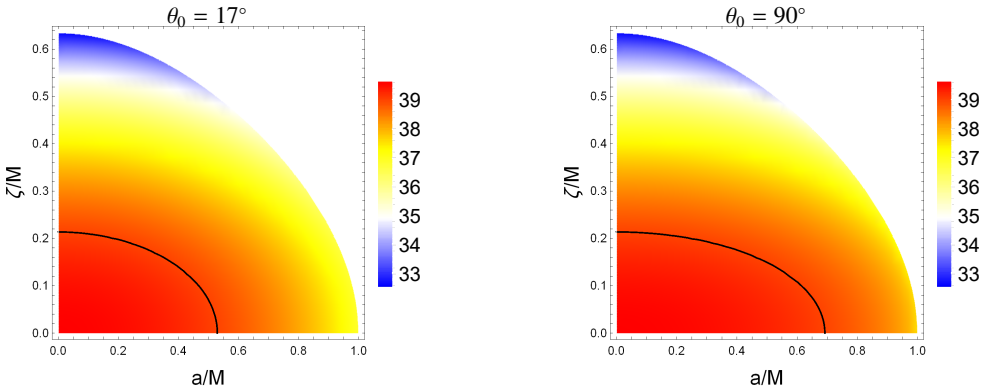
Rotating Ayón-Beato-García black holes have their charge parameter constrained to 0.132811M < ζ < 0.213607M by matching shadow sizes to EHT data for M87* and Sgr A*.
A machine-rendered reading of the paper's core claim, the machinery that carries it, and where it could break.
Core claim
The central claim is that theoretical shadow diameters computed from the rotating Ayón-Beato-García metric, when compared with EHT observations of M87* and Sgr A* at inclinations of 17°, 50°, and 90°, restrict the allowed charge to the interval 0.132811 M < ζ < 0.213607 M. The analysis extends the accretion disk inner edge to the event horizon, treats orbital dynamics differently inside and outside the ISCO, and shows that shadow size decreases with ζ while near-extremal spin yields a D-shaped morphology.
What carries the argument
The shadow diameter computed from the photon orbits in the rotating Ayón-Beato-García metric, used as the observable that directly constrains the charge parameter ζ against EHT data.
If this is right
- Shadow size decreases monotonically as the charge parameter ζ increases.
- Near-extremal spin a = 0.95 produces a D-shaped shadow rather than a circular one.
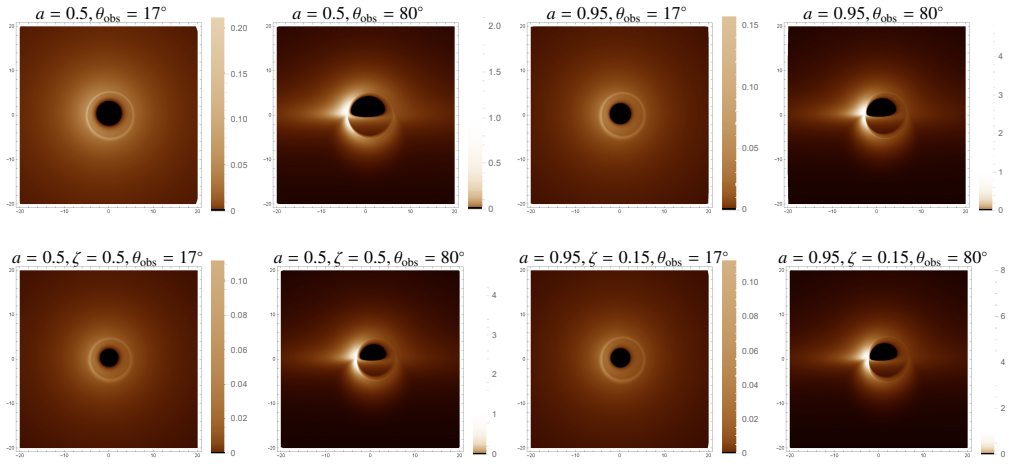
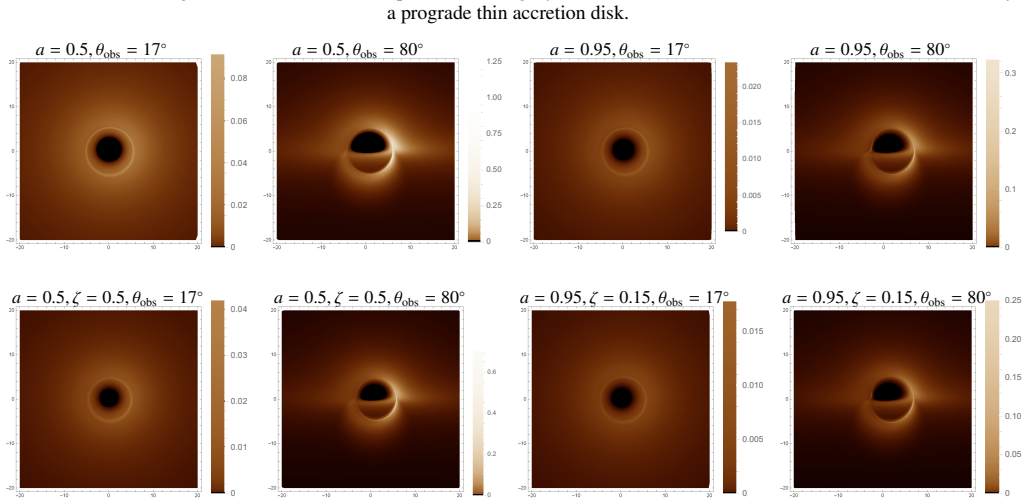
- At higher observer inclinations the direct and lensed images of the accretion disk separate and form a hat-like structure.
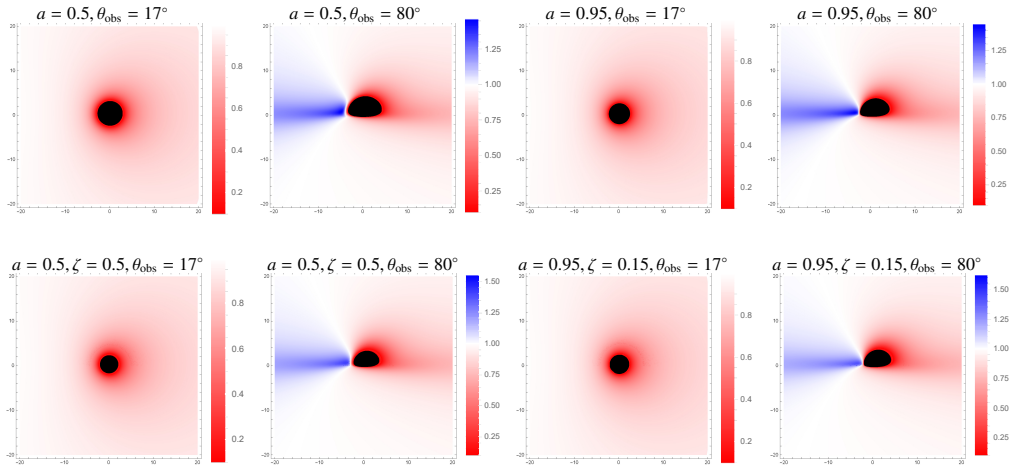
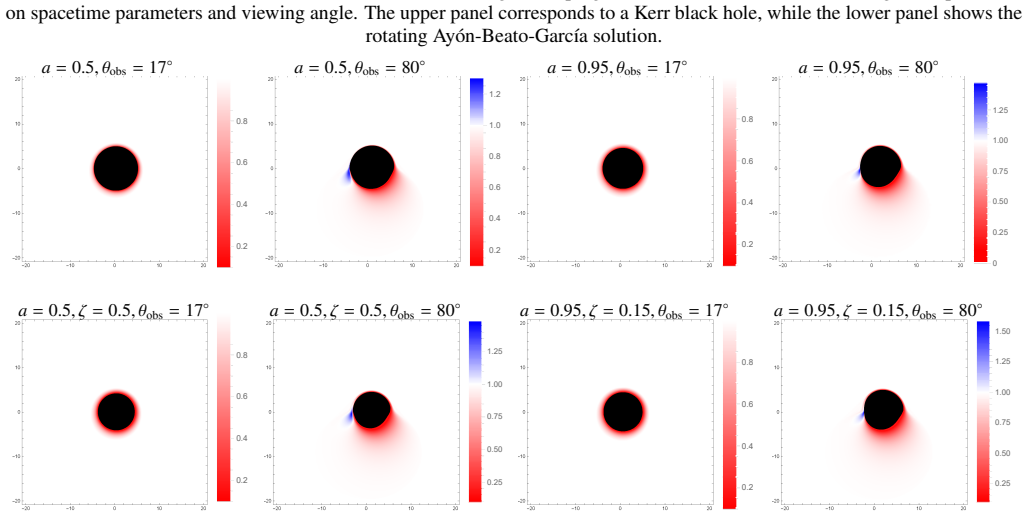
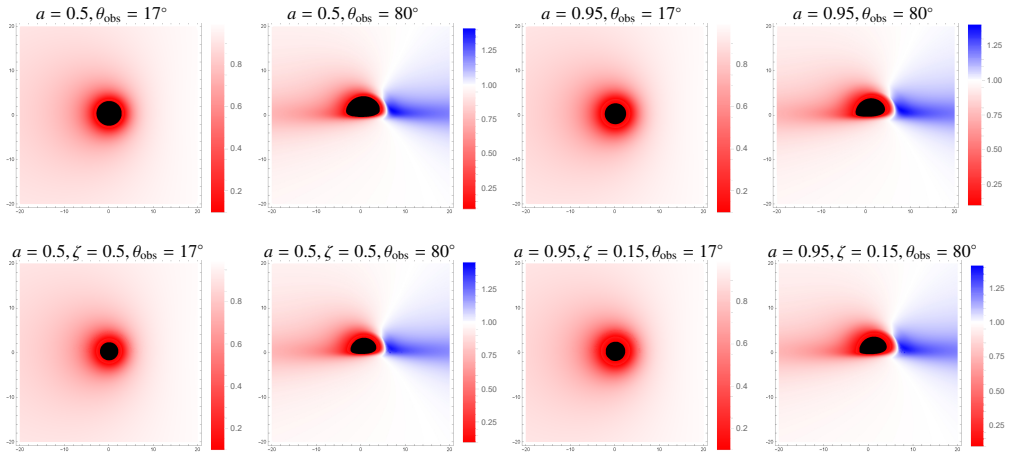
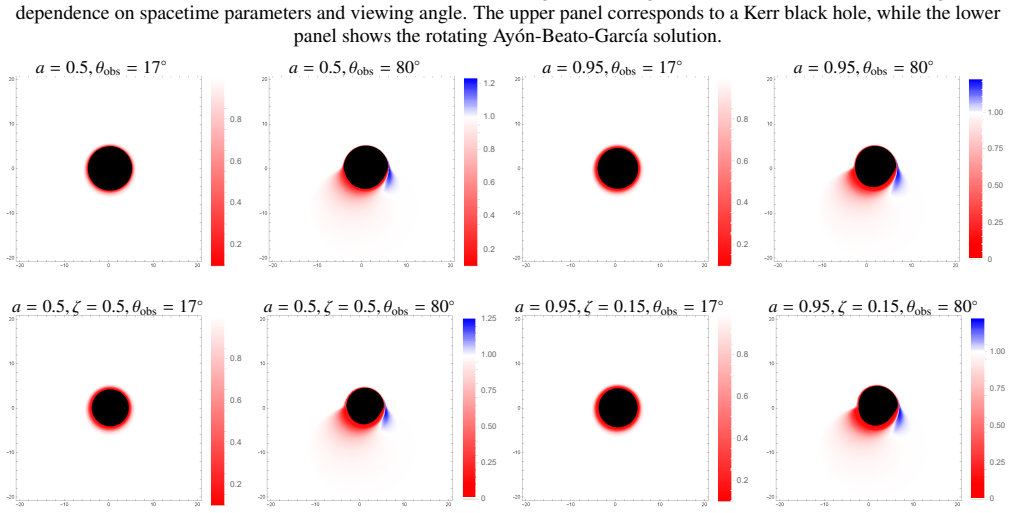
- Redshift distributions of the disk emission vary systematically with spin, charge, and viewing angle.
- The same ζ interval remains consistent when the same shadow-diameter comparison is applied to both M87* and Sgr A*.
Where Pith is reading between the lines
- Future higher-resolution imaging could tighten the ζ interval or reveal whether the D-shaped morphology is detectable.
- The bound on ζ offers a concrete target for testing whether modified-gravity black-hole solutions can remain compatible with existing EHT data.
- Refining the inner-disk model or relaxing the fixed-inclination assumption would show how sensitive the reported interval is to those modeling choices.
- Similar shadow-diameter comparisons could be performed on other rotating black-hole solutions to produce comparable observational limits.
Load-bearing premise
The analysis assumes specific observer inclination angles and a particular accretion-disk model that extends the inner edge to the event horizon while treating particle dynamics differently inside and outside the ISCO.
What would settle it
A new measurement of the shadow diameter for either M87* or Sgr A* that lies outside the range predicted for ζ values between 0.132811M and 0.213607M at the tested inclinations would falsify the reported bound.
Figures




read the original abstract
We investigate the shadows, accretion disks, and observational images of rotating Ay\'{o}n-Beato-Garc\'{i}a black holes characterized by mass $ M $ , spin $ a $ , and electric charge $ \zeta $ . Our analysis reveals that the shadow size decreases with increasing $ \zeta $, and in near-extremal configurations (e.g., $ a = 0.95 $), the shadow adopts a distinctive ``D''-shaped morphology. For the accretion disk, we extend its inner edge to the event horizon and account for distinct particle dynamics inside and outside the innermost stable circular orbit (ISCO). We find that the correlation between $ (a, \zeta) $ and the observer's inclination angle significantly influences image asymmetry and inner shadow distortion. At higher inclinations, the direct and lensed images separate, forming a hat-like structure. Additionally, we compute the redshift distribution of the disk's direct and lensed emissions under varying parameters and viewing angles. By comparing theoretical shadow diameters with the Event Horizon Telescope observations of M87 $^{*}$ and Sgr A $^{*}$--using inclination angles of $17^{\circ} $, $ 50^{\circ} $, and $ 90^{\circ} $--we constrain the viable parameter space, yielding the joint bound $0.132811\,M < \zeta < 0.213607\,M$ consistent with both sources.
Editorial analysis
A structured set of objections, weighed in public.
Referee Report
Summary. The paper investigates the shadows, accretion disks, and observational images of rotating Ayón-Beato-García black holes parameterized by mass M, spin a, and charge ζ. It reports that shadow size decreases with increasing ζ, with near-extremal cases (a ≈ 0.95) producing D-shaped silhouettes; models the accretion disk extending inward to the event horizon while treating particle dynamics differently inside versus outside the ISCO; computes redshift distributions for direct and lensed emission; and derives the joint constraint 0.132811 M < ζ < 0.213607 M by matching theoretical shadow diameters to EHT ring sizes for M87* and Sgr A* at the three discrete inclinations 17°, 50°, and 90°.
Significance. If the shadow-diameter calculations are robust, the derived interval supplies a concrete observational bound on the charge parameter of this non-Kerr solution, offering a potential test of modified gravity. The inclusion of inclination-dependent image asymmetry, inner-shadow distortion, and redshift maps strengthens the link to EHT-style observables. The absence of reported numerical uncertainties or validation against known limits (e.g., ζ = 0 recovery of Kerr) limits the immediate utility of the quoted interval.
major comments (2)
- [Abstract] Abstract (and the section presenting the joint bound): the interval 0.132811 M < ζ < 0.213607 M is obtained by direct comparison of theoretical shadow diameters with EHT measurements at fixed inclinations 17°/50°/90°; no derivative ∂(diameter)/∂i or repeat calculation at neighboring angles (especially 30°–80° for Sgr A*) is reported, so the quoted intersection is tied to an untested choice whose variation can shift the allowed range.
- [Accretion disk analysis] The accretion-disk modeling section: the inner edge is extended to the event horizon with distinct dynamics inside versus outside the ISCO; this choice directly affects the lensed-image and redshift calculations that support the overall observational signatures, yet no comparison to standard thin-disk truncation at the ISCO is provided to justify the extension.
minor comments (2)
- [Abstract] The abstract states the final numerical bound to six decimal places without accompanying error bars or convergence tests; adding these would improve verifiability.
- [Figures] Figure captions and text should explicitly label the observer inclinations used for each panel when displaying the hat-like structures at high i.
Simulated Author's Rebuttal
We thank the referee for the careful review and constructive comments on our manuscript. We address each major comment below and will revise the paper to incorporate the suggested improvements.
read point-by-point responses
-
Referee: [Abstract] Abstract (and the section presenting the joint bound): the interval 0.132811 M < ζ < 0.213607 M is obtained by direct comparison of theoretical shadow diameters with EHT measurements at fixed inclinations 17°/50°/90°; no derivative ∂(diameter)/∂i or repeat calculation at neighboring angles (especially 30°–80° for Sgr A*) is reported, so the quoted intersection is tied to an untested choice whose variation can shift the allowed range.
Authors: The inclinations 17°, 50°, and 90° are the standard values adopted in the EHT literature for M87* and Sgr A*. The joint bound represents the intersection of the allowed ζ intervals consistent with both sources at these angles. We acknowledge that the result would be more robust with an explicit sensitivity analysis. In the revised manuscript we will add calculations at intermediate inclinations (30°, 60°, 80°) and include a brief discussion of how the ζ range varies with inclination, together with a short error estimate derived from the spread across these angles. revision: yes
-
Referee: [Accretion disk analysis] The accretion-disk modeling section: the inner edge is extended to the event horizon with distinct dynamics inside versus outside the ISCO; this choice directly affects the lensed-image and redshift calculations that support the overall observational signatures, yet no comparison to standard thin-disk truncation at the ISCO is provided to justify the extension.
Authors: Extending the disk to the horizon allows us to include emission from plunging orbits, which is relevant for the strong-field images and redshift maps in this non-Kerr spacetime. We treat the dynamics differently inside and outside the ISCO to reflect the change from stable circular motion to free-fall. We agree that a side-by-side comparison with the conventional ISCO truncation would clarify the impact of this choice. We will add a dedicated paragraph (and, if space permits, a supplementary figure) contrasting the two truncations and their effects on the lensed images and redshift distributions. revision: yes
Circularity Check
No circularity: shadow-diameter bounds obtained from independent EHT data
full rationale
The paper computes theoretical shadow diameters and morphologies directly from the rotating Ayón-Beato-García metric (via null geodesics) for given (M, a, ζ) and observer inclinations. It then intersects the resulting allowed (a, ζ) regions with the external EHT-measured ring diameters of M87* and Sgr A*. This comparison uses independent observational inputs rather than fitting the model to itself or renaming a fitted parameter as a prediction. No self-citation chain, self-definitional loop, or ansatz smuggling is present in the derivation; the bound 0.132811 M < ζ < 0.213607 M is an external constraint, not a tautology. The choice of discrete inclinations is an assumption whose robustness is debatable but does not constitute circularity under the defined criteria.
Axiom & Free-Parameter Ledger
free parameters (1)
- ζ
axioms (2)
- domain assumption The Ayón-Beato-García metric with rotation parameter a is a valid solution of the Einstein equations with nonlinear electrodynamics.
- standard math Ray tracing of null geodesics accurately reproduces the observed shadow boundary.
Lean theorems connected to this paper
-
IndisputableMonolith/Foundation/RealityFromDistinction.leanreality_from_one_distinction unclear?
unclearRelation between the paper passage and the cited Recognition theorem.
We investigate the shadows, accretion disks, and observational images of rotating Ayón-Beato-García black holes characterized by mass M, spin a, and electric charge ζ... yielding the joint bound 0.132811 M < ζ < 0.213607 M
What do these tags mean?
- matches
- The paper's claim is directly supported by a theorem in the formal canon.
- supports
- The theorem supports part of the paper's argument, but the paper may add assumptions or extra steps.
- extends
- The paper goes beyond the formal theorem; the theorem is a base layer rather than the whole result.
- uses
- The paper appears to rely on the theorem as machinery.
- contradicts
- The paper's claim conflicts with a theorem or certificate in the canon.
- unclear
- Pith found a possible connection, but the passage is too broad, indirect, or ambiguous to say the theorem truly supports the claim.
Reference graph
Works this paper leans on
-
[1]
B. P. Abbottet al.[LIGO Scientific and Virgo], Observation of Gravitational Waves from a Binary Black Hole Merger, Phys. Rev. Lett.116, no.6, 061102 (2016), [arXiv:1602.03837 [gr- qc]]
work page internal anchor Pith review Pith/arXiv arXiv 2016
-
[2]
First M87 Event Horizon Telescope Results. I. The Shadow of the Supermassive Black Hole
K. Akiyamaet al.[Event Horizon Telescope], First M87 Event Horizon Telescope Results. I. The Shadow of the Su- permassive Black Hole, Astrophys. J. Lett.875, L1 (2019), [arXiv:1906.11238 [astro-ph.GA]]
work page internal anchor Pith review Pith/arXiv arXiv 2019
-
[3]
First M87 Event Horizon Telescope Results. II. Array and Instrumentation
K. Akiyamaet al.[Event Horizon Telescope], First M87 Event Horizon Telescope Results. II. Array and Instrumentation, As- 11 trophys. J. Lett.875, no.1, L2 (2019), [arXiv:1906.11239 [astro-ph.IM]]
work page internal anchor Pith review Pith/arXiv arXiv 2019
-
[4]
First M87 Event Horizon Telescope Results. III. Data Processing and Calibration
K. Akiyamaet al.[Event Horizon Telescope], First M87 Event Horizon Telescope Results. III. Data Processing and Calibration, Astrophys. J. Lett.875, no.1, L3 (2019), [arXiv:1906.11240 [astro-ph.GA]]
work page internal anchor Pith review Pith/arXiv arXiv 2019
-
[5]
First M87 Event Horizon Telescope Results. IV. Imaging the Central Supermassive Black Hole
K. Akiyamaet al.[Event Horizon Telescope], First M87 Event Horizon Telescope Results. IV . Imaging the Central Supermas- sive Black Hole, Astrophys. J. Lett.875, no.1, L4 (2019), [arXiv:1906.11241 [astro-ph.GA]]
work page internal anchor Pith review Pith/arXiv arXiv 2019
-
[6]
First M87 Event Horizon Telescope Results. V. Physical Origin of the Asymmetric Ring
K. Akiyamaet al.[Event Horizon Telescope], First M87 Event Horizon Telescope Results. V . Physical Origin of the Asymmetric Ring, Astrophys. J. Lett.875, no.1, L5 (2019), [arXiv:1906.11242 [astro-ph.GA]]
work page internal anchor Pith review Pith/arXiv arXiv 2019
-
[7]
First M87 Event Horizon Telescope Results. VI. The Shadow and Mass of the Central Black Hole
K. Akiyamaet al.[Event Horizon Telescope], First M87 Event Horizon Telescope Results. VI. The Shadow and Mass of the Central Black Hole, Astrophys. J. Lett.875, no.1, L6 (2019), [arXiv:1906.11243 [astro-ph.GA]]
work page internal anchor Pith review Pith/arXiv arXiv 2019
-
[8]
K. Akiyamaet al.[Event Horizon Telescope], First Sagittarius A* Event Horizon Telescope Results. I. The Shadow of the Su- permassive Black Hole in the Center of the Milky Way, Astro- phys. J. Lett.930, no.2, L12 (2022), [arXiv:2311.08680 [astro- ph.HE]]
work page internal anchor Pith review Pith/arXiv arXiv 2022
-
[9]
Akiyamaet al.[Event Horizon Telescope], First Sagittarius A* Event Horizon Telescope Results
K. Akiyamaet al.[Event Horizon Telescope], First Sagittarius A* Event Horizon Telescope Results. II. EHT and Multiwave- length Observations, Data Processing, and Calibration, Astro- phys. J. Lett.930, no.2, L13 (2022), [arXiv:2311.08679 [astro- ph.HE]]
-
[10]
Akiyamaet al.[Event Horizon Telescope], First Sagittar- ius A* Event Horizon Telescope Results
K. Akiyamaet al.[Event Horizon Telescope], First Sagittar- ius A* Event Horizon Telescope Results. III. Imaging of the Galactic Center Supermassive Black Hole, Astrophys. J. Lett. 930, no.2, L14 (2022), [arXiv:2311.09479 [astro-ph.HE]]
-
[11]
Akiyamaet al.[Event Horizon Telescope], First Sagittarius A* Event Horizon Telescope Results
K. Akiyamaet al.[Event Horizon Telescope], First Sagittarius A* Event Horizon Telescope Results. IV . Variability, Morphol- ogy, and Black Hole Mass, Astrophys. J. Lett.930, no.2, L15 (2022), [arXiv:2311.08697 [astro-ph.HE]]
-
[12]
Akiyamaet al.[Event Horizon Telescope], First Sagittarius A* Event Horizon Telescope Results
K. Akiyamaet al.[Event Horizon Telescope], First Sagittarius A* Event Horizon Telescope Results. V . Testing Astrophysical Models of the Galactic Center Black Hole, Astrophys. J. Lett. 930, no.2, L16 (2022), [arXiv:2311.09478 [astro-ph.HE]]
-
[13]
Akiyamaet al.(Event Horizon Telescope), First Sagit- tarius A* Event Horizon Telescope Results
K. Akiyamaet al.[Event Horizon Telescope], First Sagit- tarius A* Event Horizon Telescope Results. VI. Testing the Black Hole Metric, Astrophys. J. Lett.930, no.2, L17 (2022), [arXiv:2311.09484 [astro-ph.HE]]
- [15]
-
[16]
J. M. Bardeen, Timelike and null geodesics in the Kerr metric, inProceedings, Ecole d’Et´ e de Physique Th´ eorique: Les As- tres Occlus : Les Houches, France, August, 1972, pp. 215-240 (1973)
work page 1972
- [17]
-
[18]
Y . Guo and Y .-G. Miao, Charged black-bounce spacetimes: Photon rings, shadows and observational appearances, Nucl. Phys. B983, 115938 (2022), [arXiv:2112.01747 [gr-qc]]
-
[19]
M. Heydari-Fard, M. Heydari-Fard and H. R. Sepangi, Null geodesics and shadow of hairy black holes in Einstein- Maxwell-dilaton gravity, Phys. Rev. D105, 124009 (2022), [arXiv:2110.02713 [gr-qc]]
- [20]
-
[21]
Shadow of rotating regular black holes
A. Abdujabbarov, M. Amir, B. Ahmedov and S. G. Ghosh, Shadow of rotating regular black holes, Phys. Rev. D93, no.10, 104004 (2016), [arXiv:1604.03809 [gr-qc]]
work page internal anchor Pith review Pith/arXiv arXiv 2016
-
[22]
Shapes of rotating nonsingular black hole shadows
M. Amir and S. G. Ghosh, Shapes of rotating nonsingular black hole shadows, Phys. Rev. D94, no.2, 024054 (2016), [arXiv:1603.06382 [gr-qc]]
work page internal anchor Pith review Pith/arXiv arXiv 2016
-
[23]
Shadow of a Charged Rotating Non-Commutative Black Hole
M. Sharif and S. Iftikhar, Shadow of a Charged Rotating Non- Commutative Black Hole, Eur. Phys. J. C76, no.11, 630 (2016), [arXiv:1611.00611 [gr-qc]]
work page internal anchor Pith review Pith/arXiv arXiv 2016
-
[24]
S. W. Wei and Y . X. Liu, Observing the shadow of Einstein- Maxwell-Dilaton-Axion black hole, JCAP11, 063 (2013), [arXiv:1311.4251 [gr-qc]]
work page internal anchor Pith review Pith/arXiv arXiv 2013
-
[25]
Shadow of Kerr-Taub-NUT black hole
A. Abdujabbarov, F. Atamurotov, Y . Kucukakca, B. Ahme- dov and U. Camci, Shadow of Kerr-Taub-NUT black hole, Astrophys. Space Sci.344, 429-435 (2013), [arXiv:1212.4949 [physics.gen-ph]]
work page internal anchor Pith review Pith/arXiv arXiv 2013
- [26]
-
[27]
Shadow of a Kaluza-Klein rotating dilaton black hole
L. Amarilla and E. F. Eiroa, Shadow of a Kaluza-Klein rotat- ing dilaton black hole, Phys. Rev. D87, no.4, 044057 (2013), [arXiv:1301.0532 [gr-qc]]
work page internal anchor Pith review Pith/arXiv arXiv 2013
-
[28]
F. Atamurotov, A. Abdujabbarov and B. Ahmedov, Shadow of rotating non-Kerr black hole, Phys. Rev. D88, no.6, 064004 (2013)
work page 2013
-
[29]
A. K. Mishra, S. Chakraborty and S. Sarkar, Understand- ing photon sphere and black hole shadow in dynamically evolving spacetimes, Phys. Rev. D99, no.10, 104080 (2019), [arXiv:1903.06376 [gr-qc]]
work page internal anchor Pith review Pith/arXiv arXiv 2019
-
[30]
F. Sarikulov, F. Atamurotov, A. Abdujabbarov and B. Ahmedov, Shadow of the Kerr-like black hole, Eur. Phys. J. C82, no.9, 771 (2022)
work page 2022
-
[31]
Shadow of five-dimensional rotating Myers-Perry black hole
U. Papnoi, F. Atamurotov, S. G. Ghosh and B. Ahmedov, Shadow of five-dimensional rotating Myers-Perry black hole, Phys. Rev. D90, no.2, 024073 (2014), [arXiv:1407.0834 [gr- qc]]
work page internal anchor Pith review Pith/arXiv arXiv 2014
-
[32]
A. Abdujabbarov, F. Atamurotov, N. Dadhich, B. Ahmedov and Z. Stuchl´ık, Energetics and optical properties of 6-dimensional rotating black hole in pure Gauss–Bonnet gravity, Eur. Phys. J. C75, no.8, 399 (2015), [arXiv:1508.00331 [gr-qc]]
work page internal anchor Pith review Pith/arXiv arXiv 2015
-
[33]
R. A. Konoplya, Shadow of a black hole surrounded by dark matter, Phys. Lett. B795, 1–6 (2019), [arXiv:1905.00064 [gr- qc]]
work page internal anchor Pith review Pith/arXiv arXiv 2019
-
[34]
K. Jusufi, M. Azreg-A ¨ınou, M. Jamil, S.-W. Wei, Q. Wu and A. Wang, Quasinormal modes, quasiperiodic oscillations, and the shadow of rotating regular black holes in nonminimally coupled Einstein-Yang-Mills theory, Phys. Rev. D103, 024013 (2021), [arXiv:2008.08450 [gr-qc]]
- [35]
- [36]
-
[37]
Hot Accretion Flows Around Black Holes
F. Yuan and R. Narayan, Hot Accretion Flows Around Black Holes, Ann. Rev. Astron. Astrophys.52, 529–588 (2014), [arXiv:1401.0586 [astro-ph.HE]]
work page internal anchor Pith review Pith/arXiv arXiv 2014
-
[39]
D. N. Page and K. S. Thorne, Disk-Accretion onto a Black Hole. Time-Averaged Structure of Accretion Disk, Astrophys. J.191, 499-506 (1974), [astro-ph/0301586]
work page internal anchor Pith review Pith/arXiv arXiv 1974
-
[40]
Testing Ho\v{r}ava-Lifshitz gravity using thin accretion disk properties
T. Harko, Z. Kovacs and F. S. N. Lobo, Testing Hoˇrava-Lifshitz gravity using thin accretion disk properties, Phys. Rev. D80, no.4, 044021 (2009), [arXiv:0907.1449 [gr-qc]]
work page internal anchor Pith review Pith/arXiv arXiv 2009
-
[41]
Thin accretion disk around a Kaluza-Klein black hole with squashed horizons
S. Chen and J. Jing, Thin accretion disk around a Kaluza–Klein black hole with squashed horizons, Phys. Lett. B704, 641-645 (2011), [arXiv:1106.5183 [gr-qc]]
work page internal anchor Pith review Pith/arXiv arXiv 2011
- [42]
-
[43]
M. Heydari-Fard, M. Heydari-Fard and H. R. Sepangi, Thin accretion disks around rotating black holes in 4DEin- stein–Gauss–Bonnet gravity, Eur. Phys. J. C81, no.5, 473 (2021), [arXiv:2105.09192 [gr-qc]]
- [44]
-
[45]
Properties of a thin accretion disk around a rotating non-Kerr black hole
S. Chen and J. Jing, Properties of a thin accretion disk around a rotating non-Kerr black hole, Phys. Lett. B711, 81-87 (2012), [arXiv:1110.3462 [gr-qc]]
work page internal anchor Pith review Pith/arXiv arXiv 2012
-
[46]
S. Kazempour, Y . C. Zou and A. R. Akbarieh, Analysis of ac- cretion disk around a black hole in dRGT massive gravity, Eur. Phys. J. C82, no.3, 190 (2022), [arXiv:2203.05190 [gr-qc]]
-
[47]
G. Gyulchev, P. Nedkova, T. Vetsov and S. Yazadjiev, Im- age of the Janis-Newman-Winicour naked singularity with a thin accretion disk, Phys. Rev. D100, no.2, 024055 (2019), [arXiv:1905.05273 [gr-qc]]
- [48]
- [49]
- [50]
- [51]
-
[52]
S. Yang, Y .-P. Zhang, T. Zhu, L. Zhao and Y .-X. Liu, Grav- itational waveforms from periodic orbits around a quantum- corrected black hole, JCAP01, 091 (2025), [arXiv:2407.00283 [gr-qc]]
- [53]
-
[54]
Testing black hole candidates with electromagnetic radiation
C. Bambi, Testing black hole candidates with electro- magnetic radiation,Rev. Mod. Phys.89, no.2, 025001 (2017),[arXiv:1509.03884 [gr-qc]]
work page internal anchor Pith review Pith/arXiv arXiv 2017
-
[55]
R. Narayan, M. D. Johnson and C. F. Gammie, The Shadow of a Spherically Accreting Black Hole, Astrophys. J. Lett.885, L33 (2019), [arXiv:1910.02957 [astro-ph.HE]]
-
[56]
S. E. Gralla, D. E. Holz and R. M. Wald, Black Hole Shadows, Photon Rings, and Lensing Rings, Phys. Rev. D100, 024018 (2019), [arXiv:1906.00873 [astro-ph.HE]]
work page internal anchor Pith review Pith/arXiv arXiv 2019
- [57]
-
[58]
A. Chowdhuri and A. Bhattacharyya, Shadow analysis for ro- tating black holes in the presence of plasma for an expanding universe, Phys. Rev. D104, 064039 (2021), [arXiv:2012.12914 [gr-qc]]
-
[59]
Constraining the spin and the deformation parameters from the black hole shadow
N. Tsukamoto, Z. Li and C. Bambi, Constraining the spin and the deformation parameters from the black hole shadow, JCAP 06, 043 (2014), [arXiv:1403.0371 [gr-qc]]
work page internal anchor Pith review Pith/arXiv arXiv 2014
-
[60]
P. V . P. Cunha, C. A. R. Herdeiro, E. Radu and H. F. Runarsson, Shadows of Kerr black holes with scalar hair, Phys. Rev. Lett. 115, 211102 (2015), [arXiv:1509.00021 [gr-qc]]
work page internal anchor Pith review Pith/arXiv arXiv 2015
- [61]
- [62]
- [63]
- [64]
-
[65]
Y . Meng, X.-J. Wang, Y .-Z. Li and X.-M. Kuang, Effects of hair on the image of a rotating black hole illuminated by a thin ac- cretion disk, Eur. Phys. J. C85, 627 (2025), [arXiv:2501.02496 [gr-qc]]
-
[66]
M. Born and L. Infeld, Foundations of the new field theory, Proc. Roy. Soc. Lond. A144, no.852, 425-451 (1934)
work page 1934
-
[67]
V . A. De Lorenci, R. Klippert, M. Novello and J. M. Salim, Nonlinear electrodynamics and FRW cosmology, Phys. Rev. D 65, 063501 (2002)
work page 2002
-
[68]
Non-linear electrodynamics and the acceleration of the universe
M. Novello, S. E. Perez Bergliaffa and J. Salim, Non-linear electrodynamics and the acceleration of the universe, Phys. Rev. D69, 127301 (2004), [arXiv:astro-ph/0312093 [astro-ph]]
work page internal anchor Pith review Pith/arXiv arXiv 2004
-
[69]
R. P. Mignani, V . Testa, D. G. Caniulef, R. Taverna, R. Turolla, S. Zane and K. Wu, Evidence for vacuum birefringence from the first optical-polarimetry measurement of the isolated neu- tron star RX J1856.5-3754, Mon. Not. Roy. Astron. Soc.465, no.1, 492-500 (2017), [arXiv:1610.08323 [astro-ph.HE]]
work page internal anchor Pith review Pith/arXiv arXiv 2017
-
[70]
String Theory and Noncommutative Geometry
N. Seiberg and E. Witten, String theory and noncommutative geometry, JHEP09, 032 (1999), [arXiv:hep-th/9908142 [hep- th]]
work page internal anchor Pith review Pith/arXiv arXiv 1999
-
[71]
E. S. Fradkin and A. A. Tseytlin, Nonlinear Electrodynamics from Quantized Strings, Phys. Lett. B163, 123-130 (1985)
work page 1985
-
[72]
Regular Black Hole in General Relativity Coupled to Nonlinear Electrodynamics
E. Ayon-Beato and A. Garcia, Regular black hole in general rel- ativity coupled to nonlinear electrodynamics, Phys. Rev. Lett. 80, 5056-5059 (1998), [arXiv:gr-qc/9911046 [gr-qc]]
work page internal anchor Pith review Pith/arXiv arXiv 1998
-
[73]
Generating rotating regular black hole solutions without complexification
M. Azreg-A ¨ınou, Generating rotating regular black hole so- lutions without complexification, Phys. Rev. D90, 064041 (2014), [arXiv:1405.2569 [gr-qc]]
work page internal anchor Pith review Pith/arXiv arXiv 2014
-
[74]
Carter, Global structure of the Kerr family of gravitational fields, Phys
B. Carter, Global structure of the Kerr family of gravitational fields, Phys. Rev.174, 1559-1571 (1968)
work page 1968
-
[75]
I.D. Novikov, K.S. Thorne, Astrophysics and black holes, in Les Houches Summer School of Theoretical Physics: Black Holes (1973), p. 343–550
work page 1973
-
[76]
D. F. Torres, Accretion disc onto a static nonbaryonic compact object, Nucl. Phys. B626, 377-394 (2002), [hep-ph/0201154 [hep-ph]]
work page internal anchor Pith review Pith/arXiv arXiv 2002
-
[77]
R. W. Lindquist, Relativistic transport theory, Annals Phys.37, 487–518 (1966)
work page 1966
- [78]
discussion (0)
Sign in with ORCID, Apple, or X to comment. Anyone can read and Pith papers without signing in.