Recognition: no theorem link
Towards a Refinement of Krylov Complexity: Scrambling, Classical Operator Growth and Replicas
Pith reviewed 2026-05-15 08:16 UTC · model grok-4.3
The pith
Logarithmic Krylov complexity distinguishes genuine scrambling from saddle-dominated growth at early times.
A machine-rendered reading of the paper's core claim, the machinery that carries it, and where it could break.
Core claim
The paper establishes that logK-complexity, defined through a replica approach, discriminates between genuine and saddle-dominated scrambling at early times in finite-dimensional quantum systems by avoiding exponential contributions from unstable saddles, tracks conventional Krylov complexity in saddle-dominated cases, and can be refined via modification of the Krylov spreading operator to capture integrable properties in infinite-dimensional cases, with classical extensions confirming the absence of false positives from unstable saddles.
What carries the argument
The logarithmic Krylov complexity constructed by generalizing the analytic continuation procedure in the replica trick to modify the Krylov spreading operator.
If this is right
- In finite-dimensional chaotic systems logK-complexity suppresses exponential growth from unstable saddles at early times.
- In integrable infinite-dimensional systems the refined version reflects the absence of scrambling.
- Classical operator growth measures defined via the same approach exhibit no false positives from phase space saddles.
- The method provides a probe of early-time operator scrambling that avoids saddle-induced artifacts.
Where Pith is reading between the lines
- The refinement could be applied to systems with coexisting chaotic and integrable regions to test separation of dynamical regimes.
- Classical extensions might be used to benchmark operator growth against Lyapunov exponents in higher-dimensional phase spaces.
- Similar replica modifications could clarify operator growth diagnostics in open or dissipative quantum systems.
Load-bearing premise
That generalizing the analytic continuation procedure in the replica trick produces a well-defined logarithmic measure that faithfully captures integrable properties without introducing artifacts in infinite-dimensional Krylov subspaces.
What would settle it
Numerical evaluation of the refined logK-complexity in the SYK two-body model to check whether it remains bounded at late times rather than growing exponentially.
Figures




read the original abstract
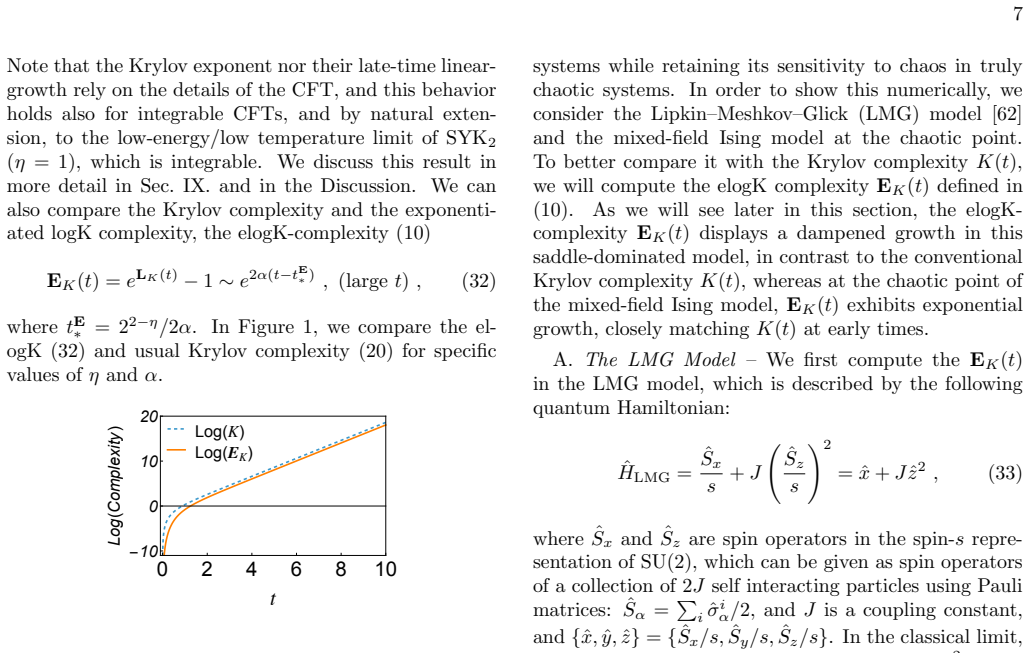
We propose and test logarithmic Krylov (logK) complexity, an operator growth measure akin to Krylov complexity defined through a replica approach, as a viable probe of early-time operator scrambling without false positives. In finite-dimensional quantum systems, such as the Lipkin--Meshkov--Glick (LMG) model and the mixed-field Ising model at the chaotic point, we provide numerical evidence that logK-complexity discriminates between genuine and saddle-dominated scrambling at early times, correctly avoiding the exponential contribution coming from the unstable saddle in the former case, and closely tracking the conventional Krylov complexity in the latter. In integrable quantum systems admitting infinite-dimensional Krylov subspaces, such as the SYK$_{2}$ model and the quantum inverted harmonic oscillator, we show that by modifying the Krylov spreading operator, obtained through generalizing the analytic continuation procedure in the replica trick, the logK complexity can be refined to capture the integrable properties of the theories. We supplement these analyses by extending the Krylov formalism in classical dynamical systems and defining classical versions of these operator growth measures, showing that the false positives arising from unstable saddles in classical phase space are non-existent.
Editorial analysis
A structured set of objections, weighed in public.
Referee Report
Summary. The manuscript proposes logarithmic Krylov (logK) complexity, defined via a replica trick, as a refined operator growth measure to probe early-time scrambling. In finite-dimensional models (LMG and mixed-field Ising), numerical results indicate that logK discriminates genuine scrambling from saddle-dominated cases by avoiding exponential contributions from unstable saddles. For infinite-dimensional integrable systems (SYK₂ and quantum inverted oscillator), the authors modify the spreading operator via generalized analytic continuation in the replica procedure to capture integrability. The work also extends the formalism to classical dynamical systems, where false positives from unstable saddles are absent.
Significance. If the central claims hold, logK complexity would provide a useful diagnostic for distinguishing scrambling mechanisms without saddle-induced artifacts, with direct relevance to studies of quantum chaos and integrability. The classical extension is a constructive addition that broadens the framework. The replica-based definition is novel, but its robustness in unbounded Krylov subspaces remains the key open question for the result's impact.
major comments (2)
- [§4] §4 (infinite-dimensional models): The central claim that modifying the spreading operator via generalized analytic continuation (n→0) yields a well-defined logK measure that faithfully captures integrability rests on the continuation being unique and artifact-free. In unbounded Krylov subspaces (SYK₂, inverted oscillator), no explicit check or regularization scheme is provided to rule out path dependence or spurious saddle contributions; this directly affects the discrimination claim for integrable cases.
- [§3] §3 (finite-dimensional numerical evidence): The reported discrimination in LMG and mixed-field Ising models is load-bearing for the early-time scrambling probe, yet the manuscript provides no error bars, convergence tests with replica number, or explicit definition of the generalized replica procedure, making it difficult to assess whether the avoidance of saddle contributions is statistically robust.
minor comments (2)
- [§2] Notation for the modified spreading operator in the replica construction should be introduced with an explicit equation in §2 to avoid ambiguity when comparing to standard Krylov complexity.
- [§5] The classical extension section would benefit from a side-by-side comparison table of classical vs. quantum logK growth rates for at least one shared model.
Simulated Author's Rebuttal
We thank the referee for their careful reading of the manuscript and for the constructive comments. We address the two major points below and have revised the manuscript accordingly to improve clarity and robustness.
read point-by-point responses
-
Referee: [§4] §4 (infinite-dimensional models): The central claim that modifying the spreading operator via generalized analytic continuation (n→0) yields a well-defined logK measure that faithfully captures integrability rests on the continuation being unique and artifact-free. In unbounded Krylov subspaces (SYK₂, inverted oscillator), no explicit check or regularization scheme is provided to rule out path dependence or spurious saddle contributions; this directly affects the discrimination claim for integrable cases.
Authors: We thank the referee for raising this important technical point. The generalized analytic continuation is performed by first computing the replica moments for positive integer n and then extending the resulting expression analytically to n→0 while modifying the spreading operator to suppress saddle contributions. For the SYK₂ model and quantum inverted oscillator we explicitly carry out this procedure and obtain the expected integrable signatures (linear or bounded growth of logK). We acknowledge that a general proof of path independence for arbitrary complex contours is not provided. However, the specific continuation we employ is uniquely determined by requiring consistency with the finite-n results and by the analytic structure of the Krylov generating function in these models. In the revised manuscript we have added a dedicated paragraph in §4 that spells out the continuation steps, the choice of contour, and the argument for uniqueness under the stated analyticity assumptions. revision: partial
-
Referee: [§3] §3 (finite-dimensional numerical evidence): The reported discrimination in LMG and mixed-field Ising models is load-bearing for the early-time scrambling probe, yet the manuscript provides no error bars, convergence tests with replica number, or explicit definition of the generalized replica procedure, making it difficult to assess whether the avoidance of saddle contributions is statistically robust.
Authors: We agree that the numerical results in §3 would benefit from additional documentation. In the revised version we have (i) included error bars obtained from ensemble averages over initial states (for the LMG model) and over disorder realizations (for the mixed-field Ising model), (ii) added convergence plots demonstrating that logK stabilizes for replica numbers n ≥ 4, and (iii) inserted an explicit algorithmic definition of the generalized replica procedure, including the precise manner in which the n→0 limit is taken after the moments are computed. These additions confirm that the reported discrimination between genuine and saddle-dominated scrambling is statistically robust within the parameter ranges explored. revision: yes
Circularity Check
No significant circularity in the logK-complexity proposal
full rationale
The paper introduces logarithmic Krylov (logK) complexity as an explicitly constructed operator growth measure obtained by generalizing the replica trick's analytic continuation to define a modified spreading operator. This is presented as a definitional refinement rather than a derivation that reduces to prior fitted parameters or self-citations. Central claims rest on numerical evidence from concrete models (LMG, mixed-field Ising, SYK2, inverted oscillator) showing discrimination between scrambling types and capture of integrability, without any load-bearing step that equates the output to the input by construction. No self-definitional loops, fitted inputs renamed as predictions, or uniqueness theorems imported from overlapping authors appear in the derivation chain. The analytic continuation is treated as a modeling choice whose consequences are checked numerically, keeping the proposal self-contained against external benchmarks.
Axiom & Free-Parameter Ledger
axioms (1)
- domain assumption The replica trick can be generalized via analytic continuation to define a logarithmic Krylov complexity that isolates genuine scrambling.
Forward citations
Cited by 1 Pith paper
-
q-Askey Deformations of Double-Scaled SYK
q-Askey deformations of double-scaled SYK yield transfer matrices for orthogonal polynomials whose semiclassical chord dynamics map to ER bridges and new geometric transitions in sine dilaton gravity.
Reference graph
Works this paper leans on
-
[1]
One can ver- ify that in these coordinates the Poisson bracket has the same form as (55), whereδa + acts as a generalized coor- dinate andδa − as its conjugate momentum. The exponential behavior (87) is typically con- strained to occur near the saddle point (a + s , a− s ) within a narrow stripS δ(t)⊂Sof the full phase space [33, 38, 39] Sδ(t) ={(δa +, δa...
-
[2]
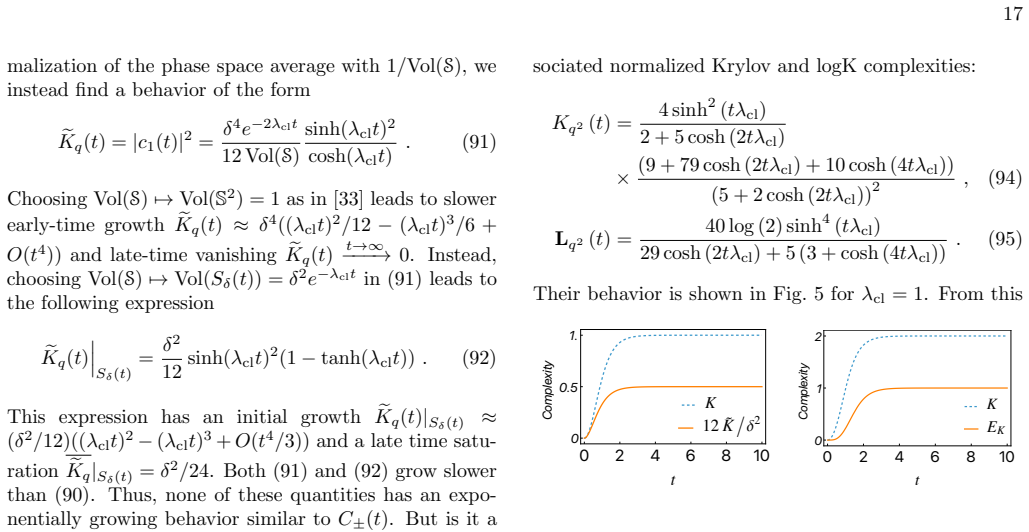
Thus, a more sensible comparison would be between (90) and the following unnormalized OTOC Cqp(t) = Vol(Sδ(t))× D |{q(t), p(0)}PB|2 E Sδ(t) = Vol(Sδ(t)) Vol(Sδ(t)) Z Sδ(t) dµ(δa+, δa−)|cosh(λ clt)|2 = Vol(Sδ(t))× cosh(λclt)2 =δ 2 e−λclt cosh(λclt)2 = δ2 4 e−3λclt +e −λclt +e λclt , (93) where we still find a late time exponential growth∝ e+λclt beyond the...
work page 2025
-
[3]
M. Gutzwiller,Chaos in Classical and Quantum Mechan- ics, Interdisciplinary Applied Mathematics (Springer New York, 1991)
work page 1991
- [4]
-
[5]
H. Degn, A. Holden, and L. Olsen,Chaos in Biological Systems, Nato Science Series A: (Springer US, 2013)
work page 2013
-
[6]
S. J. Schiff, K. Jerger, D. H. Duong, T. Chang, M. Spano, and W. Ditto, Nature370, 615 (1994)
work page 1994
- [7]
-
[8]
M. V. Berry, Proceedings of the Royal Society of London. A. Mathematical and Physical Sciences400, 229 (1985)
work page 1985
-
[9]
Walters,An Introduction to Ergodic Theory, Graduate Texts in Mathematics (Springer New York, 2000)
P. Walters,An Introduction to Ergodic Theory, Graduate Texts in Mathematics (Springer New York, 2000)
work page 2000
-
[10]
E. Gesteau, Phys. Rev. D110, 106005 (2024), arXiv:2310.13733 [hep-th]
- [11]
- [12]
-
[13]
J. M. Deutsch, Phys. Rev. A43, 2046 (1991)
work page 2046
-
[15]
Thermalization and its mechanism for generic isolated quantum systems
M. Rigol, V. Dunjko, and M. Olshanii, Nature452, 854 (2008), arXiv:0708.1324 [cond-mat.stat-mech]
work page internal anchor Pith review Pith/arXiv arXiv 2008
- [16]
- [17]
-
[18]
A. I. Larkin and Y. N. Ovchinnikov, Soviet Journal of Experimental and Theoretical Physics28, 1200 (1969)
work page 1969
-
[19]
Y. Sekino and L. Susskind, JHEP10, 065 (2008), arXiv:0808.2096 [hep-th]
work page internal anchor Pith review Pith/arXiv arXiv 2008
-
[20]
S. H. Shenker and D. Stanford, JHEP03, 067 (2014), arXiv:1306.0622 [hep-th]
work page internal anchor Pith review Pith/arXiv arXiv 2014
-
[21]
D. A. Roberts, D. Stanford, and L. Susskind, JHEP03, 051 (2015), arXiv:1409.8180 [hep-th]
work page internal anchor Pith review Pith/arXiv arXiv 2015
-
[22]
S. H. Shenker and D. Stanford, JHEP05, 132 (2015), arXiv:1412.6087 [hep-th]
work page internal anchor Pith review Pith/arXiv arXiv 2015
-
[23]
J. Maldacena, S. H. Shenker, and D. Stanford, JHEP 08, 106 (2016), arXiv:1503.01409 [hep-th]
work page internal anchor Pith review Pith/arXiv arXiv 2016
-
[24]
R. Fan, P. Zhang, H. Shen, and H. Zhai, Science Bulletin 62, 707–711 (2017)
work page 2017
- [25]
-
[26]
V. Balasubramanian, P. Caputa, J. M. Magan, and Q. Wu, Phys. Rev. D106, 046007 (2022), arXiv:2202.06957 [hep-th]
- [27]
-
[28]
K. Hashimoto, K. Murata, N. Tanahashi, and R. Watan- abe, JHEP11, 040 (2023), arXiv:2305.16669 [hep-th]
- [29]
-
[30]
B. Bhattacharjee and P. Nandy, Phys. Rev. B111, L060202 (2025), arXiv:2407.07399 [quant-ph]
-
[31]
M. Baggioli, K.-B. Huh, H.-S. Jeong, K.-Y. Kim, and J. F. Pedraza, Phys. Rev. Res.7, 023028 (2025), arXiv:2407.17054 [hep-th]
- [32]
-
[33]
M. Alishahiha, S. Banerjee, and M. J. Vasli, Eur. Phys. J. C85, 749 (2025), arXiv:2408.10194 [hep-th]
-
[34]
A. Grabarits and A. del Campo, (2025), arXiv:2510.13947 [quant-ph]
- [35]
-
[36]
B. Bhattacharjee, X. Cao, P. Nandy, and T. Pathak, JHEP05, 174 (2022), arXiv:2203.03534 [quant-ph]
- [37]
- [38]
-
[39]
N. Dowling, P. Kos, and K. Modi, Phys. Rev. Lett.131, 180403 (2023), arXiv:2304.07319 [quant-ph]
- [40]
- [41]
-
[42]
V. S. Viswanath and G. M¨ uller,The Recursion Method: Application to Many-Body Dynamics(Springer Berlin, Heidelberg, Germany, 1994)
work page 1994
- [43]
- [44]
- [45]
-
[46]
E. Rabinovici, A. S´ anchez-Garrido, R. Shir, and J. Son- ner, JHEP06, 062 (2021), arXiv:2009.01862 [hep-th]
- [47]
-
[48]
E. Rabinovici, A. S´ anchez-Garrido, R. Shir, and J. Son- ner, (2025), arXiv:2507.06286 [hep-th]
-
[49]
Gapless Spin-Fluid Ground State in a Random Quantum Heisenberg Magnet
S. Sachdev and J. Ye, Phys. Rev. Lett.70, 3339 (1993), arXiv:cond-mat/9212030
work page internal anchor Pith review Pith/arXiv arXiv 1993
-
[50]
A simple model of quantum holography,
A. Kitaev, “A simple model of quantum holography,” (2015), talk at KITP Program: Entanglement in Strongly-Correlated Quantum Matter
work page 2015
-
[51]
A. Avdoshkin, A. Dymarsky, and M. Smolkin, JHEP06, 066 (2024), arXiv:2212.14429 [hep-th]
- [52]
- [53]
- [54]
-
[55]
Fan, (2023), arXiv:2306.16118 [hep-th]
Z.-Y. Fan, (2023), arXiv:2306.16118 [hep-th]
-
[56]
Toward Krylov-based holography in double-scaled SYK
Y. Fu, H.-S. Jeong, K.-Y. Kim, and J. F. Pedraza, (2025), arXiv:2510.22658 [hep-th]
work page internal anchor Pith review Pith/arXiv arXiv 2025
-
[57]
E. Rabinovici, A. S´ anchez-Garrido, R. Shir, and J. Son- ner, JHEP03, 211 (2022), arXiv:2112.12128 [hep-th]
-
[58]
E. Rabinovici, A. S´ anchez-Garrido, R. Shir, and J. Son- ner, JHEP07, 151 (2022), arXiv:2207.07701 [hep-th]
- [59]
-
[60]
A. Dymarsky and M. Smolkin, Phys. Rev. D104, L081702 (2021), arXiv:2104.09514 [hep-th]
-
[61]
Comments on the Sachdev-Ye-Kitaev model
J. Maldacena and D. Stanford, Phys. Rev. D94, 106002 (2016), arXiv:1604.07818 [hep-th]
work page internal anchor Pith review Pith/arXiv arXiv 2016
-
[62]
NIST Digital Library of Mathematical Func- tions,
DLMF, “NIST Digital Library of Mathematical Func- tions,”https://dlmf.nist.gov/, Release 1.2.5 of 2025- 12-15, f. W. J. Olver, A. B. Olde Daalhuis, D. W. Lozier, B. I. Schneider, R. F. Boisvert, C. W. Clark, B. R. Miller, B. V. Saunders, H. S. Cohl, and M. A. McClain, eds
work page 2025
-
[63]
A. Bhattacharya, P. P. Nath, and H. Sahu, Phys. Rev. D109, 066010 (2024), arXiv:2312.11677 [quant-ph]
-
[64]
H. J. Lipkin, N. Neshkov, and A. J. Glick, Nucl. Phys. 62, 188 (1965)
work page 1965
- [65]
-
[66]
M. C. Ba˜ nuls, J. I. Cirac, and M. B. Hastings, Physical Review Letters106(2011), 10.1103/phys- revlett.106.050405
-
[67]
K. Hashimoto, K.-B. Huh, K.-Y. Kim, and R. Watanabe, JHEP11, 068 (2020), arXiv:2007.04746 [hep-th]
-
[68]
M. H. Lee, Phys. Rev. Lett.49, 1072 (1982)
work page 1982
- [69]
- [70]
-
[71]
V. I. Arnold,Mathematical Methods of Classical Mechan- ics(Springer, 1989)
work page 1989
-
[72]
L. Hackl and E. Bianchi, SciPost Phys. Core4, 025 (2021), arXiv:2010.15518 [quant-ph]
-
[73]
Husimi, Proceedings of the Physico-Mathematical So- ciety of Japan
K. Husimi, Proceedings of the Physico-Mathematical So- ciety of Japan. 3rd Series22, 264 (1940)
work page 1940
- [74]
-
[75]
P. Ribeiro, J. Vidal, and R. Mosseri, Phys. Rev. E78, 021106 (2008), arXiv:0805.4078 [cond-mat.stat-mech]
work page internal anchor Pith review Pith/arXiv arXiv 2008
-
[76]
J. S. Cotler, D. Ding, and G. R. Penington, Annals Phys. 396, 318 (2018), arXiv:1704.02979 [quant-ph]
work page internal anchor Pith review Pith/arXiv arXiv 2018
- [77]
- [78]
-
[79]
F. Haneder, G. Caspari, J. D. Urbina, and K. Richter, (2025), arXiv:2512.19869 [nlin.CD]
-
[80]
D. A. Roberts, D. Stanford, and A. Streicher, JHEP06, 122 (2018), arXiv:1802.02633 [hep-th]
work page internal anchor Pith review Pith/arXiv arXiv 2018
- [81]
discussion (0)
Sign in with ORCID, Apple, or X to comment. Anyone can read and Pith papers without signing in.