Recognition: no theorem link
Analytical Solution of Spinning, Eccentric Binary Black Hole Dynamics at the Second Post-Newtonian Order
Pith reviewed 2026-05-15 08:20 UTC · model grok-4.3
The pith
An analytical solution is constructed for the time evolution of separation, spins, and angular momentum in spinning eccentric binary black holes at 2PN order.
A machine-rendered reading of the paper's core claim, the machinery that carries it, and where it could break.
Core claim
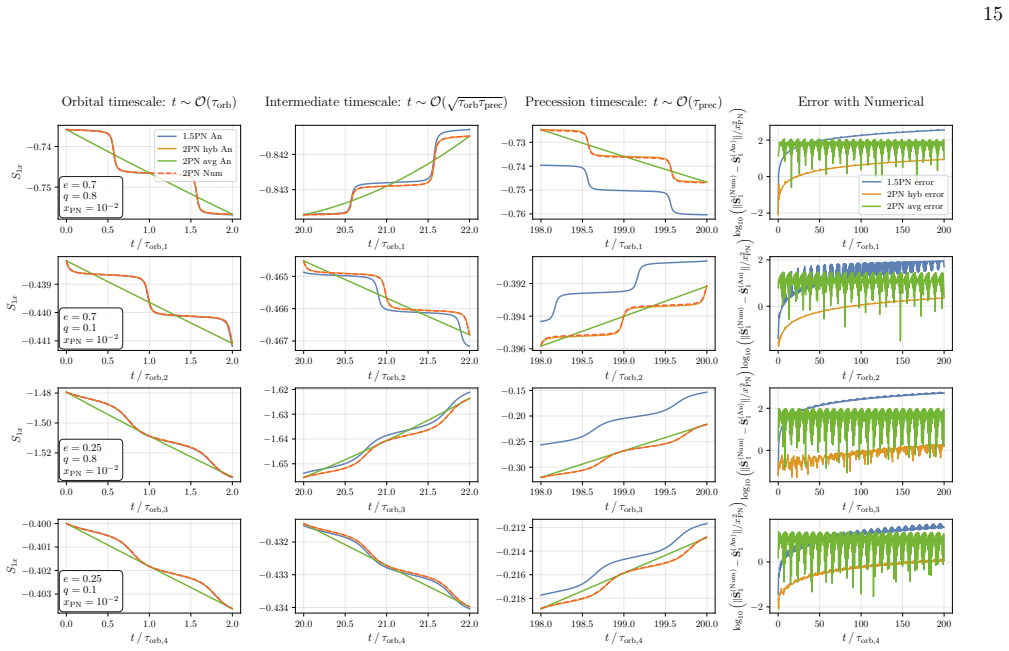
We construct an analytical solution for the time evolution of the relative separation vector, the individual black hole spin vectors, and the orbital angular momentum vector at 2PN order for BBHs with arbitrary spins and eccentricity. The solution keeps the orbital timescale spin oscillations at leading 1.5PN accuracy rather than full 2PN, but numerical checks show it still represents an order of magnitude improvement over the prior 1.5PN solution.
What carries the argument
The 2PN-order post-Newtonian equations governing the relative orbital motion, spin precession, and angular momentum evolution for eccentric binaries, solved analytically for the time-dependent vectors.
If this is right
- Gravitational waveforms can now be modeled directly from first principles for systems that exhibit both eccentricity and spin precession.
- The accuracy of predictions for gravitational wave signals from such binaries increases by an order of magnitude compared to 1.5PN models.
- This solution provides a basis for constructing templates that capture both effects simultaneously without heuristic twisting.
- Future extensions to higher post-Newtonian orders become feasible starting from this analytical framework.
Where Pith is reading between the lines
- Such solutions could enable more precise extraction of binary parameters from eccentric precessing events in current and future gravitational wave detectors.
- The method of analytical integration might apply to other post-Newtonian problems involving coupled orbital and spin dynamics.
- Testing the solution against numerical relativity for moderate eccentricity cases would confirm the claimed accuracy gain.
Load-bearing premise
The sub-dominant next-to-leading-order oscillations in the spin solutions can be neglected at 2PN without materially affecting the accuracy of the central orbital and angular-momentum evolution.
What would settle it
Direct comparison of the analytical orbital and spin evolution against a full numerical integration of the 2PN equations for a binary with eccentricity 0.5 and significant spins over 100 orbital periods, measuring the accumulated phase error.
Figures


read the original abstract
Recent gravitational wave (GW) detections showing signatures of eccentricity and spin precession underscore the need to model binary black holes (BBHs) possessing these features simultaneously. Most efforts over the past fifteen years to model spinning BBHs and their corresponding GWs have relied on heuristically twisting waveforms from non-precessing systems. This approach is based on empirical observations rather than first principles. This article aims to model the GWs from spinning and eccentric BBHs from a first-principles approach within general relativity and post-Newtonian (PN) approximation. Building on the already-existing 1.5 PN solution, we construct an analytical solution for the time evolution of the relative separation vector, the individual black hole spin vectors, and the orbital angular momentum vector at 2PN order for BBHs with arbitrary spins and eccentricity. Such a solution is not fully 2PN accurate in that the tiny orbital timescale fluctuations in the solutions for the spins are only leading 1.5PN order accurate, instead of 2PN. However, it is shown that our new 2PN solution is still an order of magnitude improvement over the earlier 1.5PN solution, underlining the sub-dominant nature of the neglected next-to-leading-order oscillations in the spin solutions.
Editorial analysis
A structured set of objections, weighed in public.
Referee Report
Summary. The paper constructs an analytical solution for the time evolution of the relative separation vector, the individual black hole spin vectors, and the orbital angular momentum vector at 2PN order for binary black holes with arbitrary spins and eccentricity, building on an existing 1.5PN solution. The solution is noted to be not fully 2PN accurate for the orbital-timescale spin oscillations, which are retained at 1.5PN order, but this is argued to be sub-dominant for the central orbital and angular-momentum evolution, providing an order of magnitude improvement over the prior result.
Significance. If the result holds, this work offers a first-principles post-Newtonian analytical model for the dynamics of spinning eccentric BBHs, which is crucial for modeling gravitational waves from such systems that show signatures of eccentricity and spin precession. The direct integration approach and the explicit qualification of accuracy limits strengthen the contribution, as it avoids heuristic methods and provides a clear path for waveform modeling improvements.
minor comments (1)
- [Abstract] Abstract: the claim of an 'order of magnitude improvement' is stated but would benefit from a brief quantitative comparison (e.g., error norms or phase drift over a fixed number of orbits) to make the sub-dominance of the neglected spin oscillations fully explicit for readers.
Simulated Author's Rebuttal
We thank the referee for their positive and accurate summary of our manuscript, as well as for recommending minor revision. The referee correctly identifies the key features of our 2PN analytical solution for eccentric, spinning binary black holes and the explicit qualification of its accuracy limits. We address the points raised in the report below.
read point-by-point responses
-
Referee: The paper constructs an analytical solution for the time evolution of the relative separation vector, the individual black hole spin vectors, and the orbital angular momentum vector at 2PN order for binary black holes with arbitrary spins and eccentricity, building on an existing 1.5PN solution. The solution is noted to be not fully 2PN accurate for the orbital-timescale spin oscillations, which are retained at 1.5PN order, but this is argued to be sub-dominant for the central orbital and angular-momentum evolution, providing an order of magnitude improvement over the prior result.
Authors: We agree with this characterization. As stated in the abstract and throughout the manuscript, the orbital-timescale spin oscillations are retained only at leading 1.5PN order while the secular evolution of the spins, orbital angular momentum, and separation vector is obtained at 2PN. We have explicitly demonstrated that the neglected higher-order oscillatory terms are sub-dominant and that the new solution improves upon the prior 1.5PN result by an order of magnitude for the quantities of primary interest. No changes to the manuscript are required on this point, as the accuracy limits are already clearly qualified. revision: no
Circularity Check
No significant circularity in the derivation chain
full rationale
The paper derives its analytical solution for the time evolution of separation, spin, and angular momentum vectors by direct integration of the post-Newtonian equations of motion, extending an existing 1.5PN solution to 2PN order. No self-definitional steps, fitted inputs renamed as predictions, or load-bearing self-citations appear in the provided abstract or description. The explicit qualification that spin oscillations are retained only at 1.5PN accuracy is presented as a sub-dominant approximation without reducing the central construction to its inputs by definition. The result remains self-contained against the PN equations themselves.
Axiom & Free-Parameter Ledger
axioms (1)
- standard math Post-Newtonian expansion of the two-body problem in general relativity is valid to the stated order
Forward citations
Cited by 1 Pith paper
-
Post-Newtonian inspiral waveform model for eccentric precessing binaries with higher-order modes and matter effects
pyEFPEHM extends prior PN models to include higher-order quasi-circular phasing, generalized precession solutions, and eccentric corrections up to 1PN in selected multipoles for eccentric precessing binaries with matt...
Reference graph
Works this paper leans on
-
[1]
Solution for the orbit-averaged orbital angular momentum Having determined the evolution of the angles between the angular momenta vectors, we now construct the explicit time dependence ofLin an inertial frame. We define two frames • Inertial Frame (IF):an orthonormal basis(x, y, z)with the z-axis aligned with the conserved total angular momentumJ. • Non-...
-
[2]
Solution for the orbit-averaged spins angular momenta The solutions forS1 andS 2 follow an analogous procedure. For each spin, we construct a non-inertial frame by rotating the IF such that thek-axis aligns with the respective spin vector. The orientation of this frame relative to the IF is characterized by two angles(θSa,ϕSa)fora∈{1,2}. ForS 1, the angle...
-
[3]
THE QUASI-KEPLERIAN SOLUTION FOR THE ORBITAL DYNAMICS We now turn to the orbital dynamics and derive a quasi-Keplerian parametric solution for eccentric orbits of the 2PN spinning system governed by the Hamiltonian(2.1). We first obtain the EOMs for the radial and azimuthal variablesr and ϕ(azimuthal angle ofrin the NIF). Then we construct a solution usin...
-
[4]
CONCLUDING REMARKS A. Scope and novelty of the present work The primary objective of this work was to provide an analytical description of the conservative dynamics of eccentric and precessing binary black hole systems at the 2PN order. Working within the ADM Hamiltonian framework with the NWP spin supplementary condition, we have extended the 1.5PN solut...
-
[5]
ST was supported by the PSL postdoctoral fellowship during this work
LB, TC and ST acknowledge financial support from the EU Horizon 2020 Research and Innovation Programme under the Marie Sklodowska-Curie Grant Agreement no.101007855. ST was supported by the PSL postdoctoral fellowship during this work. Appendix A: Triple product of angular momenta The scalar triple productl·(s1×s2)can be expressed in terms of the characte...
work page 2020
-
[6]
Time-dependent 2PN spin corrections arise from oscillating terms inC and D1s
Harmonic analysis of the radial equation The radial equation of motion (4.4) reads (dr dt )2 =A+ 2B r + C r2 + D1 r3 + D2 r4 + D3 r5 ,(G.1) where D1 =D1o +D1s. Time-dependent 2PN spin corrections arise from oscillating terms inC and D1s. Substituting the expressions from Eq.(4.16) and usingϕ=vϕandr =a(1−e2)/(1 +ecosv ϕ)at Newtonian order, these oscillator...
-
[7]
Harmonic analysis of the azimuthal equation The azimuthal equation of motion (4.23), omitting the last term that we treat separately, reads r2dϕ dt =F+ I1 r + I2 r2 + I3 r3 .(G.7) Following the same analysis, the oscillatory 2PN spin contributions are ∆ ϕ= 1 c4 3∑ k=0 [ a(ϕ) k cos(kvϕ−2ϕs) +b (ϕ) k sin(kvϕ−2ϕs) ] ,(G.8) where the expansion terminates atk=...
-
[8]
Complete quasi-Keplerian parametrization The harmonic analysis of both equations yields the following minimal ansatz for the complete quasi-Keplerian parametrization of the relative separation vectorR n(t−t0) =u−et sinu+ 1 c4 [ft sinvϕ+gt(vϕ−u) +ht sin(vϕ−2ϕs)],(G.10a) r=a r(1−er cosu) + 1 c4 [hr1 cos(vϕ−2ϕs) +hr2 cos(2vϕ−2ϕs)],(G.10b) ϕ−ϕ0 = (1 + ˜k)vϕ+ ...
-
[9]
M. Hannam, C. Hoy, J. E. Thompson, S. Fairhurst, V. Raymond,et al., General-relativistic precession in a black-hole binary 10.1038/s41586-022-05212-z, arXiv:2112.11300 [gr-qc]
-
[10]
R. Abbottet al.(LIGO Scientific, Virgo), GW190412: Observation of a Binary-Black-Hole Coalescence with Asymmetric Masses, Phys. Rev. D102, 043015 (2020), arXiv:2004.08342 [astro-ph.HE]
- [11]
-
[12]
D. Gerosa and M. Fishbach, Hierarchical mergers of stellar-mass black holes and their gravitational-wave signatures, Nature Astron.5, 749 (2021), arXiv:2105.03439 [astro-ph.HE]
-
[13]
I. Mandel and A. Farmer, Merging stellar-mass binary black holes, Phys. Rept.955, 1 (2022), arXiv:1806.05820 [astro-ph.HE]
-
[14]
I. Romero-Shaw, J. Stegmann, H. Tagawa, D. Gerosa, J. Samsing, N. Gupte, and S. R. Green, GW200208_222617 as an eccentric black-hole binary merger: Properties and astrophysical implications, Phys. Rev. D112, 063052 (2025), arXiv:2506.17105 [astro-ph.HE]
-
[15]
I. M. Romero-Shaw, D. Gerosa, and N. Loutrel, Eccentricity or spin precession? distinguishing subdomi- nant effects in gravitational-wave data, Monthly Notices of the Royal Astronomical Society519, 5352 (2023), https://academic.oup.com/mnras/article-pdf/519/4/5352/50423218/stad031.pdf
work page 2023
-
[16]
S. Tibrewal, A. Zimmerman, J. Lange, and D. Shoemaker, Misinterpreting Spin Precession as Orbital Eccentricity in Gravitational-Wave Signals, (2026), arXiv:2601.02260 [gr-qc]. 33 [9]994, L47 (2025)
-
[17]
V. Baibhav, Inferring Eccentricity of Binary Black Holes from Spin-Orbit Misalignment, (2025), arXiv:2512.22044 [astro- ph.HE]
-
[18]
Lehner, Numerical relativity: a review, Classical and Quantum Gravity18, R25 (2001)
L. Lehner, Numerical relativity: a review, Classical and Quantum Gravity18, R25 (2001)
work page 2001
-
[19]
U. Sperhake, The numerical relativity breakthrough for binary black holes, Classical and Quantum Gravity32, 124011 (2015)
work page 2015
-
[20]
K. D. Kokkotas and B. G. Schmidt, Quasi-normal modes of stars and black holes, Living Reviews in Relativity2, 2 (1999)
work page 1999
- [21]
-
[22]
L. Blanchet, Gravitational radiation from post-newtonian sources and inspiralling compact binaries, Living reviews in relativity17, 2 (2014)
work page 2014
-
[23]
A. Buonanno and T. Damour, Effective one-body approach to general relativistic two-body dynamics, Physical Review D 59, 084006 (1999)
work page 1999
-
[24]
S. Khan, S. Husa, M. Hannam, F. Ohme, M. Pürrer, X. J. Forteza, and A. Bohé, Frequency-domain gravitational waves from nonprecessing black-hole binaries. ii. a phenomenological model for the advanced detector era, Physical Review D93, 044007 (2016)
work page 2016
-
[25]
Tracking the precession of compact binaries from their gravitational-wave signal
P. Schmidt, M. Hannam, S. Husa, and P. Ajith, Tracking the precession of compact binaries from their gravitational-wave signal, Phys. Rev. D84, 024046 (2011), arXiv:1012.2879 [gr-qc]
work page internal anchor Pith review Pith/arXiv arXiv 2011
-
[26]
P.Schmidt, M.Hannam,andS.Husa,Towardsmodelsofgravitationalwaveformsfromgenericbinaries: Asimpleapproximate mapping between precessing and non-precessing inspiral signals, Phys. Rev. D86, 104063 (2012), arXiv:1207.3088 [gr-qc]
work page internal anchor Pith review Pith/arXiv arXiv 2012
-
[27]
A geometric approach to the precession of compact binaries
M. Boyle, R. Owen, and H. P. Pfeiffer, A geometric approach to the precession of compact binaries, Phys. Rev. D84, 124011 (2011), arXiv:1110.2965 [gr-qc]
work page internal anchor Pith review Pith/arXiv arXiv 2011
-
[28]
K. Chatziioannou, A. Klein, N. Yunes, and N. Cornish, Constructing gravitational waves from generic spin-precessing compact binary inspirals, Physical Review D95, 104004 (2017)
work page 2017
- [29]
- [30]
-
[31]
T. Damour and N. Deruelle, General relativistic celestial mechanics of binary systems. i. the post-newtonian motion, Annales de l’I.H.P. Physique théorique43, 107 (1985)
work page 1985
- [32]
-
[33]
G. Cho, S. Tanay, A. Gopakumar, and H. M. Lee, Generalized quasi-keplerian solution for eccentric, nonspinning compact binaries at 4pn order and the associated inspiral-merger-ringdown waveform, Physical Review D105, 064010 (2022)
work page 2022
-
[34]
M. Tessmer, J. Hartung, and G. Schäfer, Motion and gravitational wave forms of eccentric compact binaries with orbital- angular-momentum-aligned spins under next-to-leading order in spin–orbit and leading order in spin (1)–spin (2) and spin-squared couplings, Classical and Quantum Gravity27, 165005 (2010)
work page 2010
-
[35]
M. Tessmer, J. Hartung, and G. Schäfer, Aligned spins: orbital elements, decaying orbits, and last stable circular orbit to high post-newtonian orders, Classical and Quantum Gravity30, 015007 (2013)
work page 2013
-
[36]
R. V. Wagoner and C. M. Will, Post-Newtonian gravitational radiation from orbiting point masses., Astrophys. J.210, 764 (1976)
work page 1976
-
[37]
G. Schäfer and N. Wex, Second post-newtonian motion of compact binaries, Physics Letters A174, 196 (1993)
work page 1993
-
[38]
R.-M. Memmesheimer, A. Gopakumar, and G. Schaefer, Third post-Newtonian accurate generalized quasi-Keplerian parametrization for compact binaries in eccentric orbits, Phys. Rev. D70, 104011 (2004), arXiv:gr-qc/0407049
work page internal anchor Pith review Pith/arXiv arXiv 2004
- [39]
-
[40]
R. Arnowitt, S. Deser, and C. W. Misner, Republication of: The dynamics of general relativity, General Relativity and Gravitation40, 1997–2027 (2008)
work page 1997
- [41]
-
[42]
Closed-form solutions of spinning, eccentric binary black holes at 1.5 post-Newtonian order
R. Samanta, S. Tanay, and L. C. Stein, Closed-form solutions of spinning, eccentric binary black holes at 1.5 post-newtonian order, Phys. Rev. D108, 124039 (2023), arXiv:2210.01605 [gr-qc]
work page internal anchor Pith review Pith/arXiv arXiv 2023
-
[43]
J. D. Schnittman, Spin-orbit resonance and the evolution of compact binary systems, Phys. Rev. D70, 124020 (2004), arXiv:astro-ph/0409174
work page internal anchor Pith review Pith/arXiv arXiv 2004
-
[44]
Precessional instability in binary black holes with aligned spins
D. Gerosa, M. Kesden, R. O’Shaughnessy, A. Klein, E. Berti, U. Sperhake, and D. Trifirò, Precessional instability in binary black holes with aligned spins, Phys. Rev. Lett.115, 141102 (2015), arXiv:1506.09116 [gr-qc]
work page internal anchor Pith review Pith/arXiv arXiv 2015
-
[45]
Multi-timescale analysis of phase transitions in precessing black-hole binaries
D. Gerosa, M. Kesden, U. Sperhake, E. Berti, and R. O’Shaughnessy, Multi-timescale analysis of phase transitions in precessing black-hole binaries, Phys. Rev. D92, 064016 (2015), arXiv:1506.03492 [gr-qc]
work page internal anchor Pith review Pith/arXiv arXiv 2015
- [46]
-
[47]
Analysis of spin precession in binary black hole systems including quadrupole-monopole interaction
E. Racine, Analysis of spin precession in binary black hole systems including quadrupole-monopole interaction, Phys. Rev. D78, 044021 (2008), arXiv:0803.1820 [gr-qc]
work page internal anchor Pith review Pith/arXiv arXiv 2008
-
[48]
L. A. Gergely, Spin spin effects in radiating compact binaries, Phys. Rev. D61, 024035 (2000), arXiv:gr-qc/9911082. 34
work page internal anchor Pith review Pith/arXiv arXiv 2000
-
[49]
A. Klein and P. Jetzer, Spin effects in the phasing of gravitational waves from binaries on eccentric orbits, Physical Review D—Particles, Fields, Gravitation, and Cosmology81, 124001 (2010)
work page 2010
-
[50]
L. E. Kidder, Coalescing binary systems of compact objects to (post) 5/2-newtonian order. v. spin effects, Physical Review D52, 821 (1995)
work page 1995
-
[51]
B. M. Barker and R. F. O’Connell, Nongeodesic motion in general relativity, General Relativity and Gravitation5, 539 (1974)
work page 1974
-
[52]
T. Colin, 2PN_BBH_solution.nb: Mathematica notebook for the analytical 2PN spinning, eccentric binary black hole solution,https://github.com/sashwattanay/BBH-PN-Toolkit(2026), file: 2PN_BBH_solution.nb
work page 2026
-
[53]
M. H. L. Pryce, The mass-centre in the restricted theory of relativity and its connexion with the quantum theory of elementary particles, Proceedings of the Royal Society of London. Series A. Mathematical and Physical Sciences195, 62 (1948)
work page 1948
-
[54]
T. D. Newton and E. P. Wigner, Localized states for elementary systems, Rev. Mod. Phys.21, 400 (1949)
work page 1949
-
[55]
Damour, Coalescence of two spinning black holes: An effective one-body approach, Phys
T. Damour, Coalescence of two spinning black holes: An effective one-body approach, Phys. Rev. D64, 124013 (2001)
work page 2001
-
[56]
M. D. Hartl and A. Buonanno, The Dynamics of precessing binary black holes using the post-Newtonian approximation, Phys. Rev. D71, 024027 (2005), arXiv:gr-qc/0407091
work page internal anchor Pith review Pith/arXiv arXiv 2005
-
[57]
B. M. Barker, S. N. Gupta, and R. D. Haracz, One-Graviton Exchange Interaction of Elementary Particles, Phys. Rev.149, 1027 (1966)
work page 1966
-
[58]
B. M. Barker and R. F. O’Connell, Gravitational two-body problem with arbitrary masses, spins, and quadrupole moments, Phys. Rev. D12, 329 (1975)
work page 1975
-
[59]
Canonical Formulation of Spin in General Relativity
J. Steinhoff, Canonical formulation of spin in general relativity, Annalen Phys.523, 296 (2011), arXiv:1106.4203 [gr-qc]
work page internal anchor Pith review Pith/arXiv arXiv 2011
- [60]
-
[61]
Q. Henry and M. Khalil, Spin effects in gravitational waveforms and fluxes for binaries on eccentric orbits to the third post-Newtonian order, Phys. Rev. D108, 104016 (2023), arXiv:2308.13606 [gr-qc]
discussion (0)
Sign in with ORCID, Apple, or X to comment. Anyone can read and Pith papers without signing in.