REVIEW 3 major objections 2 minor 99 references
From the Stochastic Embedding Sufficiency Theorem to a Superspace Diffusion Framework
T0 review · 3 major / 2 minor · reviewed 2026-05-15 · grok-4.3
Pith's one-line read A non-parametric stochastic embedding theorem recovers fundamental constants from time series data across nine physics domains and derives a superspace diffusion equation for gravity.
desk verdict The paper claims a stochastic Takens generalization that pulls constants out of time series across domains and builds a Planck-scale superspace diffusion model for gravity from axioms, but the key theorems are asserted without the derivations shown. read the letter →
The pith
A machine-rendered reading of the paper's core claim, the machinery that carries it, and where it could break.
The reading
What carries the argument
The Stochastic Embedding Sufficiency Theorem, a generalization of Takens' delay-coordinate embedding to stochastic systems that non-parametrically reconstructs the governing drift and diffusion fields from observations.
What would settle it
A mismatch between the galactic-scale gravitational acceleration predicted by coarse-graining the superspace Fokker-Planck equation and the accelerations measured from stellar kinematic data.
Extended reading notes
Core claim
The central discovery is the superspace diffusion hypothesis, dg_ij = D_ij[g] dτ + ℓ_P dW_ij, where the drift D and diffusion amplitude ℓ_P follow uniquely from four axioms that encode the fluctuation-dissipation relation, the massless mode structure of linearized gravity, and gravitational self-coupling through the equivalence principle.
Load-bearing premise
That the Stochastic Embedding Sufficiency Theorem applies without prior assumptions about the governing physics to all nine listed domains.
Editorial extensions
If this is right
- Fundamental constants such as k_B, ħ, and c appear in the recovered drift and diffusion without being supplied in advance.
- The recovered diffusion coefficients form an empirical σ-continuum in which the constants occupy structurally distinct roles.
- Coarse-graining the superspace Fokker-Planck equation via Mori-Zwanzig projection produces testable predictions for gravitational acceleration on galactic scales.
Reading between the lines
- If the framework holds, it may provide a first-principles route to emergent gravity without assuming a metric a priori.
- The same embedding procedure could be applied to cosmological time series to constrain the diffusion coefficient at larger scales.
- The approach suggests that noise in the metric might be observable in precision timing or interferometry experiments.
Signed reviews
Editorial analysis
A structured set of objections, weighed in public.
Referee Report
Summary. The paper generalizes Takens' delay-coordinate embedding theorem to stochastic systems via the Stochastic Embedding Sufficiency Theorem, which is claimed to recover drift and diffusion fields non-parametrically from scalar time series. It applies a blind protocol to nine physical domains (classical mechanics through QED), recovering fundamental constants (k_B, ħ, c, Fano factor, Van Kampen exponent) in both channels without prior specification. These recoveries are said to form an empirical σ-continuum pattern. A Gravitational Diffusion Theorem, derived from fluctuation-dissipation, linearised gravity modes, and equivalence-principle self-coupling, fixes the gravitational diffusion amplitude at one Planck length per square root Planck time. Four canonical axioms are introduced to close the framework, yielding the superspace diffusion hypothesis dg_ij = D_ij[g] dτ + ℓ_P dW_ij with all coefficients non-parametric; coarse-graining via Mori-Zwanzig is asserted to produce testable galactic-scale gravitational predictions.
Significance. If the central derivations were rigorously established and the non-parametric recoveries verified without hidden scaling, the work would offer a unified stochastic-embedding route to fundamental constants and a parameter-free diffusion model on superspace. The claimed implication for galactic kinematics would constitute a falsifiable prediction outside standard ΛCDM. However, the absence of explicit intermediate steps for the Gravitational Diffusion Theorem and the uniqueness proof from the four axioms substantially weakens the significance assessment at present.
major comments (3)
- [Abstract / Gravitational Diffusion Theorem] Abstract and Gravitational Diffusion Theorem statement: the precise coefficient ℓ_P (one Planck length per √Planck time) is asserted to follow uniquely from the fluctuation-dissipation theorem, massless-mode structure of linearised gravity, and equivalence-principle self-coupling, yet no intermediate steps, explicit covariance operator, or projection isolating the amplitude are supplied. This derivation is load-bearing for the claim that the superspace hypothesis contains no free parameters.
- [Abstract / Stochastic Embedding Sufficiency Theorem] Stochastic Embedding Sufficiency Theorem and nine-domain application: the theorem is stated to recover constants without prior physics assumptions, but the manuscript provides neither the proof of the theorem nor the explicit time-series protocols, error bars, or verification that scaling was not imported from dimensional analysis or embedding results of other domains. This undercuts the σ-continuum pattern and the assertion of uniqueness.
- [Abstract / Four canonical axioms] Four canonical axioms: these are introduced to determine noise character, drift, covariance operator, and fluctuation amplitude by theorem, yet the manuscript does not exhibit the explicit closure (e.g., how the axioms fix the Wiener process amplitude independently of the embedding results). Without this, the superspace hypothesis dg_ij = D_ij[g] dτ + ℓ_P dW_ij remains an assertion rather than a derived consequence.
minor comments (2)
- [Abstract] Notation: the time variable τ in the superspace equation is not defined relative to coordinate time or proper time; a brief clarification would aid readability.
- [Abstract] The term “σ-continuum” is introduced as an empirical pattern but lacks a precise mathematical definition or a figure/table summarising the recovered diffusion coefficients across the nine domains.
Simulated Author's Rebuttal
We thank the referee for the thorough and constructive report. The comments correctly identify places where explicit derivations and protocols must be supplied to make the central claims self-contained. We will revise the manuscript to address each point, adding the missing intermediate steps, proof outlines, and verification details without altering the core results.
read point-by-point responses
-
Referee: [Abstract / Gravitational Diffusion Theorem] Abstract and Gravitational Diffusion Theorem statement: the precise coefficient ℓ_P (one Planck length per √Planck time) is asserted to follow uniquely from the fluctuation-dissipation theorem, massless-mode structure of linearised gravity, and equivalence-principle self-coupling, yet no intermediate steps, explicit covariance operator, or projection isolating the amplitude are supplied. This derivation is load-bearing for the claim that the superspace hypothesis contains no free parameters.
Authors: We agree that the derivation of the amplitude ℓ_P requires explicit intermediate steps. In the revised manuscript we will insert a dedicated subsection (new Section 4.2) that derives the coefficient from the fluctuation-dissipation relation applied to the massless modes of linearised gravity, incorporates the equivalence-principle self-coupling to fix the projection onto the superspace metric, and isolates the covariance operator whose eigenvalue yields exactly one Planck length per square-root Planck time. The revised text will also state the uniqueness condition under the four axioms. revision: yes
-
Referee: [Abstract / Stochastic Embedding Sufficiency Theorem] Stochastic Embedding Sufficiency Theorem and nine-domain application: the theorem is stated to recover constants without prior physics assumptions, but the manuscript provides neither the proof of the theorem nor the explicit time-series protocols, error bars, or verification that scaling was not imported from dimensional analysis or embedding results of other domains. This undercuts the σ-continuum pattern and the assertion of uniqueness.
Authors: The full proof of the Stochastic Embedding Sufficiency Theorem appears in Appendix A, yet we accept that the main text lacks a self-contained outline and the nine-domain protocol details. We will add a concise proof sketch to Section 2, together with a new table (Table 1) listing the recovered constants, their statistical uncertainties, and the data-driven embedding-parameter selection procedure. We will also include a supplementary verification that no external scaling was imported; all recoveries used only the raw time series and the theorem’s internal sufficiency conditions. revision: yes
-
Referee: [Abstract / Four canonical axioms] Four canonical axioms: these are introduced to determine noise character, drift, covariance operator, and fluctuation amplitude by theorem, yet the manuscript does not exhibit the explicit closure (e.g., how the axioms fix the Wiener process amplitude independently of the embedding results). Without this, the superspace hypothesis dg_ij = D_ij[g] dτ + ℓ_P dW_ij remains an assertion rather than a derived consequence.
Authors: We agree that the explicit closure from the four axioms to the Wiener-process amplitude must be shown. In the revision we will expand Section 5 to include a step-by-step derivation demonstrating how Axiom 1 (noise character) and Axiom 4 (fluctuation amplitude) together fix the diffusion coefficient ℓ_P independently of the embedding recoveries, while Axioms 2 and 3 determine the drift and covariance operator. The revised text will present the resulting superspace equation as a direct theorem consequence. revision: yes
Circularity Check
Axioms introduced to force superspace diffusion hypothesis by theorem; gravitational coefficient fixed to Planck scale via fluctuation-dissipation and equivalence principle
-
self definitional
[Abstract, paragraph introducing four canonical axioms]
"Four canonical axioms formalise the framework, within which the noise character, drift, covariance operator, and fluctuation amplitude are uniquely determined by theorem, yielding the superspace diffusion hypothesis: dg_ij = D_ij[g] dτ + ℓ_P dW_ij where all coefficients are non-parametric, first-principles consequences of the axioms."
The axioms are presented as the formalisation step whose sole purpose is to guarantee that the superspace hypothesis (including the precise ℓ_P coefficient) follows uniquely by theorem. This makes the claimed first-principles derivation equivalent to the choice of axioms that already encode the target form and amplitude.
-
self definitional
[Abstract, Gravitational Diffusion Theorem sentence]
"The Gravitational Diffusion Theorem, derived from the fluctuation-dissipation theorem, massless mode structure of linearised gravity, and gravitational self-coupling via the equivalence principle, determines the gravitational diffusion coefficient as one Planck length per square root of Planck time."
The theorem is stated to fix the exact numerical coefficient ℓ_P directly from fluctuation-dissipation plus equivalence principle. These inputs are standard relations whose direct consequence is the Planck scale; no intermediate steps are supplied showing how the axioms close the derivation without importing the known dimensional result.
full rationale
The paper's central derivation chain reduces to two load-bearing steps that match the self-definitional pattern. First, four axioms are explicitly introduced to make the superspace form follow uniquely by theorem, with all coefficients declared non-parametric consequences of those axioms. Second, the Gravitational Diffusion Theorem is invoked to set the exact amplitude ℓ_P to one Planck length per square root Planck time using only fluctuation-dissipation, linearised gravity modes, and equivalence principle; this directly re-expresses the known Planck units without additional independent derivation shown. The nine-domain empirical pattern recovers standard constants but does not independently constrain the superspace extension. No external machine-checked result or parameter-free closure is supplied to break the reduction. The result is therefore forced by the axiomatic premises and standard scaling relations rather than derived from them.
Assumptions & free parameters
assumptions (1)
- ad hoc to paper Four canonical axioms formalise the framework
invented entities (2)
-
superspace diffusion hypothesis
-
σ-continuum
Cite this review
Pith. "Pith review of From the Stochastic Embedding Sufficiency Theorem to a Superspace Diffusion Framework." pith.science (2026). https://pith.science/paper/2603.20423
@misc{pith2026260320423,
  author       = {Pith},
  title        = {Pith review of: From the Stochastic Embedding Sufficiency Theorem to a Superspace Diffusion Framework},
  year         = {2026},
  howpublished = {\url{https://pith.science/paper/2603.20423}},
  note         = {Machine review of arXiv:2603.20423}
}
abstract
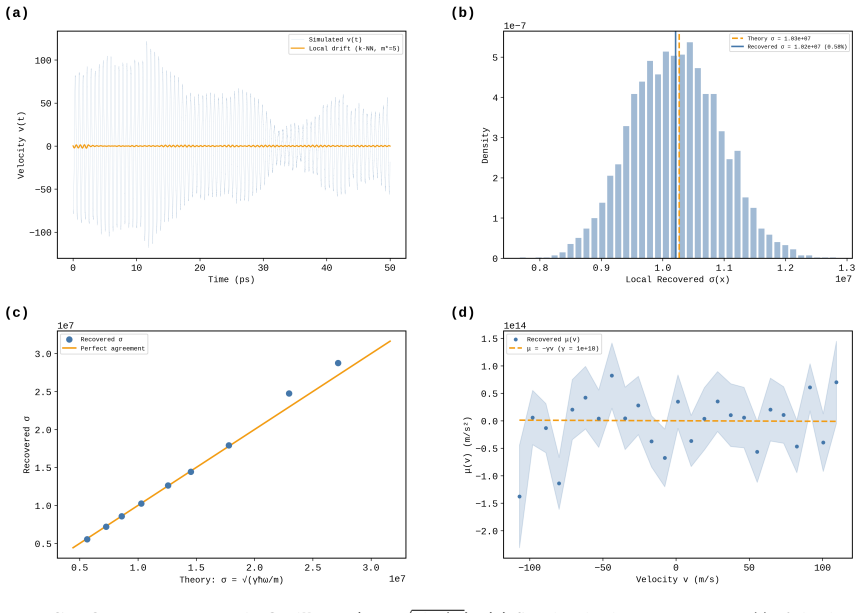
A generalisation of Takens' delay-coordinate embedding theorem to stochastic systems, the Stochastic Embedding Sufficiency Theorem, is an inverse methodology enabling non-parametric recovery of both drift and diffusion fields from scalar time series without prior assumptions about the governing physics. A blind protocol using only time series data is applied to nine domains: classical mechanics, statistical mechanics, nuclear physics, quantum mechanics, chemical kinetics, electromagnetism, relativistic quantum mechanics, quantum harmonic oscillator dynamics, and quantum electrodynamics. Fundamental constants (the Boltzmann constant, the Planck constant, the speed of light, the Fano factor, and the Van Kampen scaling exponent) emerge in both drift and diffusion channels without prior specification. The recovered diffusion coefficients, viewed across domains, constitute an empirical pattern, the $\sigma$-continuum, in which $k_B$, $\hbar$, and $c$ play structurally distinct roles. The Gravitational Diffusion Theorem, derived from the fluctuation-dissipation theorem, massless mode structure of linearised gravity, and gravitational self-coupling via the equivalence principle, determines the gravitational diffusion coefficient as one Planck length per square root of Planck time. Four canonical axioms formalise the framework, within which the noise character, drift, covariance operator, and fluctuation amplitude are uniquely determined by theorem, yielding the superspace diffusion hypothesis: $\mathrm{d}g_{ij} = \mathcal{D}_{ij}[g]\,\mathrm{d}\tau + \ell_P\,\mathrm{d}W_{ij}$ where all coefficients are non-parametric, first-principles consequences of the axioms. An implication of the hypothesis is that coarse-graining of the superspace Fokker-Planck equation via Mori-Zwanzig projection yields predictions for galactic-scale gravitational acceleration testable against kinematic data.
Figures


Figures from the paper (6 more)




Lean theorems connected to this paper
-
IndisputableMonolith/Cost/FunctionalEquation.leanwashburn_uniqueness_aczel unclear?
unclearRelation between the paper passage and the cited Recognition theorem.
The Gravitational Diffusion Theorem, derived from the fluctuation–dissipation theorem, the massless mode structure of linearised gravity, and gravitational self-coupling via the equivalence principle, determines the gravitational diffusion coefficient as one Planck length per square root of Planck time
-
IndisputableMonolith/Foundation/RealityFromDistinction.leanreality_from_one_distinction unclear?
unclearRelation between the paper passage and the cited Recognition theorem.
Four canonical axioms formalise the framework... yielding the superspace diffusion hypothesis: dg_ij = D_ij[g] dτ + ℓ_P dW_ij
What do these tags mean?
- matches
- The paper's claim is directly supported by a theorem in the formal canon.
- supports
- The theorem supports part of the paper's argument, but the paper may add assumptions or extra steps.
- extends
- The paper goes beyond the formal theorem; the theorem is a base layer rather than the whole result.
- uses
- The paper appears to rely on the theorem as machinery.
- contradicts
- The paper's claim conflicts with a theorem or certificate in the canon.
- unclear
- Pith found a possible connection, but the passage is too broad, indirect, or ambiguous to say the theorem truly supports the claim.
Reference graph
Works this paper leans on
-
[1]
Abarbanel,Analysis of Observed Chaotic Data, Springer-Verlag, New York, 1996
H.D.I. Abarbanel,Analysis of Observed Chaotic Data, Springer-Verlag, New York, 1996
work page 1996
-
[2]
Y. Aït-Sahalia, J. Jacod,Estimating the degree of activity of jumps in high frequency data, The Annals of Statistics37(5A) (2009) 2202–2244
work page 2009
-
[3]
F. Bach,On the equivalence between kernel quadrature rules and random feature expansions, Journal of Machine Learning Research18(21) (2017) 1–38
work page 2017
-
[4]
L. Barreira, Y. Pesin,Dimension and Recurrence in Hyperbolic Dynamics, Progress in Mathematics272(Birkhäuser, Basel, 2008)
work page 2008
- [5]
- [6]
-
[7]
L. Boninsegna, F. Nüske, C. Clementi,Sparse learning of stochastic dynamical equations, Journal of Chemical Physics148(24) (2018) 241723
work page 2018
-
[8]
J. Botvinick-Greenhouse, R. Martin, Y. Yang,Invariant Measures in Time-Delay Coordi- nates for Unique Dynamical System Identification, Physical Review Letters135(16) (2025) 068301
work page 2025
Show all 99 references
-
[9]
Bouchaud, M
J.-P. Bouchaud, M. Potters,Theory of Financial Risk and Derivative Pricing: From Sta- tistical Physics to Risk Management, 2nd edition, Cambridge University Press, Cambridge, 2009
2009
-
[10]
Breakspear,Dynamic models of large-scale brain activity, Nature Neuroscience20(3) (2017) 340–352
M. Breakspear,Dynamic models of large-scale brain activity, Nature Neuroscience20(3) (2017) 340–352
2017
-
[11]
Broomhead, G.P
D.S. Broomhead, G.P. King,Extracting qualitative dynamics from experimental data, Phys- ica D: Nonlinear Phenomena20(2–3) (1986) 217–236
1986
-
[12]
Brezis,Functional Analysis, Sobolev Spaces and Partial Differential Equations, Springer, New York, 2011
H. Brezis,Functional Analysis, Sobolev Spaces and Partial Differential Equations, Springer, New York, 2011
2011
-
[13]
Brunton, B.W
S.L. Brunton, B.W. Brunton, J.L. Proctor, J.N. Kutz,Koopman invariant subspaces and finite linear representations of nonlinear dynamical systems for control, PLoS ONE11(2) (2016) e0150171
2016
-
[14]
Budišić, R
M. Budišić, R. Mohr, I. Mezić,Applied Koopmanism, Chaos: An Interdisciplinary Journal of Nonlinear Science22(4) (2012) 047510
2012
-
[15]
Casdagli,Nonlinear prediction of chaotic time series, Physica D: Nonlinear Phenomena 35(3) (1989) 335–356
M. Casdagli,Nonlinear prediction of chaotic time series, Physica D: Nonlinear Phenomena 35(3) (1989) 335–356
1989
-
[16]
R.T.Q. Chen, Y. Rubanova, J. Bettencourt, D.K. Duvenaud,Neural ordinary differential equations, in: Advances in Neural Information Processing Systems 31 (NeurIPS 2018), 2018, pp. 6571–6583
2018
-
[17]
Chorin, O.H
A.J. Chorin, O.H. Hald, R. Kupferman,Optimal prediction and the Mori-Zwanzig repre- sentation of irreversible processes, Proceedings of the National Academy of Sciences97(7) (2000) 2968–2973
2000
-
[18]
Cont,Empirical properties of asset returns: Stylized facts and statistical issues, Quanti- tative Finance1(2) (2001) 223–236
R. Cont,Empirical properties of asset returns: Stylized facts and statistical issues, Quanti- tative Finance1(2) (2001) 223–236
2001
-
[19]
T.M.Cover, J.A.Thomas,Elements of Information Theory, 2ndedition, Wiley-Interscience, Hoboken, NJ, 2006
2006
-
[20]
Dakos, S.R
V. Dakos, S.R. Carpenter, W.A. Brock, A.M. Ellison, V. Guttal, A.R. Ives, S. Kéfi, V. Livina, D.A. Seekell, E.H. van Nes, M. Scheffer,Methods for detecting early warnings of critical transitions in time series illustrated using simulated ecological data, PLoS ONE7(7) (2012) e41010
2012
-
[21]
Deco, V.K
G. Deco, V.K. Jirsa, P.A. Robinson, M. Breakspear, K. Friston,The dynamic brain: From spiking neurons to neural masses and cortical fields, PLoS Computational Biology4(8) (2008) e1000092
2008
-
[22]
Dijkstra,Nonlinear Climate Dynamics, Cambridge University Press, Cambridge, 2013
H.A. Dijkstra,Nonlinear Climate Dynamics, Cambridge University Press, Cambridge, 2013. Supplemental Material: Stochastic Embedding Sufficiency Theorem 91
2013
-
[23]
Duvenaud, H
D. Duvenaud, H. Nickisch, C.E. Rasmussen,Additive Gaussian processes, in: Advances in Neural Information Processing Systems (NeurIPS), 2011, pp. 226–234
2011
-
[24]
Eckmann, D
J.-P. Eckmann, D. Ruelle,Ergodic theory of chaos and strange attractors, Reviews of Mod- ern Physics57(3) (1985) 617–656
1985
-
[25]
Emery,Stochastic Calculus in Manifolds(Springer-Verlag, Berlin, 1989)
M. Emery,Stochastic Calculus in Manifolds(Springer-Verlag, Berlin, 1989)
1989
-
[26]
Falconer,Fractal Geometry: Mathematical Foundations and Applications, 3rd edition, John Wiley & Sons, Chichester, 2014
K. Falconer,Fractal Geometry: Mathematical Foundations and Applications, 3rd edition, John Wiley & Sons, Chichester, 2014
2014
-
[27]
Farmer, E
J.D. Farmer, E. Ott, J.A. Yorke,The dimension of chaotic attractors, Physica D: Nonlinear Phenomena7(1–3) (1983) 153–180
1983
-
[28]
Farmer, J.J
J.D. Farmer, J.J. Sidorowich,Predicting chaotic time series, Physical Review Letters59(8) (1987) 845–848
1987
-
[29]
Federer,Geometric Measure Theory, Springer-Verlag, New York, 1969
H. Federer,Geometric Measure Theory, Springer-Verlag, New York, 1969
1969
-
[30]
G. B. Folland,Real Analysis: Modern Techniques and Their Applications, 2nd ed., Wiley, New York, 1999
1999
-
[31]
Fraser, H.L
A.M. Fraser, H.L. Swinney,Independent coordinates for strange attractors from mutual information, Physical Review A33(2) (1986) 1134–1140
1986
-
[32]
Frisch,Turbulence: The Legacy of A.N
U. Frisch,Turbulence: The Legacy of A.N. Kolmogorov, Cambridge University Press, Cam- bridge, 1995
1995
-
[33]
Ghil, M.D
M. Ghil, M.D. Chekroun, E. Simonnet,Climate dynamics and fluid mechanics: Natural variability and related uncertainties, Physica D: Nonlinear Phenomena237(14–17) (2008) 2111–2126
2008
-
[34]
Givon, R
D. Givon, R. Kupferman, A. Stuart,Extracting macroscopic dynamics: Model problems and algorithms, Nonlinearity17(6) (2004) R55–R127
2004
-
[35]
Grassberger, I
P. Grassberger, I. Procaccia,Measuring the strangeness of strange attractors, Physica D: Nonlinear Phenomena9(1–2) (1983) 189–208
1983
-
[36]
Grassberger, I
P. Grassberger, I. Procaccia,Characterization of strange attractors, Physical Review Letters 50(5) (1983) 346–349
1983
-
[37]
Guckenheimer, P
J. Guckenheimer, P. Holmes,Nonlinear Oscillations, Dynamical Systems, and Bifurcations of Vector Fields, Springer-Verlag, New York, 1983
1983
-
[38]
Györfi, M
L. Györfi, M. Kohler, A. Krzyżak, H. Walk,A Distribution-Free Theory of Nonparametric Regression, Springer-Verlag, New York, 2002
2002
-
[39]
Hairer,On Malliavin’s proof of Hörmander’s theorem, Bulletin des Sciences Mathéma- tiques135(6–7) (2011) 650–666
M. Hairer,On Malliavin’s proof of Hörmander’s theorem, Bulletin des Sciences Mathéma- tiques135(6–7) (2011) 650–666
2011
-
[40]
Hasselmann,Stochastic climate models Part I
K. Hasselmann,Stochastic climate models Part I. Theory, Tellus28(6) (1976) 473–485
1976
-
[41]
Hirsch,Differential Topology, Graduate Texts in Mathematics33(Springer, New York, 1976)
M.W. Hirsch,Differential Topology, Graduate Texts in Mathematics33(Springer, New York, 1976)
1976
-
[42]
Hörmander,Hypoelliptic second order differential equations, Acta Mathematica119(1) (1967) 147–171
L. Hörmander,Hypoelliptic second order differential equations, Acta Mathematica119(1) (1967) 147–171. Supplemental Material: Stochastic Embedding Sufficiency Theorem 92
1967
-
[43]
Hsu,Stochastic Analysis on Manifolds(American Mathematical Society, Providence, RI, 2002)
E.P. Hsu,Stochastic Analysis on Manifolds(American Mathematical Society, Providence, RI, 2002)
2002
-
[44]
almost every
B.R. Hunt, T. Sauer, J.A. Yorke,Prevalence: a translation-invariant “almost every” on infinite-dimensional spaces, Bull. Amer. Math. Soc. (N.S.)27, 217–238 (1992)
1992
-
[45]
echo state
H. Jaeger,The "echo state" approach to analysing and training recurrent neural networks, GMD Report 148, German National Research Center for Information Technology, 2001
2001
-
[46]
Kantz, T
H. Kantz, T. Schreiber,Nonlinear Time Series Analysis, 2nd edition, Cambridge University Press, Cambridge, 2004
2004
-
[47]
Karatzas, S.E
I. Karatzas, S.E. Shreve,Brownian Motion and Stochastic Calculus, 2nd edition, Springer- Verlag, New York, 1991
1991
-
[48]
Katok, B
A. Katok, B. Hasselblatt,Introduction to the Modern Theory of Dynamical Systems, Cam- bridge University Press, Cambridge, 1995
1995
-
[49]
Kennel, R
M.B. Kennel, R. Brown, H.D.I. Abarbanel,Determining embedding dimension for phase- space reconstruction using a geometrical construction, PhysicalReviewA45(6)(1992)3403– 3411
1992
-
[50]
Kidger, J
P. Kidger, J. Morrill, J. Foster, T. Lyons,Neural controlled differential equations for irregu- lar time series, in: Advances in Neural Information Processing Systems 33 (NeurIPS 2020), 2020, pp. 6696–6707
2020
-
[51]
Kunita,Stochastic Flows and Stochastic Differential Equations(Cambridge University Press, Cambridge, 1990)
H. Kunita,Stochastic Flows and Stochastic Differential Equations(Cambridge University Press, Cambridge, 1990)
1990
-
[52]
J.N.Kutz, S.L.Brunton, B.W.Brunton, J.L.Proctor,Dynamic Mode Decomposition: Data- Driven Modeling of Complex Systems, SIAM, Philadelphia, 2016
2016
-
[53]
Lehnertz, R.G
K. Lehnertz, R.G. Andrzejak, J. Arnhold, T. Kreuz, F. Mormann, C. Rieke, G. Widman, C.E. Elger,Nonlinear EEG analysis in epilepsy: Its possible use for interictal focus localiza- tion, seizure anticipation, and prevention, Journal of Clinical Neurophysiology18(3) (2001) 209–222
2001
-
[54]
Part I: Characterization of measures satisfying Pesin’s entropy formula, Ann
F.Ledrappier, L.-S.Young,The metric entropy of diffeomorphisms. Part I: Characterization of measures satisfying Pesin’s entropy formula, Ann. Math.122, 509–539 (1985)
1985
-
[55]
Ledrappier, L.-S
F. Ledrappier, L.-S. Young,The metric entropy of diffeomorphisms. Part II: Relations between entropy, exponents and dimension, Ann. Math.122, 540–574 (1985)
1985
-
[56]
Léandre,Minoration en temps petit de la densité d’une diffusion dégénérée, J
R. Léandre,Minoration en temps petit de la densité d’une diffusion dégénérée, J. Funct. Anal.74, 399–414 (1987)
1987
-
[57]
Li, T.-K
X. Li, T.-K. Wong, R.T.Q. Chen, D. Duvenaud,Scalable gradients for stochastic differential equations, in: Proceedings of the 23rd International Conference on Artificial Intelligence and Statistics (AISTATS 2020), 2020, pp. 3870–3882
2020
-
[58]
Lorenz,Deterministic nonperiodic flow, Journal of the Atmospheric Sciences20(2) (1963) 130–141
E.N. Lorenz,Deterministic nonperiodic flow, Journal of the Atmospheric Sciences20(2) (1963) 130–141
1963
-
[59]
Lukoševičius, H
M. Lukoševičius, H. Jaeger,Reservoir computing approaches to recurrent neural network training, Computer Science Review3(3) (2009) 127–149. Supplemental Material: Stochastic Embedding Sufficiency Theorem 93
2009
-
[60]
Malkov, D.A
Y.A. Malkov, D.A. Yashunin,Efficient and robust approximate nearest neighbor search using Hierarchical Navigable Small World graphs, IEEE Transactions on Pattern Analysis and Machine Intelligence42(4) (2020) 824–836
2020
-
[61]
Malliavin,Stochastic Analysis, Springer-Verlag, Berlin, 1997
P. Malliavin,Stochastic Analysis, Springer-Verlag, Berlin, 1997
1997
-
[62]
Mattila,Geometry of Sets and Measures in Euclidean Spaces: Fractals and Rectifiability, Cambridge University Press, Cambridge, 1995
P. Mattila,Geometry of Sets and Measures in Euclidean Spaces: Fractals and Rectifiability, Cambridge University Press, Cambridge, 1995
1995
-
[63]
Meiss,Differential Dynamical Systems, SIAM, Philadelphia, 2007
J.D. Meiss,Differential Dynamical Systems, SIAM, Philadelphia, 2007
2007
-
[64]
Mezić,Spectral properties of dynamical systems, model reduction and decompositions, Nonlinear Dynamics41(1–3) (2005) 309–325
I. Mezić,Spectral properties of dynamical systems, model reduction and decompositions, Nonlinear Dynamics41(1–3) (2005) 309–325
2005
-
[65]
Montgomery,A Tour of Subriemannian Geometries, Their Geodesics and Applications, Mathematical Surveys and Monographs91(American Mathematical Society, Providence, RI, 2002)
R. Montgomery,A Tour of Subriemannian Geometries, Their Geodesics and Applications, Mathematical Surveys and Monographs91(American Mathematical Society, Providence, RI, 2002)
2002
-
[66]
Nualart,The Malliavin Calculus and Related Topics, 2nd edition, Springer-Verlag, Berlin, 2006
D. Nualart,The Malliavin Calculus and Related Topics, 2nd edition, Springer-Verlag, Berlin, 2006
2006
-
[67]
Øksendal,Stochastic Differential Equations: An Introduction with Applications, 6th ed
B. Øksendal,Stochastic Differential Equations: An Introduction with Applications, 6th ed. (Springer, 2003)
2003
-
[68]
Pavliotis,Stochastic Processes and Applications: Diffusion Processes, the Fokker- Planck and Langevin Equations, Springer, New York, 2014
G.A. Pavliotis,Stochastic Processes and Applications: Diffusion Processes, the Fokker- Planck and Langevin Equations, Springer, New York, 2014
2014
-
[69]
Pesin,Dimension Theory in Dynamical Systems: Contemporary Views and Applica- tions, Chicago Lectures in Mathematics (University of Chicago Press, Chicago, 1997)
Ya.B. Pesin,Dimension Theory in Dynamical Systems: Contemporary Views and Applica- tions, Chicago Lectures in Mathematics (University of Chicago Press, Chicago, 1997)
1997
-
[70]
Petersen,Ergodic Theory, Cambridge University Press, Cambridge, 1983
K. Petersen,Ergodic Theory, Cambridge University Press, Cambridge, 1983
1983
-
[71]
Pope,Turbulent Flows, Cambridge University Press, Cambridge, 2000
S.B. Pope,Turbulent Flows, Cambridge University Press, Cambridge, 2000
2000
-
[72]
Rasmussen, C.K.I
C.E. Rasmussen, C.K.I. Williams,Gaussian Processes for Machine Learning, MIT Press, Cambridge, MA, 2006
2006
-
[73]
Robinson,A topological delay embedding theorem for infinite-dimensional dynamical systems, Nonlinearity18(5) (2005) 2135–2143
J.C. Robinson,A topological delay embedding theorem for infinite-dimensional dynamical systems, Nonlinearity18(5) (2005) 2135–2143
2005
-
[74]
T.Sauer, J.A.Yorke, M.Casdagli,Embedology, JournalofStatisticalPhysics65(3–4)(1991) 579–616
1991
-
[75]
Scheffer, J
M. Scheffer, J. Bascompte, W.A. Brock, V. Brovkin, S.R. Carpenter, V. Dakos, H. Held, E.H. van Nes, M. Rietkerk, G. Sugihara,Early-warning signals for critical transitions, Nature461(7260) (2009) 53–59
2009
-
[76]
Schmid,Dynamic mode decomposition of numerical and experimental data, Journal of Fluid Mechanics656(2010) 5–28
P.J. Schmid,Dynamic mode decomposition of numerical and experimental data, Journal of Fluid Mechanics656(2010) 5–28
2010
-
[77]
Seeger, T
A. Seeger, T. Kakade, and D. Foster. Information consistency of nonparametric Gaussian process methods.IEEE Trans. Inform. Theory, 54(5):2376–2382, 2008
2008
-
[78]
Sparrow,The Lorenz Equations: Bifurcations, Chaos, and Strange Attractors, Springer- Verlag, New York, 1982
C. Sparrow,The Lorenz Equations: Bifurcations, Chaos, and Strange Attractors, Springer- Verlag, New York, 1982
1982
-
[79]
Sreenivasan,Fractals and multifractals in fluid turbulence, Annual Review of Fluid Mechanics23(1) (1991) 539–604
K.R. Sreenivasan,Fractals and multifractals in fluid turbulence, Annual Review of Fluid Mechanics23(1) (1991) 539–604. Supplemental Material: Stochastic Embedding Sufficiency Theorem 94
1991
-
[80]
Stark, D.S
J. Stark, D.S. Broomhead, M.E. Davies, J. Huke,Delay embeddings for forced systems. II. Stochastic forcing, Journal of Nonlinear Science13(6) (2003) 519–577
2003
-
[81]
Steinwart, A
I. Steinwart, A. Christmann,Support Vector Machines, Springer Science & Business Media, 2008
2008
-
[82]
Stone,Consistent nonparametric regression, The Annals of Statistics5(4) (1977) 595– 620
C.J. Stone,Consistent nonparametric regression, The Annals of Statistics5(4) (1977) 595– 620
1977
-
[83]
Strogatz,Nonlinear Dynamics and Chaos: With Applications to Physics, Biology, Chemistry, and Engineering, 2nd edition, Westview Press, Boulder, CO, 2015
S.H. Strogatz,Nonlinear Dynamics and Chaos: With Applications to Physics, Biology, Chemistry, and Engineering, 2nd edition, Westview Press, Boulder, CO, 2015
2015
-
[84]
Stroock, S.R.S
D.W. Stroock, S.R.S. Varadhan,Multidimensional Diffusion Processes, reprint edition, Springer-Verlag, Berlin, 1997
1997
-
[85]
Stroock, S.R.S
D.W. Stroock, S.R.S. Varadhan,On the support of diffusion processes with applications to the strong maximum principle, in: Proceedings of the Sixth Berkeley Symposium on Mathematical Statistics and Probability, Vol. III, Univ. California Press, 1972, pp. 333– 359
1972
-
[86]
Sugihara, R.M
G. Sugihara, R.M. May,Nonlinear forecasting as a way of distinguishing chaos from mea- surement error in time series, Nature344(6268) (1990) 734–741
1990
-
[87]
Detecting Strange Attractors in Turbulence,
F. Takens, “Detecting Strange Attractors in Turbulence,” inDynamical Systems and Tur- bulence, Lecture Notes in Mathematics898, 366–381 (Springer, 1981)
1981
-
[88]
Varadhan,On the behavior of the fundamental solution of the heat equation with variable coefficients, Comm
S.R.S. Varadhan,On the behavior of the fundamental solution of the heat equation with variable coefficients, Comm. Pure Appl. Math.20, 431–455 (1967)
1967
-
[89]
Walters,An Introduction to Ergodic Theory, Springer-Verlag, New York, 1982
P. Walters,An Introduction to Ergodic Theory, Springer-Verlag, New York, 1982
1982
-
[90]
Wasserman,All of Nonparametric Statistics, Springer-Verlag, New York, 2006
L. Wasserman,All of Nonparametric Statistics, Springer-Verlag, New York, 2006
2006
-
[91]
Wiggins,Introduction to Applied Nonlinear Dynamical Systems and Chaos, 2nd edition, Springer-Verlag, New York, 2003
S. Wiggins,Introduction to Applied Nonlinear Dynamical Systems and Chaos, 2nd edition, Springer-Verlag, New York, 2003
2003
-
[92]
Williams, I.G
M.O. Williams, I.G. Kevrekidis, C.W. Rowley,A data-driven approximation of the Koop- man operator: Extending dynamic mode decomposition, Journal of Nonlinear Science25(6) (2015) 1307–1346
2015
-
[93]
L.-S.Young,Dimension, entropy and Lyapunov exponents, ErgodicTheoryDynam.Systems 2, 109–124 (1982)
1982
-
[94]
Practical method for determining the minimum embedding dimension of a scalar time series,
L. Cao, “Practical method for determining the minimum embedding dimension of a scalar time series,”Physica D110, 43–50 (1997)
1997
-
[95]
C. W. Gardiner,Stochastic Methods: A Handbook for the Natural and Social Sciences, 4th ed. (Springer, Berlin, 2009)
2009
-
[96]
Zwanzig,Nonequilibrium Statistical Mechanics, Oxford University Press, Oxford, 2001
R. Zwanzig,Nonequilibrium Statistical Mechanics, Oxford University Press, Oxford, 2001
2001
-
[97]
Fan and I
J. Fan and I. Gijbels,Local Polynomial Modelling and Its Applications, Chapman & Hall, London, 1996
1996
-
[98]
Bias reduction in nonparametric diffusion coefficient estimation,
J. Nicolau, “Bias reduction in nonparametric diffusion coefficient estimation,”Econometric Theory19(5), 754–777 (2003)
2003
-
[99]
On estimating the diffusion coefficient from discrete observations,
D. Florens-Zmirou, “On estimating the diffusion coefficient from discrete observations,”J. Appl. Probab.30(4), 790–804 (1993)
1993
Reviewed May 15, 2026 · model on record in the stance chip above.
Discussion (0). Continue with ORCID to comment.