Recognition: 2 theorem links
· Lean TheoremSupercurrent-Driven N\'eel Torque in Superconductor/Altermagnet Hybrids
Pith reviewed 2026-05-15 00:45 UTC · model grok-4.3
The pith
Supercurrent in a superconductor-altermagnet heterostructure generates a tunable Néel spin-orbit torque through spin-triplet correlations.
A machine-rendered reading of the paper's core claim, the machinery that carries it, and where it could break.
Core claim
We predict a supercurrent-driven Néel spin-orbit torque in a superconductor/d-wave altermagnet heterostructure, associated with the emergence of spin-triplet correlations. The supercurrent-induced spin polarization, owing to the interplay between spin-orbit coupling and momentum-dependent spin splitting, allows the supercurrent to be tuned by the Néel-vector direction and enables the torque to propel magnetic domain walls and reverse the Néel-vector orientation within a domain wall.
What carries the argument
Supercurrent-induced spin polarization arising from the interplay of spin-orbit coupling and altermagnet spin splitting, which generates Néel torque via spin-triplet correlations at the interface.
If this is right
- The supercurrent can be tuned by the direction of the Néel vector.
- The torque can propel magnetic domain walls.
- The torque can reverse the Néel-vector orientation within a domain wall.
- This establishes superconductor/altermagnet heterostructures as a platform for dissipationless control of the Néel vector.
Where Pith is reading between the lines
- Such systems could enable low-power racetrack memory devices based on superconducting currents.
- Similar torque effects might be explored in other superconductor-spin-split material hybrids for unconventional computing.
- Experimental tests could involve applying currents and measuring domain wall dynamics in specific altermagnetic materials paired with superconductors.
Load-bearing premise
That spin-triplet correlations emerge at the superconductor-altermagnet interface and interact with the spin-orbit coupling to produce the predicted torque.
What would settle it
Observation of supercurrent dependence on Néel vector orientation or direct measurement of domain wall propulsion under supercurrent in a fabricated heterostructure would confirm or refute the claim.
Figures
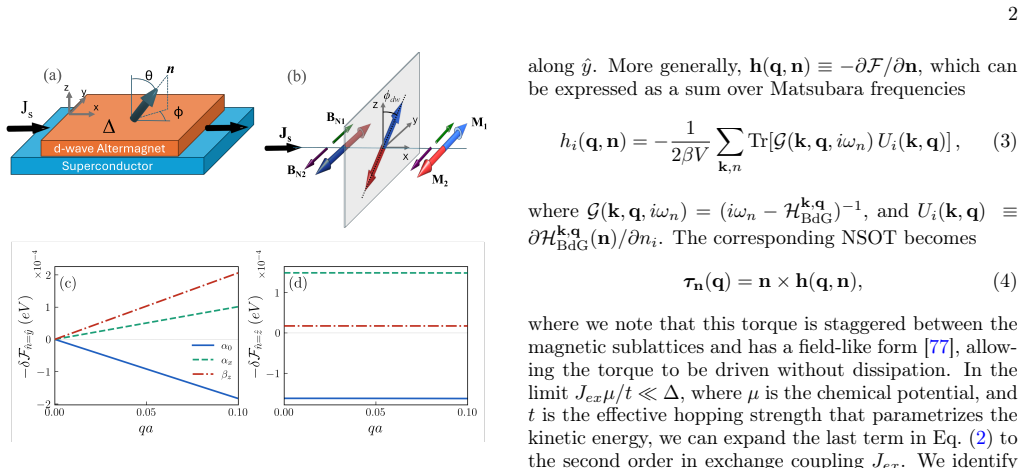


read the original abstract
We predict a supercurrent-driven N\'eel spin-orbit torque in a superconductor/$d$-wave altermagnet heterostructure, associated with the emergence of spin-triplet correlations. The effect can be understood as a consequence of the supercurrent-induced spin polarization, owing to the interplay between spin-orbit coupling and momentum-dependent spin splitting, as found, for example, in altermagnets. Remarkably, the supercurrent can be tuned by the N\'eel-vector direction, and the supercurrent-induced torque can both propel magnetic domain walls and reverse the N\'eel-vector orientation within a domain wall. These findings establish superconductor/altermagnet heterostructures as a versatile platform for the dissipationless control of the N\'eel vector, with potential applications in racetrack memory, dissipationless superconducting electronics, and unconventional computing.
Editorial analysis
A structured set of objections, weighed in public.
Referee Report
Summary. The manuscript predicts a supercurrent-driven Néel spin-orbit torque in superconductor/d-wave altermagnet heterostructures arising from proximity-induced spin-triplet correlations. The torque originates from supercurrent-induced spin polarization due to the interplay of spin-orbit coupling and the momentum-dependent spin splitting of the altermagnet. The supercurrent amplitude is tunable by the Néel-vector direction, and the resulting torque is shown to propel magnetic domain walls and enable reversal of the Néel-vector orientation inside a domain wall, positioning these hybrids for dissipationless Néel-vector control.
Significance. If the central prediction holds, the work establishes a new route to dissipationless electrical control of antiferromagnetic order via superconducting currents in altermagnet hybrids. This is significant for racetrack memory, low-dissipation spintronics, and hybrid superconducting devices, as it leverages the recently recognized altermagnetic spin splitting to generate spin-triplet pairing and a net torque without external magnetic fields.
major comments (3)
- [§3] §3 (BdG model and interface): The torque derivation assumes a perfectly transparent interface and clean-limit d-wave altermagnetic term in the Bogoliubov-de Gennes Hamiltonian; no calculation of the triplet amplitude or torque for finite barrier strength or weak disorder is presented, leaving open whether the effect survives realistic interface conditions.
- [§4] §4 (torque and domain-wall results): The claim that the supercurrent-induced torque can reverse the Néel vector inside a domain wall is stated qualitatively; no explicit estimate of the torque magnitude relative to anisotropy or damping, nor any Landau-Lifshitz-Gilbert simulation, is provided to confirm reversal is possible within the model's parameter range.
- [§4] §4, Fig. 3 (parameter dependence): The supercurrent and torque are shown only for a single set of altermagnetic exchange and SOC values; a scan demonstrating that the torque remains finite and sign-consistent over a reasonable range of these parameters is required to support the robustness of the predicted domain-wall propulsion.
minor comments (2)
- [Abstract and §2] The abstract and introduction use 'd-wave altermagnet' without specifying whether this denotes a particular lattice symmetry or a general even-parity spin-splitting form; a brief clarification in §2 would aid readers.
- [Throughout] Notation for the Néel vector (n) and supercurrent (J_s) should be checked for consistency between equations and figure captions.
Simulated Author's Rebuttal
We thank the referee for the positive evaluation and insightful comments, which have helped us improve the manuscript. We address each major comment point by point below, indicating revisions made where appropriate.
read point-by-point responses
-
Referee: [§3] §3 (BdG model and interface): The torque derivation assumes a perfectly transparent interface and clean-limit d-wave altermagnetic term in the Bogoliubov-de Gennes Hamiltonian; no calculation of the triplet amplitude or torque for finite barrier strength or weak disorder is presented, leaving open whether the effect survives realistic interface conditions.
Authors: We agree that the derivation is performed in the clean limit with a transparent interface, which is the standard starting point for such microscopic predictions. The torque arises from proximity-induced spin-triplet correlations enabled by the altermagnetic spin splitting and SOC; analogous effects in superconductor-ferromagnet hybrids remain robust for moderate barrier strengths. In the revised manuscript we have added a dedicated paragraph in §3 discussing these assumptions, citing related literature on interface transparency, and explicitly noting that quantitative studies with finite barriers or weak disorder are left for future work. revision: partial
-
Referee: [§4] §4 (torque and domain-wall results): The claim that the supercurrent-induced torque can reverse the Néel vector inside a domain wall is stated qualitatively; no explicit estimate of the torque magnitude relative to anisotropy or damping, nor any Landau-Lifshitz-Gilbert simulation, is provided to confirm reversal is possible within the model's parameter range.
Authors: The reversal is inferred from the torque direction (perpendicular to the Néel vector) and its magnitude relative to the domain-wall energy scale. In the revised manuscript we have added an order-of-magnitude estimate in §4 comparing the supercurrent-induced torque to typical anisotropy fields in d-wave altermagnets, showing that reversal becomes energetically favorable above a threshold current density achievable in these hybrids. Full micromagnetic LLG simulations lie beyond the scope of the present microscopic theory paper but are now explicitly suggested as future work. revision: partial
-
Referee: [§4] §4, Fig. 3 (parameter dependence): The supercurrent and torque are shown only for a single set of altermagnetic exchange and SOC values; a scan demonstrating that the torque remains finite and sign-consistent over a reasonable range of these parameters is required to support the robustness of the predicted domain-wall propulsion.
Authors: We agree that a parameter scan strengthens the robustness claim. In the revised manuscript we have added a new panel to Fig. 3 (and corresponding discussion in §4) showing the torque amplitude and sign as functions of the altermagnetic exchange strength J and SOC parameter λ over a representative range (J/Δ from 0.05 to 0.5 and λ from 0.01 to 0.2). The torque remains finite and sign-consistent throughout this window, confirming that domain-wall propulsion is not restricted to the specific parameter choice originally presented. revision: yes
Circularity Check
No significant circularity; derivation from BdG model is self-contained
full rationale
The paper presents a theoretical prediction of supercurrent-driven Néel torque arising from the interplay of established mechanisms (supercurrent-induced spin polarization, SOC, and d-wave altermagnetic splitting) solved via Bogoliubov-de Gennes equations at the interface. No load-bearing step reduces by construction to a fitted parameter renamed as prediction, a self-citation chain, or a self-definitional ansatz. The central result follows from the model's assumptions about clean-limit pairing and interface transparency rather than from re-deriving its own inputs. External benchmarks (standard proximity-effect theory) remain independent of the target torque expression.
Axiom & Free-Parameter Ledger
axioms (2)
- domain assumption Spin-triplet correlations emerge in the superconductor/altermagnet heterostructure
- domain assumption Supercurrent induces spin polarization through spin-orbit coupling and momentum-dependent spin splitting
Lean theorems connected to this paper
-
IndisputableMonolith/Cost/FunctionalEquation.leanwashburn_uniqueness_aczel unclear?
unclearRelation between the paper passage and the cited Recognition theorem.
We use the Bogoliubov–de Gennes (BdG) theory... finite-q BdG Hamiltonian Hk,q BdG(n) = ... F(q,n) = Fsc − 1/2βV Σ Tr ln(iωn − Hk,q BdG(n))
-
IndisputableMonolith/Foundation/BranchSelection.leanbranch_selection unclear?
unclearRelation between the paper passage and the cited Recognition theorem.
leading order expansion ... F(1)(q,n) = Jex γ(qx ny + qy nx) ... F(2)(q,n) = −J²ex Az n²z
What do these tags mean?
- matches
- The paper's claim is directly supported by a theorem in the formal canon.
- supports
- The theorem supports part of the paper's argument, but the paper may add assumptions or extra steps.
- extends
- The paper goes beyond the formal theorem; the theorem is a base layer rather than the whole result.
- uses
- The paper appears to rely on the theorem as machinery.
- contradicts
- The paper's claim conflicts with a theorem or certificate in the canon.
- unclear
- Pith found a possible connection, but the passage is too broad, indirect, or ambiguous to say the theorem truly supports the claim.
Reference graph
Works this paper leans on
-
[1]
J. Krempaský, L. Šmejkal, S. W. D’Souza, M. Ha- jlaoui, G. Springholz, K. Uhliřová, F. Alarab, P. C. Constantinou, V. Strocov, D. Usanov, W. R. Pudelko, R. González-Hernández, A. Birk Hellenes, Z. Jansa, H. Reichlová, Z. Šobáň, R. D. Gonzalez Betancourt, P. Wadley, J. Sinova, D. Kriegner, J. Minár, J. H. Dil, andT.Jungwirth,AltermagneticliftingofKramerssp...
work page 2024
-
[2]
Y.-P. Zhu, X. Chen, X.-R. Liu, Y. Liu, P. Liu, H. Zha, G. Qu, C. Hong, J. Li, Z. Jiang,et al., Observation of plaid-like spin splitting in a noncoplanar antiferromag- net, Nature626, 523 (2024)
work page 2024
-
[3]
R. Yamada, M. T. Birch, P. R. Baral, S. Okumura, R. Nakano, S. Gao, M. Ezawa, T. Nomoto, J. Masell, Y. Ishihara, K. K. Kolincio, I. Belopolski, H. Sagayama, H. Nakao, K. Ohishi, T. Ohhara, R. Kiyanagi, T. Naka- jima, Y. Tokura, T.-h. Arima, Y. Motome, M. M. Hirschmann, and M. Hirschberger, A metallic p-wave magnet with commensurate spin helix, Nature646, ...
work page 2025
-
[4]
Q. Song, S. Stavrić, P. Barone, A. Droghetti, D. S. An- tonenko, J. W. F. Venderbos, C. A. Occhialini, B. Ilyas, E. Ergeçen, N. Gedik, S.-W. Cheong, R. M. Fernandes, S. Picozzi, and R. Comin, Electrical switching of ap- wave magnet, Nature642, 64 (2025)
work page 2025
- [5]
-
[6]
L. Šmejkal, R. Gonzalez-Hernandez, T. Jungwirth, and J. Sinova, Crystal time-reversal symmetry breaking and spontaneous Hall effect in collinear antiferromagnets, Sci. Adv.6, eaaz8809 (2020)
work page 2020
-
[7]
M. Naka, S. Hayami, H. Kusunose, Y. Yanagi, Y. Mo- tome, and H. Seo, Spin current generation in organic antiferromagnets, Nat. Commun.10, 4305 (2019)
work page 2019
-
[8]
L. M. Sandratski, R. F. Egorov, and A. A. Berdy- shev, Energy Band Structure and Electronic Properties of NiAs Type Compounds II. Antiferromagnetic Man- ganese Telluride, phys. stat. sol. (b)103, 511 (1981)
work page 1981
-
[9]
I. I.Mazin, K. Koepernik, M.D.Johannes, R.González- Hernández, and L. Šmejkal, Prediction of unconven- tional magnetism in doped FeSb2, Proc. Natl. Acad. Sci. U.S.A.118, e2108924118 (2021)
work page 2021
-
[10]
L.-D. Yuan, Z. Wang, J.-W. Luo, and A. Zunger, Prediction of low-Z collinear and noncollinear antifer- romagnetic compounds having momentum-dependent spin splitting even without spin-orbit coupling, Phys. Rev. Mater.5, 014409 (2021)
work page 2021
-
[11]
L.-D. Yuan, Z. Wang, J.-W. Luo, E. I. Rashba, and A. Zunger, Giant momentum-dependent spin splitting in centrosymmetric low-zantiferromagnets, Phys. Rev. B102, 014422 (2020)
work page 2020
-
[12]
H.-Y. Ma, M. Hu, N. Li, J. Liu, W. Yao, J.-F. Jia, and J. Liu, Multifunctional antiferromagnetic materials with giant piezomagnetism and noncollinear spin cur- rent, Nat. Commun.12, 2846 (2021)
work page 2021
-
[13]
L. Šmejkal, J. Sinova, and T. Jungwirth, Emerging re- search landscape of altermagnetism, Phys. Rev. X12, 040501 (2022)
work page 2022
-
[14]
L. Šmejkal, J. Sinova, and T. Jungwirth, Beyond con- ventional ferromagnetism and antiferromagnetism: A phasewithnonrelativisticspinandcrystalrotationsym- metry, Phys. Rev. X12, 031042 (2022)
work page 2022
-
[15]
Mazin (The PRX Editors), Editorial: Altermagnetism—A new punch line of fundamen- tal magnetism, Phys
I. Mazin (The PRX Editors), Editorial: Altermagnetism—A new punch line of fundamen- tal magnetism, Phys. Rev. X12, 040002 (2022)
work page 2022
- [16]
-
[17]
Q. Liu, X. Dai, and S. Blügel, Different facets of uncon- ventional magnetism, Nat. Phys.21, 329 (2025)
work page 2025
-
[18]
Y. Guo, H. Liu, O. Janson, I. C. Fulga, J. van den Brink, and J. I. Facio, Spin-split collinear antiferromag- nets: A large-scale ab-initio study, Mater. Today Phys. 32, 100991 (2023)
work page 2023
-
[19]
W. F. Brinkman and R. J. Elliott, Theory of spin-space groups, Proc. R. Soc. Lond. A294, 343 (1966)
work page 1966
-
[20]
D. B. Litvin and W. Opechowski, Spin groups, Physica 76, 538 (1974)
work page 1974
-
[21]
L. M. Sandratskii, Classification of single-electron states in a crystal on the basis of spin space groups, Sov. Phys. J.22, 941 (1979)
work page 1979
-
[22]
P. Liu, J. Li, J. Han, X. Wan, and Q. Liu, Spin-group symmetry in magnetic materials with negligible spin- 6 orbit coupling, Phys. Rev. X12, 021016 (2022)
work page 2022
-
[23]
X. Chen, J. Ren, Y. Zhu, Y. Yu, A. Zhang, P. Liu, J. Li, Y. Liu, C. Li, and Q. Liu, Enumeration and represen- tation theory of spin space groups, Phys. Rev. X14, 031038 (2024)
work page 2024
- [24]
- [25]
-
[26]
H. Bai, L. Han, X. Y. Feng, Y. J. Zhou, R. X. Su, Q. Wang, L. Y. Liao, W. X. Zhu, X. Z. Chen, F. Pan, X. L. Fan, and C. Song, Observation of spin splitting torque in a collinear antiferromagnetRuO2, Phys. Rev. Lett.128, 197202 (2022)
work page 2022
-
[27]
A. Bose, N. J. Schreiber, R. Jain, D.-F. Shao, H. P. Nair, J. Sun, X. S. Zhang, D. A. Muller, E. Y. Tsymbal, D. G. Schlom, and D. C. Ralph, Tilted spin current generated by the collinear antiferromagnet ruthenium dioxide, Nat. Electron.5, 267 (2022)
work page 2022
- [28]
- [29]
-
[30]
X. Duan, J. Zhang, Z. Zhu, Y. Liu, Z. Zhang, I. Žutić, and T. Zhou, Antiferroelectric altermagnets: Antiferro- electricity alters magnets, Phys. Rev. Lett.134, 106801 (2025)
work page 2025
-
[31]
M. Gu, Y. Liu, H. Zhu, K. Yananose, X. Chen, Y. Hu, A. Stroppa, and Q. Liu, Ferroelectric switchable alter- magnetism, Phys. Rev. Lett.134, 106802 (2025)
work page 2025
-
[32]
A. Urru, D. Seleznev, Y. Teng, S. Y. Park, S. E. Reyes-Lillo, and K. M. Rabe, G-type antiferromagnetic BiFeO3 is a multiferroicg-wave altermagnet, Phys. Rev. B112, 104411 (2025)
work page 2025
-
[33]
R. M. Fernandes, V. S. de Carvalho, T. Birol, and R. G. Pereira, Topological transition from nodal to nodeless Zeeman splitting in altermagnets, Phys. Rev. B109, 024404 (2024)
work page 2024
-
[34]
D.S.Antonenko, R.M.Fernandes,andJ.W.F.Vender- bos, Mirror Chern bands and Weyl nodal loops in alter- magnets, Phys. Rev. Lett.134, 096703 (2025)
work page 2025
- [35]
-
[36]
Q. Cui, B. Zeng, P. Cui, T. Yu, and H. Yang, Efficient spin Seebeck and spin Nernst effects of magnons in al- termagnets, Phys. Rev. B108, L180401 (2023)
work page 2023
-
[37]
M. Weißenhofer and A. Marmodoro, Atomistic spin dynamics simulations of magnonic spin Seebeck and spin Nernst effects in altermagnets, Phys. Rev. B110, 094427 (2024)
work page 2024
-
[38]
K. V. Yershov, V. P. Kravchuk, M. Daghofer, and J. van den Brink, Fluctuation-induced piezomagnetism in local moment altermagnets, Phys. Rev. B110, 144421 (2024)
work page 2024
-
[39]
K. Wu, J. Dong, M. Zhu, F. Zheng, and J. Zhang, Magnon splitting and magnon spin transport in alter- magnets, Chin. Phys. Lett.42, 070702 (2025)
work page 2025
-
[40]
Thermomagnonic Torques in Insulating Altermagnets
E. Schwartz, H. Vakili, and A. A. Kovalev, The- ory of thermomagnonic torques in altermagnets, arXiv:2512.14660
work page internal anchor Pith review Pith/arXiv arXiv
-
[41]
J. D. Cao, K. S. Denisov, Y. Liu, and I. Žutić, Symmetry Classification for Alternating Excitons in Two-Dimensional Altermagnets, Phys. Rev. Lett.135, 266703 (2025)
work page 2025
-
[42]
Papaj, Andreev reflection at the altermagnetic metal-superconductor interface, Phys
M. Papaj, Andreev reflection at the altermagnetic metal-superconductor interface, Phys. Rev. B108, L060508 (2023)
work page 2023
-
[43]
S. A. A. Ghorashi, T. L. Hughes, and J. Cano, Alter- magnetic routes to Majorana modes in zero net magne- tization, Phys. Rev. Lett.133, 106601 (2024)
work page 2024
-
[44]
J. A. Ouassou, A. Brataas, and J. Linder, dc Joseph- son effect in altermagnets, Phys. Rev. Lett.131, 076003 (2023)
work page 2023
-
[45]
H. G. Giil and J. Linder, Superconductor-altermagnet memory functionality without stray fields, Phys. Rev. B 109, 134511 (2024)
work page 2024
-
[46]
H. G. Giil, B. Brekke, J. Linder, and A. Brataas, Quasi- classical theory of superconducting spin-splitter effects and spin-filtering via altermagnets, Phys. Rev. B110, L140506 (2024)
work page 2024
-
[47]
J.-X. Hu, O. Matsyshyn, and J. C. W. Song, Nonlin- ear superconducting magnetoelectric effect, Phys. Rev. Lett.134, 026001 (2025)
work page 2025
-
[48]
Z. Zhu, R. Huang, X. Chen, Z. Cui, X. Duan, J. Zhang, I. Žutić, and T. Zhou, Altermagnetic proximity effect, Phys. Rev. Lett. 10.1103/kqy8-myz1 (2026), in press
-
[49]
J. Linder and J. W. A. Robinson, Superconducting spin- tronics, Nat. Phys.11, 307 (2015)
work page 2015
-
[50]
Eschrig, Spin-polarized supercurrents for spintron- ics: a review of current progress, Rep
M. Eschrig, Spin-polarized supercurrents for spintron- ics: a review of current progress, Rep. Prog. Phys.78, 104501 (2015)
work page 2015
-
[51]
M. Amundsen, J. Linder, J. W. A. Robinson, I. Žutić, and N. Banerjee, Colloquium: Spin-orbit effects in su- perconducting hybrid structures, Rev. Mod. Phys.96, 021003 (2024)
work page 2024
-
[52]
Ando et al., Observation of superconducting diode effect, Nature584, 373 (2020)
F. Ando et al., Observation of superconducting diode effect, Nature584, 373 (2020)
work page 2020
-
[53]
I. Žutić and S. Das Sarma, Spin-polarized transport and Andreev reflection in semiconductor/superconductor hybrid structures, Phys. Rev. B60, R16322 (1999)
work page 1999
-
[54]
A. I. Buzdin, Proximity effects in superconductor- ferromagnet heterostructures, Rev. Mod. Phys.77, 935 (2005)
work page 2005
-
[55]
F. S. Bergeret, A. F. Volkov, and K. B. Efetov, Odd triplet superconductivity and related phenomena in superconductor-ferromagnet structures, Rev. Mod. Phys.77, 1321 (2005)
work page 2005
-
[56]
V. V. Ryazanov, V. A. Oboznov, A. Y. Rusanov, A. V. Veretennikov, A. A. Golubov, and J. Aarts, Coupling of two superconductors through a ferromagnet: Evidence for aπjunction, Phys. Rev. Lett.86, 2427 (2001)
work page 2001
-
[57]
T. S. Khaire, M. A. Khasawneh, W. P. Pratt, Jr., and N. O. Birge, Observation of spin-triplet superconductiv- ity in Co-based Josephson junctions, Phys. Rev. Lett. 104, 137002 (2010)
work page 2010
-
[58]
O.T.Valls, Superconductor/Ferromagnet Nanostructures (World Scientific, Hackensack, NJ, 2022)
work page 2022
-
[59]
C. Shen, J. E. Han, T. Vezin, M. Alidoust, and I. Žu- 7 tić, Signatures of enhanced spin-triplet superconductiv- ity induced by interfacial properties, Phys. Rev. B110, 104514 (2024)
work page 2024
- [60]
-
[61]
N. Banerjee, J. W. A. Robinson, and M. G. Blamire, Reversible control of spin-polarized supercurrents in fer- romagnetic Josephson junctions, Nat. Commun.5, 4771 (2014)
work page 2014
-
[62]
M. Duckheim and P. W. Brouwer, Andreev reflection from noncentrosymmetric superconductors and Majo- rana bound-state generation in half-metallic ferromag- nets, Phys. Rev. B83, 054513 (2011)
work page 2011
-
[63]
S. Nadj-Perge, I. K. Drozdov, J. Li, H. Chen, S. Jeon, J. Seo, A. H. MacDonald, B. A. Bernevig, and A. Yaz- dani, Observation of Majorana fermions in ferromag- netic atomic chains on a superconductor, Science346, 602 (2014)
work page 2014
-
[64]
G. L. Fatin, A. Matos-Abiague, B. Scharf, and I. Žutić, Wireless Majorana bound states: From magnetic tun- ability to braiding, Phys. Rev. Lett.117, 077002 (2016)
work page 2016
-
[65]
C. González-Ruano, C. Shen, P. Tuero, C. Tiusan, Y. Lu, J. E. Han, I. Žutić, and F. G. Aliev, Gi- ant shot noise in superconductor/ferromagnet junctions with orbital-symmetry-controlled spin-orbit coupling, Nat. Commun.16, 9524 (2025)
work page 2025
-
[66]
U. Güngördü and A. A. Kovalev, Majorana bound stateswithchiralmagnetictextures,J.Appl.Phys.132, 041101 (2022)
work page 2022
-
[67]
A. G. Aronov and Y. B. Lyanda-Geller, Nuclear electric resonance and orientation of carrier spins by an elec- tric field, JETP Lett.50, 431 (1989), [Pis’ma Zh. Eksp. Teor. Fiz. 50, 398–400 (1989)]
work page 1989
-
[68]
V. M. Edelstein, Spin polarization of conduction elec- trons induced by electric current in two-dimensional asymmetric electron systems, Solid State Commun.73, 233 (1990)
work page 1990
-
[69]
L. S. Levitov, Y. V. Nazarov, and G. M. Eliashberg, Magnetoelectric effects in conductors with mirror iso- mer symmetry, Sov. Phys. JETP61, 133 (1985)
work page 1985
-
[70]
V. M. Edelstein, Magnetoelectric effect in polar super- conductors, Phys. Rev. Lett.75, 2004 (1995)
work page 2004
-
[71]
A. Chernyshov, M. Overby, X. Liu, J. K. Furdyna, Y. Lyanda-Geller, and L. P. Rokhinson, Evidence for re- versible control of magnetization in a ferromagnetic ma- terial by means of spin–orbit magnetic field, Nat. Phys. 5, 656 (2009)
work page 2009
-
[72]
P. Högl, A. Matos-Abiague, I. Žutić, and J. Fabian, Magnetoanisotropic Andreev reflection in ferromag- net/superconductor junctions, Phys. Rev. Lett.115, 116601 (2015)
work page 2015
-
[73]
R. Cai, Y. Yao, P. Lv, Y. Ma, W. Xing, B. Li, Y. Ji, H. Zhou, C. Shen, S. Jia, X. C. Xie, I. Žutić, Q.-F. Sun, and W. Han, Evidence for anisotropic spin-triplet Andreev reflection at the 2D van der Waals ferromag- net/superconductor interface, Nat. Commun.12, 6725 (2021)
work page 2021
-
[74]
I. Martinez, P. Högl, C. González-Ruano, J. P. Cas- cales, C. Tiusan, Y. Lu, M. Hehn, A. Matos-Abiague, J.Fabian, I.Žutić,andF.G.Aliev,Interfacialspin-orbit coupling: A platform for superconducting spintronics, Phys. Rev. Applied13, 014030 (2020)
work page 2020
-
[75]
I. M. Miron, K. Garello, G. Gaudin, P.-J. Zermatten, M. V. Costache, S. Auffret, S. Bandiera, B. Rodmacq, A. Schuhl, and P. Gambardella, Perpendicular switch- ing of a single ferromagnetic layer induced by in-plane current injection, Nature476, 189 (2011)
work page 2011
-
[76]
A. Manchon, J. Železný, I. M. Miron, T. Jungwirth, J. Sinova, A. Thiaville, K. Garello, and P. Gambardella, Current-inducedspin-orbittorquesinferromagneticand antiferromagnetic systems, Rev. Mod. Phys.91, 035004 (2019)
work page 2019
-
[77]
E. Y. Tsymbal and I. Žutić, eds., Spintronics Handbook Spin Transport and Magnetism, 2nd Ed. (CRC Press, Taylor & Francis, Boca Raton, FL, 2019)
work page 2019
-
[78]
P. Wadley, B. Howells, J. Železný, C. Andrews, V. Hills, R. P. Campion, V. Novák, K. Olejník, F. Maccherozzi, S. S. Dhesi, S. Y. Martin, T. Wagner, J. Wunderlich, F. Freimuth, Y. Mokrousov, J. Kuneš, J. S. Chauhan, M. J. Grzybowski, A. W. Rushforth, K. W. Edmonds, B. L. Gallagher, and T. Jungwirth, Electrical switching of an antiferromagnet, Science351, 5...
work page 2016
-
[79]
H. Yang, S. O. Valenzuela, M. Chshiev, S. Couet, B. Di- eny, B. Dlubak, A. Fert, K. Garello, M. Jamet, D.- E. Jeong, K. Lee, T. Lee, M.-B. Martin, G. S. Kar, P. Sénéor, H.-J. Shin, and S. Roche, Two-dimensional materials prospects for non-volatile spintronic memo- ries, Nature606, 663 (2022)
work page 2022
- [80]
discussion (0)
Sign in with ORCID, Apple, or X to comment. Anyone can read and Pith papers without signing in.