Recognition: 2 theorem links
· Lean TheoremMIOFlow 2.0: A unified framework for inferring cellular stochastic dynamics from single cell and spatial transcriptomics data
Pith reviewed 2026-05-15 00:12 UTC · model grok-4.3
The pith
MIOFlow 2.0 infers cellular trajectories by modeling stochastic branching, population growth, and spatial niche influences in a shared latent space.
A machine-rendered reading of the paper's core claim, the machinery that carries it, and where it could break.
Core claim
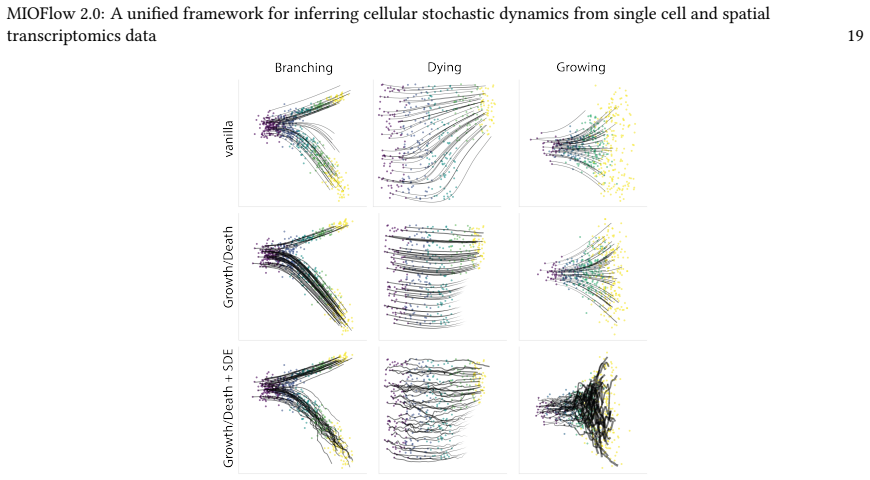
MIOFlow 2.0 learns biologically informed cellular trajectories by integrating manifold learning, optimal transport, and neural differential equations. It models stochasticity and branching via Neural SDEs, non-conservative population changes with a learned growth-rate model initialized by unbalanced optimal transport, and environmental influence through a joint latent space that unifies gene expression with spatial features such as local cell type composition and signaling. The latent space is constructed by a PHATE-distance matching autoencoder so that trajectories respect the data's intrinsic geometry.
What carries the argument
Joint latent space from a PHATE-distance matching autoencoder combined with Neural Stochastic Differential Equations that incorporate learned growth rates for population dynamics and spatial features.
If this is right
- Neural differential equation models for trajectories outperform simulation-free flow matching and other generative baselines on the tested datasets.
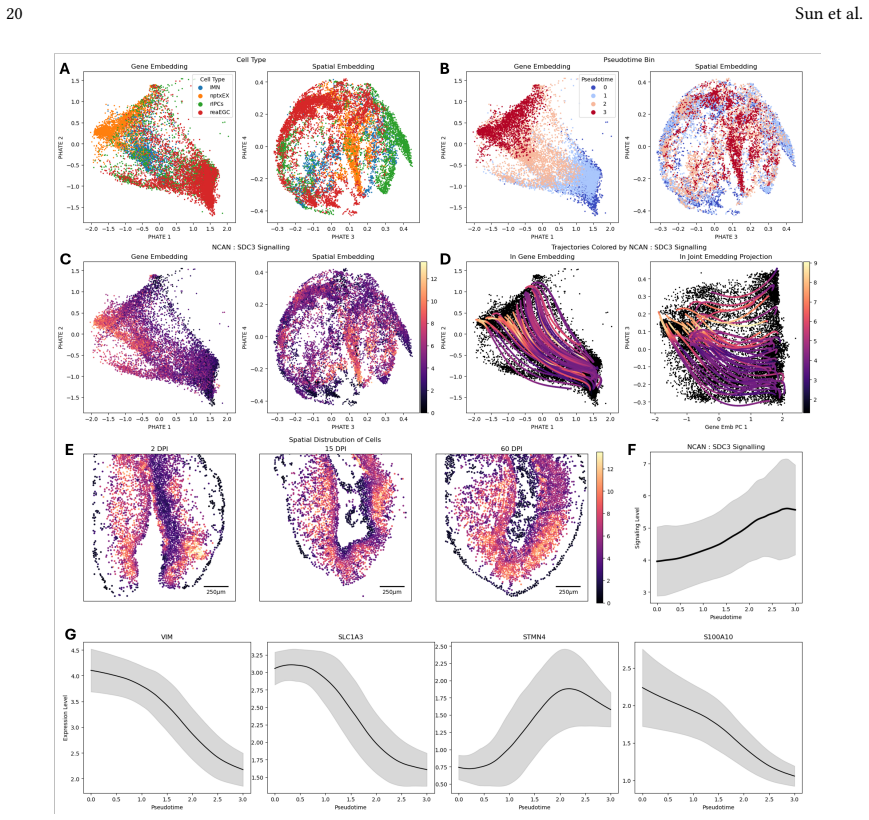
- The framework identifies specific signaling niches as drivers of cellular transitions in spatially resolved data.
- Unbalanced optimal transport initialization enables modeling of non-conservative population changes during differentiation.
- A single latent space unifies single-cell and spatial transcriptomics to recover tissue-scale trajectories.
Where Pith is reading between the lines
- If the stochastic components prove reliable, the model could support in silico perturbation experiments to test how changes in niche signals alter cell fate probabilities.
- The growth-rate module might be adapted to datasets that include explicit cell death or proliferation measurements for more quantitative population forecasts.
- Joint modeling of spatial and expression features suggests the method could generalize to other modalities that combine molecular profiles with positional information.
- Improved trajectory accuracy could help prioritize candidate regulatory genes or ligands for experimental validation in regeneration studies.
Load-bearing premise
The PHATE-distance matching autoencoder latent space accurately captures the data's intrinsic geometry and the neural differential equations faithfully represent the underlying stochastic biological processes.
What would settle it
Predicted trajectories from MIOFlow 2.0 show large mismatches with ground-truth paths on a new synthetic dataset engineered with known stochastic branching and spatial signaling, or the model fails to recover established signaling niches in the axolotl regeneration data.
Figures


read the original abstract
Understanding cellular trajectories via time-resolved single-cell transcriptomics is vital for studying development, regeneration, and disease. A key challenge is inferring continuous trajectories from discrete snapshots. Biological complexity stems from stochastic cell fate decisions, temporal proliferation changes, and spatial environmental influences. Current methods often use deterministic interpolations treating cells in isolation, failing to capture the probabilistic branching, population shifts, and niche-dependent signaling driving real biological processes. We introduce Manifold Interpolating Optimal-Transport Flow (MIOFlow) 2.0. This framework learns biologically informed cellular trajectories by integrating manifold learning, optimal transport, and neural differential equations. It models three core processes: (1) stochasticity and branching via Neural Stochastic Differential Equations; (2) non-conservative population changes using a learned growth-rate model initialized with unbalanced optimal transport; and (3) environmental influence through a joint latent space unifying gene expression with spatial features like local cell type composition and signaling. By operating in a PHATE-distance matching autoencoder latent space, MIOFlow 2.0 ensures trajectories respect the data's intrinsic geometry. Empirical comparisons show expressive trajectory learning via neural differential equations outperforms existing generative models, including simulation-free flow matching. Validated on synthetic datasets, embryoid body differentiation, and spatially resolved axolotl brain regeneration, MIOFlow 2.0 improves trajectory accuracy and reveals hidden drivers of cellular transitions, like specific signaling niches. MIOFlow 2.0 thus bridges single-cell and spatial transcriptomics to uncover tissue-scale trajectories.
Editorial analysis
A structured set of objections, weighed in public.
Referee Report
Summary. The paper introduces MIOFlow 2.0, a unified framework that learns cellular trajectories from single-cell and spatial transcriptomics by embedding data in a PHATE-distance matching autoencoder latent space, modeling stochastic branching and dynamics via Neural SDEs, capturing non-conservative population changes with a growth-rate model initialized from unbalanced optimal transport, and incorporating environmental influences (e.g., local cell-type composition and signaling) in a joint latent space. It reports improved trajectory accuracy over flow-matching baselines on synthetic data, embryoid-body differentiation, and axolotl brain regeneration, while identifying signaling niches.
Significance. If the central claims hold after validation, the work would provide a principled way to jointly handle stochasticity, proliferation, and spatial context in trajectory inference, extending beyond deterministic or simulation-free methods and enabling discovery of niche-driven transitions across single-cell and spatial modalities.
major comments (2)
- [Methods (latent-space construction) and Results (validation)] The central claim that trajectories respect intrinsic geometry rests on the PHATE-distance matching autoencoder producing a faithful latent representation, yet the manuscript provides no quantitative validation of geometry preservation (e.g., geodesic distance error, local neighborhood fidelity, or reconstruction metrics) nor ablations against PCA/UMAP on the synthetic or real datasets. Without these, downstream Neural SDE and unbalanced-OT components risk propagating embedding distortions rather than recovering true stochastic dynamics.
- [Results (comparisons to baselines)] The empirical superiority over simulation-free flow matching is stated but not supported by load-bearing quantitative details: specific trajectory accuracy metrics (e.g., Wasserstein distance to ground truth, branching fidelity scores), ablation studies removing the growth-rate or spatial components, and statistical tests on the embryoid-body and axolotl datasets are absent or insufficiently reported.
minor comments (2)
- [Methods] Notation for the Neural SDE drift and diffusion terms, as well as the precise initialization of the growth-rate model from unbalanced OT, should be made explicit with equations.
- [Figures] Figure legends for trajectory visualizations should include quantitative error bars or distance metrics rather than qualitative overlays only.
Simulated Author's Rebuttal
We thank the referee for the constructive and detailed feedback. We have revised the manuscript to address the concerns on latent space validation and quantitative comparisons, adding the requested metrics, ablations, and statistical analyses.
read point-by-point responses
-
Referee: [Methods (latent-space construction) and Results (validation)] The central claim that trajectories respect intrinsic geometry rests on the PHATE-distance matching autoencoder producing a faithful latent representation, yet the manuscript provides no quantitative validation of geometry preservation (e.g., geodesic distance error, local neighborhood fidelity, or reconstruction metrics) nor ablations against PCA/UMAP on the synthetic or real datasets. Without these, downstream Neural SDE and unbalanced-OT components risk propagating embedding distortions rather than recovering true stochastic dynamics.
Authors: We agree that explicit quantitative validation of geometry preservation is needed to support the claim. In the revised manuscript we add geodesic distance error, local neighborhood fidelity (trustworthiness and continuity), and reconstruction metrics for the PHATE-distance matching autoencoder. We also include direct ablations against PCA and UMAP embeddings on the synthetic, embryoid-body, and axolotl datasets, with new figures and tables demonstrating superior manifold preservation. These additions appear in the Methods (latent-space construction) and Results sections. revision: yes
-
Referee: [Results (comparisons to baselines)] The empirical superiority over simulation-free flow matching is stated but not supported by load-bearing quantitative details: specific trajectory accuracy metrics (e.g., Wasserstein distance to ground truth, branching fidelity scores), ablation studies removing the growth-rate or spatial components, and statistical tests on the embryoid-body and axolotl datasets are absent or insufficiently reported.
Authors: We thank the referee for highlighting this gap. The revised manuscript now reports Wasserstein distances to ground-truth trajectories on synthetic data, branching fidelity scores, and ablation results that isolate the growth-rate and spatial components. We further include statistical significance tests (paired t-tests with p-values) comparing MIOFlow 2.0 against baselines on both the embryoid-body and axolotl datasets. These quantitative results and ablations are presented in updated tables and figures in the Results section. revision: yes
Circularity Check
No circularity: method is an explicit construction from independent components
full rationale
The paper presents MIOFlow 2.0 as an integrated modeling framework that combines existing techniques (Neural SDEs for stochasticity, unbalanced OT for growth rates, PHATE-distance autoencoder for latent space, joint gene-spatial features). No derivation chain is claimed that reduces a 'prediction' or 'first-principles result' back to its own fitted inputs or self-citations by construction. The central statements ('ensures trajectories respect the data's intrinsic geometry', 'improves trajectory accuracy') are design choices and empirical claims, not self-referential reductions. External validation on synthetic and real datasets (embryoid body, axolotl) is described, making the work falsifiable outside any internal loop. No self-citation load-bearing, ansatz smuggling, or renaming of known results appears in the provided text.
Axiom & Free-Parameter Ledger
free parameters (2)
- growth-rate model parameters
- neural SDE parameters
axioms (1)
- domain assumption PHATE embedding preserves the intrinsic manifold geometry of the transcriptomics data
Lean theorems connected to this paper
-
IndisputableMonolith/Foundation/AbsoluteFloorClosure.leanreality_from_one_distinction unclearBy operating in a PHATE-distance matching autoencoder latent space, MIOFlow 2.0 ensures trajectories respect the data's intrinsic geometry.
-
IndisputableMonolith/Cost/FunctionalEquation.leanwashburn_uniqueness_aczel unclearWe employ Neural Stochastic Differential Equations... dZ_t = b(Z_t,t;θ)dt + σ(Z_t,t;ϕ)dW_t
Reference graph
Works this paper leans on
-
[1]
Kaoru Akita, Munetoyo Toda, Yuki Hosoki, Mizue Inoue, Shinji Fushiki, Atsuhiko Oohira, Minoru Okayama, Ikuo Yamashina, and Hiroshi Nakada
-
[2]
Heparan sulphate proteoglycans interact with neurocan and promote neurite outgrowth from cerebellar granule cells.Biochemical Journal 383, 1 (Sept. 2004), 129–138. doi:10.1042/bj20040585
-
[3]
Anna Alemany, Maria Florescu, Chloé S Baron, Josi Peterson-Maduro, and Alexander Van Oudenaarden. 2018. Whole-organism clone tracing using single-cell sequencing.Nature556, 7699 (2018), 108–112
2018
-
[4]
Frances Balkwill and Alberto Mantovani. 2001. Inflammation and cancer: back to Virchow?The Lancet357, 9255 (2001), 539–545. doi:10.1016/S0140- 6736(00)04046-0
-
[5]
Mikhail Belkin and Partha Niyogi. 2004. Semi-Supervised Learning on Riemannian Manifolds.Machine Learning56, 1-3 (2004), 209–239
2004
-
[6]
Jean-David Benamou and Yann Brenier. 2000. A computational fluid mechanics solution to the Monge-Kantorovich mass transfer problem.Numer. Math.84, 3 (2000), 375–393
2000
-
[7]
Volker Bergen, Ruslan A Soldatov, Peter V Kharchenko, and Fabian J Theis. 2021. RNA velocity—current challenges and future perspectives. Molecular systems biology17, 8 (2021), e10282
2021
-
[8]
Klaus Bichteler. 2002. Stochastic Integration with Jumps.Stochastic Integration with Jumps(5 2002). doi:10.1017/CBO9780511549878
-
[9]
Mikhail Binnewies, Edward W Roberts, Kelly Kersten, Vincent Chan, Douglas F Fearon, Miriam Merad, Lisa M Coussens, Dmitry I Gabrilovich, Suzanne Ostrand-Rosenberg, Catherine C Hedrick, et al. 2018. Understanding the tumor immune microenvironment (TIME) for effective therapy. Nature medicine24, 5 (2018), 541–550
2018
- [10]
-
[11]
Ricky TQ Chen, Yulia Rubanova, Jesse Bettencourt, and David K Duvenaud. 2018. Neural ordinary differential equations.Advances in Neural Information Processing Systems31 (2018)
2018
-
[12]
Lénaïc Chizat, Gabriel Peyré, Bernhard Schmitzer, and François-Xavier Vialard. 2015. Unbalanced optimal transport: Dynamic and Kantorovich formulations.Journal of Functional Analysis(2015). https://api.semanticscholar.org/CorpusID:85454196
2015
-
[13]
Coifman and Stéphane Lafon
Ronald R. Coifman and Stéphane Lafon. 2006. Diffusion maps.Applied and Computational Harmonic Analysis21, 1 (2006), 5–30
2006
-
[14]
Valentin De Bortoli, James Thornton, Jeremy Heng, and Arnaud Doucet. 2021. Diffusion Schrödinger bridge with applications to score-based generative modeling.Advances in Neural Information Processing Systems34 (2021)
2021
-
[15]
Payam Dibaeinia and Saurabh Sinha. 2020. SERGIO: a single-cell expression simulator guided by gene regulatory networks.Cell systems11, 3 (2020), 252–271
2020
-
[16]
Andrés F Duque, Sacha Morin, Guy Wolf, and Kevin Moon. 2020. Extendable and invertible manifold learning with geometry regularized autoencoders. In2020 IEEE International Conference on Big Data (Big Data). IEEE, 5027–5036
2020
-
[17]
Michael B Elowitz, Arnold J Levine, Eric D Siggia, and Peter S Swain. 2002. Stochastic gene expression in a single cell.Science297, 5584 (2002), 1183–1186. doi:10.1126/science.1070919
-
[18]
Napoleone Ferrara and Anthony P Adamis. 2016. Ten years of anti-vascular endothelial growth factor therapy.Nature Reviews Drug Discovery15, 6 (2016), 385–403. doi:10.1038/nrd.2015.17
-
[19]
Alaya, Aurélie Boisbunon, Stanislas Chambon, Laetitia Chapel, Adrien Corenflos, Kilian Fatras, Nemo Fournier, Léo Gautheron, Nathalie T.H
Rémi Flamary, Nicolas Courty, Alexandre Gramfort, Mokhtar Z. Alaya, Aurélie Boisbunon, Stanislas Chambon, Laetitia Chapel, Adrien Corenflos, Kilian Fatras, Nemo Fournier, Léo Gautheron, Nathalie T.H. Gayraud, Hicham Janati, Alain Rakotomamonjy, Ievgen Redko, Antoine Rolet, Antony Schutz, Vivien Seguy, Danica J. Sutherland, Romain Tavenard, Alexander Tong,...
2021
-
[20]
Thomas F Gajewski, Seng-Ryong Woo, Yuanyuan Zha, Robbert Spaapen, Yan Zheng, Leticia Corrales, and Stefani Spranger. 2013. Cancer immunotherapy strategies based on overcoming barriers within the tumor microenvironment.Current opinion in immunology25, 2 (2013), 268–276
2013
-
[21]
Robert A Gatenby and Joel S Brown. 2017. Integrating evolutionary dynamics into cancer therapy.Nature Reviews Clinical Oncology14, 11 (2017), 671–681. doi:10.1038/nrclinonc.2017.160
-
[22]
Marco Gerlinger, Andrew J Rowan, Stuart Horswell, James Larkin, David Endesfelder, et al. 2012. Intratumor heterogeneity and branched evolution revealed by multiregion sequencing.New England Journal of Medicine366, 10 (2012), 883–892. doi:10.1056/NEJMoa1113205
-
[24]
Will Grathwohl, Ricky T. Q. Chen, Jesse Bettencourt, Ilya Sutskever, and David Duvenaud. 2019. FFJORD: Free-form Continuous Dynamics for Scalable Reversible Generative Models. In7th International Conference on Learning Representations. arXiv:1810.01367
work page internal anchor Pith review Pith/arXiv arXiv 2019
-
[25]
Laleh Haghverdi, Maren Büttner, F Alexander Wolf, Florian Buettner, and Fabian J Theis. 2016. Diffusion pseudotime robustly reconstructs lineage branching.Nature methods13, 10 (2016), 845–848
2016
-
[26]
Douglas Hanahan and Robert A Weinberg. 2011. Hallmarks of cancer: the next generation.Cell144, 5 (2011), 646–674. doi:10.1016/j.cell.2011.02.013
-
[27]
Jonathan Ho, Ajay Jain, and Pieter Abbeel. 2020. Denoising Diffusion Probabilistic Models.Advances in Neural Information Processing Systems33 (2020), 6840–6851. arXiv:2006.11239
work page internal anchor Pith review Pith/arXiv arXiv 2020
-
[28]
Guillaume Huguet, Daniel Sumner Magruder, Alexander Tong, Oluwadamilola Fasina, Manik Kuchroo, Guy Wolf, and Smita Krishnaswamy. 2022. Manifold interpolating optimal-transport flows for trajectory inference.NeurIPS(2022). MIOFlow 2.0: A unified framework for inferring cellular stochastic dynamics from single cell and spatial transcriptomics data 23
2022
-
[29]
Byungjin Hwang, Ji Hyun Lee, and Duhee Bang. 2018. Single-cell RNA sequencing technologies and bioinformatics pipelines.Experimental & molecular medicine50, 8 (2018), 1–14
2018
-
[30]
Suoqin Jin, Christian F Guerrero-Juarez, Lihua Zhang, Ivan Chang, Raul Ramos, Chen-Hsiang Kuan, Peggy Myung, Maksim V Plikus, and Qing Nie
-
[31]
Commun.12, 1 (Feb
Inference and analysis of cell-cell communication using CellChat.Nat. Commun.12, 1 (Feb. 2021), 1088
2021
-
[32]
Dragomirka Jovic, Xue Liang, Hua Zeng, Lin Lin, Fengping Xu, and Yonglun Luo. 2022. Single-cell RNA sequencing technologies and applications: A brief overview.Clinical and translational medicine12, 3 (2022), e694
2022
-
[33]
Aleksandra A Kolodziejczyk, Jong Kyoung Kim, Valentine Svensson, John C Marioni, and Sarah A Teichmann. 2015. The technology and biology of single-cell RNA sequencing.Molecular cell58, 4 (2015), 610–620
2015
-
[34]
Ilya Korsunsky, Nghia Millard, Jean Fan, Kamil Slowikowski, Fan Zhang, Kevin Wei, Yuriy Baglaenko, Michael Brenner, Po-ru Loh, and Soumya Raychaudhuri. 2019. Fast, sensitive and accurate integration of single-cell data with Harmony.Nature Methods16, 12 (Nov 2019), 1289–1296. doi:10.1038/s41592-019-0619-0
-
[35]
Gioele La Manno, Ruslan Soldatov, Amit Zeisel, Emelie Braun, Hannah Hochgerner, Viktor Petukhov, Katja Lidschreiber, Maria E Kastriti, Peter Lönnerberg, Alessandro Furlan, et al. 2018. RNA velocity of single cells.Nature560, 7719 (2018), 494–498
2018
-
[36]
Arthur D Lander. 2011. Pattern, growth, and control.Cell144, 6 (2011), 955–969
2011
-
[37]
Yaron Lipman, Ricky T. Q. Chen, Heli Ben-Hamu, Maximilian Nickel, and Matt Le. 2023. Flow Matching for Generative Modeling. arXiv:2210.02747
work page internal anchor Pith review Pith/arXiv arXiv 2023
-
[38]
Richard Losick and Claude Desplan. 2008. Stochasticity and cell fate.Science320, 5872 (2008), 65–68. doi:10.1126/science.1147888
-
[39]
Andriy Marusyk and Kornelia Polyak. 2012. Intra-tumour heterogeneity: a looking glass for cancer?Nature Reviews Cancer12, 5 (2012), 323–334. doi:10.1038/nrc3261
-
[40]
Aaron McKenna, Gregory M Findlay, James A Gagnon, Marshall S Horwitz, Alexander F Schier, and Jay Shendure. 2016. Whole-organism lineage tracing by combinatorial and cumulative genome editing.Science353, 6298 (2016), aaf7907
2016
-
[41]
Gal Mishne, Uri Shaham, Alexander Cloninger, and Israel Cohen. 2019. Diffusion nets.Applied and Computational Harmonic Analysis47, 2 (2019), 259–285
2019
-
[42]
Moon, Jay S
Kevin R. Moon, Jay S. Stanley, Daniel Burkhardt, David van Dijk, Guy Wolf, and Smita Krishnaswamy. 2018. Manifold Learning-Based Methods for Analyzing Single-Cell RNA-sequencing Data.Current Opinion in Systems Biology7 (2018), 36–46
2018
-
[43]
Moon, David van Dijk, Zheng Wang, Scott Gigante, Daniel B
Kevin R. Moon, David van Dijk, Zheng Wang, Scott Gigante, Daniel B. Burkhardt, William S. Chen, Kristina Yim, Antonia van den Elzen, Matthew J. Hirn, Ronald R. Coifman, Natalia B. Ivanova, Guy Wolf, and Smita Krishnaswamy. 2019. Visualizing structure and transitions in high-dimensional biological data.Nat Biotechnol37, 12 (2019), 1482–1492
2019
-
[44]
Michele Pavon, Giulio Trigila, and Esteban G Tabak. 2021. The Data-Driven Schrödinger Bridge.Communications on Pure and Applied Mathematics 74, 7 (2021), 1545–1573
2021
-
[45]
Gabriel Peyré and Marco Cuturi. 2020. Computational Optimal Transport.arXiv(2020)
2020
-
[46]
Alex A Pollen, Tomasz J Nowakowski, Joe Shuga, Xiaohui Wang, Anne A Leyrat, Jan H Lui, Nianzhen Li, Lukasz Szpankowski, Brian Fowler, Peilin Chen, et al. 2014. Low-coverage single-cell mRNA sequencing reveals cellular heterogeneity and activated signaling pathways in developing cerebral cortex.Nature biotechnology32, 10 (2014), 1053–1058
2014
-
[47]
Philip E. Protter. 2005. Stochastic Integration and Differential Equations.Springer21 (2005). doi:10.1007/978-3-662-10061-5
-
[48]
Daniela F Quail and Johanna A Joyce. 2013. Microenvironmental regulation of tumor progression and metastasis.Nature Medicine19, 11 (2013), 1423–1437. doi:10.1038/nm.3394
-
[49]
Kristiyan Sakalyan, Alessandro Palma, Filippo Guerranti, Fabian J Theis, and Stephan Günnemann. 2025. Modeling Microenvironment Trajectories on Spatial Transcriptomics with NicheFlow. InThe Thirty-ninth Annual Conference on Neural Information Processing Systems. https://openreview. net/forum?id=5ofJyjgrth
2025
-
[50]
Antoine-Emmanuel Saliba, Alexander J Westermann, Stanislaw A Gorski, and Jörg Vogel. 2014. Single-cell RNA-seq: advances and future challenges. Nucleic acids research42, 14 (2014), 8845–8860
2014
-
[51]
David T Scadden. 2006. The stem-cell niche as an entity of action.nature441, 7097 (2006), 1075–1079
2006
-
[52]
Geoffrey Schiebinger, Jian Shu, Marcin Tabaka, Brian Cleary, Vidya Subramanian, Aryeh Solomon, Siyan Liu, Stacie Lin, Peter Berube, Lia Lee, Jenny Chen, Justin Brumbaugh, Philippe Rigollet, Konrad Hochedlinger, Rudolf Jaenisch, Aviv Regev, and Eric S. Lander. 2019. Reconstruction of developmental landscapes by optimal-transport analysis of single-cell gen...
2019
-
[53]
Xunan Shen, Lulu Zuo, Zhongfei Ye, Zhongyang Yuan, Ke Huang, Zeyu Li, Qichao Yu, Xuanxuan Zou, Xiaoyu Wei, Ping Xu, Yaqi Deng, Xin Jin, Xun Xu, Liang Wu, Hongmei Zhu, and Pengfei Qin. 2025. Inferring cell trajectories of spatial transcriptomics via optimal transport analysis.Cell Systems16, 2 (2025), 101194. doi:10.1016/j.cels.2025.101194
- [54]
-
[55]
Bastiaan Spanjaard, Bo Hu, Nina Mitic, Pedro Olivares-Chauvet, Sharan Janjuha, Nikolay Ninov, and Jan Philipp Junker. 2018. Simultaneous lineage tracing and cell-type identification using CRISPR–Cas9-induced genetic scars.Nature biotechnology36, 5 (2018), 469–473
2018
-
[56]
Kelly Street, Davide Risso, Russell B Fletcher, Diya Das, John Ngai, Nir Yosef, Elizabeth Purdom, and Sandrine Dudoit. 2018. Slingshot: cell lineage and pseudotime inference for single-cell transcriptomics.BMC genomics19, 1 (2018), 1–16
2018
-
[57]
Xingzhi Sun, Shabarni Gupta, Alexander Tong, Manik Kuchroo, Chen Liu, Aarthi Venkat, Beatriz P San Juan, Laura Rangel, Vanina Rodriguez, Brandon Zhu, John G Lock, Christine L Chaffer, and Smita Krishnaswamy. 2023. Revealing dynamic temporal trajectories and underlying regulatory 24 Sun et al. networks with Cflows.bioRxiv(2023), 2023–03
2023
-
[58]
Xingzhi Sun, Danqi Liao, Kincaid MacDonald, Yanlei Zhang, Guillaume Huguet, Guy Wolf, Ian Adelstein, Tim GJ Rudner, and Smita Krishnaswamy
-
[59]
InICML 2024 Workshop on Geometry-grounded Representation Learning and Generative Modeling
Geometry-Aware Generative Autoencoders for Metric Learning and Generative Modeling on Data Manifolds. InICML 2024 Workshop on Geometry-grounded Representation Learning and Generative Modeling
2024
-
[60]
Xingzhi Sun, Charles Xu, João F Rocha, Chen Liu, Benjamin Hollander-Bodie, Laney Goldman, Marcello DiStasio, Michael Perlmutter, and Smita Krishnaswamy. 2025. Hyperedge representations with hypergraph wavelets: applications to spatial transcriptomics. InICASSP 2025-2025 IEEE International Conference on Acoustics, Speech and Signal Processing (ICASSP). IEEE, 1–5
2025
-
[61]
Alexander Tong, Jessie Huang, Guy Wolf, David Van Dijk, and Smita Krishnaswamy. 2020. TrajectoryNet: A Dynamic Optimal Transport Network for Modeling Cellular Dynamics. InProceedings of the 37th International Conference on Machine Learning. PMLR, 9526–9536
2020
-
[62]
Alexander Tong, Nikolay Malkin, Guillaume Huguet, Yanlei Zhang, Jarrid Rector-Brooks, Kilian Fatras, Guy Wolf, and Yoshua Bengio. 2023. Improving and generalizing flow-based generative models with minibatch optimal transport. arXiv:2302.00482
work page internal anchor Pith review Pith/arXiv arXiv 2023
-
[63]
Cole Trapnell, Davide Cacchiarelli, Jonna Grimsby, Prapti Pokharel, Shuqiang Li, Michael Morse, Niall J Lennon, Kenneth J Livak, Tarjei S Mikkelsen, and John L Rinn. 2014. Pseudo-temporal ordering of individual cells reveals dynamics and regulators of cell fate decisions.Nature biotechnology32, 4 (2014), 381
2014
- [64]
-
[65]
Belinda Tzen and Maxim Raginsky. 2019. Theoretical guarantees for sampling and inference in generative models with latent diffusions.Proceedings of Machine Learning Research99 (3 2019), 3084–3114. https://arxiv.org/abs/1903.01608v2
work page internal anchor Pith review Pith/arXiv arXiv 2019
-
[66]
David van Dijk, Roshan Sharma, Juozas Nainys, Kristina Yim, Pooja Kathail, Ambrose J Carr, Cassandra Burdziak, Kevin R Moon, Christine L Chaffer, Diwakar Pattabiraman, Brian Bierie, Linas Mazutis, Guy Wolf, Smita Krishnaswamy, and Dana Pe’er. 2018. Recovering gene interactions from single-cell data using data diffusion.Cell174, 3 (July 2018), 716–729.e27
2018
-
[67]
2009.Optimal transport: old and new
Cédric Villani. 2009.Optimal transport: old and new. Vol. 338. Springer
2009
-
[68]
Jin Wang, Kun Zhang, Li Xu, and Erkang Wang. 2011. Quantifying the Waddington landscape and biological paths for development and differentiation. Proceedings of the National Academy of Sciences108, 20 (2011), 8257–8262. doi:10.1073/pnas.1017017108
-
[69]
Xiaoyu Wei, Sulei Fu, Hanbo Li, Yang Liu, Shuai Wang, Weimin Feng, Yunzhi Yang, Xiawei Liu, Yan-Yun Zeng, Mengnan Cheng, Yiwei Lai, Xiaojie Qiu, Liang Wu, Nannan Zhang, Yujia Jiang, Jiangshan Xu, Xiaoshan Su, Cheng Peng, Lei Han, Wilson Pak-Kin Lou, Chuanyu Liu, Yue Yuan, Kailong Ma, Tao Yang, Xiangyu Pan, Shang Gao, Ao Chen, Miguel A. Esteban, Huanming Y...
-
[70]
Alexander Wolf, Philipp Angerer, and Fabian J
F. Alexander Wolf, Philipp Angerer, and Fabian J. Theis. 2018. SCANPY: large-scale single-cell gene expression data analysis.Genome Biology19, 1 (Feb. 2018). doi:10.1186/s13059-017-1382-0
-
[71]
Amit Zeisel, Ana B Muñoz-Manchado, Simone Codeluppi, Peter Lönnerberg, Gioele La Manno, Anna Juréus, Sueli Marques, Hermany Munguba, Liqun He, Christer Betsholtz, et al. 2015. Cell types in the mouse cortex and hippocampus revealed by single-cell RNA-seq.Science347, 6226 (2015), 1138–1142. MIOFlow 2.0: A unified framework for inferring cellular stochastic...
2015
discussion (0)
Sign in with ORCID, Apple, or X to comment. Anyone can read and Pith papers without signing in.