A search for heavy axion-like particles in light-by-light scattering at the FCC-hh
Pith reviewed 2026-05-19 18:01 UTC · model grok-4.3
The pith
The FCC-hh collider can set new limits on heavy axion-like particles through light-by-light scattering in proton and ion collisions.
A machine-rendered reading of the paper's core claim, the machinery that carries it, and where it could break.
Core claim
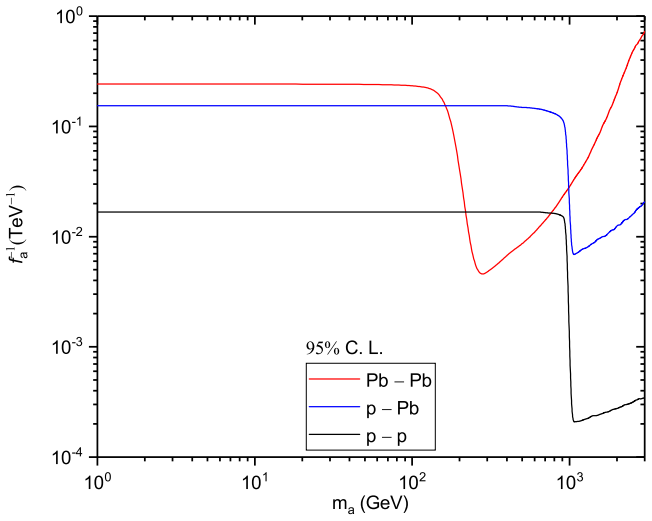
Virtual production of heavy axion-like particles via light-by-light scattering is studied in pp, pPb and PbPb collisions at the future 100 TeV collider FCC-hh. Both differential and total cross sections are calculated. The 95% C.L. exclusion limits, as well as 3 sigma and 5 sigma discovery limits on an ALP coupling constant versus ALP mass m_a are given, using integrated luminosities of 30 ab^{-1}, 27 pb^{-1} and 110 nb^{-1}. The strongest limit on the ALP coupling is obtained if m_a is about 250 GeV for the PbPb collisions, and if m_a is about 1 TeV for pp or pPb collisions.
What carries the argument
Calculation of differential and total cross sections for virtual ALP production in light-by-light scattering, used to derive coupling limits versus mass for different collision modes.
If this is right
- The FCC-hh offers better sensitivity to heavy ALPs than the current LHC.
- Strongest constraints expected at m_a around 250 GeV in PbPb collisions.
- Proton collisions provide best reach near 1 TeV.
- Discovery at 3 or 5 sigma possible with planned luminosities if signal is present.
Where Pith is reading between the lines
- Such searches could help distinguish ALPs from other new physics candidates in the TeV range.
- Success would motivate dedicated studies of ALP contributions to other processes at high-energy colliders.
Load-bearing premise
The projected limits assume the quoted integrated luminosities will be achieved and that standard-model backgrounds and detector efficiencies can be controlled at the level needed to extract the light-by-light signal.
What would settle it
A measurement of light-by-light scattering rates at the FCC-hh that matches standard-model predictions without excess events near 250 GeV in PbPb runs or 1 TeV in proton runs would show the claimed sensitivity cannot be reached.
Figures




read the original abstract
A virtual production of heavy axion-like particles (ALPs) via light-by-light scattering in pp, pPb and Pb collisions at the future 100 TeV collider FCC-hh is studied. Both differential and total cross sections are calculated. The 95\% C.L. exclusion limits, as well as $3\sigma$ and $5\sigma$ discovery limits on an ALP coupling constant versus ALP mass $m_a$ are given, using integrated luminosities of 30 ab$^{-1}$, 27 pb$^{-1}$ and 110 nb$^{-1}$. Our results are compared with the current LHC bounds. The strongest limit on the ALP coupling is obtained if $m_a \simeq 250$ GeV for the PbPb collisions, and if $m_a \simeq 1$ TeV for pp or pPb collisions. This suggests that the FCC-hh has a great physics potential of searching for the heavy ALPs.
Editorial analysis
A structured set of objections, weighed in public.
Referee Report
Summary. The manuscript studies virtual production of heavy axion-like particles (ALPs) via light-by-light scattering in pp, pPb, and PbPb collisions at the 100 TeV FCC-hh. It calculates both differential and total cross sections for the process and derives projected 95% C.L. exclusion limits together with 3σ and 5σ discovery reaches on the ALP-photon coupling g_{aγγ} as a function of ALP mass m_a, employing assumed integrated luminosities of 30 ab^{-1} (pp), 27 pb^{-1} (pPb), and 110 nb^{-1} (PbPb). The results are compared with existing LHC bounds, with the strongest projected sensitivity reported near m_a ≃ 250 GeV in PbPb collisions and m_a ≃ 1 TeV in pp or pPb collisions, leading to the conclusion that the FCC-hh has substantial potential for heavy-ALP searches.
Significance. If the background modeling and efficiency assumptions hold, the work supplies useful projections that extend current LHC constraints into the multi-hundred-GeV to TeV mass range and underscores the complementary reach of heavy-ion running at a future hadron collider. The explicit treatment of three distinct collision systems is a positive feature that allows direct comparison of sensitivity.
major comments (2)
- [§4] §4 (limit-setting procedure): the 3σ/5σ discovery and 95% C.L. exclusion contours are obtained by comparing the computed ALP signal cross section to an assumed SM background level and luminosity; however, the manuscript provides neither the post-cut SM light-by-light background cross section nor the signal efficiency as functions of m_a, making it impossible to verify that the quoted reaches at 250 GeV (PbPb) and 1 TeV (pp/pPb) survive realistic background subtraction.
- [§3] §3 (cross-section calculation): the differential cross section for the ALP-mediated contribution to γγ → γγ is stated to have been computed, yet the explicit analytic expression (including the propagator and the g_{aγγ} dependence) is not displayed; without this formula or a reference to a standard result, independent reproduction of the total rates used for the limits cannot be performed.
minor comments (2)
- [Abstract] The abstract and introduction should cite the specific LHC analyses (e.g., ATLAS or CMS light-by-light results) against which the FCC-hh projections are compared.
- [Figure 5] Figure captions for the limit plots should explicitly state the assumed integrated luminosities and the statistical significance criterion (3σ or 5σ) used for each curve.
Simulated Author's Rebuttal
We thank the referee for the careful review and constructive feedback on our manuscript. We address each of the major comments below and will incorporate the suggested improvements in the revised version.
read point-by-point responses
-
Referee: [§4] §4 (limit-setting procedure): the 3σ/5σ discovery and 95% C.L. exclusion contours are obtained by comparing the computed ALP signal cross section to an assumed SM background level and luminosity; however, the manuscript provides neither the post-cut SM light-by-light background cross section nor the signal efficiency as functions of m_a, making it impossible to verify that the quoted reaches at 250 GeV (PbPb) and 1 TeV (pp/pPb) survive realistic background subtraction.
Authors: We agree with the referee that additional details on the background and efficiency are necessary to allow independent verification of the projected sensitivities. In the revised manuscript, we will add a new table presenting the post-cut SM light-by-light background cross sections and the signal selection efficiencies as functions of the ALP mass m_a for the pp, pPb, and PbPb collision modes. This will enable readers to reproduce the limit-setting calculations. revision: yes
-
Referee: [§3] §3 (cross-section calculation): the differential cross section for the ALP-mediated contribution to γγ → γγ is stated to have been computed, yet the explicit analytic expression (including the propagator and the g_{aγγ} dependence) is not displayed; without this formula or a reference to a standard result, independent reproduction of the total rates used for the limits cannot be performed.
Authors: We thank the referee for pointing this out. The differential cross section was computed using the standard effective Lagrangian for ALP-photon interactions, but the explicit formula was inadvertently omitted. We will include the analytic expression for the differential cross section dσ/dΩ in the revised manuscript, explicitly showing the dependence on the propagator 1/(ŝ - m_a² + i m_a Γ_a) and the coupling g_{aγγ}. This will facilitate independent reproduction of our results. revision: yes
Circularity Check
No circularity: limits projected from independent cross-section calculations and external luminosity assumptions
full rationale
The derivation computes ALP signal cross sections via light-by-light scattering using standard QED and effective-field-theory methods, then applies external integrated luminosities (30 ab^{-1} for pp, etc.) and assumed background control to obtain 95% CL exclusion and 3σ/5σ discovery contours. These steps do not reduce to a parameter fitted from the projected data itself, nor to any self-citation chain or ansatz smuggled from prior author work. The comparison to existing LHC bounds draws on independent experimental results. The paper is therefore self-contained against external benchmarks with no load-bearing circular step.
Axiom & Free-Parameter Ledger
axioms (1)
- domain assumption ALP interactions are described by an effective field theory with a dimension-5 photon coupling term.
invented entities (1)
-
Heavy axion-like particle
no independent evidence
Lean theorems connected to this paper
-
IndisputableMonolith/Cost/FunctionalEquation.leanwashburn_uniqueness_aczel unclear?
unclearRelation between the paper passage and the cited Recognition theorem.
differential cross sections ... dσ_AB = ∫ dL_γγ/dW dσ̂_γγ→γγ(W) dW ... helicity amplitudes M = M^(a) + M_SM with poles at s,t,u = m_a²
-
IndisputableMonolith/Foundation/RealityFromDistinction.leanreality_from_one_distinction unclear?
unclearRelation between the paper passage and the cited Recognition theorem.
95% C.L. exclusion limits ... using L = 30 ab^{-1}, 27 pb^{-1}, 110 nb^{-1}
What do these tags mean?
- matches
- The paper's claim is directly supported by a theorem in the formal canon.
- supports
- The theorem supports part of the paper's argument, but the paper may add assumptions or extra steps.
- extends
- The paper goes beyond the formal theorem; the theorem is a base layer rather than the whole result.
- uses
- The paper appears to rely on the theorem as machinery.
- contradicts
- The paper's claim conflicts with a theorem or certificate in the canon.
- unclear
- Pith found a possible connection, but the passage is too broad, indirect, or ambiguous to say the theorem truly supports the claim.
Reference graph
Works this paper leans on
-
[1]
S.C. ˙Inan and A.V. Kisselev, A search for axion-like particles in light-by-light scattering at the CLIC , JHEP 06, 183 (2020) [arXiv:2003.01978]
-
[2]
S.C. ˙Inan and A.V. Kisselev, Polarized light-by-light scattering at the CLIC induced by axion-like particles , Chin. Phys. C 45, 043109 (2021) [arXiv:2007.01693]
-
[3]
S.C. ˙Inan and A.V. Kisselev, Analysis of axion-like particles in a top- quark pair production at the CLIC , Eur. Phus. J. C 85, 1455 (2025) [arXiv:2501.15500]
-
[4]
S.C. ˙Inan and A.V. Kisselev, Probe of axion-like particles in vector boson scattering at a muon collider , J. Phys. G: Nucl. Part. Phys. 50, 105002 (2023) [arXiv:2207.03325]
-
[5]
R.D. Peccei and H.R. Quinn, CP conservation in the presence of pseu- doparticles, Phys. Rev. Lett. 38, 1440 (1977)
work page 1977
-
[6]
R.D. Peccei and H.R. Quinn, Constraints imposed by CP conservation in the presence of pseudoparticles , Phys. Rev. D 16, 1791 (1977)
work page 1977
-
[7]
Weinberg, A new light boson? , Phys
S. Weinberg, A new light boson? , Phys. Rev. Lett. 40, 223 (1978)
work page 1978
-
[8]
Wilzcek, Problem of strong P and T invariance in the presence of instantons, Phys
F. Wilzcek, Problem of strong P and T invariance in the presence of instantons, Phys. Rev. Lett. 40, 279 (1978)
work page 1978
-
[9]
Kim, Weak-interaction singlet and strong CP invariance , Phys
E. Kim, Weak-interaction singlet and strong CP invariance , Phys. Rev. Lett. 43, 103 (1979)
work page 1979
-
[10]
M.A. Shifman, A.I. Vainshtein and V.I. Zakharov, Can confinement ensure natural CP invariance of strong interactions? , Nucl. Phys. B 166, 4933 (1980). 16
work page 1980
-
[11]
M. Dine, W. Fisher and M. Srednicki, A simple solution of the strong CP problem with a harmless axion , Phys. Lett. B 104, 199 (1981)
work page 1981
-
[12]
Zhitnitsky, On the possible suppression of axion hadron interac- tions, Yad
A.P. Zhitnitsky, On the possible suppression of axion hadron interac- tions, Yad. Fiz. 31, 497 (1980) [Sov. J. Nucl. Phys. 31, 260 (1980)]
work page 1980
-
[13]
Albertus et al., WISPedia – the WISPs Encyclopedia , arXiv:2602
C. Albertus et al., WISPedia – the WISPs Encyclopedia , arXiv:2602. 09089
-
[14]
J. Preskill, M.B. Wise and F. Wilczek, Cosmology of the invisible axion , Phys. Lett. B 120, 127 (1983)
work page 1983
-
[15]
L.F. Abbott and P. Sikivie, A cosmological bound on the invisible axion , Phys. Lett. B 120, 113 (1983)
work page 1983
-
[16]
M. Dine and W. Fischler, The not so harmless axion , Phys. Lett. B 120, 137 (1983)
work page 1983
-
[17]
D.J.E. Marsh, Axion cosmology , Phys. Rep. 643, 1 (2016) [arXiv:1510.07633]
work page internal anchor Pith review Pith/arXiv arXiv 2016
-
[18]
F. Chadha-Day, J. Ellis and D.J.E. Marsh, Axion dark matter: what is it and why now? , Sci. Adv. 8, eabj3618 (2022) [arXiv:2105.01406]
- [19]
-
[20]
Akg¨ um¨ us et al.,A new limit for axion dark matter with SPACE , arXiv:2506.18411
M.A. Akg¨ um¨ us et al.,A new limit for axion dark matter with SPACE , arXiv:2506.18411
-
[21]
E.W. Lentz, C.R. Boutan, M.S. Taubman and K.L. Gervais, Developing centimeter-scale-cavity arrays for axion dark matter dete ction in the 100 micro-electron-volt range , arXiv:2601.21074
-
[22]
K. Mimasu and V. Sanz, ALPs at colliders , JHEP 06, 173 (2015) [arXiv:1409.4792]
work page internal anchor Pith review Pith/arXiv arXiv 2015
-
[23]
Collider Probes of Axion-Like Particles
M. Bauer, M. Neubert and A. Thamm, Collider probes of axion-like particles, JHEP 12, 044 (2017) [arXiv:1708.00443]
work page internal anchor Pith review Pith/arXiv arXiv 2017
- [24]
-
[25]
A. Biek¨ otter and K. Mimasu, Axions and axion-like particles: collider searches, arXiv:2508.19358
-
[26]
ATLAS Collaboration, Search for scalar diphoton resonances in the mass range 65.600 GeV with the ATLAS detector in pp collision data at √ s = 8 TeV, Phys. Rev. Lett. 113, 171801 (2014) [arXiv:1407.6583]
work page internal anchor Pith review Pith/arXiv arXiv 2014
-
[27]
ATLAS Collaboration, Search for new phenomena in events with at least three photons collected in pp collisions at √ s = 8 TeV with the ATLAS detector, Eur. Phys. J. C 76, 210 (2016) [arXiv:1509.05051]
work page internal anchor Pith review Pith/arXiv arXiv 2016
- [28]
- [29]
- [30]
-
[31]
CMS Collaboration, Evidence for light-by-light scattering and searches for axion-like particles in ultraperipheral PbPb collisio ns at √ sN N =
- [33]
- [34]
-
[35]
02 TeV, JHEP 08, 006 (2025) [arXiv:2412.15413]
CMS Collaboration, Measurement of light-by-light scattering and the Breit-Wheeler process, and search for axion-like particle s in ultrape- ripheral PbPb collisions at √ sN N = 5 . 02 TeV, JHEP 08, 006 (2025) [arXiv:2412.15413]. 18
-
[36]
Probing the anomalous $\gamma\gamma\gamma Z$ coupling at the LHC with proton tagging
C. Baldenegro, S. Fichet, G. von Gersdorff and C. Royon, Probing the anomalous γγγZ coupling at the LHC with proton tagging , JHEP 06, 142 (2017) [arXiv:1703.10600]
work page internal anchor Pith review Pith/arXiv arXiv 2017
-
[37]
Searching for axion-like particles with proton tagging at the LHC
C. Baldenegro, S. Fichet, G. von Gersdorff and C. Royon, Searching for axion-like particles with proton tagging at the LHC , JHEP 06, 131 (2018) [arXiv:1803.10835]
work page internal anchor Pith review Pith/arXiv arXiv 2018
-
[39]
New Probes for Axion-like Particles at Hadron Colliders
J. Ebadi, S. Khatibi and M.M. Najafabadi, New probes for axion- like particles at hadron colliders , Phys. Rev. D 100, 015016 (2019) [arXiv:1901.03061]
work page internal anchor Pith review Pith/arXiv arXiv 2019
-
[40]
M.B. Gavela, J.M. No, V. Sanz and J.F. de Troc´ oniz, Non-resonant searches for axion-like particles at the LHC , Phys. Rev. Lett. 124, 051802 (2020) [arXiv:1905.12953]
- [41]
- [42]
- [43]
-
[44]
S. Carra et al., Constraining off-shell production of axion-like particles with γZ and W W differential cross-section measurements , Phys. Rev. D 104, 092005 (2021) [arXiv:2106.10085]
-
[45]
J. Bonilla, I. Brivio, J. Machado-Rodriguez and J.F. de Troconiz, Non- resonant searches for axion-like particles in vector boson scattering pro- cesses at the LHC , JHEP 06, 113 (2022) [arXiv:2202.03450]. 19
-
[46]
F.A. Ghebretinsaea, Z.S. Wang and K. Wang, Probing axion-like particles coupling to gluons at the LHC , JHEP 07, 070 (2022) [arXiv:2203.01734]
-
[47]
A. Carmona, F. Elahi, C. Scherb and P. Schwaller, The ALPs from the top: Searching for long lived axion-like particles from exo tic top decays, JHEP 07, 122 (2022) [arXiv:2202.09371]
-
[48]
A. de Giorgi, L. Merlo and J.-L. Tastet, Probing HNL-ALP couplings at colliders , Fortsch. Phys. 71, 2300027 (2023) [arXiv:2212.11290]
-
[49]
L. Rygaard et al., Top secrets: long-lived ALPs in top production , JHEP 10, 138 (2023) [arXiv:2306.08686]
- [50]
-
[51]
Y. Hosseini and M.M. Najafabadi, Exploring axion-like particle cou- plings through single top tW -channel and top pair production at the LHC, Phys. Rev. D 110, 055026 (2024) [arXiv:2408.11588]
-
[52]
A. Anua et al., ALP-ine quests at the LHC: hunting axion-like par- ticles via peaks and dips in t¯t production, JHEP 12, 197 (2024) [arXiv:2404.19014]
-
[53]
K. Cheung, C.-T. Lu, C.J. Ouseph and P. Sarmah, Exploring inter- ference effects between two ALP effective operators at the LHC , JHEP 09, 101 (2024) [arXiv:2404.14833]
-
[54]
K. Cheung et al., Quark flavor violation and axion-like particles from top-quark decays at the LHC , JHEP 07, 209 (2024) [arXiv:2404.06126]
- [55]
- [56]
-
[57]
A.V. Phan and S. Westhoff, Precise tests of the axion coupling to tops , JHEP 05, 075 (2024) [arXiv:2312.00872]. 20
-
[58]
M. Aiko and M. Endo, Heavy photophobic ALP at the LHC , JHEP 06, 194 (2024) [arXiv:2401.13323]
- [59]
- [60]
-
[61]
A. Adhikary, A. Bharucha, L. Feligioni and M. Frigerio, Prospects for sub-EW-scale ALP searches via γ + b¯b signatures at the LHC using jet substructure techniques , Phys. Rev. D 112, 055042 (2025) [arXiv:2410.09033]
- [62]
- [63]
-
[64]
Z. Ding, Y.-n. Mao and K. Wang, Search for the γZ decay mode of heavy photophobic axion-like particles at the LHC , JHEP 06, 087 (2025) [arXiv:2411.08660]
-
[65]
Long-Lived HNLs via ALP Portal at the LHC
R. Beltr´ an, C. Hati, M. Hirsch and A. Martin-Gal´ an,Long-lived HNLs via ALP portal at the LHC , arXiv:2510.26946
work page internal anchor Pith review Pith/arXiv arXiv
-
[66]
S. Chenarani and M.M. Najafabadi, Concurrent exploration of axion-like particle interactions with gauge bosons at the L HC, arXiv:2505.21305
- [67]
-
[68]
S. Bhattacharya, D. Choudhury, S. Maharana and T. Srivast ava, Axion icebergs: clockwork ALPs at hadron colliders , Phys. Rev. D 112, 055030 (2025) [arXiv:2409.05983]. 21
-
[69]
J. Feng, Y.-N. Mao and K. Wang, Discovery prospects for photophobic axion-like particles in the W W jj final state at the High-Luminosity LHC, arXiv:2511.21003
-
[70]
X.-H. Jiang1 and C.-T. Lu, Leptophilic axion-like particles at forward detectors, Phys. Rev. D 111, 035035 (2025) [arXiv:2412.19195]
-
[71]
J. Butterworth, M. Cullingworth, J. Egan, F. Esser, V. Sanz a nd M. Ubiali, Probing the coupling of axions to tops and gluons with LHC measurements, JHEP 02, 073 (2026) [arXiv:2508.21660]
-
[72]
Phan, Top observables as precise probes of the ALP , SciPost Phys
A.V. Phan, Top observables as precise probes of the ALP , SciPost Phys. Proc. 18, 022 (2026) [arXiv:2412.06506]
-
[73]
New LHC bound on low-mass diphoton resonances
A. Mariotti, D. Redigolo, F. Sala and K. Tobioka, New LHC bound on low-mass diphoton resonances , Phys. Lett. B 783, 13 (2018) [arXiv:1710.01743]
work page internal anchor Pith review Pith/arXiv arXiv 2018
- [74]
- [75]
-
[76]
Searching for axion-like particles with ultra-peripheral heavy-ion collisions
S. Knapen, T. Lin, H.K. Lou and T. Melia, Searching for axion-like par- ticles with ultra-peripheral heavy-ion collisions , Phys. Rev. Lett. 118, 171801 (2017) [arXiv:1607.06083]
work page internal anchor Pith review Pith/arXiv arXiv 2017
-
[77]
LHC limits on axion-like particles from heavy-ion collisions
S. Knapen, T. Lin, H.K. Lou and T. Melia, LHC limits on axion- like particles from heavy-ion collisions , in Proceeding of the PHO- TON 2017 Conference, Geneva, Switzerland, 22-26 May, 2017, ed s. D. d’Enterria, A. de Roeck and M. Mangano, vol. 1, 2018, pp. 65-68 [arXiv:1709.07110]
work page internal anchor Pith review Pith/arXiv arXiv 2017
-
[78]
C. Baldenegro, S. Hassani, C. Royon and L. Schoeffel, Extending the constraint for axion-like particles as resonances at the LH C and laser beam experiments, Phys. Lett. B 795, 339 (2019) [arXiv:1903.04151]. 22
work page internal anchor Pith review Pith/arXiv arXiv 2019
-
[79]
R.O. Coelho, V.P. Goncalves, D.E. Martins and M.S. Rangel, Exclusive and diffractive γγ production in P bP b collisions at the LHC, HE-LHC and FCC , Eur. Phys. J. C 80, 488 (2020) [arXiv:2002.03902]
-
[80]
R.O. Coelho and V.P. Goncalves, Photoproduction of massive gauge bosons in pp, pP b and P bP b collisions, Phys. Lett. B 806, 135498 (2020) [arXiv:2002.10713]
-
[81]
R.O. Coelho, V.P. Goncalves, D.E. Martins and M.S. Rangel, Produc- tion of axionlike particles in P bP b collisions at the LHC, HE-LHC and FCC: A phenomenological analysis , Phys. Lett. B 806, 135512 (2020) [arXiv:2002.06027]
-
[82]
V.P. Goncalves and W.K. Sauter, Exclusive axionlike particle produc- tion by gluon-induced interactions in hadronic collisions , Phys. Lett. B 811, 135981 (2020) [arXiv:2006.16716]
discussion (0)
Sign in with ORCID, Apple, or X to comment. Anyone can read and Pith papers without signing in.