Recognition: 2 theorem links
· Lean TheoremLocal and Global Master Equations through the Lens of Non-Hermitian Physics
Pith reviewed 2026-05-15 01:00 UTC · model grok-4.3
The pith
In a minimal two-qubit heat-current setup, exceptional points appear only in the local master equation and its non-Hermitian counterpart under strong nonequilibrium.
A machine-rendered reading of the paper's core claim, the machinery that carries it, and where it could break.
Core claim
In a two-qubit system mediating steady-state heat flow between two reservoirs, exceptional points emerge only in the local Markovian master equation and its associated non-Hermitian Hamiltonian once the nonequilibrium bias exceeds a threshold; the global master equation remains free of such points. Hybrid master equations that treat one bath locally and the other globally produce intermediate spectra that can be tuned continuously between the two extremes.
What carries the argument
Local versus global Markovian master equations and their non-Hermitian Hamiltonian reductions, applied to a two-qubit heat-current geometry.
If this is right
- Non-Hermitian features such as exceptional points can appear in unconditional Lindblad dynamics without requiring postselection.
- The local approximation is the minimal description that allows exceptional points to enter the spectrum under strong nonequilibrium.
- Hybrid local-global treatments provide a continuous tuning knob between Hermitian-like and non-Hermitian spectra.
- The architecture is directly realizable in circuit-QED platforms with two superconducting qubits and independent resonators.
Where Pith is reading between the lines
- If the distinction persists in larger chains, local approximations may systematically overestimate non-Hermitian effects in extended nonequilibrium systems.
- Global master equations might still host other non-Hermitian signatures, such as skin modes, that do not rely on exceptional points.
- Circuit-QED experiments could map the critical bias at which exceptional points appear by monitoring the steady-state current or qubit coherences.
Load-bearing premise
The minimal two-qubit heat-current setup captures the essential distinction between local and global Markovian dynamics for non-Hermitian effects in nonequilibrium open systems.
What would settle it
Observation of exceptional points in the eigenvalues of the global master-equation Liouvillian at large temperature bias, or their complete absence in the local Liouvillian at the same bias.
Figures



read the original abstract
We investigate the relation between non-Hermitian Hamiltonian and Lindblad dynamics in nonequilibrium open quantum systems. Non-Hermitian models can extend phase diagrams and enable sensing advantages, but such effects often rely on postselection, raising questions about their relevance for unconditional dynamics. Using a minimal two-qubit setup mediating a heat current, we compare local and global Markovian master equations with their non-Hermitian counterparts. We observe that exceptional points emerge only in the local master equation and in the corresponding non-Hermitian Hamiltonian at sufficiently strong nonequilibrium. We further consider hybrid configurations, where one bath is treated with a Lindblad description and the other with a non-Hermitian approach, interpolating between the two extremes. Our results contribute understanding the role of quantum jumps and exceptional points in nonequilibrium open quantum systems and identify a simple, experimentally accessible architecture, realizable, for instance, in circuit-QED platforms, for their exploration.
Editorial analysis
A structured set of objections, weighed in public.
Referee Report
Summary. The manuscript investigates the relation between non-Hermitian Hamiltonians and Lindblad dynamics in nonequilibrium open quantum systems. Using a minimal two-qubit setup mediating a heat current between two baths, it compares local and global Markovian master equations to their non-Hermitian counterparts. The central observation is that exceptional points appear only in the local master equation and corresponding non-Hermitian Hamiltonian at sufficiently strong nonequilibrium; hybrid Lindblad/non-Hermitian configurations are also examined as interpolations between the two limits.
Significance. If the reported observation holds beyond the minimal model, the work clarifies the role of quantum jumps versus coherent non-Hermitian evolution in nonequilibrium open systems and points to an experimentally accessible circuit-QED architecture. The hybrid-construction approach offers a concrete way to interpolate between descriptions, which could inform sensing or phase-diagram studies that rely on postselection.
major comments (1)
- [numerical spectra of Liouvillian and non-Hermitian counterpart] The claim that exceptional points emerge 'only' in the local master equation (and its non-Hermitian counterpart) rests on numerical spectra of the Liouvillian for a single two-qubit, two-bath heat-current model. No analytical argument or additional models are supplied to exclude exceptional points in global dynamics for higher-dimensional systems, different bath couplings, or other nonequilibrium drives; the qualifier therefore lacks support beyond this specific case.
minor comments (2)
- [hybrid configurations] The construction of the hybrid Lindblad/non-Hermitian configurations (one bath treated with Lindblad, the other with non-Hermitian) should be specified with explicit equations or parameter choices to allow reproduction.
- [comparison of master equations] Notation for the local versus global dissipators and the corresponding non-Hermitian Hamiltonians could be unified in a single table or appendix for clarity.
Simulated Author's Rebuttal
We thank the referee for their careful reading and constructive feedback on our manuscript. We address the major comment below and have revised the manuscript to clarify the scope of our claims.
read point-by-point responses
-
Referee: [numerical spectra of Liouvillian and non-Hermitian counterpart] The claim that exceptional points emerge 'only' in the local master equation (and its non-Hermitian counterpart) rests on numerical spectra of the Liouvillian for a single two-qubit, two-bath heat-current model. No analytical argument or additional models are supplied to exclude exceptional points in global dynamics for higher-dimensional systems, different bath couplings, or other nonequilibrium drives; the qualifier therefore lacks support beyond this specific case.
Authors: We agree that our observation is based on numerical results for this specific minimal two-qubit model. The manuscript employs this setup as a representative, experimentally accessible example (e.g., circuit-QED) to illustrate the difference between local and global Markovian descriptions. We have revised the abstract, introduction, and conclusions to replace the absolute qualifier 'only' with phrasing such as 'in the present model' and added a short paragraph noting that extensions to higher-dimensional systems, different couplings, or analytical proofs remain open for future work. This ensures the claims are precisely supported by the evidence provided without implying universality. revision: yes
Circularity Check
No circularity: numerical spectra from standard master-equation derivations
full rationale
The paper constructs local and global Lindblad master equations for a two-qubit heat-current model using standard Born-Markov-secular approximations, then numerically computes the Liouvillian spectra and compares them to the eigenvalues of the corresponding non-Hermitian Hamiltonians. No step reduces a claimed result to a fitted parameter renamed as a prediction, nor does any load-bearing premise rest on a self-citation whose content is itself unverified or defined in terms of the target claim. The observation that exceptional points appear only above a threshold nonequilibrium strength is an empirical finding within this minimal model and does not rely on self-referential definitions or ansatzes smuggled via prior work by the same authors.
Axiom & Free-Parameter Ledger
axioms (2)
- domain assumption Markovian approximation for bath coupling
- domain assumption Weak system-bath coupling allowing perturbative master equations
Lean theorems connected to this paper
-
IndisputableMonolith/Foundation/RealityFromDistinction.leanreality_from_one_distinction unclear?
unclearRelation between the paper passage and the cited Recognition theorem.
We observe that exceptional points emerge only in the local master equation and in the corresponding non-Hermitian Hamiltonian at sufficiently strong nonequilibrium.
-
IndisputableMonolith/Cost/FunctionalEquation.leanwashburn_uniqueness_aczel unclear?
unclearRelation between the paper passage and the cited Recognition theorem.
Using a minimal two-qubit setup mediating a heat current, we compare local and global Markovian master equations with their non-Hermitian counterparts.
What do these tags mean?
- matches
- The paper's claim is directly supported by a theorem in the formal canon.
- supports
- The theorem supports part of the paper's argument, but the paper may add assumptions or extra steps.
- extends
- The paper goes beyond the formal theorem; the theorem is a base layer rather than the whole result.
- uses
- The paper appears to rely on the theorem as machinery.
- contradicts
- The paper's claim conflicts with a theorem or certificate in the canon.
- unclear
- Pith found a possible connection, but the passage is too broad, indirect, or ambiguous to say the theorem truly supports the claim.
Reference graph
Works this paper leans on
-
[1]
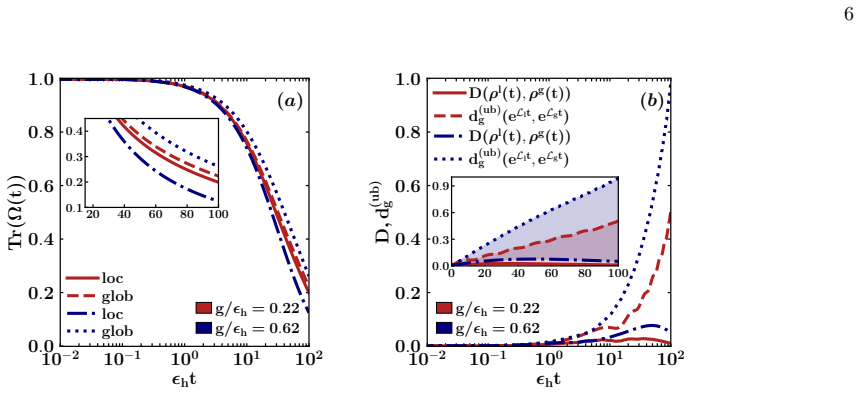
Local vs. global using non-Hermitian Hamiltonian We now turn to a comparison between the local and global approaches using non-Hermitian Hamiltonian dy- namics, which, in contrast to the Lindblad case, remain 6 10−2 10−1 100 101 102 ϵht 0.0 0.2 0.4 0.6 0.8 1.0 Tr(Ω(t)) (a) loc glob loc glob g/ϵh = 0.22 g/ϵh = 0.62 20 40 60 80 1000.1 0.2 0.3 0.4 10−2 10−1 ...
-
[2]
non-Hermitian Hamiltonian In Fig
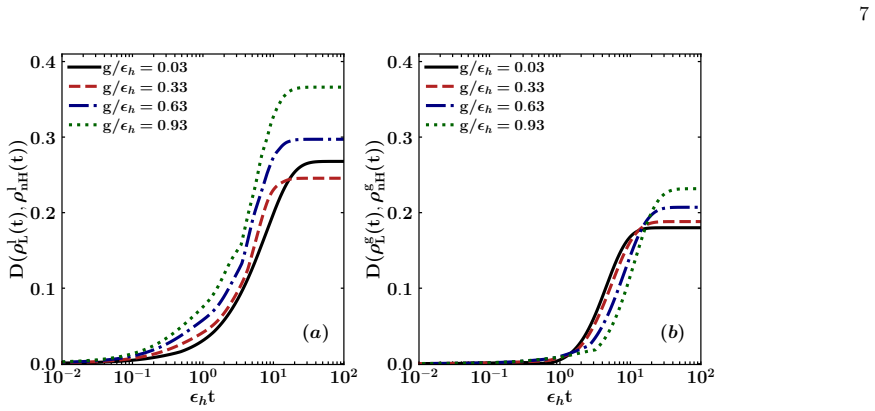
Lindblad vs. non-Hermitian Hamiltonian In Fig. 3, we numerically compare Lindblad and non- Hermitian Hamiltonian dynamics, separately for the local approach (Fig. 3(a)) and the global approach (Fig. 3(b)). This is done through the trace distance between the evolved (normalized) states, that is shown as a func- tion of time for four values of the coupling ...
-
[3]
1 describes a thermody- namic nonequilibrium configuration
Thermodynamic considerations The setting depicted in Fig. 1 describes a thermody- namic nonequilibrium configuration. In the Lindblad framework, the presence of a temperature bias gives rise to a steady state characterized by a constant heat cur- rent and a constant entropy production rate. While this scenario has been extensively studied in the literatur...
-
[4]
Non-Hermitian Hamiltonian We now investigate the occurrence of exceptional points, starting from the non-Hermitian Hamiltonian de- scriptions. In our analysis, we observe the emergence of exceptional points when increasing the coupling strength gbetween the two qubits, but only within the local approach and when the qubit energy detuning is zero (δ= 0). T...
-
[5]
Lindblad and hybrid postselection frameworks We now include the quantum-jump terms, thereby forming Lindblad dissipators, and study the emergence of Liouvillian exceptional points. While local and global Lindblad master equations have been extensively stud- ied in the literature, their potential for generating ex- ceptional points remains largely unexplor...
-
[6]
Heinz-Peter Breuer and Francesco Petruccione,The The- ory of Open Quantum Systems(Oxford University Press, 2007)
work page 2007
-
[7]
Patrick P Hofer, Mart´ ı Perarnau-Llobet, L David M Miranda, G´ eraldine Haack, Ralph Silva, Jonatan Bohr Brask, and Nicolas Brunner, Markovian master equations for quantum thermal machines: local versus global ap- proach, New J. Phys.19, 123037 (2017)
work page 2017
-
[8]
J Onam Gonz´ alez, Luis A Correa, Giorgio Nocerino, Jos´ e P Palao, Daniel Alonso, and Gerardo Adesso, Test- ing the validity of the ‘local’and ‘global’gkls master equa- tions on an exactly solvable model, Open Systems & In- formation Dynamics24, 1740010 (2017)
work page 2017
-
[9]
Stefano Scali, Janet Anders, and Luis A Correa, Lo- cal master equations bypass the secular approximation, Quantum5, 451 (2021)
work page 2021
-
[10]
Amikam Levy and Ronnie Kosloff, The local approach to quantum transport may violate the second law of ther- modynamics, Europhysics Letters107, 20004 (2014)
work page 2014
-
[11]
Gabriele De Chiara, Gabriel Landi, Adam Hewgill, Bren- dan Reid, Alessandro Ferraro, Augusto J Roncaglia, and Mauro Antezza, Reconciliation of quantum local master equations with thermodynamics, New Journal of Physics 20, 113024 (2018)
work page 2018
-
[12]
Adam Hewgill, Gabriele De Chiara, and Alberto Im- parato, Quantum thermodynamically consistent local master equations, Physical Review Research3, 013165 (2021)
work page 2021
-
[13]
Frank Verstraete, Michael M Wolf, and J Ignacio Cirac, Quantum computation and quantum-state engineering driven by dissipation, Nature physics5, 633–636 (2009)
work page 2009
-
[14]
Chi-Fang Chen, Michael Kastoryano, Fernando GSL Brand˜ ao, and Andr´ as Gily´ en, Efficient quantum thermal simulation, Nature646, 561–566 (2025)
work page 2025
-
[15]
Donato Farina, Giulio De Filippis, Vittorio Cataudella, Marco Polini, and Vittorio Giovannetti, Going beyond local and global approaches for localized thermal dissi- pation, Phys. Rev. A102, 052208 (2020)
work page 2020
-
[16]
Marco Cattaneo, Gian Luca Giorgi, Sabrina Maniscalco, and Roberta Zambrini, Local versus global master equa- tion with common and separate baths: superiority of the global approach in partial secular approximation, New J. Phys.21, 113045 (2019)
work page 2019
-
[17]
Shishir Khandelwal, Nicolas Palazzo, Nicolas Brunner, and G´ eraldine Haack, Critical heat current for operating an entanglement engine, New J. Phys.22, 073039 (2020)
work page 2020
-
[18]
Nunzia Cerrato, Sauro Succi, Giacomo De Palma, and Vittorio Giovannetti, Statistical characterization of en- tanglement degradation under markovian noise in com- posite quantum systems, Phys. Rev. A112, 022219 14 (2025)
work page 2025
- [19]
- [20]
-
[21]
Francesco Albarelli and Marco G Genoni, A pedagogical introduction to continuously monitored quantum systems and measurement-based feedback, Phys. Lett. A494, 129260 (2024)
work page 2024
-
[22]
Donato Farina, Vasco Cavina, Marco G. Genoni, and Vit- torio Giovannetti, Entanglement-assisted, noise-assisted, and monitoring-enhanced quantum bath tagging, Phys. Rev. A106, 042609 (2022)
work page 2022
-
[23]
Federico Roccati, G Massimo Palma, Francesco Cic- carello, and Fabio Bagarello, Non-hermitian physics and master equations, Open Systems & Information Dynam- ics29, 2250004 (2022)
work page 2022
-
[24]
Jinkang Guo, Oliver Hart, Chi-Fang Chen, Aaron J Friedman, and Andrew Lucas, Designing open quantum systems with known steady states: Davies generators and beyond, Quantum9, 1612 (2025)
work page 2025
-
[25]
Yuto Ashida, Zongping Gong, and Masahito Ueda, Non- hermitian physics, Advances in Physics69, 249–435 (2020)
work page 2020
-
[26]
Walter D Heiss, The physics of exceptional points, Jour- nal of Physics A: Mathematical and Theoretical45, 444016 (2012)
work page 2012
-
[27]
Fabrizio Minganti, Adam Miranowicz, Ravindra W Chhajlany, and Franco Nori, Quantum exceptional points of non-Hermitian Hamiltonians and Liouvillians: The effects of quantum jumps, Phys. Rev. A100, 062131 (2019)
work page 2019
-
[28]
M Naghiloo, M Abbasi, Yogesh N Joglekar, and KW Murch, Quantum state tomography across the ex- ceptional point in a single dissipative qubit, Nature Physics15, 1232–1236 (2019)
work page 2019
-
[29]
Shishir Khandelwal, Nicolas Brunner, and G´ eraldine Haack, Signatures of liouvillian exceptional points in a quantum thermal machine, PRX quantum2, 040346 (2021)
work page 2021
- [30]
-
[31]
Henning Schomerus, Nonreciprocal response theory of non-hermitian mechanical metamaterials: Response phase transition from the skin effect of zero modes, Phys. Rev. Res.2, 013058 (2020)
work page 2020
-
[32]
Bergholtz, Jan Carl Budich, and Flore K
Emil J. Bergholtz, Jan Carl Budich, and Flore K. Kunst, Exceptional topology of non-hermitian systems, Rev. Mod. Phys.93, 015005 (2021)
work page 2021
-
[33]
Kohei Kawabata, Ken Shiozaki, Masahito Ueda, and Masatoshi Sato, Symmetry and topology in non- hermitian physics, Phys. Rev. X9, 041015 (2019)
work page 2019
-
[34]
Alexander McDonald and Aashish A Clerk, Exponentially-enhanced quantum sensing with non- hermitian lattice dynamics, Nature communications11, 5382 (2020)
work page 2020
- [35]
- [36]
-
[37]
Federico Settimo, Kimmo Luoma, Dariusz Chru´ sci´ nski, Bassano Vacchini, Andrea Smirne, and Jyrki Pi- ilo, Stochastic unravelings for trace-nonpreserving open quantum system dynamics, arXiv preprint arXiv:2511.15516 (2025)
work page internal anchor Pith review Pith/arXiv arXiv 2025
-
[38]
Chi- tra, Observables in non-hermitian systems: A method- ological comparison, Phys
Karin Sim, Nicol` o Defenu, Paolo Molignini, and R. Chi- tra, Observables in non-hermitian systems: A method- ological comparison, Phys. Rev. Res.7, 013325 (2025)
work page 2025
-
[39]
Alessandro Sergi and Konstantin G Zloshchastiev, Quan- tum entropy of systems described by non-Hermitian Hamiltonians, J. Stat. Mech.: Theory Exp.2016(3), 033102
work page 2016
-
[40]
Schmidt, Quantum thermodynamics of the resonant-level model with driven system-bath coupling, Phys
Patrick Haughian, Massimiliano Esposito, and Thomas L. Schmidt, Quantum thermodynamics of the resonant-level model with driven system-bath coupling, Phys. Rev. B97, 085435 (2018)
work page 2018
-
[41]
Ilaria Gianani, Donato Farina, Marco Barbieri, Valeria Cimini, Vasco Cavina, and Vittorio Giovannetti, Dis- crimination of thermal baths by single-qubit probes, Phys. Rev. Res.2, 033497 (2020)
work page 2020
-
[42]
Donato Farina, Vasco Cavina, and Vittorio Giovannetti, Quantum bath statistics tagging, Phys. Rev. A100, 042327 (2019)
work page 2019
-
[43]
Carl W Helstrom, Quantum detection and estimation theory, Journal of Statistical Physics1, 231–252 (1969)
work page 1969
-
[44]
Yu Shi and Edo Waks, Error metric for non-trace- preserving quantum operations, Phys. Rev. A108, 032609 (2023)
work page 2023
-
[45]
Dorit Aharonov, Alexei Kitaev, and Noam Nisan, Quan- tum circuits with mixed states, inProceedings of the thir- tieth annual ACM symposium on Theory of computing (1998) pp. 20–30
work page 1998
-
[46]
Alexei Gilchrist, Nathan K. Langford, and Michael A. Nielsen, Distance measures to compare real and ideal quantum processes, Phys. Rev. A71, 062310 (2005)
work page 2005
-
[47]
Ronnie Kosloff, Quantum thermodynamics: A dynamical viewpoint, Entropy15, 2100–2128 (2013)
work page 2013
-
[48]
Sai Vinjanampathy and Janet Anders, Quantum thermo- dynamics, Contemporary Physics57, 545–579 (2016)
work page 2016
-
[49]
Alessandro Sergi, The density matrix in the non- Hermitian approach to open quantum system dynamics, Atti della Accademia Peloritana dei Pericolanti-Classe di Scienze Fisiche, Matematiche e Naturali97, 11 (2019)
work page 2019
-
[50]
Serban Belinschi, Maciej A Nowak, Roland Speicher, and Wojciech Tarnowski, Squared eigenvalue condition num- bers and eigenvector correlations from the single ring the- orem, J. Phys. A-Math.50, 105204 (2017)
work page 2017
-
[51]
Adi Pick, Shahar Silberstein, Nimrod Moiseyev, and Nir Bar-Gill, Robust mode conversion in NV centers using exceptional points, Phys. Rev. Res.1, 013015 (2019)
work page 2019
-
[52]
Alexei Gilchrist, Daniel R Terno, and Christopher J Wood, Vectorization of quantum operations and its use, arXiv preprint arXiv:0911.2539 (2009)
work page internal anchor Pith review Pith/arXiv arXiv 2009
-
[53]
Nimrod Moiseyev,Non-Hermitian quantum mechanics (Cambridge University Press, 2011)
work page 2011
-
[54]
Shishir Khandelwal and Gianmichele Blasi, Emergent li- ouvillian exceptional points from exact principles, Quan- tum9, 1944 (2025)
work page 1944
-
[55]
Alberto Ronzani, Bayan Karimi, Jorden Senior, Yu- Cheng Chang, Joonas T Peltonen, ChiiDong Chen, and 15 Jukka P Pekola, Tunable photonic heat transport in a quantum heat valve, Nature Physics14, 991–995 (2018)
work page 2018
-
[56]
Alfred G Redfield, On the theory of relaxation processes, IBM Journal of Research and Development1, 19–31 (1957)
work page 1957
-
[57]
Akihito Ishizaki and Graham R Fleming, On the ade- quacy of the redfield equation and related approaches to the study of quantum dynamics in electronic energy transfer, The Journal of chemical physics130(2009)
work page 2009
-
[58]
Donato Farina and Vittorio Giovannetti, Open-quantum- system dynamics: Recovering positivity of the redfield equation via the partial secular approximation, Phys. Rev. A100, 012107 (2019)
work page 2019
-
[59]
Antonio D’Abbruzzo, Vasco Cavina, and Vittorio Gio- vannetti, A time-dependent regularization of the redfield equation, SciPost Physics15, 117 (2023)
work page 2023
-
[60]
Antonio D’Abbruzzo, Donato Farina, and Vittorio Giovannetti, Recovering complete positivity of non- markovian quantum dynamics with choi-proximity reg- ularization, Phys. Rev. X14, 031010 (2024)
work page 2024
-
[61]
Donato Farina, Bilal Benazout, Federico Centrone, and Antonio Ac´ ın, Thermodynamic precision in the nonequi- librium exchange scenario, Phys. Rev. E109, 034112 (2024)
work page 2024
-
[62]
Luis A Correa and Jonas Glatthard, Potential renormal- isation, lamb shift and mean-force gibbs state–to shift or not to shift?, Quantum9, 1868 (2025)
work page 2025
discussion (0)
Sign in with ORCID, Apple, or X to comment. Anyone can read and Pith papers without signing in.