Recognition: 2 theorem links
· Lean TheoremEnergy conditions of bouncing solutions in quadratic curvature gravity coupled with a scalar field
Pith reviewed 2026-05-15 01:11 UTC · model grok-4.3
The pith
In quadratic curvature gravity with a scalar field, bouncing solutions satisfy null, weak, and dominant energy conditions when the tensor is sourced only by the scalar field, but violate the strong condition during the bounce.
A machine-rendered reading of the paper's core claim, the machinery that carries it, and where it could break.
Core claim
In the scalar-field description, the null, weak, and dominant energy conditions remain satisfied throughout the cosmological evolution, while the strong energy condition is necessarily violated during the bounce phase, enabling the avoidance of the initial singularity. In contrast, when the effective energy-momentum tensor is considered, all four energy conditions are violated near the bounce, highlighting the intrinsically non-Einsteinian nature of the underlying gravitational dynamics.
What carries the argument
The two formulations of the energy-momentum tensor: one sourced solely by the scalar field, the other an effective tensor that includes the quadratic curvature corrections.
If this is right
- Violation of only the strong energy condition in the scalar-field picture is sufficient to produce a nonsingular bounce.
- Higher-curvature corrections force violations of all energy conditions when treated as part of an effective tensor.
- The two formulations give different pictures of which energy conditions are required to break for singularity avoidance.
- Nonsingular evolution is possible in this theory while preserving the null, weak, and dominant conditions in one consistent description.
Where Pith is reading between the lines
- The split between formulations suggests that energy-condition statements in higher-order gravity are interpretation-dependent rather than absolute.
- Similar selective violations could be examined in other modified-gravity models that support bounces.
- Observational probes sensitive to early-universe energy densities might distinguish which formulation better matches data.
Load-bearing premise
The chosen bouncing solutions satisfy the modified field equations exactly, and both the scalar-field-only and effective formulations of the energy-momentum tensor are physically valid.
What would settle it
A direct numerical check, using the explicit scale-factor and scalar-field profiles near the bounce, of whether the strong energy condition can stay non-negative while the Hubble parameter still changes sign.
Figures


read the original abstract
We examine the validity of classical energy conditions in nonsingular bouncing cosmological solutions arising in quadratic curvature gravity minimally coupled to a scalar field. Focusing on the null, weak, strong, and dominant energy conditions, we perform a systematic analysis under two distinct formulations of the energy-momentum tensor. In the first approach, the energy-momentum tensor is assumed to be sourced solely by the scalar field, whereas in the second, an effective energy-momentum tensor is constructed that incorporates the higher-curvature corrections characterizing deviations from general relativity. Our results reveal that, in the scalar-field description, the null, weak, and dominant energy conditions remain satisfied throughout the cosmological evolution, while the strong energy condition is necessarily violated during the bounce phase, enabling the avoidance of the initial singularity. In contrast, when the effective energy-momentum tensor is considered, all four energy conditions are violated near the bounce, highlighting the intrinsically non-Einsteinian nature of the underlying gravitational dynamics. These findings clarify the role of higher-order curvature terms in facilitating nonsingular cosmological bounces, providing important insights into the energy condition violations required in modified theories of gravity.
Editorial analysis
A structured set of objections, weighed in public.
Referee Report
Summary. The manuscript examines the validity of the null, weak, strong, and dominant energy conditions in nonsingular bouncing cosmological solutions within quadratic curvature gravity minimally coupled to a scalar field. It performs a systematic analysis under two formulations of the energy-momentum tensor: one sourced solely by the scalar field, and an effective tensor that incorporates the higher-curvature corrections. The central results are that, in the scalar-field description, the null, weak, and dominant conditions remain satisfied throughout the evolution while the strong condition is violated at the bounce, whereas all four conditions are violated near the bounce when the effective tensor is used.
Significance. If the computations hold, this work clarifies how quadratic curvature terms enable nonsingular bounces by inducing effective energy-condition violations while preserving standard conditions in the matter sector. The explicit distinction between the two tensor formulations and the focus on concrete bouncing solutions constitute a strength, providing concrete insight into the non-Einsteinian dynamics required for singularity avoidance in modified gravity.
major comments (1)
- [Bouncing solutions and field equations] The analysis assumes the chosen bouncing solutions satisfy the modified field equations derived from the quadratic action. An explicit verification (or reference to the derivation) that the scale-factor ansatz and scalar-field profile solve the full set of equations without post-hoc parameter adjustments is needed to confirm that the reported energy-condition violations are not artifacts of the ansatz choice.
minor comments (1)
- [Abstract] The abstract would benefit from stating the explicit form of the quadratic curvature action and the functional form of the bouncing scale factor used in the analysis.
Simulated Author's Rebuttal
We thank the referee for the positive evaluation of our manuscript and for the constructive comment on the verification of the bouncing solutions. We address the major comment below and will incorporate the requested clarification in the revised version.
read point-by-point responses
-
Referee: The analysis assumes the chosen bouncing solutions satisfy the modified field equations derived from the quadratic action. An explicit verification (or reference to the derivation) that the scale-factor ansatz and scalar-field profile solve the full set of equations without post-hoc parameter adjustments is needed to confirm that the reported energy-condition violations are not artifacts of the ansatz choice.
Authors: We agree that explicit verification strengthens the presentation. The scale-factor and scalar-field profiles employed in the manuscript were obtained by direct substitution into the modified field equations of quadratic curvature gravity (derived from the action in Sec. II) and solved for the parameter values that permit a nonsingular bounce; no post-hoc adjustments were made. To address the referee's concern, we will add an explicit verification step in the revised manuscript (new subsection in Sec. III) showing that the ansatz satisfies the full set of equations identically for the chosen parameters, thereby confirming that the reported energy-condition results follow directly from the dynamics. revision: yes
Circularity Check
No significant circularity; derivation follows from explicit computation
full rationale
The paper derives its results on energy condition violations by direct substitution of the chosen bouncing scale-factor solutions into the modified Einstein equations under two explicit definitions of the energy-momentum tensor (scalar-field only versus effective including quadratic terms). These steps are algebraic evaluations of the null, weak, strong, and dominant conditions at each epoch; they do not reduce to fitted parameters renamed as predictions, self-definitional loops, or load-bearing self-citations whose validity is presupposed. The distinction between the two tensor formulations is stated explicitly in the field equations and is not smuggled in via prior ansatz. Any self-citations present are peripheral and do not carry the central claim.
Axiom & Free-Parameter Ledger
axioms (2)
- domain assumption The modified field equations of quadratic curvature gravity minimally coupled to a scalar field admit nonsingular bouncing solutions.
- domain assumption The two formulations of the energy-momentum tensor (scalar-field only and effective) are both legitimate for checking classical energy conditions.
Lean theorems connected to this paper
-
IndisputableMonolith/Foundation/RealityFromDistinction.leanreality_from_one_distinction unclear?
unclearRelation between the paper passage and the cited Recognition theorem.
We examine the validity of classical energy conditions in nonsingular bouncing cosmological solutions arising in quadratic curvature gravity minimally coupled to a scalar field.
-
IndisputableMonolith/Cost/FunctionalEquation.leanwashburn_uniqueness_aczel unclear?
unclearRelation between the paper passage and the cited Recognition theorem.
NEC (scalar field) ⇔ ρ_ϕ + P_ϕ = ϕ̇² ≥ 0; SEC (effective) ⇔ ρ_eff + 3P_eff = −6M_Pl²(Ḣ + H²) ≥ 0
What do these tags mean?
- matches
- The paper's claim is directly supported by a theorem in the formal canon.
- supports
- The theorem supports part of the paper's argument, but the paper may add assumptions or extra steps.
- extends
- The paper goes beyond the formal theorem; the theorem is a base layer rather than the whole result.
- uses
- The paper appears to rely on the theorem as machinery.
- contradicts
- The paper's claim conflicts with a theorem or certificate in the canon.
- unclear
- Pith found a possible connection, but the passage is too broad, indirect, or ambiguous to say the theorem truly supports the claim.
Reference graph
Works this paper leans on
-
[1]
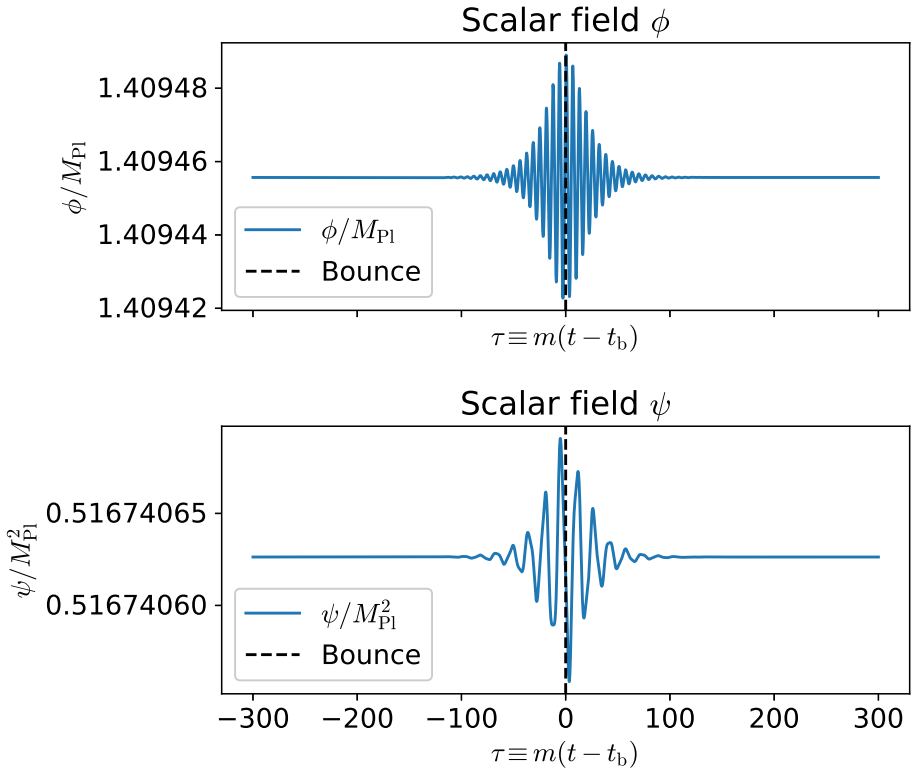
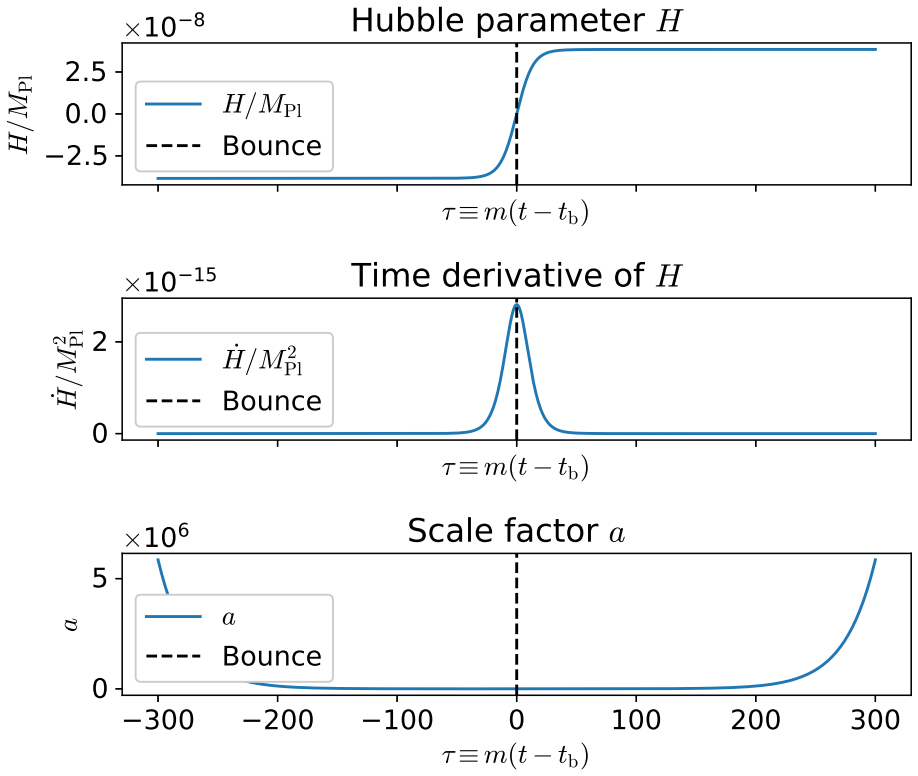
75 1.00 ρ φ + P φ [ M 4 Pl ] × 10 −21 Null Energy Condition (scalar field φ ) NEC: ρ φ + P φ Bounce (a) NEC: ρ ϕ +Pϕ −300 −200 −100 0 100 200 300 τ ≡ m ( t − t b ) −4.424672 −4.424671 −4.424670 −4.424669 −4.424668 ρ φ + 3 P φ [ M 4 Pl ] × 10 −15 Strong Energy Condi ion (scalar field φ ) SEC: ρ φ + 3 P φ Bounce (b) SEC: ρ ϕ + 3Pϕ −300 −200 −100 0 100 200 3...
-
[2]
75 1.00 ρ φ + P φ [ M 4 Pl ] × 10 −21 (c) WEC: ρ ϕ and ρ ϕ +Pϕ −300 −200 −100 0 100 200 300 τ ≡ m ( t − t b ) 0.00
-
[3]
75 1.00 ρ φ − | P φ | [ M 4 Pl ] × 10 −21 Dominant Energy Condition (scalar field φ ) DEC: ρ φ − | P φ | Bounce (d) DEC: ρ ϕ − | Pϕ | FIG. 4. Evolution of the scalar-field energy-condition indi cators, using the same parameters and initial conditions as in Fig. 1. The horizontal axis in all pa nels is τ ≡ m(t − tb), and the vertical dashed line marks the b...
-
[4]
A. H. Guth, Phys. Rev. D 23, 347 (1981)
work page 1981
- [5]
-
[6]
A. A. Starobinsky, Phys. Lett. B 91, 99 (1980)
work page 1980
-
[7]
A. D. Linde, Phys. Lett. B 108, 389 (1982)
work page 1982
- [8]
-
[9]
Y. A. et al. [Planck Collaboration], Astron. Astrophys. 641, A10 (2020), arXiv:1807.06211 [astro-ph.CO]
work page internal anchor Pith review Pith/arXiv arXiv 2020
-
[10]
The Atacama Cosmology Telescope: DR6 Power Spectra, Likelihoods and $\Lambda$CDM Parameters
T. Louis et al. (Atacama Cosmology Telescope), JCAP 11, 062, arXiv:2503.14452 [astro-ph.CO]
work page internal anchor Pith review Pith/arXiv arXiv
-
[11]
R. Kallosh, A. Linde, and D. Roest, Phys. Rev. Lett. 135, 161001 (2025), arXiv:2503.21030 [hep-th]
- [12]
-
[13]
M. Drees and Y. Xu, Phys. Lett. B 867, 139612 (2025), arXiv:2504.20757 [astro-ph.CO]
- [14]
-
[15]
Introduction to Modified Gravity and Gravitational Alternative for Dark Energy
S. Nojiri and S. D. Odintsov, eConf C0602061, 06 (2006), [Int. J. Geom. Meth. Mod. Phys. 4, 115 (2007)], arXiv:hep-th/0601213 [hep-th]
work page internal anchor Pith review Pith/arXiv arXiv 2006
-
[16]
T. Padmanabhan, Gen. Rel. Grav. 40, 529 (2008), arXiv:0705.2533 [gr-qc]
work page internal anchor Pith review Pith/arXiv arXiv 2008
-
[17]
T. P. Sotiriou and V. Faraoni, Rev. Mod. Phys. 82, 451 (2010), arXiv:0805.1726 [gr-qc]
work page internal anchor Pith review Pith/arXiv arXiv 2010
-
[18]
A. D. Felice and S. Tsujikawa, Living Rev. Rel. 13, 3 (2010), arXiv:1002.4928 [gr-qc]
work page internal anchor Pith review Pith/arXiv arXiv 2010
-
[19]
S. Capozziello and M. D. Laurentis, Phys. Rept. 509, 167 (2011), arXiv:1108.6266 [gr-qc]
work page internal anchor Pith review Pith/arXiv arXiv 2011
-
[20]
Unified cosmic history in modified gravity: from F(R) theory to Lorentz non-invariant models
S. Nojiri and S. D. Odintsov, Phys. Rept. 505, 59 (2011), arXiv:1011.0544 [gr-qc]
work page internal anchor Pith review Pith/arXiv arXiv 2011
-
[21]
Beyond the Cosmological Standard Model
A. Joyce, B. Jain, J. Khoury, and M. Trodden, Phys. Rept. 568, 1 (2015), arXiv:1407.0059 [astro-ph.CO]
work page internal anchor Pith review Pith/arXiv arXiv 2015
- [22]
-
[23]
Inflationary cosmology in modified gravity theories
K. Bamba and S. D. Odintsov, Symmetry 7, 220 (2015), arXiv:1503.00442 [hep-th]
work page internal anchor Pith review Pith/arXiv arXiv 2015
- [24]
-
[25]
S. W. Hawking and R. Penrose, Proc. Roy. Soc. Lond. A 314, 529 (1970)
work page 1970
-
[26]
Minimal conditions for the creation of a Friedman-Robertson-Walker universe from a "bounce"
C. Molina-Paris and M. Visser, Phys. Lett. B 455, 90 (1999), arXiv:gr-qc/9810023
work page internal anchor Pith review Pith/arXiv arXiv 1999
-
[27]
M. Novello and S. E. P. Bergliaffa, Phys. Rept. 463, 127 (2008), arXiv:0802.1634 [astro-ph]. 15
work page internal anchor Pith review Pith/arXiv arXiv 2008
-
[28]
Bouncing Cosmologies: Progress and Problems
R. Brandenberger and P. Peter, Found. Phys. 47, 797 (2017), arXiv:1603.05834 [hep-th]
work page internal anchor Pith review Pith/arXiv arXiv 2017
-
[29]
Bouncing Universes in String-inspired Gravity
T. Biswas, A. Mazumdar, and W. Siegel, JCAP 03, 009, arXiv:hep-th/0508194 [hep-th]
work page internal anchor Pith review Pith/arXiv arXiv
-
[30]
Y.-F. Cai, T. Qiu, Y.-S. Piao, M. Li, and X. Zhang, JHEP 10, 071, arXiv:0704.1090 [gr-qc]
work page internal anchor Pith review Pith/arXiv arXiv
-
[31]
Y.-F. Cai, D. A. Easson, and R. Brandenberger, JCAP 08, 020, arXiv:1206.2382 [hep-th]
work page internal anchor Pith review Pith/arXiv arXiv
-
[32]
Matter Bounce in Horava-Lifshitz Cosmology
R. Brandenberger, Phys. Rev. D 80, 043516 (2009), arXiv:0904.2835 [hep-th]
work page internal anchor Pith review Pith/arXiv arXiv 2009
-
[33]
Y.-F. Cai, T.-t. Qiu, R. Brandenberger, and X.-m. Zhang , Phys. Rev. D 80, 023511 (2009), arXiv:0810.4677 [hep-th]
work page internal anchor Pith review Pith/arXiv arXiv 2009
-
[34]
Y.-F. Cai, T. Qiu, J.-Q. Xia, H. Li, and X. Zhang, Phys. Re v. D 79, 021303 (2009), arXiv:0808.0819 [astro-ph]
work page internal anchor Pith review Pith/arXiv arXiv 2009
- [35]
-
[36]
The Raychaudhuri equations: a brief review
S. Kar and S. SenGupta, Pramana 69, 49 (2007), arXiv:gr-qc/0611123
work page internal anchor Pith review Pith/arXiv arXiv 2007
-
[37]
E. Curiel, Einstein Stud. 13, 43 (2017), arXiv:1405.0403 [physics.hist-ph]
-
[38]
General Relativistic Energy Conditions: The Hubble expansion in the epoch of galaxy formation
M. Visser, Phys. Rev. D 56, 7578 (1997), arXiv:gr-qc/9705070
work page internal anchor Pith review Pith/arXiv arXiv 1997
-
[39]
M. K. Parikh, JHEP 10, 089, arXiv:1501.04606 [hep-th]
work page internal anchor Pith review Pith/arXiv arXiv
-
[40]
A Critical Review of Classical Bouncing Cosmologies
D. Battefeld and P. Peter, Phys. Rept. 571, 1 (2015), arXiv:1406.2790 [astro-ph.CO]
work page internal anchor Pith review Pith/arXiv arXiv 2015
-
[41]
Generic instabilities of non-singular cosmologies in Horndeski theory: a no-go theorem
T. Kobayashi, Phys. Rev. D 94, 043511 (2016), arXiv:1606.05831 [hep-th]
work page internal anchor Pith review Pith/arXiv arXiv 2016
-
[42]
Generalized Galileons: instabilities of bouncing and Genesis cosmologies and modified Genesis
M. Libanov, S. Mironov, and V. Rubakov, JCAP 08, 037, arXiv:1605.05992 [hep-th]
work page internal anchor Pith review Pith/arXiv arXiv
-
[43]
S. M. Carroll, M. Hoffman, and M. Trodden, Phys. Rev. D 68, 023509 (2003), arXiv:astro-ph/0301273
work page internal anchor Pith review Pith/arXiv arXiv 2003
-
[44]
S. D. H. Hsu, A. Jenkins, and M. B. Wise, Phys. Lett. B 597, 270 (2004), arXiv:astro-ph/0406043
work page internal anchor Pith review Pith/arXiv arXiv 2004
-
[45]
Null energy condition and superluminal propagation
S. Dubovsky, T. Gregoire, A. Nicolis, and R. Rattazzi, J HEP 03, 025, arXiv:hep-th/0512260
work page internal anchor Pith review Pith/arXiv arXiv
-
[46]
R. V. Buniy and S. D. H. Hsu, Phys. Lett. B 632, 543 (2006), arXiv:hep-th/0502203
work page internal anchor Pith review Pith/arXiv arXiv 2006
-
[47]
D. A. Easson, I. Sawicki, and A. Vikman, JCAP 11, 021, arXiv:1109.1047 [hep-th]
work page internal anchor Pith review Pith/arXiv arXiv
-
[48]
T. Qiu, J. Evslin, Y.-F. Cai, M. Li, and X. Zhang, JCAP 10, 036, arXiv:1108.0593 [hep-th]
work page internal anchor Pith review Pith/arXiv arXiv
-
[49]
G. W. Horndeski, Int. J. Theor. Phys. 10, 363 (1974)
work page 1974
-
[50]
Healthy theories beyond Horndeski
J. Gleyzes, D. Langlois, F. Piazza, and F. Vernizzi, Phy s. Rev. Lett. 114, 211101 (2015), arXiv:1404.6495 [hep-th]
work page internal anchor Pith review Pith/arXiv arXiv 2015
-
[51]
A. Ijjas and P. J. Steinhardt, Phys. Lett. B 764, 289 (2017), arXiv:1609.01253 [gr-qc]
-
[52]
R. P. Woodard, Scholarpedia 10, 32243 (2015), arXiv:1506.02210 [hep-th]
work page internal anchor Pith review Pith/arXiv arXiv 2015
- [53]
-
[54]
A. D. Dolgov and M. Kawasaki, Phys. Lett. B 573, 1 (2003), arXiv:astro-ph/0307285
work page internal anchor Pith review Pith/arXiv arXiv 2003
-
[55]
Bounce cosmology from $F(R)$ gravity and $F(R)$ bigravity
K. Bamba, A. N. Makarenko, A. N. Myagky, S. Nojiri, and S. D. Odintsov, JCAP 01, 008, arXiv:1309.3748 [hep-th]
work page internal anchor Pith review Pith/arXiv arXiv
-
[56]
Bouncing Cosmologies in Palatini $f(R)$ Gravity
C. Barragan, G. J. Olmo, and H. Sanchis-Alepuz, Phys. Re v. D 80, 024016 (2009), arXiv:0907.0318 [gr-qc]
work page internal anchor Pith review Pith/arXiv arXiv 2009
-
[57]
S. D. Odintsov and V. K. Oikonomou, Phys. Rev. D 92, 024016 (2015), arXiv:1504.06866 [gr-qc]
work page internal anchor Pith review Pith/arXiv arXiv 2015
-
[58]
S. K. Tripathy, R. K. Khuntia, and P. Parida, Eur. Phys. J . Plus 134, 504 (2019), arXiv:1905.09477 [gr-qc]
work page internal anchor Pith review Pith/arXiv arXiv 2019
- [59]
- [60]
-
[61]
M. Koussour, N. Myrzakulov, J. Rayimbaev, A. H. A. Alfed eel, and H. M. Elkhair, Int. J. Geom. Meth. Mod. Phys. 21, 2450184 (2024), arXiv:2403.15772 [gr-qc]. 16
- [62]
- [63]
-
[64]
Ö. Güngör and G. D. Starkman, JCAP 04, 003, arXiv:2011.05133 [gr-qc]
- [65]
-
[66]
Energy conditions in f(R)-gravity
J. Santos, J. S. Alcaniz, M. J. Reboucas, and F. C. Carval ho, Phys. Rev. D 76, 083513 (2007), arXiv:0708.0411 [astro-ph]
work page internal anchor Pith review Pith/arXiv arXiv 2007
-
[67]
Energy Conditions and Stability in $f(R)$ theories of gravity with non-minimal coupling to matter
O. Bertolami and M. C. Sequeira, Phys. Rev. D 79, 104010 (2009), arXiv:0903.4540 [gr-qc]
work page internal anchor Pith review Pith/arXiv arXiv 2009
-
[68]
The role of energy conditions in $f(R)$ cosmology
S. Capozziello, S. Nojiri, and S. D. Odintsov, Phys. Let t. B 781, 99 (2018), arXiv:1803.08815 [gr-qc]
work page internal anchor Pith review Pith/arXiv arXiv 2018
-
[69]
T. Harko and F. S. N. Lobo, Eur. Phys. J. C 70, 373 (2010), arXiv:1008.4193 [gr-qc]
work page internal anchor Pith review Pith/arXiv arXiv 2010
-
[70]
T. Harko, Phys. Rev. D 81, 044021 (2010), arXiv:1001.5349 [gr-qc]
work page internal anchor Pith review Pith/arXiv arXiv 2010
- [71]
-
[72]
R. L. Arnowitt, S. Deser, and C. W. Misner, Gen. Rel. Grav . 40, 1997 (2008), arXiv:gr-qc/0405109
work page internal anchor Pith review Pith/arXiv arXiv 1997
-
[73]
X. Gao, Y. Wang, R. Brandenberger, and A. Riotto, Phys. R ev. D 81, 083508 (2010), arXiv:0905.3821 [hep-th]
work page internal anchor Pith review Pith/arXiv arXiv 2010
-
[74]
Density perturbations in general modified gravitational theories
A. De Felice, S. Mukohyama, and S. Tsujikawa, Phys. Rev. D 82, 023524 (2010), arXiv:1006.0281 [astro-ph.CO]. 17
work page internal anchor Pith review Pith/arXiv arXiv 2010
discussion (0)
Sign in with ORCID, Apple, or X to comment. Anyone can read and Pith papers without signing in.