Recognition: 2 theorem links
· Lean TheoremQuantum-classical dynamics of Rashba spin-orbit coupling
Pith reviewed 2026-05-14 23:57 UTC · model grok-4.3
The pith
A new koopmon method for Rashba nanowires reproduces full quantum spin and orbital dynamics more accurately than Ehrenfest models, especially under harmonic confinement.
A machine-rendered reading of the paper's core claim, the machinery that carries it, and where it could break.
Core claim
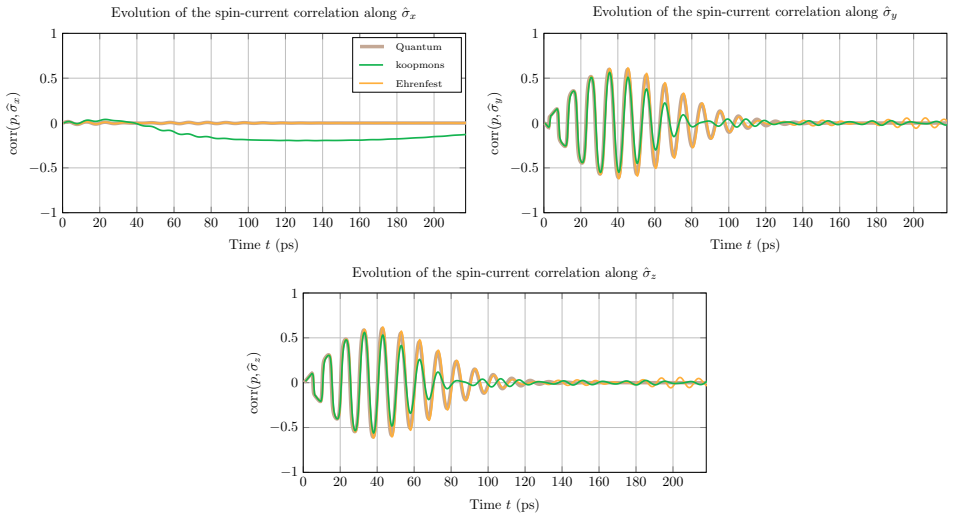
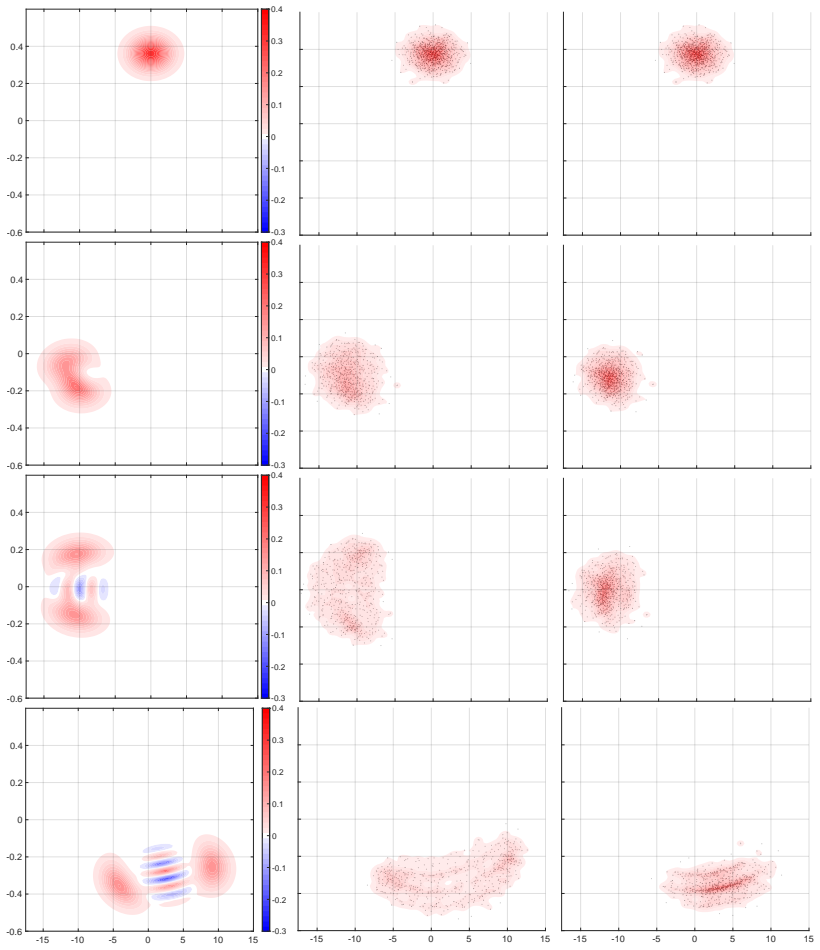
The koopmon scheme, obtained by extending Koopman wavefunctions to spin-orbit coupling, reproduces the full quantum evolution of a quantum spin-1/2 interacting with classical orbital momentum in Rashba nanowire models; in the presence of a harmonic potential it achieves accuracy in both quantum and classical sectors that remains out of reach for the Ehrenfest model, while still recovering the main qualitative features of exact quantum dynamics in the absence of confinement.
What carries the argument
The koopmon particle scheme that extends Koopman wavefunctions to spin-orbit coupling, thereby retaining the Heisenberg principle and capturing correlations beyond the Ehrenfest mean-field limit.
If this is right
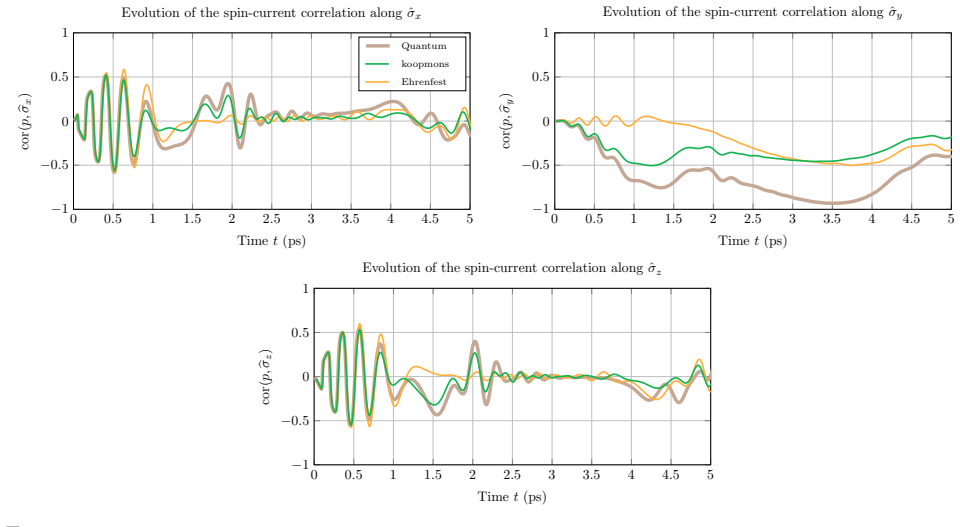
- Without external potential, koopmon reproduces qualitative quantum features in both Rashba- and Zeeman-dominated regimes.
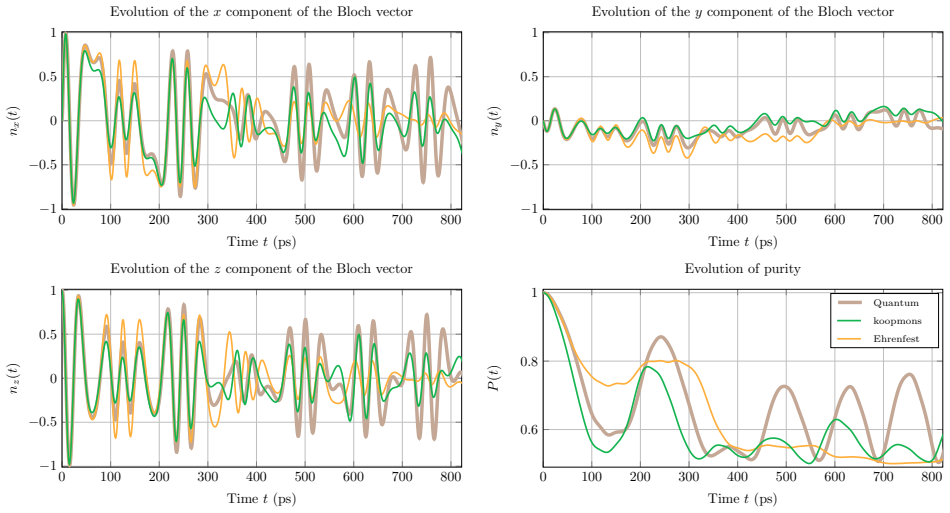
- With harmonic confinement, koopmon matches full quantum results in spin and orbital sectors at levels unreachable by Ehrenfest.
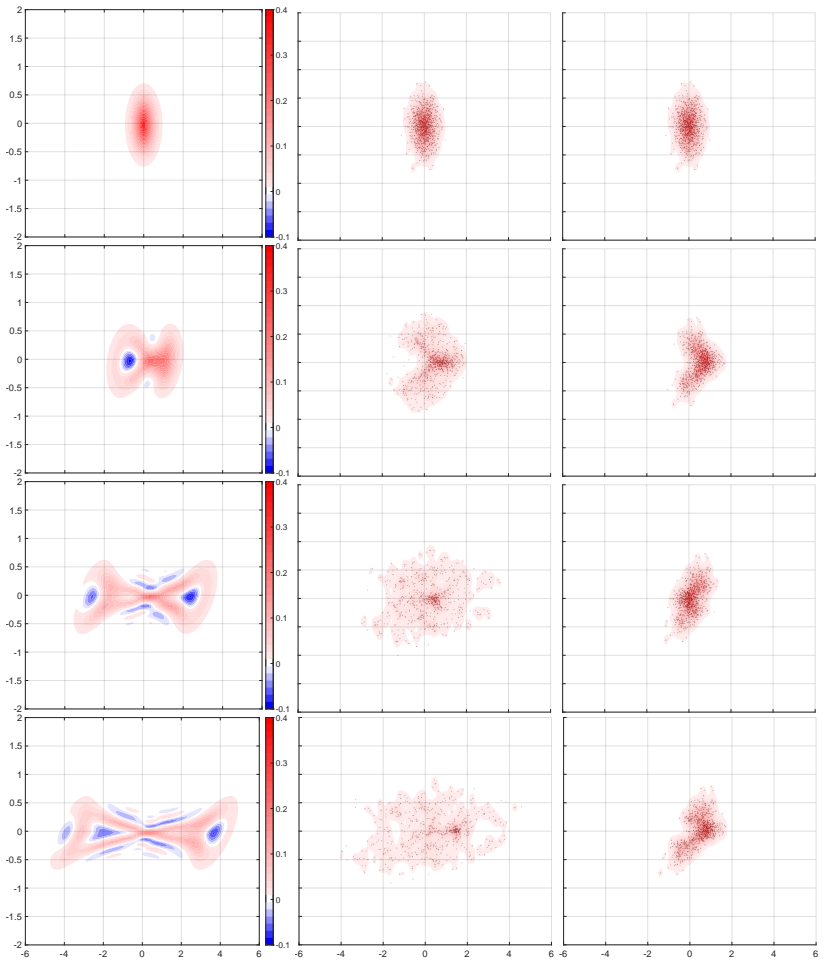
- The method can generate cat-like states in suitable test cases.
- Ehrenfest captures spin accuracy better without potential but fails to track orbital motion.
Where Pith is reading between the lines
- The same koopmon extension could be tested on two-dimensional or curved Rashba structures to check whether correlation capture remains robust.
- If the accuracy gain holds for larger systems, it would allow quantum-classical simulations of spintronic devices at scales where full quantum methods become prohibitive.
- The observed formation of cat-like states suggests the method may naturally incorporate entanglement-like effects between spin and orbital degrees of freedom.
Load-bearing premise
The Koopman wavefunction formalism can be extended consistently to spin-orbit coupling while preserving the Heisenberg principle and the ability to capture correlations beyond mean-field.
What would settle it
A side-by-side numerical run for a Rashba nanowire with harmonic potential at realistic semiconductor parameters where the koopmon orbital trajectories or spin expectation values diverge from the exact quantum solution by more than a few percent while Ehrenfest remains closer.
Figures








read the original abstract
Mixed quantum-classical models are widely used to reduce the computational cost of fully quantum simulations. However, their general applicability across different classes of problems remains an open question. Here, we address this issue for systems featuring spin-orbit coupling. In particular, we study the interaction dynamics of quantum spin-1/2 and classical orbital momentum in one-dimensional models of Rashba nanowires. We tackle this problem by resorting to a new quantum-classical Hamiltonian model that, unlike conventional approaches, retains the Heisenberg principle and captures correlation effects beyond the common Ehrenfest approach. Based on Koopman wavefunctions in classical mechanics, the new model was recently implemented numerically via a particle scheme -- the koopmon method -- which is extended here to treat spin-orbit coupling. We apply the koopmon method to study the quantum-classical dynamics of nanowire models, with and without the presence of a harmonic potential and in both Rashba-dominated (strong coupling) and Zeeman-dominated (weak coupling) regimes. Considering realistic semiconductor parameters, the results are contrasted with both fully quantum and quantum-classical Ehrenfest dynamics. In the absence of external potential, the koopmon method qualitatively reproduces the features of the fully quantum evolution for all coupling regimes. While it exhibits a slight loss in spin accuracy compared to Ehrenfest simulations, the latter fail to capture the orbital dynamics. In the presence of a harmonic potential, the koopmon scheme reproduces the full quantum results with accuracy levels that are unachievable by the Ehrenfest model in both quantum and classical sectors. We conclude by presenting a test case that exhibits the formation of cat-like states.
Editorial analysis
A structured set of objections, weighed in public.
Referee Report
Summary. The manuscript introduces an extension of the Koopman wavefunction formalism (koopmon method) to quantum-classical dynamics of Rashba spin-orbit coupling in one-dimensional nanowire models. It constructs a new Hamiltonian that retains the Heisenberg uncertainty principle and goes beyond Ehrenfest mean-field, then applies a particle-based numerical scheme to compare dynamics against full quantum simulations and Ehrenfest evolution. Results are shown for Rashba- and Zeeman-dominated regimes, both with and without an external harmonic potential, using realistic semiconductor parameters; the koopmon approach is reported to qualitatively match full quantum features (including cat-like states) and to achieve higher accuracy than Ehrenfest when a harmonic trap is present.
Significance. If the numerical comparisons hold under scrutiny, the work supplies a practical mixed quantum-classical route for spin-orbit systems that preserves key quantum features at lower cost than full quantum propagation. The explicit Hamiltonian construction and direct side-by-side tests against independent quantum benchmarks constitute a concrete advance over standard Ehrenfest treatments for this class of problems.
major comments (2)
- [§4] §4 (harmonic-potential results): the claim that koopmon accuracy is 'unachievable by the Ehrenfest model in both quantum and classical sectors' rests on visual or qualitative agreement; quantitative error metrics (e.g., L2 norms on spin and orbital observables, or fidelity to the full-quantum wavefunction) and their dependence on particle number or time-step are not reported, making it impossible to judge whether the improvement is systematic or parameter-specific.
- [§3.1] §3.1 (Koopman extension): the retention of the Heisenberg principle under Rashba coupling is asserted via the wavefunction representation, yet the explicit form of the extended Koopman Hamiltonian (including the spin-orbit term) and the proof that the commutator structure is preserved are not derived; without this step the central advantage over Ehrenfest remains formal rather than demonstrated.
minor comments (3)
- [Abstract] The abstract states a 'slight loss in spin accuracy' relative to Ehrenfest in the free-nanowire case; this should be quantified (e.g., by reporting the time-averaged spin expectation error) so readers can weigh the trade-off against the improved orbital dynamics.
- [Figures] Figure captions and axis labels in the comparison plots should explicitly state the number of koopmon particles, the time-step, and the full-quantum basis size used, to allow reproducibility.
- [§5] The final cat-state test case is presented without a quantitative measure of coherence or visibility; adding a simple fidelity or Wigner-function overlap metric would strengthen the claim.
Simulated Author's Rebuttal
We thank the referee for the positive assessment and constructive comments. We address the two major points below and will revise the manuscript accordingly to strengthen the presentation.
read point-by-point responses
-
Referee: [§4] §4 (harmonic-potential results): the claim that koopmon accuracy is 'unachievable by the Ehrenfest model in both quantum and classical sectors' rests on visual or qualitative agreement; quantitative error metrics (e.g., L2 norms on spin and orbital observables, or fidelity to the full-quantum wavefunction) and their dependence on particle number or time-step are not reported, making it impossible to judge whether the improvement is systematic or parameter-specific.
Authors: We agree that quantitative error metrics would make the comparison more rigorous. In the revised manuscript we will add L2-norm errors for the spin and orbital observables (relative to the full-quantum benchmark) as functions of time, together with a brief discussion of their dependence on particle number and time step. This will allow readers to assess the systematic nature of the improvement over Ehrenfest dynamics. revision: yes
-
Referee: [§3.1] §3.1 (Koopman extension): the retention of the Heisenberg principle under Rashba coupling is asserted via the wavefunction representation, yet the explicit form of the extended Koopman Hamiltonian (including the spin-orbit term) and the proof that the commutator structure is preserved are not derived; without this step the central advantage over Ehrenfest remains formal rather than demonstrated.
Authors: The extended Koopman Hamiltonian that incorporates the Rashba term is written explicitly in Eq. (3) of Section 3.1, and the preservation of the commutator structure follows from the underlying Koopman-wavefunction representation. To make this step fully explicit we will insert a short derivation of the Hamiltonian and a one-paragraph proof that the relevant commutators remain unchanged under the Rashba coupling. This addition will be placed in the revised version of Section 3.1. revision: yes
Circularity Check
Minor self-citation to prior Koopman framework; central results independent of fitted inputs
full rationale
The paper extends the koopmon particle scheme (previously implemented for classical mechanics via Koopman wavefunctions) to Rashba spin-orbit coupling in nanowire models. The derivation chain relies on explicit Hamiltonian construction and numerical integration that are self-contained within the manuscript. Central claims are validated by direct comparison to independent fully quantum simulations and Ehrenfest dynamics, which serve as external benchmarks rather than internal fits. No self-definitional reduction, fitted parameter renamed as prediction, or load-bearing uniqueness theorem from overlapping authors appears in the reported regimes. The retention of Heisenberg uncertainty follows from the Koopman representation as adopted from prior work, but this does not force the numerical outcomes. Overall, the results remain falsifiable against external quantum benchmarks, justifying a low circularity score.
Axiom & Free-Parameter Ledger
axioms (2)
- standard math Standard quantum mechanics for spin-1/2 particles
- domain assumption Classical mechanics for orbital momentum
invented entities (1)
-
Koopman wavefunctions extended to spin-orbit coupling
no independent evidence
Lean theorems connected to this paper
-
IndisputableMonolith/Cost/FunctionalEquation.leanwashburn_uniqueness_aczel unclear?
unclearRelation between the paper passage and the cited Recognition theorem.
the koopmon scheme (1.7)-(1.9) ... regularizing the backreaction energy density ... bIab := 1/2 ∫ (Ka{Kb,bH} − Kb{Ka,bH}) / Σ wc Kc d²z
-
IndisputableMonolith/Foundation/RealityFromDistinction.leanreality_from_one_distinction unclear?
unclearRelation between the paper passage and the cited Recognition theorem.
iℏ ∂bP/∂t + iℏ div(bP X) = [bH, bP] with X = ⟨XbH⟩ + ℏ/2f Tr(...) corrections
What do these tags mean?
- matches
- The paper's claim is directly supported by a theorem in the formal canon.
- supports
- The theorem supports part of the paper's argument, but the paper may add assumptions or extra steps.
- extends
- The paper goes beyond the formal theorem; the theorem is a base layer rather than the whole result.
- uses
- The paper appears to rely on the theorem as machinery.
- contradicts
- The paper's claim conflicts with a theorem or certificate in the canon.
- unclear
- Pith found a possible connection, but the passage is too broad, indirect, or ambiguous to say the theorem truly supports the claim.
Forward citations
Cited by 1 Pith paper
-
Quantum-classical solvation hydrodynamics: Hamiltonian functionals and dissipation
A Hamiltonian-based quantum-classical solvation hydrodynamics model is developed that includes dissipative terms for inertial effects and extends Marcus theory to fast collective fluid sloshing.
Reference graph
Works this paper leans on
-
[1]
Akimov, A.V.; Long, R.; Prezhdo, O.V.Coherence penalty functional: A simple method for adding decoherence in Ehrenfest dynamics. J. Chem. Phys. 140 (2014), 194107
work page 2014
-
[2]
Aleksandrov, I.V.The statistical dynamics of a system consisting of a classical and a quantum subsystem. Z. Naturforsch. 36a (1981), 902–908
work page 1981
-
[3]
Badawy, G.; Bakkers, E.P.A.M.Electronic transport and quantum phenomena in nanowires. Chem. Rev. 124 (2024), n. 5, 2419–2440
work page 2024
-
[4]
Bajpai, U.; Nikoli´ c, B.K.Spintronics meets nonadiabatic molecular dynamics: Geometric spin torque and damping on dynamical classical magnetic texture due to an electronic open quantum system. Phys. Rev. Lett. 125 (2020), n. 18, 187202
work page 2020
-
[5]
Koopmontrajectories in nonadiabatic quantum-classical dynamics
Bauer, W.; Bergold, P.; Gay-Balmaz, F.; Tronci, C. Koopmontrajectories in nonadiabatic quantum-classical dynamics. Multiscale Model. Simul. 22 (2024), no. 4, 1365–1401
work page 2024
-
[6]
Bergold, P.; Tronci, C.Madelung transform and variational asymptotics in Born– Oppenheimer molecular dynamics. Lecture Notes in Comput. Sci. 14072 (2023), 231–241
work page 2023
-
[7]
Birkholz, J.E.; Meden, V.Spin orbit coupling effects in one-dimensional ballistic quantum wires. J. Phys.: Condens. Matter 20 (2008), n. 8, 085226
work page 2008
-
[8]
Bondar, D.I.; Gay-Balmaz, F.; Tronci, C.Koopman wavefunctions and classical-quantum correlation dynamics. Proc. R. Soc. A 475 (2019), n. 2229, 20180879
work page 2019
-
[9]
Bondarenko, A.S.; Tempelaar, R.Overcoming positivity violations for density matrices in surface hopping. J. Chem. Phys. 158 (2023), n. 5, 054117
work page 2023
-
[10]
Boucher, W.; Traschen, J.Semiclassical physics and quantum fluctuations. Phys. Rev. D 37 (1988), 3522–3532
work page 1988
-
[11]
Bychkov, Yu.A.; Rashba, E.I.Properties of a 2D electron gas with lifted spectral degeneracy. Sov. Phys. – JETP Lett. 39 (1984), 78–81
work page 1984
-
[12]
Cavaliere, F.; Ziani, N.; Traverso, S.; Dolcini, F.; Sassetti, M.; Rossi, F.Coherent charge and spin oscillations induced by local quenches in nanowires with spin-orbit coupling. Phys. Rev. B 100 (2019), n. 15, 155306
work page 2019
-
[13]
Crespo-Otero, R.; Barbatti, M.Recent advances and perspectives on nonadiabatic mixed quantum-classical dynamics. Chem. Rev. 118 (2018), n. 15, 7026–7068 30
work page 2018
-
[14]
Culcer, D.; Sinova, J.; Sinitsyn, N.A.; Jungwirth, T.; MacDonald, A.H.; Niu, Q.Semiclas- sical spin transport in spin-orbit-coupled bands. Phys. Rev. Lett. 93 (2004), n. 4, 046602
work page 2004
-
[15]
Di´ osi, L.Classical-quantum hybrid canonical dynamics and its difficulties with special and general relativity. Phys. Rev. D 110 (2024), n. 8, 084052
work page 2024
-
[16]
Di´ osi, L.; Halliwell, J.J.Coupling classical and quantum variables using continuous quan- tum measurement theory. Phys. Rev. Lett. 81 (1998), 2846
work page 1998
-
[17]
Dolcini, F.; Rossi, F.Magnetic field effects on a nanowire with inhomogeneous Rashba spin-orbit coupling: Spin properties at equilibrium. Phys. Rev. B 98 (2018), n. 4, 045436
work page 2018
-
[18]
Fan, J.; Chen, Y.; Chen, G.; et al.Electric-field-induced interferometric resonance of a one-dimensional spin-orbit-coupled electron. Sci. Rep. 6 (2016), 38851
work page 2016
-
[19]
Fang, D.; Jin, S.; Sparber, C.An efficient time-splitting method for the Ehrenfest dynamics. Multiscale Model. Simul. 16 (2018), 900–921
work page 2018
-
[20]
Feit, M.D.; Fleck Jr., J.A.; Steiger, A.Solution of the Schr¨ odinger equation by a spectral method. J. Comput. Phys. 47 (1982), 412–433. [III.3]
work page 1982
-
[21]
Foldy, L.L.The electromagnetic properties of Dirac particles. Phys. Rev. 87 (1952), 688
work page 1952
-
[22]
Fay, T.P.; Lindoy, L.P.; Manolopoulos, D.E.; Hore, P.J.How quantum is radical pair magnetoreception?Faraday Discuss. 221 (2020), 77–91
work page 2020
-
[23]
Flindt, C.; Sørensen, A.S.; Flensberg, K.Spin-orbit induced spin-qubit control in nano- wires. J. Phys.: Conf. Ser. 61 (2007), n. 1, 302–306
work page 2007
-
[24]
Flindt, C.; Sørensen, A.S.; Flensberg, K.Spin-orbit mediated control of spin qubits. Phys. Rev. Lett. 97 (2006), 240501
work page 2006
- [25]
-
[26]
Gay-Balmaz, F.; Tronci, C.Complex fluid models of mixed quantum-classical dynamics. J. Nonlinear Sci. 34 (2024), n. 5, 81
work page 2024
-
[27]
Gay-Balmaz, F.; Tronci, C.Dynamics of mixed quantum-classical spin systems. J. Phys. A 56 (2023), 144002
work page 2023
-
[28]
Gay-Balmaz, F.; Tronci, C.Evolution of hybrid quantum-classical wavefunctions. Phys. D 440 (2022), 133450
work page 2022
-
[29]
Gay-Balmaz, F.; Tronci, C.Koopman wavefunctions and classical states in hybrid quantum-classical dynamics. J. Geom. Mech. 14 (2022), n. 4, 559–596
work page 2022
-
[30]
Gay-Balmaz, F.; Tronci, C.Madelung transform and probability densities in hybrid quantum-classical dynamics. Nonlinearity 33 (2019), n. 10, 5383–5424
work page 2019
-
[31]
Gerasimenko, V.Dynamical equations of quantum-classical systems. Theor. Math. Phys. 50 (1982), 49–55
work page 1982
-
[32]
Ghose, P.The unfinished search for wave-particle and classical-quantum harmony. J. Adv. Phys. 4 (2015), n. 3, 236–251
work page 2015
-
[33]
Gilbert, T.L.A phenomenological theory of damping in ferromagnetic materials. IEEE Trans. Magn. 40 (2004), 3443–3449
work page 2004
-
[34]
Gogin, L.; Rossi, F.; Dolcini, F.Electron transport in quantum channels with spin–orbit interaction: Effects of the sign of the Rashba coupling and applications to nanowires. New J. Phys. 24 (2022), n. 9, 093025 31
work page 2022
-
[35]
Governale, M.; Z¨ ulicke, U.Spin accumulation in quantum wires with strong Rashba spin- orbit coupling. Phys. Rev. B 66 (2002), n. 7, 073311
work page 2002
-
[36]
Governale, M.; Z¨ ulicke, U.Rashba spin splitting in quantum wires. Solid State Commun. 131 (2004), 581–589
work page 2004
-
[37]
Greene, S. M.; Batista, V. S.Tensor-train split-operator Fourier transform (TT-SOFT) method: Multidimensional nonadiabatic quantum dynamics. J. Chem. Theory Comput. (2017), 4034–4042
work page 2017
-
[38]
Ensembles on configuration space
Hall, M.J.W.; Reginatto, M. Ensembles on configuration space. Springer (2016)
work page 2016
-
[39]
J.; Pierz, K.Mapping thegfactor anisotropy of InAs self-assembled quantum dots
Hapke-Wurst, I.; Zeitler, U.; Haug, R. J.; Pierz, K.Mapping thegfactor anisotropy of InAs self-assembled quantum dots. Phys. E 12 (2002), n. 1, 802–805
work page 2002
- [40]
-
[41]
Hinschberger, Y.; Hervieux, P.-A.Foldy–Wouthuysen transformation applied to the inter- action of an electron with ultrafast electromagnetic fields. Phys. Lett. A 376 (2012), n. 6–7, 813–819
work page 2012
-
[42]
Hochbruck, M.; Lubich, C.On Krylov subspace approximations to the matrix exponential operator. SIAM J. Numer. Anal. 34 (1997), 1911–1925
work page 1997
-
[43]
Holm, D.D.; Rawlinson, J.I.; Tronci, C.The bohmion method in nonadiabatic quantum hydrodynamics. J. Phys. A: Math. Theor. 54 (2021), n. 49, 495201
work page 2021
-
[44]
Hurst, J.; Hervieux, P.-A.; Manfredi, G.Phase-space methods for the spin dynamics in condensed matter systems. Phil. Trans. R. Soc. A 375 (2017), 20160199
work page 2017
-
[45]
Iserles, A.; Kropielnicka, K.; Singh, P.Solving Schr¨ odinger equation in semiclassical regime with highly oscillatory time-dependent potentials. J. Comput. Phys. 376 (2019), 564–584
work page 2019
-
[46]
Mathematical horizons for quantum physics
Jauslin, H.R.; Sugny, D.Dynamics of mixed quantum-classical systems, geometric quanti- zation and coherent states. In “Mathematical horizons for quantum physics”. Lect. Notes Ser. Inst. Math. Sci. Natl. Univ. Singap. 20 (2010), 65–96. World Scientific
work page 2010
-
[47]
Koopman, B.O.Hamiltonian systems and transformations in Hilbert space. Proc. Nat. Acad. Sci. 17 (1931), 315
work page 1931
-
[48]
Kosloff, D.; Kosloff, R.A Fourier method solution for the time dependent Schr¨ odinger equation as a tool in molecular dynamics. J. Comput. Phys. 52 (1983), 35–53
work page 1983
-
[49]
Layton, I.Effective theories of classical-quantum dynamics. Ph.D. thesis, University Col- lege London (2025)
work page 2025
-
[50]
Li, R.; You, J.Q.; Sun, C.P.; Nori, F.Controlling a nanowire spin-orbit qubit via electric- dipole spin resonance. Phys. Rev. Lett. 111 (2013), n. 8, 086805
work page 2013
-
[51]
Lin, Y.-J.; Jim´ enez-Garc´ ıa, K.; Spielman, I.B.Spin–orbit-coupled Bose–Einstein conden- sates. Nature 471 (2011), 83–86
work page 2011
-
[52]
Litvinenko, K. L.; Nikzad, L.; Pidgeon, C. R.; et al.Temperature dependence of the electron Land´ egfactor in InSb and GaAs. Phys. Rev. B 77 (2008), 033204
work page 2008
-
[53]
From quantum to classical molecular dynamics: Reduced models and numerical analysis
Lubich, C. From quantum to classical molecular dynamics: Reduced models and numerical analysis. European Mathematical Society (EMS) (2008)
work page 2008
-
[54]
Manfredi, G.; Rittaud, A.; Tronci, C.Hybrid quantum-classical dynamics of pure- dephasing systems. J. Phys. A: Math. Theor. 56 (2023), 154002 32
work page 2023
-
[55]
Mart´ ınez-Crespo, D.; Tronci, C.Heisenberg dynamics of mixed quantum-classical systems. Eur. Phys. J. Plus 140 (2025), 580
work page 2025
-
[56]
Mireles, F.; Kirczenow, G.Ballistic spin-polarized transport and Rashba spin precession in semiconductor nanowires. Phys. Rev. B 64 (2001), n. 2, 024426
work page 2001
-
[57]
Nadj-Perge, S.; Frolov, S.M.; Bakkers, E.P.A.M.; Kouwenhoven, L.P.Spin-orbit qubit in a semiconductor nanowire. Nature 468 (2010), n. 7327, 1084–1087
work page 2010
-
[58]
Park, T.J.; Light, J.C.Unitary quantum time evolution by iterative Lanczos reduction. J. Chem. Phys. 85 (1986), 5870–5876
work page 1986
-
[59]
Pereira, R.G.; Miranda, E.Magnetically controlled impurities in quantum wires with strong Rashba coupling. Phys. Rev. B 71 (2005), n. 8, 085318
work page 2005
-
[60]
Peres, A.; Terno, D.R.Hybrid quantum-classical dynamics. Phys. Rev. A 63 (2001), 022101
work page 2001
-
[61]
Petrovi´ c, M.D.; Popescu, B.S.; Bajpai, U.; Plech´ aˇ c, P.; Nikoli´ c, B.K.Spin and charge pumping by a steady or pulse-current-driven magnetic domain wall: A self-consistent mul- tiscale time-dependent quantum-classical hybrid approach. Phys. Rev. App. 10 (2018), n. 5, 054038
work page 2018
-
[62]
Sladek, R.J.Effective masses of electrons in indium arsenide and indium antimonide. Phys. Rev. 105 (1957), 460
work page 1957
-
[63]
Stˇ reda, P.;ˇSeba, P.Antisymmetric spin filtering in one-dimensional electron systems with uniform spin-orbit coupling. Phys. Rev. Lett. 90 (2003), n. 25, 256601
work page 2003
-
[64]
Stroppa, A.; Barone, P.; Di Sante, D.; Cuoco, M.; Picozzi, S.; Whangbo, M.-H.Analogies between Jahn–Teller and Rashba spin physics. Int. J. Quantum Chem. 116 (2016), 1442– 1450
work page 2016
-
[65]
Thomas, L.H.The kinematics of an electron with an axis. Phil. Mag. 7 (1927), 1–23
work page 1927
- [66]
-
[67]
Tronci, C.; Gay-Balmaz, F.Lagrangian trajectories and closure models in mixed quantum- classical dynamics. Lecture Notes in Comput. Sci. 14072 (2023), 290–300
work page 2023
-
[68]
Tronci, C.; Mart´ ınez-Crespo, D.; Gay-Balmaz, F.Entropy functionals and equilibrium states in mixed quantum-classical dynamics. Lecture Notes in Comput. Sci. 16034 (2026), 182–192
work page 2026
-
[69]
Tully, J.C.Mixed quantum-classical dynamics. Faraday Discuss. 110 (1998), 407–419
work page 1998
-
[70]
Tully, J.C.Molecular dynamics with electronic transitions. J. Chem. Phys. 93 (1990), 1061
work page 1990
-
[71]
Zhang, Y.; Mossman, M.E.; Busch, T.; Engels, P.; Zhang, C.Properties of spin-orbit- coupled Bose–Einstein condensates. Front. Phys. 11 (2016), n. 3, 118103
work page 2016
-
[72]
Zimmermann, T.; Van´ ıˇ cek, J.Measuring nonadiabaticity of molecular quantum dynamics with quantum fidelity and with its efficient semiclassical approximation. J. Chem. Phys. 136 (2012), 094106 [73]https://www.ioffe.ru/SVA/NSM/Semicond/InAs/basic.html [74]https://www.ioffe.ru/SVA/NSM/Semicond/InSb/basic.html 33
work page 2012
discussion (0)
Sign in with ORCID, Apple, or X to comment. Anyone can read and Pith papers without signing in.