Recognition: 2 theorem links
· Lean TheoremA unified quantum computing quantum Monte Carlo framework through structured state preparation
Pith reviewed 2026-05-15 00:31 UTC · model grok-4.3
The pith
Task-adapted unitaries extend QCQMC to excited states, optimization and finite temperature while the diffusion step improves energy accuracy across domains.
A machine-rendered reading of the paper's core claim, the machinery that carries it, and where it could break.
Core claim
Replacing the original VQE prescription with task-adapted unitaries (VFF, VUMPO, symmetry-preserving VQE, Haar-random) lets QCQMC address excited-state spectra, combinatorial optimization and finite-temperature observables. Benchmarks across molecular, condensed-matter, nuclear-structure and graph-optimization problems show the QMC diffusion step improves energy accuracy over the underlying state-preparation method in every domain. For weakly correlated systems VUMPO reaches near-exact energies with shallower circuits after classical tensor-network pre-training; for strongly correlated systems the diffusion correction becomes essential.
What carries the argument
Task-adapted state-preparation unitaries integrated with the QCQMC diffusion step, where the diffusion refines the prepared quantum states to lower variational energies.
If this is right
- For weakly correlated systems, VUMPO plus classical pre-training yields near-exact energies with significantly shallower quantum circuits.
- For strongly correlated systems the diffusion correction is required to reach useful accuracy.
- Finite-temperature observables become accessible from pure-state dynamics via Haar-random basis preparation inside QCQMC.
- The same diffusion layer improves results uniformly across molecular, condensed-matter, nuclear and graph problems.
Where Pith is reading between the lines
- The framework could function as a general post-processing layer for other variational quantum algorithms once suitable unitaries are identified.
- Classical tensor-network pre-training paired with shallow quantum circuits may improve scalability for larger systems where full variational optimization is expensive.
- Choosing different structured unitaries might allow the same QCQMC core to tackle time-dependent or open-system problems.
Load-bearing premise
The task-adapted unitaries can be systematically built and combined with the diffusion step without introducing errors that cancel the accuracy gains.
What would settle it
An example in which the QCQMC diffusion step applied to a well-constructed task-adapted unitary produces a higher energy than the unitary alone, or a problem class for which no suitable task-adapted unitary can be constructed.
Figures




read the original abstract
We extend Quantum Computing Quantum Monte Carlo (QCQMC) beyond ground-state energy estimation by systematically constructing the quantum circuits used for state preparation. Replacing the original Variational Quantum Eigensolver (VQE) prescription with task-adapted unitaries, we show that QCQMC can address excited-state spectra via Variational Fast Forwarding and the Variational Unitary Matrix Product Operator (VUMPO), combinatorial optimization via a symmetry-preserving VQE ansatz, and finite-temperature observables via Haar-random unitaries. Benchmarks on molecular, condensed-matter, nuclear-structure, and graph-optimization problems demostrate that the QMC diffusion step consistently improves the energy accuracy of the underlying state-preparation method across all tested domains. For weakly correlated systems, VUMPO achieves near-exact energies with significantly shallower circuits by offloading optimization to a classical tensor-network pre-training step, while for strongly correlated systems, the QMC correction becomes essential. We further provide a proof-of-concept demonstration that Haar-random basis state preparation within QCQMC yields finite-temperature estimates from pure-state dynamics.
Editorial analysis
A structured set of objections, weighed in public.
Referee Report
Summary. The paper extends QCQMC beyond ground-state estimation by replacing standard VQE state preparation with task-adapted unitaries (VFF for excited states, VUMPO for weakly correlated systems via classical tensor-network pre-training, symmetry-preserving VQE for combinatorial optimization, and Haar-random unitaries for finite-temperature observables). Benchmarks on molecular, condensed-matter, nuclear-structure, and graph-optimization problems are reported to show that the QMC diffusion step consistently improves energy accuracy over the underlying state-preparation methods, with VUMPO achieving near-exact results for weakly correlated cases and the diffusion correction becoming essential for strongly correlated regimes; a proof-of-concept for finite-temperature estimates from pure-state dynamics is also included.
Significance. If the reported benchmarks hold with adequate controls, the work offers a systematic unification of QCQMC with multiple quantum algorithms, enabling broader applicability while leveraging classical pre-training to reduce circuit depth in selected regimes. The consistent cross-domain improvement and the finite-temperature demonstration represent a meaningful advance in hybrid quantum-classical simulation frameworks.
major comments (1)
- The central claim of consistent accuracy improvement across domains rests on the benchmark comparisons, yet the manuscript must supply explicit numerical energy values, error bars, circuit depths, and statistical tests for each domain and method (including direct before/after diffusion comparisons) to allow independent evaluation; without these the improvement cannot be quantified or verified.
minor comments (1)
- Abstract: 'demostrate' is a typographical error and should read 'demonstrate'.
Simulated Author's Rebuttal
We thank the referee for the positive assessment and recommendation of minor revision. We address the single major comment below.
read point-by-point responses
-
Referee: The central claim of consistent accuracy improvement across domains rests on the benchmark comparisons, yet the manuscript must supply explicit numerical energy values, error bars, circuit depths, and statistical tests for each domain and method (including direct before/after diffusion comparisons) to allow independent evaluation; without these the improvement cannot be quantified or verified.
Authors: We agree that explicit numerical values are required for independent verification. In the revised manuscript we add Table II, which tabulates, for every domain and method: the raw energy (or observable) from the state-preparation unitary alone, the energy after the QCQMC diffusion step, the Monte Carlo statistical error bars, the circuit depth of the preparation unitary, and the p-value from a paired t-test on the before/after improvement. Direct before/after columns are included for all four domains (molecular, condensed-matter, nuclear, graph). revision: yes
Circularity Check
No significant circularity identified
full rationale
The paper extends QCQMC by replacing VQE with task-adapted unitaries (VFF, VUMPO, symmetry-preserving VQE, Haar-random) for different regimes and demonstrates via benchmarks that the diffusion step improves energy accuracy across molecular, condensed-matter, nuclear, and graph problems. No equations, definitions, or self-citations in the abstract or described chain reduce the claimed improvements to fitted parameters, self-referential quantities, or load-bearing prior results by the same authors. The constructions and benefits are presented as independent extensions validated externally rather than derived tautologically from the inputs.
Axiom & Free-Parameter Ledger
Lean theorems connected to this paper
-
IndisputableMonolith/Cost/FunctionalEquation.leanwashburn_uniqueness_aczel unclear?
unclearRelation between the paper passage and the cited Recognition theorem.
Benchmarks on molecular, condensed-matter, nuclear-structure, and graph-optimization problems demonstrate that the QMC diffusion step consistently improves the energy accuracy of the underlying state-preparation method
-
IndisputableMonolith/Foundation/AlphaCoordinateFixation.leanalpha_pin_under_high_calibration unclear?
unclearRelation between the paper passage and the cited Recognition theorem.
VUMPO achieves near-exact energies with significantly shallower circuits by offloading optimization to a classical tensor-network pre-training step
What do these tags mean?
- matches
- The paper's claim is directly supported by a theorem in the formal canon.
- supports
- The theorem supports part of the paper's argument, but the paper may add assumptions or extra steps.
- extends
- The paper goes beyond the formal theorem; the theorem is a base layer rather than the whole result.
- uses
- The paper appears to rely on the theorem as machinery.
- contradicts
- The paper's claim conflicts with a theorem or certificate in the canon.
- unclear
- Pith found a possible connection, but the passage is too broad, indirect, or ambiguous to say the theorem truly supports the claim.
Reference graph
Works this paper leans on
-
[1]
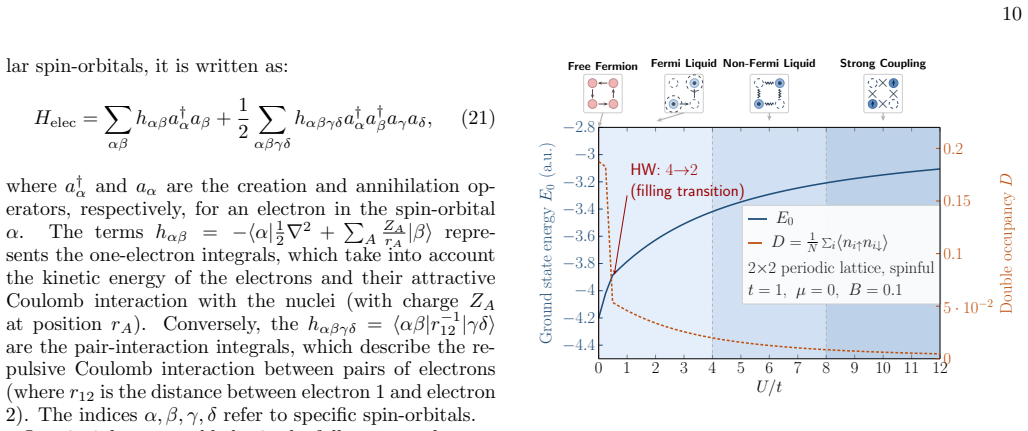
2D Fermi-Hubbard model One of the cornerstone models of electronic systems and materials is the Fermi-Hubbard model. Despite its simplicity, it shows a wide variety of phenomena, even in its one-dimensional formulation [83]. In two dimensions, the Fermi-Hubbard Hamiltonian is considered a non- trivial benchmark for studying strongly correlated sys- tems a...
-
[2]
Nuclear shell model In the nuclear shell model, atomic nuclei are described similarly to how molecules are described in quantum chemistry. This involves treating protons and neutrons (nucleons) as fundamental fermions that occupy single- particle states, or orbitals, within a valence space as shown in Fig. 6. These orbitals are characterized by quantum nu...
-
[3]
Cardinality-Constrained MaxCut Optimization Optimization problems defined on graphs play a cen- tral role in combinatorial optimization, where the ob- jective is to make decisions based on the structure and weights of vertices and edges. The cost function in Eq. (24) defines acardinality-constrained MaxCut prob- lemon a graphG= (V, E), whereVis the set of...
-
[4]
M. B. Donnelly, Y. Chung, R. Garreis, S. Plugge, D. Pye, M. Kiczynski, J. T´ amara-Isaza, M. M. Mu- nia, S. Sutherland, B. Voisin, L. Kranz, Y. L. Hsueh, A. M. S.-E. Huq, C. R. Myers, R. Rahman, J. G. Keizer, S. K. Gorman, and M. Y. Simmons, Large-scale ana- logue quantum simulation using atom dot arrays, Na- ture650, 574 (2026)
work page 2026
-
[5]
W.-W. Fan, L. J. Hong, G.-X. Jiang, and J. Luo, Review of large-scale simulation optimization, Journal of the Operations Research Society of China13, 688 (2025)
work page 2025
-
[6]
S. E. Venegas-Andraca, Quantum walks: a comprehen- sive review, Quantum Information Processing11, 1015 (2012)
work page 2012
-
[7]
F. R. Petruzielo, A. A. Holmes, H. J. Changlani, M. P. Nightingale, and C. J. Umrigar, Semistochastic projec- tor monte carlo method, Phys. Rev. Lett.109, 230201 (2012)
work page 2012
-
[8]
X. Hu, Y. Nonomura, and M. Kohno, Monte carlo simu- lation, inSpringer Handbook of Materials Measurement Methods, edited by H. Czichos, T. Saito, and L. Smith (Springer Berlin Heidelberg, Berlin, Heidelberg, 2006) pp. 1057–1096
work page 2006
-
[9]
B. M. Austin, D. Y. Zubarev, and W. A. Lester Jr., Quantum monte carlo and related approaches, Chemical Reviews112, 263 (2012)
work page 2012
- [10]
-
[11]
J. Carlson, S. Gandolfi, F. Pederiva, S. C. Pieper, R. Schiavilla, K. E. Schmidt, and R. B. Wiringa, Quan- tum monte carlo methods for nuclear physics, Reviews of modern physics87, 1067 (2015)
work page 2015
-
[12]
G. H. Booth, A. J. Thom, and A. Alavi, Fermion monte carlo without fixed nodes: A game of life, death, and annihilation in slater determinant space, The Journal of Chemical Physics131, 054106 (2009)
work page 2009
-
[13]
D. Cleland, G. H. Booth, C. Overy, and A. Alavi, Tam- ing the first-row diatomics: A full configuration inter- action quantum monte carlo study, Journal of chemical theory and computation8, 4138 (2012)
work page 2012
-
[14]
M. H. Kolodrubetz, J. S. Spencer, B. K. Clark, and W. M. Foulkes, The effect of quantization on the full configuration interaction quantum monte carlo sign problem, The Journal of Chemical Physics138, 024110 (2013)
work page 2013
-
[15]
M. Troyer and U.-J. Wiese, Computational complex- ity and fundamental limitations to fermionic quantum monte carlo simulations, Phys. Rev. Lett.94, 170201 (2005)
work page 2005
-
[16]
G. H. Booth and A. Alavi, Approaching chemical accu- racy using full configuration-interaction quantum monte carlo: A study of ionization potentials, The Journal of Chemical Physics132, 174104 (2010)
work page 2010
- [17]
-
[18]
A. J. Daley, I. Bloch, C. Kokail, S. Flannigan, N. Pear- son, M. Troyer, and P. Zoller, Practical quantum advan- tage in quantum simulation, Nature607, 667 (2022)
work page 2022
-
[19]
H. Qi, S. Xiao, Z. Liu, C. Gong, and A. Gani, Varia- tional quantum algorithms: fundamental concepts, ap- plications and challenges, Quantum Information Pro- cessing23, 224 (2024)
work page 2024
-
[20]
Mind the gaps: The fraught road to quantum advantage
J. Eisert and J. Preskill, Mind the gaps: The fraught road to quantum advantage, arXiv preprint arXiv:2510.19928 (2025)
-
[21]
M. Larocca, S. Thanasilp, S. Wang, K. Sharma, J. Bia- monte, P. J. Coles, L. Cincio, J. R. McClean, Z. Holmes, and M. Cerezo, Barren plateaus in variational quantum computing, Nature Reviews Physics7, 174 (2025)
work page 2025
-
[22]
W. Saib, P. Wallden, and I. Akhalwaya, The effect of noise on the performance of variational algorithms for quantum chemistry, in2021 IEEE International Confer- ence on Quantum Computing and Engineering (QCE) (2021) pp. 42–53
work page 2021
- [23]
- [24]
-
[25]
W. J. Huggins, B. A. O’Gorman, N. C. Rubin, D. R. Reichman, R. Babbush, and J. Lee, Unbiasing fermionic quantum monte carlo with a quantum computer, Nature 603, 416 (2022)
work page 2022
-
[26]
A. W. Sandvik and G. Vidal, Variational quantum monte carlo simulations with tensor-network states, Phys. Rev. Lett.99, 220602 (2007)
work page 2007
-
[27]
J. Chen, J. Jiang, D. Hangleiter, and N. Schuch, Sign problem in tensor-network contraction, PRX Quantum 6, 010312 (2025)
work page 2025
- [28]
-
[29]
S. Shepard, A. Scemama, S. Moroni, and C. Filippi, Op- timizing excited states in quantum monte carlo: A re- assessment of double excitations, The Journal of Chem- ical Physics163, 024119 (2025)
work page 2025
-
[30]
O. Higgott, D. Wang, and S. Brierley, Variational Quan- tum Computation of Excited States, Quantum3, 156 (2019)
work page 2019
-
[31]
C. De Grandi, A. Polkovnikov, and A. W. Sandvik, Uni- versal nonequilibrium quantum dynamics in imaginary time, Phys. Rev. B84, 224303 (2011)
work page 2011
-
[32]
I. Kolotouros, D. Joseph, and A. K. Narayanan, Accel- erating quantum imaginary-time evolution with random measurements, Phys. Rev. A111, 012424 (2025)
work page 2025
-
[33]
N. S. Blunt, S. D. Smart, G. H. Booth, and A. Alavi, An excited-state approach within full configuration inter- action quantum monte carlo, The Journal of Chemical Physics143, 134117 (2015)
work page 2015
-
[34]
N. S. Blunt, T. W. Rogers, J. S. Spencer, and W. M. C. Foulkes, Density-matrix quantum monte carlo method, Phys. Rev. B89, 245124 (2014)
work page 2014
-
[35]
S. Egginger, K. Kirova, S. Bruckner, S. Hillmich, and R. Kueng, A rigorous quantum framework for inequality-constrained and multi-objective binary opti- mization: Quadratic cost functions and empirical eval- uations, arXiv preprint arXiv:2510.13987 (2025)
-
[36]
P. Jordan and E. Wigner, ¨ uber das paulische ¨ aquivalenzverbot, Zeitschrift f¨ r Physik47, 631–651 (1928)
work page 1928
-
[37]
S. B. Bravyi and A. Y. Kitaev, Fermionic quantum com- putation, Annals of Physics298, 210 (2002)
work page 2002
- [38]
-
[39]
A. M. Childs and N. Wiebe, Hamiltonian simulation us- ing linear combinations of unitary operations, Quantum Information & Computation12, 901 (2012)
work page 2012
-
[40]
Campbell, Random compiler for fast hamiltonian simulation, Phys
E. Campbell, Random compiler for fast hamiltonian simulation, Phys. Rev. Lett.123, 070503 (2019)
work page 2019
-
[41]
K. Wan, M. Berta, and E. T. Campbell, Random- ized quantum algorithm for statistical phase estimation, Phys. Rev. Lett.129, 030503 (2022)
work page 2022
- [42]
-
[43]
J. G¨ unther, F. Witteveen, A. Schmidhuber, M. Miller, M. Christandl, and A. Harrow, Phase estimation with partially randomized time evolution, arXiv preprint arXiv:2503.05647 (2025)
-
[44]
P. K. Faehrmann, J. Eisert, and R. Kueng, In the shadow of the hadamard test: Using the garbage state for good and further modifications, Phys. Rev. Lett. 135, 150603 (2025)
work page 2025
- [45]
- [46]
- [47]
-
[48]
P. K. Barkoutsos, J. F. Gonthier, I. Sokolov, N. Moll, G. Salis, A. Fuhrer, M. Ganzhorn, D. J. Egger, M. Troyer, A. Mezzacapo, S. Filipp, and I. Tavernelli, Quantum algorithms for electronic structure calcula- tions: Particle-hole hamiltonian and optimized wave- function expansions, Phys. Rev. A98, 022322 (2018)
work page 2018
-
[49]
A. M. Childs, Y. Su, M. C. Tran, N. Wiebe, and S. Zhu, Theory of trotter error with commutator scaling, Phys. Rev. X11, 011020 (2021)
work page 2021
- [50]
-
[51]
B. T. Gard, L. Zhu, G. S. Barron, N. J. Mayhall, S. E. Economou, and E. Barnes, Efficient symmetry- preserving state preparation circuits for the variational quantum eigensolver algorithm, npj Quantum Informa- tion6, 10 (2020)
work page 2020
-
[52]
A. Kandala, A. Mezzacapo, K. Temme, M. Takita, M. Brink, J. M. Chow, and J. M. Gambetta, Hardware- efficient variational quantum eigensolver for small molecules and quantum magnets, nature549, 242 (2017)
work page 2017
-
[53]
J. R. McClean, S. Boixo, V. N. Smelyanskiy, R. Bab- bush, and H. Neven, Barren plateaus in quantum neural network training landscapes, Nature Communications 9, 4812 (2018)
work page 2018
-
[54]
E. R. Anschuetz and B. T. Kiani, Beyond barren plateaus: Quantum variational algorithms are swamped with traps, Nature Communications13, 7760 (2022)
work page 2022
- [55]
-
[56]
A. Peruzzo, J. McClean, P. Shadbolt, M.-H. Yung, X.- Q. Zhou, P. J. Love, A. Aspuru-Guzik, and J. L. O’brien, A variational eigenvalue solver on a photonic quantum processor, Nature Communications5, 4213 (2014)
work page 2014
-
[57]
J. R. McClean, J. Romero, R. Babbush, and A. Aspuru- Guzik, The theory of variational hybrid quantum- classical algorithms, New Journal of Physics18, 023023 (2016)
work page 2016
-
[58]
C. Cirstoiu, Z. Holmes, J. Iosue, L. Cincio, P. J. Coles, and A. Sornborger, Variational fast forwarding for quan- tum simulation beyond the coherence time, npj Quan- tum Information6, 82 (2020)
work page 2020
- [59]
- [60]
- [61]
- [62]
-
[63]
L. Gover, V. Wimalaweera, F. Azad, M. DeCross, M. Foss-Feig, and A. G. Green, Fully optimised vari- ational simulation of a dynamical quantum phase tran- sition on a trapped-ion quantum computer, arXiv preprint arXiv:2502.06961 (2025)
work page internal anchor Pith review Pith/arXiv arXiv 2025
- [64]
-
[65]
E. Recio-Armengol, S. Ahmed, and J. Bowles, Train on classical, deploy on quantum: scaling generative quantum machine learning to a thousand qubits, arXiv preprint arXiv:2503.02934 (2025)
-
[66]
M. Herrero-Gonzalez, B. Coyle, K. McDowall, R. Grassie, S. Beentjes, A. Khamseh, and E. Kashefi, The born ultimatum: Conditions for classical surro- gation of quantum generative models with correlators, arXiv preprint arXiv:2511.01845 (2025)
-
[67]
M. S. Rudolph, J. Miller, D. Motlagh, J. Chen, A. Acharya, and A. Perdomo-Ortiz, Synergistic pre- training of parametrized quantum circuits via tensor networks, Nature Communications14, 8367 (2023)
work page 2023
-
[68]
M. C. Ba˜ nuls, Tensor Network Algorithms: A Route Map, Annual Review of Condensed Matter Physics14, 173 (2023)
work page 2023
-
[69]
R. Or´ us, Tensor networks for complex quantum systems, Nature Reviews Physics1, 538 (2019), springer Nature
work page 2019
-
[70]
M. D. Garc´ ıa and A. M´ arquez Romero, Survey on com- putational applications of tensor-network simulations, IEEE Access12, 193212 (2024)
work page 2024
-
[71]
R. Or´ us, A practical introduction to tensor networks: Matrix product states and projected entangled pair states, Annals of Physics349, 117 (2014)
work page 2014
-
[72]
U. Schollw¨ ock, The density-matrix renormalization group in the age of matrix product states, Annals of physics326, 96 (2011)
work page 2011
-
[73]
S. R. White, Density matrix formulation for quantum renormalization groups, Physical review letters69, 2863 (1992)
work page 1992
-
[74]
G. K.-L. Chan, J. J. Dorando, D. Ghosh, J. Hachmann, E. Neuscamman, H. Wang, and T. Yanai, An introduc- tion to the density matrix renormalization group ansatz in quantum chemistry, inFrontiers in quantum systems in chemistry and physics(Springer, 2008) pp. 49–65
work page 2008
-
[75]
E. M. Stoudenmire and S. R. White, Studying two- dimensional systems with the density matrix renormal- ization group, Annu. Rev. Condens. Matter Phys.3, 111 (2012)
work page 2012
- [76]
-
[77]
F. Pollmann, V. Khemani, J. I. Cirac, and S. L. Sondhi, Efficient variational diagonalization of fully many-body localized hamiltonians, Physical Review B94, 041116 (2016)
work page 2016
-
[78]
N. Yoshioka, H. Hakoshima, Y. Matsuzaki, Y. Toku- naga, Y. Suzuki, and S. Endo, Generalized quantum subspace expansion, Phys. Rev. Lett.129, 020502 (2022)
work page 2022
-
[79]
S. Scali, C. Umeano, and O. Kyriienko, The topology of data hides in quantum thermal states, APL Quantum 1, 10.1063/5.0209201 (2024)
-
[80]
M. P lodzie´ n, Lecture notes on information scrambling, quantum chaos, and haar-random states, arXiv preprint arXiv:2511.14397 (2025)
discussion (0)
Sign in with ORCID, Apple, or X to comment. Anyone can read and Pith papers without signing in.