ARTA: Adversarial-Robust Multivariate Time--Series Anomaly Detection via Sparsity-Constrained Perturbations
Pith reviewed 2026-05-14 23:56 UTC · model grok-4.3
The pith
ARTA jointly trains a time-series anomaly detector and a sparsity-constrained mask generator so the detector learns to ignore minimal structured perturbations.
A machine-rendered reading of the paper's core claim, the machinery that carries it, and where it could break.
Core claim
ARTA simultaneously trains an anomaly detector and a sparsity-constrained mask generator; the generator identifies the smallest set of time steps whose alteration maximally increases the detector's anomaly score, and the detector is trained to keep its output unchanged under those alterations. The resulting masks both regularize the detector and serve as explanations for its decisions.
What carries the argument
The sparsity-constrained mask generator that, during each training step, produces minimal task-relevant temporal perturbations used in the inner maximization of the min-max objective.
If this is right
- Detectors trained under ARTA achieve higher F1 scores on the TSB-AD collection than prior state-of-the-art methods.
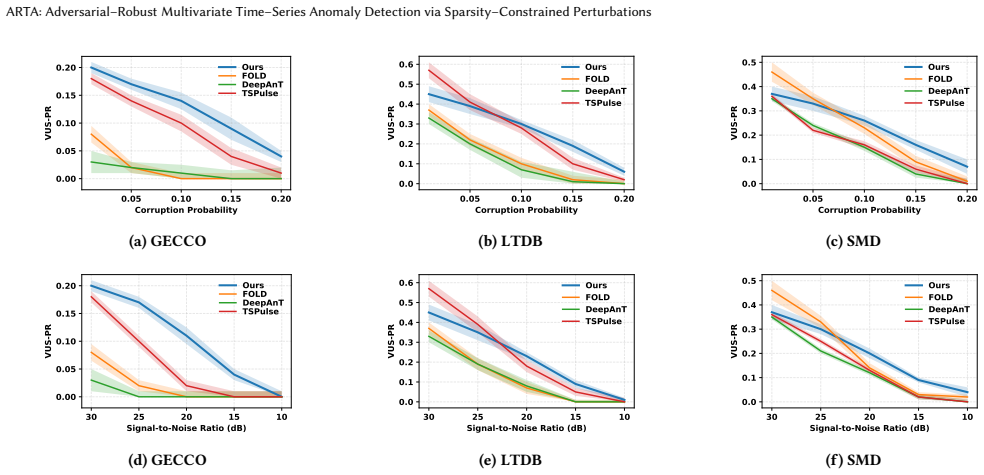
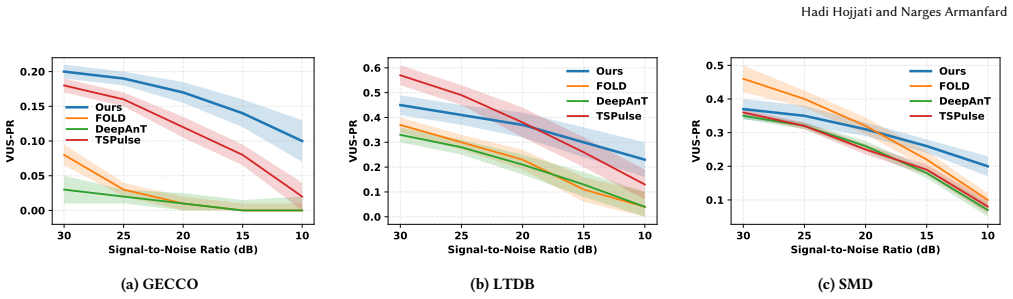
- Accuracy declines more slowly as additive or structured noise intensity is increased.
- The masks produced by the generator highlight the temporal regions to which the detector is most sensitive.
- The trained detector relies on distributed temporal patterns rather than isolated spikes or drops.
Where Pith is reading between the lines
- The same joint-training pattern could be adapted to other sequential tasks such as forecasting or classification where localized noise is a known failure mode.
- In production monitoring the generated masks could be logged as diagnostic signals when an anomaly is flagged.
- Varying the sparsity budget at training time might yield a family of detectors with different robustness-accuracy trade-offs for different deployment environments.
Load-bearing premise
The perturbations the mask generator creates during training are representative of the structured noise that actually appears in deployed time-series streams.
What would settle it
Measure whether an ARTA-trained detector retains its accuracy advantage on a held-out real-world dataset containing structured corruptions (sensor dropouts, calibration shifts) never seen in the training masks.
Figures


read the original abstract
Time-series anomaly detection (TSAD) is a critical component in monitoring complex systems, yet modern deep learning-based detectors are often highly sensitive to localized input corruptions and structured noise. We propose ARTA (Adversarially Robust multivariate Time-series Anomaly detection via sparsity-constrained perturbations), a joint training framework that improves detector robustness through a principled min-max optimization objective. ARTA comprises an anomaly detector and a sparsity-constrained mask generator that are trained simultaneously. The generator identifies minimal, task-relevant temporal perturbations that maximally increase the detector's anomaly score, while the detector is optimized to remain stable under these structured perturbations. The resulting masks characterize the detector's sensitivity to adversarial temporal corruptions and can serve as explanatory signals for the detector's decisions. This adversarial training strategy exposes brittle decision pathways and encourages the detector to rely on distributed and stable temporal patterns rather than spurious localized artifacts. We conduct extensive experiments on the TSB-AD benchmark, demonstrating that ARTA consistently improves anomaly detection performance across diverse datasets and exhibits significantly more graceful degradation under increasing noise levels compared to state-of-the-art baselines.
Editorial analysis
A structured set of objections, weighed in public.
Referee Report
Summary. The paper proposes ARTA, a joint min-max training framework for multivariate time-series anomaly detection consisting of an anomaly detector and a sparsity-constrained mask generator. The generator produces minimal temporal perturbations that maximize the detector's anomaly score; the detector is then optimized for stability under these perturbations. Experiments on the TSB-AD benchmark are reported to show consistent performance gains over baselines together with more graceful degradation under increasing noise levels.
Significance. If the robustness claims hold under the stated assumptions, ARTA would provide a practical adversarial-training recipe for hardening TSAD models against structured corruptions, with the added benefit that the learned masks can serve as explanatory signals. The use of the TSB-AD benchmark and the explicit sparsity penalty are positive features that make the approach reproducible in principle.
major comments (2)
- [§4] §4 (Experiments): The manuscript reports consistent gains and graceful degradation but supplies no tables of exact F1/AUC values, baseline names with hyper-parameters, perturbation budgets (sparsity level, amplitude), or statistical significance tests across the TSB-AD datasets. This absence makes the magnitude and reliability of the claimed improvements impossible to assess quantitatively.
- [§3] §3 (Method) and §4: The central robustness claim rests on the assumption that the sparsity-constrained masks generated during training share key statistics with real-world structured noise. No empirical comparison (e.g., histograms of temporal support, sparsity levels, or autocorrelation) is provided between the learned masks and either the noise patterns present in TSB-AD or external real-world traces, leaving the generalization of the graceful-degradation result unvalidated.
minor comments (2)
- [§3] Notation for the mask generator objective (Eq. 3 or equivalent) should explicitly state the range of the sparsity hyper-parameter and how it is chosen per dataset.
- [§4] Figure captions for the degradation curves should include the exact noise model (additive Gaussian, structured, etc.) and the number of runs used to compute means and error bars.
Simulated Author's Rebuttal
We thank the referee for the constructive feedback on our manuscript. We address each major comment point by point below, providing clarifications and indicating where revisions will be made.
read point-by-point responses
-
Referee: [§4] §4 (Experiments): The manuscript reports consistent gains and graceful degradation but supplies no tables of exact F1/AUC values, baseline names with hyper-parameters, perturbation budgets (sparsity level, amplitude), or statistical significance tests across the TSB-AD datasets. This absence makes the magnitude and reliability of the claimed improvements impossible to assess quantitatively.
Authors: We agree with the referee that the experimental section would benefit from more detailed quantitative reporting. In the revised version, we will add tables presenting the exact F1 and AUC values for ARTA and all baselines on each TSB-AD dataset. We will also specify the hyper-parameters used for each baseline and for ARTA, detail the perturbation budgets including sparsity levels and amplitudes, and include statistical significance tests (such as t-tests over multiple random seeds) to assess the reliability of the improvements. revision: yes
-
Referee: [§3] §3 (Method) and §4: The central robustness claim rests on the assumption that the sparsity-constrained masks generated during training share key statistics with real-world structured noise. No empirical comparison (e.g., histograms of temporal support, sparsity levels, or autocorrelation) is provided between the learned masks and either the noise patterns present in TSB-AD or external real-world traces, leaving the generalization of the graceful-degradation result unvalidated.
Authors: We respectfully disagree that the robustness claim centrally rests on the masks sharing exact statistics with real-world noise. The ARTA framework trains the detector against sparsity-constrained adversarial perturbations that maximize the anomaly score, targeting vulnerable temporal locations by construction. The graceful degradation result is directly shown by evaluating on TSB-AD test sets with increasing levels of added structured noise. Direct distributional comparisons between generated masks and real-world noise traces are not required to validate the min-max objective's effectiveness, as the experiments demonstrate practical robustness gains. revision: no
Circularity Check
No significant circularity in ARTA derivation chain
full rationale
The paper presents a standard min-max adversarial training objective with an added sparsity penalty on the mask generator. The detector and generator are jointly optimized via the described framework, but the claimed performance gains and graceful degradation under noise are reported as empirical outcomes on the external TSB-AD benchmark. No equations reduce the final metrics to quantities fitted directly from test data, no self-definitional loops appear in the optimization, and no load-bearing claims rest on self-citations that collapse to unverified inputs. The derivation remains self-contained against the benchmark evaluations.
Axiom & Free-Parameter Ledger
axioms (1)
- standard math The anomaly detector is differentiable and can be optimized with gradient descent.
Lean theorems connected to this paper
-
IndisputableMonolith/Cost/FunctionalEquation.leanwashburn_uniqueness_aczel unclear?
unclearRelation between the paper passage and the cited Recognition theorem.
The generator loss is defined as: L_G(ϕ) = −A_D(˜X) + λ∥M∥_1
What do these tags mean?
- matches
- The paper's claim is directly supported by a theorem in the formal canon.
- supports
- The theorem supports part of the paper's argument, but the paper may add assumptions or extra steps.
- extends
- The paper goes beyond the formal theorem; the theorem is a base layer rather than the whole result.
- uses
- The paper appears to rely on the theorem as machinery.
- contradicts
- The paper's claim conflicts with a theorem or certificate in the canon.
- unclear
- Pith found a possible connection, but the passage is too broad, indirect, or ambiguous to say the theorem truly supports the claim.
Reference graph
Works this paper leans on
-
[1]
Abdul Fatir Ansari, Lorenzo Stella, Ali Caner Turkmen, Xiyuan Zhang, Pedro Mercado, Huibin Shen, Oleksandr Shchur, Syama Sundar Rangapuram, Sebas- tian Pineda Arango, Shubham Kapoor, Jasper Zschiegner, Danielle C. Maddix, ARTA: Adversarial–Robust Multivariate Time–Series Anomaly Detection via Sparsity–Constrained Perturbations Hao Wang, Michael W. Mahoney...
work page 2024
-
[2]
Julien Audibert, Pietro Michiardi, Frédéric Guyard, Sébastien Marti, and Maria A. Zuluaga. 2020. USAD: Unsupervised Anomaly Detection on Multivariate Time Series. InProceedings of the 26th ACM SIGKDD International Conference on Knowl- edge Discovery & Data Mining(Virtual Event). Association for Computing Ma- chinery, New York, NY, USA, 3395–3404
work page 2020
-
[3]
Breunig, Hans-Peter Kriegel, Raymond T
Markus M. Breunig, Hans-Peter Kriegel, Raymond T. Ng, and Jörg Sander. 2000. LOF: Identifying Density-Based Local Outliers. InProceedings of the 2000 ACM SIGMOD International Conference on Management of Data(Dallas, Texas, USA). Association for Computing Machinery, New York, NY, USA, 93–104
work page 2000
-
[4]
Gifford, and Jayant Kalagnanam
Vijay Ekambaram, Subodh Kumar, Arindam Jati, Sumanta Mukherjee, Tomoya Sakai, Pankaj Dayama, Wesley M. Gifford, and Jayant Kalagnanam. 2026. TSPulse: Tiny Pre-Trained Models with Disentangled Representations for Rapid Time- Series Analysis. InProceedings of the 14th International Conference on Learning Representations (ICLR 2026). OpenReview.net, Rio de J...
work page 2026
-
[5]
Markus Goldstein and Andreas Dengel. 2012. Histogram-based outlier score (hbos): A fast unsupervised anomaly detection algorithm.KI-2012: poster and demo track1 (2012), 59–63
work page 2012
-
[6]
Mononito Goswami, Konrad Szafer, Arjun Choudhry, Yifu Cai, Shuo Li, and Artur Dubrawski. 2024. MOMENT: A Family of Open Time-series Foundation Models. InProceedings of the 41st International Conference on Machine Learning (Proceedings of Machine Learning Research, Vol. 235). PMLR, San Diego, CA, USA, 16115–16152
work page 2024
- [7]
-
[8]
Sahand Hariri, Matias Carrasco Kind, and Robert J Brunner. 2019. Extended isolation forest.IEEE transactions on knowledge and data engineering33, 4 (2019), 1479–1489
work page 2019
-
[9]
Zengyou He, Xiaofei Xu, and Shengchun Deng. 2003. Discovering cluster-based local outliers.Pattern recognition letters24, 9-10 (2003), 1641–1650
work page 2003
-
[10]
Hadi Hojjati, Mohammadreza Sadeghi, and Narges Armanfard. 2023. Multivariate Time-Series Anomaly Detection with Temporal Self-supervision and Graphs: Application to Vehicle Failure Prediction. InMachine Learning and Knowledge Discovery in Databases: Applied Data Science and Demo Track. Springer Nature Switzerland, Cham, 242–259
work page 2023
-
[11]
Sheo Yon Jhin and Noseong Park. 2026. Point-wise Anomaly Detection via Fold- bifurcation ODE. InProceedings of the 14th International Conference on Learning Representations (ICLR 2026). OpenReview.net, Appleton, WI, USA, 1–18
work page 2026
- [12]
-
[13]
HyunGi Kim, Jisoo Mok, Dongjun Lee, Jaihyun Lew, Sungjae Kim, and Sungroh Yoon. 2025. Causality-Aware Contrastive Learning for Robust Multivariate Time- Series Anomaly Detection. InProceedings of the 42nd International Conference on Machine Learning (Proceedings of Machine Learning Research, Vol. 267). PMLR, San Diego, CA, USA, 30591–30608
work page 2025
-
[14]
Siwon Kim, Kukjin Choi, Hyun-Soo Choi, Byunghan Lee, and Sungroh Yoon
-
[15]
In Proceedings of the AAAI Conference on Artificial Intelligence
Towards a Rigorous Evaluation of Time-Series Anomaly Detection. In Proceedings of the AAAI Conference on Artificial Intelligence. Association for the Advancement of Artificial Intelligence, Washington, DC, USA, 7194–7201
-
[16]
Daesoo Lee, Sara Malacarne, and Erlend Aune. 2024. Explainable time series anomaly detection using masked latent generative modeling.Pattern Recognition 156 (2024), 110826
work page 2024
-
[17]
Zheng Li, Yue Zhao, Nicola Botta, Cezar Ionescu, and Xiyang Hu. 2020. COPOD: Copula-Based Outlier Detection. InProceedings of the 2020 IEEE International Conference on Data Mining (ICDM). IEEE, Piscataway, NJ, USA, 1118–1123
work page 2020
-
[18]
Fei Tony Liu, Kai Ming Ting, and Zhi-Hua Zhou. 2008. Isolation Forest. In Proceedings of the 2008 IEEE International Conference on Data Mining (ICDM). IEEE, Piscataway, NJ, USA, 413–422
work page 2008
-
[19]
Qinghua Liu, John Paparrizos, et al. 2024. The Elephant in the Room: Towards a Reliable Time-Series Anomaly Detection Benchmark. InAdvances in Neural Information Processing Systems 37 (NeurIPS 2024) (NeurIPS 2024 Datasets and Benchmarks Track). Curran Associates, Inc., Red Hook, NY, USA, 1–18
work page 2024
-
[20]
Dongsheng Luo, Wei Cheng, Yingheng Wang, Dongkuan Xu, Jingchao Ni, Wen- chao Yu, Xuchao Zhang, Yanchi Liu, Yuncong Chen, Haifeng Chen, and Xiang Zhang. 2023. Time Series Contrastive Learning with Information-Aware Aug- mentations.Proceedings of the AAAI Conference on Artificial Intelligence37, 4 (Jun. 2023), 4534–4542
work page 2023
-
[21]
Junshui Ma and Simon Perkins. 2003. Online novelty detection on temporal sequences. InProceedings of the Ninth ACM SIGKDD International Conference on Knowledge Discovery and Data Mining(Washington, D.C.)(KDD ’03). Association for Computing Machinery, New York, NY, USA, 613–618
work page 2003
-
[22]
Pankaj Malhotra, Lovekesh Vig, Gautam Shroff, and Puneet Agarwal. 2015. Long Short Term Memory Networks for Anomaly Detection in Time Series. InProceed- ings of the 23rd European Symposium on Artificial Neural Networks, Computational Intelligence and Machine Learning (ESANN). ESANN, Bruges, Belgium, 89–94
work page 2015
-
[23]
Takeru Miyato, Toshiki Kataoka, Masanori Koyama, and Yuichi Yoshida. 2018. Spectral Normalization for Generative Adversarial Networks. InProceedings of the 6th International Conference on Learning Representations (ICLR 2018). Open- Review.net, Vancouver, BC, Canada, 1–15
work page 2018
-
[24]
Mohsin Munir, Shoaib Ahmed Siddiqui, Andreas Dengel, and Sheraz Ahmed
-
[25]
DeepAnT: A deep learning approach for unsupervised anomaly detection in time series.Ieee Access7 (2018), 1991–2005
work page 2018
-
[26]
Randy Paffenroth, Kathleen Kay, and Les Servi. 2018. Robust PCA for Anomaly Detection in Cyber Networks.arXiv preprint arXiv:1801.015712018 (2018), 1–12
work page internal anchor Pith review Pith/arXiv arXiv 2018
-
[27]
Tsay, Aaron Elmore, and Michael J
John Paparrizos, Paul Boniol, Themis Palpanas, Ruey S. Tsay, Aaron Elmore, and Michael J. Franklin. 2022. Volume Under the Surface: A New Accuracy Evaluation Measure for Time-Series Anomaly Detection.Proceedings of the VLDB Endowment (PVLDB)15, 11 (2022), 2774–2787
work page 2022
-
[28]
Sridhar Ramaswamy, Rajeev Rastogi, and Kyuseok Shim. 2000. Efficient Algo- rithms for Mining Outliers from Large Data Sets. InProceedings of the 2000 ACM SIGMOD International Conference on Management of Data(Dallas, Texas, USA). Association for Computing Machinery, New York, NY, USA, 427–438
work page 2000
-
[29]
Peter J Rousseeuw and Katrien Van Driessen. 1999. A fast algorithm for the minimum covariance determinant estimator.Technometrics41, 3 (1999), 212–223
work page 1999
-
[30]
Mayu Sakurada and Takehisa Yairi. 2014. Anomaly Detection Using Autoen- coders with Nonlinear Dimensionality Reduction. InProceedings of the 2nd Workshop on Machine Learning for Sensory Data Analysis (MLSDA). Association for Computing Machinery, New York, NY, USA, 4–11
work page 2014
-
[31]
Ya Su, Youjian Zhao, Chenhao Niu, Rong Liu, Wei Sun, and Dan Pei. 2019. Robust Anomaly Detection for Multivariate Time Series Through Stochastic Recurrent Neural Network. InProceedings of the 25th ACM SIGKDD International Conference on Knowledge Discovery and Data Mining. Association for Computing Machinery, New York, NY, USA, 2828–2837
work page 2019
- [32]
- [33]
-
[34]
Yaxuan Wang, Hao Cheng, Jing Xiong, Qingsong Wen, Han Jia, Ruixuan Song, Liyuan Zhang, Zhaowei Zhu, and Yang Liu. 2025. Noise-Resilient Point-wise Anomaly Detection in Time Series Using Weak Segment Labels. InProceedings of the 31st ACM SIGKDD Conference on Knowledge Discovery and Data Mining V.1 (KDD ’25). Association for Computing Machinery, New York, N...
work page 2025
-
[35]
Haixu Wu, Tengge Hu, Yong Liu, Hang Zhou, Jianmin Wang, and Mingsheng Long. 2022. TimesNet: Temporal 2D-Variation Modeling for General Time Series Analysis.arXiv preprint arXiv:2210.021862022 (2022), 1–19
work page internal anchor Pith review arXiv 2022
-
[36]
Renjie Wu and Eamonn J. Keogh. 2022. Current Time Series Anomaly Detection Benchmarks are Flawed and are Creating the Illusion of Progress. InProceed- ings of the 38th IEEE International Conference on Data Engineering (ICDE). IEEE, Piscataway, NJ, USA, 1557–1569
work page 2022
-
[37]
Yajing Xing, Jinbiao Tan, Rui Zhang, and Jiafu Wan. 2025. Robust Anomaly Detection of Multivariate Time Series Data via Adversarial Graph Attention BiGRU.Big Data and Cognitive Computing9, 5 (2025), 1–20
work page 2025
-
[38]
Haowen Xu, Wenxiao Chen, Nengwen Zhao, Zeyan Li, Jiahao Bu, Zhihan Li, Ying Liu, Youjian Zhao, Dan Pei, Yang Feng, Jie Chen, Zhaogang Wang, and Honglin Qiao. 2018. Unsupervised Anomaly Detection via Variational Auto-Encoder for Seasonal KPIs in Web Applications. InProceedings of the 2018 World Wide Web Conference (WWW ’18). Association for Computing Machi...
work page 2018
-
[39]
Jiehui Xu, Haixu Wu, Jianmin Wang, and Mingsheng Long. 2022. Anomaly Transformer: Time Series Anomaly Detection with Association Discrepancy. In Proceedings of the 10th International Conference on Learning Representations (ICLR 2022). OpenReview.net, Appleton, WI, USA, 1–18
work page 2022
-
[40]
Zhijian Xu, Ailing Zeng, and Qiang Xu. 2024. FITS: Modeling Time Series with 10k Parameters. InProceedings of the 12th International Conference on Learning Representations (ICLR 2024). OpenReview.net, Appleton, WI, USA, 1–16
work page 2024
-
[41]
Takehisa Yairi, Yoshikiyo Kato, and Koichi Hori. 2001. Fault Detection by Mining Association Rules from House-Keeping Data. InProceedings of the 6th Interna- tional Symposium on Artificial Intelligence, Robotics and Automation in Space (i-SAIRAS 2001). Canadian Space Agency, Saint-Hubert, QC, Canada, 1–8
work page 2001
-
[42]
Xiao Zhang, Shuqing Xu, Huashan Chen, Zekai Chen, Fuzhen Zhuang, Hui Xiong, and Dongxiao Yu. 2024. Rethinking Robust Multivariate Time Series Anomaly Detection: A Hierarchical Spatio-Temporal Variational Perspective . IEEE Transactions on Knowledge & Data Engineering36, 12 (Dec. 2024), 9136– 9149
work page 2024
-
[43]
Tian Zhou, Peisong Niu, Liang Sun, Rong Jin, et al . 2023. One fits all: Power general time series analysis by pretrained lm.Advances in neural information processing systems36 (2023), 43322–43355
work page 2023
discussion (0)
Sign in with ORCID, Apple, or X to comment. Anyone can read and Pith papers without signing in.