Recognition: 2 theorem links
· Lean TheoremComplex bumblebee model
Pith reviewed 2026-05-14 22:14 UTC · model grok-4.3
The pith
In the complex bumblebee model, the one-loop effective potential develops a nontrivial minimum by dimensional transmutation, generating dynamical Lorentz symmetry breaking.
A machine-rendered reading of the paper's core claim, the machinery that carries it, and where it could break.
Core claim
In this complex bumblebee model the leading-logarithmic one-loop effective potential evaluated on a real constant background acquires a nontrivial minimum through dimensional transmutation whenever the renormalization-group flow of the couplings permits it; the resulting vacuum expectation value spontaneously breaks Lorentz symmetry without any explicit breaking term in the classical Lagrangian.
What carries the argument
RG-covariant leading-logarithmic improvement of the Vilkovisky-DeWitt effective potential in normal field coordinates, with the RG operator driven only by the beta functions.
If this is right
- A nonzero vacuum expectation value for the bumblebee field is generated purely by quantum corrections.
- Lorentz invariance is broken spontaneously once the minimum forms.
- The existence of the minimum is controlled by the signs and magnitudes of the one-loop beta functions.
- The construction remains consistent inside a renormalizable framework at the one-loop level.
Where Pith is reading between the lines
- The same RG-improved potential technique could be applied to non-Abelian extensions or to models with gravity couplings to check whether the vacuum persists.
- If the bumblebee couples to fermions, the generated vacuum might produce observable effects in high-energy scattering or in cosmological backgrounds.
- The stability of the minimum against higher-loop corrections remains an open question that could be tested by computing the two-loop beta functions.
Load-bearing premise
The Vilkovisky-DeWitt effective potential written in normal field coordinates and improved solely by the beta-function RG operator correctly captures the leading-logarithmic physics without residual gauge or reparametrization artifacts.
What would settle it
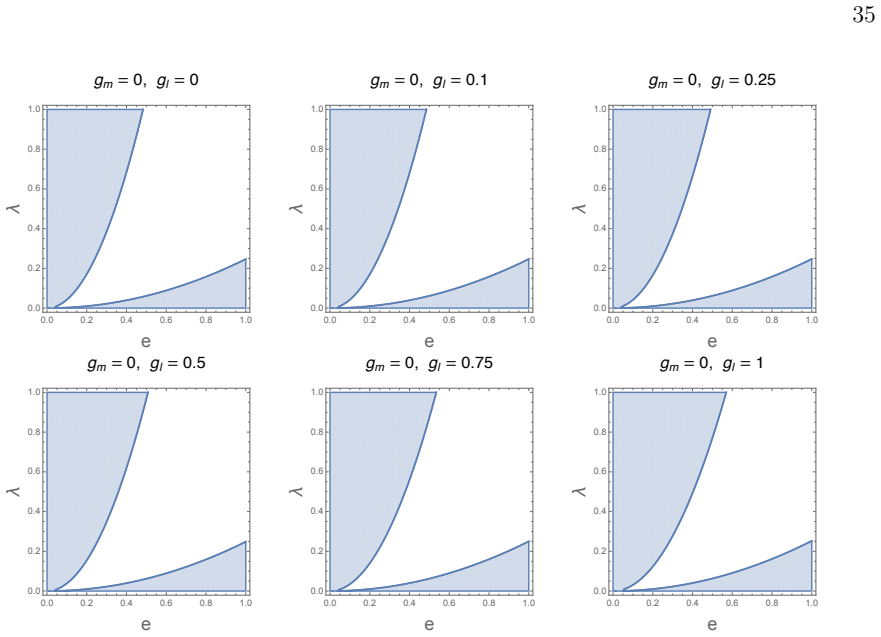
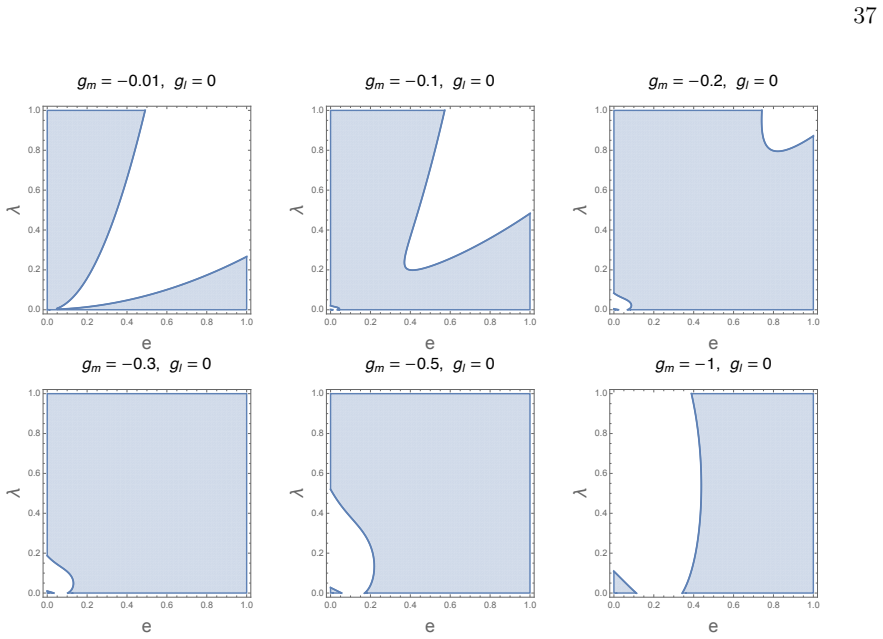
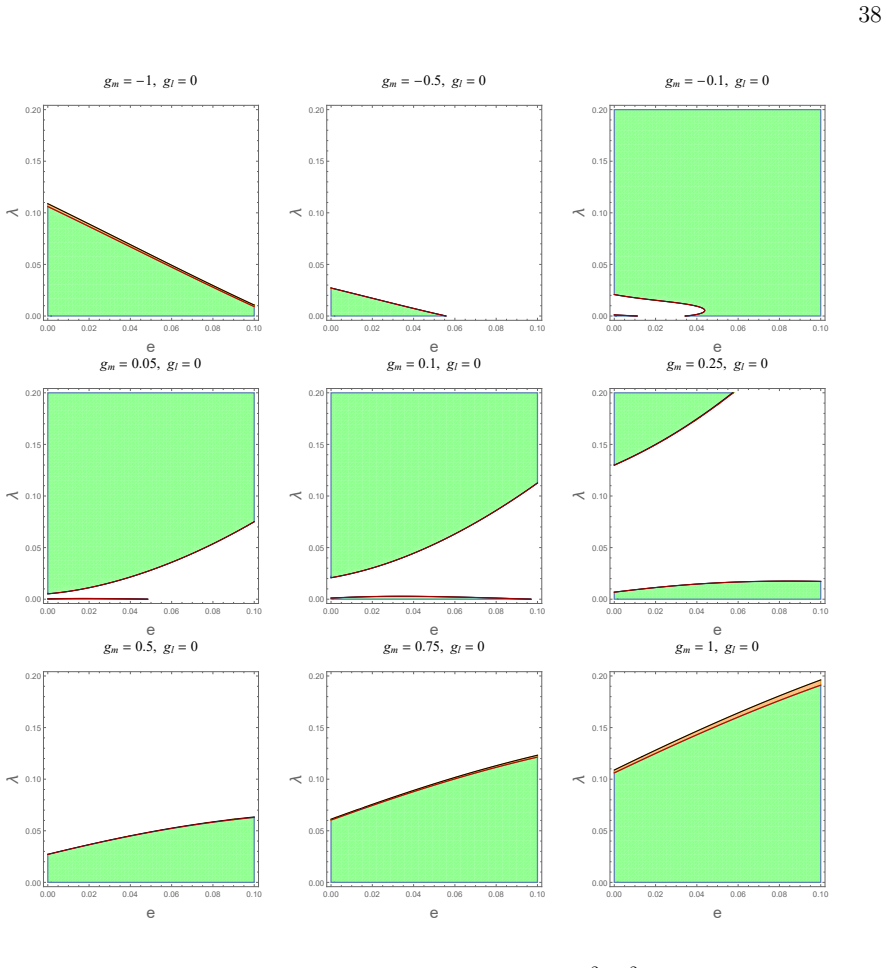
Numerical evaluation of the improved effective potential for concrete numerical values of g_l, g_m, lambda and tilde-lambda that shows whether the radiatively generated minimum lies below the trivial vacuum or coincides with it.
Figures



read the original abstract
We formulate a renormalizable complex extension of the bumblebee theory in which the bumblebee field is promoted to a complex one and coupled to an Abelian gauge sector. Besides the minimal gauge covariant interaction, the model includes a longitudinal kinetic term controlled by a dimensionless parameter $g_l$ and a non-minimal magnetic-type coupling $g_m$ between the complex bumblebee and the photon. Using dimensional regularization and minimal subtraction, we determine the one-loop UV divergences of the two-, three-, and four-point functions relevant to the renormalization of the gauge, longitudinal, and quartic sectors. We obtain the corresponding counterterms and derive the one-loop renormalization-group functions for $e$, $g_l$, $g_m$, and the bumblebee self-couplings $\lambda$ and $\tilde\lambda$. Motivated by the known gauge- and field-reparametrization subtleties of the conventional Coleman--Weinberg analysis, we formulate an RG-covariant leading-logarithmic improvement scheme for the Vilkovisky--DeWitt effective potential in normal field coordinates, in which the RG operator is governed solely by the beta functions. We apply this framework to a real constant bumblebee background and obtain the leading-logarithmic one-loop effective potential, discussing the conditions under which a nontrivial vacuum is generated by dimensional transmutation and thereby provides a dynamical realization of Lorentz symmetry breaking in this class of models.
Editorial analysis
A structured set of objections, weighed in public.
Referee Report
Summary. The manuscript formulates a renormalizable complex bumblebee model coupled to an Abelian gauge sector, incorporating a longitudinal kinetic term (g_l) and a non-minimal magnetic-type coupling (g_m). Using dimensional regularization and minimal subtraction, it computes one-loop UV divergences of two-, three-, and four-point functions to obtain counterterms and the beta functions for e, g_l, g_m, λ, and λ̃. It then introduces an RG-covariant leading-logarithmic improvement of the Vilkovisky-DeWitt effective potential in normal field coordinates, applies this to a constant real bumblebee background, and identifies parameter regimes where dimensional transmutation generates a nontrivial vacuum that dynamically breaks Lorentz symmetry.
Significance. If the central results hold, the work supplies explicit one-loop beta functions and an RG-improved effective potential for a complex bumblebee extension, furnishing a concrete dynamical mechanism for Lorentz violation via dimensional transmutation. The use of the Vilkovisky-DeWitt formalism to mitigate Coleman-Weinberg subtleties and the derivation of conditions for a nontrivial minimum constitute a clear advance over minimal bumblebee models, with potential implications for phenomenological studies of Lorentz breaking.
major comments (1)
- [RG-covariant Vilkovisky-DeWitt scheme] The section deriving the RG-improved Vilkovisky-DeWitt potential: the claim that the RG operator built solely from the computed beta functions fully eliminates residual gauge and parametrization dependence must be verified explicitly for the non-minimal g_m term, since the magnetic-type coupling introduces structures whose one-loop contributions to the potential are not shown to cancel independently after RG improvement.
minor comments (2)
- [Introduction] The abstract and introduction should clarify the precise definition of 'normal field coordinates' used for the Vilkovisky-DeWitt potential to aid readers unfamiliar with the formalism.
- [One-loop renormalization] In the beta-function derivations, the contributions from the longitudinal kinetic term g_l to the three-point functions should be tabulated separately for transparency.
Simulated Author's Rebuttal
We thank the referee for the positive overall assessment and the constructive comment on the RG-improved Vilkovisky-DeWitt potential. We address the point below and indicate the revision that will be incorporated.
read point-by-point responses
-
Referee: [RG-covariant Vilkovisky-DeWitt scheme] The section deriving the RG-improved Vilkovisky-DeWitt potential: the claim that the RG operator built solely from the computed beta functions fully eliminates residual gauge and parametrization dependence must be verified explicitly for the non-minimal g_m term, since the magnetic-type coupling introduces structures whose one-loop contributions to the potential are not shown to cancel independently after RG improvement.
Authors: We appreciate the referee's request for explicit verification concerning the g_m term. The one-loop beta functions for e, g_l, g_m, λ and λ̃ were obtained from the complete set of UV divergences of the two-, three- and four-point functions, so the RG operator already encodes all g_m-dependent counterterms. The Vilkovisky-DeWitt construction in normal coordinates ensures gauge and parametrization independence of the effective action by definition; the leading-logarithmic improvement is performed covariantly with respect to this operator and therefore inherits the same invariance. Nevertheless, to make the cancellation manifest for the non-minimal magnetic coupling, we will add a short explicit check in the revised manuscript (either as a paragraph in Section 4 or a brief appendix) showing that the g_m structures appearing in the one-loop potential are rendered consistent under the RG flow and do not leave residual dependence. revision: yes
Circularity Check
No significant circularity: beta functions from explicit diagrams feed independent RG improvement of Vilkovisky-DeWitt potential
full rationale
The derivation computes one-loop divergences and beta functions for e, g_l, g_m, λ, λ̃ directly from two-, three-, and four-point functions via dimensional regularization. These betas are then inserted into an RG operator acting on the Vilkovisky-DeWitt potential evaluated in normal field coordinates for a constant real bumblebee background. The resulting leading-log effective potential and its minimum are outputs of this procedure, not inputs; no equation reduces the claimed nontrivial vacuum (generated by dimensional transmutation) to a fitted quantity or to a self-citation chain. The scheme is presented as a motivated improvement over conventional Coleman-Weinberg analysis, but the load-bearing steps remain self-contained against the paper's own diagrammatic results.
Axiom & Free-Parameter Ledger
free parameters (4)
- g_l
- g_m
- lambda
- tilde_lambda
axioms (2)
- standard math Dimensional regularization and minimal subtraction scheme are valid for extracting UV divergences in this theory.
- domain assumption The Vilkovisky-DeWitt effective potential in normal field coordinates is gauge-independent and suitable for RG improvement.
invented entities (1)
-
Complex bumblebee field
no independent evidence
Lean theorems connected to this paper
-
IndisputableMonolith/Cost/FunctionalEquationwashburn_uniqueness_aczel unclear?
unclearRelation between the paper passage and the cited Recognition theorem.
RG-covariant leading-logarithmic improvement scheme for the Vilkovisky–DeWitt effective potential... beta functions for e, g_l, g_m, λ, λ̃
-
IndisputableMonolith/Foundation/RealityFromDistinctionreality_from_one_distinction unclear?
unclearRelation between the paper passage and the cited Recognition theorem.
leading-logarithmic one-loop effective potential... nontrivial vacuum generated by dimensional transmutation
What do these tags mean?
- matches
- The paper's claim is directly supported by a theorem in the formal canon.
- supports
- The theorem supports part of the paper's argument, but the paper may add assumptions or extra steps.
- extends
- The paper goes beyond the formal theorem; the theorem is a base layer rather than the whole result.
- uses
- The paper appears to rely on the theorem as machinery.
- contradicts
- The paper's claim conflicts with a theorem or certificate in the canon.
- unclear
- Pith found a possible connection, but the passage is too broad, indirect, or ambiguous to say the theorem truly supports the claim.
Reference graph
Works this paper leans on
-
[1]
the effective action) of renormal- ized fieldsϕ A(x), renormalized couplingsλ i, and scaleµ
= (2πµ)4−D iπ2 Z dDq 1 q2 −m 2 1 (q+p) 2 −m 2 2 = 1 ϵ + finite,(66) C0(p2 i ;m 2 i ) = (2πµ)4−D iπ2 Z dDq 1 q2 −m 2 1 (q+p 1)2 −m 2 2 1 (q+p 1 +p 2)2 −m 2 3 = finite,(67) D0(p2 i ;m 2 i ) = (2πµ)4−D iπ2 Z dDq 1 q2 −m 2 1 (q+p 1)2 −m 2 2 × 1 (q+p 1 +p 2)2 −m 2 3 (q+p 1 +p 2 +p 3)2 −m 2 4 = finite.(68) APPENDIX B: CHANGE OF VARIABLES TO RG–COVARIANT COORDIN...
-
[2]
V. A. Kostelecky, Phys. Rev. D69(2004), 105009 [arXiv:hep-th/0312310 [hep-th]]
work page internal anchor Pith review Pith/arXiv arXiv 2004
- [3]
-
[4]
O. Bertolami, J. Paramos, Phys. Rev. D72, 044001 (2005), hep-th/0504215
work page internal anchor Pith review Pith/arXiv arXiv 2005
-
[5]
An exact Schwarzschild-like solution in a bumblebee gravity model
R. Casana, A. Cavalcante, F. P. Poulis and E. B. Santos, Phys. Rev. D97, no. 10, 104001 (2018), arXiv:1711.02273
work page internal anchor Pith review Pith/arXiv arXiv 2018
- [6]
-
[7]
Cosmological implications of Bumblebee vector models
D. Capelo and J. P´ aramos, Phys. Rev. D91(2015) no.10, 104007 [arXiv:1501.07685 [gr-qc]]
work page internal anchor Pith review Pith/arXiv arXiv 2015
- [8]
-
[9]
R. V. Maluf, C. A. S. Almeida, R. Casana and M. M. Ferreira, Jr., Phys. Rev. D90(2014) no.2, 025007 [arXiv:1402.3554 [hep-th]]
work page internal anchor Pith review Pith/arXiv arXiv 2014
- [10]
- [11]
-
[12]
Dynamical Lorentz and CPT symmetry breaking in a 4D four-fermion model
M. Gomes, T. Mariz, J. R. Nascimento and A. J. da Silva, Phys. Rev. D77(2008), 105002 [arXiv:0709.2904 [hep-th]]
work page internal anchor Pith review Pith/arXiv arXiv 2008
-
[13]
J. F. Assuncao, T. Mariz, J. R. Nascimento and A. Y. Petrov, Phys. Rev. D96(2017) no.6, 065021 [arXiv:1707.07778 [hep-th]]
work page internal anchor Pith review Pith/arXiv arXiv 2017
- [14]
- [15]
- [16]
- [17]
-
[18]
New Developments in FeynCalc 9.0
V. Shtabovenko, R. Mertig and F. Orellana, Comput. Phys. Commun.207, 432-444 (2016) [arXiv:1601.01167 [hep-ph]]
work page internal anchor Pith review Pith/arXiv arXiv 2016
-
[19]
V. Shtabovenko, R. Mertig and F. Orellana, Comput. Phys. Commun.256, 107478 (2020) [arXiv:2001.04407 [hep-ph]]
-
[20]
Generating Feynman Diagrams and Amplitudes with FeynArts 3
T. Hahn, Comput. Phys. Commun.140, 418-431 (2001) [arXiv:hep-ph/0012260 [hep-ph]]
work page internal anchor Pith review Pith/arXiv arXiv 2001
-
[21]
N. D. Christensen and C. Duhr, Comput. Phys. Commun.180, 1614-1641 (2009) [arXiv:0806.4194 [hep-ph]]
work page internal anchor Pith review Pith/arXiv arXiv 2009
-
[22]
FeynRules 2.0 - A complete toolbox for tree-level phenomenology
A. Alloul, N. D. Christensen, C. Degrande, C. Duhr and B. Fuks, Comput. Phys. Commun. 185, 2250-2300 (2014) [arXiv:1310.1921 [hep-ph]]
work page internal anchor Pith review Pith/arXiv arXiv 2014
-
[23]
FeynHelpers: Connecting FeynCalc to FIRE and Package-X
V. Shtabovenko, Comput. Phys. Commun.218, 48-65 (2017) [arXiv:1611.06793 [physics.comp- ph]]
work page internal anchor Pith review Pith/arXiv arXiv 2017
-
[24]
R. Jackiw, Phys. Rev. D9, 1686 (1974) doi:10.1103/PhysRevD.9.1686
-
[25]
N. K. Nielsen, Nucl. Phys. B101, 173-188 (1975)
work page 1975
- [26]
-
[27]
A. F. de Lima and D. Bazeia, Z. Phys. C45, 471 (1990)
work page 1990
-
[28]
G. A. Vilkovisky, Nucl. Phys. B234, 125-137 (1984)
work page 1984
-
[29]
S. D. Odintsov, Phys. Lett. B262(1991), 394-397
work page 1991
-
[30]
S. D. Odintsov, Fortsch. Phys.38(1990), 371-391
work page 1990
-
[31]
I. L. Buchbinder, S. D. Odintsov and I. L. Shapiro, Routledge, 2017, ISBN 978-0-203-75892-2, 9780750301228, 978-0-7503-0122-0. 32
work page 2017
-
[32]
Vilkovisky’s unique effective action: An introduction and explicit calculation,
G. Kunstatter, “Vilkovisky’s unique effective action: An introduction and explicit calculation,” inSuper Field Theories, edited by H. C. Lee, V. Elias, G. Kunstatter, R. B. Mann and K. S. Viswanathan (Springer, Boston, MA, 1987), pp. 503–517
work page 1987
-
[33]
P. M. Lavrov, S. D. Odintsov and I. V. Tyutin, Mod. Phys. Lett. A3(1988), 1273-1276
work page 1988
-
[34]
S. D. Odintsov, EPL10(1989), 287-292
work page 1989
-
[35]
S. R. Coleman and E. J. Weinberg, Phys. Rev. D7, 1888-1910 (1973)
work page 1910
-
[36]
D. G. C. McKeon, Int. J. Theor. Phys.37, 817-826 (1998)
work page 1998
-
[37]
Radiative Electroweak Symmetry-Breaking Revisited
V. Elias, R. B. Mann, D. G. C. McKeon and T. G. Steele, Phys. Rev. Lett.91, 251601 (2003). [arXiv:hep-ph/0304153 [hep-ph]]
work page internal anchor Pith review Pith/arXiv arXiv 2003
-
[38]
Higher Order Stability of a Radiatively Induced 220 GeV Higgs Mass
V. Elias, R. B. Mann, D. G. C. McKeon and T. G. Steele, Phys. Rev. D72, 037902 (2005). [arXiv:hep-ph/0411161 [hep-ph]]
work page internal anchor Pith review Pith/arXiv arXiv 2005
-
[39]
A. G. Dias and A. F. Ferrari, Phys. Rev. D82, 085006 (2010). [arXiv:1006.5672 [hep-th]]
work page internal anchor Pith review Pith/arXiv arXiv 2010
- [40]
- [41]
- [42]
-
[43]
F. A. Chishtie, D. G. C. McKeon and T. G. Steele, Phys. Rev. D77, 065007 (2008). [arXiv:0706.1760 [hep-ph]]
work page internal anchor Pith review Pith/arXiv arXiv 2008
-
[44]
Spontaneous Lorentz Violation, Nambu-Goldstone Modes, and Gravity
R. Bluhm and V. A. Kostelecky, Phys. Rev. D71(2005), 065008 [arXiv:hep-th/0412320 [hep- th]]
work page internal anchor Pith review Pith/arXiv arXiv 2005
-
[45]
Spontaneous Lorentz and Diffeomorphism Violation, Massive Modes, and Gravity
R. Bluhm, S. H. Fung and V. A. Kostelecky, Phys. Rev. D77(2008), 065020 [arXiv:0712.4119 [hep-th]]
work page internal anchor Pith review Pith/arXiv arXiv 2008
- [46]
-
[47]
M. E. Peskin and D. V. Schroeder, Addison-Wesley, 1995, ISBN 978-0-201-50397-5, 978-0-429- 50355-9, 978-0-429-49417-8
work page 1995
-
[48]
Srednicki, Cambridge University Press, 2007, ISBN 978-0-521-86449-7, 978-0-511-26720-8
M. Srednicki, Cambridge University Press, 2007, ISBN 978-0-521-86449-7, 978-0-511-26720-8. 33 γ γ B 1 γ γ B B 2 γ γ 3 Figure 1: One-loop bumblebee contributions to the photon two-point function (vacuum polariza- tion). Wavy and wiggly lines denote the photon and bumblebee propagators, respectively. B B γ 1 B B B 2 B B γ B 3 B B 4 Figure 2: Bumblebee self-...
work page 2007
discussion (0)
Sign in with ORCID, Apple, or X to comment. Anyone can read and Pith papers without signing in.