Recognition: no theorem link
Interpretable liquid crystal phase classification via two-by-two ordinal patterns
Pith reviewed 2026-05-15 08:04 UTC · model grok-4.3
The pith
Two-by-two ordinal patterns map liquid crystal textures to seven mesophases with near-perfect accuracy and full interpretability.
A machine-rendered reading of the paper's core claim, the machinery that carries it, and where it could break.
Core claim
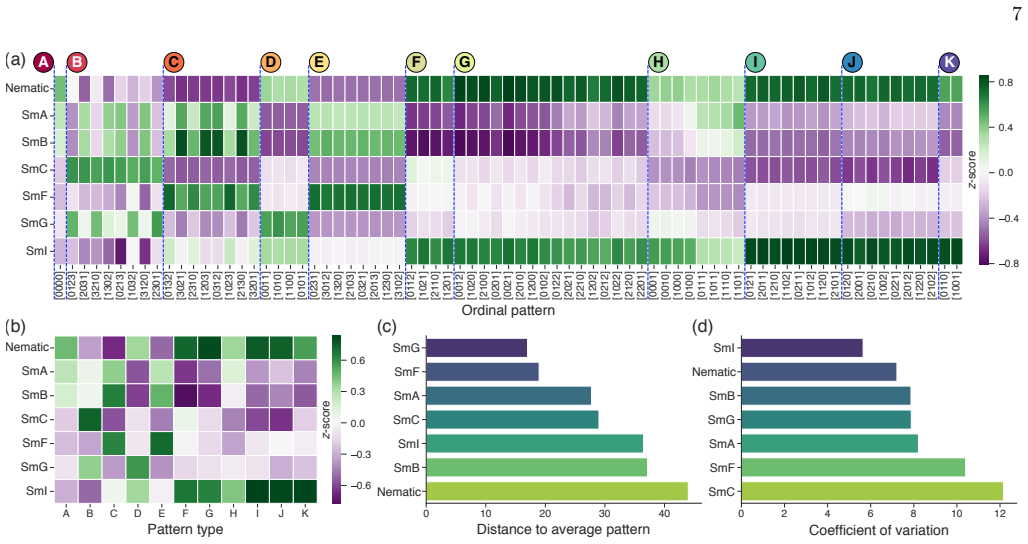
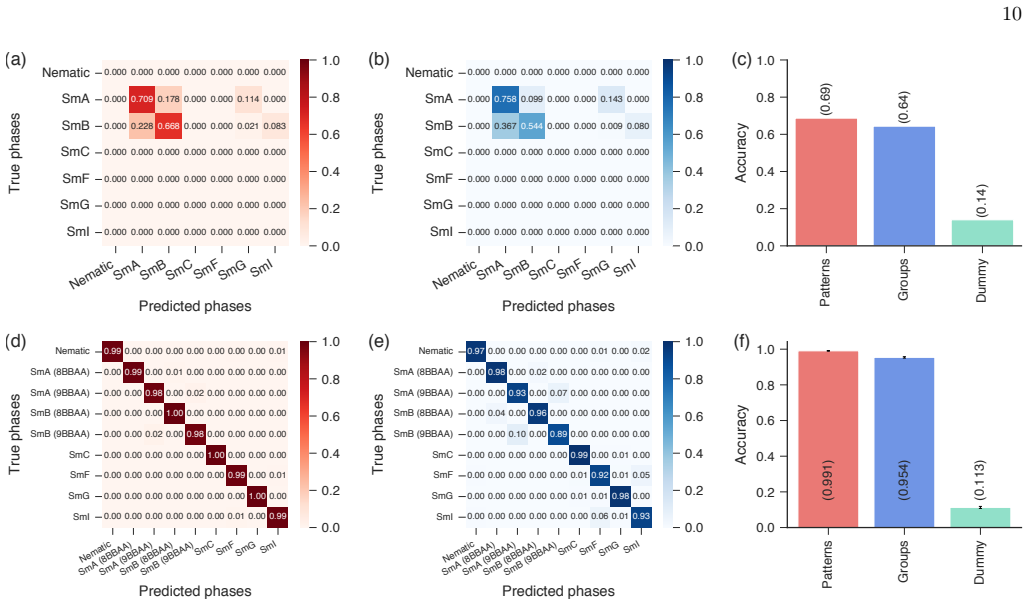
Liquid crystal textures are mapped to a 75-dimensional frequency vector of two-by-two ordinal patterns grouped into eleven symmetry-based types. This lightweight representation, paired with a simple classifier, yields near-perfect recognition of seven mesophases, including the difficult smectic A versus smectic B distinction. The approach generalizes to unseen compounds, distinguishes phase identity from material origin, and provides interpretable explanations through pattern interactions.
What carries the argument
Two-by-two ordinal patterns, defined as local orderings of pixel intensities in 2x2 blocks of the texture image, grouped by symmetry into eleven types whose frequencies form the feature vector for classification.
If this is right
- Near-perfect classification accuracy for liquid crystal mesophases using a simple model.
- Successful distinction between smectic A and smectic B phases based on texture patterns.
- Generalization of the classification to new, unseen liquid crystal compounds.
- Separation of phase-specific features from material-specific ones in the analysis.
- Identification of specific ordinal patterns and their interactions that determine each phase decision.
Where Pith is reading between the lines
- The method might extend to classifying phases in other materials with patterned textures, such as block copolymers or colloidal systems.
- Local 2x2 patterns could be combined with larger scale analysis to capture hierarchical structures in liquid crystals.
- This interpretable approach could help in designing new liquid crystal materials by linking texture features directly to molecular arrangements.
- Real-time image analysis using these patterns could monitor phase changes in liquid crystal devices during operation.
Load-bearing premise
The essential differences between mesophases are encoded in the frequencies of two-by-two ordinal patterns and their symmetry groupings without losing key distinguishing information.
What would settle it
A dataset of liquid crystal textures from new compounds where the classifier fails to achieve high accuracy or cannot distinguish smectic A from smectic B despite clear visual differences in the images.
Figures





read the original abstract
Liquid crystal textures encode rich structural information, yet mapping these images to mesophase identity remains challenging because visually similar patterns can arise from distinct structures. Here we present a simple, interpretable representation that maps textures to a 75-dimensional frequency vector of two-by-two ordinal patterns, grouped into eleven symmetry-based types to characterize a large-scale dataset spanning seven mesophases. Combined with a simple machine learning classifier, this lightweight representation yields near-perfect phase recognition, including the difficult distinction between smectic A and smectic B mesophases. Our approach generalizes to unseen compounds and accurately distinguishes between phase identity and material origin. Unlike deep learning methods, each ordinal pattern is readily interpretable, and model explanations augmented with network visualizations of pattern interactions reveal the specific types and pairwise dependencies that drive each mesophase decision, providing compact, physically meaningful summaries of texture determinants. These results establish two-by-two ordinal patterns as an interpretable and scalable tool for liquid crystal image analysis, with potential applications to other complex patterned systems in materials science.
Editorial analysis
A structured set of objections, weighed in public.
Referee Report
Summary. The manuscript proposes mapping liquid crystal textures to a 75-dimensional frequency vector of two-by-two ordinal patterns (intensity-rank permutations within 2x2 blocks), aggregated into eleven symmetry classes. This representation is combined with a standard machine-learning classifier to achieve near-perfect recognition across seven mesophases, including the difficult SmA–SmB distinction, while providing interpretability via pattern visualizations and explanations of pairwise dependencies. The approach is claimed to generalize to unseen compounds and to separate phase identity from material origin.
Significance. If the performance claims hold under rigorous validation, the method supplies a lightweight, fully interpretable alternative to deep-learning pipelines for texture-based mesophase identification. The symmetry-based grouping and explicit model explanations could yield physically meaningful summaries of texture determinants, with potential extension to other complex-patterned soft-matter systems.
major comments (3)
- [Abstract] Abstract and Methods: The abstract asserts strong performance on a large dataset spanning seven mesophases, yet supplies no information on total image count, images per phase, cross-validation procedure, error bars, or class-imbalance handling. These details are load-bearing for assessing whether the reported near-perfect accuracy is robust.
- [Feature construction] Feature-construction section: The representation is a global frequency histogram of 2x2 ordinal patterns with no retained spatial or longer-range information. Smectic A and B differ principally in in-plane ordering (isotropic vs. hexagonal) and layer coherence at scales ≫2 pixels; no equation or ablation demonstrates that the eleven-class symmetry reduction preserves the higher-order statistics required for this distinction.
- [Results] Results section: The claims of generalization to unseen compounds and separation of phase identity from material origin require quantitative support (e.g., per-compound confusion matrices or leave-one-compound-out accuracies). Without these, it remains possible that reported performance reflects dataset-specific contrast or resolution rather than structural differences.
minor comments (2)
- [Methods] A table or explicit equation mapping the 24 possible 2x2 permutations onto the 75-dimensional vector and the eleven symmetry classes would improve reproducibility and allow readers to verify the dimensionality reduction.
- [Figures] Figure captions for network visualizations should state the physical pixel scale and typical texture resolution so that pattern interactions can be related to molecular length scales.
Simulated Author's Rebuttal
We thank the referee for the constructive and detailed review. We address each major comment below and will update the manuscript to incorporate the suggested clarifications and additional analyses.
read point-by-point responses
-
Referee: [Abstract] Abstract and Methods: The abstract asserts strong performance on a large dataset spanning seven mesophases, yet supplies no information on total image count, images per phase, cross-validation procedure, error bars, or class-imbalance handling. These details are load-bearing for assessing whether the reported near-perfect accuracy is robust.
Authors: We agree that these details should be explicitly stated in the abstract for completeness. The Methods section already describes the dataset composition, 5-fold stratified cross-validation, and class-imbalance handling via stratification, with accuracies reported as means and standard deviations across folds. We will revise the abstract to include the total image count, per-phase image numbers, cross-validation procedure, error bars, and imbalance handling method. revision: yes
-
Referee: [Feature construction] Feature-construction section: The representation is a global frequency histogram of 2x2 ordinal patterns with no retained spatial or longer-range information. Smectic A and B differ principally in in-plane ordering (isotropic vs. hexagonal) and layer coherence at scales ≫2 pixels; no equation or ablation demonstrates that the eleven-class symmetry reduction preserves the higher-order statistics required for this distinction.
Authors: The 2x2 ordinal patterns capture local intensity rank permutations that directly reflect differences in short-range ordering: isotropic in SmA versus hexagonal in SmB. The eleven symmetry classes are obtained by partitioning the 24 possible permutations according to their transformation properties under rotation and reflection, thereby preserving the frequency distinctions relevant to these local structures. We will add an explicit equation for the symmetry grouping and an ablation comparing 75-dimensional versus 11-class performance to confirm that the reduction retains the information needed for SmA–SmB separation. revision: yes
-
Referee: [Results] Results section: The claims of generalization to unseen compounds and separation of phase identity from material origin require quantitative support (e.g., per-compound confusion matrices or leave-one-compound-out accuracies). Without these, it remains possible that reported performance reflects dataset-specific contrast or resolution rather than structural differences.
Authors: The manuscript already employs leave-one-compound-out validation to demonstrate generalization, but we acknowledge that explicit per-compound metrics would strengthen the claim. We will add per-compound confusion matrices and tabulated leave-one-compound-out accuracies to the Results section, confirming that classification performance is driven by phase-specific texture features rather than compound-specific imaging conditions. revision: yes
Circularity Check
No circularity detected in the proposed feature extraction and classification approach
full rationale
The paper computes a frequency vector of two-by-two ordinal patterns directly from image pixel intensities without reference to phase labels. This representation is then used with a standard machine learning classifier trained on labeled data. No equations or steps reduce the classification result to the inputs by construction, nor rely on self-citations for uniqueness or ansatz. The approach is self-contained as an empirical method.
Axiom & Free-Parameter Ledger
axioms (1)
- domain assumption Two-by-two ordinal patterns in texture images encode the structural information needed to distinguish the seven mesophases.
Reference graph
Works this paper leans on
-
[1]
P. J. Collings and J. W. Goodby,Introduction to Liquid Crystals: Chemistry and Physics(CRC Press, London, 2019)
work page 2019
-
[2]
J. W. Goodby, P. J. Collings, T. Kato, C. Tschierske, H. Gleeson, P. Raynes, and V. Vill,Handbook of Liquid Crystals, 8 Volume Set(John Wiley & Sons, Hoboken, 2014)
work page 2014
-
[3]
T. Kato, J. Uchida, T. Ichikawa, and T. Sakamoto, Func- tional liquid crystals towards the next generation of ma- terials, Angewandte Chemie International Edition57, 4355 (2018)
work page 2018
-
[4]
H. K. Bisoyi and Q. Li, Liquid crystals: Versatile self- organized smart soft materials, Chemical Reviews122, 4887 (2021)
work page 2021
- [5]
-
[6]
Dierking,Textures of Liquid Crystals(Wiley-VCH, Weinheim, 2003) Chap
I. Dierking,Textures of Liquid Crystals(Wiley-VCH, Weinheim, 2003) Chap. 3, pp. 33–42
work page 2003
-
[7]
Dierking, Liquid crystal textures: An overview, Liquid Crystals, pp
I. Dierking, Liquid crystal textures: An overview, Liquid Crystals, pp. 1;33 (2025), in press (available online)
work page 2025
- [8]
- [9]
- [10]
-
[11]
C. Dreissigacker, R. Sharma, C. Messenger, R. Zhao, and R. Prix, Deep-learning continuous gravitational waves, Physical Review D100, 044009 (2019)
work page 2019
- [12]
-
[13]
H. Y. D. Sigaki, E. K. Lenzi, R. S. Zola, M. Perc, and H. V. Ribeiro, Learning physical properties of liquid crys- tals with deep convolutional neural networks, Scientific Reports10, 7664 (2020)
work page 2020
-
[14]
I. Dierking, J. Dominguez, J. Harbon, and J. Heaton, Classification of liquid crystal textures using convolu- tional neural networks, Liquid Crystals50, 1526 (2023)
work page 2023
-
[15]
I. Dierking, J. Dominguez, J. Harbon, and J. Heaton, Testing different supervised machine learning architec- tures for the classification of liquid crystals, Liquid Crys- tals50, 1461 (2023)
work page 2023
-
[16]
I. Dierking, J. Dominguez, J. Harbon, and J. Heaton, Deep learning techniques for the localization and classi- fication of liquid crystal phase transitions, Frontiers in Soft Matter3, 1114551 (2023)
work page 2023
-
[17]
R. Betts and I. Dierking, Machine learning classification of polar sub-phases in liquid crystal MHPOBC, Soft Mat- ter19, 7502 (2023)
work page 2023
-
[18]
N. Osiecka-Drewniak, A. Drzewicz, and E. Juszyńska- Gałązka, Distinguishing the focal-conic fan texture of smectic A from the focal-conic fan texture of smectic B, Crystals13, 1187 (2023)
work page 2023
-
[19]
N. Osiecka-Drewniak, M. Piwowarczyk, A. Drzewicz, and E. Juszyńska-Gałązka, Liquid crystal textures, neural networks and art, Liquid Crystals51, 128 (2024)
work page 2024
-
[20]
N. Osiecka-Drewniak, A. Drzewicz, and E. Juszyńska- Gałązka, Machine learning studies for liquid crystal tex- ture recognition, Liquid Crystals51, 255 (2024)
work page 2024
-
[21]
R. Betts and I. Dierking, Possibilities and limitations of convolutional neural network machine learning architec- tures inthe characterisation of achiral orthogonal smectic liquid crystals, Soft Matter20, 4226 (2024). 15
work page 2024
- [22]
-
[23]
J. Zaplotnik, J. Pišljar, M. Škarabot, and M. Ravnik, Neural networks determination of material elastic con- stantsand structuresinnematiccomplexfluids,Scientific Reports13, 6028 (2023)
work page 2023
-
[24]
P. Y. Taser, G. Onsal, and O. Ugurlu, Comparison of experimental measurements and machine learning pre- dictions of dielectric constant of liquid crystals, Bulletin of Materials Science46, 1 (2022)
work page 2022
-
[25]
E. Hedlund, K. Hedlund, A. Green, R. Chowdhury, C. S. Park, J. E. Maclennan, and N. A. Clark, Detection of is- lands and droplets on smectic films using machine learn- ing, Physics of Fluids34, 10.1063/5.0117358 (2022)
-
[26]
S. B. Kang, J. H. Lee, K. Y. Song, and H. J. Pahk, Auto- matic defect classification of TFT-LCD panels using ma- chine learning, in2009 IEEE International Symposium on Industrial Electronics(2009) pp. 2175–2177
work page 2009
-
[27]
E. N. Minor, S. D. Howard, A. A. S. Green, M. A. Glaser, C.S.Park,andN.A.Clark,End-to-endmachinelearning for experimental physics: Using simulated data to train a neural network for object detection in video microscopy, Soft Matter16, 1751 (2020)
work page 2020
-
[28]
Y.-H. Liu and Y.-J. Chen, Automatic defect detection for TFT-LCD array process using quasiconformal kernel support vector data description, International Journal of Molecular Sciences12, 5762 (2011)
work page 2011
-
[29]
C. Bandt and B. Pompe, Permutation entropy: A natu- ral complexity measure for time series, Physical Review Letters88, 174102 (2002)
work page 2002
-
[30]
H. V. Ribeiro, L. Zunino, E. K. Lenzi, P. A. Santoro, and R. S. Mendes, Complexity-entropy causality plane as a complexity measure for two-dimensional patterns, PLOS ONE7, e40689 (2012)
work page 2012
-
[31]
L. Zunino and H. V. Ribeiro, Discriminating image tex- tures with the multiscale two-dimensional complexity- entropy causality plane, Chaos, Solitons & Fractals91, 679 (2016)
work page 2016
-
[32]
A. A. B. Pessa and H. V. Ribeiro, Mapping images into ordinal networks, Physical Review E102, 052312 (2020)
work page 2020
-
[33]
H. Y. D. Sigaki, R. F. de Souza, R. T. de Souza, R. S. Zola, and H. V. Ribeiro, Estimating physical proper- ties from liquid crystal textures via machine learning and complexity-entropy methods, Physical Review E99, 013311 (2019)
work page 2019
-
[34]
A. A. Pessa, R. S. Zola, M. Perc, and H. V. Ribeiro, De- termining liquid crystal properties with ordinal networks and machine learning, Chaos, Solitons & Fractals154, 111607 (2022)
work page 2022
-
[35]
L. G. J. M. Voltarelli, A. A. B. Pessa, L. Zunino, R. S. Zola, E. K. Lenzi, M. Perc, and H. V. Ribeiro, Char- acterizing unstructured data with the nearest neighbor permutation entropy, Chaos34, 053130 (2024)
work page 2024
-
[36]
L. A. N. Amaral, Artificial intelligence needs a scientific method-driven reset, Nature Physics20, 523 (2024)
work page 2024
- [37]
-
[38]
C. Bian, C. Qin, Q. D. Ma, and Q. Shen, Modi- fied permutation-entropy analysis of heartbeat dynamics, Physical Review E85, 021906 (2012)
work page 2012
-
[39]
M. M. Tarozo, A. A. B. Pessa, L. Zunino, O. A. Rosso, M. Perc, and H. V. Ribeiro, Two-by-two ordinal patterns in art paintings, PNAS Nexus4, pgaf092 (2025)
work page 2025
-
[40]
C. Bandt and K. Wittfeld, Two new parameters for the ordinal analysis of images, Chaos33, 043124 (2023)
work page 2023
-
[41]
Interactive visualization of the UMAP projection in Fig- ure 2,https://complex.pfi.uem.br/umap_lc/(2026), Due to the large number of points, the page may take some time to fully load. Accessed: 2026-01-30
work page 2026
-
[42]
M. Piwowarczyk, A. Deptuch, A. Drzewicz, E. Juszyńska-Gałązka, M. Gałązka, and Z. Galewski, Azobenzene derivatives with two aliphatic chains: mesogenic and photoisomerisation studies of (E)- 4-[(4-heptyloxyphenyl) diazenyl] phenyl alkanoates (7OABOOC m), Liquid Crystals51, 2104 (2024)
work page 2024
-
[43]
M. Piwowarczyk, A. Deptuch, Z. Galewski, and M. Gałązka, Terminal chain length dependence on phase behaviour of novel photosensitive (E)-4-[(4- octyloxyphenyl) diazenyl] phenyl alkanoates, Journal of Molecular Liquids434, 128080 (2025)
work page 2025
-
[44]
See Supplemental Material for Figs. S1–S7
-
[45]
S. Van der Walt, J. L. Schönberger, J. Nunez-Iglesias, F. Boulogne, J. D. Warner, N. Yager, E. Gouillart, and T. Yu, scikit-image: Image processing in Python, PeerJ 2, e453 (2014)
work page 2014
-
[46]
A. A. B. Pessa and H. V. Ribeiro, ordpy: A Python pack- age for data analysis with permutation entropy and or- dinal network methods, Chaos31, 063110 (2021)
work page 2021
-
[47]
UMAP: Uniform Manifold Approximation and Projection for Dimension Reduction
L. McInnes, J. Healy, and J. Melville, UMAP: Uniform manifold approximation and projection for dimension re- duction, ArXiv 10.48550/arXiv.1802.03426 (2018)
work page internal anchor Pith review Pith/arXiv arXiv doi:10.48550/arxiv.1802.03426 2018
-
[48]
L. McInnes, J. Healy, N. Saul, and L. Grossberger, UMAP:Uniformmanifoldapproximationandprojection, The Journal of Open Source Software3, 861 (2018)
work page 2018
- [49]
-
[50]
T. Chari and L. Pachter, The specious art of single-cell genomics, PLOS Computational Biology19, e1011288 (2023)
work page 2023
-
[51]
T. Cover and P. Hart, Nearest neighbor pattern classifi- cation, IEEE Transactions on Information Theory13, 21 (1967)
work page 1967
- [52]
-
[53]
L. Le Cam and G. L. Yang,Asymptotics in Statis- tics: Some Basic Concepts, Springer Series in Statistics (Springer, New York, 1990)
work page 1990
-
[54]
S.M.LundbergandS.-I.Lee,Aunifiedapproachtointer- preting model predictions, inProceedings of the 31st In- ternational Conference on Neural Information Processing Systems, NIPS’17 (Curran Associates Inc., Red Hook,
-
[55]
T. Chen and C. Guestrin, XGBoost: A scalable tree boosting system, inProceedings of the 22nd ACM SIGKDD International Conference on Knowledge Dis- covery and Data Mining, KDD ’16 (Association for Computing Machinery, New York, NY, USA, 2016) p. 785–794
work page 2016
-
[56]
S. M. Lundberg, G. Erion, H. Chen, A. DeGrave, J. M. Prutkin, B. Nair, R. Katz, J. Himmelfarb, N. Bansal, and S.-I. Lee, From local explanations to global under- 16 standing with explainable AI for trees, Nature Machine Intelligence2, 56 (2020)
work page 2020
-
[57]
S.M.Lundberg, G.G.Erion,andS.-I.Lee,Consistentin- dividualized feature attribution for tree ensembles, arXiv preprint arXiv:1802.03888 10.48550/arXiv.1802.03888 (2018)
work page internal anchor Pith review Pith/arXiv arXiv doi:10.48550/arxiv.1802.03888 2018
-
[58]
F. Furger, M. Thomas, J. Aligon, E. Doumard, C. Delpierre, L. Casteilla, and P. Monsarrat, A single- graph visualization to reveal hidden explainability pat- terns of shap feature interactions in machine learning for biomedical issues, PLOS Complex Systems2, e0000060 (2025). Interpretable liquid crystal phase classification via two-by-two ordinal patterns...
work page 2025
discussion (0)
Sign in with ORCID, Apple, or X to comment. Anyone can read and Pith papers without signing in.