Approximate Error Correction for Quantum Simulations of SU(2) Lattice Gauge Theories
Pith reviewed 2026-05-21 09:51 UTC · model grok-4.3
The pith
A gauge syndrome detects every single-qubit Pauli error at SU(2) vertices with four spin-1/2 edges.
A machine-rendered reading of the paper's core claim, the machinery that carries it, and where it could break.
Core claim
The central claim is that a syndrome-based recovery protocol called gauge cooling can detect all single-qubit Pauli errors at a coordination-four vertex with four spin-1/2 edges in SU(2) lattice gauge theory simulations and approximately correct gauge violations. The syndrome (J,M,N) is obtained via a group quantum Fourier transform to resolve the total angular momentum and magnetic quantum numbers of the violation. Recovery maps the state back to the invariant subspace. The protocol shows that Knill-Laflamme conditions fail for syndrome recovery when singlet multiplicity exceeds one. The remaining errors admit a structured decomposition with no Y component. Numerical results on a truncated
What carries the argument
The (J, M, N) gauge syndrome extracted at each vertex by a group quantum Fourier transform, which both detects the violation sector and conditions the recovery operation to the gauge-invariant subspace.
If this is right
- Every single-qubit Pauli error at a coordination-four vertex with four spin-1/2 edges produces a detectable change in the gauge syndrome.
- Syndrome-based recovery alone cannot satisfy the Knill-Laflamme conditions for perfect correction when the multiplicity of singlet states is greater than one.
- The residual errors in the physical subspace have a Pauli decomposition with vanishing Y component, indicating compatibility with concatenation by a CSS stabilizer code.
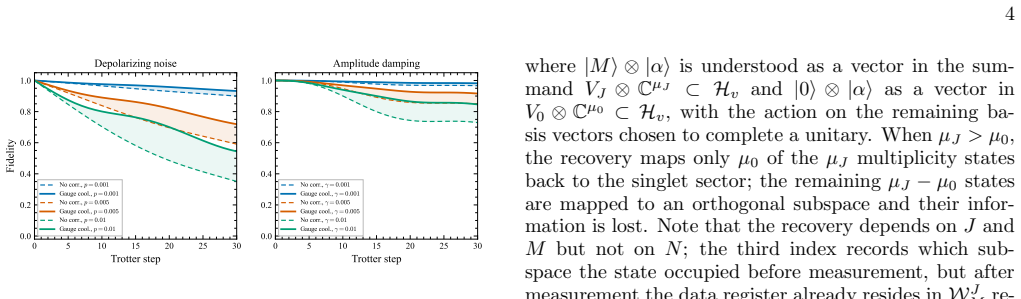
- The gauge cooling procedure restores approximate gauge invariance and improves state fidelity in single-plaquette simulations under depolarizing and amplitude-damping noise at rates typical of current hardware.
Where Pith is reading between the lines
- The protocol could be tested on larger lattices to check whether the sweep over vertices remains effective as system size grows.
- Concatenation with CSS codes may provide a path to fault-tolerant quantum simulations of lattice gauge theories.
- The structured error form without Y errors might generalize to other gauge groups or representations beyond spin-1/2.
Load-bearing premise
The numerical tests use only a single-plaquette lattice truncated to the spin-1/2 representation under depolarizing and amplitude-damping noise.
What would settle it
A counterexample calculation or experiment in which a single-qubit Pauli error at a coordination-four vertex with four spin-1/2 edges produces no detectable change in the (J, M, N) syndrome.
Figures


read the original abstract
We present a protocol for actively suppressing Gauss law violations in quantum simulations of SU(2) lattice gauge theory. Mid-circuit measurements extract a syndrome $(J,M,N)$ characterising the gauge-violation sector at each vertex by resolving both the total angular momentum and the magnetic quantum numbers of the violation through a group quantum Fourier transform. A syndrome-conditional recovery operation maps the state back to the gauge-invariant subspace, and the procedure is iterated as a sweep over vertices in a process we call gauge cooling. We prove that every single-qubit Pauli error at a coordination-four vertex with four spin-$1/2$ edges is detected by the gauge syndrome, and we show that the Knill--Laflamme conditions fail for syndrome-based recovery alone whenever the singlet multiplicity exceeds one. The residual physical-subspace errors carry a structured Pauli decomposition with vanishing $Y$ component, which suggests compatibility with concatenation by a CSS stabilizer code. We demonstrate the protocol on a single-plaquette simulation of the Kogut--Susskind Hamiltonian truncated to the spin-$1/2$ representation under depolarising and amplitude damping noise, and we observe that gauge cooling restores approximate gauge invariance and improves fidelity at noise rates representative of current superconducting hardware.
Editorial analysis
A structured set of objections, weighed in public.
Referee Report
Summary. The manuscript presents a protocol for actively suppressing Gauss law violations in quantum simulations of SU(2) lattice gauge theory using mid-circuit measurements to extract a syndrome (J,M,N) via group quantum Fourier transform, followed by syndrome-conditional recovery in an iterated 'gauge cooling' process. It proves detection of every single-qubit Pauli error at coordination-four vertices with four spin-1/2 edges by the gauge syndrome, shows failure of the Knill-Laflamme conditions for syndrome-based recovery when singlet multiplicity exceeds one, and demonstrates the protocol numerically on a single-plaquette simulation of the Kogut-Susskind Hamiltonian truncated to spin-1/2 under depolarizing and amplitude-damping noise, observing restoration of approximate gauge invariance and improved fidelity.
Significance. If the central results hold, this work introduces a practical active correction method for gauge invariance in quantum lattice gauge simulations, which is essential for reliable computations on near-term devices. The explicit proof for a concrete case and the structured residual errors (vanishing Y component) that may allow concatenation with CSS stabilizer codes are valuable contributions. The numerical demonstration at hardware-relevant noise rates provides initial validation. These strengths position the manuscript as a useful addition to the literature on error mitigation in quantum simulations of gauge theories.
major comments (2)
- [Abstract] Abstract: The proof of single-qubit Pauli error detection is explicitly limited to coordination-four vertices with four spin-1/2 edges. The manuscript should include a clear statement on whether this extends to general vertex coordination numbers or higher spin representations, as this affects the applicability of the protocol to full lattice simulations.
- [Numerical demonstration] Numerical demonstration: The demonstration is performed on a single-plaquette simulation truncated to the spin-1/2 representation. The manuscript should report the number of trials or statistical significance of the fidelity improvement to support the claim of effectiveness under depolarizing and amplitude-damping noise.
minor comments (3)
- The term 'group quantum Fourier transform' should be accompanied by a reference or brief explanation for accessibility to readers outside quantum information.
- Ensure consistent capitalization and definition of 'Knill-Laflamme conditions' upon first mention in the main text.
- Any figures illustrating the protocol or fidelity results would benefit from expanded captions explaining the quantitative improvement.
Simulated Author's Rebuttal
We thank the referee for the careful review and the positive recommendation for minor revision. Below we provide point-by-point responses to the major comments and indicate the changes made to the manuscript.
read point-by-point responses
-
Referee: [Abstract] Abstract: The proof of single-qubit Pauli error detection is explicitly limited to coordination-four vertices with four spin-1/2 edges. The manuscript should include a clear statement on whether this extends to general vertex coordination numbers or higher spin representations, as this affects the applicability of the protocol to full lattice simulations.
Authors: We agree that the limited scope of the explicit detection proof should be stated unambiguously. In the revised manuscript we have added a clarifying sentence to the abstract and a short paragraph in Section III noting that the complete single-qubit Pauli-error detection guarantee holds specifically for coordination-four vertices with four spin-1/2 edges. The syndrome-extraction protocol itself is formulated for general SU(2) representations and vertex degrees, but the full detection result relies on the algebraic structure available only in the spin-1/2, degree-four case; we explicitly flag generalizations to higher spins or coordinations as an open question for future work. revision: yes
-
Referee: [Numerical demonstration] Numerical demonstration: The demonstration is performed on a single-plaquette simulation truncated to the spin-1/2 representation. The manuscript should report the number of trials or statistical significance of the fidelity improvement to support the claim of effectiveness under depolarizing and amplitude-damping noise.
Authors: We thank the referee for this suggestion. In the revised numerical section we now report the number of independent Monte Carlo trials performed for each noise model and include the standard error of the mean for the observed fidelity improvements, thereby confirming that the reported gains in gauge invariance and fidelity are statistically significant at the hardware-relevant noise rates considered. revision: yes
Circularity Check
No significant circularity; derivation uses standard primitives and explicit proofs.
full rationale
The paper's central claims consist of an explicit proof that single-qubit Pauli errors are detected by the gauge syndrome at coordination-four vertices with four spin-1/2 edges, a demonstration that Knill-Laflamme conditions fail when singlet multiplicity exceeds one, and a numerical simulation on a single-plaquette Kogut-Susskind model under standard noise channels. These elements rely on the well-known tensor-product structure of SU(2) representations, the group quantum Fourier transform for syndrome extraction, and conventional quantum error correction concepts. No equations reduce a prediction to a fitted parameter by construction, no load-bearing step collapses to a self-citation chain, and the protocol is not defined in terms of its own outputs. The derivation is therefore self-contained against external benchmarks.
Axiom & Free-Parameter Ledger
axioms (2)
- standard math Standard quantum information assumptions including the validity of mid-circuit measurements and the Knill-Laflamme error-correction conditions.
- domain assumption The Kogut-Susskind Hamiltonian truncated to the spin-1/2 representation is a faithful model for the gauge theory dynamics in the demonstration.
Reference graph
Works this paper leans on
-
[1]
Concretely,R J,M is any uni- tary onH v satisfying RJ,M |M⟩ ⊗ |α⟩=|0⟩ ⊗ |α⟩α= 1, . . . ,min(µ J , µ0), (22) where|M⟩ ⊗ |α⟩is understood as a vector in the sum- mandV J ⊗C µJ ⊂ H v and|0⟩ ⊗ |α⟩as a vector in V0 ⊗C µ0 ⊂ H v, with the action on the remaining ba- sis vectors chosen to complete a unitary. Whenµ J > µ0, the recovery maps onlyµ 0 of theµ J multi...
-
[2]
M. K. Gaillard, P. D. Grannis, and F. J. Sciulli, Reviews of Modern Physics71, S96 (1999)
work page 1999
-
[3]
Tong, Lecture notes, DAMTP Cambridge10, 74 (2018)
D. Tong, Lecture notes, DAMTP Cambridge10, 74 (2018)
work page 2018
- [4]
-
[5]
W. Greiner, S. Schramm, and E. Stein,Quantum chro- modynamics(Springer, 2007)
work page 2007
-
[6]
J. B. Kogut, Reviews of Modern Physics51, 659 (1979)
work page 1979
-
[7]
J. B. Kogut, Reviews of Modern Physics55, 775 (1983)
work page 1983
- [8]
-
[9]
H. J. Rothe,Lattice gauge theories: an introduction (World Scientific Publishing Company, 2012)
work page 2012
-
[10]
K. G. Wilson, Physical review D10, 2445 (1974)
work page 1974
-
[11]
S. Durr, Z. Fodor, J. Frison, C. Hoelbling, R. Hoffmann, S. D. Katz, S. Krieg, T. Kurth, L. Lellouch, T. Lippert, et al., Science322, 1224 (2008)
work page 2008
-
[12]
S. Bors´ anyi, Z. Fodor, C. Hoelbling, S. D. Katz, S. Krieg, and K. K. Szabo, Physics Letters B730, 99 (2014)
work page 2014
-
[13]
A. Bazavov, T. Bhattacharya, C. DeTar, H.-T. Ding, S. Gottlieb, R. Gupta, P. Hegde, U. Heller, F. Karsch, E. Laermann,et al., Physical Review D90, 094503 (2014)
work page 2014
-
[14]
Y. Aoki, T. Blum, S. Collins, L. Del Debbio, M. Della Morte, P. Dimopoulos, X. Feng, M. Golter- man, S. Gottlieb, R. Gupta, G. Herdo´ ıza, P. Hernan- dez, A. J¨ uttner, T. Kaneko, E. Lunghi, S. Meinel, C. Monahan, A. Nicholson, T. Onogi, P. Petreczky, A. Portelli, A. Ramos, S. R. Sharpe, J. N. Simone, S. Sint, R. Sommer, N. Tantalo, R. Van de Water, A. Va...
work page 2026
-
[15]
M. Carmen Ba˜ nuls and K. Cichy, Reports on Progress in Physics83, 024401 (2020)
work page 2020
- [16]
-
[17]
H. B. Meyer, The European Physical Journal A47, 86 (2011)
work page 2011
- [18]
-
[19]
I. M. Georgescu, S. Ashhab, and F. Nori, Reviews of Modern Physics86, 153 (2014)
work page 2014
-
[20]
A. J. Daley, I. Bloch, C. Kokail, S. Flannigan, N. Pearson, M. Troyer, and P. Zoller, Nature607, 667 (2022)
work page 2022
- [21]
- [22]
- [23]
-
[24]
R. P. Feynman, inFeynman and computation(cRc Press,
-
[25]
S. P. Jordan, K. S. Lee, and J. Preskill, Science336, 1130 (2012)
work page 2012
-
[26]
E. A. Martinez, C. A. Muschik, P. Schindler, D. Nigg, A. Erhard, M. Heyl, P. Hauke, M. Dalmonte, T. Monz, P. Zoller, and R. Blatt, Nature534, 516–519 (2016)
work page 2016
-
[27]
B. Yang, H. Sun, R. Ott, H.-Y. Wang, T. V. Zache, J. C. Halimeh, Z.-S. Yuan, P. Hauke, and J.-W. Pan, Nature 587, 392 (2020)
work page 2020
-
[28]
J. Mildenberger, W. Mruczkiewicz, J. C. Halimeh, Z. Jiang, and P. Hauke, Nature Physics21, 312 (2025)
work page 2025
- [29]
- [30]
- [31]
- [32]
-
[33]
D. B. Kaplan and J. R. Stryker, Phys. Rev. D102, 094515 (2020)
work page 2020
-
[34]
J. C. Halimeh and P. Hauke, Phys. Rev. Lett.125, 030503 (2020)
work page 2020
-
[35]
J. C. Halimeh, H. Lang, J. Mildenberger, Z. Jiang, and P. Hauke, PRX Quantum2, 040311 (2021)
work page 2021
-
[36]
M. Van Damme, H. Lang, P. Hauke, and J. C. Halimeh, Phys. Rev. B107, 035153 (2023)
work page 2023
-
[37]
M. C. Tran, Y. Su, D. Carney, and J. M. Taylor, PRX Quantum2, 010323 (2021)
work page 2021
-
[38]
J. R. Stryker, Phys. Rev. A99, 042301 (2019)
work page 2019
-
[39]
I. Raychowdhury and J. R. Stryker, Phys. Rev. Res.2, 033039 (2020)
work page 2020
-
[40]
Quantum error correction with gauge symmetries,
A. Rajput, A. Roggero, and N. Wiebe, npj Quantum Inf. 9, 41 (2023), arXiv:2112.05186 [quant-ph]
- [41]
-
[42]
N. H. Nguyen, M. C. Tran, Y. Zhu, A. M. Green, C. H. Alderete, Z. Davoudi, and N. M. Linke, PRX Quantum 3, 020324 (2022)
work page 2022
- [43]
-
[44]
T. V. Zache, F. Hebenstreit, F. Jendrzejewski, M. K. Oberthaler, J. Berges, and P. Hauke, Quantum science and technology3, 034010 (2018)
work page 2018
-
[45]
N. Klco, E. F. Dumitrescu, A. J. McCaskey, T. D. Morris, R. C. Pooser, M. Sanz, E. Solano, P. Lougovski, and M. J. Savage, Physical Review A98, 032331 (2018)
work page 2018
-
[46]
Gottesman,Stabilizer codes and quantum error cor- rection(California Institute of Technology, 1997)
D. Gottesman,Stabilizer codes and quantum error cor- rection(California Institute of Technology, 1997)
work page 1997
-
[47]
Z. P. Bradshaw, J. J. Dale, and E. N. Evans, Annals of Physics487, 170353 (2026)
work page 2026
-
[48]
Z. P. Bradshaw, M. L. LaBorde, and D. Montero, Phys. Rev. A , (2026)
work page 2026
-
[49]
J. Diestel and A. Spalsbury,The joys of Haar measure (American Mathematical Soc., 2014)
work page 2014
-
[50]
A. A. Mele, Quantum8, 1340 (2024)
work page 2024
-
[51]
M. L. LaBorde, S. Rethinasamy, and M. M. Wilde, Quan- tum7, 1120 (2023)
work page 2023
-
[52]
Z. P. Bradshaw, M. L. LaBorde, and M. M. Wilde, Pro- ceedings of the Royal Society A: Mathematical, Physical and Engineering Sciences479, 10.1098/rspa.2022.0733 (2023)
- [53]
- [54]
- [55]
- [56]
-
[57]
C. Dankert, R. Cleve, J. Emerson, and E. Livine, Physical Review A80, 10.1103/physreva.80.012304 (2009)
- [58]
-
[59]
J. E. Mandula and M. Ogilvie, Physics Letters B185, 127 (1987)
work page 1987
-
[60]
A. Cucchieri and T. Mendes, Computer physics commu- nications154, 1 (2003). 7 I. PETER-WEYL DECOMPOSITION AND VERTEX REGROUPING In this section, we provide the details of the passage from the Peter-Weyl decomposition on individual edges to the Clebsch-Gordan decomposition at each vertex, which was summarized in the main text. By the Peter-Weyl theorem, ea...
work page 2003
-
[61]
Electric term The electric Hamiltonian is HE = g2 2 X e∈E ˆje(ˆje + 1),(S19) where ˆje is the Casimir operator on edgee, diagonal in the Wigner basis with eigenvaluej e(je + 1). Forj max = 1/2, the single-edge electric Hamiltonian is H(e) E = g2 2 diag 0, 3 4 , 3 4 , 3 4 , 3 4 ,(S20) where the entries correspond toj= 0 (eigenvalue 0) and the fourj= 1/2 st...
-
[62]
Magnetic (plaquette) term The magnetic Hamiltonian involves the trace of the product of link operators around the plaquette: HB =− 1 g2 Re Tr1/2[Uplaq] ,(S21) 11 where Tr1/2 denotes the trace in the fundamental (j= 1/2) representation and Uplaq =U e0 Ue1 Ue2 Ue3 (S22) is the ordered product of link operators around the pla- quette. In the group element pi...
-
[63]
AllA k matrices have singular values (1,1) when ex- pressed in the spherical tensor basis. Equivalently, the Cartesian Pauli errorsXandY, which are su- perpositions of theq=±1 components with co- efficient 1/ √ 2, yield singular values (1/ √ 2,1/ √ 2) when projected onto a definiteMsector
-
[64]
Edges within the same pair in the (12)(34) coupling scheme (edges 0 and 1, or edges 2 and
Errors on different edges produce differentA k ma- trices. Edges within the same pair in the (12)(34) coupling scheme (edges 0 and 1, or edges 2 and
-
[65]
produceA k matrices that differ only by sign flips, reflecting their symmetric role in the first- stage coupling. Edges from different pairs (e.g., edges 0 and 2) produceA k matrices with nonzero entries in different positions, reflecting the fact that they participate in different stages of the coupling. This structural distinction is what causes the off...
-
[66]
and compute the effective 2×2 operatorR·A k for each edgek. Decomposing into Pauli components, we find the following structure for theM= 0 sector (Zerrors): ErrorIweightXweightZweight Z0 1.00 0 0 Z1 0.20 0 0.80 Z2 0.20 0.60 0.20 Z3 0.20 0.60 0.20 Here the weights are|c P |2/P P ′ |cP ′|2, wherec P is the coefficient of PauliPin the decomposition ofR·A k. ...
-
[67]
The reference edge (edge 0) is perfectly corrected: the residual is proportional to the identity
-
[68]
The paired edge (edge 1) produces a residual that is predominantly PauliZon the multiplicity qubit
-
[69]
The cross-pair edges (edges 2 and 3) produce resid- uals that are a mixture of PauliXandZ
-
[70]
No residualYcomponent appears for any single- qubit error. The absence ofYerrors and the bounded weights ofX andZerrors suggest compatibility with CSS-type con- catenation. An [[n,1, d]] CSS code encoding the multi- plicity qubit acrossnvertices could correct these resid- uals, implementing a two-layer error correction scheme consisting of gauge cooling t...
discussion (0)
Sign in with ORCID, Apple, or X to comment. Anyone can read and Pith papers without signing in.