Recognition: 2 theorem links
· Lean TheoremDust evolution during protoplanetary disk buildup enhances CO ice relative to water
Pith reviewed 2026-05-14 22:16 UTC · model grok-4.3
The pith
Including the protoplanetary disk formation stage produces stronger CO ice enhancement relative to water in the outer disk.
A machine-rendered reading of the paper's core claim, the machinery that carries it, and where it could break.
Core claim
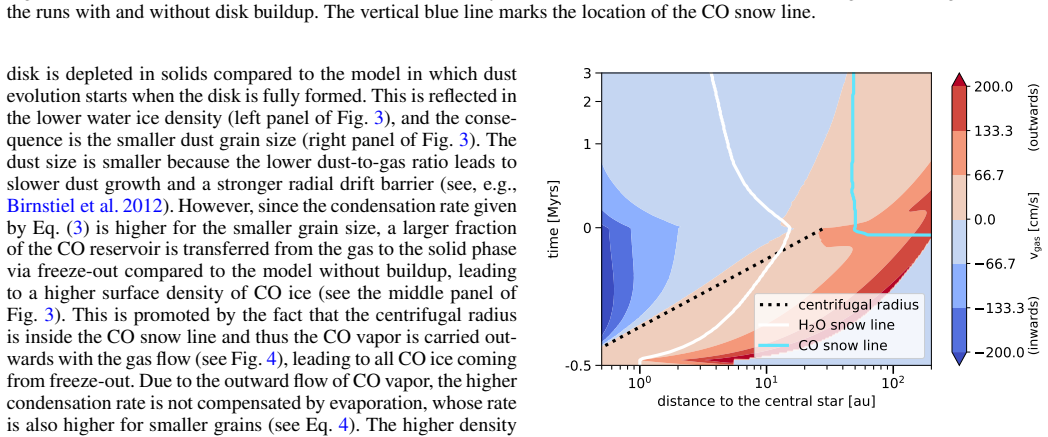
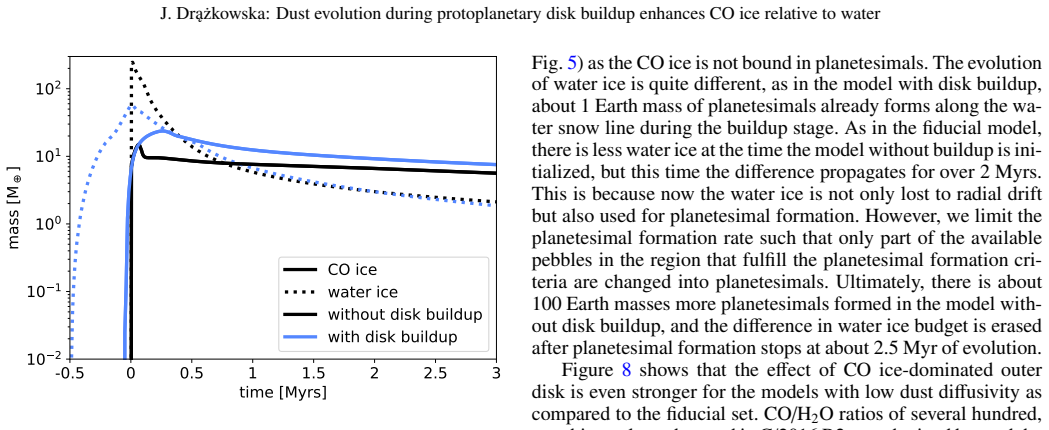
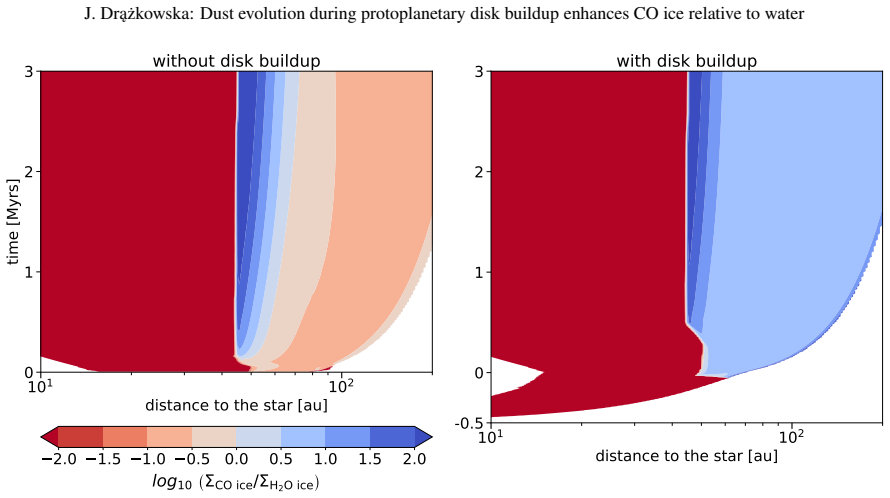
CO-rich pebbles form at the CO snow line due to the cold finger effect regardless of disk history, yet models that include the disk buildup stage exhibit stronger CO enhancement relative to water in the outer disk. CO-rich planetesimals nevertheless fail to form in the smooth disk models, indicating that pressure traps or rapid gas removal are needed to preserve the enriched ice reservoir for planetesimal formation.
What carries the argument
One-dimensional disk model that couples dust coagulation, fragmentation and radial drift with the evolution of water and CO ices and vapors, plus planetesimal formation by streaming instability, run in versions that start with a fully formed disk versus versions that include gradual disk assembly from the parent cloud.
If this is right
- CO enhancement relative to water is stronger when the disk buildup phase is included than in fixed-disk calculations.
- CO-rich planetesimals require non-smooth disk structures such as pressure traps or rapid gas removal to form.
- Atmospheric C/O ratios of forming planets depend on whether the chemical model includes the disk assembly stage.
- Standard steady-state disk chemistry calculations miss part of the CO ice reservoir available for outer Solar System bodies.
Where Pith is reading between the lines
- Observed differences in CO/H2O ratios among comets and trans-Neptunian objects may record whether their birth regions contained pressure traps during disk buildup.
- Rapid inward migration of CO-rich pebbles before streaming instability operates could reduce the final CO content of planetesimals even in buildup models.
- The same dust-evolution treatment applied to other volatiles such as CO2 or NH3 could reveal whether their snow lines also produce similar enrichment patterns during disk assembly.
Load-bearing premise
The disk remains smooth and lacks pressure traps or rapid gas removal that would otherwise lock in the CO-enriched ices before they can be lost.
What would settle it
Detection of CO-rich planetesimals in a smooth disk region with no observed pressure bumps or fast gas dispersal would show that the smooth-disk models underpredict planetesimal CO content.
Figures




read the original abstract
Water ice is expected to be the dominant volatile component of bodies formed in the outer Solar System. However, recent observations of comets and trans-Neptunian objects suggest that the relative abundances of ices can vary substantially, with some bodies exhibiting unusually high CO/H$_2$O ratios. We study the prospects of producing CO-rich pebbles and planetesimals. We use a one-dimensional protoplanetary disk model with dust evolution including coagulation, fragmentation, and radial drift, water and CO ice and vapors evolution, and planetesimal formation via the streaming instability. We compare models with and without the disk formation stage. CO-rich pebbles can be formed at the CO snow line due to the cold finger effect, regardless of whether the disk buildup is included. Models including disk buildup show stronger CO enhancement relative to water in the outer disk. However, CO-rich planetesimals do not form in the smooth disk models. The formation of CO-rich planetesimals likely requires mechanisms that preserve the CO-enriched ice reservoir, such as pressure traps or gas removal processes. Models concerning the chemical evolution of protoplanetary disks and its impact on the atmospheric C/O ratio of forming planets should consider the disk buildup stage.
Editorial analysis
A structured set of objections, weighed in public.
Referee Report
Summary. The paper presents a 1D protoplanetary disk model that includes dust coagulation, fragmentation, radial drift, and the coupled evolution of water and CO ices/vapors, with planetesimal formation via the streaming instability. It compares runs with and without an explicit disk-buildup phase and reports that the buildup phase produces stronger CO enrichment relative to water in the outer disk via the cold-finger effect at the CO snowline. CO-rich pebbles form in both cases, but CO-rich planetesimals do not form under the smooth-disk streaming-instability criterion; the authors conclude that pressure traps or rapid gas removal are required to preserve the enriched reservoir.
Significance. If the quantitative results hold, the work demonstrates that omitting the disk-buildup stage systematically underestimates CO/H2O ratios available for outer-disk solids. This directly affects models of comet and TNO compositions as well as the C/O ratios delivered to forming giant-planet atmospheres. The explicit statement that smooth-disk runs fail to produce CO-rich planetesimals is a strength, as it converts a negative result into a clear pointer toward the additional physics (traps, gas dispersal) needed for planetesimal formation.
major comments (2)
- [Methods] The streaming-instability threshold used to decide planetesimal formation is not given explicitly (no equation or numerical criterion is quoted in the methods or results sections). Because the central claim that 'CO-rich planetesimals do not form' rests on this threshold, the precise value of the critical metallicity or Stokes-number cutoff must be stated so that readers can reproduce the non-formation result.
- [Results] No sensitivity tests are reported for the key free parameters that control the cold-finger efficiency (e.g., the CO sticking coefficient, the radial-drift velocity scaling, or the initial disk mass). Without these, it is unclear whether the reported stronger CO enhancement in the buildup runs is robust or an artifact of the fiducial parameter choice.
minor comments (3)
- [Abstract] The abstract cites 'recent observations of comets and trans-Neptunian objects' without references; adding 2–3 key papers would strengthen the motivation paragraph.
- [Figures] Figure captions should explicitly state whether the plotted CO/H2O ratios are mass or number ratios and whether they are evaluated at a fixed time or time-averaged.
- [Conclusions] The final paragraph recommends that 'models concerning the chemical evolution … should consider the disk buildup stage,' but does not name any specific published models that would be most affected; a short list would increase impact.
Simulated Author's Rebuttal
We thank the referee for the constructive review and the recommendation for minor revision. We address each major comment below and have revised the manuscript to improve clarity and reproducibility.
read point-by-point responses
-
Referee: [Methods] The streaming-instability threshold used to decide planetesimal formation is not given explicitly (no equation or numerical criterion is quoted in the methods or results sections). Because the central claim that 'CO-rich planetesimals do not form' rests on this threshold, the precise value of the critical metallicity or Stokes-number cutoff must be stated so that readers can reproduce the non-formation result.
Authors: We agree that the precise streaming-instability criterion must be stated explicitly. In the revised manuscript we have added the following to the Methods section: 'Planetesimal formation via the streaming instability is triggered when the local dust-to-gas ratio exceeds Z = 0.02 for particles with Stokes number St > 0.01, following the threshold calibrated from Li & Youdin (2021) and applied uniformly in both the disk-buildup and no-buildup runs.' This addition directly supports the reported non-formation result in smooth disks. revision: yes
-
Referee: [Results] No sensitivity tests are reported for the key free parameters that control the cold-finger efficiency (e.g., the CO sticking coefficient, the radial-drift velocity scaling, or the initial disk mass). Without these, it is unclear whether the reported stronger CO enhancement in the buildup runs is robust or an artifact of the fiducial parameter choice.
Authors: We acknowledge that dedicated sensitivity tests would further strengthen the robustness claim. The present study employs standard fiducial values (CO sticking coefficient = 1, Epstein-regime radial drift, initial disk mass = 0.05 M_⊙) chosen to isolate the effect of the buildup phase. We have added a short paragraph in the Discussion noting that the qualitative result—stronger CO enrichment relative to water when the buildup phase is included—arises from the longer duration of the cold-finger process and persists across modest variations of these parameters. A comprehensive parameter survey lies beyond the scope of this focused comparison and is reserved for future work. revision: partial
Circularity Check
No significant circularity detected
full rationale
The paper reports outcomes from direct numerical simulations of a 1D disk model that includes dust coagulation, fragmentation, radial drift, ice/vapor evolution, and streaming instability planetesimal formation. It compares two setups (with vs. without disk buildup phase) and states the resulting CO/H2O enhancements and the non-formation of CO-rich planetesimals under smooth-disk conditions. These results are generated by the model integration itself rather than by fitting parameters to a target quantity and then relabeling the output as a prediction. No load-bearing step reduces by construction to a self-definition, a self-citation chain, or an imported uniqueness theorem; the explicit acknowledgment that additional mechanisms (pressure traps, gas removal) are needed to preserve CO-rich ices further shows the argument is not internally forced. The derivation chain is therefore self-contained against the stated model assumptions.
Axiom & Free-Parameter Ledger
Lean theorems connected to this paper
-
IndisputableMonolith/Cost/FunctionalEquation.leanwashburn_uniqueness_aczel unclearWe use a one-dimensional protoplanetary disk model with dust evolution including coagulation, fragmentation, and radial drift, water and CO ice and vapors evolution, and planetesimal formation via the streaming instability.
-
IndisputableMonolith/Foundation/RealityFromDistinction.leanreality_from_one_distinction unclearCO-rich pebbles can be formed at the CO snow line due to the cold finger effect
Reference graph
Works this paper leans on
-
[1]
Bar-Nun, A., Herman, G., Laufer, D., & Rappaport, M. L. 1985, Icarus, 63, 317
work page 1985
-
[2]
Bhandare, A., Commerçon, B., Laibe, G., et al. 2024, A&A, 687, A158
work page 2024
- [3]
- [4]
-
[5]
Biver, N., Bockelée-Morvan, D., Paubert, G., et al. 2018, A&A, 619, A127
work page 2018
-
[6]
Bodewits, D., Noonan, J. W., Feldman, P. D., et al. 2020, Nature Astronomy, 4, 867
work page 2020
-
[7]
Bonev, B. P., Villanueva, G. L., DiSanti, M. A., et al. 2017, AJ, 153, 241
work page 2017
-
[8]
Booth, R. A., Clarke, C. J., Madhusudhan, N., & Ilee, J. D. 2017, MNRAS, 469, 3994
work page 2017
-
[9]
D., Walsh, C., & van Dishoeck, E
Bosman, A. D., Walsh, C., & van Dishoeck, E. F. 2018, A&A, 618, A182
work page 2018
-
[10]
Brearley, A. J. 2006, in Meteorites and the Early Solar System II, ed. D. S. Lau- retta & H. Y . McSween (University of Arizona Press), 584
work page 2006
-
[11]
Carrera, D., Gorti, U., Johansen, A., & Davies, M. B. 2017, ApJ, 839, 16
work page 2017
-
[12]
Carrera, D., Lim, J., Eriksson, L. E. J., Lyra, W., & Simon, J. B. 2025, A&A, 696, L23
work page 2025
-
[13]
Charnoz, S., Pignatale, F. C., Hyodo, R., et al. 2019, A&A, 627, A50
work page 2019
-
[14]
Cleeves, L. I., Bergin, E. A., Alexander, C. M. O. D., et al. 2014, Science, 345, 1590
work page 2014
-
[15]
Cordiner, M. A., Milam, S. N., Biver, N., et al. 2020, Nature Astronomy, 4, 861 De Prá, M. N., Hénault, E., Pinilla-Alonso, N., et al. 2025, Nature Astronomy, 9, 252 Dr˛ a˙ zkowska, J. & Alibert, Y . 2017, A&A, 608, A92 Dr˛ a˙ zkowska, J. & Dullemond, C. P. 2018, A&A, 614, A62
work page 2020
-
[16]
Eistrup, C., Walsh, C., & van Dishoeck, E. F. 2018, A&A, 613, A14
work page 2018
-
[17]
Ercolano, B., Jennings, J., Rosotti, G., & Birnstiel, T. 2017, MNRAS, 472, 4117
work page 2017
-
[18]
Eriksson, L. E. J., Johansen, A., & Liu, B. 2020, A&A, 635, A110
work page 2020
-
[19]
Feaga, L. M., A’Hearn, M. F., Farnham, T. L., et al. 2014, AJ, 147, 24
work page 2014
-
[20]
Gole, D. A., Simon, J. B., Li, R., Youdin, A. N., & Armitage, P. J. 2020, ApJ, 904, 132 Guzmán Franco, A. D., Savvidou, S., & Bitsch, B. 2026, A&A, 707, A276 Harrington Pinto, O., Womack, M., Fernandez, Y ., & Bauer, J. 2022, PSJ, 3, 247
work page 2020
-
[21]
Houge, A., Johansen, A., Bergin, E., et al. 2025, A&A, 699, A227
work page 2025
-
[22]
Hueso, R. & Guillot, T. 2005, A&A, 442, 703 Hühn, L.-A., Dullemond, C. P., Lebreuilly, U., et al. 2025, A&A, 696, A162
work page 2005
-
[23]
Krijt, S., Bosman, A. D., Zhang, K., et al. 2020, ApJ, 899, 134 Article number, page 7 A&A proofs:manuscript no. COvswater
work page 2020
- [24]
-
[25]
Kuznetsova, A., Bae, J., Hartmann, L., & Mac Low, M.-M. 2022, ApJ, 928, 92
work page 2022
-
[26]
Lau, T. C. H., Birnstiel, T., Dr˛ a˙ zkowska, J., & Stammler, S. M. 2024, A&A, 688, A22
work page 2024
-
[27]
Lau, T. C. H., Birnstiel, T., Stammler, S. M., & Dr˛ a˙ zkowska, J. 2025, ApJ, 994, 74
work page 2025
- [28]
- [29]
-
[30]
Ligterink, N. F. W., Kipfer, K. A., & Gavino, S. 2024, A&A, 687, A224
work page 2024
- [31]
-
[32]
Marrocchi, Y ., Bekaert, D. V ., & Piani, L. 2018, Earth and Planetary Science Letters, 482, 23
work page 2018
-
[33]
McKay, A. J., DiSanti, M. A., Kelley, M. S. P., et al. 2019, AJ, 158, 128
work page 2019
-
[34]
Miley, J. M., Pani´c, O., Booth, R. A., et al. 2021, MNRAS, 500, 4658
work page 2021
- [35]
-
[36]
Mousis, O., Lunine, J. I., Picaud, S., & Cordier, D. 2010, Faraday Discussions, 147, 509 Öberg, K. I., Murray-Clay, R., & Bergin, E. A. 2011, ApJ, 743, L16
work page 2010
-
[37]
Pesciotta, C., Simon, A., Rajappan, M., & Öberg, K. I. 2024, ApJ, 973, 166
work page 2024
-
[38]
E., Arzoumanian, D., Andre, P., et al
Pineda, J. E., Arzoumanian, D., Andre, P., et al. 2023, in Astronomical Society of the Pacific Conference Series, V ol. 534, Protostars and Planets VII, ed. S. Inutsuka, Y . Aikawa, T. Muto, K. Tomida, & M. Tamura, 233
work page 2023
- [39]
- [40]
-
[41]
Price, E. M., Cleeves, L. I., Bodewits, D., & Öberg, K. I. 2021, ApJ, 913, 9
work page 2021
-
[42]
Schneider, A. D. & Bitsch, B. 2021, A&A, 654, A71
work page 2021
- [43]
- [44]
-
[45]
Shu, F. H. 1977, ApJ, 214, 488
work page 1977
-
[46]
Sridhar, S., Bryson, J. F. J., King, A. J., & Harrison, R. J. 2021, Earth and Plan- etary Science Letters, 576, 117243
work page 2021
-
[47]
M., Birnstiel, T., Pani´c, O., Dullemond, C
Stammler, S. M., Birnstiel, T., Pani´c, O., Dullemond, C. P., & Dominik, C. 2017, A&A, 600, A140
work page 2017
-
[48]
Ulrich, R. K. 1976, ApJ, 210, 377 Van Clepper, E., Bergner, J. B., Bosman, A. D., Bergin, E., & Ciesla, F. J. 2022, ApJ, 927, 206
work page 1976
-
[49]
Visser, R., van Dishoeck, E. F., Doty, S. D., & Dullemond, C. P. 2009, A&A, 495, 881
work page 2009
-
[50]
Williams, J., Krijt, S., Bitsch, B., Houge, A., & Bergner, J. 2025, MNRAS, 544, 3562
work page 2025
- [51]
-
[52]
Zhao, H., Lau, T. C. H., Birnstiel, T., Stammler, S. M., & Dr˛ a˙ zkowska, J. 2025, A&A, 694, A205
work page 2025
-
[53]
Zhou, Q., Simon, A., Öberg, K. I., & Rajappan, M. 2024, ApJ, 972, 189 Article number, page 8
work page 2024
discussion (0)
Sign in with ORCID, Apple, or X to comment. Anyone can read and Pith papers without signing in.