Recognition: 2 theorem links
· Lean TheoremFrustrated out-of-plane Dzyaloshinskii-Moriya interaction and the onset of atomic-scale 3q magnetic textures in 2D Fe₃GeXTe (X = Te, Se, S) monolayers
Pith reviewed 2026-05-14 22:33 UTC · model grok-4.3
The pith
Frustrated out-of-plane DMI stabilizes atomic-scale 3q magnetic textures in Fe3GeXTe monolayers at low scaling factors
A machine-rendered reading of the paper's core claim, the machinery that carries it, and where it could break.
Core claim
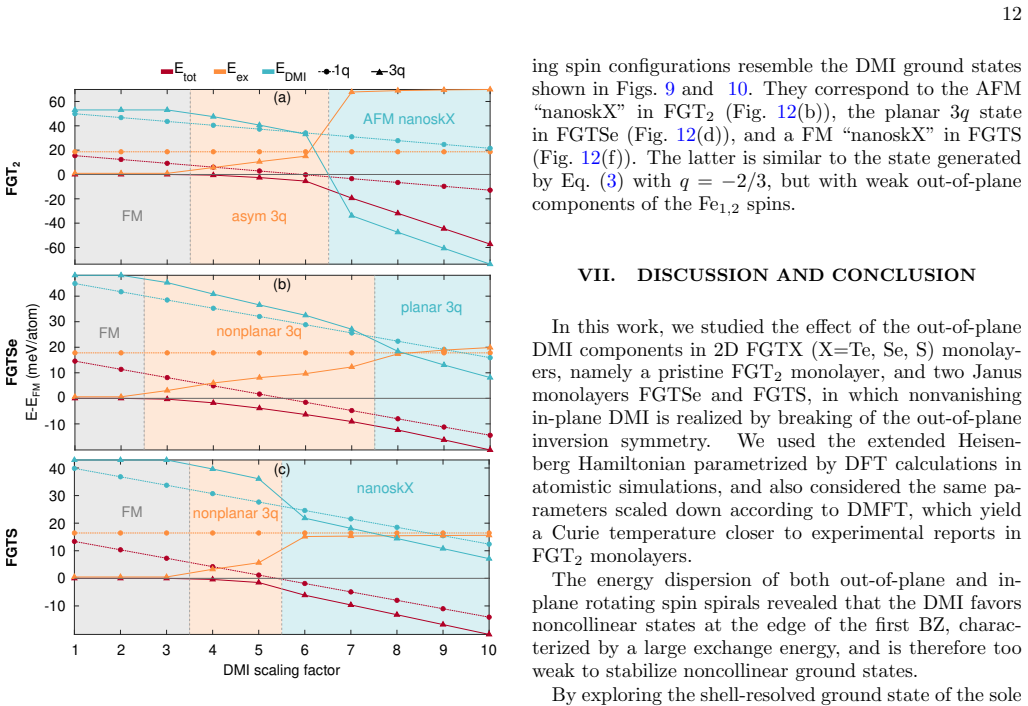
The frustrated out-of-plane DMI tends to favor atomic-scale 3q magnetic textures at the edge of the Brillouin zone. Nonplanar 3q states are favored under scaling factors as low as 3, while larger DMI tends to stabilize states reminiscent of nanoskyrmion lattices at the atomic-scale.
What carries the argument
The frustrated out-of-plane component of the Dzyaloshinskii-Moriya interaction inside the extended Heisenberg Hamiltonian parametrized from first principles, which competes with other exchange terms to select 3q states at the zone boundary.
Load-bearing premise
The extended Heisenberg Hamiltonian from first-principles calculations captures all relevant magnetic interactions and uniform DMI scaling realistically models strain or electric-field effects.
What would settle it
Atomistic simulations or measurements that show no 3q textures form when the out-of-plane DMI is scaled by a factor of three or more would falsify the central claim.
Figures


read the original abstract
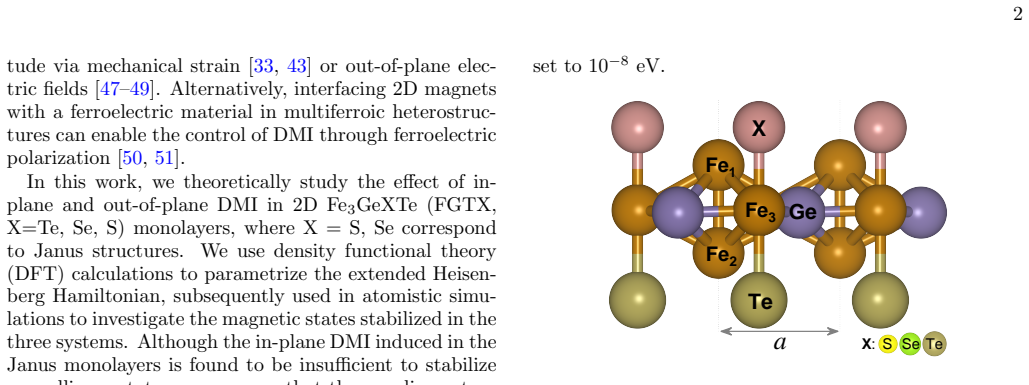
We theoretically study the effect of in- and out-of-plane Dzyaloshinskii-Moriya interaction (DMI) on the magnetic ground states of two-dimensional (2D) Fe$_3$GeXTe (X=Te, Se, S) monolayers, where X=Se, S correspond to antisymmetric Janus structures with nonvanishing in-plane DMI. We perform atomistic spin simulations with the extended Heisenberg Hamiltonian parametrized by first principles calculations. While we find that the base DMI in all systems is too weak to stabilize noncollinear states, we show how the frustrated out-of-plane DMI tends to favor atomic-scale $3q$ magnetic textures at the edge of the Brillouin zone. Owing to the ability to tune the DMI in 2D magnets via applied strain or electric field, we study the evolution of the systems' ground state with increasing DMI amplitude. We find that nonplanar $3q$ states are favored under scaling factors as low as 3, while larger DMI tends to stabilize states reminiscent of nanoskyrmion lattices at the atomic-scale.
Editorial analysis
A structured set of objections, weighed in public.
Referee Report
Summary. The manuscript studies the magnetic ground states of 2D Fe₃GeXTe (X=Te, Se, S) monolayers via atomistic spin simulations of an extended Heisenberg Hamiltonian parametrized from first-principles calculations. It reports that the intrinsic DMI is too weak to stabilize noncollinear states, but that frustrated out-of-plane DMI favors atomic-scale 3q textures at the Brillouin-zone edge; nonplanar 3q states appear for DMI scaling factors as low as 3, while larger scalings produce states reminiscent of atomic-scale nanoskyrmion lattices. The work explores DMI tuning via strain or electric field by uniformly scaling only the DMI amplitudes.
Significance. If the central results hold, the paper identifies a concrete route to stabilize atomic-scale 3q and nanoskyrmion-like textures in 2D magnets through DMI frustration, which is potentially relevant for spintronic device concepts. The first-principles parametrization of the spin model combined with atomistic simulations constitutes a reproducible computational framework that supports the claims within the model's assumptions; the finding that 3q states emerge at modest scaling factors (as low as 3) suggests experimental accessibility via external tuning.
major comments (1)
- [DMI scaling analysis (evolution of ground state with increasing DMI amplitude)] The claim that nonplanar 3q states are favored for DMI scaling factors as low as 3 (and that larger DMI stabilizes nanoskyrmion-like states) rests on uniform scaling of only the DMI vector components while holding isotropic exchanges J, single-ion anisotropy K, and dipole-dipole terms fixed. Realistic strain or electric-field tuning that increases DMI will simultaneously renormalize J and K (typically by several percent per percent strain), which can shift the energy balance selecting the 3q phase at the zone edge. No explicit check is described that recomputes the full parameter set under strain to confirm 3q survival.
minor comments (3)
- [Abstract] The abstract states that base DMI is 'too weak' but provides no numerical values for the unscaled DMI amplitudes, exchange constants, or energy differences that would allow readers to assess the scale of the reported effects.
- [Methods] Simulation details such as system size, boundary conditions, and convergence criteria with respect to k-point sampling or supercell size are not summarized in the main text; these would strengthen the validation against known limits.
- [Figures] Figure captions would benefit from explicit labeling of the Brillouin-zone edge points and the color scale for spin orientations to improve clarity of the 3q and nanoskyrmion textures.
Simulated Author's Rebuttal
We thank the referee for the thorough review and constructive criticism. We address the major comment point by point below and will make appropriate revisions to the manuscript.
read point-by-point responses
-
Referee: [DMI scaling analysis (evolution of ground state with increasing DMI amplitude)] The claim that nonplanar 3q states are favored for DMI scaling factors as low as 3 (and that larger DMI stabilizes nanoskyrmion-like states) rests on uniform scaling of only the DMI vector components while holding isotropic exchanges J, single-ion anisotropy K, and dipole-dipole terms fixed. Realistic strain or electric-field tuning that increases DMI will simultaneously renormalize J and K (typically by several percent per percent strain), which can shift the energy balance selecting the 3q phase at the zone edge. No explicit check is described that recomputes the full parameter set under strain to confirm 3q survival.
Authors: We appreciate the referee highlighting this limitation in our approach. Our study intentionally scales only the DMI amplitudes to isolate the impact of DMI frustration on stabilizing the 3q textures, as this is the key interaction under investigation and the primary one proposed for tuning in 2D magnets. This is a standard methodology in theoretical explorations of magnetic phase diagrams to identify the relevant parameter regimes. We agree that in a realistic scenario involving strain or electric fields, the exchange J and anisotropy K would also be modified. In the revised manuscript, we will add a paragraph discussing this approximation, citing typical values from the literature for strain-induced changes in similar Fe-based 2D magnets (on the order of a few percent per percent strain), and note that since the 3q states appear already at modest scaling factors of 3, the qualitative conclusions are likely robust against small renormalizations of J and K. A full recomputation of the entire parameter set under specific strain conditions is computationally intensive and beyond the scope of the present work but represents an important avenue for future research. We will also clarify in the text that the scaling is a model exploration rather than a direct simulation of a particular experimental tuning method. revision: partial
Circularity Check
No circularity in derivation chain
full rationale
The paper computes interaction parameters via first-principles DFT for the extended Heisenberg Hamiltonian, then runs atomistic spin simulations while explicitly scaling only the DMI vector components by integer factors. The emergence of 3q textures at scaling factor 3 is a direct numerical output of those simulations, not a quantity fitted to or defined by the target states. No self-citations, ansatzes, or uniqueness theorems are invoked to close the loop; the uniform-DMI-scaling choice is stated as an exploratory modeling assumption rather than a hidden fit. The derivation therefore remains self-contained against external benchmarks.
Axiom & Free-Parameter Ledger
free parameters (1)
- DMI scaling factor
axioms (1)
- domain assumption Extended Heisenberg Hamiltonian with DMI terms fully describes the magnetic energetics of the monolayers
Lean theorems connected to this paper
-
IndisputableMonolith/Cost/FunctionalEquation.leanwashburn_uniqueness_aczel unclear?
unclearRelation between the paper passage and the cited Recognition theorem.
We perform atomistic spin simulations with the extended Heisenberg Hamiltonian parametrized by first principles calculations... nonplanar 3q states are favored under scaling factors as low as 3
-
IndisputableMonolith/Foundation/RealityFromDistinction.leanreality_from_one_distinction unclear?
unclearRelation between the paper passage and the cited Recognition theorem.
the frustrated out-of-plane DMI tends to favor atomic-scale 3q magnetic textures at the edge of the Brillouin zone
What do these tags mean?
- matches
- The paper's claim is directly supported by a theorem in the formal canon.
- supports
- The theorem supports part of the paper's argument, but the paper may add assumptions or extra steps.
- extends
- The paper goes beyond the formal theorem; the theorem is a base layer rather than the whole result.
- uses
- The paper appears to rely on the theorem as machinery.
- contradicts
- The paper's claim conflicts with a theorem or certificate in the canon.
- unclear
- Pith found a possible connection, but the passage is too broad, indirect, or ambiguous to say the theorem truly supports the claim.
Reference graph
Works this paper leans on
-
[1]
C. Gong, L. Li, Z. Li, H. Ji, A. Stern, Y. Xia, T. Cao, W. Bao, C. Wang, Y. Wang,et al., Discovery of intrinsic ferromagnetism in two-dimensional van der waals crys- tals, Nature546, 265 (2017)
work page 2017
- [2]
-
[3]
Y. Deng, Y. Yu, Y. Song, J. Zhang, N. Z. Wang, Z. Sun, Y. Yi, Y. Z. Wu, S. Wu, J. Zhu,et al., Gate-tunable room-temperature ferromagnetism in two-dimensional Fe3GeTe2, Nature563, 94 (2018)
work page 2018
-
[4]
Q. H. Wang, A. Bedoya-Pinto, M. Blei, A. H. Dismukes, A. Hamo, S. Jenkins, M. Koperski, Y. Liu, Q.-C. Sun, E. J. Telford, H. H. Kim, M. Augustin, U. Vool, J.- X. Yin, L. H. Li, A. Falin, C. R. Dean, F. Casanova, R. F. L. Evans, M. Chshiev, A. Mishchenko, C. Petrovic, R. He, L. Zhao, A. W. Tsen, B. D. Gerardot, M. Brotons- Gisbert, Z. Guguchia, X. Roy, S. ...
work page 2022
-
[5]
H. Yang, S. O. Valenzuela, M. Chshiev, S. Couet, B. Di- eny, B. Dlubak, A. Fert, K. Garello, M. Jamet, D.- E. Jeong, K. Lee, T. Lee, M.-B. Martin, G. S. Kar, P. S´ en´ eor, H.-J. Shin, and S. Roche, Two-dimensional materials prospects for non-volatile spintronic memories, Nature606, 663 (2022)
work page 2022
- [6]
-
[7]
A. Bogdanov and A. Hubert, Thermodynamically stable magnetic vortex states in magnetic crystals, Journal of Magnetism and Magnetic Materials138, 255 (1994)
work page 1994
-
[8]
I. E. Dzyaloshinskii, A thermodynamic theory of “weak” ferromagnetism of antiferromagnetics, Journal of Physics and Chemistry of Solids4, 241 (1958)
work page 1958
-
[9]
Moriya, Anisotropic superexchange interaction and weak ferromagnetism, Physical Review120, 91 (1960)
T. Moriya, Anisotropic superexchange interaction and weak ferromagnetism, Physical Review120, 91 (1960)
work page 1960
-
[10]
A. Fert, M. Chshiev, A. Thiaville, and H. Yang, From early theories of dzyaloshinskii–moriya interactions in metallic systems to today’s novel roads, Journal of the Physical Society of Japan92, 081001 (2023)
work page 2023
-
[11]
A. Fert, V. Cros, and J. Sampaio, Skyrmions on the track, Nature Nanotechnology8, 152 (2013)
work page 2013
-
[12]
S. M¨ uhlbauer, B. Binz, F. Jonietz, C. Pfleiderer, A. Rosch, A. Neubauer, R. Georgii, and P. B¨ oni, Skyrmion lattice in a chiral magnet, Science323, 915 (2009)
work page 2009
-
[13]
X. Yu, Y. Onose, N. Kanazawa, J. Park, J. Han, Y. Mat- sui, N. Nagaosa, and Y. Tokura, Real-space observation of a two-dimensional skyrmion crystal, Nature465, 901 (2010)
work page 2010
-
[14]
N. Romming, C. Hanneken, M. Menzel, J. E. Bickel, B. Wolter, K. von Bergmann, A. Kubetzka, and R. Wiesendanger, Writing and deleting single magnetic skyrmions, Science341, 636 (2013)
work page 2013
-
[15]
C. Moreau-Luchaire, C. Moutafis, N. Reyren, J. Sam- paio, C. Vaz, N. Van Horne, K. Bouzehouane, K. Gar- cia, C. Deranlot, P. Warnicke,et al., Additive interfacial chiral interaction in multilayers for stabilization of small individual skyrmions at room temperature, Nature nan- otechnology11, 444 (2016)
work page 2016
-
[16]
O. Boulle, J. Vogel, H. Yang, S. Pizzini, D. De Souza Chaves, A. Locatelli, T. O. Mente¸ s, A. Sala, L. D. Buda-Prejbeanu, O. Klein, M. Belmegue- nai, Y. Roussign´ e, A. Stashkevich, S. M. Ch´ erif, L. Aballe, M. Foerster, M. Chshiev, S. Auffret, I. M. Miron, and G. Gaudin, Room-temperature chiral mag- netic skyrmions in ultrathin magnetic nanostructures,...
work page 2016
-
[17]
B. Ding, Z. Li, G. Xu, H. Li, Z. Hou, E. Liu, X. Xi, F. Xu, Y. Yao, and W. Wang, Observation of magnetic skyrmion bubbles in a van der waals ferromagnet Fe 3GeTe2, Nano letters20, 868 (2019)
work page 2019
-
[18]
Y. Wu, S. Zhang, J. Zhang, W. Wang, Y. L. Zhu, J. Hu, G. Yin, K. Wong, C. Fang, C. Wan,et al., N´ eel-type skyrmion in WTe2/Fe3GeTe2 van der Waals heterostruc- ture, Nature communications11, 3860 (2020)
work page 2020
-
[19]
T.-E. Park, L. Peng, J. Liang, A. Hallal, F. S. Yasin, X. Zhang, K. M. Song, S. J. Kim, K. Kim, M. Weigand, G. Sch¨ utz, S. Finizio, J. Raabe, K. Garcia, J. Xia, Y. Zhou, M. Ezawa, X. Liu, J. Chang, H. C. Koo, Y. D. Kim, M. Chshiev, A. Fert, H. Yang, X. Yu, and S. Woo, N´ eel-type skyrmions and their current-induced motion in van der waals ferromagnet-bas...
work page 2021
-
[20]
M.-G. Han, J. A. Garlow, Y. Liu, H. Zhang, J. Li, D. DiMarzio, M. W. Knight, C. Petrovic, D. Jariwala, and Y. Zhu, Topological magnetic-spin textures in two- dimensional van der Waals Cr 2Ge2Te6, Nano Lett.19, 7859–7865 (2019)
work page 2019
- [21]
-
[22]
X. Lv, H. Lv, Y. Huang, R. Zhang, G. Qin, Y. Dong, M. Liu, K. Pei, G. Cao, J. Zhang,et al., Distinct skyrmion phases at room temperature in two-dimensional ferromagnet Fe 3GaTe2, Nature Communications15, 3278 (2024)
work page 2024
-
[23]
M. T. Birch, F. S. Yasin, K. Litzius, L. Powalla, S. Wintz, F. Schulz, A. E. Kossak, M. Weigand, T. Scholz, B. V. Lotsch, G. Sch¨ utz, X. Z. Yu, and M. Burghard, Influ- ence of magnetic sublattice ordering on skyrmion bubble stability in 2d magnet fe5gete2, ACS Nano18, 18246 (2024)
work page 2024
-
[24]
L. Powalla, M. T. Birch, K. Litzius, S. Wintz, S. Satheesh, M. Weigand, E. Goering, G. Sch¨ utz, and M. Burghard, Skyrmion and skyrmionium formation in the two-dimensional magnet cr2ge2te6, Phys. Rev. B108, 214417 (2023)
work page 2023
-
[25]
J. Xu, W. A. Phelan, and C.-L. Chien, Large anomalous nernst effect in a van der waals ferromagnet fe3gete2, Nano Letters19, 8250 (2019)
work page 2019
-
[26]
A. Chakraborty, A. K. Srivastava, A. K. Sharma, A. K. Gopi, K. Mohseni, A. Ernst, H. Deniz, B. K. Hazra, S. Das, P. Sessi, I. Kostanovskiy, T. Ma, H. L. Mey- erheim, and S. S. P. Parkin, Magnetic skyrmions in a thickness tunable 2d ferromagnet from a defect driven dzyaloshinskii–moriya interaction, Advanced Materials 34, 2108637 (2022)
work page 2022
-
[27]
Y. Wu, B. Francisco, Z. Chen, W. Wang, Y. Zhang, C. Wan, X. Han, H. Chi, Y. Hou, A. Lodesani, G. Yin, K. Liu, Y.-t. Cui, K. L. Wang, and J. S. Moodera, A van der Waals interface hosting two groups of magnetic skyrmions, Advanced Materials34, 2110583 (2022)
work page 2022
- [28]
-
[29]
C. Xu, X. Li, P. Chen, Y. Zhang, H. Xiang, and L. Bel- laiche, Assembling diverse skyrmionic phases in fe3gete2 monolayers, Advanced Materials34, 2107779 (2022)
work page 2022
-
[30]
S. Laref, K.-W. Kim, and A. Manchon, Elusive Dzyaloshinskii-Moriya interaction in monolayer Fe3GeTe2, Physical Review B102, 060402 (2020)
work page 2020
- [31]
-
[32]
W. Du, K. Dou, Z. He, Y. Dai, B. Huang, and Y. Ma, Spontaneous magnetic skyrmions in single-layer CrInX3 (X= Te, Se), Nano letters22, 3440 (2022)
work page 2022
-
[33]
Z. Shen, C. Song, Y. Xue, Z. Wu, J. Wang, and Z. Zhong, Strain-tunable dzyaloshinskii-moriya interac- tion and skyrmions in two-dimensional Janus Cr 2X3Y3 (X,Y = Cl, Br, I X̸=Y)sa trihalide monolayers, Phys. Rev. B106, 094403 (2022)
work page 2022
-
[34]
D. Li, S. Haldar, T. Drevelow, and S. Heinze, Tuning the magnetic interactions in van der waals Fe3GeTe2 het- erostructures: A comparative study of ab initio methods, Physical Review B107, 104428 (2023)
work page 2023
-
[35]
D. Li, M. A. Goerzen, S. Haldar, T. Drevelow, H. Schrautzer, and S. Heinze, Stability and localization of nanoscale skyrmions and bimerons in an all- magnetic van der waals heterostructure, arXiv preprint arXiv:2408.15974 doi.org/10.48550/arXiv.2408.15974 (2024)
-
[36]
W. Sun, W. Wang, H. Li, G. Zhang, D. Chen, J. Wang, and Z. Cheng, Controlling bimerons as skyrmion ana- logues by ferroelectric polarization in 2d van der waals multiferroic heterostructures, Nature communications 11, 5930 (2020)
work page 2020
-
[37]
W. Sun, W. Wang, J. Zang, H. Li, G. Zhang, J. Wang, and Z. Cheng, Manipulation of magnetic skyrmion in a 2d van der waals heterostructure via both electric and mag- netic fields, Advanced Functional Materials31, 2104452 (2021)
work page 2021
-
[38]
M. Yang, Q. Li, R. V. Chopdekar, R. Dhall, J. Turner, J. D. Carlstr¨ om, C. Ophus, C. Klewe, P. Shafer, A. T. N’Diaye, J. W. Choi, G. Chen, Y. Z. Wu, C. Hwang, F. Wang, and Z. Q. Qiu, Creation of skyrmions in van der Waals ferromagnet Fe3GeTe2 on (Co/Pd)n superlattice, Science Advances6, eabb5157 (2020)
work page 2020
-
[39]
M. A. Goerzen, T. Drevelow, H. Schrautzer, S. Haldar, S. Heinze, and D. Li, Emergence of coexisting topolog- ical spin textures in an all-magnetic van der waals het- erostructure, arXiv e-prints , arXiv (2024)
work page 2024
-
[40]
J. Yuan, Y. Yang, Y. Cai, Y. Wu, Y. Chen, X. Yan, and L. Shen, Intrinsic skyrmions in monolayer Janus magnets, Phys. Rev. B101, 094420 (2020)
work page 2020
-
[41]
C. Xu, J. Feng, S. Prokhorenko, Y. Nahas, H. Xiang, and L. Bellaiche, Topological spin texture in janus monolayers of the chromium trihalides Cr(I,X) 3, Phys. Rev. B101, 060404 (2020)
work page 2020
-
[42]
J. Jiang, X. Liu, R. Li, and W. Mi, Topolog- ical spin textures in a two-dimensional MnBi 2(Se, Te)4 Janus material, Applied Physics Letters119, doi.org/10.1063/5.0057794 (2021)
-
[43]
Q. Cui, J. Liang, Z. Shao, P. Cui, and H. Yang, Strain- tunable ferromagnetism and chiral spin textures in two- dimensional Janus chromium dichalcogenides, Phys. Rev. B102, 094425 (2020)
work page 2020
- [44]
-
[45]
R. Caglayan, A. Mogulkoc, Y. Mogulkoc, M. Modarresi, and A. N. Rudenko, Dzyaloshinskii-moriya interaction and nontrivial spin textures in the janus semiconductor monolayers VXY (X= Cl, Br, I; Y= S, Se, Te), Phys. Rev. B110, 094440 (2024)
work page 2024
-
[46]
A. Mogulkoc and R. Caglayan, Remarkable Dzyaloshinskii-Moriya interaction in ferromagnetic SnC/MnSeX(X= Se,Te) heterobilayers, Phys. Rev. Mater.9, 064004 (2025)
work page 2025
-
[47]
J. Liu, M. Shi, J. Lu, and M. P. Anantram, Analy- sis of electrical-field-dependent dzyaloshinskii-moriya in- teraction and magnetocrystalline anisotropy in a two- dimensional ferromagnetic monolayer, Phys. Rev. B97, 15 054416 (2018)
work page 2018
-
[48]
J. Liu, M. Shi, P. Mo, and J. Lu, Electrical-field-induced magnetic skyrmion ground state in a two-dimensional chromium tri-iodide ferromagnetic monolayer, AIP Ad- vances8, 055316 (2018)
work page 2018
-
[49]
A. K. Behera, S. Chowdhury, and S. R. Das, Mag- netic skyrmions in atomic thin CrI 3 monolayer, Applied Physics Letters114, doi.org/10.1063/1.5096782 (2019)
- [50]
-
[51]
K. Huang, D.-F. Shao, and E. Y. Tsymbal, Ferroelectric control of magnetic skyrmions in two-dimensional van der waals heterostructures, Nano Letters22, 3349 (2022)
work page 2022
- [52]
- [53]
-
[54]
A. Leonov and M. Mostovoy, Multiply periodic states and isolated skyrmions in an anisotropic frustrated magnet, Nature Communications6, 8275 (2015)
work page 2015
-
[55]
X. Yu, M. Mostovoy, Y. Tokunaga, W. Zhang, K. Ki- moto, Y. Matsui, Y. Kaneko, N. Nagaosa, and Y. Tokura, Magnetic stripes and skyrmions with helicity reversals, Proceedings of the National Academy of Sciences109, 8856 (2012)
work page 2012
- [56]
-
[57]
S. Paul, S. Haldar, S. von Malottki, and S. Heinze, Role of higher-order exchange interactions for skyrmion stability, Nature communications11, 1 (2020)
work page 2020
-
[58]
M. Gutzeit, A. Kubetzka, S. Haldar, H. Pralow, M. A. Goerzen, R. Wiesendanger, S. Heinze, and K. von Bergmann, Nano-scale collinear multi-q states driven by higher-order interactions, Nature Communications13, 5764 (2022)
work page 2022
-
[59]
L. Desplat and B. Dup´ e, Eigenmodes of magnetic skyrmion lattices, Phys. Rev. B107, 144415 (2023)
work page 2023
-
[60]
K. S. Denisov, I. V. Rozhansky, N. S. Averkiev, and E. L¨ ahderanta, Electron scattering on a magnetic skyrmion in the nonadiabatic approximation, Phys. Rev. Lett.117, 027202 (2016)
work page 2016
-
[61]
K. Denisov, I. Rozhansky, N. Averkiev, and E. L¨ ahderanta, A nontrivial crossover in topologi- cal hall effect regimes, Scientific Reports7, 17204 (2017)
work page 2017
-
[62]
P. E. Bl¨ ochl, Projector augmented-wave method, Phys. Rev. B50, 17953 (1994)
work page 1994
-
[63]
G. Kresse and D. Joubert, From ultrasoft pseudopoten- tials to the projector augmented-wave method, Phys. Rev. B59, 1758 (1999)
work page 1999
-
[64]
G. Kresse and J. Furthm¨ uller, Efficiency of ab-initio total energy calculations for metals and semiconductors using a plane-wave basis set, Computational Materials Science 6, 15 (1996)
work page 1996
-
[65]
G. Kresse and J. Furthm¨ uller, Efficient iterative schemes for ab initio total-energy calculations using a plane-wave basis set, Phys. Rev. B54, 11169 (1996)
work page 1996
-
[66]
J. P. Perdew, K. Burke, and M. Ernzerhof, Generalized gradient approximation made simple, Phys. Rev. Lett. 77, 3865 (1996)
work page 1996
-
[67]
H. J. Monkhorst and J. D. Pack, Special points for Brillouin-zone integrations, Phys. Rev. B13, 5188 (1976)
work page 1976
-
[68]
H.-J. Deiseroth, K. Aleksandrov, C. Reiner, L. Kienle, and R. K. Kremer, Fe 3GeTe2 and Ni 3GeTe2 – two new layered transition-metal compounds: Crystal structures, hrtem investigations, and magnetic and electrical properties, European Journal of Inorganic Chemistry2006, 1561 (2006), https://chemistry- europe.onlinelibrary.wiley.com/doi/pdf/10.1002/ejic.200501020
-
[69]
B. Chen, J. Yang, H. Wang, M. Imai, H. Ohta, C. Mi- chioka, K. Yoshimura, and M. Fang, Magnetic properties of layered itinerant electron ferromagnet Fe3GeTe2, Jour- nal of the Physical Society of Japan82, 124711 (2013)
work page 2013
- [70]
-
[71]
B. Kim, Q. ul ain, and S. H. Rhim, Strain tunability of magnetocrystalline anisotropy in Fe3GeTe2 thin films, Phys. Rev. B109, 174434 (2024)
work page 2024
-
[72]
See Supplemental Material at URL for additional de- tails and supporting data on the dynamical stability of Fe 3GeXTe (FGTX, X = Te, Se, S) monolayers via phonon spectra, Bader charge analysis and electronic band structures, details on Curie temperature calcula- tions, and dispersions of out-of-plane spin spirals, includ- ing shell-resolved DMI dispersion...
-
[73]
G. Henkelman, A. Arnaldsson, and H. J´ onsson, A fast and robust algorithm for Bader decomposition of charge density, Computational Materials Science36, 354 (2006)
work page 2006
-
[74]
E. Sanville, S. D. Kenny, R. Smith, and G. Henkel- man, Improved grid-based algorithm for bader charge al- location, Journal of Computational Chemistry28, 899 (2007)
work page 2007
-
[75]
W. Tang, E. Sanville, and G. Henkelman, A grid-based bader analysis algorithm without lattice bias, Journal of Physics: Condensed Matter21, 084204 (2009)
work page 2009
-
[76]
A. A. Mostofi, J. R. Yates, G. Pizzi, Y.-S. Lee, I. Souza, D. Vanderbilt, and N. Marzari, An updated version of wannier90: A tool for obtaining maximally-localised Wannier functions, Computer Physics Communications 185, 2309 (2014)
work page 2014
-
[77]
R. Fujimura, R. Yoshimi, M. Mogi, A. Tsukazaki, M. Kawamura, K. S. Takahashi, M. Kawasaki, and Y. Tokura, Current-induced magnetization switch- ing at charge-transferred interface between topologi- cal insulator (Bi, Sb) 2Te3 and van der Waals fer- romagnet Fe 3GeTe2, Applied Physics Letters119, doi.org/10.1063/5.0057863 (2021)
-
[78]
S.-R. Kim, I. K. Park, J.-G. Yoo, J. Seo, J.-G. Kim, J.- H. Park, J. S. Kim, K. Kim, G. Lee, and K.-T. Ko, Role of orbital bond and local magnetism in Fe3GeTe2 and Fe4GeTe2: implication for ultrathin nano devices, ACS Applied Nano Materials5, 10341 (2022)
work page 2022
-
[79]
S. Liu, X. Yuan, Y. Zou, Y. Sheng, C. Huang, E. Zhang, J. Ling, Y. Liu, W. Wang, C. Zhang,et al., Wafer- scale two-dimensional ferromagnetic Fe3GeTe2 thin films grown by molecular beam epitaxy, npj 2D Materials and Applications1, 30 (2017)
work page 2017
-
[80]
A. F. May, S. Calder, C. Cantoni, H. Cao, and M. A. 16 McGuire, Magnetic structure and phase stability of the van der waals bonded ferromagnet fe3−xgete2, Phys. Rev. B93, 014411 (2016)
work page 2016
discussion (0)
Sign in with ORCID, Apple, or X to comment. Anyone can read and Pith papers without signing in.