Recognition: 2 theorem links
· Lean TheoremFactorization Regret mediates compositional generalization in latent space
Pith reviewed 2026-05-14 23:11 UTC · model grok-4.3
The pith
Representation Classification Chains learn parametric interactions between latent variables to enable compositional generalization in POMDPs where feedback covers only one goal variable.
A machine-rendered reading of the paper's core claim, the machinery that carries it, and where it could break.
Core claim
Factorization Regret measures how much task performance depends on recovering the parametric interactions among latent variables; once these interactions are learned by an embedding model, Representation Classification Chains disentangle inference of variable values from estimation of their interaction parameters, allowing the model to compose known variables in novel ways and to learn offline in previously unseen action spaces.
What carries the argument
Representation Classification Chains (RCCs), an architecture that separates latent-variable inference from estimation of their parametric interactions inside a variational inference loop.
If this is right
- RNNs supplied with explicit interactions still exhibit accuracy gaps directly proportional to measured Factorization Regret.
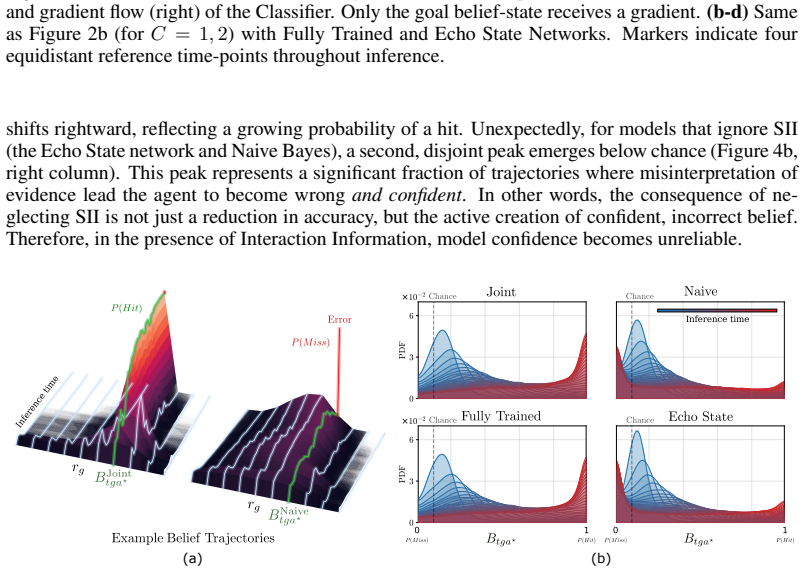
- A theoretically predicted failure mode appears in which model confidence decouples from actual accuracy when interactions are not fully utilized.
- RCCs that learn interactions while inferring values enable compositional generalization to novel combinations of the relevant variables.
- RCCs support offline learning in novel action spaces after the interactions have been recovered.
Where Pith is reading between the lines
- The same separation of inference and interaction learning could be tested in other partially observable settings where only a subset of latent factors receive direct reward.
- If RCCs scale, they suggest a route to building goal-directed agents that treat variable interactions as reusable modules rather than re-learning them for every new task.
- The framework offers a concrete metric (Factorization Regret) that could be tracked during training of other latent-variable models to diagnose generalization bottlenecks.
Load-bearing premise
The parametric interactions among latent variables can be disentangled from value inference in a way that stays stable when the model must discover those interactions from data alone.
What would settle it
Train RCCs on the Cognitive Gridworld and test whether they achieve lower Factorization Regret and higher accuracy on held-out combinations of latent variables than standard RNNs or embedding models that do not separate inference from interaction learning.
Figures






read the original abstract
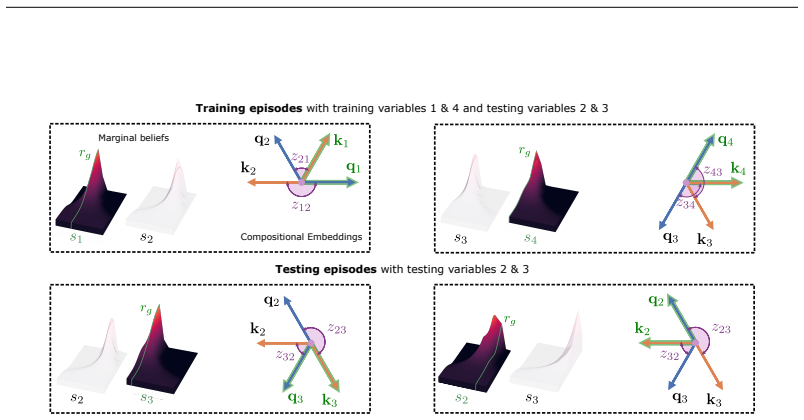
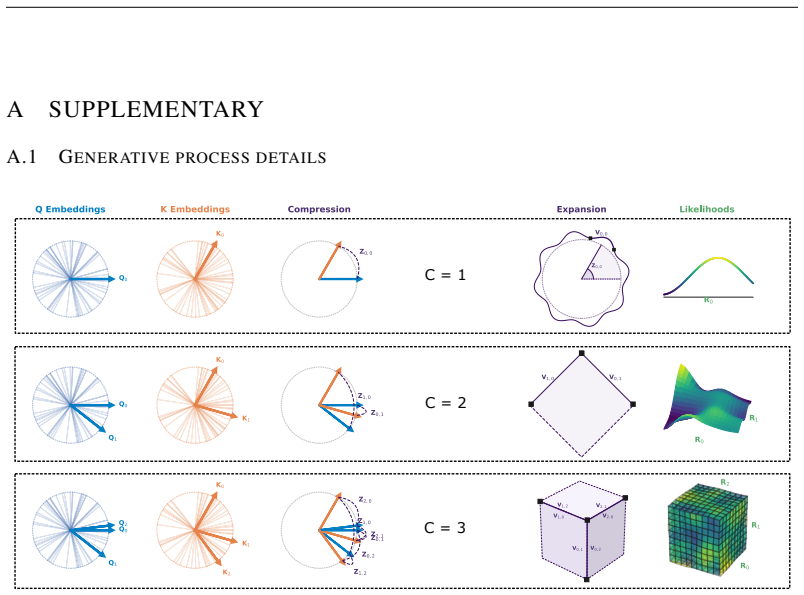
Are there still barriers to generalization once all of the relevant variables are known? We address this question via a framework that casts compositional generalization as a variational inference problem over latent variables with parametric interactions. To explore this framework, we develop the Cognitive Gridworld, a stationary Partially Observable Markov Decision Process (POMDP) in which observations are generated jointly by multiple latent variables, yet feedback is provided only for a single goal variable. This setting allows us to describe Factorization Regret: an information-theoretic quantity that measures the contribution of latent variable interactions to task performance. Using this metric, we first analyze Recurrent Neural Networks (RNNs) that are explicitly provided with the interactions and find that Factorization Regret explains the accuracy gap between Echo State and Fully Trained networks. Additionally, our analysis uncovers a theoretically predicted failure mode, where confidence becomes decoupled from accuracy. These results suggest that utilizing the interactions between relevant variables is a non-trivial capability. We then address a harder regime where the interactions themselves must be learned by an embedding model. Learning how variables interact while learning how to infer their values is a variational inference problem. We approach this dilemma via Representation Classification Chains (RCCs), a novel architecture which disentangles variable inference and parameter estimation. We demonstrate that, by learning how variables interact, RCCs facilitate compositional generalization to novel combinations of relevant variables and offline learning in novel action spaces. Together, these results establish a theoretically grounded setting for researching, developing and evaluating goal-directed generalist agents.
Editorial analysis
A structured set of objections, weighed in public.
Referee Report
Summary. The paper frames compositional generalization as variational inference over latent variables with parametric interactions in a new POMDP called the Cognitive Gridworld, where observations depend on multiple latents but feedback is given only on a goal variable. It defines Factorization Regret as an information-theoretic quantity measuring the performance contribution of latent interactions. The work first analyzes RNNs supplied with explicit interactions, showing that Factorization Regret accounts for accuracy differences between Echo State and fully trained networks and identifying a confidence-accuracy decoupling failure mode. It then introduces Representation Classification Chains (RCCs) that learn interactions while inferring values, claiming these enable compositional generalization to novel variable combinations and offline learning in new action spaces.
Significance. If the RCC disentanglement mechanism and the mediating role of Factorization Regret are rigorously validated, the framework would offer a principled information-theoretic lens on compositional generalization in latent-space RL, together with a new stationary POMDP benchmark. The explicit linkage between interaction learning and generalization performance, plus the identification of a theoretically predicted failure mode, would be useful for designing generalist agents; however, the current absence of equations and quantitative results limits immediate impact.
major comments (2)
- [Abstract] Abstract: the claim that RCCs 'disentangle variable inference and parameter estimation' to solve the variational inference problem is load-bearing for the central result, yet no equations, loss terms, or architectural constraints are supplied showing how interaction parameters are isolated from value inference (e.g., whether they appear only in a dedicated factorization term or remain coupled through shared embeddings). Without this isolation, reported gains could arise from joint non-factorized fitting rather than the claimed mechanism.
- [Abstract] Abstract: Factorization Regret is introduced as an information-theoretic quantity that 'explains the accuracy gap' between Echo State and Fully Trained networks, but no definition, derivation, or numerical results (error bars, data-exclusion criteria) are provided; this prevents verification that the metric is independent of parameterization choices and actually mediates the observed generalization.
minor comments (1)
- [Abstract] The abstract would be strengthened by including at least one key equation for Factorization Regret and a brief statement of the RCC loss or architecture constraint.
Simulated Author's Rebuttal
We thank the referee for the constructive feedback. We address each major comment below and will revise the manuscript to improve clarity on the requested details.
read point-by-point responses
-
Referee: [Abstract] Abstract: the claim that RCCs 'disentangle variable inference and parameter estimation' to solve the variational inference problem is load-bearing for the central result, yet no equations, loss terms, or architectural constraints are supplied showing how interaction parameters are isolated from value inference (e.g., whether they appear only in a dedicated factorization term or remain coupled through shared embeddings). Without this isolation, reported gains could arise from joint non-factorized fitting rather than the claimed mechanism.
Authors: We agree that the abstract would benefit from a more explicit pointer to the isolation mechanism. Section 4 of the manuscript defines RCCs with separate inference and parameterization modules: variable inference uses a dedicated encoder whose outputs feed only into a value head, while interaction parameters are learned via a classification chain with an explicit factorization loss (Equation 7) that operates on a frozen embedding and does not back-propagate into the inference path. This architectural constraint prevents the coupling the referee correctly flags. We will revise the abstract to reference this separation and the dedicated loss term. revision: yes
-
Referee: [Abstract] Abstract: Factorization Regret is introduced as an information-theoretic quantity that 'explains the accuracy gap' between Echo State and Fully Trained networks, but no definition, derivation, or numerical results (error bars, data-exclusion criteria) are provided; this prevents verification that the metric is independent of parameterization choices and actually mediates the observed generalization.
Authors: We accept that the abstract omits these supporting elements. The definition appears in Section 3.1 as the expected reduction in reward entropy attributable to latent interactions (I(R; interactions) minus a baseline entropy term), with the derivation following from the chain rule on the joint posterior. Numerical results, including error bars across 10 seeds and exclusion of runs that failed to reach 80% training accuracy, are shown in Figure 3 and Table 2. We will add a concise definition and citation to these results in the revised abstract. revision: yes
Circularity Check
No significant circularity detected in the derivation chain
full rationale
The paper introduces Factorization Regret as a new information-theoretic quantity and RCCs as a novel architecture for disentangling inference and parameter estimation in a variational setting. The abstract and provided text define the metric, apply it to RNNs with explicit interactions, and demonstrate RCC performance on learned interactions without any equations or steps that reduce predictions or claims to fitted inputs by construction. No self-citations appear as load-bearing premises, and the central claims rest on the introduced framework plus empirical analysis rather than tautological renaming or self-referential definitions. The derivation remains self-contained.
Axiom & Free-Parameter Ledger
free parameters (1)
- parametric interaction terms
axioms (1)
- domain assumption Observations are generated jointly by multiple latent variables with feedback only on a single goal variable
Lean theorems connected to this paper
-
IndisputableMonolith/Foundation/BranchSelection.leanbranch_selection echoes?
echoesECHOES: this paper passage has the same mathematical shape or conceptual pattern as the Recognition theorem, but is not a direct formal dependency.
Representation Classification Chains (RCCs), a JEPA-style architecture which disentangles two processes: variable inference and variable embeddings are learned by separate modules through Reinforcement Learning and self-supervised learning, respectively.
-
IndisputableMonolith/Cost/FunctionalEquation.leanwashburn_uniqueness_aczel unclear?
unclearRelation between the paper passage and the cited Recognition theorem.
Semantic Interaction Information (SII) ... D_KL(B^Joint_tg || B^Naive_tg)
What do these tags mean?
- matches
- The paper's claim is directly supported by a theorem in the formal canon.
- supports
- The theorem supports part of the paper's argument, but the paper may add assumptions or extra steps.
- extends
- The paper goes beyond the formal theorem; the theorem is a base layer rather than the whole result.
- uses
- The paper appears to rely on the theorem as machinery.
- contradicts
- The paper's claim conflicts with a theorem or certificate in the canon.
- unclear
- Pith found a possible connection, but the passage is too broad, indirect, or ambiguous to say the theorem truly supports the claim.
Reference graph
Works this paper leans on
-
[1]
Burgess, Nicholas Watters, Alexander Lerchner, and Irina Higgins
Alessandro Achille, Tom Eccles, Lo ¨ıc Matthey, Christopher P. Burgess, Nicholas Watters, Alexander Lerchner, and Irina Higgins. Life-long disentangled representation learning with cross-domain latent homologies. InNeural Information Processing Systems, 2018. URL https://api.semanticscholar.org/CorpusID:52049801
work page 2018
-
[2]
Anurag Ajay, Yilun Du, Abhi Gupta, Joshua B. Tenenbaum, T. Jaakkola, and Pulkit Agrawal. Is conditional generative modeling all you need for decision-making?ArXiv, abs/2211.15657, 2022. URLhttps://api.semanticscholar.org/CorpusID: 254044710
-
[3]
Sergio A Alvarez. An exact analytical relation among recall, precision, and classification accuracy in information retrieval.Boston College, Boston, Technical Report BCCS-02, 1: 1–22, 2002
work page 2002
-
[4]
V-JEPA 2: Self-Supervised Video Models Enable Understanding, Prediction and Planning
Mahmoud Assran, Adrien Bardes, David Fan, Quentin Garrido, Russell Howes, Mojtaba Komeili, Matthew Muckley, Ammar Rizvi, Claire Roberts, Koustuv Sinha, Artem Zho- lus, Sergio Arnaud, Abha Gejji, Ada Martin, Francois Robert Hogan, Daniel Dugas, Pi- otr Bojanowski, Vasil Khalidov, Patrick Labatut, Francisco Massa, Marc Szafraniec, Kapil Krishnakumar, Yong L...
work page internal anchor Pith review Pith/arXiv arXiv 2025
-
[5]
Optimal control of markov processes with incomplete state information
Karl Johan ˚Astr¨om. Optimal control of markov processes with incomplete state information. Journal of Mathematical Analysis and Applications, 10:174–205, 1965. URLhttps:// api.semanticscholar.org/CorpusID:121222106
work page 1965
-
[6]
Omri Barak, Mattia Rigotti, and Stefano Fusi. The sparseness of mixed selectivity neurons controls the generalization–discrimination trade-off.The Journal of Neuroscience, 33:3844 – 3856, 2013. URLhttps://api.semanticscholar.org/CorpusID:1766932
work page 2013
-
[7]
Raunak Basu, Robert Gebauer, Tim Herfurth, Simon Kolb, Zahra Golipour, Tatjana Tchumatchenko, and Hiroshi T. Ito. The orbitofrontal cortex maps future navigational goals.Nature, 599:449 – 452, 2021. URLhttps://api.semanticscholar.org/ CorpusID:240072183
work page 2021
-
[8]
Timothy Edward John Behrens, Timothy H. Muller, James C. R. Whittington, Shirley Mark, Alon B. Baram, Kimberly L. Stachenfeld, and Zeb Kurth-Nelson. What is a cognitive map? organizing knowledge for flexible behavior.Neuron, 100:490–509, 2018. URLhttps: //api.semanticscholar.org/CorpusID:53105626
work page 2018
-
[9]
Dynamic programming.Science, 153:34 – 37, 1957
Richard Bellman. Dynamic programming.Science, 153:34 – 37, 1957. URLhttps: //api.semanticscholar.org/CorpusID:271544899
work page 1957
-
[10]
Predictive learning enables compositional repre- sentations.bioRxiv, pp
Gauthier Boeshertz and Claudia Clopath. Predictive learning enables compositional repre- sentations.bioRxiv, pp. 2025–09, 2025
work page 2025
-
[11]
Bowler, Dua Azhar, Cambria M Jensen, Hyun-Woo Lee, and James G
John C. Bowler, Dua Azhar, Cambria M Jensen, Hyun-Woo Lee, and James G. Heys. Struc- tured experience shapes strategy learning and neural dynamics in the medial entorhinal cortex.bioRxiv, 2025. URLhttps://api.semanticscholar.org/CorpusID: 278664552
work page 2025
-
[12]
Bingni W. Brunton, Matthew M. Botvinick, and Carlos D. Brody. Rats and humans can optimally accumulate evidence for decision-making.Science, 340:95 – 98, 2013. URL https://api.semanticscholar.org/CorpusID:13098239. 12
work page 2013
-
[13]
Yoram Burak. Spatial coding and attractor dynamics of grid cells in the entorhinal cortex.Current Opinion in Neurobiology, 25:169–175, 2014. URLhttps://api. semanticscholar.org/CorpusID:16681043
work page 2014
-
[14]
Jennifer J. Bussell, Ryan P. Badman, Christian David M ´arton, Ethan S. Bromberg-Martin, Larry Abbott, Kanaka Rajan, and Richard Axel. Representations of the intrinsic value of information in mouse orbitofrontal cortex.bioRxiv, 2024. URLhttps://api. semanticscholar.org/CorpusID:264171514
work page 2024
-
[15]
Charles M. Butter. Perseveration in extinction and in discrimination reversal tasks following selective frontal ablations in macaca mulatta.Physiology & Behavior, 4:163–171, 1969. URL https://api.semanticscholar.org/CorpusID:17920166
work page 1969
-
[16]
Stephanie C. Y . Chan, Yael Niv, and Kenneth A. Norman. A probability distribution over latent causes, in the orbitofrontal cortex.The Journal of Neuroscience, 36:7817 – 7828,
-
[17]
URLhttps://api.semanticscholar.org/CorpusID:9673546
-
[18]
On the Measure of Intelligence
Franc ¸ois Chollet. On the measure of intelligence.arXiv preprint arXiv:1911.01547, 2019
work page internal anchor Pith review Pith/arXiv arXiv 1911
-
[19]
Arc prize 2024: Technical report
Francois Chollet, Mike Knoop, Gregory Kamradt, and Bryan Landers. Arc prize 2024: Tech- nical report.ArXiv, abs/2412.04604, 2024. URLhttps://api.semanticscholar. org/CorpusID:274581906
-
[20]
Yogita Chudasama and Trevor William Robbins. Dissociable contributions of the or- bitofrontal and infralimbic cortex to pavlovian autoshaping and discrimination reversal learn- ing: Further evidence for the functional heterogeneity of the rodent frontal cortex.The Jour- nal of Neuroscience, 23:8771 – 8780, 2003. URLhttps://api.semanticscholar. org/CorpusI...
work page 2003
-
[21]
Mark M. Churchland and Krishna V . Shenoy. Preparatory activity and the expansive null- space.Nature reviews. Neuroscience, 2024. URLhttps://api.semanticscholar. org/CorpusID:268250917
work page 2024
-
[22]
Information processing capacity of dynamical systems.Scientific Reports, 2, 2012
Joni Dambre, David Verstraeten, Benjamin Schrauwen, and Serge Massar. Information processing capacity of dynamical systems.Scientific Reports, 2, 2012. URLhttps: //api.semanticscholar.org/CorpusID:7342429
work page 2012
-
[23]
Victor de Lafuente, Mehrdad Jazayeri, and Michael N. Shadlen. Representation of accumu- lating evidence for a decision in two parietal areas.The Journal of Neuroscience, 35:4306 – 4318, 2015. URLhttps://api.semanticscholar.org/CorpusID:14214715
work page 2015
-
[24]
Rebecca Dias, Trevor William Robbins, and Angela C. Roberts. Dissociation in prefrontal cortex of affective and attentional shifts.Nature, 380:69–72, 1996. URLhttps://api. semanticscholar.org/CorpusID:4301013
work page 1996
-
[25]
Audrey Duarte, Richard N. A. Henson, Robert T. Knight, Tina Emery, and Kim S. Gra- ham. Orbito-frontal cortex is necessary for temporal context memory.Journal of Cognitive Neuroscience, 22:1819–1831, 2010. URLhttps://api.semanticscholar.org/ CorpusID:14909943
work page 2010
-
[26]
Dubreuil, Adrian Valente, Manuel Beir ´an, Francesca Mastrogiuseppe, and Srdjan Ostojic
Alexis M. Dubreuil, Adrian Valente, Manuel Beir ´an, Francesca Mastrogiuseppe, and Srdjan Ostojic. The role of population structure in computations through neural dynamics.Nature Neuroscience, 25:783 – 794, 2022. URLhttps://api.semanticscholar.org/ CorpusID:256838997
work page 2022
-
[27]
Porter, Catherine E Munro, and Howard Eichenbaum
Anja Farovik, Ryan Place, Sam McKenzie, Blake S. Porter, Catherine E Munro, and Howard Eichenbaum. Orbitofrontal cortex encodes memories within value-based schemas and rep- resents contexts that guide memory retrieval.The Journal of Neuroscience, 35:8333 – 8344,
-
[28]
URLhttps://api.semanticscholar.org/CorpusID:17512263. 13
-
[29]
Ming Gao, Chang-Liang Liu, Shen Yang, Guo-Zhang Jin, Benjamin S Bunney, and Wei-Xing Shi. Functional coupling between the prefrontal cortex and dopamine neurons in the ventral tegmental area.Journal of Neuroscience, 27(20):5414–5421, 2007
work page 2007
-
[30]
Garvert, Tankred Saanum, Eric Schulz, Nicolas W
Mona M. Garvert, Tankred Saanum, Eric Schulz, Nicolas W. Schuck, and Chris- tian F. Doeller. Hippocampal spatio-predictive cognitive maps adaptively guide reward generalization.Nature Neuroscience, 26:615 – 626, 2023. URLhttps://api. semanticscholar.org/CorpusID:257924320
work page 2023
-
[31]
Samuel J. Gershman and Yael Niv. Learning latent structure: carving nature at its joints.Current Opinion in Neurobiology, 20:251–256, 2010. URLhttps://api. semanticscholar.org/CorpusID:10255984
work page 2010
-
[32]
AmirEmad Ghassami and Negar Kiyavash. Interaction information for causal inference: The case of directed triangle.2017 IEEE International Symposium on Information Theory (ISIT), pp. 1326–1330, 2017. URLhttps://api.semanticscholar.org/CorpusID: 8283977
work page 2017
-
[33]
Joshua I. Gold and Michael N. Shadlen. The neural basis of decision making.Annual review of neuroscience, 30:535–74, 2007. URLhttps://api.semanticscholar. org/CorpusID:6842034
work page 2007
-
[34]
Pa ˇsukonis, Jimmy Ba, and Timothy P
Danijar Hafner, J. Pa ˇsukonis, Jimmy Ba, and Timothy P. Lillicrap. Mastering diverse con- trol tasks through world models.Nature, 640:647 – 653, 2025. URLhttps://api. semanticscholar.org/CorpusID:277508993
work page 2025
-
[35]
Jeff Hawkins, Marcus Lewis, Mirko Klukas, Scott Purdy, and Subutai Ahmad. A framework for intelligence and cortical function based on grid cells in the neocortex.Frontiers in Neu- ral Circuits, 12, 2018. URLhttps://api.semanticscholar.org/CorpusID: 57761278
work page 2018
-
[36]
Springer Science & Business Media, 2001
Steven C Hayes, Dermot Barnes-Holmes, and Bryan Roche.Relational frame theory: A post- Skinnerian account of human language and cognition. Springer Science & Business Media, 2001
work page 2001
-
[37]
Jay A. Hennig, Sandra A. Romero Pinto, Takahiro Yamaguchi, Scott W. Linderman, Naoshige Uchida, and Samuel J. Gershman. Emergence of belief-like representations through reinforcement learning.PLOS Computational Biology, 19, 2023. URLhttps: //api.semanticscholar.org/CorpusID:258051351
work page 2023
-
[38]
Jeffrey R. Hollerman and Wolfram Schultz. Dopamine neurons report an error in the temporal prediction of reward during learning.Nature Neuroscience, 1:304–309, 1998. URLhttps: //api.semanticscholar.org/CorpusID:7785929
work page 1998
-
[39]
J. Hornak, John P. O’Doherty, Jessica Bramham, Edmund T. Rolls, Robin G. Morris, Pe- ter R. Bullock, and C. E. Polkey. Reward-related reversal learning after surgical exci- sions in orbito-frontal or dorsolateral prefrontal cortex in humans.Journal of Cogni- tive Neuroscience, 16:463–478, 2004. URLhttps://api.semanticscholar.org/ CorpusID:132678
work page 2004
-
[40]
Hospedales, Antreas Antoniou, Paul Micaelli, and Amos J
Timothy M. Hospedales, Antreas Antoniou, Paul Micaelli, and Amos J. Storkey. Meta- learning in neural networks: A survey.IEEE Transactions on Pattern Analysis and Ma- chine Intelligence, 44:5149–5169, 2020. URLhttps://api.semanticscholar. org/CorpusID:215744839
work page 2020
-
[41]
Active Learning with Partial Feedback
Peiyun Hu, Zachary Chase Lipton, Anima Anandkumar, and Deva Ramanan. Active learning with partial feedback.ArXiv, abs/1802.07427, 2018. URLhttps://api. semanticscholar.org/CorpusID:3534906. 14
work page internal anchor Pith review Pith/arXiv arXiv 2018
-
[42]
Reservoir computing beyond memory- nonlinearity trade-off.Scientific Reports, 7, 2017
Masanobu Inubushi and Kazuyuki Yoshimura. Reservoir computing beyond memory- nonlinearity trade-off.Scientific Reports, 7, 2017. URLhttps://api. semanticscholar.org/CorpusID:10886282
work page 2017
-
[43]
Alicia Izquierdo, Robin K. Suda, and Elisabeth A. Murray. Bilateral orbital prefrontal cortex lesions in rhesus monkeys disrupt choices guided by both reward value and re- ward contingency.The Journal of Neuroscience, 24:7540 – 7548, 2004. URLhttps: //api.semanticscholar.org/CorpusID:17542448
work page 2004
-
[44]
Yong Sang Jo and Sheri J. Y . Mizumori. Prefrontal regulation of neuronal activity in the ventral tegmental area.Cerebral cortex, 26 10:4057–4068, 2016. URLhttps://api. semanticscholar.org/CorpusID:4875389
work page 2016
-
[45]
Leslie Pack Kaelbling, Michael L. Littman, and Anthony R. Cassandra. Planning and acting in partially observable stochastic domains.Artif. Intell., 101:99–134, 1998. URLhttps: //api.semanticscholar.org/CorpusID:5613003
work page 1998
-
[46]
Thorsten Kahnt, Jakob Heinzle, Soyoung Q. Park, and John-Dylan Haynes. The neural code of reward anticipation in human orbitofrontal cortex.Proceedings of the National Academy of Sciences, 107:6010 – 6015, 2010. URLhttps://api.semanticscholar.org/ CorpusID:22879670
work page 2010
-
[47]
Yul HR Kang, Frederike H. Petzschner, Daniel M. Wolpert, and Michael N. Shadlen. Piercing of consciousness as a threshold-crossing operation.Current Biology, 27:2285 – 2295.e6,
-
[48]
URLhttps://api.semanticscholar.org/CorpusID:27618011
-
[49]
How goals affect information seeking
Gili Karni, Yael Niv, and Nathaniel Daw. How goals affect information seeking. InProceed- ings of the Annual Meeting of the Cognitive Science Society, volume 47, 2025
work page 2025
-
[50]
Cueva, Daphna Shohamy, Greg Jensen, Xue-Xin Wei, Vincent P
Kenneth Kay, Natalie Biderman, Ramin Khajeh, Manuel Beiran, Christopher J. Cueva, Daphna Shohamy, Greg Jensen, Xue-Xin Wei, Vincent P. Ferrera, and L.F. Abbott. Emer- gent neural dynamics and geometry for generalization in a transitive inference task.PLOS Computational Biology, 20, 2023. URLhttps://api.semanticscholar.org/ CorpusID:260381252
work page 2023
-
[51]
Roozbeh Kiani and Michael N. Shadlen. Representation of confidence associated with a decision by neurons in the parietal cortex.Science, 324:759 – 764, 2009. URLhttps: //api.semanticscholar.org/CorpusID:11581812
work page 2009
-
[52]
Eric B. Knudsen and Joni D. Wallis. Closed-loop theta stimulation in the or- bitofrontal cortex prevents reward-based learning.Neuron, 2020. URLhttps://api. semanticscholar.org/CorpusID:212644121
work page 2020
-
[53]
Artemy Kolchinsky and David H. Wolpert. Semantic information, autonomous agency and non-equilibrium statistical physics.Interface Focus, 8, 2018. URLhttps://api. semanticscholar.org/CorpusID:53566383
work page 2018
-
[54]
Brenden M. Lake and Marco Baroni. Human-like systematic generalization through a meta-learning neural network.Nature, 623:115 – 121, 2023. URLhttps://api. semanticscholar.org/CorpusID:264489248
work page 2023
-
[55]
Andrew Kyle Lampinen, Martin Engelcke, Yuxuan Li, Arslan Chaudhry, and James L. Mc- Clelland. Latent learning: episodic memory complements parametric learning by enabling flexible reuse of experiences. 2025. URLhttps://api.semanticscholar.org/ CorpusID:281410976
work page 2025
-
[56]
Denis C L Lan, Laurence T Hunt, and Christopher Summerfield. Goal-directed navi- gation in humans and deep reinforcement learning agents relies on an adaptive mix of vector-based and transition-based strategies.PLOS Biology, 23, 2025. URLhttps: //api.semanticscholar.org/CorpusID:280389881. 15
work page 2025
-
[57]
Huixin Lin and Jingfeng Zhou. Hippocampal and orbitofrontal neurons contribute to com- plementary aspects of associative structure.Nature Communications, 15, 2024. URL https://api.semanticscholar.org/CorpusID:270638438
work page 2024
-
[58]
Daniel J. Lodge. The medial prefrontal and orbitofrontal cortices differentially regulate dopamine system function.Neuropsychopharmacology, 36:1227–1236, 2011. URLhttps: //api.semanticscholar.org/CorpusID:28747941
work page 2011
-
[59]
Valerio Mante, David Sussillo, Krishna V . Shenoy, and William T. Newsome. Context- dependent computation by recurrent dynamics in prefrontal cortex.Nature, 503:78 – 84,
-
[60]
URLhttps://api.semanticscholar.org/CorpusID:4450696
-
[61]
Valerio Mante, David Sussillo, Krishna V Shenoy, and William T Newsome. Context- dependent computation by recurrent dynamics in prefrontal cortex.nature, 503(7474):78–84, 2013
work page 2013
-
[62]
Kerry McAlonan and Verity J. Brown. Orbital prefrontal cortex mediates reversal learning and not attentional set shifting in the rat.Behavioural Brain Research, 146:97–103, 2003. URLhttps://api.semanticscholar.org/CorpusID:11359123
work page 2003
-
[63]
Kevin Miller, Maria Eckstein, Matt Botvinick, and Zeb Kurth-Nelson. Cognitive model discovery via disentangled rnns.Advances in Neural Information Processing Systems, 36: 61377–61394, 2023
work page 2023
-
[64]
Walter Mischel and Ebbe B. Ebbesen. Attention in delay of gratification.Jour- nal of Personality and Social Psychology, 16:329–337, 1970. URLhttps://api. semanticscholar.org/CorpusID:53464175
work page 1970
-
[65]
Eda Mizrak, Nichole R. Bouffard, Laura A. Libby, Erie D. Boorman, and Charan Ranganath. The hippocampus and orbitofrontal cortex jointly represent task structure during memory- guided decision making.Cell reports, 37:110065 – 110065, 2021. URLhttps://api. semanticscholar.org/CorpusID:244792239
work page 2021
-
[66]
George E. Monahan. State of the art—a survey of partially observable markov decision processes: Theory, models, and algorithms.Management Science, 28:1–16, 1982. URL https://api.semanticscholar.org/CorpusID:123582406
work page 1982
-
[67]
Muhle-Karbe, Hannah Sheahan, Giovanni Pezzulo, Hugo J
Paul S. Muhle-Karbe, Hannah Sheahan, Giovanni Pezzulo, Hugo J. Spiers, Samson Chien, Nicolas W. Schuck, and Christopher Summerfield. Goal-seeking compresses neural codes for space in the human hippocampus and orbitofrontal cortex.Neuron, 111:3885–3899.e6,
-
[68]
URLhttps://api.semanticscholar.org/CorpusID:255850293
-
[69]
Eda Mızrak, Nichole R. Bouffard, Laura A. Libby, Erie D. Boorman, and Charan Ranganath. The hippocampus and orbitofrontal cortex jointly represent task structure during memory- guided decision making.Cell reports, 37:110065 – 110065, 2021. URLhttps://api. semanticscholar.org/CorpusID:244792239
work page 2021
-
[70]
Vijay Mohan K. Namboodiri, James M. Otis, Kay van Heeswijk, Elisa S V oets, Rizk A. Alghorazi, Jose Rodr ´ıguez-Romaguera, Stefan Mihalas, and Garret D. Stuber. Single-cell activity tracking reveals that orbitofrontal neurons acquire and maintain a long-term memory to guide behavioral adaptation.Nature neuroscience, 22:1110 – 1121, 2019. URLhttps: //api.s...
work page 2019
-
[71]
Gershman, Yuan Chang Leong, Angela Radulescu, and Robert C
Yael Niv, Reka Daniel, Andra Geana, Samuel J. Gershman, Yuan Chang Leong, Angela Radulescu, and Robert C. Wilson. Reinforcement learning in multidimensional environments relies on attention mechanisms.The Journal of Neuroscience, 35:8145 – 8157, 2015. URL https://api.semanticscholar.org/CorpusID:18446484. 16
work page 2015
-
[72]
Meta-learning of Sequential Strategies
Pedro A. Ortega, Jane X. Wang, Mark Rowland, Tim Genewein, Zeb Kurth-Nelson, Raz- van Pascanu, Nicolas Manfred Otto Heess, Joel Veness, Alexander Pritzel, Pablo Sprech- mann, Siddhant M. Jayakumar, Tom McGrath, Kevin J. Miller, Mohammad Gheshlaghi Azar, Ian Osband, Neil C. Rabinowitz, Andr ´as Gy ¨orgy, Silvia Chiappa, Simon Osindero, Yee Whye Teh, H. V ....
work page internal anchor Pith review Pith/arXiv arXiv 1905
-
[73]
Camillo Padoa-Schioppa. Range-adapting representation of economic value in the or- bitofrontal cortex.The Journal of Neuroscience, 29:14004 – 14014, 2009. URLhttps: //api.semanticscholar.org/CorpusID:7643973
work page 2009
-
[74]
Camillo Padoa-Schioppa and John A Assad. The representation of economic value in the orbitofrontal cortex is invariant for changes of menu.Nature Neuroscience, 11:95–102, 2008. URLhttps://api.semanticscholar.org/CorpusID:901185
work page 2008
-
[75]
Gabriel Pelletier and Lesley K. Fellows. A critical role for human ventromedial frontal lobe in value comparison of complex objects based on attribute configuration.The Journal of Neuroscience, 39:4124 – 4132, 2019. URLhttps://api.semanticscholar.org/ CorpusID:76659569
work page 2019
-
[76]
Michael Pereira, Pierre M ´egevand, Mi Xue Tan, Wenwen Chang, Shuo Wang, Ali Rezai, Margitta Seeck, Marco Vincenzo Corniola, Shahan Momjian, Fosco Bernasconi, Olaf Blanke, and Nathan Faivre. Evidence accumulation relates to perceptual consciousness and moni- toring.Nature Communications, 12, 2021. URLhttps://api.semanticscholar. org/CorpusID:235268827
work page 2021
-
[77]
Philip and Hemang. SimpleBench: The Text Benchmark in which Unspecialized Human Performance Exceeds that of Current Frontier Models.https://simple-bench.com/, October 2024. Technical Report
work page 2024
-
[78]
Todd M. Preuss and Steven P. Wise. Evolution of prefrontal cortex.Neuropsychopharma- cology, 47:3–19, 2021. URLhttps://api.semanticscholar.org/CorpusID: 236940889
work page 2021
-
[79]
Alexandra Proca, Fernando E. Rosas, Andrea I. Luppi, Daniel Bor, Matthew Crosby, and Pedro A. M. Mediano. Synergistic information supports modality integration and flexible learning in neural networks solving multiple tasks.PLOS Computational Biology, 20, 2024. URLhttps://api.semanticscholar.org/CorpusID:252734834
work page 2024
-
[80]
Yidan Qiu, Huakang Li, Jiajun Liao, Kemeng Chen, Xiaoyan Wu, Bingyi Liu, and Rui- wang Huang. Forming cognitive maps for abstract spaces: the roles of the human hip- pocampus and orbitofrontal cortex.Communications Biology, 7, 2024. URLhttps: //api.semanticscholar.org/CorpusID:269499660
work page 2024
discussion (0)
Sign in with ORCID, Apple, or X to comment. Anyone can read and Pith papers without signing in.