Recognition: 2 theorem links
· Lean TheoremReconfigurable kirigami mesostructure enables modulation of lift and drag
Pith reviewed 2026-05-14 22:06 UTC · model grok-4.3
The pith
Kirigami sheets buckle into 3D lattices that generate controllable lift and drag in crossflow.
A machine-rendered reading of the paper's core claim, the machinery that carries it, and where it could break.
Core claim
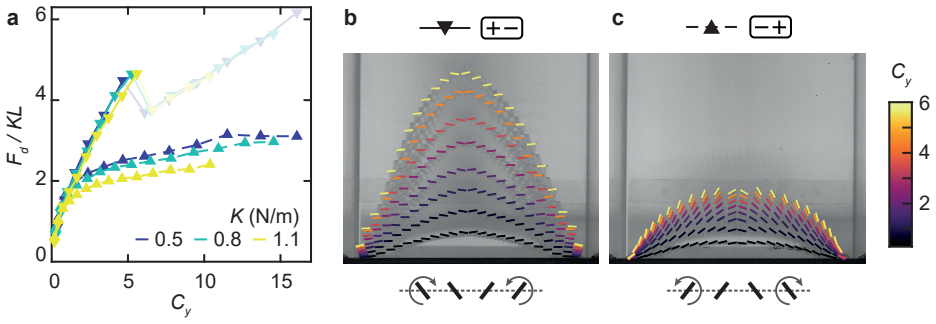
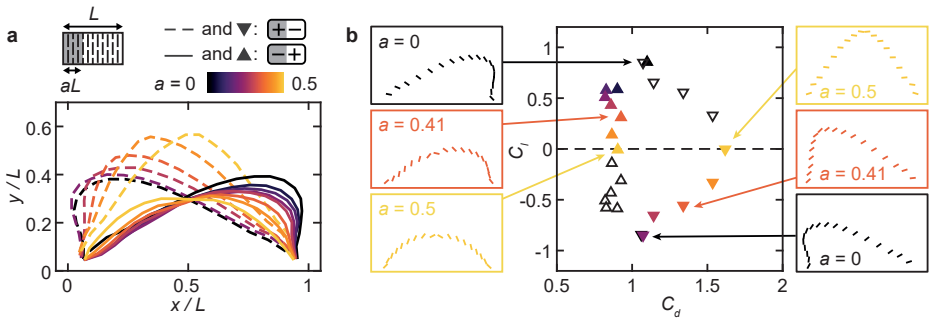
Parallel-cut kirigami sheets, when placed perpendicular to oncoming flow, buckle out of plane to form a lattice of inclined plate-like elements. This mesostructure produces both drag and a substantial transverse lift force. Because the buckling pattern can switch between distinct states, the same sheet can achieve large changes in lift and drag coefficients under fixed flow conditions, and in some cases partially decouple the two forces. Force data for different patterns collapse when normalized by the Cauchy number, with the continuum elastic model capturing the dependence on stiffness.
What carries the argument
The reconfigurable kirigami mesostructure formed by out-of-plane buckling of parallel-slit sheets into an array of inclined plates.
If this is right
- The mesostructure alters the scaling of aerodynamic forces with flow speed.
- Stiffness from the cutting pattern is the dominant control parameter for the forces.
- The architecture can be reversibly reconfigured in flow to switch between different force states.
- Force measurements can be collapsed using the Cauchy number across different patterns.
Where Pith is reading between the lines
- If the buckling is reliable across scales, this could enable passive flow control on larger structures like wind turbines or vehicles.
- The partial decoupling of lift and drag suggests possible applications in directional force management without active control.
- Extending the pattern to other cut geometries might allow even finer tuning of the force ratios.
- Testing in unsteady flows could reveal how the reconfiguration responds to changing conditions.
Load-bearing premise
The buckling into the lattice of inclined plates happens reliably and reversibly for the tested patterns without needing extra parameters beyond the continuum model.
What would settle it
Observing whether a kirigami sheet with a given cut pattern fails to buckle consistently or produces force data that does not collapse onto the Cauchy-number curve when flow speed or stiffness is varied.
Figures


read the original abstract
Flexible surfaces can modulate fluid forces through deformation, enabling passive adaptation to flow conditions. Here we show that kirigami sheets, planar surfaces patterned with arrays of parallel slits, provide a simple route to tunable aerodynamics by transforming into three-dimensional porous meso-architectures that can be reversibly reconfigured in flow. When exposed to crossflow, parallel-cut kirigami buckle out of plane to form a lattice of inclined plate-like elements. Experiments reveal that this architecture generates not only drag but also a substantial transverse lift force, even when the sheet is held perpendicular to the incoming flow. Because the mesostructure can switch between distinct states, a single sheet produces large and selective variations in drag and lift under identical flow conditions, in some cases partially decoupling these forces. The evolving mesostructure also alters the scaling of forces with flow speed, influencing both instantaneous loads and their velocity dependence. Force measurements collapse when expressed in terms of the Cauchy number, identifying stiffness, set by the cutting pattern, as the dominant control parameter, a relationship captured by a continuum elastic model. These results show how kirigami architectures encode aerodynamic functionality and behavior directly through their structure, providing a scalable platform for surfaces with reprogrammable fluid forces.
Editorial analysis
A structured set of objections, weighed in public.
Referee Report
Summary. The manuscript demonstrates that kirigami sheets patterned with parallel slits buckle under crossflow into reversible 3D lattices of inclined plate-like elements. Experiments show that this mesostructure generates both drag and substantial lift even when held perpendicular to the flow, enabling large selective variations and partial decoupling of the two forces via the cutting pattern. Force data collapse when nondimensionalized by the Cauchy number, with the observed velocity dependence captured by a continuum elastic model that identifies stiffness (set by the pattern) as the dominant parameter.
Significance. If the central scaling result holds, the work establishes a simple, passive, and scalable route to reconfigurable aerodynamic surfaces whose lift and drag can be tuned directly through planar patterning. The data collapse versus Cauchy number and the continuum model provide a parameter-efficient explanation for the force-velocity relationship, which is a strength for both fundamental understanding and potential applications in adaptive fluid-structure systems.
major comments (2)
- [Continuum model and force scaling analysis] The continuum elastic model is presented as capturing the Cauchy-number collapse without additional parameters, yet the 3D flow around the buckled inclined plates involves separation, reattachment, and vortex structures whose strength varies with Reynolds number. The manuscript does not report the tested Re range or compare the model predictions against 3D fluid-structure simulations that include wake effects; without this, the claim that stiffness alone sets the scaling remains vulnerable to being an artifact of limited parameter space.
- [Experimental methods and results] The experimental force measurements are said to collapse versus Cauchy number, but the manuscript provides no details on error bars, number of independent trials, data-selection criteria, or how the elastic modulus and geometric stiffness were independently measured versus fitted. These omissions make it difficult to judge whether the reported collapse is robust or whether modest parameter adjustment was used to achieve it.
minor comments (2)
- [Abstract and figure captions] Figure captions and the abstract could explicitly state the Reynolds-number range explored so readers can immediately assess the regime in which the Cauchy-number collapse is claimed to hold.
- [Model section] Notation for the Cauchy number and the definition of the effective stiffness should be introduced once with a clear equation reference rather than repeated descriptively.
Simulated Author's Rebuttal
We thank the referee for their constructive comments and positive assessment of the work. We address each major comment point by point below, indicating where revisions will be made.
read point-by-point responses
-
Referee: [Continuum model and force scaling analysis] The continuum elastic model is presented as capturing the Cauchy-number collapse without additional parameters, yet the 3D flow around the buckled inclined plates involves separation, reattachment, and vortex structures whose strength varies with Reynolds number. The manuscript does not report the tested Re range or compare the model predictions against 3D fluid-structure simulations that include wake effects; without this, the claim that stiffness alone sets the scaling remains vulnerable to being an artifact of limited parameter space.
Authors: We appreciate the referee highlighting the potential role of Reynolds-number-dependent wake effects. The experiments were performed at Reynolds numbers (based on sheet width) between approximately 2,000 and 15,000; within this range the force coefficients for comparable bluff-body geometries are known to vary only weakly with Re. The continuum model is deliberately formulated to capture the dominant elastic-fluid loading balance via the Cauchy number, and the observed data collapse across multiple patterns supports that stiffness is the primary control parameter. We acknowledge that full 3D fluid-structure simulations would provide further validation but are computationally demanding and lie outside the present scope, which emphasizes experimental demonstration and a minimal predictive model. In the revised manuscript we will explicitly state the tested Re range and add a paragraph discussing the model assumptions and the regime in which wake effects remain secondary. revision: partial
-
Referee: [Experimental methods and results] The experimental force measurements are said to collapse versus Cauchy number, but the manuscript provides no details on error bars, number of independent trials, data-selection criteria, or how the elastic modulus and geometric stiffness were independently measured versus fitted. These omissions make it difficult to judge whether the reported collapse is robust or whether modest parameter adjustment was used to achieve it.
Authors: We agree that these details are necessary to establish robustness. In the revised manuscript we will add: (i) error bars showing the standard deviation across a minimum of three independent trials per condition; (ii) explicit data-selection criteria, namely time-averaging over the steady-state portion of each record after transients have subsided; and (iii) clarification that the elastic modulus was obtained from separate tensile tests on unpatterned sheets, while all geometric stiffness parameters were computed directly from measured cutting-pattern dimensions and inserted into the model without any fitting to the aerodynamic force data. These additions will demonstrate that the collapse is not the result of parameter adjustment. revision: yes
Circularity Check
No significant circularity; elastic model and Cauchy-number collapse presented as independent explanatory framework
full rationale
The paper's central derivation rests on experimental force data collapsing when nondimensionalized by the Cauchy number, with a continuum elastic model invoked to explain the observed velocity scaling in terms of pattern-set stiffness. No quoted step shows the model parameters being fitted to the identical dataset used for the collapse plot and then relabeled as a prediction; the model is described as capturing an observed relationship rather than being constructed from it. No self-citation chain is load-bearing for the uniqueness of the scaling, no ansatz is smuggled via prior work, and no renaming of a known result occurs. The derivation therefore remains self-contained against the reported experiments and does not reduce to its inputs by construction.
Axiom & Free-Parameter Ledger
free parameters (1)
- stiffness set by cutting pattern
axioms (1)
- domain assumption Parallel-slit kirigami buckles out of plane to form a lattice of inclined plate-like elements when exposed to crossflow
Lean theorems connected to this paper
-
IndisputableMonolith/Cost/FunctionalEquation.leanwashburn_uniqueness_aczel unclear?
unclearRelation between the paper passage and the cited Recognition theorem.
Force measurements collapse when expressed in terms of the Cauchy number, identifying stiffness... as the dominant control parameter, a relationship captured by a continuum elastic model.
-
IndisputableMonolith/Foundation/BranchSelection.leanbranch_selection unclear?
unclearRelation between the paper passage and the cited Recognition theorem.
fN,T = ½ ρ H CN,T(θ) (a(ε) U·n)² with cosθ = 1/(1+ε)
What do these tags mean?
- matches
- The paper's claim is directly supported by a theorem in the formal canon.
- supports
- The theorem supports part of the paper's argument, but the paper may add assumptions or extra steps.
- extends
- The paper goes beyond the formal theorem; the theorem is a base layer rather than the whole result.
- uses
- The paper appears to rely on the theorem as machinery.
- contradicts
- The paper's claim conflicts with a theorem or certificate in the canon.
- unclear
- Pith found a possible connection, but the passage is too broad, indirect, or ambiguous to say the theorem truly supports the claim.
Reference graph
Works this paper leans on
-
[1]
Drag and reconfiguration of broad leaves in high winds.J
Vogel, S. Drag and reconfiguration of broad leaves in high winds.J. Exp. Bot.40, 941–948 (1989)
work page 1989
-
[2]
Alben, S., Shelley, M. & Zhang, J. Drag reduction through self-similar bending of a flexible body.Nature420, 479–481 (2002)
work page 2002
-
[3]
Harder, D. L., Speck, O., Hurd, C. L. & Speck, T. Reconfiguration as a prerequisite for survival in highly unstable flow-dominated habitats: Dl harder et al.J. Plant Growth Regul.23, 98–107 (2004)
work page 2004
-
[4]
Schouveiler, L. & Boudaoud, A. The rolling up of sheets in a steady flow.J. Fluid Mech.563, 71–80 (2006)
work page 2006
-
[5]
Marzin, T., de Langre, E. & Ramananarivo, S. Shape reconfiguration through origami folding sets an upper limit on drag.Proc. R. Soc. A478, 20220592 (2022)
work page 2022
-
[6]
The aerodynamic theory of sails
Thwaites, B. The aerodynamic theory of sails. i. two-dimensional sails.Proc. R. Soc. Lond. A261, 402–422 (1961)
work page 1961
-
[7]
Nielsen, J. N. Theory of flexible aerodynamic surfaces.J. Appl. Mech.(1963)
work page 1963
-
[8]
Song, A.et al.Aeromechanics of membrane wings with implications for animal flight.AIAA J.46, 2096–2106 (2008)
work page 2096
-
[9]
Tiomkin, S. & Raveh, D. E. A review of membrane-wing aeroelasticity.Prog. Aerosp. Sci.126, 100738 (2021)
work page 2021
-
[10]
Lian, Y., Shyy, W., Viieru, D. & Zhang, B. Membrane wing aerodynamics for micro air vehicles.Prog. Aerosp. Sci.39, 425–465 (2003)
work page 2003
-
[11]
Ramananarivo, S., Godoy-Diana, R. & Thiria, B. Rather than resonance, flapping wing flyers may play on aerodynamics to improve performance.Proc. Natl. Acad. Sci. U.S.A.108, 5964–5969 (2011). 11
work page 2011
-
[12]
Mathai, V., Das, A., Naylor, D. L. & Breuer, K. S. Shape-morphing dynamics of soft compliant membranes for drag and turbulence modulation.Phys. Rev. Lett.131, 114003 (2023)
work page 2023
-
[13]
Løland, G.Current forces on and flow through fish farms(Institutt for Marin Hydrodynamikk Trondheim, Norway, 1991)
work page 1991
-
[14]
Zhan, J.et al.Analytical and experimental investigation of drag on nets of fish cages.Aquacult. Eng.35, 91–101 (2006)
work page 2006
-
[15]
Li, J.et al.Aerodynamics-assisted, efficient and scalable kirigami fog collectors.Nat. Commun.12, 5484 (2021)
work page 2021
-
[16]
Moncuquet, A., Mitranescu, A., Marchand, O. C., Ramananarivo, S. & Duprat, C. Collecting fog with vertical fibres: combined laboratory and in-situ study.Atmos. Res.277, 106312 (2022)
work page 2022
-
[17]
Müller, W. & Patone, G. Air transmissivity of feathers.J. Exp. Biol.201, 2591–2599 (1998)
work page 1998
-
[18]
Kolomenskiy, D.et al.Aerodynamic performance of a bristled wing of a very small insect: D. kolomenskiy et al.Exp. Fluids61, 194 (2020)
work page 2020
- [19]
-
[20]
Jin, Y., Kim, J.-T., Cheng, S., Barry, O. & Chamorro, L. P. On the distinct drag, reconfiguration and wake of perforated structures.J. Fluid Mech.890, A1 (2020)
work page 2020
-
[21]
Aerodynamics of permeable membrane wings.Eur
Iosilevskii, G. Aerodynamics of permeable membrane wings.Eur. J. Mech. B-Fluids30, 534–542 (2011)
work page 2011
-
[22]
Gehrke, A., King, Z. & Breuer, K. S. Coupled poro-elastic behavior of hyper-elastic membranes.J. Fluids Struct.139, 104411 (2025)
work page 2025
-
[23]
Louf, J.-F., Knoblauch, J. & Jensen, K. H. Bending and stretching of soft pores enable passive control of fluid flows.Phys. Rev. Lett.125, 098101 (2020)
work page 2020
-
[24]
Lamoureux, D., Fillion, J., Ramananarivo, S., Gosselin, F. P. & Melancon, D. Kirigami-inspired parachutes with programmable reconfiguration.Nature646, 88–94 (2025)
work page 2025
-
[25]
Callens, S. J. & Zadpoor, A. A. From flat sheets to curved geometries: Origami and kirigami approaches.Mater. Today21, 241–264 (2018)
work page 2018
-
[26]
Zhai, Z., Wu, L. & Jiang, H. Mechanical metamaterials based on origami and kirigami.Appl. Phys. Rev.8 (2021)
work page 2021
-
[27]
Tao, J., Khosravi, H., Deshpande, V. & Li, S. Engineering by cuts: how kirigami principle enables unique mechanical properties and functionalities.Adv. Sci.10, 2204733 (2023)
work page 2023
- [28]
-
[29]
Isobe, M. & Okumura, K. Initial rigid response and softening transition of highly stretchable kirigami sheet materials.Sci. Rep.6, 24758 (2016)
work page 2016
-
[30]
A.et al.Kirigami actuators.Soft Matter13, 9087–9092 (2017)
Dias, M. A.et al.Kirigami actuators.Soft Matter13, 9087–9092 (2017)
work page 2017
-
[31]
Rafsanjani, A. & Bertoldi, K. Buckling-induced kirigami.Phys. Rev. Lett.118, 084301 (2017)
work page 2017
-
[32]
Rafsanjani, A., Zhang, Y., Liu, B., Rubinstein, S. M. & Bertoldi, K. Kirigami skins make a simple soft actuator crawl.Sci. Robot.3, eaar7555 (2018)
work page 2018
-
[33]
Babaee, S.et al.Bioinspired kirigami metasurfaces as assistive shoe grips.Nat. Biomed. Eng.4, 778–786 (2020)
work page 2020
-
[34]
Lamoureux, A., Lee, K., Shlian, M., Forrest, S. R. & Shtein, M. Dynamic kirigami structures for integrated solar tracking.Nat. Commun.6, 8092 (2015)
work page 2015
-
[35]
Babaee, S.et al.Kirigami-inspired stents for sustained local delivery of therapeutics.Nat. Mater.20, 1085–1092 (2021)
work page 2021
-
[36]
Stein-Montalvo, L., Ding, L., Hultmark, M., Adriaenssens, S. & Bou-Zeid, E. Kirigami-inspired wind steering for natural ventilation.J. Wind Eng. Ind. Aerodyn.246, 105667 (2024)
work page 2024
-
[37]
Gamble, L., Lamoureux, A. & Shtein, M. Multifunctional composite kirigami skins for aerodynamic control. Appl. Phys. Lett.117(2020)
work page 2020
-
[38]
Wen, X.et al.Dynamic kirigami structures for wake flow control behind a circular cylinder.Phys. Fluids35 (2023)
work page 2023
-
[39]
Marzin, T., Le Hay, K., de Langre, E. & Ramananarivo, S. Flow-induced deformation of kirigami sheets.Phys. Rev. Fluids7, 023906 (2022)
work page 2022
-
[40]
Carleton, A. G. & Modarres-Sadeghi, Y. Kirigami sheets in fluid flow.Extrem. Mech. Lett.71, 102198 (2024)
work page 2024
-
[41]
Yang, Y., Dias, M. A. & Holmes, D. P. Multistable kirigami for tunable architected materials.Phys. Rev. Mater. 2, 110601 (2018)
work page 2018
-
[42]
Khosravi, H. & Li, S. Phononic bandgap programming in kirigami by unique mechanical input sequencing.Adv. Mater. Technol.8, 2202129 (2023)
work page 2023
-
[43]
Janbaz, S. & Coulais, C. Diffusive kinks turn kirigami into machines.Nat. Commun.15, 1255 (2024)
work page 2024
-
[44]
Hwang, D.-G. & Bartlett, M. D. Tunable mechanical metamaterials through hybrid kirigami structures.Sci. Rep.8, 3378 (2018). 12
work page 2018
-
[45]
Gosselin, F., De Langre, E. & Machado-Almeida, B. A. Drag reduction of flexible plates by reconfiguration.J. Fluid Mech.650, 319–341 (2010)
work page 2010
-
[46]
Taniyama, H. & Iwase, E. Design of rigidity and breaking strain for a kirigami structure with non-uniform deformed regions.Micromachines10, 395 (2019)
work page 2019
-
[47]
Taniyama, H. & Iwase, E. Design of a kirigami structure with a large uniform deformation region.Micromachines 12, 76 (2021)
work page 2021
-
[48]
Marzin, T.Flow-gamis: Interaction of folds and cuts with a flow. Ph.D. thesis, Institut polytechnique de Paris (2023)
work page 2023
-
[49]
Tang, Y.et al.Programmable kiri-kirigami metamaterials.Adv. Mater.29, 1604262 (2017)
work page 2017
- [50]
-
[51]
Lasher, W. C. The interaction of downwind sails. InFluids Engineering Division Summer Meeting, vol. 47500, 263–272 (2006)
work page 2006
-
[52]
Lasher, W. C. & Sonnenmeier, J. R. An analysis of practical rans simulations for spinnaker aerodynamics.J. Wind Eng. Ind. Aerodyn.96, 143–165 (2008)
work page 2008
-
[53]
Brandenbourger, M., Dangremont, A., Sprik, R. & Coulais, C. Tunable flow asymmetry and flow rectification with bio-inspired soft leaflets.Phys. Rev. Fluids5, 084102 (2020)
work page 2020
-
[54]
Weathers, A., Folie, B., Liu, B., Childress, S. & Zhang, J. Hovering of a rigid pyramid in an oscillatory airflow. J. Fluid Mech.650, 415–425 (2010). Acknowledgements We thank P. Hémon for helpful discussions on force measurement, J. Bicot and the Mecawet team at PMMH for providing access to their tensile test machine and water jet cutter, and V. Baslé (i...
work page 2010
discussion (0)
Sign in with ORCID, Apple, or X to comment. Anyone can read and Pith papers without signing in.