Recognition: no theorem link
Quantum simulation of thermalization dynamics of a nonuniform Dicke model
Pith reviewed 2026-05-14 22:08 UTC · model grok-4.3
The pith
Trapped ions in a two-dimensional crystal simulate a nonuniform Dicke model to track its thermalization dynamics.
A machine-rendered reading of the paper's core claim, the machinery that carries it, and where it could break.
Core claim
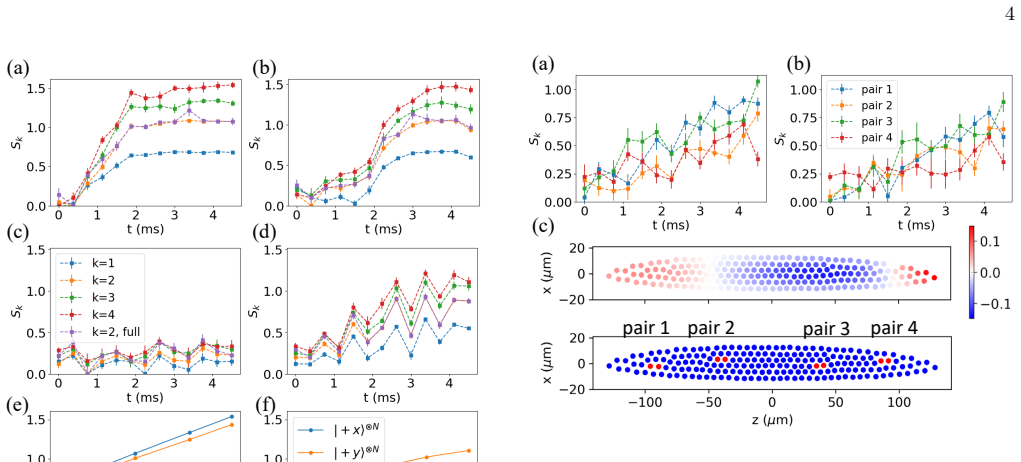
We report the quantum simulation of a nonuniform Dicke-like model in a two-dimensional crystal of up to 200 ions. We explicitly demonstrate the sensitivity of few-spin observables and multi-spin distributions to the spatial inhomogeneity of the model, and examine the thermalization dynamics of the nonuniform model by measuring the subsystem entropies of selected ion groups. Our work enables the study of Dicke-like models beyond the symmetric subspace, paving the way toward understanding the role of disorder in its thermalization and quantum chaos behavior.
What carries the argument
The 2D ion crystal with controllable spatial inhomogeneity in spin-boson coupling, accessed via site-resolved measurements of spin states.
If this is right
- Few-spin observables show clear dependence on the position-dependent coupling strengths.
- Multi-spin distributions become measurable and reflect the nonuniformity.
- Subsystem entropies evolve to reflect thermalization in the nonuniform model.
- The simulation extends the study beyond the symmetric subspace.
- Disorder influences thermalization and quantum chaos signatures.
Where Pith is reading between the lines
- Extending to larger systems could probe finite-size effects in disordered quantum systems.
- The method might apply to other spin-boson models with engineered disorder.
- Entropy measurements could benchmark theoretical predictions for chaotic dynamics.
- This informs simulator designs where uniformity is challenging.
Load-bearing premise
The experimental ion-trap Hamiltonian accurately matches the intended nonuniform Dicke-like model with controllable spatial inhomogeneity.
What would settle it
If the measured subsystem entropies do not grow as expected toward thermal values or match uniform model results despite the controlled inhomogeneity, the claim of simulating the nonuniform dynamics would be falsified.
Figures


read the original abstract
Previous experimental realizations of Dicke model in atomic or ionic systems are based on global observables assuming uniform spin-boson coupling, while inevitable experimental nonuniformity on the one hand requires site-resolved measurement of spin states, and on the other hand provides potential quantum advantage on the simulation of multi-spin distributions. Here we report the quantum simulation of a nonuniform Dicke-like model in a two-dimensional (2D) crystal of up to 200 ions. We explicitly demonstrate the sensitivity of few-spin observables and multi-spin distributions to the spatial inhomogeneity of the model, and examine the thermalization dynamics of the nonuniform model by measuring the subsystem entropies of selected ion groups. Our work enables the study of Dicke-like models beyond the symmetric subspace, paving the way toward understanding the role of disorder in its thermalization and quantum chaos behavior.
Editorial analysis
A structured set of objections, weighed in public.
Referee Report
Summary. The manuscript reports the quantum simulation of a nonuniform Dicke-like model realized in a 2D crystal of up to 200 trapped ions. It demonstrates the sensitivity of few-spin observables and multi-spin distributions to spatial inhomogeneity of the coupling and examines thermalization dynamics via measurements of subsystem entropies for selected ion groups, extending Dicke-model studies beyond the symmetric subspace.
Significance. If the ion-trap Hamiltonian is shown to match the target nonuniform model and the entropy measurements are validated against decoherence and readout artifacts, the work would provide concrete experimental access to disorder effects in Dicke-like thermalization and quantum chaos. The scale (200 ions) and site-resolved readout constitute a technical advance over prior uniform-coupling realizations.
major comments (2)
- [Abstract] Abstract: the stated demonstrations of sensitivity to inhomogeneity and of thermalization dynamics via subsystem entropies are presented without error bars, controls, or quantitative comparison to theory; this absence makes it impossible to assess whether the reported curves are dominated by the designed nonuniformity or by site-dependent decoherence and projection noise.
- [Thermalization dynamics] Thermalization dynamics results: the central claim that subsystem entropy growth reflects ideal-model evolution of the nonuniform Dicke-like Hamiltonian rests on an unstated assumption that global laser addressing and motional-mode coupling do not introduce uncontrolled site-dependent decoherence; an explicit error budget and cross-check against the uniform case are required to substantiate this.
minor comments (2)
- [Methods] Clarify in the methods how the spatial inhomogeneity is calibrated and controlled, including any measured variation in the spin-boson coupling strengths across the crystal.
- [Figures] Add error bars to all entropy and distribution plots and label the specific ion groups used for each subsystem entropy trace.
Simulated Author's Rebuttal
We thank the referee for the careful reading and constructive feedback on our manuscript. We have revised the manuscript to incorporate error bars, controls, quantitative theory comparisons, an explicit error budget, and cross-checks against the uniform case, as detailed in the point-by-point responses below.
read point-by-point responses
-
Referee: [Abstract] Abstract: the stated demonstrations of sensitivity to inhomogeneity and of thermalization dynamics via subsystem entropies are presented without error bars, controls, or quantitative comparison to theory; this absence makes it impossible to assess whether the reported curves are dominated by the designed nonuniformity or by site-dependent decoherence and projection noise.
Authors: We agree that error bars, controls, and quantitative comparisons are essential for assessing the role of inhomogeneity versus experimental artifacts. In the revised manuscript, we have added error bars to all relevant figures, included quantitative comparisons between experimental data and theoretical predictions for both few-spin observables and subsystem entropies, and added controls (including measurements of projection noise and site-dependent effects) to demonstrate that the observed sensitivities arise from the designed spatial inhomogeneity rather than decoherence. revision: yes
-
Referee: [Thermalization dynamics] Thermalization dynamics results: the central claim that subsystem entropy growth reflects ideal-model evolution of the nonuniform Dicke-like Hamiltonian rests on an unstated assumption that global laser addressing and motional-mode coupling do not introduce uncontrolled site-dependent decoherence; an explicit error budget and cross-check against the uniform case are required to substantiate this.
Authors: We have added a dedicated section providing an explicit error budget that quantifies contributions from global laser addressing, motional-mode coupling, and other potential sources of site-dependent decoherence. We have also included a direct cross-check comparison of entropy growth in the nonuniform case against the uniform-coupling realization under identical experimental conditions, confirming that the observed dynamics align with ideal-model evolution of the nonuniform Hamiltonian. revision: yes
Circularity Check
No circularity: experimental report with direct measurements
full rationale
The paper is an experimental quantum simulation report on an ion-trap realization of a nonuniform Dicke-like model. It describes hardware implementation, site-resolved spin measurements, and direct computation of subsystem entropies from observed distributions. No derivations, fitted parameters, or predictions are presented that reduce by construction to the inputs; all claims rest on measured observables without self-referential fitting or self-citation load-bearing steps. The work is self-contained against external benchmarks of ion-trap control and readout.
Axiom & Free-Parameter Ledger
axioms (1)
- domain assumption The 2D ion crystal realizes a Dicke-like model with controllable spatial inhomogeneity in spin-boson coupling
Reference graph
Works this paper leans on
-
[1]
L. D’Alessio, Y. Kafri, A. Polkovnikov, and M. Rigol, From quantum chaos and eigenstate thermalization to statistical mechanics and thermodynamics, Advances in Physics65, 239 (2016)
work page 2016
-
[2]
J. M. Deutsch, Eigenstate thermalization hypothesis, Re- ports on Progress in Physics81, 082001 (2018)
work page 2018
-
[3]
J. M. Deutsch, Quantum statistical mechanics in a closed system, Phys. Rev. A43, 2046 (1991)
work page 2046
-
[4]
Srednicki, Chaos and quantum thermalization, Phys
M. Srednicki, Chaos and quantum thermalization, Phys. Rev. E50, 888 (1994)
work page 1994
- [5]
-
[6]
A. Polkovnikov, K. Sengupta, A. Silva, and M. Vengalat- tore, Colloquium: Nonequilibrium dynamics of closed in- teracting quantum systems, Rev. Mod. Phys.83, 863 (2011)
work page 2011
-
[7]
Peres, Ergodicity and mixing in quantum theory
A. Peres, Ergodicity and mixing in quantum theory. i, Phys. Rev. A30, 504 (1984)
work page 1984
-
[8]
P. Hayden and J. Preskill, Black holes as mirrors: quan- tum information in random subsystems, Journal of High Energy Physics2007, 120 (2007)
work page 2007
-
[9]
Y. Sekino and L. Susskind, Fast scramblers, Journal of High Energy Physics2008, 065 (2008)
work page 2008
-
[10]
Swingle, Unscrambling the physics of out-of-time- order correlators, Nature Physics14, 988 (2018)
B. Swingle, Unscrambling the physics of out-of-time- order correlators, Nature Physics14, 988 (2018)
work page 2018
-
[11]
H. Kim, T. N. Ikeda, and D. A. Huse, Testing whether all eigenstates obey the eigenstate thermalization hypothe- sis, Phys. Rev. E90, 052105 (2014)
work page 2014
-
[12]
A. Dymarsky, N. Lashkari, and H. Liu, Subsystem eigen- state thermalization hypothesis, Phys. Rev. E97, 012140 (2018)
work page 2018
- [13]
-
[14]
J. Wang, M. H. Lamann, J. Richter, R. Steinigeweg, A. Dymarsky, and J. Gemmer, Eigenstate thermaliza- tion hypothesis and its deviations from random-matrix theory beyond the thermalization time, Phys. Rev. Lett. 128, 180601 (2022)
work page 2022
- [15]
-
[16]
M. Schreiber, S. S. Hodgman, P. Bordia, H. P. L¨ uschen, M. H. Fischer, R. Vosk, E. Altman, U. Schneider, and I. Bloch, Observation of many-body localization of inter- acting fermions in a quasirandom optical lattice, Science 349, 842 (2015)
work page 2015
-
[17]
A. M. Kaufman, M. E. Tai, A. Lukin, M. Rispoli, R. Schittko, P. M. Preiss, and M. Greiner, Quantum ther- malization through entanglement in an isolated many- body system, Science353, 794 (2016)
work page 2016
-
[18]
C. Neill, P. Roushan, M. Fang, Y. Chen, M. Kolodru- betz, Z. Chen, A. Megrant, R. Barends, B. Campbell, B. Chiaro, A. Dunsworth, E. Jeffrey, J. Kelly, J. Mutus, P. J. J. O’Malley, C. Quintana, D. Sank, A. Vainsencher, J. Wenner, T. C. White, A. Polkovnikov, and J. M. Mar- tinis, Ergodic dynamics and thermalization in an isolated quantum system, Nature Phy...
work page 2016
- [19]
-
[20]
G. Clos, D. Porras, U. Warring, and T. Schaetz, Time- resolved observation of thermalization in an isolated quantum system, Phys. Rev. Lett.117, 170401 (2016)
work page 2016
-
[21]
T. Brydges, A. Elben, P. Jurcevic, B. Vermersch, C. Maier, B. P. Lanyon, P. Zoller, R. Blatt, and C. F. Roos, Probing r´ enyi entanglement entropy via random- ized measurements, Science364, 260 (2019)
work page 2019
-
[22]
Z.-Y. Zhou, G.-X. Su, J. C. Halimeh, R. Ott, H. Sun, P. Hauke, B. Yang, Z.-S. Yuan, J. Berges, and J.-W. Pan, Thermalization dynamics of a gauge theory on a quantum simulator, Science377, 311 (2022)
work page 2022
- [23]
-
[24]
L. Zhao, P. R. Datla, W. Tian, M. M. Aliyu, and H. Loh, Observation of quantum thermalization restricted to hilbert space fragments and𭟋 2k scars, Phys. Rev. X15, 011035 (2025)
work page 2025
- [25]
-
[26]
T. I. Andersen, N. Astrakhantsev, A. H. Karamlou, J. Berndtsson, J. Motruk, A. Szasz, J. A. Gross, A. Schuckert, T. Westerhout, Y. Zhang, E. Forati, D. Rossi, B. Kobrin, A. D. Paolo, A. R. Klots, I. Droz- dov, V. Kurilovich, A. Petukhov, L. B. Ioffe, A. Elben, A. Rath, V. Vitale, B. Vermersch, R. Acharya, L. A. Beni, K. Anderson, M. Ansmann, F. Arute, K. ...
work page 2025
-
[27]
D. A. Abanin, E. Altman, I. Bloch, and M. Serbyn, Col- loquium: Many-body localization, thermalization, and entanglement, Rev. Mod. Phys.91, 021001 (2019)
work page 2019
-
[28]
B. L. Altshuler, Y. Gefen, A. Kamenev, and L. S. Levitov, Quasiparticle lifetime in a finite system: A nonperturba- tive approach, Phys. Rev. Lett.78, 2803 (1997)
work page 1997
- [29]
- [30]
-
[31]
S. Moudgalya, B. A. Bernevig, and N. Regnault, Quan- tum many-body scars and hilbert space fragmentation: a review of exact results, Reports on Progress in Physics 85, 086501 (2022)
work page 2022
-
[32]
R. H. Dicke, Coherence in spontaneous radiation pro- cesses, Phys. Rev.93, 99 (1954)
work page 1954
-
[33]
K. Hepp and E. H. Lieb, On the superradiant phase tran- sition for molecules in a quantized radiation field: the dicke maser model, Annals of Physics76, 360 (1973)
work page 1973
-
[34]
Y. K. Wang and F. T. Hioe, Phase transition in the dicke model of superradiance, Phys. Rev. A7, 831 (1973)
work page 1973
-
[35]
F. T. Hioe, Phase transitions in some generalized dicke models of superradiance, Phys. Rev. A8, 1440 (1973)
work page 1973
-
[36]
H. Carmichael, C. Gardiner, and D. Walls, Higher order corrections to the dicke superradiant phase transition, Physics Letters A46, 47 (1973)
work page 1973
-
[37]
G. C. Duncan, Effect of antiresonant atom-field interac- tions on phase transitions in the dicke model, Phys. Rev. A9, 418 (1974)
work page 1974
- [38]
-
[39]
R. J. Lewis-Swan, A. Safavi-Naini, J. J. Bollinger, and A. M. Rey, Unifying scrambling, thermalization and en- tanglement through measurement of fidelity out-of-time- order correlators in the dicke model, Nature Communi- cations10, 1581 (2019)
work page 2019
-
[40]
R. J. Lewis-Swan, S. R. Muleady, D. Barberena, J. J. Bollinger, and A. M. Rey, Characterizing the dynamical phase diagram of the dicke model via classical and quan- tum probes, Phys. Rev. Res.3, L022020 (2021)
work page 2021
-
[41]
B. Bullock, S. R. Muleady, J. F. Lilieholm, Y. Zhang, R. J. Lewis-Swan, J. J. Bollinger, A. M. Rey, and A. L. Carter, Quantum simulation of the dicke model in a two- dimensional ion crystal: chaos, quantum thermalization, and revivals, arXiv:2602.06114 (2026)
-
[42]
K. Baumann, C. Guerlin, F. Brennecke, and T. Esslinger, Dicke quantum phase transition with a superfluid gas in an optical cavity, Nature464, 1301 (2010)
work page 2010
-
[43]
D. Nagy, G. K´ onya, G. Szirmai, and P. Domokos, Dicke- model phase transition in the quantum motion of a bose- einstein condensate in an optical cavity, Phys. Rev. Lett. 104, 130401 (2010)
work page 2010
-
[44]
K. Baumann, R. Mottl, F. Brennecke, and T. Esslinger, Exploring symmetry breaking at the dicke quantum phase transition, Phys. Rev. Lett.107, 140402 (2011)
work page 2011
-
[45]
J. Klinder, H. Keßler, M. Wolke, L. Mathey, and A. Hem- merich, Dynamical phase transition in the open dicke model, Proceedings of the National Academy of Sciences 112, 3290 (2015)
work page 2015
-
[46]
Z. Zhiqiang, C. H. Lee, R. Kumar, K. J. Arnold, S. J. Masson, A. S. Parkins, and M. D. Barrett, Nonequilib- rium phase transition in a spin-1 dicke model, Optica4, 424 (2017)
work page 2017
-
[47]
M. P. Baden, K. J. Arnold, A. L. Grimsmo, S. Parkins, and M. D. Barrett, Realization of the dicke model using cavity-assisted raman transitions, Phys. Rev. Lett.113, 7 020408 (2014)
work page 2014
-
[48]
J. Cohn, A. Safavi-Naini, R. J. Lewis-Swan, J. G. Bohnet, M. G¨ arttner, K. A. Gilmore, J. E. Jordan, A. M. Rey, J. J. Bollinger, and J. K. Freericks, Bang-bang shortcut to adiabaticity in the dicke model as realized in a pen- ning trap experiment, New Journal of Physics20, 055013 (2018)
work page 2018
-
[49]
A. Safavi-Naini, R. J. Lewis-Swan, J. G. Bohnet, M. G¨ arttner, K. A. Gilmore, J. E. Jordan, J. Cohn, J. K. Freericks, A. M. Rey, and J. J. Bollinger, Verification of a many-ion simulator of the dicke model through slow quenches across a phase transition, Phys. Rev. Lett.121, 040503 (2018)
work page 2018
-
[50]
J. W. Britton, B. C. Sawyer, A. C. Keith, C.-C. J. Wang, J. K. Freericks, H. Uys, M. J. Biercuk, and J. J. Bollinger, Engineered two-dimensional ising interactions in a trapped-ion quantum simulator with hundreds of spins, Nature484, 489 (2012)
work page 2012
-
[51]
J. G. Bohnet, B. C. Sawyer, J. W. Britton, M. L. Wall, A. M. Rey, M. Foss-Feig, and J. J. Bollinger, Quantum spin dynamics and entanglement generation with hun- dreds of trapped ions, Science352, 1297 (2016)
work page 2016
-
[52]
S.-A. Guo, Y.-K. Wu, J. Ye, L. Zhang, W.-Q. Lian, R. Yao, Y. Wang, R.-Y. Yan, Y.-J. Yi, Y.-L. Xu, B.- W. Li, Y.-H. Hou, Y.-Z. Xu, W.-X. Guo, C. Zhang, B.-X. Qi, Z.-C. Zhou, L. He, and L.-M. Duan, A site- resolved two-dimensional quantum simulator with hun- dreds of trapped ions, Nature630, 613 (2024)
work page 2024
-
[53]
C. H. Baldwin, B. J. Bjork, M. Foss-Feig, J. P. Gae- bler, D. Hayes, M. G. Kokish, C. Langer, J. A. Sedlacek, D. Stack, and G. Vittorini, High-fidelity light-shift gate for clock-state qubits, Phys. Rev. A103, 012603 (2021)
work page 2021
-
[54]
K. R. Brown, A. W. Harrow, and I. L. Chuang, Arbitrar- ily accurate composite pulse sequences, Phys. Rev. A70, 052318 (2004)
work page 2004
- [55]
-
[56]
C. L. Edmunds, T. R. Tan, A. R. Milne, A. Singh, M. J. Biercuk, and C. Hempel, Scalable hyperfine qubit state detection via electron shelving in the 2D5/2 and 2F7/2 manifolds in 171yb+, Phys. Rev. A104, 012606 (2021)
work page 2021
-
[57]
Quantum simulation of thermalization dynamics of a nonuniform Dicke model
Y.-H. Hou, Y.-J. Yi, Y.-K. Wu, Y.-Y. Chen, L. Zhang, Y. Wang, Y.-L. Xu, C. Zhang, Q.-X. Mei, H.-X. Yang, J.- Y. Ma, S.-A. Guo, J. Ye, B.-X. Qi, Z.-C. Zhou, P.-Y. Hou, and L.-M. Duan, Individually addressed entangling gates in a two-dimensional ion crystal, Nature Communications 15, 9710 (2024). Supplementary Material for “Quantum simulation of thermalizat...
work page 2024
-
[58]
A site-resolved two-dimensional quantum simulator with hundreds of trapped ions,
S.-A. Guo, Y.-K. Wu, J. Ye, L. Zhang, W.-Q. Lian, R. Yao, Y. Wang, R.-Y. Yan, Y.-J. Yi, Y.-L. Xu, B.-W. Li, Y.-H. Hou, Y.-Z. Xu, W.-X. Guo, C. Zhang, B.-X. Qi, Z.-C. Zhou, L. He, and L.-M. Duan, “A site-resolved two-dimensional quantum simulator with hundreds of trapped ions,” Nature630, 613–618 (2024)
work page 2024
-
[59]
Hamiltonian learning for 300 trapped ion qubits with long-range couplings,
Shi-An Guo, Yu-Kai Wu, Jing Ye, Lin Zhang, Ye Wang, Wen-Qian Lian, Rui Yao, Yu-Lin Xu, Chi Zhang, Yu-Zi Xu, Bin-Xiang Qi, Pan-Yu Hou, Li He, Zi-Chao Zhou, and Lu-Ming Duan, “Hamiltonian learning for 300 trapped ion qubits with long-range couplings,” Science Advances11, eadt4713 (2025)
work page 2025
-
[60]
Iterative algorithm for reconstruction of entangled states,
J. ˇReh´ aˇ cek, Z. Hradil, and M. Jeˇ zek, “Iterative algorithm for reconstruction of entangled states,” Phys. Rev. A63, 040303 (2001)
work page 2001
discussion (0)
Sign in with ORCID, Apple, or X to comment. Anyone can read and Pith papers without signing in.