Recognition: 1 theorem link
· Lean TheoremShining light on short-range atomic ordering in semiconductors alloys
Pith reviewed 2026-05-14 21:05 UTC · model grok-4.3
The pith
Short-range atomic order directly modifies the bandgap in GeSn alloys.
A machine-rendered reading of the paper's core claim, the machinery that carries it, and where it could break.
Core claim
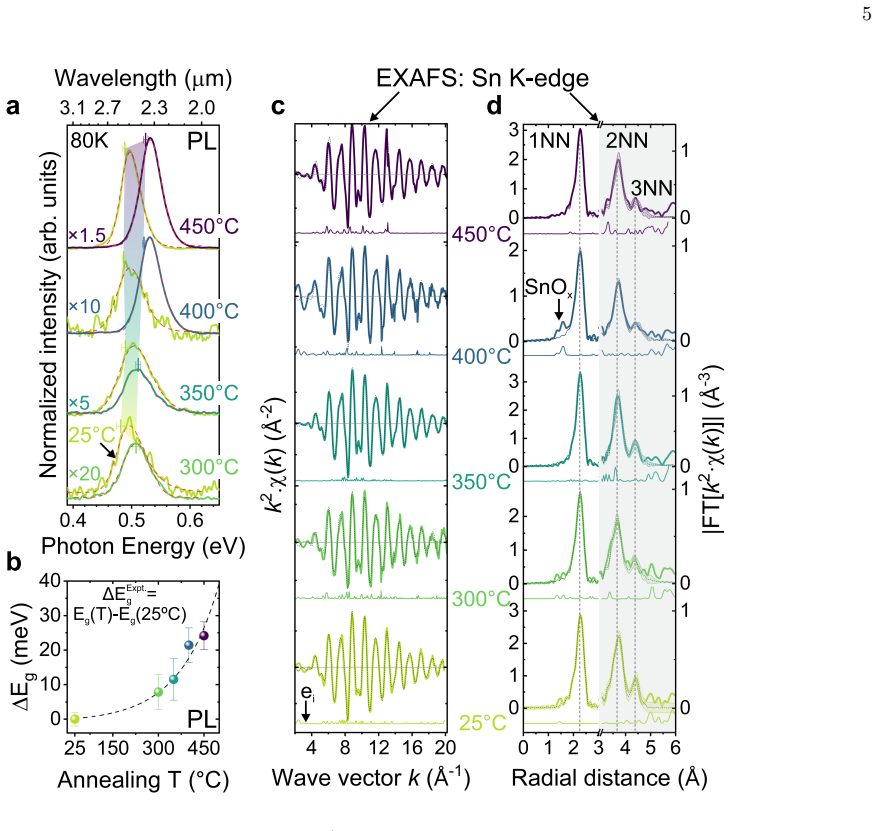
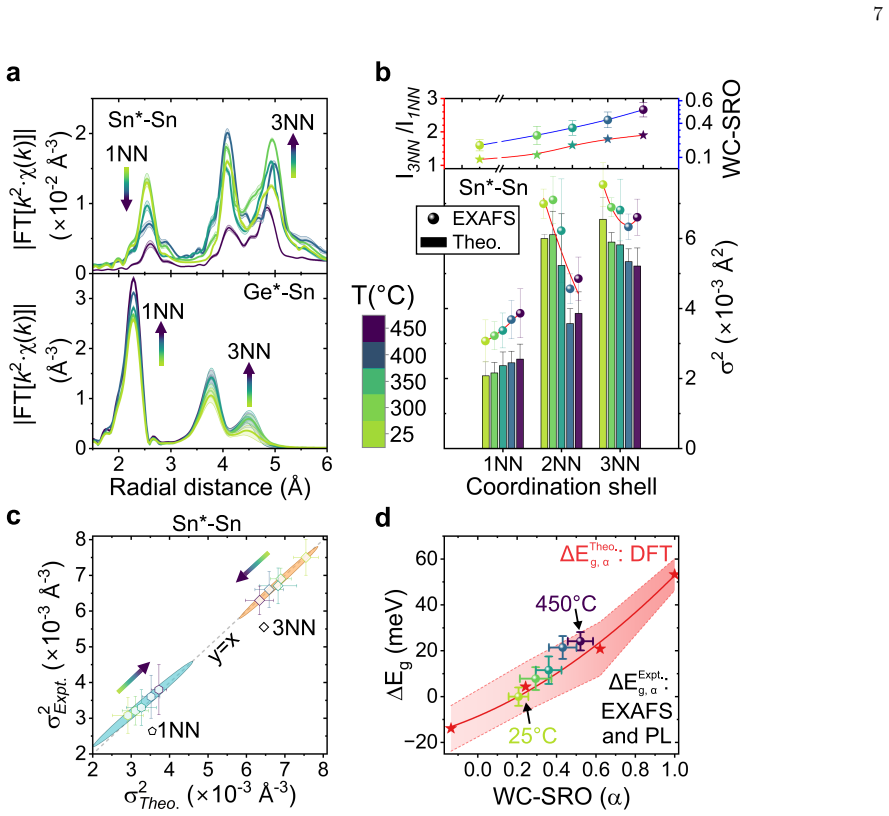
Correlative analysis of EXAFS and photoluminescence establishes the relationship between bandgap and the Warren-Cowley short-range order parameter of the GeSn alloys, and demonstrates that short-range order can be tuned over a broad range by post-deposition annealing.
What carries the argument
The Warren-Cowley short-range order parameter, obtained through a machine learning guided EXAFS analysis that quantifies local atomic arrangements and links them to the observed bandgap shift.
If this is right
- Short-range order can be tuned over a broad range by post-deposition annealing of the alloy crystals.
- Control of short-range order functions as an additional design parameter for semiconducting properties beyond composition and strain.
- The same quantitative approach to short-range order can be extended to other semiconductor alloy systems.
Where Pith is reading between the lines
- Device processes could incorporate targeted annealing steps to set short-range order for a desired bandgap without changing overall composition.
- Local ordering effects may appear in other group-IV or III-V alloys and could be mapped similarly to improve property predictions.
- If the correlation holds across strain states, short-range order measurements could become a standard input for bandgap modeling in nanostructure design.
Load-bearing premise
The machine learning enabled EXAFS analysis accurately quantifies the Warren-Cowley short-range order parameter without significant bias or artifacts from training or data processing.
What would settle it
GeSn samples in which photoluminescence bandgap shows no systematic correlation with the Warren-Cowley parameter extracted from the same EXAFS data, or in which annealing produces no measurable change in the extracted order parameter.
Figures


read the original abstract
The functional properties of semiconductors are typically controlled by tailoring their chemical composition and their state of strain, and by controlling their long-range structural order, including the presence of extended defects such as dislocations. In addition to these approaches, theoretical predictions suggest that short-range order (SRO) of atoms in group-IV semiconductor alloys can modify the bandgap, a defining property of any semiconductor. Herein, a new machine learning enabled, computation-guided methodology for extended X-ray absorption fine structure (EXAFS) analysis of SRO is used to quantify the effects of local atomic order on the bandgap of germanium-tin (GeSn) alloy single crystal nanostructures with well-controlled strain and composition. Correlative analysis of EXAFS and photoluminescence (PL) establishes the relationship between bandgap and the Warren-Cowley short-range order (WC-SRO) parameter of the GeSn alloys. It is further demonstrated that SRO can be tuned over a broad range by post-deposition annealing of the alloy crystals. This work establishes control of SRO as an important design parameter for semiconducting properties and suggests the potential for quantitative measurement and tuning of SRO in other semiconductor alloy systems.
Editorial analysis
A structured set of objections, weighed in public.
Referee Report
Summary. The paper claims that a new machine learning-enabled, computation-guided EXAFS methodology can accurately quantify the Warren-Cowley short-range order (WC-SRO) parameter in GeSn alloy nanostructures with controlled strain and composition; correlative analysis with photoluminescence then establishes a direct relationship between this WC-SRO parameter and the alloy bandgap, which can additionally be tuned over a broad range via post-deposition annealing.
Significance. If the ML-EXAFS extraction of unbiased WC-SRO values is confirmed, the result would be significant because it experimentally demonstrates short-range atomic order as a controllable design variable for bandgap engineering in group-IV semiconductor alloys, independent of composition and strain. This extends beyond conventional approaches and suggests a pathway for quantitative SRO measurement and tuning in other alloy systems, provided the pipeline is shown to be free of systematic bias.
major comments (2)
- [EXAFS analysis section] EXAFS analysis section: The manuscript describes a computation-guided ML approach for extracting the WC-SRO parameter but does not report validation against synthetic EXAFS spectra generated from supercells or Monte Carlo snapshots with independently known SRO values. Without such a blind test, residual leakage from composition or strain into the fitted SRO metric cannot be ruled out, directly undermining the central correlative claim with photoluminescence bandgap.
- [Results (correlative analysis)] Results (correlative analysis): No sample statistics, error bars on WC-SRO or bandgap values, or explicit controls for confounding variables (e.g., small composition variations across nanostructures) are reported, despite the abstract stating that strain and composition are well-controlled. This leaves the strength of the claimed relationship between bandgap and WC-SRO unclear.
minor comments (2)
- The title contains a grammatical error ('semiconductors alloys' should read 'semiconductor alloys').
- [Figure captions] Figure captions and methods should explicitly reference the definition of the Warren-Cowley parameter (typically Eq. form α = 1 - P_AB / x_B) to aid readers unfamiliar with the metric.
Simulated Author's Rebuttal
We thank the referee for their careful reading and constructive comments on our manuscript. We have addressed both major concerns by adding the requested validation and statistical details. Point-by-point responses follow.
read point-by-point responses
-
Referee: [EXAFS analysis section] EXAFS analysis section: The manuscript describes a computation-guided ML approach for extracting the WC-SRO parameter but does not report validation against synthetic EXAFS spectra generated from supercells or Monte Carlo snapshots with independently known SRO values. Without such a blind test, residual leakage from composition or strain into the fitted SRO metric cannot be ruled out, directly undermining the central correlative claim with photoluminescence bandgap.
Authors: We agree that explicit validation on synthetic spectra is essential to rule out bias. Although not reported in the original submission, we have now generated synthetic EXAFS spectra from Monte Carlo supercells with independently known WC-SRO values (ranging from -0.2 to +0.2) while independently varying composition (10-20% Sn) and strain. Blind application of the ML pipeline recovers the input SRO parameters with mean absolute error <0.03 and shows no systematic leakage from composition or strain. A new subsection and supplementary figure documenting the blind-test protocol and results will be added to the EXAFS analysis section. revision: yes
-
Referee: [Results (correlative analysis)] Results (correlative analysis): No sample statistics, error bars on WC-SRO or bandgap values, or explicit controls for confounding variables (e.g., small composition variations across nanostructures) are reported, despite the abstract stating that strain and composition are well-controlled. This leaves the strength of the claimed relationship between bandgap and WC-SRO unclear.
Authors: We acknowledge that the original presentation lacked sufficient statistical reporting. The revised manuscript will include: (i) error bars on all WC-SRO and PL bandgap values representing one standard deviation from repeated measurements, (ii) explicit sample sizes (n=8-12 per annealing condition), and (iii) EDX data confirming composition control to within 0.5 at.% Sn across the measured nanostructures. A supplementary multivariate regression analysis further shows that the bandgap-WC-SRO correlation remains statistically significant (p<0.01) after accounting for minor composition variations. These additions will be incorporated into the Results and Methods sections. revision: yes
Circularity Check
No circularity: empirical correlation from independent EXAFS and PL measurements
full rationale
The paper's central claim is an observed correlation between bandgap (from photoluminescence) and the Warren-Cowley SRO parameter (extracted from EXAFS via a new ML-guided analysis pipeline). This is presented as a direct experimental relationship established by correlative analysis of two independent measurement techniques on the same GeSn samples, with no equations or derivations that reduce the reported relationship to fitted parameters or self-citations by construction. The ML-EXAFS method is introduced as a quantification tool rather than a predictive model whose outputs are forced by training on the target bandgap data. No self-definitional loops, fitted-input predictions, or load-bearing self-citations appear in the derivation chain.
Axiom & Free-Parameter Ledger
free parameters (1)
- Machine learning model hyperparameters
axioms (1)
- domain assumption The Warren-Cowley short-range order parameter extracted from EXAFS data accurately quantifies local atomic arrangements that influence the bandgap.
Lean theorems connected to this paper
-
IndisputableMonolith/Cost/FunctionalEquation.leanwashburn_uniqueness_aczel unclear?
unclearRelation between the paper passage and the cited Recognition theorem.
α1NNij=1−P1NN(i|j)/(cicj) quantifies deviation from random alloy; Bayesian inference maps EXAFS to α via DFT supercells
What do these tags mean?
- matches
- The paper's claim is directly supported by a theorem in the formal canon.
- supports
- The theorem supports part of the paper's argument, but the paper may add assumptions or extra steps.
- extends
- The paper goes beyond the formal theorem; the theorem is a base layer rather than the whole result.
- uses
- The paper appears to rely on the theorem as machinery.
- contradicts
- The paper's claim conflicts with a theorem or certificate in the canon.
- unclear
- Pith found a possible connection, but the passage is too broad, indirect, or ambiguous to say the theorem truly supports the claim.
Reference graph
Works this paper leans on
-
[1]
The bond lengths are also evaluated (Supple- mentary Information Table 1)
[44]. The bond lengths are also evaluated (Supple- mentary Information Table 1). The WC-SRO parameter αincreases monotonically from0.20 (±0.05)for the as- grown material to0.52 (±0.05)after annealing at450 ◦C (Fig. 4b, top inset, left). Progressive redistribution ofSn atoms from first- to third-neighbor shells is tracked by the3NN-to-1NN peak integrated i...
-
[2]
Cao, B., Chen, S., Jin, X., Liu, J. & Li, T. Short- Range Order in GeSn Alloy.ACS Applied Materi- als & Interfaces12, 57245–57253 (2020). URL https: //doi.org/10.1021/acsami.0c18483
-
[3]
Xu, X. & Jiang, H. Cluster expansion based configura- tional averaging approach to bandgaps of semiconductor alloys.The Journal of Chemical Physics150, 034102 (2019). URLhttps://doi.org/10.1063/1.5078399
-
[4]
Chen, S., Jin, X., Zhao, W. & Li, T. Intricate short-range order in GeSn alloys revealed by atom- istic simulations with highly accurate and efficient machine-learning potentials.Physical Review Materials 8, 043805 (2024). URLhttps://link.aps.org/doi/10. 1103/PhysRevMaterials.8.043805
2024
-
[5]
& Zunger, A
Bellaiche, L. & Zunger, A. Effects of atomic short-range order on the electronic and optical properties of GaAsN, GaInN, and GaInAs alloys.Physical Review B57, 4425– 4431 (1998). URLhttps://link.aps.org/doi/10.1103/ PhysRevB.57.4425
1998
-
[6]
Liu, J., Fernández-Serra, M. V. & Allen, P. B. Special quasiordered structures: Role of short-range order in the semiconductor alloy (GaN)1−x(ZnO)x.Physical Review B93, 054207 (2016). URL https://link.aps.org/doi/ 10.1103/PhysRevB.93.054207
-
[7]
Singh, P., Smirnov, A. V. & Johnson, D. D. Atomic short- range order and incipient long-range order in high-entropy alloys.Physical Review B91, 224204 (2015). URL https: //link.aps.org/doi/10.1103/PhysRevB.91.224204
-
[8]
C., Gammer, C., Ciston, J., Ophus, C
Pekin, T. C., Gammer, C., Ciston, J., Ophus, C. & Minor, A. M. In situ nanobeam electron diffraction strain map- ping of planar slip in stainless steel.Scripta Materialia 146, 87–90 (2018). URLhttps://www.sciencedirect. com/science/article/pii/S1359646217306462
2018
-
[9]
URLhttps://www.nature.com/articles/ s41467-023-43314-y
Li, Y.et al.Quantitative three-dimensional imaging of chemical short-range order via machine learning enhanced atom probe tomography.Nature Communications14, 7410 (2023). URLhttps://www.nature.com/articles/ s41467-023-43314-y
2023
-
[10]
J., Breen, A
He, M., Davids, W. J., Breen, A. J. & Ringer, S. P. Quan- tifying short-range order using atom probe tomography. Nature Materials23, 1200–1207 (2024). URL https: //www.nature.com/articles/s41563-024-01912-1
2024
-
[11]
Vogl, L. M.et al.Identification of short-range ordering motifs in semiconductors.Science389, 1342–1346 (2025). URL https://www.science.org/doi/10.1126/science. adu0719
-
[12]
URL https://www.sciencedirect.com/ science/article/pii/S1369800116305182
Shimura, Y.et al.EXAFS study of local structure contributing to sn stability in SiyGe1−y−zSnz.Ma- terials Science in Semiconductor Processing70, 133– 138 (2017). URL https://www.sciencedirect.com/ science/article/pii/S1369800116305182
2017
-
[13]
V., Valeev, R
Robouch, B. V., Valeev, R. G., Kisiel, A. & Marcelli, A. Atomic distributions observed in group IV-IV bi- nary tetrahedron alloys: A revised analysis ofSiGe and GeSn compounds.Journal of Alloys and Compounds831, 154743 (2020). URLhttps://www.sciencedirect.com/ science/article/pii/S0925838820311063
2020
-
[14]
Lentz, J. Z.et al.Local ordering in ge/GeSn semi- conductor alloy core/shell nanowires revealed by ex- tended x-ray absorption fine structure (EXAFS).Ap- 12 plied Physics Letters122, 062103 (2023). URL https: //doi.org/10.1063/5.0136746
-
[15]
Lentz, J. Z.et al.Composition dependence of atomic order in strain-relaxed, metastableGeSn alloys.Journal of Applied Physics137, 145701 (2025). URL https:// doi.org/10.1063/5.0245736
-
[16]
URL https://link.aps.org/doi/10
Gougam, S.et al.EXAFS sheds light on short- range ordering inGe1−xSnx heteroepitaxial layers grown by MBE and CVD.Physical Review Materials9, 064601 (2025). URL https://link.aps.org/doi/10. 1103/PhysRevMaterials.9.064601
2025
-
[17]
D.et al.Enhanced absorption and carrier collection in Si wire arrays for photovoltaic applications
Kelzenberg, M. D.et al.Enhanced absorption and carrier collection in Si wire arrays for photovoltaic applications. Nature Materials9, 239–244 (2010). URLhttps://www. nature.com/articles/nmat2635
2010
-
[18]
Enabling 2µm communications.Nature Photon- ics9, 358–359 (2015)
Soref, R. Enabling 2µm communications.Nature Photon- ics9, 358–359 (2015). URLhttps://www.nature.com/ articles/nphoton.2015.87
2015
-
[19]
URL https://doi.org/10
Moutanabbir, O.et al.Monolithic infrared silicon photon- ics: The rise of (Si)GeSn semiconductors.Applied Physics Letters118, 110502 (2021). URL https://doi.org/10. 1063/5.0043511
2021
-
[20]
URL https://onlinelibrary.wiley.com/doi/ abs/10.1002/adma.202201192
Assali, S.et al.A Light-Hole Germanium Quan- tum Well on Silicon.Advanced Materials34, 2201192 (2022). URL https://onlinelibrary.wiley.com/doi/ abs/10.1002/adma.202201192
-
[21]
URL https://www.nature.com/articles/ s43246-025-00934-9
Kaul, P.et al.GeSn quantum wells as a platform for spin- resolved hole transport.Communications Materials6, 216 (2025). URL https://www.nature.com/articles/ s43246-025-00934-9
2025
-
[22]
Braun, M. R.et al.Oxide Decomposition and Sn Surface Segregation on Core/Shell Ge/GeSn Nanowires.ACS Applied Electronic Materials4, 5406–5412 (2022). URL https://doi.org/10.1021/acsaelm.2c01061
-
[23]
Cowley, J. M. An Approximate Theory of Order in Alloys. Physical Review77, 669–675 (1950). URLhttps://link. aps.org/doi/10.1103/PhysRev.77.669
-
[24]
Proceedings of the National Academy of Sciences120(33) (2023) https://doi.org/10.1073/pnas
Sheriff, K., Cao, Y., Smidt, T. & Freitas, R. Quantifying chemical short-range order in metallic alloys.Proceedings of the National Academy of Sciences121, e2322962121 (2024). URL https://www.pnas.org/doi/10.1073/pnas. 2322962121
-
[25]
Gupta, S., Magyari-Köpe, B., Nishi, Y. & Saraswat, K. C. Achieving direct band gap in germanium through in- tegration of sn alloying and external strain.Journal of Applied Physics113, 073707 (2013). URL https: //aip.scitation.org/doi/full/10.1063/1.4792649
-
[26]
npj Computational Materials10, 82 (2024)
Liang, Y.et al.Group IV topological quantum alloy and the role of short-range order: The case of Ge-richge1-xpbx. npj Computational Materials10, 82 (2024). URL https: //www.nature.com/articles/s41524-024-01271-0
2024
-
[27]
URLhttps://www.sciencedirect.com/ science/article/pii/S0022024812008913
Chen, R.et al.Material characterization of high Sn- content, compressively-strainedGeSn epitaxial films after rapid thermal processing.Journal of Crystal Growth365, 29–34 (2013). URLhttps://www.sciencedirect.com/ science/article/pii/S0022024812008913
2013
-
[28]
Berghuis, W. J. H. W.-J.et al.Excellent surface pas- sivation of germanium by a-si:h/al2o3 stacks.Journal of Applied Physics130, 135303 (2021). URL https: //doi.org/10.1063/5.0064808
-
[29]
Attiaoui, A. & Moutanabbir, O. Indirect-to-direct band gap transition in relaxed and strainedGe1−x−ySixSny ternary alloys.Journal of Applied Physics116, 063712 (2014). URLhttps://doi.org/10.1063/1.4889926
-
[30]
URL https://link.aps.org/doi/ 10.1103/PhysRevApplied.15.024031
Assali, S.et al.Midinfrared Emission and Ab- sorption in Strained and Relaxed Direct-Band-Gap Ge1−xSnx- Semiconductors.Physical Review Applied 15, 024031 (2021). URL https://link.aps.org/doi/ 10.1103/PhysRevApplied.15.024031
-
[31]
C.et al.Coupling of coherent misfit strain and composition distributions in core–shellge/Ge1−xSnx nanowire light emitters.Materials Today Nano5, 100026 (2019)
Meng, A. C.et al.Coupling of coherent misfit strain and composition distributions in core–shellge/Ge1−xSnx nanowire light emitters.Materials Today Nano5, 100026 (2019). URLhttps://www.sciencedirect.com/ science/article/pii/S258884201830155X
2019
-
[32]
Nano Letters17, 1538–1544 (2017)
Assali, S.et al.Growth and Optical Properties of Direct Band Gap Ge/Ge0.87Sn0.13 Core/Shell Nanowire Arrays. Nano Letters17, 1538–1544 (2017). URLhttps://doi. org/10.1021/acs.nanolett.6b04627
-
[33]
Gupta, S., Chen, R., Harris, J. S. & Saraswat, K. C. Atomic layer deposition of Al2O3 on germanium-tin (GeSn) and impact of wet chemical surface pre-treatment. Applied Physics Letters103, 241601 (2013). URL https: //doi.org/10.1063/1.4850518
-
[34]
Ge Crystals on Si Show Their Light.Physical Review Applied1, 044005 (2014)
Pezzoli, F.et al. Ge Crystals on Si Show Their Light.Physical Review Applied1, 044005 (2014). URL https://link.aps.org/doi/10.1103/ PhysRevApplied.1.044005
2014
-
[35]
Pavesi, L. & Guzzi, M. Photoluminescence of AlxGa1-xAs alloys.Journal of Applied Physics75, 4779–4842 (1994). URLhttps://doi.org/10.1063/1.355769
-
[36]
Viña, L., Logothetidis, S. & Cardona, M. Tempera- ture dependence of the dielectric function of germanium. Physical Review B30, 1979–1991 (1984). URL https: //link.aps.org/doi/10.1103/PhysRevB.30.1979
-
[37]
Von Den Driesch, N.et al.Direct Bandgap Group IV Epi- taxy on Si for Laser Applications.Chemistry of Materials 27, 4693–4702 (2015)
2015
-
[38]
Gallagher, J. D., Senaratne, C. L., Kouvetakis, J. & Menéndez, J. Compositional dependence of the bow- ing parameter for the direct and indirect band gaps in Ge1−ySny alloys.Applied Physics Letters105, 142102 (2014). URLhttps://doi.org/10.1063/1.4897272
-
[39]
URL https://www.nature.com/articles/ nphoton.2014.321
Wirths, S.et al.Lasing in direct-bandgap GeSn alloy grown on si.Nature Photonics9, 88–92 (2015). URL https://www.nature.com/articles/ nphoton.2014.321
2015
-
[40]
C., McIntyre, P
Wang, Y., Meng, A. C., McIntyre, P. C. & Cai, W. Phase-field investigation of the stages in radial growth of core–shellge/Ge1−xSnx nanowires.Nanoscale11, 21974– 21980 (2019). URLhttps://pubs.rsc.org/en/content/ articlelanding/2019/nr/c9nr07587a
2019
-
[41]
Seifner, M. S.et al.Epitaxial Ge0.81Sn0.19Nanowires for Nanoscale Mid-Infrared Emitters.ACS Nano13, 8047– 8054 (2019). URL https://doi.org/10.1021/acsnano. 9b02843
-
[42]
Gerber, M. W. & Kleiman, R. N. Decoupling recombi- nation mechanisms and trap state localization in direct bandgap semiconductors using photoluminescence decay. Journal of Applied Physics122, 095705 (2017). URL https://doi.org/10.1063/1.5001128
-
[44]
Rehr, J. J. & Albers, R. C. Theoretical approaches to x- ray absorption fine structure.Reviews of Modern Physics 72, 621–654 (2000). URLhttps://link.aps.org/doi/ 13 10.1103/RevModPhys.72.621
-
[45]
Woicik, J. C.et al.Lattice vibrations and energy land- scape of the isoelectronic semiconductor series CuBr, ZnSe, GaAs, and Ge: The special case of CuBr and its d -level chemistry.Physical Review B108, 195202 (2023). URL https://link.aps.org/doi/10. 1103/PhysRevB.108.195202
2023
-
[46]
Jin, X., Chen, S., Lemkan, C. & Li, T. Role of local atomic short-range order distribution in alloys: Why it matters in Si-Ge-Sn alloys.Physical Review Materials 7, L111601 (2023). URLhttps://link.aps.org/doi/10. 1103/PhysRevMaterials.7.L111601
2023
-
[47]
Jin, X., Chen, S. & Li, T. Coexistence of two types of short-range order in Si–Ge–Sn medium-entropy alloys. Communications Materials3, 1–9 (2022). URL https: //www.nature.com/articles/s43246-022-00289-5
2022
-
[48]
SpecialpointsforBrillouin- zone integrations.Physical Review B13, 5188 (1976)
Monkhorst, H.J.&Pack, J.D. SpecialpointsforBrillouin- zone integrations.Physical Review B13, 5188 (1976)
1976
-
[49]
& Blaha, P
Tran, F. & Blaha, P. Accurate Band Gaps of Semi- conductors and Insulators with a Semilocal Exchange- Correlation Potential.Phys. Rev. Lett.102, 226401 (2009). URL https://link.aps.org/doi/10.1103/ PhysRevLett.102.226401
2009
-
[50]
& Furthmüller, J
Kresse, G. & Furthmüller, J. Efficient iterative schemes for ab initio total-energy calculations using a plane-wave basis set.Physical Review B54, 11169– 11186 (1996). URL https://link.aps.org/doi/10. 1103/PhysRevB.54.11169
1996
-
[51]
Eckhardt, C., Hummer, K. & Kresse, G. Indirect-to- direct gap transition in strained and unstrained snxge1−x alloys.Phys. Rev. B89, 165201 (2014). URL https: //link.aps.org/doi/10.1103/PhysRevB.89.165201
-
[52]
Polak, M. P., Scharoch, P. & Kudrawiec, R. The electronic band structure ofGe1−xSnx in the full composition range: Indirect, direct, and inverted gaps regimes, band offsets, and the Burstein–Moss effect.Journal of Physics D: Applied Physics50, 195103 (2017). URL https://dx. doi.org/10.1088/1361-6463/aa67bf
-
[53]
& Zunger, A
Popescu, V. & Zunger, A. Effective Band Struc- ture of Random Alloys.Physical Review Letters104, 236403 (2010). URL https://link.aps.org/doi/10. 1103/PhysRevLett.104.236403
2010
-
[54]
Rubel, O., Bokhanchuk, A., Ahmed, S. J. & Assmann, E. Unfolding the band structure of disordered solids: From bound states to high-mobility Kane fermions.Physical Review B90, 115202 (2014). URL https://link.aps. org/doi/10.1103/PhysRevB.90.115202
-
[55]
Meng, A. C.et al.Core-Shell Germanium/Germanium– Tin Nanowires Exhibiting Room-Temperature Direct- and Indirect-Gap Photoluminescence.Nano Letters16, 7521–7529 (2016). URLhttps://doi.org/10.1021/acs. nanolett.6b03316
work page doi:10.1021/acs 2016
-
[56]
C.et al.Growth mode control for direct-gap core/shell ge/GeSn nanowire light emis- sion.Materials Today40, 101–113 (2020)
Meng, A. C.et al.Growth mode control for direct-gap core/shell ge/GeSn nanowire light emis- sion.Materials Today40, 101–113 (2020). URL https://www.sciencedirect.com/science/article/ pii/S136970212030208X
2020
-
[57]
URLhttps://doi.org/10.1021/ acsnano.9b09929
Assali, S.et al.Kinetic Control of Morphology and Com- position inge/GeSn Core/Shell Nanowires.ACS Nano 14, 2445–2455 (2020). URLhttps://doi.org/10.1021/ acsnano.9b09929
2020
-
[58]
URL https://iopscience.iop.org/article/10
Gencarelli, F.et al.Crystalline Properties and Strain Relaxation Mechanism of CVD Grown GeSn.ECS Journal of Solid State Science and Technology2, P134 (2013). URL https://iopscience.iop.org/article/10. 1149/2.011304jss/meta
2013
-
[59]
C.et al.Bending and precipitate for- mation mechanisms in epitaxial Ge-core/GeSn-shell nanowires.Nanoscale13, 17547–17555 (2021)
Meng, A. C.et al.Bending and precipitate for- mation mechanisms in epitaxial Ge-core/GeSn-shell nanowires.Nanoscale13, 17547–17555 (2021). URL https://pubs.rsc.org/en/content/articlelanding/ 2021/nr/d1nr04220c
2021
-
[60]
& Newville, M
Ravel, B. & Newville, M. ATHENA, ARTEMIS, HEP- HAESTUS: Data analysis for X-ray absorption spec- troscopy using IFEFFIT.Journal of Synchrotron Ra- diation12, 537–541 (2005). URL//scripts.iucr.org/ cgi-bin/paper?ph5155
2005
-
[61]
Shirley, E. L. & Woicik, J. C. Revisiting the K-edge X-ray absorption fine structure of Si, Ge–Si alloys, and the isoelectronic series: CuBr, ZnSe, GaAs, and Ge.Physical Chemistry Chemical Physics24, 20742– 20759 (2022). URLhttps://pubs.rsc.org/en/content/ articlelanding/2022/cp/d2cp00912a
2022
-
[62]
F., Göbel, E
Schubert, E. F., Göbel, E. O., Horikoshi, Y., Ploog, K. & Queisser, H. J. Alloy broadening in photolumines- cence spectra of AlxGa1−xAs.Physical Review B30, 813–820 (1984). URL https://link.aps.org/doi/10. 1103/PhysRevB.30.813
1984
-
[63]
Ouadjaout, D. & Marfaing, Y. Localized excitons in II-VI semiconductor alloys: Density-of-states model and photoluminescence line-shape analysis.Physical Review B 41, 12096–12105 (1990). URLhttps://link.aps.org/ doi/10.1103/PhysRevB.41.12096
discussion (0)
Sign in with ORCID, Apple, or X to comment. Anyone can read and Pith papers without signing in.