Recognition: 2 theorem links
· Lean TheoremStructured force reformulation of many-body dispersion: towards effective atom--atom decomposition and surrogate modeling
Pith reviewed 2026-05-14 01:22 UTC · model grok-4.3
The pith
A many-body correlation matrix unifies MBD energy, force, and Hessian expressions to enable consistent atom-atom force decomposition.
A machine-rendered reading of the paper's core claim, the machinery that carries it, and where it could break.
Core claim
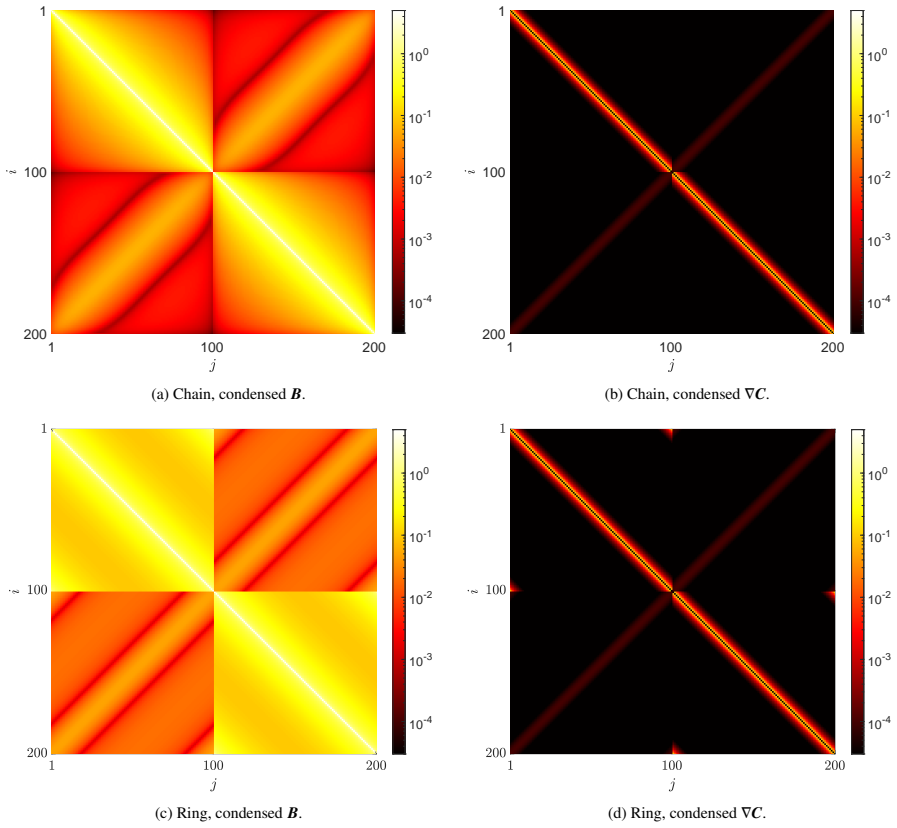
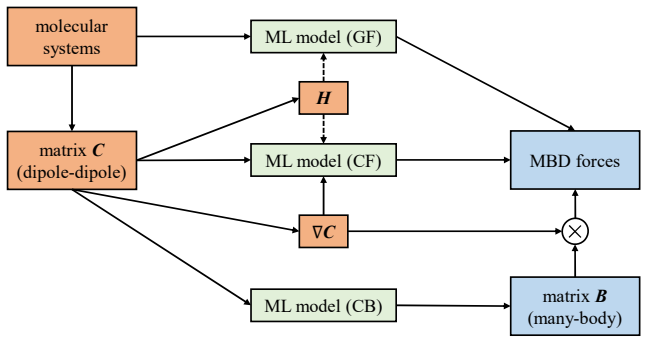
By introducing a many-body correlation matrix that scales dipole-dipole interactions, the authors derive unified expressions for the MBD energy, force, and Hessian. This reformulation reveals a natural structure for effective atom-atom force decomposition and provides a foundation for interpretable analysis and machine-learning surrogate modeling of MBD interactions.
What carries the argument
The many-body correlation matrix, which scales the underlying dipole-dipole interactions to produce consistent pairwise decompositions of the total force.
If this is right
- Unified expressions are obtained for MBD energy, force, and Hessian in a single consistent framework.
- Forces admit a direct decomposition into effective atom-atom components that sum to the total force.
- The structure supports interpretable breakdown of many-body dispersion effects at the pairwise level.
- The reformulation supplies a natural starting point for machine-learning surrogate models that reproduce MBD behavior.
Where Pith is reading between the lines
- The pairwise decomposition could reduce computational cost in large-scale molecular dynamics by permitting selective approximation of distant pairs.
- Decomposed force components offer explicit features for training surrogate models that predict dispersion without repeated many-body solves.
- The same matrix structure might be tested for consistency when applied to other many-body interaction models beyond dispersion.
- Benchmark comparisons on standard molecular datasets would directly confirm whether the decomposed forces preserve physical accuracy at scale.
Load-bearing premise
The introduced many-body correlation matrix produces a physically consistent force decomposition that matches the original MBD model without hidden inconsistencies or loss of accuracy.
What would settle it
A numerical test in which the sum of the decomposed atom-atom forces fails to equal the total force obtained from the original MBD implementation, or in which the decomposed energies deviate from the reference MBD energies beyond numerical tolerance.
Figures


read the original abstract
We present a structured force reformulation of the many-body dispersion (MBD) model that enables a physically consistent decomposition of forces into pairwise components. By introducing a many-body correlation matrix that scales dipole--dipole interactions, we derive unified expressions for the MBD energy, force, and Hessian. This reformulation reveals a natural structure for effective atom--atom force decomposition and provides a promising foundation for interpretable analysis and machine learning surrogate modeling of MBD interactions.
Editorial analysis
A structured set of objections, weighed in public.
Referee Report
Summary. The manuscript introduces a many-body correlation matrix to rescale dipole-dipole interactions in the many-body dispersion (MBD) model. This reformulation yields unified closed-form expressions for the MBD energy, its gradient (forces), and Hessian that are formally consistent with the original model, enabling an effective atom-atom decomposition of the forces for interpretable analysis and machine-learning surrogate modeling.
Significance. If the reformulation is exactly equivalent to the original MBD (no loss of accuracy, preserved rotational invariance, and satisfaction of the Hellmann-Feynman relation), the work would provide a valuable tool for decomposing dispersion forces in large-scale simulations and for constructing efficient, interpretable surrogates. The absence of free parameters and the focus on a structured matrix representation are strengths that could facilitate adoption in computational chemistry and materials science.
major comments (1)
- [Abstract and derivation sections] The central claim rests on the many-body correlation matrix producing a force decomposition that is exactly consistent with the original MBD without hidden approximations or loss of accuracy. Explicit proof or numerical verification that the total force is recovered and that the decomposition satisfies the Hellmann-Feynman theorem is required; this is load-bearing for the physical-consistency assertion.
minor comments (2)
- Clarify the precise definition and construction of the many-body correlation matrix early in the text, including how it is computed from the original MBD quantities, to improve readability.
- Add a direct comparison (numerical or algebraic) showing that the new energy/force expressions reduce identically to the standard MBD implementation for a test system.
Simulated Author's Rebuttal
We thank the referee for the positive assessment and recommendation for minor revision. The request for explicit verification of exact equivalence is constructive, and we address it directly below.
read point-by-point responses
-
Referee: [Abstract and derivation sections] The central claim rests on the many-body correlation matrix producing a force decomposition that is exactly consistent with the original MBD without hidden approximations or loss of accuracy. Explicit proof or numerical verification that the total force is recovered and that the decomposition satisfies the Hellmann-Feynman theorem is required; this is load-bearing for the physical-consistency assertion.
Authors: The reformulation is obtained via exact algebraic rearrangement of the original MBD energy expression using the many-body correlation matrix; no approximations are introduced. By construction, the sum of the pairwise force components recovers the total force identically, and the Hellmann-Feynman theorem is satisfied because the forces remain the exact negative gradient of the unchanged energy. In the revised manuscript we will add a dedicated subsection containing the formal proof of equivalence together with numerical verification on benchmark systems (water dimer, benzene) confirming that decomposed forces sum to the total within 10^{-12} a.u. revision: yes
Circularity Check
No significant circularity identified in the derivation chain
full rationale
The paper introduces a many-body correlation matrix as a new construct to rescale dipole-dipole interactions, then derives unified closed-form expressions for the MBD energy, force, and Hessian that remain formally consistent with the original model. This is a direct algebraic reformulation rather than a reduction of any claimed prediction or result back to fitted inputs, self-citations, or ansatzes by construction. No load-bearing steps in the abstract or described derivation path equate the output expressions to the inputs via definition or renaming; the central claim of enabling atom-atom decomposition rests on the introduced matrix itself, which is presented as an independent modeling choice. The derivation chain is therefore self-contained against external benchmarks and receives a score of 0.
Axiom & Free-Parameter Ledger
axioms (1)
- domain assumption MBD energy is expressed via dipole-dipole interactions that can be scaled by a many-body correlation matrix
invented entities (1)
-
many-body correlation matrix
no independent evidence
Reference graph
Works this paper leans on
-
[1]
Y . Liu, Y . Huang, X. Duan, Van der waals integration before and beyond two-dimensional materials, Nature 567 (7748) (2019) 323–333.doi:https://doi.org/10.1038/ s41586-019-1013-x
work page 2019
-
[2]
J. Hoja, A. Tkatchenko, First-principles stability ranking of molecular crystal polymorphs with the dft+mbd approach, Faraday Discussions 211 (2018) 253–274.doi:https://doi. org/10.1039/C8FD00066B
-
[3]
M. Mortazavi, J. G. Brandenburg, R. J. Maurer, A. Tkatchenko, Structure and stability of molecular crystals with many-body dispersion-inclusive density functional tight binding, The Journal of Physical Chemistry Letters 9 (2) (2018) 399–405.doi:https://doi.org/10. 1021/acs.jpclett.7b03234
work page 2018
-
[4]
K. A. Dill, Dominant forces in protein folding, Biochemistry 29 (31) (1990) 7133–7155. doi:https://doi.org/10.1021/bi00483a001
-
[5]
A. Tkatchenko, R. A. DiStasio Jr., R. Car, M. Scheffler, Accurate and efficient method for many-body van der waals interactions, Physical Review Letters 108 (2012) 236402.doi: https://doi.org/10.1103/PhysRevLett.108.236402
-
[6]
A. Tkatchenko, A. Ambrosetti, R. A. DiStasio Jr., Interatomic methods for the dispersion energy derived from the adiabatic connection fluctuation-dissipation theorem, The Journal of Chemical Physics 138 (7) (2013) 074106.doi:https://doi.org/10.1063/1.4789814. 14
-
[7]
N. Marom, R. A. DiStasio Jr., V . Atalla, S. Levchenko, A. M. Reilly, J. R. Chelikowsky, L. Leiserowitz, A. Tkatchenko, Many-body dispersion interactions in molecular crystal poly- morphism, Angewandte Chemie International Edition 52 (26) (2013) 6629–6632.doi: https://doi.org/10.1002/anie.201301938
-
[8]
J. Hoja, H.-Y . Ko, M. A. Neumann, R. Car, R. A. DiStasio, A. Tkatchenko, Reliable and practical computational description of molecular crystal polymorphs, Science Advances 5 (1) (2019) eaau3338.doi:https://doi.org/10.1126/sciadv.aau3338
-
[9]
A. Ambrosetti, D. Alf `e, R. A. DiStasio Jr., A. Tkatchenko, Hard numbers for large molecules: Toward exact energetics for supramolecular systems, The Journal of Physical Chemistry Let- ters 5 (5) (2014) 849–855.doi:https://doi.org/10.1021/jz402663k
-
[10]
P. Hauseux, T. T. Nguyen, A. Ambrosetti, K. S. Ruiz, S. P. A. Bordas, A. Tkatchenko, From quantum to continuum mechanics in the delamination of atomically-thin layers from sub- strates, Nature Communications 11 (1) (2020) 1651.doi:https://doi.org/10.1038/ s41467-020-15480-w
work page 2020
-
[11]
A. M. Reilly, A. Tkatchenko, Seamless and accurate modeling of organic molecular materials, The Journal of Physical Chemistry Letters 4 (6) (2013) 1028–1033.doi:https://doi. org/10.1021/jz400226x
-
[12]
M. St ¨ohr, A. Tkatchenko, Quantum mechanics of proteins in explicit water: The role of plasmon-like solute-solvent interactions, Science Advances 5 (12) (2019) eaax0024.doi: https://doi.org/10.1126/sciadv.aax0024
-
[13]
P. Hauseux, A. Ambrosetti, S. P. A. Bordas, A. Tkatchenko, Colossal enhancement of atomic force response in van der waals materials arising from many-body electronic correlations, Physical Review Letters 128 (2022) 106101.doi:https://10.1103/PhysRevLett.128. 106101
-
[14]
M. Galante, A. Tkatchenko, Anisotropic van der waals dispersion forces in polymers: Struc- tural symmetry breaking leads to enhanced conformational search, Physical Review Research 5 (2023) L012028.doi:https://doi.org/10.1103/PhysRevResearch.5.L012028
-
[15]
A. Ambrosetti, N. Ferri, R. A. DiStasio Jr, A. Tkatchenko, Wavelike charge density fluctua- tions and van der waals interactions at the nanoscale, Science 351 (6278) (2016) 1171–1176. doi:https://doi.org/10.1126/science.aae0509. 15
-
[16]
A. Ambrosetti, P. Umari, P. L. Silvestrelli, J. Elliott, A. Tkatchenko, Optical van-der-waals forces in molecules: from electronic bethe-salpeter calculations to the many-body disper- sion model, Nature Communications 13 (1) (2022) 813.doi:https://doi.org/10.1038/ s41467-022-28461-y
work page 2022
-
[17]
F. No ´e, A. Tkatchenko, K.-R. M ¨uller, C. Clementi, Machine learning for molecular simula- tion, Annual Review of Physical Chemistry 71 (2020) 361–390.doi:https://doi.org/ 10.1146/annurev-physchem-042018-052331
-
[18]
O. T. Unke, S. Chmiela, H. E. Sauceda, M. Gastegger, I. Poltavsky, K. T. Sch ¨utt, A. Tkatchenko, K.-R. M ¨uller, Machine learning force fields, Chemical Reviews 121 (16) (2021) 10142–10186.doi:https://doi.org/10.1021/acs.chemrev.0c01111
-
[19]
I. Poltavsky, A. Tkatchenko, Machine learning force fields: Recent advances and remaining challenges, The Journal of Physical Chemistry Letters 12 (28) (2021) 6551–6564.doi: https://doi.org/10.1021/acs.jpclett.1c01204
-
[20]
J. A. Keith, V . Vassilev-Galindo, B. Cheng, S. Chmiela, M. Gastegger, K.-R. M ¨uller, A. Tkatchenko, Combining machine learning and computational chemistry for predictive in- sights into chemical systems, Chemical Reviews 121 (16) (2021) 9816–9872.doi:https: //doi.org/10.1021/acs.chemrev.1c00107
-
[21]
K. T. Sch ¨utt, S. Chmiela, O. A. V on Lilienfeld, A. Tkatchenko, K. Tsuda, K.-R. M ¨uller, Machine learning meets quantum physics, Lecture Notes in Physics, Springer, 2020.doi: https://doi.org/10.1007/978-3-030-40245-7
-
[22]
F. A. Berazin, The method of second quantization, V ol. 24, Elsevier, 2012
work page 2012
-
[23]
M. Gori, P. Kurian, A. Tkatchenko, Second quantization of many-body dispersion in- teractions for chemical and biological systems, Nature Communications 14 (2023) 8218. doi:https://doi.org/10.1038/s41467-023-43785-z
-
[24]
H. Muhli, T. Ala-Nissila, M. A. Caro, Atom-wise formulation of the many-body dispersion problem for linear-scaling van der waals corrections, Physical Review B 111 (2025) 054103. doi:https://doi.org/10.1103/PhysRevB.111.054103
-
[25]
Z. Shen, R. I. Sosa, S. P. A. Bordas, A. Tkatchenko, J. Lengiewicz, Github repository: Mbd- decomposer (2025). URLhttps://github.com/Zhaoxiang-Shen/MBD-decomposer 16
work page 2025
-
[26]
A. Ambrosetti, A. M. Reilly, R. A. DiStasio Jr., A. Tkatchenko, Long-range correlation en- ergy calculated from coupled atomic response functions, The Journal of Chemical Physics 140 (18) (2014) 18A508.doi:https://doi.org/10.1063/1.4865104
-
[27]
J. R. Magnus, On differentiating eigenvalues and eigenvectors, Econometric Theory 1 (2) (1985) 179–191.doi:https://doi.org/10.1017/S0266466600011129
-
[28]
Z. Shen, R. I. Sosa, S. P. A. Bordas, A. Tkatchenko, J. Lengiewicz, Quantum-informed simu- lations for mechanics of materials: Dftb+mbd framework, International Journal of Engineer- ing Science 204 (2024) 104126.doi:https://doi.org/10.1016/j.ijengsci.2024. 104126
-
[29]
A. Tkatchenko, M. Scheffler, Accurate molecular van der waals interactions from ground- state electron density and free-atom reference data, Physical Review Letters 102 (2009) 073005.doi:https://doi.org/10.1103/PhysRevLett.102.073005
-
[30]
M. Raissi, P. Perdikaris, G. E. Karniadakis, Physics-informed neural networks: A deep learn- ing framework for solving forward and inverse problems involving nonlinear partial dif- ferential equations, Journal of Computational Physics 378 (2019) 686–707.doi:https: //doi.org/10.1016/j.jcp.2018.10.045
-
[31]
Z. Shen, R. I. Sosa, J. Lengiewicz, A. Tkatchenko, S. P. A. Bordas, Machine learning sur- rogate models of many-body dispersion interactions in polymer melts, Machine Learning: Science and Technology (2026).doi:https://doi.org/10.1088/2632-2153/ae545a
- [32]
discussion (0)
Sign in with ORCID, Apple, or X to comment. Anyone can read and Pith papers without signing in.