Recognition: no theorem link
Hadron Structure from lattice QCD in the context of the Electron-Ion Collider
Pith reviewed 2026-05-14 00:35 UTC · model grok-4.3
The pith
Lattice QCD now computes precise charges, form factors, GPDs, and TMDs for nucleons and mesons to inform EIC experiments.
A machine-rendered reading of the paper's core claim, the machinery that carries it, and where it could break.
Core claim
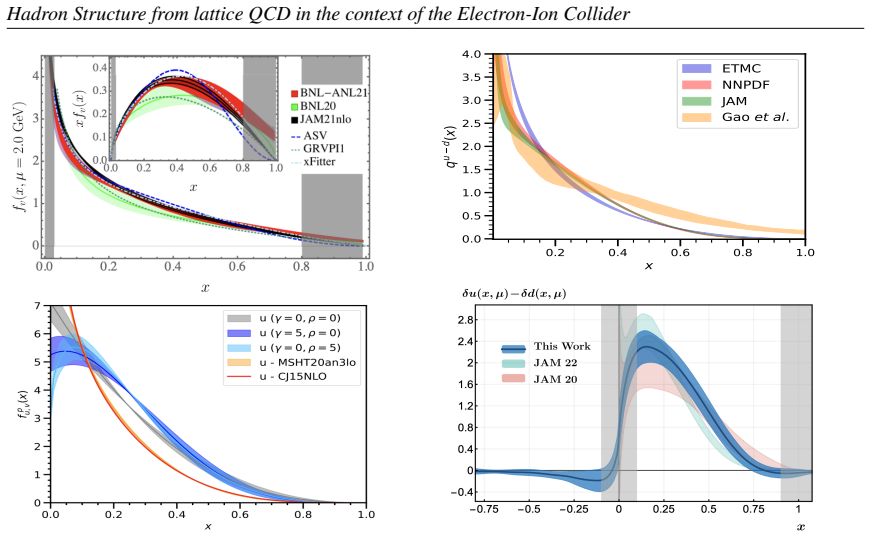
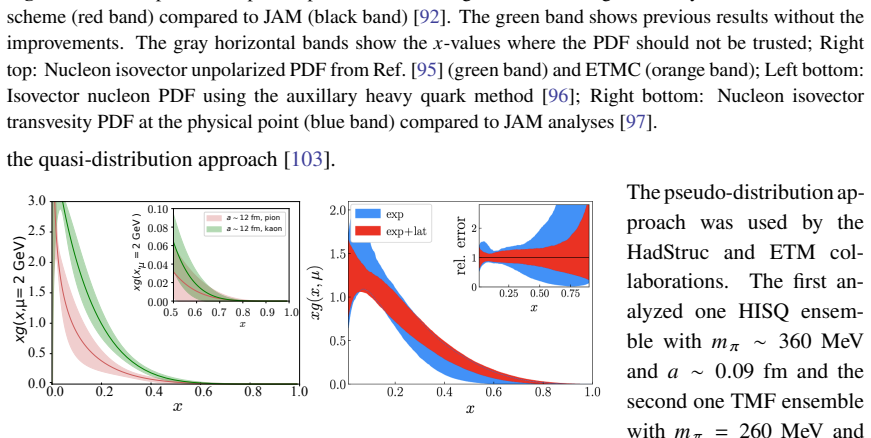
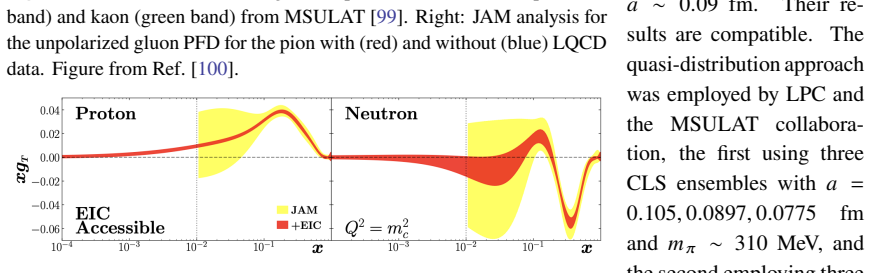
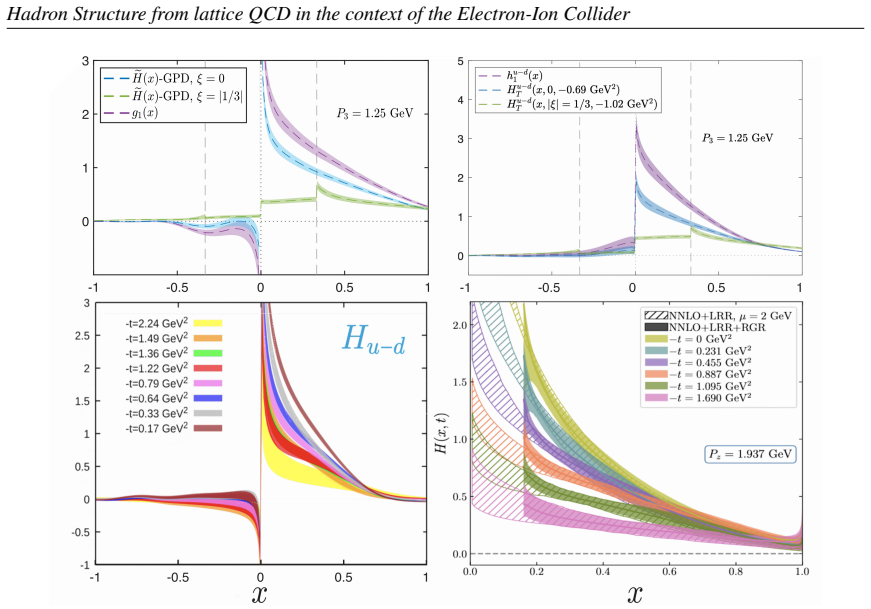
Hadron structure calculations using lattice QCD have advanced to the point where charges, form factors, and lower Mellin moments are available at high precision, generalized parton distributions can be computed directly or reconstructed from moments, and transverse-momentum-dependent distributions are accessible through direct lattice methods. Together these provide detailed complementary insights into hadron internal structure that inform the scientific agenda of the Electron-Ion Collider, with emphasis on the pion, kaon, and nucleon.
What carries the argument
Lattice QCD matrix-element calculations that extract charges, form factors, Mellin moments, generalized parton distributions, and transverse-momentum-dependent distributions from Euclidean correlation functions.
Load-bearing premise
The summarized lattice QCD results are mature, free of uncontrolled systematics, and can be used at EIC kinematics without further model-dependent corrections.
What would settle it
An EIC measurement of a nucleon or meson observable that differs from the corresponding lattice prediction by an amount larger than the combined stated uncertainties.
Figures








read the original abstract
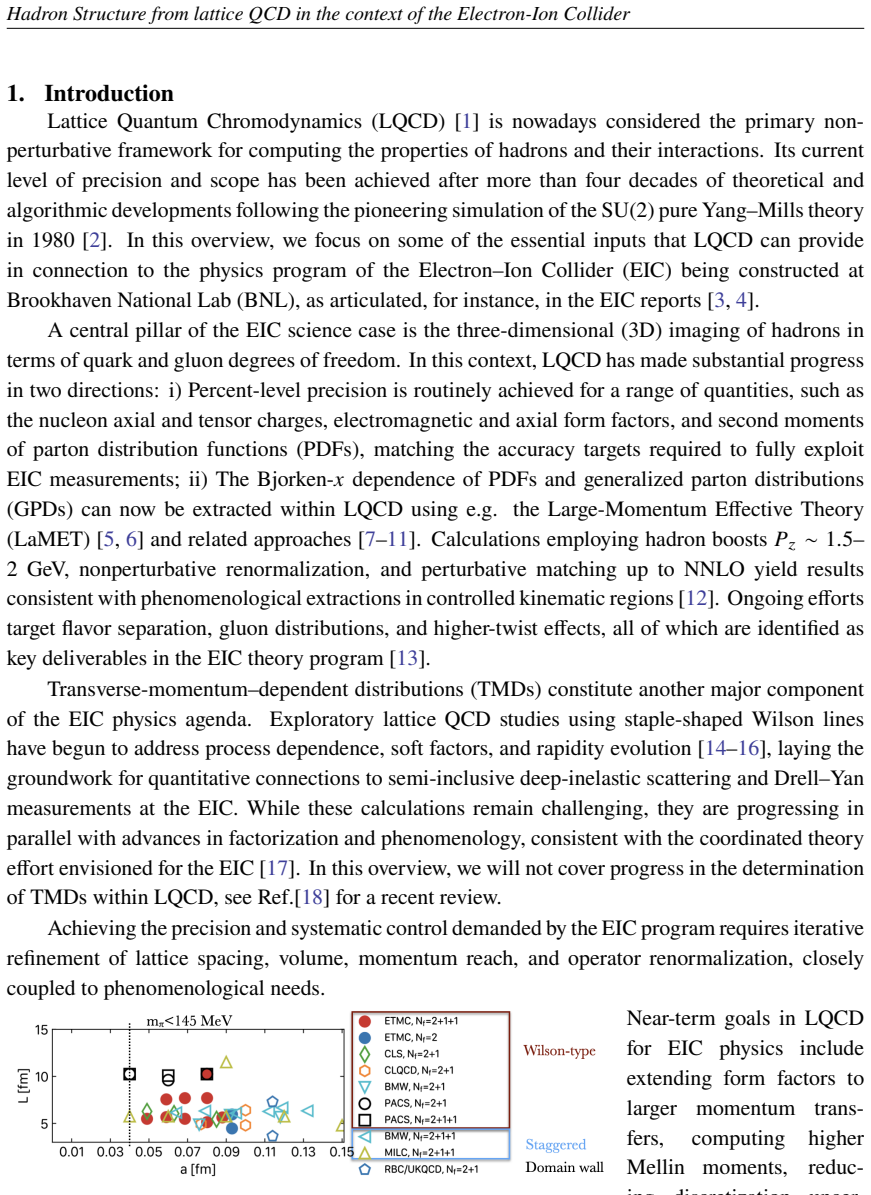
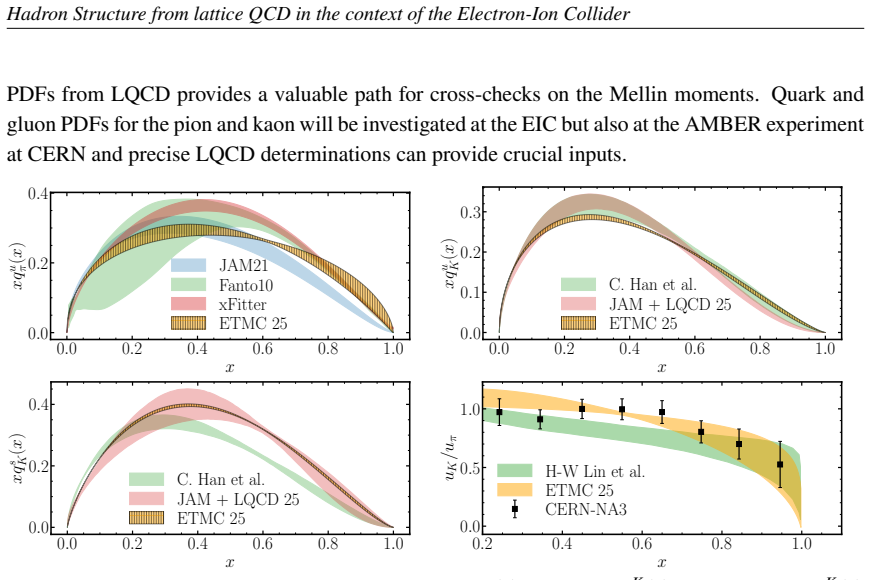
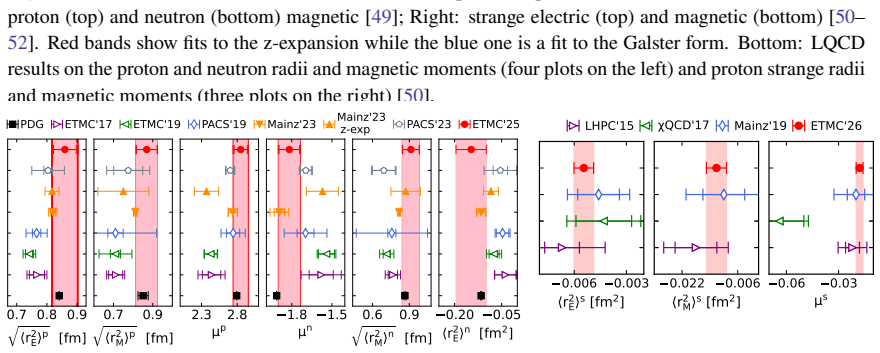
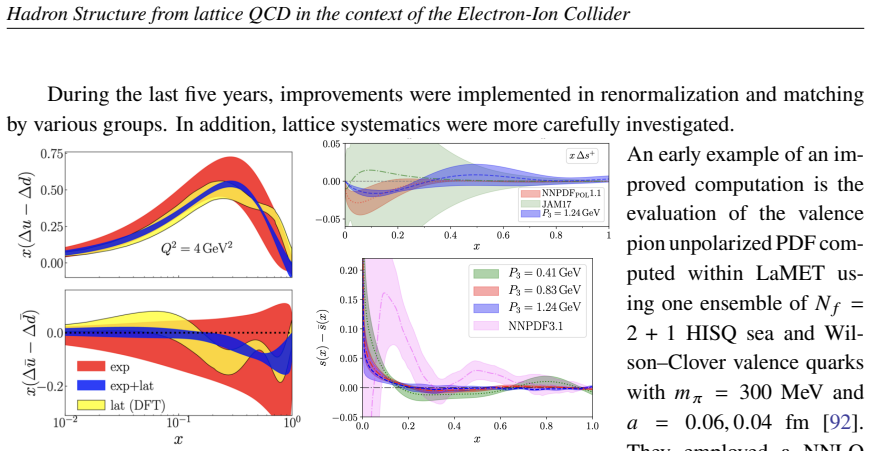
Hadron structure calculations using lattice Quantum Chromodynamics (QCD) have advanced significantly in recent years. Results for charges, form factors, and lower Mellin moments can be obtained to high precision, generalized parton distributions can now be computed either directly or reconstructed from moments, and transverse-momentum-dependent distributions can be accessed through direct lattice calculations. Together, these quantities provide detailed and complementary insights into the internal structure of hadrons. These theoretical developments are highly relevant to the experimental program of the Electron-Ion Collider (EIC) and of other facilities. We review the most pertinent lattice QCD results for hadron structure that inform the EIC scientific agenda, with particular emphasis on the pion, kaon, and nucleon.
Editorial analysis
A structured set of objections, weighed in public.
Referee Report
Summary. The manuscript is a review that summarizes recent lattice QCD advances in computing hadron structure quantities—charges, electromagnetic and axial form factors, lower Mellin moments of PDFs, GPDs (both direct and moment-reconstructed), and TMDs—for the pion, kaon, and nucleon. It argues that these results are now sufficiently mature to provide complementary, quantitative input for the EIC physics program, particularly for interpreting parton distributions and form-factor measurements at the kinematics accessible to the collider.
Significance. If the cited lattice results are faithfully represented, the review supplies a timely, single-source overview that experimentalists and phenomenologists can use to assess the current theoretical constraints on nucleon and meson structure. By collating precision lattice numbers with EIC-relevant observables, it helps identify which quantities are already under good control and which still require further lattice or model input before EIC data arrive.
major comments (2)
- [§4] §4 (GPDs): the statement that GPDs 'can now be computed either directly or reconstructed from moments' is not accompanied by any quantitative comparison of the systematic uncertainties of the two approaches (e.g., truncation of the moment series versus lattice discretization effects in direct calculations), which is load-bearing for the claim that these results are ready for EIC use.
- [§5] §5 (TMDs): the assertion that TMDs 'can be accessed through direct lattice calculations' omits discussion of the renormalization and matching procedures required to connect lattice quasi-TMDs to the continuum MS-bar scheme; without this, the precision quoted for the TMD results cannot be assessed for EIC phenomenology.
minor comments (3)
- [Abstract] Abstract: the phrase 'high precision' is used without any numerical benchmark (e.g., percent-level errors on charges or moments); a single sentence referencing the typical error budgets of the cited works would improve clarity.
- [Table 1] Table 1 (nucleon charges): the caption does not state whether the quoted uncertainties are statistical only or include systematic contributions from chiral and continuum extrapolations.
- [References] References: several 2022–2023 papers on lattice TMD renormalization (e.g., works using the Collins-Soper kernel on the lattice) are absent; their inclusion would strengthen the TMD section.
Simulated Author's Rebuttal
We thank the referee for the careful reading of the manuscript and the constructive comments on §§4 and 5. We address each major comment below and will revise the manuscript to strengthen the discussion of systematic uncertainties and renormalization procedures.
read point-by-point responses
-
Referee: [§4] §4 (GPDs): the statement that GPDs 'can now be computed either directly or reconstructed from moments' is not accompanied by any quantitative comparison of the systematic uncertainties of the two approaches (e.g., truncation of the moment series versus lattice discretization effects in direct calculations), which is load-bearing for the claim that these results are ready for EIC use.
Authors: We agree that a quantitative comparison of the systematic uncertainties would improve the utility of the review for EIC phenomenology. In the revised manuscript we will expand the discussion in §4 to include a brief comparison of truncation errors in moment reconstruction versus discretization and other lattice systematics in direct calculations, drawing on the specific results and references already cited in the section. revision: yes
-
Referee: [§5] §5 (TMDs): the assertion that TMDs 'can be accessed through direct lattice calculations' omits discussion of the renormalization and matching procedures required to connect lattice quasi-TMDs to the continuum MS-bar scheme; without this, the precision quoted for the TMD results cannot be assessed for EIC phenomenology.
Authors: We acknowledge that the present text in §5 does not explicitly address the renormalization and matching steps. In the revised version we will add a concise paragraph outlining the quasi-TMD renormalization procedure and the matching to the MS-bar scheme, thereby allowing readers to assess the quoted precision in the context of EIC applications. revision: yes
Circularity Check
No significant circularity
full rationale
The manuscript is a review paper that summarizes published lattice QCD results on hadron structure quantities (charges, form factors, Mellin moments, GPDs, TMDs) and their relevance to EIC kinematics. No new derivations, predictions, parameter fittings, or model-independent extrapolations are performed within the text. All referenced results are drawn from external literature via citations, with no self-citation chains or internal equations that reduce claims to inputs defined by the paper itself. The central content is descriptive collation rather than any load-bearing derivation, making the work self-contained against external benchmarks.
Axiom & Free-Parameter Ledger
axioms (1)
- domain assumption Lattice QCD on a discrete Euclidean grid accurately approximates continuum QCD in the limit of vanishing lattice spacing and infinite volume.
Reference graph
Works this paper leans on
-
[1]
Wilson,Confinement of quarks,Phys
K.G. Wilson,Confinement of quarks,Phys. Rev. D10(1974) 2445
work page 1974
-
[2]
M.Creutz,Montecarlostudyofquantizedsu(2)gaugetheory,Phys.Rev.D21(1980)2308
work page 1980
-
[3]
Science Requirements and Detector Concepts for the Electron-Ion Collider: EIC Yellow Report
R. Abdul Khalek et al.,Science requirements and detector concepts for the electron–ion collider,Nucl. Phys. A1026(2022) 122447 [2103.05419]
work page internal anchor Pith review arXiv 2022
-
[4]
E.C. Aschenauer, I. Borsa, R. Sassot and C. Van Hulse,Semi-inclusive Deep-Inelastic Scattering, Parton Distributions and Fragmentation Functions at a Future Electron-Ion Collider,Phys. Rev. D99(2019) 094004 [1902.10663]
work page Pith review arXiv 2019
-
[5]
Ji,Parton physics on a euclidean lattice,Phys
X. Ji,Parton physics on a euclidean lattice,Phys. Rev. Lett.110(2013) 262002 [1305.1539]
-
[7]
Y.-Q. Ma and J.-W. Qiu,Exploring Partonic Structure of Hadrons Using ab initio Lattice QCD Calculations,Phys. Rev. Lett.120(2018) 022003 [1709.03018]
-
[8]
A.V. Radyushkin,Quasi-parton distribution functions, momentum distributions, and pseudo-parton distribution functions,Phys. Rev. D96(2017) 034025 [1705.01488]
-
[9]
A.J. Chambers, R. Horsley, Y. Nakamura, H. Perlt, P.E.L. Rakow, G. Schierholz et al., Nucleon Structure Functions from Operator Product Expansion on the Lattice,Phys. Rev. Lett.118(2017) 242001 [1703.01153]
-
[10]
K.-F. Liu,Parton Distribution Function from the Hadronic Tensor on the Lattice,PoS LATTICE2015(2016) 115 [1603.07352]
-
[11]
Deep-inelastic scattering and the operator product expansion in lattice QCD
W. Detmold and C.J.D. Lin,Deep-inelastic scattering and the operator product expansion in lattice QCD,Phys. Rev. D73(2006) 014501 [hep-lat/0507007]
work page internal anchor Pith review Pith/arXiv arXiv 2006
-
[13]
Electron Ion Collider: The Next QCD Frontier - Understanding the glue that binds us all
A. Accardi et al.,Electron ion collider: The next qcd frontier,Eur. Phys. J. A52(2016) 268 [1212.1701]. 18 Hadron Structure from lattice QCD in the context of the Electron-Ion Collider
work page Pith review arXiv 2016
-
[14]
Exploring quark transverse momentum distributions with lattice QCD
B.U. Musch et al.,Transverse momentum distributions of quarks in the nucleon from lattice qcd,Phys. Rev. D83(2011) 094507 [1011.1213]
work page internal anchor Pith review Pith/arXiv arXiv 2011
- [15]
-
[16]
M.A. Ebert, I.W. Stewart and Y. Zhao,Determining the Nonperturbative Collins-Soper Kernel From Lattice QCD,Phys. Rev. D99(2019) 034505 [1811.00026]
-
[17]
I. Scimemi and A. Vladimirov,Non-perturbative structure of semi-inclusive deep-inelastic and Drell-Yan scattering at small transverse momentum,JHEP06(2020) 137 [1912.06532]
-
[18]
Boussarie et al.,TMD Handbook,2304.03302
R. Boussarie et al.,TMD Handbook,2304.03302
-
[19]
P. Shanahan et al.,Snowmass 2021 Computational Frontier CompF03 Topical Group Report: Machine Learning,2209.07559
-
[20]
Hadron structure from lattice quantum chromodynamics
P. Hagler,Hadron structure from lattice quantum chromodynamics,Phys. Rept.490(2010) 49 [0912.5483]. [21]ETMcollaboration,Pion vector form factor from lattice QCD at the physical point,Phys. Rev. D97(2018) 014508 [1710.10401]
work page internal anchor Pith review Pith/arXiv arXiv 2010
-
[21]
X. Gao, N. Karthik, S. Mukherjee, P. Petreczky, S. Syritsyn and Y. Zhao,Pion form factor and charge radius from lattice QCD at the physical point,Phys. Rev. D104(2021) 114515 [2102.06047]. [23]chiQCDcollaboration,Lattice Calculation of Pion Form Factor with Overlap Fermions, Phys. Rev. D104(2021) 074502 [2006.05431]. [24]Extended Twisted Masscollaboration...
-
[22]
D.C. Hackett, P.R. Oare, D.A. Pefkou and P.E. Shanahan,Gravitational form factors of the pion from lattice QCD,Phys. Rev. D108(2023) 114504 [2307.11707]. [26]ETMcollaboration,Pion and kaon⟨x3⟩from lattice QCD and PDF reconstruction from Mellin moments,Phys. Rev. D104(2021) 054504 [2104.02247]
- [23]
- [24]
-
[25]
C. Han, G. Xie, R. Wang and X. Chen,An Analysis of Parton Distribution Functions of the Pion and the Kaon with the Maximum Entropy Input,Eur. Phys. J. C81(2021) 302 [2010.14284]. [30]JAMcollaboration,First simultaneous global QCD analysis of kaon and pion parton distributions with lattice QCD constraints,2510.11979. [31]Saclay -CERN-College de France-Ecol...
- [26]
-
[27]
I. Novikov et al.,Parton Distribution Functions of the Charged Pion Within The xFitter Framework,Phys. Rev. D102(2020) 014040 [2002.02902]
-
[28]
Shindler,Moments of parton distribution functions of any order from lattice QCD,Phys
A. Shindler,Moments of parton distribution functions of any order from lattice QCD,Phys. Rev. D110(2024) L051503 [2311.18704]
-
[29]
A.Francis,P.Fritzsch,R.Karur,J.Kim,G.Pederiva,D.A.Pefkouetal.,Momentsofparton distributions functions of the pion from lattice QCD using gradient flow,2510.26738. [37]HOPEcollaboration,Parton physics from a heavy-quark operator product expansion: Formalism and Wilson coefficients,Phys. Rev. D104(2021) 074511 [2103.09529]. [38]HOPEcollaboration,Parton phys...
-
[30]
A. Francis et al.,Gradient flow for parton distribution functions: first application to the pion,2509.02472
-
[31]
Parton physics from a heavy-quark operator product expansion
A. Chang et al., “Parton physics from a heavy-quark operator product expansion.” PoS Lattice 2025. [41]CLQCDcollaboration,Precision determination of nucleon iso-vector scalar and tensor charges at the physical point,2511.02326. [42]Flavour Lattice A veraging Group (FLAG)collaboration,FLAG review 2024,Phys. Rev. D113(2026) 014508 [2411.04268]. [43]RQCDcoll...
-
[32]
C. Alexandrou, S. Bacchio, J. Finkenrath, C. Iona, G. Koutsou, Y. Li et al.,Nucleon charges and𝜎-terms in lattice QCD,Phys. Rev. D111(2025) 054505 [2412.01535]
- [33]
-
[34]
D. Djukanovic, H. Meyer, K. Ottnad, G. von Hippel, J. Wilhelm and H. Wittig,Strange nucleon form factors and isoscalar charges with𝑁𝑓 =2+1O (𝑎)-improved Wilson fermions,PoSLATTICE2019(2019) 158 [1911.01177]
-
[35]
J. Liang, Y.-B. Yang, T. Draper, M. Gong and K.-F. Liu,Quark spins and Anomalous Ward Identity,Phys. Rev. D98(2018) 074505 [1806.08366]. [48]JAMcollaboration,Transversity Distributions and Tensor Charges of the Nucleon: Extraction from Dihadron Production and Their Universal Nature,Phys. Rev. Lett.132 20 Hadron Structure from lattice QCD in the context of...
-
[36]
C. Alexandrou, S. Bacchio, G. Koutsou, B. Prasad and G. Spanoudes,Proton and neutron electromagnetic form factors from lattice QCD in the continuum limit,2507.20910
-
[37]
C. Alexandrou, S. Bacchio, M. Bode, J. Finkenrath, A. Herten, C. Iona et al.,Nucleon strange electromagnetic form factors using𝑁𝑓 =2+1+1twisted-mass fermions at the physical point,PoSLATTICE2025(2026) 218
work page 2026
-
[38]
C. Alexandrou, S. Bacchio, M. Bode, J. Finkenrath, A. Herten, C. Iona et al.,Strangeness of nucleons from𝑁 𝑓 =2+1+1lattice QCD,2603.26600
-
[39]
C. Alexandrou, S. Bacchio, M. Bode, J. Finkenrath, A. Herten, C. Iona et al.,Nucleon strange electromagnetic form factors from𝑁𝑓 =2+1+1lattice QCD,2603.26591
-
[40]
D. Djukanovic, G. von Hippel, H.B. Meyer, K. Ottnad, M. Salg and H. Wittig, Electromagnetic form factors of the nucleon from Nf=2+1 lattice QCD,Phys. Rev. D109 (2024) 094510 [2309.06590]
-
[41]
D. Djukanovic, G. von Hippel, H.B. Meyer, K. Ottnad, M. Salg and H. Wittig,Precision Calculation of the Electromagnetic Radii of the Proton and Neutron from Lattice QCD, Phys. Rev. Lett.132(2024) 211901 [2309.07491]. [55]RQCDcollaboration,Nucleon axial structure from lattice QCD,JHEP05(2020) 126 [1911.13150]. [56]Nucleon Matrix Elements (NME)collaboration...
-
[42]
D. Djukanovic, G. von Hippel, J. Koponen, H.B. Meyer, K. Ottnad, T. Schulz et al., Isovector axial form factor of the nucleon from lattice QCD,Phys. Rev. D106(2022) 074503 [2207.03440]. [58]Extended Twisted Masscollaboration,Nucleon axial and pseudoscalar form factors using twisted-mass fermion ensembles at the physical point,Phys. Rev. D109(2024) 034503 ...
-
[43]
D.C. Hackett, D.A. Pefkou and P.E. Shanahan,Gravitational Form Factors of the Proton from Lattice QCD,Phys. Rev. Lett.132(2024) 251904 [2310.08484]
-
[44]
R. Abbott, D.C. Hackett, D.A. Pefkou, F. Romero-López and P.E. Shanahan,Lattice Evidence That Scalar Glueballs are Small,Phys. Rev. Lett.136(2026) 041901 [2508.21821]
-
[45]
Nucleon isovactor charges from RQCD
S. Collins, “Nucleon isovactor charges from RQCD.” Private communication
-
[46]
Flavor decomposition of the nucleon momentum and spin sums
C. Alexandrou et al., “Flavor decomposition of the nucleon momentum and spin sums.” Forthcoming publication
-
[47]
Meziani,Gluonic Energy-Momentum Tensor Form Factors of the Proton,PoS QCHSC24(2025) 076 [2505.05671]
Z.-E. Meziani,Gluonic Energy-Momentum Tensor Form Factors of the Proton,PoS QCHSC24(2025) 076 [2505.05671]
-
[48]
M. Gockeler, R. Horsley, D. Pleiter, P.E.L. Rakow, A. Schafer, G. Schierholz et al., 21 Hadron Structure from lattice QCD in the context of the Electron-Ion Collider Investigation of the second moment of the nucleon’s g(1) and g(2) structure functions in two-flavor lattice QCD,Phys. Rev. D72(2005) 054507 [hep-lat/0506017]. [66]QCDSFcollaboration,Transvers...
work page internal anchor Pith review Pith/arXiv arXiv 2005
-
[49]
Higher moments of parton distribution functions from Lattice QCD at the physical point
T. E., “Higher moments of parton distribution functions from Lattice QCD at the physical point.” Lattice 2025
work page 2025
-
[51]
K. Cichy and M. Constantinou,A guide to light-cone pdfs from lattice qcd,Advances in High Energy Physics2019(2019) 3036904 [1811.07248]
-
[52]
Y. Zhao,Unraveling high-energy hadron structures with lattice qcd,International Journal of Modern Physics A33(2019) 1830033 [1812.07192]
-
[53]
A.V. Radyushkin,Theory and applications of parton pseudodistributions,International Journal of Modern Physics A35(2020) 2030002 [1912.04244]
- [54]
-
[55]
M. Constantinou,The x-dependence of hadronic parton distributions,European Physical Journal A57(2021) 77 [2010.02445]
-
[56]
M. Constantinou et al.,Parton distributions and lattice qcd calculations: a community white paper,Progress in Particle and Nuclear Physics121(2021) 103908 [2006.08636]
-
[57]
K. Cichy,Status and perspectives of quasi-pdfs,Proceedings of ScienceLATTICE2021 (2022) 017 [2110.07440]
-
[58]
Ji,Large-Momentum Effective Theory vs
X. Ji,Large-Momentum Effective Theory vs. Short-Distance Operator Expansion: Contrast and Complementarity,Research8(2025) 0695 [2209.09332]
- [59]
- [60]
-
[61]
T. Izubuchi, L. Jin, C. Kallidonis, N. Karthik, S. Mukherjee, P. Petreczky et al.,Valence parton distribution function of pion from fine lattice,Phys. Rev. D100(2019) 034516 [1905.06349]
-
[62]
C. Alexandrou, K. Cichy, V. Drach, E. Garcia-Ramos, K. Hadjiyiannakou, K. Jansen et al., Lattice calculation of parton distributions,Phys. Rev. D92(2015) 014502 [1504.07455]
-
[63]
C. Alexandrou, K. Cichy, M. Constantinou, K. Jansen, A. Scapellato and F. Steffens, Light-Cone Parton Distribution Functions from Lattice QCD,Phys. Rev. Lett.121(2018) 112001 [1803.02685]. 22 Hadron Structure from lattice QCD in the context of the Electron-Ion Collider
- [64]
- [65]
-
[66]
Y.-Q. Ma and J.-W. Qiu,Extracting Parton Distribution Functions from Lattice QCD Calculations,Phys. Rev. D98(2018) 074021 [1404.6860]
-
[67]
Pion Valence Quark Distribution from Matrix Element Calculated in Lattice QCD
R.S. Sufian, J. Karpie, C. Egerer, K. Orginos, J.-W. Qiu and D.G. Richards,Pion Valence Quark Distribution from Matrix Element Calculated in Lattice QCD,Phys. Rev. D99 (2019) 074507 [1901.03921]
work page Pith review arXiv 2019
- [68]
-
[69]
R. Zhang, H.-W. Lin and B. Yoon,Probing nucleon strange and charm distributions with lattice QCD,Phys. Rev. D104(2021) 094511 [2005.01124]
-
[70]
C. Alexandrou, M. Constantinou, K. Hadjiyiannakou, K. Jansen and F. Manigrasso,Flavor decomposition for the proton helicity parton distribution functions,Phys. Rev. Lett.126 (2021) 102003 [2009.13061]
-
[71]
C. Alexandrou, M. Constantinou, K. Hadjiyiannakou, K. Jansen and F. Manigrasso,Flavor decomposition of the nucleon unpolarized, helicity, and transversity parton distribution functions from lattice QCD simulations,Phys. Rev. D104(2021) 054503 [2106.16065]
-
[72]
J. Bringewatt, N. Sato, W. Melnitchouk, J.-W. Qiu, F. Steffens and M. Constantinou, Confronting lattice parton distributions with global QCD analysis,Phys. Rev. D103(2021) 016003 [2010.00548]
- [73]
- [74]
- [75]
- [76]
-
[77]
C. Zimmermann and A. Schäfer,Valence quark PDFs of the proton from two-current correlations in lattice QCD,Phys. Rev. D110(2024) 074503 [2405.07712]. [97]Lattice Partoncollaboration,Nucleon Transversity Distribution in the Continuum and 23 Hadron Structure from lattice QCD in the context of the Electron-Ion Collider Physical Mass Limit from Lattice QCD,Ph...
- [78]
-
[79]
A. NieMiera, W. Good and H.-W. Lin,Kaon gluon parton distribution and momentum fraction from 2+1+1 lattice QCD with high statistics,Phys. Rev. D112(2025) 074504 [2506.03002]. [100]Jefferson Lab Angular Momentum (JAM), HadStruccollaboration,Complementarity of experimental and lattice QCD data on pion parton distributions,Phys. Rev. D105 (2022) 114051 [2204.00543]
-
[80]
J. Delmar, C. Alexandrou, K. Cichy, M. Constantinou and K. Hadjiyiannakou,Gluon PDF of the proton using twisted mass fermions,Phys. Rev. D108(2023) 094515 [2310.01389]. [102]HadStruccollaboration,Unpolarized gluon distribution in the nucleon from lattice quantum chromodynamics,Phys. Rev. D104(2021) 094516 [2107.08960]
-
[81]
C. Chen, H. Dong, L. Liu, P. Sun, X. Xiong, Y.-B. Yang et al.,Unpolarized gluon PDF of the nucleon from lattice QCD in the continuum limit,2510.26425. [104]HadStruccollaboration,Toward the determination of the gluon helicity distribution in the nucleon from lattice quantum chromodynamics,Phys. Rev. D106(2022) 094511 [2207.08733]
- [82]
-
[83]
T.A. Chowdhury, T. Izubuchi, M. Kamruzzaman, N. Karthik, T. Khan, T. Liu et al., Polarized and unpolarized gluon PDFs: Generative machine learning applications for lattice QCD matrix elements at short distance and large momentum,Phys. Rev. D111 (2025) 074509 [2409.17234]. [107]Jefferson Lab Angular Momentum, HadStruccollaboration,Gluon helicity from globa...
discussion (0)
Sign in with ORCID, Apple, or X to comment. Anyone can read and Pith papers without signing in.