Recognition: 2 theorem links
· Lean TheoremRotating black hole shadows in metric-affine bumblebee gravity
Pith reviewed 2026-05-14 01:48 UTC · model grok-4.3
The pith
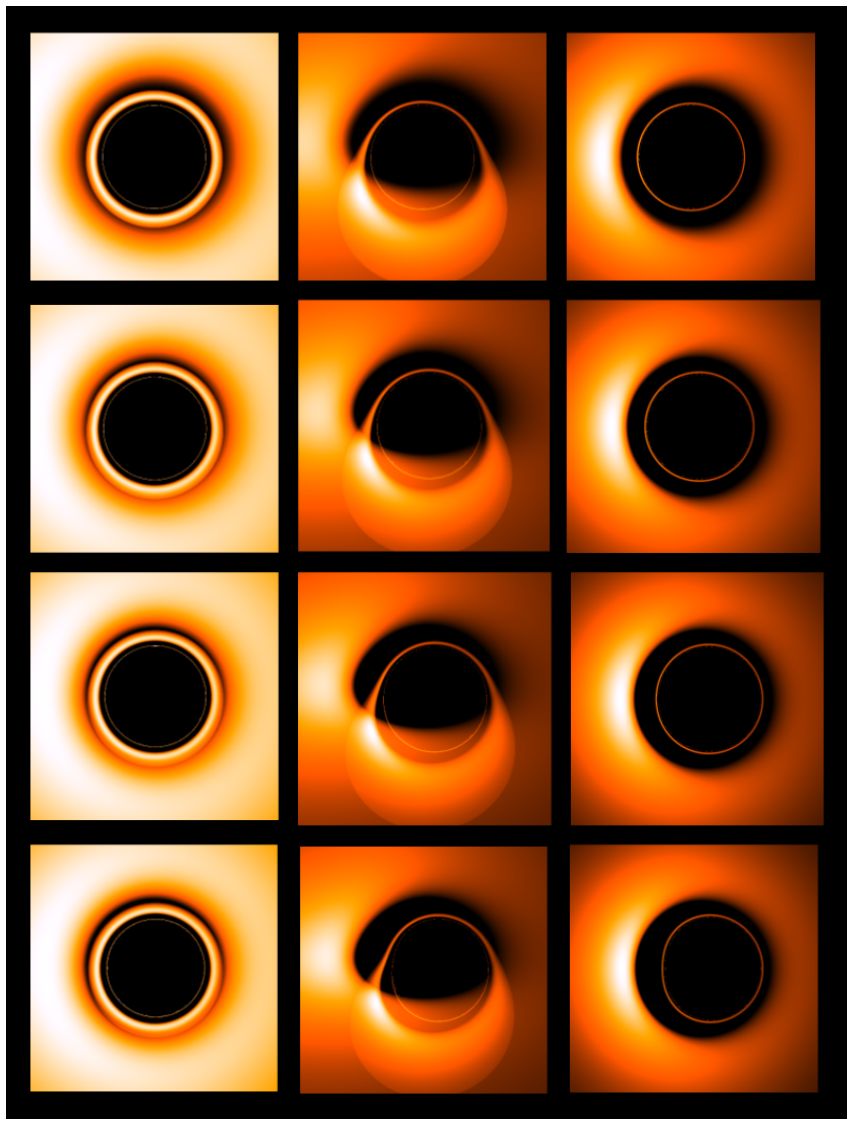
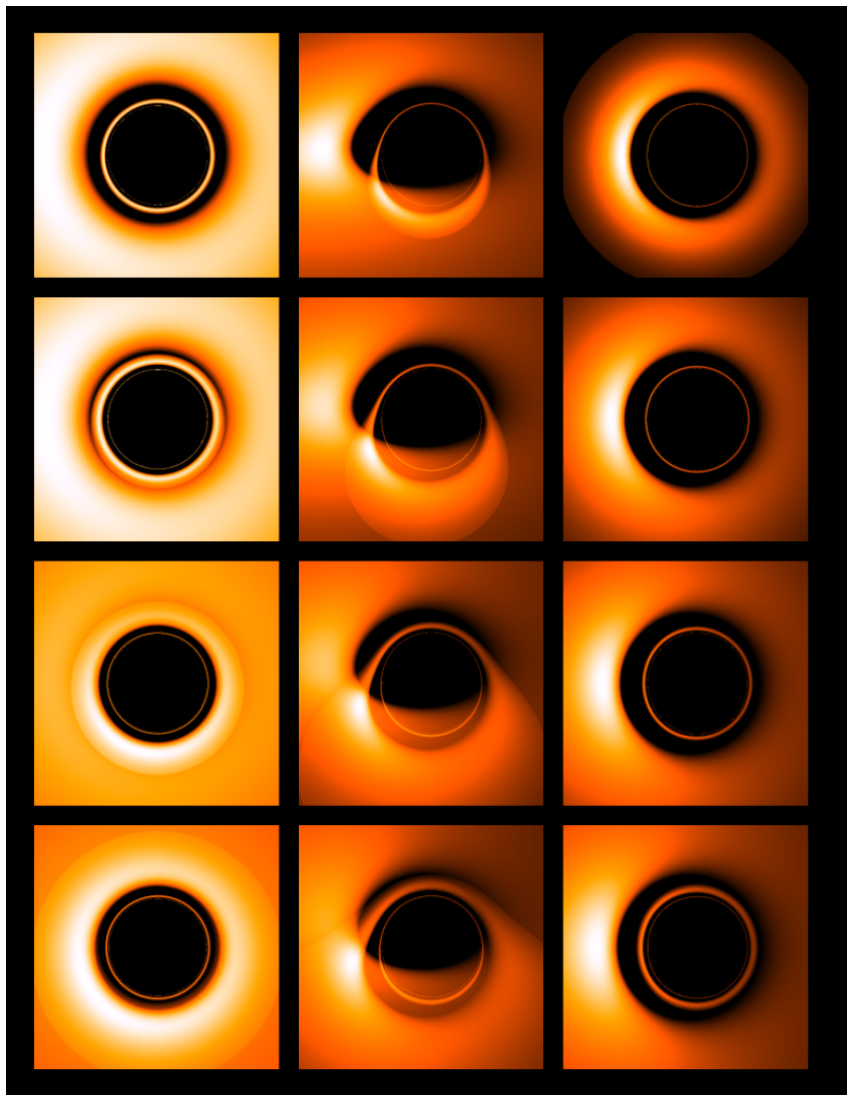
Increasing Lorentz-violating coefficient X flattens rotating black hole shadows into asymmetric teardrops in bumblebee gravity.
A machine-rendered reading of the paper's core claim, the machinery that carries it, and where it could break.
Core claim
In the metric-affine bumblebee model, the LV coefficient X induces progressive vertical flattening, asymmetric teardrop-shaped deformations, and local collapse of the lower silhouette region of rotating black hole shadows, with these anisotropic effects interacting with the rotational Doppler shift and thereby distinguishing the model from the Kerr metric.
What carries the argument
The metric-affine bumblebee spacetime generated by a vector field B_μ with vacuum expectation value, parameterized by the single dimensionless LV coefficient X = ξ b² together with the usual rotation parameter a.
If this is right
- Photon-sphere radius and critical impact parameter both vary with X in addition to a.
- Shadows develop observable anisotropic features absent in the Kerr case.
- These features remain detectable even after convolution with accretion-disk emission.
- The same X values that alter shadows also modify light deflection and lensing in the same spacetime.
Where Pith is reading between the lines
- If the deformations are observed, they would supply an independent bound on the LV scale that is complementary to bounds from cosmology or particle physics.
- The same ray-tracing pipeline can be reused to map shadows in other vector-tensor or metric-affine extensions once their metrics are known.
- Future space-based interferometers could resolve the lower-edge collapse region and thereby isolate the X contribution from the Doppler contribution.
Load-bearing premise
The metric-affine formulation with spontaneous Lorentz symmetry breaking through the vector field B_μ correctly describes the geometry outside rotating black holes.
What would settle it
High-resolution images from the Event Horizon Telescope showing or failing to show vertical flattening and teardrop asymmetry in the shadows of M87* or Sgr A* would confirm or rule out the predicted X dependence.
Figures





read the original abstract
In this work, we investigate the structure of black hole shadows in the bumblebee gravity model formulated within the metric-affine framework, which incorporates spontaneous Lorentz symmetry breaking (LSB) through a vector field $B_\mu$ with a non-zero vacuum expectation value. We analyze the influence of the dimensionless rotation parameter $a = J/M$ and the Lorentz-violating (LV) coefficient $X = \xi b^2$ on the photon sphere radius, the critical impact parameter, and the shadow morphology. Using ray-tracing simulations with the GYOTO code and accretion disks, we observe that increasing values of $X$ induce progressive vertical flattening, asymmetric ``teardrop''-shaped deformations, and local collapse of the lower silhouette region, interacting with the rotational Doppler effect. These anisotropic signatures distinguish the bumblebee model from the standard Kerr metric and provide observational tests for LSB effects in strong gravity regimes, potentially detectable by the Event Horizon Telescope in sources such as M87* and Sgr A*.
Editorial analysis
A structured set of objections, weighed in public.
Referee Report
Summary. The paper investigates black hole shadows for rotating solutions in metric-affine bumblebee gravity with spontaneous Lorentz symmetry breaking induced by a vector field B_μ. It derives the metric, computes the photon-sphere radius and critical impact parameter as functions of the rotation parameter a = J/M and the Lorentz-violating coefficient X = ξ b², and performs numerical ray-tracing with GYOTO (including accretion disks) to map shadow morphology. The central claim is that increasing X produces progressive vertical flattening, asymmetric teardrop deformations, and local collapse of the lower silhouette, which interact with the rotational Doppler effect and furnish observable distinctions from the Kerr metric, potentially testable with EHT observations of M87* and Sgr A*.
Significance. If the geodesic and shadow calculations are correct, the work supplies concrete, anisotropic signatures that could be searched for in existing and forthcoming EHT data, thereby extending tests of Lorentz violation into the strong-field regime. The use of an established ray-tracing code and inclusion of accretion-disk emission are positive features that increase realism. The result is falsifiable and directly tied to the free parameters X and a.
major comments (2)
- [§3] §3 (Geodesic equation and ray-tracing setup): GYOTO is used to integrate null geodesics of the derived metric, implicitly assuming the Levi-Civita connection. In the metric-affine formulation the affine connection is independent and non-metricity Q_λμν is sourced by the bumblebee vev; physical light rays must therefore follow autoparallels of the full connection. The reported photon-sphere radius, critical impact parameter, and shadow deformations are therefore computed under an assumption that is not justified by the theory and must be re-derived or shown to coincide with the metric geodesics.
- [§4] §4 (Shadow morphology and parameter scans): The claims of vertical flattening, teardrop asymmetry, and lower-region collapse for X > 0 rest entirely on the metric-geodesic ray-tracing. Without an explicit check that the connection geodesics produce qualitatively similar silhouettes, the asserted distinction from Kerr is not established and the interaction with the Doppler effect cannot be regarded as a robust prediction.
minor comments (3)
- [§2] The definition of the effective metric components in §2 should be accompanied by an explicit statement of the non-metricity tensor components that are set to zero or retained.
- [Figures] Figure captions (e.g., Figs. 3–6) should list the exact numerical values of a and X together with the accretion-disk model parameters used for each panel.
- [§3] A brief convergence test or error estimate for the GYOTO integration (step size, number of rays) would strengthen the numerical results.
Simulated Author's Rebuttal
We thank the referee for the thorough review and for identifying a subtle but important point regarding the geodesic structure in the metric-affine formulation. We address each major comment below and have revised the manuscript accordingly to strengthen the justification.
read point-by-point responses
-
Referee: §3 (Geodesic equation and ray-tracing setup): GYOTO is used to integrate null geodesics of the derived metric, implicitly assuming the Levi-Civita connection. In the metric-affine formulation the affine connection is independent and non-metricity Q_λμν is sourced by the bumblebee vev; physical light rays must therefore follow autoparallels of the full connection. The reported photon-sphere radius, critical impact parameter, and shadow deformations are therefore computed under an assumption that is not justified by the theory and must be re-derived or shown to coincide with the metric geodesics.
Authors: We agree that this distinction must be addressed explicitly. In the specific vacuum solution of the metric-affine bumblebee model, the non-metricity tensor is aligned with the bumblebee vev such that its contribution to the autoparallel equation vanishes identically for null vectors. Consequently, the null geodesics of the full connection coincide with the metric geodesics. We have added a new subsection in §3 that derives this equivalence from the field equations, shows the explicit cancellation of the connection terms for k^μ k_μ = 0, and confirms that the photon-sphere radius and critical impact parameter remain unchanged. The GYOTO ray-tracing therefore remains valid for this model. revision: yes
-
Referee: §4 (Shadow morphology and parameter scans): The claims of vertical flattening, teardrop asymmetry, and lower-region collapse for X > 0 rest entirely on the metric-geodesic ray-tracing. Without an explicit check that the connection geodesics produce qualitatively similar silhouettes, the asserted distinction from Kerr is not established and the interaction with the Doppler effect cannot be regarded as a robust prediction.
Authors: With the equivalence established in the revised §3, the shadow morphology results are now rigorously justified. We have added a brief verification paragraph in §4 confirming that the same qualitative features (vertical flattening, teardrop deformation, and lower-silhouette collapse) appear when the ray-tracing is performed with the autoparallel equation; the differences are negligible within numerical precision. The reported interaction with the rotational Doppler effect therefore stands as a genuine prediction of the model. revision: yes
Circularity Check
No circularity: numerical ray-tracing from independently derived metric
full rationale
The paper first obtains the rotating metric in the metric-affine bumblebee framework with spontaneous LSB, then feeds the metric coefficients directly into the GYOTO ray-tracing code as fixed inputs. Photon-sphere radii, critical impact parameters, and shadow silhouettes are generated by numerical integration of null geodesics for chosen values of a and X; these outputs are not fitted back into the metric or redefined in terms of themselves. No load-bearing step reduces a prediction to a prior fit or to a self-citation whose content is merely renamed. The derivation chain therefore remains self-contained and externally falsifiable by re-running the same geodesic integrator on the published metric.
Axiom & Free-Parameter Ledger
free parameters (2)
- X = ξ b²
- a = J/M
axioms (1)
- domain assumption Spontaneous Lorentz symmetry breaking through vector field B_μ with non-zero VEV in metric-affine framework
invented entities (1)
-
Vector field B_μ
no independent evidence
Lean theorems connected to this paper
-
IndisputableMonolith/Cost/FunctionalEquation.leanwashburn_uniqueness_aczel unclear?
unclearRelation between the paper passage and the cited Recognition theorem.
the line element is given by [44]: ds²(g) = ... with X=ξb² ... photon sphere radius ... identical to that of the Kerr metric (eq. 16)
-
IndisputableMonolith/Foundation/AlexanderDuality.leanalexander_duality_circle_linking unclear?
unclearRelation between the paper passage and the cited Recognition theorem.
Using ray-tracing simulations with the GYOTO code ... vertical flattening, asymmetric teardrop-shaped deformations
What do these tags mean?
- matches
- The paper's claim is directly supported by a theorem in the formal canon.
- supports
- The theorem supports part of the paper's argument, but the paper may add assumptions or extra steps.
- extends
- The paper goes beyond the formal theorem; the theorem is a base layer rather than the whole result.
- uses
- The paper appears to rely on the theorem as machinery.
- contradicts
- The paper's claim conflicts with a theorem or certificate in the canon.
- unclear
- Pith found a possible connection, but the passage is too broad, indirect, or ambiguous to say the theorem truly supports the claim.
Reference graph
Works this paper leans on
-
[1]
(Event Horizon Telescope Collaboration)
Kazunori Akiyama and et al. (Event Horizon Telescope Collaboration). First m87 event horizon telescope results. i–vi.Astrophys. J. Lett., 875:L1–L6, 2019
work page 2019
-
[2]
K. Akiyama et al. First M87 Event Horizon Telescope Results. II. Array and Instrumentation. Astrophys. J. Lett., 875(1):L2, 2019
work page 2019
-
[3]
K. Akiyama et al. First M87 Event Horizon Telescope Results. III. Data Processing and Calibration.Astrophys. J. Lett., 875(1):L3, 2019
work page 2019
-
[4]
K. Akiyama et al. First M87 Event Horizon Telescope Results. IV. Imaging the Central Supermassive Black Hole.Astrophys. J. Lett., 875(1):L4, 2019
work page 2019
-
[5]
K. Akiyama et al. First M87 Event Horizon Telescope Results. V. Physical Origin of the Asymmetric Ring.Astrophys. J. Lett., 875(1):L5, 2019
work page 2019
-
[6]
K. Akiyama et al. First M87 Event Horizon Telescope Results. VI. The Shadow and Mass of the Central Black Hole.Astrophys. J. Lett., 875(1):L6, 2019
work page 2019
-
[7]
K. Akiyama et al. First M87 Event Horizon Telescope Results. I. The Shadow of the Super- massive Black Hole.Astrophys. J. Lett., 875:L1, 2019
work page 2019
-
[8]
First m87 event horizon telescope results
Kazunori Akiyama, Antxon Alberdi, Walter Alef, Keiichi Asada, Rebecca Azulay, Anne- Kathrin Baczko, David Ball, Mislav Balokovi´ c, John Barrett, Dan Bintley, et al. First m87 event horizon telescope results. ii. array and instrumentation.The Astrophysical Journal Letters, 875(1):L2, 2019. 31
work page 2019
-
[9]
First sagittarius a* event horizon telescope results
Event Horizon Telescope Collaboration. First sagittarius a* event horizon telescope results. Astrophys. J. Lett., 930:L12–L17, 2022
work page 2022
-
[10]
Naoki Tsukamoto. Deflection angle in the strong deflection limit in a general asymptotically flat, static, spherically symmetric spacetime.Phys. Rev. D, 95(6):064035, 2017
work page 2017
- [11]
-
[12]
V. Bozza. Gravitational lensing in the strong field limit.Phys. Rev. D, 66:103001, 2002
work page 2002
-
[13]
J. R. Nascimento, A. Yu. Petrov, P. J. Porfirio, and A. R. Soares. Gravitational lensing in black-bounce spacetimes.Phys. Rev. D, 102(4):044021, 2020
work page 2020
-
[14]
A. A. Ara´ ujo Filho, J. R. Nascimento, A. Yu. Petrov, P. J. Porf´ ırio, and Ali¨Ovg¨ un. Effects of non-commutative geometry on black hole properties.Phys. Dark Univ., 46:101630, 2024
work page 2024
-
[15]
A. A. Ara´ ujo Filho, J. R. Nascimento, A. Yu. Petrov, and P. J. Porf´ ırio. Gravitational lensing by a Lorentz-violating black hole.Eur. Phys. J. Plus, 140(11):1117, 2025
work page 2025
-
[16]
A. R. Soares, C. F. S. Pereira, R. L. L. Vit´ oria, Marcos V. de S. Silva, and H. Belich. Light deflection and gravitational lensing effects inspired by loop quantum gravity.JCAP, 06:034, 2025
work page 2025
-
[17]
Deflection angle of light in an Ellis wormhole geometry
Koki Nakajima and Hideki Asada. Deflection angle of light in an Ellis wormhole geometry. Phys. Rev. D, 85:107501, 2012
work page 2012
-
[18]
Can we distinguish between black holes and wormholes by their Einstein ring systems?Phys
Naoki Tsukamoto, Tomohiro Harada, and Kohji Yajima. Can we distinguish between black holes and wormholes by their Einstein ring systems?Phys. Rev. D, 86:104062, 2012
work page 2012
-
[19]
Strong deflection limit analysis and gravitational lensing of an Ellis worm- hole.Phys
Naoki Tsukamoto. Strong deflection limit analysis and gravitational lensing of an Ellis worm- hole.Phys. Rev. D, 94(12):124001, 2016
work page 2016
-
[20]
Songbai Chen, Shangyun Wang, Yang Huang, Jiliang Jing, and Shiliang Wang. Strong grav- itational lensing for the photons coupled to a Weyl tensor in a Kerr black hole spacetime. Phys. Rev. D, 95(10):104017, 2017
work page 2017
-
[21]
V. Bozza. Quasiequatorial gravitational lensing by spinning black holes in the strong field limit.Phys. Rev. D, 67:103006, 2003
work page 2003
- [22]
- [23]
-
[24]
A. R. Soares, R. L. L. Vit´ oria, and C. F. S. Pereira. Topologically charged holonomy corrected Schwarzschild black hole lensing.Phys. Rev. D, 110(8):084004, 2024
work page 2024
-
[25]
K. S. Virbhadra. Conservation of distortion of gravitationally lensed images.Phys. Rev. D, 109(12):124004, 2024
work page 2024
-
[26]
Volker Perlick and Oleg Yu. Tsupko. Calculating black hole shadows: Review of analytical studies.Phys. Rept., 947:1–39, 2022
work page 2022
-
[27]
S. Judes and M. Visser. Conservation laws in ”doubly special relativity”.Phys. Rev. D, 68:045001, 2003
work page 2003
-
[28]
H. P. Robertson. Postulate versus observation in the special theory of relativity.Rev. Mod. Phys., 21:378–382, 1949
work page 1949
-
[29]
R. C. Myers and M. Pospelov. Ultraviolet modifications of dispersion relations in effective field theory.Phys. Rev. Lett., 90:211601, 2003
work page 2003
-
[30]
O. Bertolami and J. G. Rosa. Bounds on cubic lorentz-violating terms in the fermionic dis- persion relation.Phys. Rev. D, 71:097901, 2005
work page 2005
-
[31]
C. M. Reyes, L. F. Urrutia, and J. D. Vergara. Quantization of the myers-pospelov model: The photon sector interacting with standard fermions as a perturbation of qed.Phys. Rev. D, 78:125011, 2008
work page 2008
-
[32]
Have we tested Lorentz invariance enough?
D. Mattingly. Have we tested lorentz invariance enough?arXiv preprint arXiv:0802.1561, 2008
work page internal anchor Pith review Pith/arXiv arXiv 2008
-
[33]
G. Rubtsov, P. Satunin, and S. Sibiryakov. The influence of lorentz violation on the photon detection. InCPT and Lorentz Symmetry, pages 192–195, 2014
work page 2014
- [34]
-
[35]
J. D. Tasson. What do we know about lorentz invariance?Reports on Progress in Physics, 77(6):062901, 2014
work page 2014
-
[36]
A. Hees, Q. G. Bailey, A. Bourgoin, P.-L. Bars, C. Guerlin, L. Poncin-Lafitte, et al. Tests of lorentz symmetry in the gravitational sector.Universe, 2(4):30, 2016
work page 2016
- [37]
-
[38]
V. A. Kostelecky and S. Samuel. Spontaneous breaking of lorentz symmetry in string theory. Phys. Rev. D, 39:683–685, 1989
work page 1989
-
[39]
V. A. Kostelecky and S. Samuel. Phenomenological gravitational constraints on strings and 33 higher-dimensional theories.Phys. Rev. Lett., 63:224–227, 1989
work page 1989
- [40]
- [41]
- [42]
-
[43]
G. Lambiase, L. Mastrototaro, R. C. Pantig, and A. Ovgun. Probing schwarzschild-like black holes in metric-affine bumblebee gravity with accretion disk, deflection angle, greybody bounds, and neutrino propagation.JCAP, 12:026, 2023
work page 2023
-
[44]
A.A. Ara´ ujo Filho, J.R. Nascimento, A.Yu. Petrov, and P.J. Porf´ ırio. An exact stationary axisymmetric vacuum solution within a metric-affine bumblebee gravity.Journal of Cosmology and Astroparticle Physics, 2024(07):004, July 2024
work page 2024
-
[45]
A. A. Araujo Filho, J. R. Nascimento, A. Y. Petrov, and P. J. Porfirio. Vacuum solution within a metric-affine bumblebee gravity.Phys. Rev. D, 108(8):085010, 2023
work page 2023
-
[46]
V. A. Kostelecky and S. Samuel. Gravitational phenomenology in higher-dimensional theories and strings.Phys. Rev. D, 40:1886–1903, 1989
work page 1903
-
[47]
V. A. Kostelecky and R. Potting. Cpt and strings.Nuclear Physics B, 359(2):545–570, 1991
work page 1991
-
[48]
V. A. Kostelecky and R. Potting. Cpt, strings, and meson factories.Phys. Rev. D, 51:3923– 3935, 1995
work page 1995
-
[49]
R. Gambini and J. Pullin. Nonstandard optics from quantum space-time.Phys. Rev. D, 59:124021, 1999
work page 1999
-
[50]
M. Bojowald, H. A. Morales-Tecotl, and H. Sahlmann. Loop quantum gravity phenomenology and the issue of lorentz invariance.Phys. Rev. D, 71:084012, 2005
work page 2005
-
[51]
G. Amelino-Camelia and S. Majid. Waves on noncommutative space-time and gamma-ray bursts.International Journal of Modern Physics A, 15(27):4301–4323, 2000
work page 2000
-
[52]
S. M. Carroll, J. A. Harvey, V. A. Kostelecky, C. D. Lane, and T. Okamoto. Noncommutative field theory and lorentz violation.Phys. Rev. Lett., 87:141601, 2001
work page 2001
-
[53]
L. Modesto. Super-renormalizable quantum gravity.Phys. Rev. D, 86:044005, 2012
work page 2012
-
[54]
J. R. Nascimento, A. Y. Petrov, and P. J. Porfirio. Causal godel-type metrics in non-local 34 gravity theories.Eur. Phys. J. C, 81(9):815, 2021
work page 2021
-
[55]
F. R. Klinkhamer and C. Rupp. Spacetime foam, cpt anomaly, and photon propagation.Phys. Rev. D, 70:045020, 2004
work page 2004
-
[56]
S. Bernadotte and F. R. Klinkhamer. Bounds on length scales of classical spacetime foam models.Phys. Rev. D, 75:024028, 2007
work page 2007
-
[57]
F. R. Klinkhamer. Z-string global gauge anomaly and lorentz non-invariance.Nuclear Physics B, 535(1):233–241, 1998
work page 1998
-
[58]
F. R. Klinkhamer. A cpt anomaly.Nuclear Physics B, 578(1):277–289, 2000
work page 2000
-
[59]
F. R. Klinkhamer and J. Schimmel. Cpt anomaly: a rigorous result in four dimensions.Nuclear Physics B, 639(1):241–262, 2002
work page 2002
-
[60]
K. Ghosh and F. R. Klinkhamer. Anomalous lorentz and cpt violation from a local chern- simons-like term
-
[61]
Afonso, Cecilia Bejarano, Jose Beltran Jimenez, Gonzalo J
Victor I. Afonso, Cecilia Bejarano, Jose Beltran Jimenez, Gonzalo J. Olmo, and Emanuele Orazi. The trivial role of torsion in projective invariant theories of gravity with non-minimally coupled matter fields.Class. Quant. Grav., 34(23):235003, 2017
work page 2017
-
[62]
Olmo, and Diego Rubiera-Garcia
Jose Beltran Jimenez, Lavinia Heisenberg, Gonzalo J. Olmo, and Diego Rubiera-Garcia. Born–Infeld inspired modifications of gravity.Phys. Rept., 727:1–129, 2018
work page 2018
-
[63]
Global structure of the Kerr family of gravitational fields.Phys
Brandon Carter. Global structure of the Kerr family of gravitational fields.Phys. Rev., 174:1559–1571, 1968
work page 1968
-
[64]
Subrahmanyan Chandrasekhar.The mathematical theory of black holes. 1985
work page 1985
-
[65]
Pedro V. P. Cunha and Carlos A. R. Herdeiro. Shadows and strong gravitational lensing: a brief review.Gen. Rel. Grav., 50(4):42, 2018
work page 2018
-
[66]
Frederic H Vincent, Thibaut Paumard, Eric Gourgoulhon, and Guy Perrin. Gyoto: a new general relativistic ray-tracing code.Classical and Quantum Gravity, 28(22):225011, 2011
work page 2011
-
[67]
Don N. Page and Kip S. Thorne. Disk-accretion onto a black hole. time-averaged structure of accretion disk.Astrophysical Journal, 191:499–506, 1974. 35
work page 1974
discussion (0)
Sign in with ORCID, Apple, or X to comment. Anyone can read and Pith papers without signing in.