Recognition: 2 theorem links
· Lean TheoremHolographic two-point functions of heavy operators revisited
Pith reviewed 2026-05-14 00:48 UTC · model grok-4.3
The pith
The D3-brane action requires additional boundary terms to compute holographic two-point functions of heavy operators correctly.
A machine-rendered reading of the paper's core claim, the machinery that carries it, and where it could break.
Core claim
The central claim is that the D3-brane action for the giant gravitons and their BPS counterparts must include additional boundary terms derived from the path integral to ensure the variational problem is well-posed, and that the on-shell value of this corrected action reproduces the two-point functions of the corresponding gauge theory operators. For operators with scaling dimension scaling as N squared, the two-point function is obtained from the Gibbons-Hawking-York boundary term in the Type IIB pseudo-action evaluated in the bubbling geometry background.
What carries the argument
Additional boundary terms in the D3-brane action derived from the path integral to ensure a well-defined variational problem.
Load-bearing premise
That the proposed additional boundary terms arise naturally from the path integral, make the variational problem well-defined, and allow the on-shell action to directly reproduce the gauge theory two-point function.
What would settle it
A direct computation of the two-point function with the standard D3-brane action without the added terms yields a result that does not match the gauge theory expectation, while the version with the terms also fails to match after evaluation.
Figures
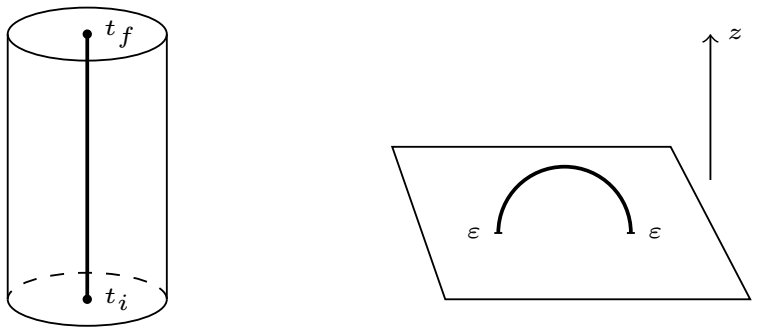

read the original abstract
In this paper we investigate the holographic computation of the two-point functions of $\frac{1}{2}$-BPS chiral primary operators with scaling dimensions $\Delta \sim N$ or $\Delta \sim N^2$ in $\mathcal{N}=4$ $SU(N)$ SYM using Type IIB supergravity. First we consider giant graviton operators, resolving ambiguities in the previous literature on holographic computation of the two-point function, and make a new proposal for this calculation. We argue that the D3-brane action for the giant gravitons (as well as for their $\frac{1}{4}$- and $\frac{1}{8}$-BPS counterparts) should contain additional boundary terms which arise naturally from the path integral and which are required to make the variational problem well-defined. We derive the form of these terms and show that the corrected action has an on-shell value that reproduces the two-point function of the gauge theory operators. Then we consider operators with $\Delta \sim N^2$ and calculate the two-point function by evaluating the Gibbons-Hawking-York boundary term in the Type IIB pseudo-action in the Lin-Lunin-Maldacena bubbling geometry background.
Editorial analysis
A structured set of objections, weighed in public.
Referee Report
Summary. The paper investigates holographic two-point functions of heavy 1/2-BPS chiral primary operators (Δ ∼ N and Δ ∼ N²) in N=4 SYM via Type IIB supergravity. For giant gravitons and their 1/4- and 1/8-BPS counterparts, it proposes additional boundary terms in the D3-brane action, derived from path-integral considerations to ensure a well-defined variational problem; the on-shell value of the corrected action is shown to reproduce the gauge-theory two-point functions. For Δ ∼ N² operators, the two-point function is computed by evaluating the Gibbons-Hawking-York boundary term in the Lin-Lunin-Maldacena bubbling geometries.
Significance. If the central claims hold, the work supplies a consistent holographic prescription for correlators of heavy operators, resolving prior ambiguities in the literature and extending the dictionary to bubbling geometries. The path-integral origin of the boundary terms and the explicit on-shell matching constitute a concrete technical advance for non-perturbative regimes of AdS/CFT.
major comments (2)
- [Section 3] The derivation of the additional boundary terms for the D3-brane action (presented as arising naturally from the path integral) is load-bearing for the resolution of ambiguities; explicit steps showing how these terms emerge independently of the final correlator value, together with the precise variational problem they correct, must be verified in detail.
- [Section 4, Eq. (4.12)] The claim that the on-shell value of the corrected action reproduces the gauge-theory two-point function exactly requires explicit comparison, including normalization constants and any residual supergravity contributions, against known results for small-N cases or limiting regimes.
minor comments (2)
- [Section 3.4] Notation for the 1/4- and 1/8-BPS cases should be unified with the 1/2-BPS giant-graviton discussion to avoid reader confusion when comparing the boundary-term derivations.
- [Introduction] The abstract and introduction refer to 'resolving ambiguities in the previous literature'; a brief table or paragraph summarizing the specific prior discrepancies addressed would improve clarity.
Simulated Author's Rebuttal
We thank the referee for the careful reading of our manuscript and for the constructive comments. We appreciate the positive assessment of the significance of the work. Below we address the major comments point by point. We will incorporate the requested clarifications and comparisons into a revised version of the manuscript.
read point-by-point responses
-
Referee: [Section 3] The derivation of the additional boundary terms for the D3-brane action (presented as arising naturally from the path integral) is load-bearing for the resolution of ambiguities; explicit steps showing how these terms emerge independently of the final correlator value, together with the precise variational problem they correct, must be verified in detail.
Authors: We agree that Section 3 would benefit from a more expanded, self-contained derivation. In the revised manuscript we will insert a dedicated subsection that begins from the path-integral definition of the D3-brane partition function, isolates the boundary contributions required for a well-posed variational problem (specifically, the fixed embedding coordinates at the AdS boundary), and derives the additional terms without reference to the final two-point-function result. This will make the logical independence of the boundary-term construction explicit. revision: yes
-
Referee: [Section 4, Eq. (4.12)] The claim that the on-shell value of the corrected action reproduces the gauge-theory two-point function exactly requires explicit comparison, including normalization constants and any residual supergravity contributions, against known results for small-N cases or limiting regimes.
Authors: We acknowledge that the current presentation of Eq. (4.12) would be strengthened by direct numerical and analytic comparisons. In the revision we will add an appendix that (i) fixes the overall normalization by matching the leading large-N coefficient to the known gauge-theory result, (ii) verifies the expression in the small-N limit (N=2) where the giant-graviton operator reduces to a single-trace operator, and (iii) explicitly shows that residual bulk supergravity contributions vanish on-shell for the chosen boundary conditions. These checks will be presented alongside the existing on-shell evaluation. revision: yes
Circularity Check
No significant circularity; derivation is self-contained
full rationale
The paper derives additional boundary terms for the D3-brane action directly from path-integral requirements to ensure a well-defined variational problem, then verifies that the on-shell value of the corrected action reproduces the gauge-theory two-point function. This verification is presented as an independent consistency check rather than a definitional or fitted input. No load-bearing steps reduce by construction to the target correlator, no self-citations are invoked to justify uniqueness or ansatzes, and the central construction relies on standard holographic principles without renaming known results or smuggling assumptions. The chain is therefore self-contained against external benchmarks.
Axiom & Free-Parameter Ledger
axioms (2)
- domain assumption The variational problem for the D3-brane action is ill-defined without additional boundary terms that arise from the path integral.
- domain assumption The on-shell value of the corrected brane action equals the two-point function of the dual gauge theory operators.
Lean theorems connected to this paper
-
IndisputableMonolith/Cost/FunctionalEquation.leanwashburn_uniqueness_aczel unclear?
unclearRelation between the paper passage and the cited Recognition theorem.
We argue that the D3-brane action ... should contain additional boundary terms which arise naturally from the path integral and which are required to make the variational problem well-defined. ... the corrected action has an on-shell value that reproduces the two-point function
-
IndisputableMonolith/Foundation/AbsoluteFloorClosure.leanreality_from_one_distinction unclear?
unclearRelation between the paper passage and the cited Recognition theorem.
the bulk action vanishes on-shell and the two-point function behavior comes from the Gibbons-Hawking-York boundary term
What do these tags mean?
- matches
- The paper's claim is directly supported by a theorem in the formal canon.
- supports
- The theorem supports part of the paper's argument, but the paper may add assumptions or extra steps.
- extends
- The paper goes beyond the formal theorem; the theorem is a base layer rather than the whole result.
- uses
- The paper appears to rely on the theorem as machinery.
- contradicts
- The paper's claim conflicts with a theorem or certificate in the canon.
- unclear
- Pith found a possible connection, but the passage is too broad, indirect, or ambiguous to say the theorem truly supports the claim.
Reference graph
Works this paper leans on
-
[1]
J. M. Maldacena,The LargeNlimit of superconformal field theories and supergravity, Adv. Theor. Math. Phys.2(1998) 231–252, [hep-th/9711200]
work page internal anchor Pith review Pith/arXiv arXiv 1998
-
[2]
S. S. Gubser, I. R. Klebanov, and A. M. Polyakov,Gauge theory correlators from noncritical string theory,Phys. Lett. B428(1998) 105–114, [hep-th/9802109]
work page internal anchor Pith review Pith/arXiv arXiv 1998
-
[3]
Anti De Sitter Space And Holography
E. Witten,Anti de Sitter space and holography,Adv. Theor. Math. Phys.2(1998) 253–291, [hep-th/9802150]. 17
work page internal anchor Pith review Pith/arXiv arXiv 1998
-
[4]
Exact Correlators of Giant Gravitons from dual N=4 SYM
S. Corley, A. Jevicki, and S. Ramgoolam,Exact correlators of giant gravitons from dual N=4 SYM theory,Adv. Theor. Math. Phys.5(2002) 809–839, [hep-th/0111222]
work page internal anchor Pith review Pith/arXiv arXiv 2002
-
[5]
A toy model for the AdS/CFT correspondence
D. Berenstein,A Toy model for the AdS / CFT correspondence,JHEP07(2004) 018, [hep-th/0403110]
work page internal anchor Pith review Pith/arXiv arXiv 2004
-
[6]
Invasion of the Giant Gravitons from Anti-de Sitter Space
J. McGreevy, L. Susskind, and N. Toumbas,Invasion of the giant gravitons from Anti-de Sitter space,JHEP06(2000) 008, [hep-th/0003075]
work page internal anchor Pith review Pith/arXiv arXiv 2000
-
[7]
M. T. Grisaru, R. C. Myers, and O. Tafjord,SUSY and goliath,JHEP08(2000) 040, [hep-th/0008015]
work page internal anchor Pith review Pith/arXiv arXiv 2000
-
[8]
Large branes in AdS and their field theory dual
A. Hashimoto, S. Hirano, and N. Itzhaki,Large branes in AdS and their field theory dual,JHEP08(2000) 051, [hep-th/0008016]
work page internal anchor Pith review Pith/arXiv arXiv 2000
-
[9]
Giant Gravitons in Conformal Field Theory
V. Balasubramanian, M. Berkooz, A. Naqvi, and M. J. Strassler,Giant gravitons in conformal field theory,JHEP04(2002) 034, [hep-th/0107119]
work page internal anchor Pith review Pith/arXiv arXiv 2002
-
[10]
Holographic three-point functions of giant gravitons
A. Bissi, C. Kristjansen, D. Young, and K. Zoubos,Holographic three-point functions of giant gravitons,JHEP06(2011) 085, [arXiv:1103.4079]
work page internal anchor Pith review Pith/arXiv arXiv 2011
-
[11]
M. M. Caldarelli and P. J. Silva,Multi-giant graviton systems, SUSY breaking and CFT,JHEP02(2004) 052, [hep-th/0401213]
work page internal anchor Pith review Pith/arXiv arXiv 2004
-
[12]
D. Bak, B. Chen, and J.-B. Wu,Holographic Correlation Functions for Open Strings and Branes,JHEP06(2011) 014, [arXiv:1103.2024]
work page internal anchor Pith review Pith/arXiv arXiv 2011
- [13]
- [14]
-
[15]
T. Klose and T. McLoughlin,A light-cone approach to three-point functions in AdS5 x S5,JHEP04(2012) 080, [arXiv:1106.0495]
-
[16]
J. Abajian, F. Aprile, R. C. Myers, and P. Vieira,Holography and correlation functions of huge operators: spacetime bananas,JHEP12(2023) 058, [arXiv:2306.15105]
-
[17]
J. Abajian, F. Aprile, R. C. Myers, and P. Vieira,Correlation functions of huge operators in AdS3/CFT2: domes, doors and book pages,JHEP03(2024) 118, [arXiv:2307.13188]
- [18]
-
[19]
K. Skenderis and M. Taylor,Kaluza-Klein holography,JHEP05(2006) 057, [hep-th/0603016]. 18
work page internal anchor Pith review Pith/arXiv arXiv 2006
-
[20]
(Un)solvable Matrix Models for BPS Correlators
P. Anempodistov, A. Holguin, V. Kazakov, and H. Murali,(Un)solvable Matrix Models for BPS Correlators,JHEP04(2026) 069, [arXiv:2508.20094]
work page internal anchor Pith review Pith/arXiv arXiv 2026
-
[21]
V. Kazakov, H. Murali, and P. Vieira,Huge BPS operators and fluid dynamics in N= 4SYM,JHEP09(2025) 142, [arXiv:2406.01798]
-
[22]
Holguin,Semiclassics, branes, and extremality,arXiv:2512.24979
A. Holguin,Semiclassics, branes, and extremality,arXiv:2512.24979
- [23]
- [24]
-
[25]
D. Turton and A. Tyukov,Four-point correlators inN= 4 SYM from AdS5 bubbling geometries,JHEP10(2024) 244, [arXiv:2408.16834]
-
[26]
D. Turton and A. Tyukov,Precision holography of AdS5 bubbling geometries,JHEP07 (2025) 027, [arXiv:2503.19760]
-
[27]
D. Turton and A. Tyukov,Holographic correlators from multi-mode AdS5 bubbling geometries,arXiv:2512.19392
- [28]
-
[29]
A Calibration Bound for the M-Theory Fivebrane
O. Barwald, N. D. Lambert, and P. C. West,A Calibration bound for the M theory five-brane,Phys. Lett. B463(1999) 33–40, [hep-th/9907170]
work page internal anchor Pith review Pith/arXiv arXiv 1999
-
[30]
J. Dadok and F. R. Harvey,Calibrations and spinors,Acta Mathematica170(1993), no. 1 83 – 120
work page 1993
-
[31]
Simon,Brane Effective Actions, Kappa-Symmetry and Applications,Living Rev
J. Simon,Brane Effective Actions, Kappa-Symmetry and Applications,Living Rev. Rel. 15(2012) 3, [arXiv:1110.2422]
-
[32]
R. Harvey and H. B. Lawson,Calibrated geometries,Acta Mathematica148(1982) 47 – 157
work page 1982
-
[33]
Stable D-branes, calibrations and generalized Calabi-Yau geometry
P. Koerber,Stable D-branes, calibrations and generalized Calabi-Yau geometry,JHEP 08(2005) 099, [hep-th/0506154]
work page internal anchor Pith review Pith/arXiv arXiv 2005
-
[34]
Supersymmetric D-branes and calibrations on general N=1 backgrounds
L. Martucci and P. Smyth,Supersymmetric D-branes and calibrations on general N=1 backgrounds,JHEP11(2005) 048, [hep-th/0507099]
work page internal anchor Pith review Pith/arXiv arXiv 2005
-
[35]
Kappa symmetry, generalized calibrations and spinorial geometry
G. Papadopoulos and P. Sloane,Kappa symmetry, generalized calibrations and spinorial geometry,JHEP05(2006) 050, [hep-th/0601164]
work page internal anchor Pith review Pith/arXiv arXiv 2006
-
[36]
Branes in AdS and pp-wave spacetimes
K. Skenderis and M. Taylor,Branes in AdS and p p wave space-times,JHEP06(2002) 025, [hep-th/0204054]. 19
work page internal anchor Pith review Pith/arXiv arXiv 2002
-
[37]
Giant Gravitons from Holomorphic Surfaces
A. Mikhailov,Giant gravitons from holomorphic surfaces,JHEP11(2000) 027, [hep-th/0010206]
work page internal anchor Pith review Pith/arXiv arXiv 2000
-
[38]
K. Skenderis and M. Taylor,Anatomy of bubbling solutions,JHEP09(2007) 019, [arXiv:0706.0216]
work page internal anchor Pith review Pith/arXiv arXiv 2007
-
[39]
C. Bachas and Z. Chen,Invariant tensions from holography,JHEP08(2024) 028, [arXiv:2404.14998]. [Erratum: JHEP 11, 022 (2024)]
- [40]
- [41]
-
[42]
Izquierdo Garcıa,Higher dimensional holography,arXiv:2512.12696
R. Izquierdo Garcıa,Higher dimensional holography,arXiv:2512.12696
- [43]
-
[44]
M. Henneaux and C. Teitelboim,Dynamics of Chiral (Selfdual)PForms,Phys. Lett. B206(1988) 650–654. 20
work page 1988
discussion (0)
Sign in with ORCID, Apple, or X to comment. Anyone can read and Pith papers without signing in.