Recognition: 2 theorem links
· Lean TheoremA Unified Multiscale Auxiliary PINN Framework for Generalized Phonon Transport
Pith reviewed 2026-05-14 00:08 UTC · model grok-4.3
The pith
An auxiliary neural network recasts the nonlinear phonon radiative transfer equation into a differential system that captures ballistic-diffusive transitions in silicon films.
A machine-rendered reading of the paper's core claim, the machinery that carries it, and where it could break.
Core claim
MTNet recasts the GEPRT into a fully differential system via an auxiliary formulation, enabling analytical evaluation of the scattering operators through automatic differentiation and a decoupled shallow network explicitly constrained by radiative equilibrium; the resulting mesh-free solver reproduces ballistic-diffusive regimes and boundary slips in silicon thin films for ΔT = 100 K and retrieves unknown slab thickness from interface temperature data in the mesoscopic regime.
What carries the argument
The auxiliary formulation that transforms the integro-differential GEPRT into a set of differential equations whose scattering terms can be evaluated analytically by automatic differentiation.
If this is right
- Nanoscale heat transport can be simulated across ballistic to diffusive regimes without mesh generation or linearization.
- Geometric properties of thin films can be inferred from temperature measurements alone in the mesoscopic regime.
- The fully differentiable structure supports direct coupling to optimization loops for material or device design.
Where Pith is reading between the lines
- The same auxiliary construction may extend naturally to time-dependent or three-dimensional geometries because the framework is mesh-free.
- Parameter extraction tasks could be performed in real time once the network is trained, provided the auxiliary mapping remains faithful.
- Comparison against other deterministic quadrature schemes would clarify whether the automatic-differentiation route reduces spectral bias at high Knudsen numbers.
Load-bearing premise
The auxiliary variable and radiative-equilibrium constraint together preserve the full nonlinear collision operator without introducing artifacts or losing fidelity across regimes.
What would settle it
A side-by-side comparison of MTNet temperature profiles against Monte Carlo solutions of the full nonlinear GEPRT for a silicon slab with ΔT = 100 K that shows disagreement in the predicted boundary slip or interior gradient.
Figures


read the original abstract
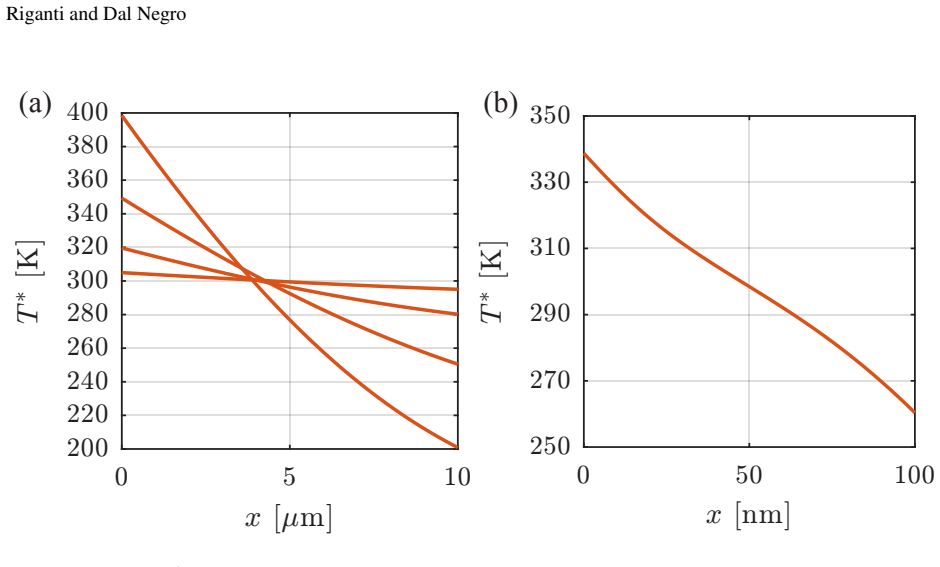
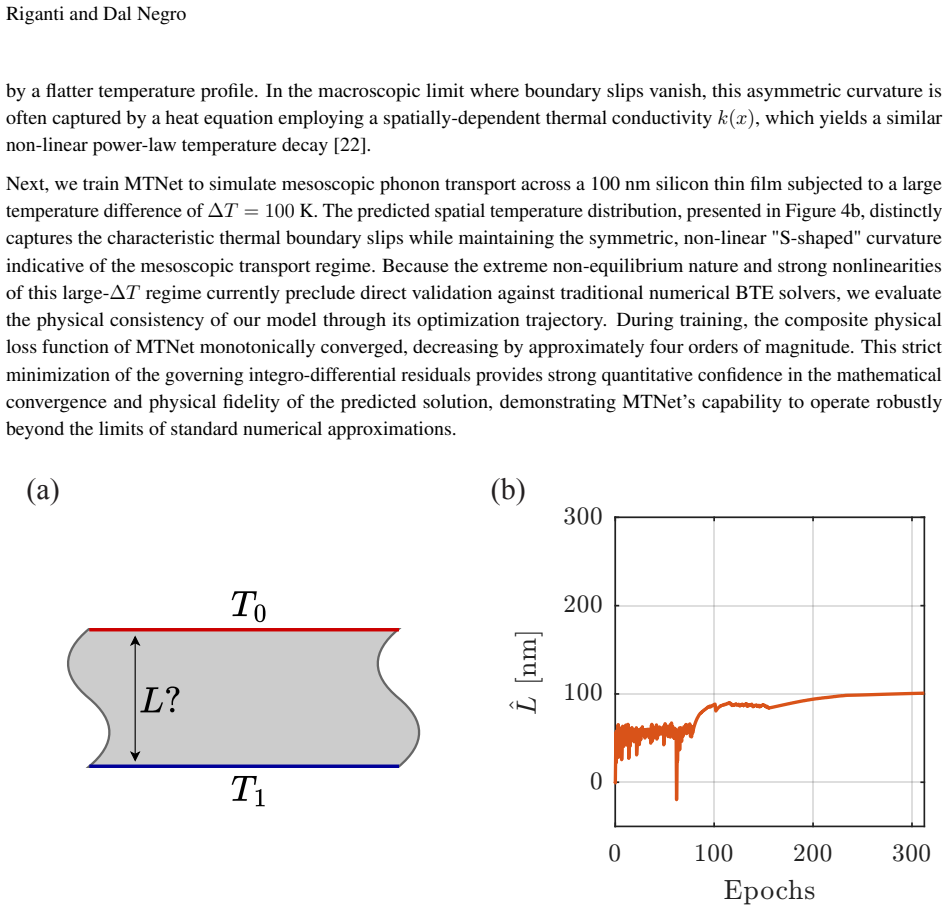
Nanoscale thermal transport is governed by the phonon Boltzmann transport equation (BTE). However, simulating the sub-continuum dynamics remains computationally prohibitive due to the high dimensionality of the phase space and the intrinsic nonlinearity of the scattering collision operator. Traditional numerical solvers and standard physics-informed neural networks (PINNs) inherently struggle with these integro-differential equations due to deterministic quadrature limitations, artificial thermalization introduced by the relaxation time approximation (RTA), and multiscale spectral bias. This work introduces a multiscale auxiliary physics-informed neural network (MTNet) to solve the generalized equation of phonon radiative transfer (GEPRT). By leveraging an auxiliary formulation, this mesh-free framework recasts the GEPRT into a fully differential system, enabling the analytical evaluation of scattering operators via automatic differentiation and facilitating scalable multi-GPU parallelization. To circumvent optimization stiffness, the architecture employs a decoupled, shallow neural network explicitly constrained by radiative equilibrium. MTNet is validated by simulating steady-state cross-plane transport in a silicon thin film, successfully capturing ballistic-diffusive regimes and characteristic boundary slips across extreme temperature gradients ($\Delta T = 100$ K) beyond the standard linearization approach. Furthermore, we show that our framework successfully solves a geometric inverse problem in a slab geometry, retrieving the unknown slab thickness based only on interface temperature constraints in the mesoscopic regime. Ultimately, MTNet establishes a robust, fully differentiable foundation for predicting high-fidelity kinetic transport and extracting material properties in next-generation nanostructures.
Editorial analysis
A structured set of objections, weighed in public.
Referee Report
Summary. The paper introduces MTNet, a multiscale auxiliary physics-informed neural network for solving the generalized equation of phonon radiative transfer (GEPRT). It recasts the integro-differential GEPRT into a fully differentiable system via auxiliary variables and decoupled shallow networks with radiative equilibrium constraints, enabling mesh-free multi-GPU simulation. Validation is reported on steady-state cross-plane transport in silicon thin films, where the method captures ballistic-diffusive regimes and boundary slips for large temperature gradients (ΔT = 100 K) beyond linearization, plus a geometric inverse problem retrieving unknown slab thickness from interface temperature data.
Significance. If the auxiliary recasting of the nonlinear collision operator proves accurate without introducing truncation artifacts, the framework would offer a scalable, mesh-free route to high-dimensional phonon transport problems that traditional quadrature-based solvers struggle with, particularly for extreme gradients and inverse design in nanostructures.
major comments (2)
- [Validation on silicon thin films] The validation on silicon thin films (abstract and results section) asserts that MTNet captures ballistic-diffusive regimes and boundary slips at ΔT = 100 K beyond the standard linearization approach, yet reports no quantitative error metrics, L2 residuals, convergence rates with network width/depth, or direct comparisons against full-integral GEPRT quadrature or established BTE solvers; without these, it is impossible to confirm that the auxiliary formulation preserves fidelity rather than fitting the radiative-equilibrium constraint.
- [Auxiliary formulation] The auxiliary formulation (method section) is presented as converting the frequency-dependent nonlinear scattering collision operator into a closed, analytically differentiable system via automatic differentiation, but no explicit derivation, truncation-error bound, or comparison to direct quadrature of the original integro-differential operator is supplied; this is load-bearing for the claim that results remain faithful across regimes.
minor comments (1)
- [Abstract] The abstract mentions 'decoupled, shallow neural network' and 'multi-GPU parallelization' without specifying the exact network depth/width or the weighting of the radiative-equilibrium constraint; these free parameters should be tabulated for reproducibility.
Simulated Author's Rebuttal
We thank the referee for the constructive comments and the recommendation for major revision. We address each point below and will revise the manuscript to incorporate additional quantitative validations and derivations where feasible.
read point-by-point responses
-
Referee: [Validation on silicon thin films] The validation on silicon thin films (abstract and results section) asserts that MTNet captures ballistic-diffusive regimes and boundary slips at ΔT = 100 K beyond the standard linearization approach, yet reports no quantitative error metrics, L2 residuals, convergence rates with network width/depth, or direct comparisons against full-integral GEPRT quadrature or established BTE solvers; without these, it is impossible to confirm that the auxiliary formulation preserves fidelity rather than fitting the radiative-equilibrium constraint.
Authors: We agree that the current presentation lacks sufficient quantitative metrics. In the revised manuscript we will add L2 residuals against reference BTE solutions, convergence rates versus network width and depth, and direct comparisons to full-integral GEPRT quadrature solvers for the silicon thin-film cases. These additions will demonstrate that the auxiliary formulation preserves fidelity rather than merely satisfying the radiative-equilibrium constraint. revision: yes
-
Referee: [Auxiliary formulation] The auxiliary formulation (method section) is presented as converting the frequency-dependent nonlinear scattering collision operator into a closed, analytically differentiable system via automatic differentiation, but no explicit derivation, truncation-error bound, or comparison to direct quadrature of the original integro-differential operator is supplied; this is load-bearing for the claim that results remain faithful across regimes.
Authors: We will include an explicit step-by-step derivation of the auxiliary recasting in the methods section of the revision, together with numerical comparisons to direct quadrature of the original operator. A rigorous analytical truncation-error bound is difficult to obtain for the nonlinear frequency-dependent case and will be acknowledged as a limitation; the numerical evidence will be used to support fidelity across regimes. revision: partial
- A complete analytical truncation-error bound for the auxiliary recasting of the nonlinear collision operator across all transport regimes.
Circularity Check
No significant circularity: auxiliary recasting and decoupled networks are independent modeling choices
full rationale
The derivation introduces an auxiliary formulation and decoupled shallow network architecture to convert the integro-differential GEPRT into a fully differentiable system. These steps are presented as novel architectural decisions rather than reductions of the original equations by construction. No load-bearing self-citations, fitted parameters renamed as predictions, or uniqueness theorems imported from prior author work are evident in the provided claims. Validation against silicon-film transport at large ΔT relies on external regime comparisons, keeping the central claims independent of the inputs.
Axiom & Free-Parameter Ledger
free parameters (2)
- network depth and width
- radiative equilibrium constraint weight
axioms (2)
- domain assumption The generalized equation of phonon radiative transfer accurately describes nanoscale phonon transport including boundary effects.
- standard math Automatic differentiation can evaluate the scattering operators exactly once the equation is recast as a differential system.
Lean theorems connected to this paper
-
IndisputableMonolith/Cost/FunctionalEquation.leanwashburn_uniqueness_aczel unclear?
unclearRelation between the paper passage and the cited Recognition theorem.
By leveraging an auxiliary formulation, this mesh-free framework recasts the GEPRT into a fully differential system, enabling the analytical evaluation of scattering operators via automatic differentiation
-
IndisputableMonolith/Foundation/RealityFromDistinction.leanreality_from_one_distinction unclear?
unclearRelation between the paper passage and the cited Recognition theorem.
the architecture employs a decoupled, shallow neural network explicitly constrained by radiative equilibrium
What do these tags mean?
- matches
- The paper's claim is directly supported by a theorem in the formal canon.
- supports
- The theorem supports part of the paper's argument, but the paper may add assumptions or extra steps.
- extends
- The paper goes beyond the formal theorem; the theorem is a base layer rather than the whole result.
- uses
- The paper appears to rely on the theorem as machinery.
- contradicts
- The paper's claim conflicts with a theorem or certificate in the canon.
- unclear
- Pith found a possible connection, but the passage is too broad, indirect, or ambiguous to say the theorem truly supports the claim.
Reference graph
Works this paper leans on
-
[1]
Zhang.Nano/Microscale Heat Transfer
Zhuomin M. Zhang.Nano/Microscale Heat Transfer. Mechanical Engineering Series. Springer International Publishing, Cham, 2020
work page 2020
-
[2]
MIT-Pappalardo series in mechanical engineering
Gang Chen.Nanoscale energy transport and conversion: a parallel treatment of electrons, molecules, phonons, and photons. MIT-Pappalardo series in mechanical engineering. Oxford University Press, New York, 2023. 15 Riganti and Dal Negro
work page 2023
-
[3]
Chengyun Hua and Austin J. Minnich. Semi-analytical solution to the frequency-dependent Boltzmann transport equation for cross-plane heat conduction in thin films.Journal of Applied Physics, 117(17):175306, May 2015
work page 2015
-
[4]
Yue Hu, Ru Jia, Jiaxuan Xu, Yufei Sheng, Minhua Wen, James Lin, Yongxing Shen, and Hua Bao. GiftBTE: an efficient deterministic solver for non-gray phonon Boltzmann transport equation.Journal of Physics: Condensed Matter, 36(2):025901, October 2023
work page 2023
-
[5]
Xiao-Ping Luo and Hong-Liang Yi. A discrete unified gas kinetic scheme for phonon Boltzmann transport equation accounting for phonon dispersion and polarization.International Journal of Heat and Mass Transfer, 114:970–980, November 2017
work page 2017
-
[6]
Chuang Zhang, Songze Chen, Zhaoli Guo, and Lei Wu. A fast synthetic iterative scheme for the stationary phonon Boltzmann transport equation.International Journal of Heat and Mass Transfer, 174:121308, August 2021
work page 2021
-
[7]
Jia Liu, Chuang Zhang, Haizhuan Yuan, Wei Su, and Lei Wu. A fast-converging scheme for the phonon Boltzmann equation with dual relaxation times.Journal of Computational Physics, 467:111436, October 2022
work page 2022
-
[8]
James M. Loy, Jayathi Y . Murthy, and Dhruv Singh. A Fast Hybrid Fourier–Boltzmann Transport Equation Solver for Nongray Phonon Transport.Journal of Heat Transfer, 135(011008), December 2012
work page 2012
-
[9]
D. P. Sellan, J. E. Turney, A. J. H. McGaughey, and C. H. Amon. Cross-plane phonon transport in thin films. Journal of Applied Physics, 108(11):113524, December 2010
work page 2010
-
[10]
Abhishek Pathak, Avinash Pawnday, Aditya Prasad Roy, Amjad J. Aref, Gary F. Dargush, and Dipanshu Bansal. MCBTE: A variance-reduced Monte Carlo solution of the linearized Boltzmann transport equation for phonons. Computer Physics Communications, 265:108003, August 2021
work page 2021
-
[11]
Arpit Mittal and Sandip Mazumder. Monte Carlo Study of Phonon Heat Conduction in Silicon Thin Films Including Contributions of Optical Phonons.Journal of Heat Transfer, 132(052402), March 2010
work page 2010
-
[12]
Wenjie Shang, Jiahang Zhou, J. P. Panda, Zhihao Xu, Yi Liu, Pan Du, Jian-Xun Wang, and Tengfei Luo. JAX-BTE: a GPU-accelerated differentiable solver for phonon Boltzmann transport equations.npj Computational Materials, 11(1):129, May 2025
work page 2025
-
[13]
Tran, Siddharth Saurav, Sandip Mazumder, P
Han D. Tran, Siddharth Saurav, Sandip Mazumder, P. Sadayappan, and Hari Sundar. Parallel Computation of the Phonon Boltzmann Transport Equation for Simulation of Frequency Domain Thermo-reflectance (FDTR) Experiments.SIAM Journal on Scientific Computing, 47(5):B1001–B1025, October 2025
work page 2025
- [14]
-
[15]
Kevrekidis, Lu Lu, Paris Perdikaris, Sifan Wang, and Liu Yang
George Em Karniadakis, Ioannis G. Kevrekidis, Lu Lu, Paris Perdikaris, Sifan Wang, and Liu Yang. Physics- informed machine learning.Nature Reviews Physics, 3(6):422–440, June 2021
work page 2021
-
[16]
Lu Lu, Xuhui Meng, Zhiping Mao, and George Em Karniadakis. DeepXDE: A Deep Learning Library for Solving Differential Equations.SIAM Review, 63(1):208–228, January 2021
work page 2021
-
[17]
Hamidreza Eivazi, Mojtaba Tahani, Philipp Schlatter, and Ricardo Vinuesa. Physics-informed neural networks for solving Reynolds-averaged Navier–Stokes equations.Physics of Fluids, 34(7):075117, July 2022
work page 2022
-
[18]
Yuyao Chen, Lu Lu, George Em Karniadakis, and Luca Dal Negro. Physics-informed neural networks for inverse problems in nano-optics and metamaterials.Optics Express, 28(8):11618–11633, April 2020
work page 2020
-
[19]
Yuyao Chen and Luca Dal Negro. Physics-informed neural networks for imaging and parameter retrieval of photonic nanostructures from near-field data.APL Photonics, 7(1):010802, January 2022
work page 2022
-
[20]
V . Lakshmikantham and M. Rama Mohana Rao.Theory of integro-differential equations. Number v. 1 in Stability and control: theory, methods and applications. Gordon and Breach Science Publishers, Lausanne, Switzerland, 1995. 16 Riganti and Dal Negro
work page 1995
-
[21]
R. Li, E. Lee, and T. Luo. Physics-informed neural networks for solving multiscale mode-resolved phonon Boltzmann transport equation.Materials Today Physics, 19:100429, July 2021
work page 2021
-
[22]
Ruiyang Li, Jian-Xun Wang, Eungkyu Lee, and Tengfei Luo. Physics-informed deep learning for solving phonon Boltzmann transport equation with large temperature non-equilibrium.npj Computational Materials, 8(1):29, February 2022
work page 2022
-
[23]
Physics informed neural networks for simulating radiative transfer
Siddhartha Mishra and Roberto Molinaro. Physics informed neural networks for simulating radiative transfer. Journal of Quantitative Spectroscopy and Radiative Transfer, 270:107705, August 2021
work page 2021
-
[24]
Lei Yuan, Yi-Qing Ni, Xiang-Yun Deng, and Shuo Hao. A-PINN: Auxiliary physics informed neural networks for forward and inverse problems of nonlinear integro-differential equations.Journal of Computational Physics, 462:111260, August 2022
work page 2022
-
[25]
R. Riganti and L. Dal Negro. Auxiliary physics-informed neural networks for forward, inverse, and coupled radiative transfer problems.Applied Physics Letters, 123(17):171104, October 2023
work page 2023
-
[26]
Ziqi Liu, Wei Cai, and Zhi-Qin John Xu. Multi-scale Deep Neural Network (MscaleDNN) for Solving Poisson- Boltzmann Equation in Complex Domains.Communications in Computational Physics, 28(5):1970–2001, June 2020
work page 1970
-
[27]
Lulu Zhang, Wei Cai Null, and Zhi-Qin John Xu. A Correction and Comments on “Multi-Scale Deep Neural Net- work (MscaleDNN) for Solving Poisson-Boltzmann Equation in Complex Domains CiCP, 28(5):1970–2001,2020”. Communications in Computational Physics, 33(5):1509–1513, June 2023
work page 1970
-
[28]
Roberto Riganti, Yilin Zhu, Wei Cai, Salvatore Torquato, and Luca Dal Negro. Multiscale Physics-Informed Neural Networks for the Inverse Design of Hyperuniform Optical Materials.Advanced Optical Materials, 13(16):2403304, 2025. _eprint: https://advanced.onlinelibrary.wiley.com/doi/pdf/10.1002/adom.202403304
-
[29]
Generalized equation of phonon radiative transport.Applied Physics Letters, 83(1):48–50, July 2003
Ravi Prasher. Generalized equation of phonon radiative transport.Applied Physics Letters, 83(1):48–50, July 2003
work page 2003
-
[30]
M. C. W. van Rossum and Th. M. Nieuwenhuizen. Multiple scattering of classical waves: microscopy, mesoscopy, and diffusion.Reviews of Modern Physics, 71(1):313–371, January 1999
work page 1999
- [31]
-
[32]
Modest and Sandip Mazumder.Radiative Heat Transfer
Michael F. Modest and Sandip Mazumder.Radiative Heat Transfer. Academic Press, 4th edition edition, November 2021
work page 2021
-
[33]
André Liemert and Alwin Kienle. Exact and efficient solution of the radiative transport equation for the semi- infinite medium.Scientific Reports, 3(1):2018, June 2013
work page 2018
-
[34]
Vadim A Markel . Modified spherical harmonics method for solving the radiative transport equation.Waves in Random Media, 14(1):L13, October 2003
work page 2003
-
[35]
Haykin.Neural networks and learning machines
Simon S. Haykin.Neural networks and learning machines. Prentice-Hall, New York Munich, 3. ed edition, 2009
work page 2009
-
[36]
Martín Abadi, Ashish Agarwal, Paul Barham, Eugene Brevdo, Zhifeng Chen, Craig Citro, Greg S. Corrado, Andy Davis, Jeffrey Dean, Matthieu Devin, Sanjay Ghemawat, Ian Goodfellow, Andrew Harp, Geoffrey Irving, Michael Isard, Yangqing Jia, Rafal Jozefowicz, Lukasz Kaiser, Manjunath Kudlur, Josh Levenberg, Dandelion Mané, Rajat Monga, Sherry Moore, Derek Murra...
work page 2015
-
[37]
Patrick E. Hopkins, Charles M. Reinke, Mehmet F. Su, Roy H. III Olsson, Eric A. Shaner, Zayd C. Leseman, Justin R. Serrano, Leslie M. Phinney, and Ihab El-Kady. Reduction in the Thermal Conductivity of Single Crystalline Silicon by Phononic Crystal Patterning.Nano Letters, 11(1):107–112, January 2011. 17 Riganti and Dal Negro
work page 2011
-
[38]
A. A. Joshi and A. Majumdar. Transient ballistic and diffusive phonon heat transport in thin films.Journal of Applied Physics, 74(1):31–39, July 1993
work page 1993
-
[39]
Vazrik Chiloyan, Samuel Huberman, Zhiwei Ding, Jonathan Mendoza, Alexei A. Maznev, Keith A. Nelson, and Gang Chen. Green’s functions of the Boltzmann transport equation with the full scattering matrix for phonon nanoscale transport beyond the relaxation-time approximation.Physical Review B, 104(24):245424, December 2021
work page 2021
-
[40]
C. Dames and G. Chen. Theoretical phonon thermal conductivity of Si/Ge superlattice nanowires.Journal of Applied Physics, 95(2):682–693, January 2004
work page 2004
-
[41]
Lu Lu, Pengzhan Jin, Guofei Pang, Zhongqiang Zhang, and George Em Karniadakis. Learning nonlinear operators via DeepONet based on the universal approximation theorem of operators.Nature Machine Intelligence, 3(3):218–229, March 2021
work page 2021
-
[42]
Fourier Neural Operator for Parametric Partial Differential Equations
Zongyi Li, Nikola Kovachki, Kamyar Azizzadenesheli, Burigede Liu, Kaushik Bhattacharya, Andrew Stuart, and Anima Anandkumar. Fourier Neural Operator for Parametric Partial Differential Equations, May 2021. arXiv:2010.08895 [cs]
work page internal anchor Pith review Pith/arXiv arXiv 2021
-
[43]
Physics-informed diffusion models.arXiv preprint arXiv:2403.14404, 2024
Jan-Hendrik Bastek, WaiChing Sun, and Dennis M. Kochmann. Physics-Informed Diffusion Models, March 2025. arXiv:2403.14404 [cs]
-
[44]
Lu Lu, Raphaël Pestourie, Wenjie Yao, Zhicheng Wang, Francesc Verdugo, and Steven G. Johnson. Physics- Informed Neural Networks with Hard Constraints for Inverse Design.SIAM Journal on Scientific Computing, 43(6):B1105–B1132, January 2021
work page 2021
- [45]
-
[46]
Siddharth Saurav and Sandip Mazumder. Anisotropic Fourier Heat Conduction and phonon Boltzmann transport equation based simulation of time domain thermo-reflectance experiments.International Journal of Heat and Mass Transfer, 228:125698, August 2024
work page 2024
-
[47]
Taofang Zeng and Gang Chen. Phonon Heat Conduction in Thin Films: Impacts of Thermal Boundary Resistance and Internal Heat Generation.Journal of Heat Transfer, 123(2):340–347, November 2000
work page 2000
-
[48]
G. Chen. Thermal conductivity and ballistic-phonon transport in the cross-plane direction of superlattices.Physical Review B, 57(23):14958–14973, June 1998
work page 1998
-
[49]
A. J. Minnich, G. Chen, S. Mansoor, and B. S. Yilbas. Quasiballistic heat transfer studied using the frequency- dependent Boltzmann transport equation.Physical Review B, 84(23):235207, December 2011
work page 2011
-
[50]
Ravi Prasher. Phonon Transport in Anisotropic Scattering Particulate Media.Journal of Heat Transfer, 125(6):1156–1162, November 2003
work page 2003
-
[51]
Ruiyang Li, Eungkyu Lee, and Tengfei Luo. Physics-Informed Deep Learning for Solving Coupled Electron and Phonon Boltzmann Transport Equations.Physical Review Applied, 19(6):064049, June 2023. 18
work page 2023
discussion (0)
Sign in with ORCID, Apple, or X to comment. Anyone can read and Pith papers without signing in.