Recognition: no theorem link
On the Entanglement Entropy Distribution of a Hybrid Quantum Circuit
Pith reviewed 2026-05-14 00:25 UTC · model grok-4.3
The pith
Higher moments of entanglement entropy distribution diagnose measurement-induced phase transitions in hybrid quantum circuits.
A machine-rendered reading of the paper's core claim, the machinery that carries it, and where it could break.
Core claim
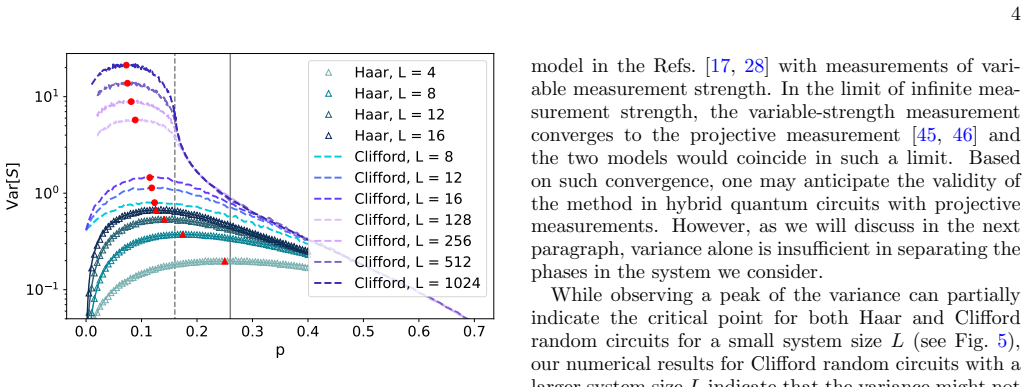
Higher moments of the entanglement entropy distribution, such as the ratio between the variance and the mean and the skewness, capture nontrivial features of the measurement-induced dynamics that are invisible to the mean entropy alone and can serve as effective diagnostics of measurement-induced entanglement transitions.
What carries the argument
The full distribution of entanglement entropy, tracked via its variance-to-mean ratio and skewness, together with a phenomenological model for measurements in the area-law regime combined with the directed polymer in a random environment description of the volume-law phase.
If this is right
- The variance-to-mean ratio and skewness take distinct, robust values in the volume-law phase compared with the area-law phase.
- These higher moments remain useful diagnostics even when the mean entropy alone does not clearly mark the transition.
- The phenomenological model for the area-law regime plus the directed-polymer description reproduces simulation results throughout the phase diagram.
- Measurement-induced transitions can be located using statistics beyond the average entanglement entropy.
Where Pith is reading between the lines
- Similar higher-moment diagnostics could be tested in other monitored quantum systems to locate transitions without full state tomography.
- The link to directed-polymer models suggests that classical statistical-mechanics tools may help predict fluctuation properties in more complex quantum circuits.
- Experimental platforms with controllable measurements might measure these skewness or variance ratios directly to map phase boundaries.
Load-bearing premise
The phenomenological model for the area-law regime, when combined with the directed polymer description, accurately reproduces the higher-moment behaviors across the phase diagram.
What would settle it
Numerical data or an experiment in which the variance-to-mean ratio or skewness fails to follow the distinct behaviors predicted for the volume-law versus area-law regimes by the combined model.
Figures





read the original abstract
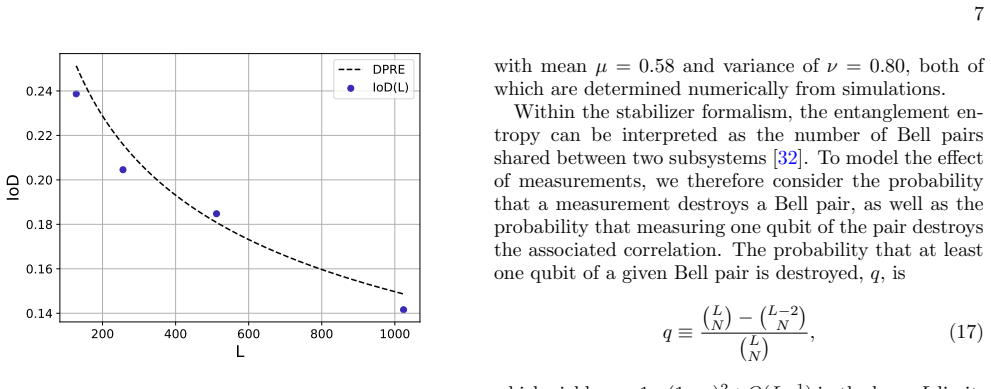
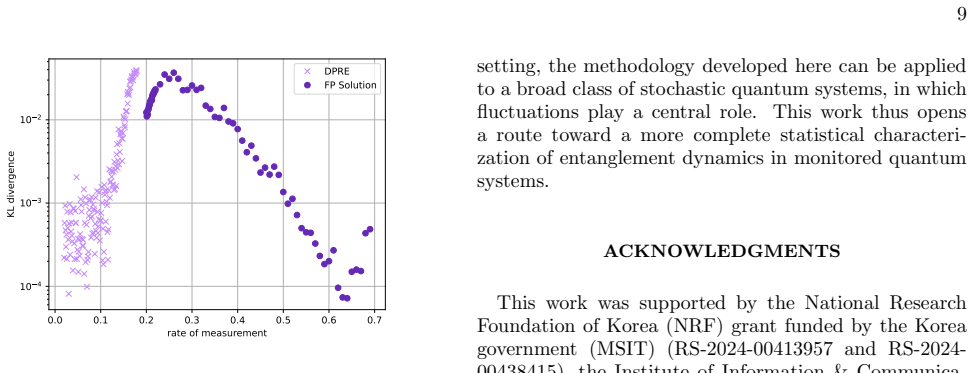
We investigate the distribution of entanglement entropy in hybrid quantum circuits consisting of random unitary gates and local measurements applied at a finite rate. We demonstrate that higher moments of the entanglement entropy distribution, such as the ratio between the variance and the mean and the skewness, capture nontrivial features of the measurement-induced dynamics that are invisible to the mean entropy alone. We demonstrate that these quantities exhibit distinct and robust behaviors across the volume-law and area-law phases, and can serve as effective diagnostics of measurement-induced entanglement transitions. We propose a phenomenological model describing the effect of measurements in the area-law regime, which, when combined with the directed polymer in a random environment description of the volume-law phase, well matches numerical simulations across the entire phase diagram.
Editorial analysis
A structured set of objections, weighed in public.
Referee Report
Summary. The manuscript investigates the distribution of entanglement entropy in hybrid quantum circuits consisting of random unitary gates and local measurements applied at finite rate. It claims that higher moments of this distribution, such as the variance-to-mean ratio and skewness, capture nontrivial features of the measurement-induced dynamics invisible to the mean entropy alone and can serve as effective diagnostics of the volume-law to area-law transition. A phenomenological model is proposed for the area-law regime that, when combined with the directed polymer in a random environment (DPRE) description for the volume-law phase, reproduces numerical simulations across the phase diagram.
Significance. If validated, the work offers new observables for characterizing measurement-induced phase transitions beyond mean entanglement entropy, which is a topic of active interest in quantum information and many-body physics. The integration of an established DPRE framework with a new phenomenological description for the area-law phase could provide a practical way to model full distributions, potentially aiding numerical and experimental studies of monitored quantum systems.
major comments (2)
- [Abstract] Abstract: The central claim that higher moments (variance/mean ratio and skewness) reveal dynamics invisible to the mean and that the phenomenological model accurately reproduces them rests on the model's predictive power. The abstract states the model 'well matches' numerics but provides no detail on whether parameters were fixed using only mean-entropy data before testing higher moments; if the same data informed both, the agreement does not establish independent diagnostic value. This requires explicit clarification, e.g., in the methods or results section describing the fitting procedure.
- [Phenomenological model] Phenomenological model (area-law regime): The functional form and any free parameters of the proposed model for the area-law phase must be shown to be fixed independently of the higher-moment data (e.g., via mean entropy or microscopic derivation) before claiming reproduction of variance and skewness across the diagram. Without this, the combination with the DPRE description risks being post-hoc rather than predictive, weakening the assertion that these moments encode new information about the transition.
minor comments (2)
- Define the directed polymer in random environment (DPRE) acronym at first use and briefly recall its key predictions for the volume-law phase to aid readers unfamiliar with the framework.
- Clarify the circuit sizes, number of realizations, and any data-exclusion criteria used in the numerical simulations to allow assessment of statistical reliability for the reported higher moments.
Simulated Author's Rebuttal
We thank the referee for the careful reading and constructive comments on our manuscript. We address the two major comments below and have revised the manuscript to provide the requested explicit clarification on the parameter determination procedure for the phenomenological model.
read point-by-point responses
-
Referee: [Abstract] Abstract: The central claim that higher moments (variance/mean ratio and skewness) reveal dynamics invisible to the mean and that the phenomenological model accurately reproduces them rests on the model's predictive power. The abstract states the model 'well matches' numerics but provides no detail on whether parameters were fixed using only mean-entropy data before testing higher moments; if the same data informed both, the agreement does not establish independent diagnostic value. This requires explicit clarification, e.g., in the methods or results section describing the fitting procedure.
Authors: We agree that explicit clarification of the fitting procedure is essential to establish the predictive power of the model. In the revised manuscript we have added a new subsection titled 'Parameter Determination' in the Methods section. There we state that the functional form of the phenomenological model was chosen on physical grounds (local measurements suppress entanglement growth in the area-law regime) and that all free parameters were obtained by fitting exclusively to the mean entanglement entropy data. These fixed parameters were then used without adjustment to compute the variance-to-mean ratio and skewness, which were compared to separate numerical runs. The fitting protocol, the resulting parameter values, and the cross-validation against higher moments are now documented in detail. revision: yes
-
Referee: [Phenomenological model] Phenomenological model (area-law regime): The functional form and any free parameters of the proposed model for the area-law phase must be shown to be fixed independently of the higher-moment data (e.g., via mean entropy or microscopic derivation) before claiming reproduction of variance and skewness across the diagram. Without this, the combination with the DPRE description risks being post-hoc rather than predictive, weakening the assertion that these moments encode new information about the transition.
Authors: We accept this criticism and have strengthened the manuscript accordingly. The revised text now contains an explicit statement that the model parameters were determined solely from mean-entropy fits performed on data sets independent of the variance and skewness calculations. We also include a supplementary figure that overlays the mean-entropy fit (used for parameter extraction) against the subsequently predicted higher moments, demonstrating that no refitting occurred. This procedure confirms that the agreement with variance and skewness is a genuine prediction rather than a post-hoc adjustment, thereby supporting the claim that these quantities carry additional diagnostic information about the transition. revision: yes
Circularity Check
No significant circularity; derivation relies on established DPRE framework and independent numerics
full rationale
The paper reuses the directed polymer in a random environment (DPRE) description for the volume-law phase, which is drawn from prior independent literature rather than self-citation. The area-law regime is addressed via a new phenomenological model whose functional form is presented as matching numerical simulations of higher moments (variance/mean ratio and skewness) across the phase diagram. No equations or sections in the provided text reduce a claimed prediction to a fitted parameter by construction, nor do any load-bearing steps collapse to self-citations or ansatzes smuggled via prior work by the same authors. The central demonstration that higher moments capture features invisible to the mean rests on direct numerical evidence, making the chain self-contained against external benchmarks.
Axiom & Free-Parameter Ledger
free parameters (1)
- measurement rate p
axioms (1)
- domain assumption Directed polymer in random environment description applies to the volume-law phase of hybrid circuits
Reference graph
Works this paper leans on
-
[1]
M. P. Fisher, V. Khemani, A. Nahum, and S. Vijay, Annu. Rev. Condens. Matter Phys.14, 335 (2023)
work page 2023
-
[2]
R. Oliveira, O. C. O. Dahlsten, and M. B. Plenio, Phys. Rev. Lett.98, 130502 (2007)
work page 2007
-
[3]
P. Hosur, X.-L. Qi, D. A. Roberts, and B. Yoshida, Jour- nal of High Energy Physics2016, 4 (2016)
work page 2016
-
[4]
X. Turkeshi, P. Calabrese, and A. De Luca, Phys. Rev. Lett.135, 040403 (2025)
work page 2025
- [5]
- [6]
- [7]
-
[8]
H. Wiseman and G. Milburn,Quantum Measurement and Control(Cambridge University Press, 2010)
work page 2010
- [9]
-
[10]
H. J. Briegel, D. E. Browne, W. D¨ ur, R. Raussendorf, and M. Van den Nest, Nat. Phys.5, 19 (2009)
work page 2009
- [11]
-
[12]
Y. Li, X. Chen, and M. P. A. Fisher, Phys. Rev. B98, 205136 (2018)
work page 2018
- [13]
-
[14]
Y. Li, X. Chen, and M. P. A. Fisher, Phys. Rev. B100, 134306 (2019)
work page 2019
-
[15]
C.-M. Jian, Y.-Z. You, R. Vasseur, and A. W. W. Ludwig, Phys. Rev. B101, 104302 (2020)
work page 2020
- [16]
-
[17]
M. Szyniszewski, A. Romito, and H. Schomerus, Phys. Rev. B100, 064204 (2019)
work page 2019
-
[18]
M. Ippoliti, M. J. Gullans, S. Gopalakrishnan, D. A. Huse, and V. Khemani, Phys. Rev. X11, 011030 (2021)
work page 2021
-
[19]
I. Poboiko, P. P¨ opperl, I. V. Gornyi, and A. D. Mirlin, Phys. Rev. X13, 041046 (2023)
work page 2023
-
[20]
I. Poboiko, I. V. Gornyi, and A. D. Mirlin, Phys. Rev. Lett.132, 110403 (2024)
work page 2024
- [21]
- [22]
-
[23]
X. Turkeshi, A. Biella, R. Fazio, M. Dalmonte, and M. Schir´ o, Phys. Rev. B103, 224210 (2021)
work page 2021
- [24]
-
[25]
S. P. Kelly and J. Marino, Phys. Rev. A111, L010402 (2025)
work page 2025
-
[26]
Y. Bao, S. Choi, and E. Altman, Phys. Rev. B101, 104301 (2020)
work page 2020
-
[27]
Y. Li, S. Vijay, and M. P. Fisher, PRX Quantum4, 010331 (2023)
work page 2023
-
[28]
J. M. Koh, S.-N. Sun, M. Motta, and A. J. Minnich, Nat. Phys.19, 1314 (2023)
work page 2023
- [29]
-
[30]
M. Schiulaz, E. J. Torres-Herrera, F. P´ erez-Bernal, and L. F. Santos, Phys. Rev. B101, 174312 (2020)
work page 2020
- [31]
-
[32]
Entanglement in the stabilizer formalism
D. Fattal, T. S. Cubitt, Y. Yamamoto, S. Bravyi, and I. L. Chuang, arXiv:quant-ph/0406168 arXiv:quant- ph/0406168 (2004)
work page internal anchor Pith review Pith/arXiv arXiv 2004
-
[33]
U. Agrawal, A. Zabalo, K. Chen, J. H. Wilson, A. C. Potter, J. H. Pixley, S. Gopalakrishnan, and R. Vasseur, Phys. Rev. X12, 041002 (2022)
work page 2022
-
[34]
H. Ha, A. Pandey, S. Gopalakrishnan, and D. A. Huse, Phys. Rev. B110, L140301 (2024)
work page 2024
- [35]
- [36]
- [37]
-
[38]
P. Niroula, C. D. White, Q. Wang, S. Johri, D. Zhu, C. Monroe, C. Noel, and M. J. Gullans, Nat. Phys.20, 1786 (2024)
work page 2024
- [39]
-
[40]
Webb, The clifford group forms a unitary 3-design (2016), arXiv:1510.02769 [quant-ph]
Z. Webb, The clifford group forms a unitary 3-design (2016), arXiv:1510.02769 [quant-ph]
- [41]
-
[42]
R. Vasseur, A. C. Potter, Y.-Z. You, and A. W. W. Lud- wig, Phys. Rev. B100, 134203 (2019). 11
work page 2019
-
[43]
L. D. Landau and E. M. Lifshitz,Statistical Physics, Part 1, 3rd ed., Course of Theoretical Physics, Vol. 5 (Butterworth-Heinemann, Oxford, 1980)
work page 1980
- [44]
-
[45]
C. A. Fuchs and K. Jacobs, Phys. Rev. A63, 062305 (2001)
work page 2001
- [46]
- [47]
- [48]
-
[49]
Fox,Quantum Optics: An Introduction(Oxford Uni- versity Press, Oxford, 2006)
M. Fox,Quantum Optics: An Introduction(Oxford Uni- versity Press, Oxford, 2006)
work page 2006
- [50]
- [51]
-
[52]
Y. Wang, H. Ye, Z. Yu, Y. Liu, and W. Xu, Sci. Rep.9, 10088 (2019)
work page 2019
-
[53]
H. K. Zhao, Y. W. Liu, L. Shao, L. Fang, and M. Dong, Phys. Rev. Fluids6, 104608 (2021)
work page 2021
-
[54]
O. E. Garcia, Phys. Rev. Lett.108, 265001 (2012)
work page 2012
- [55]
- [56]
-
[57]
C. A. Tracy and H. Widom, Commun. Math. Phys.161, 289 (1994)
work page 1994
-
[58]
T. Halpin-Healy and K. A. Takeuchi, Journal of Statisti- cal Physics160, 10.1007/s10955-015-1282-1 (2015)
- [59]
- [60]
-
[61]
H. Risken,The Fokker-Planck Equation: Methods of So- lution and Applications, 2nd ed., Springer Series in Syn- ergetics, Vol. 18 (Springer-Verlag, Berlin, Heidelberg, 1996)
work page 1996
- [62]
-
[63]
C. M. Bender and S. A. Orszag,Advanced Mathemat- ical Methods for Scientists and Engineers I: Asymptotic Methods and Perturbation Theory(Springer-Verlag, New York, 1999)
work page 1999
discussion (0)
Sign in with ORCID, Apple, or X to comment. Anyone can read and Pith papers without signing in.