Recognition: 2 theorem links
· Lean TheoremConventional and Unitarity-Conserving Peccei-Quinn Inflation Models and ACT
Pith reviewed 2026-05-13 23:20 UTC · model grok-4.3
The pith
Unitarity-conserving Peccei-Quinn inflation matches the ACT scalar spectral index while the conventional model does not.
A machine-rendered reading of the paper's core claim, the machinery that carries it, and where it could break.
Core claim
By adding Jordan-frame interactions that enforce unitarity conservation, the Peccei-Quinn inflation model produces a scalar spectral index consistent with ACT data and permits axion decay constants as large as 6.4 times 10 to the 13 GeV without restoring PQ symmetry after inflation, even for natural values of the PQ scalar self-coupling around 0.1.
What carries the argument
Additional Jordan-frame interactions that restore unitarity conservation while leaving the inflationary dynamics unchanged.
If this is right
- The unitarity-conserving model permits axion decay constants above the symmetry-restoration bound of 10 to the 12 GeV with self-couplings of order 0.1.
- Conventional PQ inflation requires self-couplings below 10 to the minus 10 to match the larger decay-constant range.
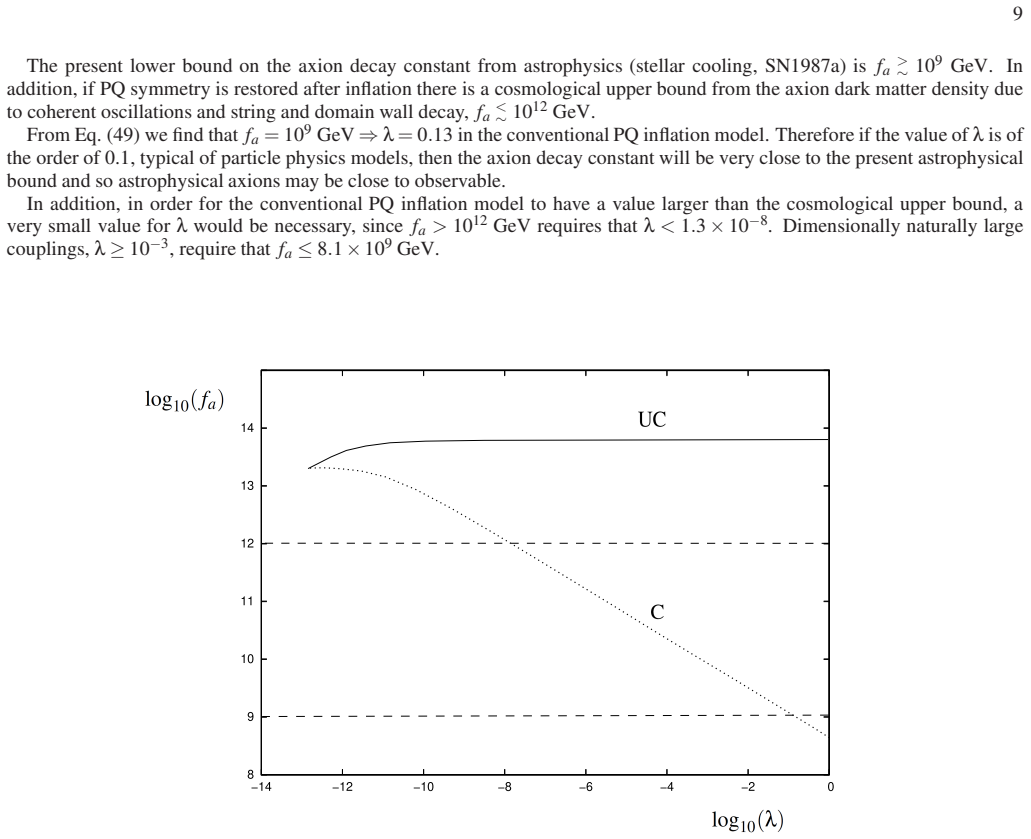
- A new isocurvature upper bound for conventional PQ inflation is 650 times smaller than the existing limit.
- A modest drop in reheating temperature for the unitarity-conserving model prevents PQ symmetry restoration and keeps the larger decay-constant window open.
Where Pith is reading between the lines
- Future CMB experiments could test the predicted spectral index difference between the two models.
- Axion direct-detection experiments could target the wider decay-constant range opened by the unitarity-conserving case.
- Detailed reheating dynamics would need to be checked to confirm that symmetry restoration is avoided.
Load-bearing premise
The analysis assumes instantaneous reheating after inflation.
What would settle it
A future measurement of the scalar spectral index that lies more than one sigma away from the unitarity-conserving prediction would rule out the reported agreement with ACT data.
Figures


read the original abstract
We compare conventional non-minimally coupled Peccei-Quinn (PQ) inflation with a version of the model in which unitarity conservation is imposed by additional Jordan frame interactions. Assuming instantaneous reheating, the unitarity-conserving model is within 1$\sigma$ agreement with the central value of the scalar spectral index reported by the ACT collaboration, whereas conventional PQ inflation is more than 2$\sigma$ below the ACT central value. In the case where dark matter is composed of axions and PQ symmetry is not restored after inflation, the axion isocurvature constraint of the unitarity-conserving model typically allows a much larger axion decay constant $f_{a}$ than the conventional model, with the conventional model upper bound being comparable only if the PQ scalar self-coupling is extremely small, $\lambda \lesssim 10^{-10}$. For $\lambda = 0.1$, the axion isocurvature upper bounds are $f_{a} \lesssim 1.1 \times 10^{9} $ GeV for conventional PQ inflation and $f_{a} \lesssim 6.4 \times 10^{13}$ GeV for unitarity-conserving PQ inflation, with the latter bound being independent of $\lambda$. We also find a new isocurvature upper bound for conventional PQ inflation which is 650 times smaller than the existing bound. A modest reduction of the reheating temperature of the unitarity-conserving model from its maximum possible value will ensure that the PQ symmetry is not restored after inflation, allowing values of $f_{a}$ up to $6.4 \times 10^{13}$ GeV. Thus only the unitarity-conserving PQ inflation model allows $f_{a}$ to access values greater than the symmetry restoration cosmological upper bound $\sim 10^{12}$ GeV with naturally large values of the PQ scalar self-coupling.
Editorial analysis
A structured set of objections, weighed in public.
Referee Report
Summary. The manuscript compares conventional non-minimally coupled Peccei-Quinn (PQ) inflation with a unitarity-conserving variant obtained by adding Jordan-frame interactions. Assuming instantaneous reheating, it claims that the unitarity-conserving model yields a scalar spectral index ns within 1σ of the ACT central value while conventional PQ inflation lies more than 2σ below it. For axion dark matter with no post-inflationary PQ symmetry restoration, it reports axion isocurvature upper bounds fa ≲ 1.1×10^9 GeV (conventional) and fa ≲ 6.4×10^13 GeV (unitarity-conserving) at λ=0.1, notes that the latter bound is independent of λ, and presents a new isocurvature bound for the conventional model that is 650 times tighter than existing limits. The work concludes that only the unitarity-conserving model permits fa > 10^12 GeV with naturally large λ.
Significance. If the central claims hold under broader reheating assumptions, the paper provides a concrete mechanism by which unitarity conservation relaxes isocurvature constraints on fa, allowing the PQ scale to exceed the symmetry-restoration bound while remaining compatible with ACT data. It supplies explicit numerical bounds and identifies a substantially tighter conventional-model limit, which could be useful for model-building in axion cosmology. The comparison with recent ACT results is timely.
major comments (2)
- [Abstract] Abstract and main results: The reported 1σ agreement of the unitarity-conserving model with the ACT ns central value (and the >2σ discrepancy for the conventional model) is obtained only after fixing the number of e-folds N via the instantaneous-reheating relation that maps the inflationary energy scale to the pivot scale. In the slow-roll expressions ns = 1 − 6ε + 2η, the horizon-exit field value is set by N; any finite-duration reheating with w_reh < 1 lengthens the post-inflationary history and lowers N by several e-folds, shifting both predicted ns values. The manuscript presents results exclusively for the instantaneous limit and does not scan w_reh or T_reh, so the σ-level distinction is not shown to be robust.
- [Results on isocurvature constraints] Isocurvature bounds: The quoted fa upper bounds (fa ≲ 1.1×10^9 GeV conventional and fa ≲ 6.4×10^13 GeV unitarity-conserving at λ=0.1) and the new 650× tighter conventional bound are derived under instantaneous reheating together with the requirement that PQ symmetry is not restored after inflation. Because the reheating temperature also controls whether symmetry restoration occurs, the bounds (including the λ-independence of the unitarity-conserving limit) may change once T_reh is varied. A scan over reheating parameters is required to establish the range of validity of these constraints.
minor comments (1)
- [Abstract] The abstract would benefit from an explicit statement of the instantaneous-reheating assumption when presenting the ns agreements and fa bounds, so that readers immediately understand the scope of the numerical results.
Simulated Author's Rebuttal
We thank the referee for their careful reading and constructive comments on our manuscript. We address the major points below, acknowledging the assumptions in our analysis and outlining targeted revisions to improve clarity and robustness.
read point-by-point responses
-
Referee: [Abstract] Abstract and main results: The reported 1σ agreement of the unitarity-conserving model with the ACT ns central value (and the >2σ discrepancy for the conventional model) is obtained only after fixing the number of e-folds N via the instantaneous-reheating relation. Any finite-duration reheating with w_reh < 1 lowers N by several e-folds, shifting both predicted ns values. The manuscript presents results exclusively for the instantaneous limit and does not scan w_reh or T_reh, so the σ-level distinction is not shown to be robust.
Authors: We acknowledge that our ns predictions and the reported σ-level agreement with ACT data are derived under the instantaneous reheating assumption, which maximizes N. This is a standard baseline choice in inflationary comparisons to highlight differences arising from the potential shape and unitarity constraints. We agree that finite reheating would reduce N and shift ns lower for both models. In the revised manuscript we will add a dedicated paragraph in the results section estimating the effect of reduced N (e.g., for w_reh = 0 or 1/3) on the predicted ns values and the resulting σ agreement. We will also revise the abstract to explicitly state the instantaneous-reheating assumption. A full scan over reheating parameters lies beyond the present scope but the added discussion will clarify the robustness of the distinction. revision: partial
-
Referee: [Results on isocurvature constraints] Isocurvature bounds: The quoted fa upper bounds (fa ≲ 1.1×10^9 GeV conventional and fa ≲ 6.4×10^13 GeV unitarity-conserving at λ=0.1) and the new 650× tighter conventional bound are derived under instantaneous reheating together with the requirement that PQ symmetry is not restored after inflation. Because the reheating temperature also controls whether symmetry restoration occurs, the bounds (including the λ-independence of the unitarity-conserving limit) may change once T_reh is varied. A scan over reheating parameters is required to establish the range of validity of these constraints.
Authors: We agree that the isocurvature bounds on fa are computed assuming instantaneous reheating (highest T_reh) and the no-restoration condition. For the unitarity-conserving model we already note that a modest reduction in T_reh from its maximum ensures no restoration while preserving large fa. In the revision we will expand the isocurvature section to explicitly discuss the T_reh dependence, including how lower reheating temperatures relax the fa upper limits and affect the λ-independence statement. We will also clarify that the 650× tighter conventional bound is specific to the instantaneous case. A comprehensive numerical scan over reheating parameters requires additional work and is reserved for future study; the present results provide a well-defined baseline under the stated assumptions. revision: partial
Circularity Check
No significant circularity; standard slow-roll predictions under explicit reheating assumption
full rationale
The paper computes n_s = 1 - 6ε + 2η and fa isocurvature bounds directly from the Jordan-frame potentials of the two PQ models using standard slow-roll expressions evaluated at horizon exit. The number of e-folds N is fixed by the instantaneous-reheating relation that maps the inflationary scale to the pivot scale, an assumption stated explicitly in the abstract and used consistently for both models. The resulting 1σ agreement for the unitarity-conserving case and >2σ offset for the conventional case, together with the fa ≲ 6.4×10^13 GeV and fa ≲ 1.1×10^9 GeV limits, are therefore outputs of these equations rather than inputs renamed as predictions. No self-citation chain, ansatz smuggling, or self-definitional loop is present; the derivation remains self-contained once the reheating assumption is granted.
Axiom & Free-Parameter Ledger
free parameters (2)
- PQ scalar self-coupling lambda
- reheating temperature
axioms (2)
- domain assumption PQ symmetry is not restored after inflation
- domain assumption Instantaneous reheating
Lean theorems connected to this paper
-
IndisputableMonolith/Cost/FunctionalEquation.leanwashburn_uniqueness_aczel unclear?
unclearRelation between the paper passage and the cited Recognition theorem.
ns ≈ 1 + 2η = 1 − 2/N , r = 16ε = 12/N² (conventional); ns ≈ 1 − 3/(2N) (unitarity-conserving) with N* = 57 or 56 from instantaneous reheating
-
IndisputableMonolith/Foundation/RealityFromDistinction.leanreality_from_one_distinction unclear?
unclearRelation between the paper passage and the cited Recognition theorem.
β_iso = ξ H² / (π² θ² M_Pl² P_R) and fa ≲ 1.1×10^9 GeV (conventional) or 6.4×10^13 GeV (unitarity-conserving)
What do these tags mean?
- matches
- The paper's claim is directly supported by a theorem in the formal canon.
- supports
- The theorem supports part of the paper's argument, but the paper may add assumptions or extra steps.
- extends
- The paper goes beyond the formal theorem; the theorem is a base layer rather than the whole result.
- uses
- The paper appears to rely on the theorem as machinery.
- contradicts
- The paper's claim conflicts with a theorem or certificate in the canon.
- unclear
- Pith found a possible connection, but the passage is too broad, indirect, or ambiguous to say the theorem truly supports the claim.
Reference graph
Works this paper leans on
-
[1]
The upper bounds of both models conv erge to the φ 4 inflation upper bound at very small λ
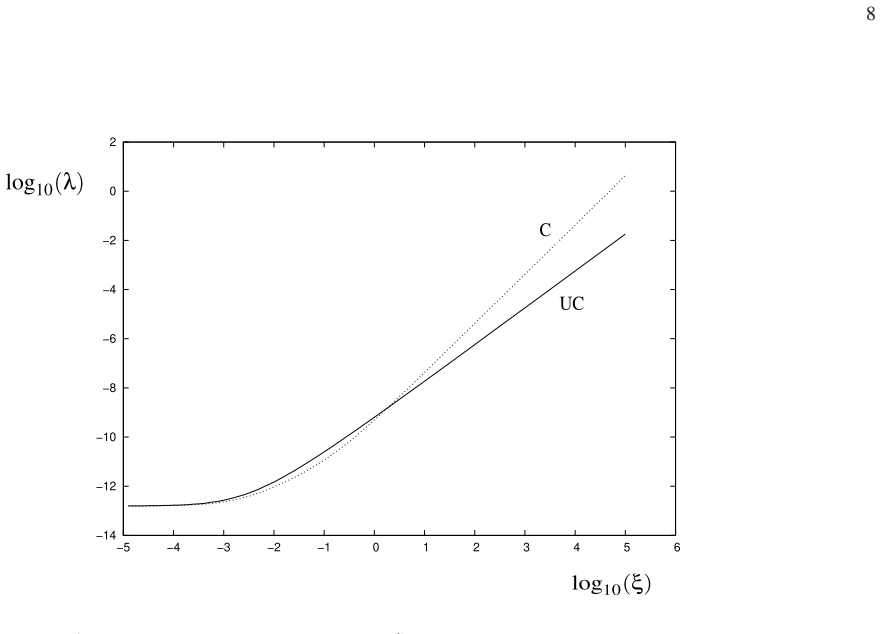
In this figure we have numerically generalised the analyti cal upper bounds for ξ > ∼ 1 to any value of ξ by using the complete expressions for Ω and V without approximation. The upper bounds of both models conv erge to the φ 4 inflation upper bound at very small λ . The upper bound is much larger for unitarity-conserving PQ inflation unless λ is very small ...
-
[2]
D. S. Salopek, J. R. Bond and J. M. Bardeen, Phys. Rev. D 40 (1989), 1753 doi:10.1103/PhysRevD.40.1753
-
[3]
F. L. Bezrukov and M. Shaposhnikov, Phys. Lett. B 659 (2008), 703-706 doi:10.1016/j.physletb.2007.11.072 [arXiv:0710.3755 [hep-th]]
work page internal anchor Pith review Pith/arXiv arXiv doi:10.1016/j.physletb.2007.11.072 2008
-
[4]
C. P . Burgess, H. M. Lee and M. Trott, JHEP 07 (2010), 007 doi:10.1007/JHEP07(2010)007 [arXiv:1002.27 30 [hep-ph]]
-
[5]
M. P . Hertzberg, JHEP 11 (2010), 023 doi:10.1007/JHEP11(2010)023 [arXiv:1002.29 95 [hep-ph]]
-
[6]
T. Han and S. Willenbrock, Phys. Lett. B 616 (2005), 215-220 doi:10.1016/j.physletb.2005.04.040 [ar Xiv:hep-ph/0404182 [hep-ph]]
work page internal anchor Pith review Pith/arXiv arXiv doi:10.1016/j.physletb.2005.04.040 2005
-
[7]
U. Aydemir, M. M. Anber and J. F. Donoghue, Phys. Rev. D 86 (2012), 014025 doi:10.1103/PhysRevD.86.014025 [arXiv:1 203.5153 [hep-ph]]
-
[8]
J. McDonald, Phys. Rev. D 112 (2025) no.12, 123525 doi:10.1103/k3r6-klxs [arXiv:2506. 12916 [hep-ph]]
-
[9]
R. N. Lerner and J. McDonald, Phys. Rev. D 82 (2010), 103525 doi:10.1103/PhysRevD.82.103525 [arXiv:1005.2978 [hep-ph]]
work page internal anchor Pith review Pith/arXiv arXiv doi:10.1103/physrevd.82.103525 2010
- [10]
- [11]
- [12]
- [13]
- [14]
- [15]
- [16]
-
[17]
S. Maity, [arXiv:2505.10534 [astro-ph.CO]]
work page internal anchor Pith review Pith/arXiv arXiv
- [18]
- [19]
-
[20]
L. Liu, Z. Yi and Y . Gong, [arXiv:2505.02407 [astro-ph. CO]]
work page internal anchor Pith review Pith/arXiv arXiv
- [21]
- [22]
-
[23]
M. Drees and Y . Xu, Phys. Lett. B 867 (2025), 139612 doi:10.1016/j.physletb.2025.139612 [arX iv:2504.20757 [astro-ph.CO]]
- [24]
- [25]
- [26]
- [27]
- [28]
-
[29]
Q. Gao, Y . Gong, Z. Yi and F. Zhang, Phys. Dark Univ. 50 (2025), 102106 doi:10.1016/j.dark.2025.102106 [arXiv:2 504.15218 [astro- ph.CO]]
-
[30]
D. Frolovsky and S. V . Ketov, Mod. Phys. Lett. A 40 (2025) no.40, 2550182 doi:10.1142/S0217732325501822 [arXiv:2505.17514 [astro- ph.CO]]
-
[31]
W. J. Wolf, JCAP 02 (2026), 088 doi:10.1088/1475-7516/2026/02/088 [arXiv:2 506.12436 [astro-ph.CO]]
-
[32]
N. Okada and O. Seto, Phys. Rev. D 112 (2025) no.8, 083549 doi:10.1103/y9s8-7b5b [arXiv:2506.1 5965 [hep-ph]]
-
[33]
J. Han, H. M. Lee and J. H. Song, [arXiv:2506.21189 [hep- ph]]
work page internal anchor Pith review Pith/arXiv arXiv
-
[34]
Pallis, JCAP 09 (2025), 061 doi:10.1088/1475-7516/2025/09/061 [arXiv:2 507.02219 [hep-ph]]
C. Pallis, JCAP 09 (2025), 061 doi:10.1088/1475-7516/2025/09/061 [arXiv:2 507.02219 [hep-ph]]
-
[35]
E. G. M. Ferreira, E. McDonough, L. Balkenhol, R. Kallos h, L. Knox and A. Linde, Phys. Rev. D 113 (2026) no.4, 043524 doi:10.1103/lq71-b84v [arXiv:2507.12459 [astro-ph.CO]]
- [36]
-
[37]
M. Zahoor, S. Khan and I. A. Bhat, JHEAp 49 (2026), 100458 doi:10.1016/j.jheap.2025.100458 [arXiv: 2507.18684 [astro-ph.CO]]
-
[38]
W. Ahmed, S. O. Allehabi and M. U. Rehman, Phys. Rev. D 113 (2026) no.4, 043532 doi:10.1103/jxg5-khj2 [arXiv:2508.0 1998 [hep- ph]]
-
[39]
C. Pallis, Phys. Rev. D 113 (2026) no.1, 015033 doi:10.1103/h1p2-c333 [arXiv:2510.0 2083 [hep-ph]]
- [40]
-
[41]
S. Khan, J. Kim and P . Ko, [arXiv:2511.04933 [hep-ph]]
work page internal anchor Pith review Pith/arXiv arXiv
-
[42]
E. McDonough and E. G. M. Ferreira, [arXiv:2512.05108 [ astro-ph.CO]]
-
[43]
Y . Aldabergenov and S. V . Ketov, Eur. Phys. J. C86 (2026) no.1, 91 doi:10.1140/epjc/s10052-026-15325-8 [ar Xiv:2512.08760 [gr-qc]]
- [44]
- [45]
-
[46]
Induced-Gravity Higgs Inflation in Palatini Supergravity Confronts ACT DR6
C. Pallis, [arXiv:2602.05623 [hep-ph]]
work page internal anchor Pith review Pith/arXiv arXiv
-
[47]
The Atacama Cosmology Telescope: DR6 Power Spectra, Likelihoods and $\Lambda$CDM Parameters
T. Louis et al. [ACT], [arXiv:2503.14452 [astro-ph.CO]]
work page internal anchor Pith review Pith/arXiv arXiv
-
[48]
R. N. Lerner and J. McDonald, JCAP 04 (2010), 015 doi:10.1088/1475-7516/2010/04/015 [arXiv:0 912.5463 [hep-ph]]. 15
-
[49]
R. N. Lerner and J. McDonald, JCAP 11 (2012), 019 doi:10.1088/1475-7516/2012/11/019 [arXiv:1 112.0954 [hep-ph]]
-
[50]
M. Fairbairn, R. Hogan and D. J. E. Marsh, Phys. Rev. D 91 (2015) no.2, 023509 doi:10.1103/PhysRevD.91.023509 [arX iv:1410.1752 [hep-ph]]
-
[51]
Planck 2018 results. VI. Cosmological parameters
N. Aghanim et al. [Planck], Astron. Astrophys. 641 (2020), A6 [erratum: Astron. Astrophys. 652 (2021), C4] doi:10.1051/0004- 6361/201833910 [arXiv:1807.06209 [astro-ph.CO]]
work page internal anchor Pith review Pith/arXiv arXiv doi:10.1051/0004- 2020
-
[52]
P . A. R. Ade et al. [BICEP and Keck], Phys. Rev. Lett. 127 (2021) no.15, 151301 doi:10.1103/PhysRevLett.127.15130 1 [arXiv:2110.00483 [astro-ph.CO]]
- [53]
-
[54]
M. Beltran, J. Garcia-Bellido and J. Lesgourgues, Phys . Rev. D 75 (2007), 103507 doi:10.1103/PhysRevD.75.103507 [arXiv:h ep- ph/0606107 [hep-ph]]
-
[55]
McDonald, JCAP 04 (2021), 069 doi:10.1088/1475-7516/2021/04/069 [arXiv:2 007.04111 [hep-ph]]
J. McDonald, JCAP 04 (2021), 069 doi:10.1088/1475-7516/2021/04/069 [arXiv:2 007.04111 [hep-ph]]
discussion (0)
Sign in with ORCID, Apple, or X to comment. Anyone can read and Pith papers without signing in.