Recognition: unknown
Sine-Gordon solitons in AdS, dS and other hyperbolic spaces
Pith reviewed 2026-05-08 02:15 UTC · model gemini-3-flash-preview
The pith
Curved spacetime supports stable localized waves that vanish in flat-space limits
A machine-rendered reading of the paper's core claim, the machinery that carries it, and where it could break.
Core claim
The paper identifies infinitely many multisoliton solutions in a deformed sine-Gordon model on higher-dimensional Anti-de Sitter (AdS) space. While single-soliton solutions in this model reduce to familiar flat-space solitons as the curvature radius becomes infinite, the authors prove that certain multisoliton clusters in AdS have no flat-space limit. These solutions are constructed by deforming the sine-Gordon potential with a coordinate-dependent factor that allows the nonlinear field equations to be solved through the separation of variables in Beltrami coordinates.
What carries the argument
Beltrami coordinates and a specific potential deformation. The authors use these coordinates to map the hyperbolic geometry into a form where the field equations become separable, while the potential is modified by a factor that mimics the structure of supersymmetric sine-Gordon theory to ensure solvability in curved space.
If this is right
- Localized energy configurations can be stable in higher-dimensional curved spacetimes even when their flat-space equivalents do not exist.
- The existence of solutions without a flat-space limit implies that some physical phenomena are strictly non-perturbative and depend entirely on the global geometry.
- Curvature-induced stability provides a new mechanism for creating localized 'lumps' of energy or matter in early-universe models.
- The mathematical link between curved-space solitons and flat-space supersymmetry suggests that geometry can effectively substitute for certain symmetries in field theories.
Where Pith is reading between the lines
- If these solitons are stable against small fluctuations, they could represent a new class of topological defects that only appear in high-curvature regimes.
- The specific deformation required for solvability might point toward a deeper geometric principle that naturally selects certain field potentials in curved backgrounds.
- These multisoliton solutions could serve as stable backgrounds for string theory or holographic models where localized 'branes' are required.
Load-bearing premise
The paper assumes that the specific mathematical adjustment made to the sine-Gordon potential—chosen to make the equations solvable—represents a physically plausible field theory rather than just a mathematical convenience.
What would settle it
A rigorous stability analysis showing that these multisoliton configurations are unstable to infinitesimal perturbations would demonstrate they are mathematical artifacts rather than physical solitons.
Figures




read the original abstract
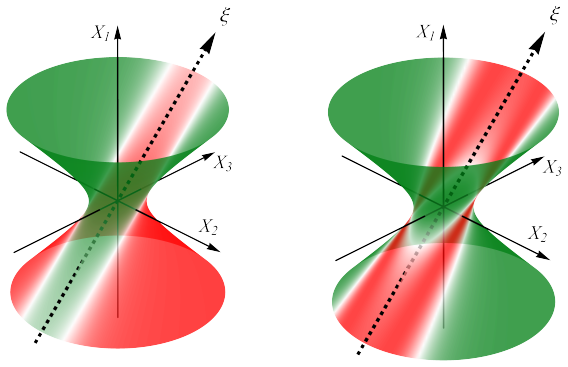
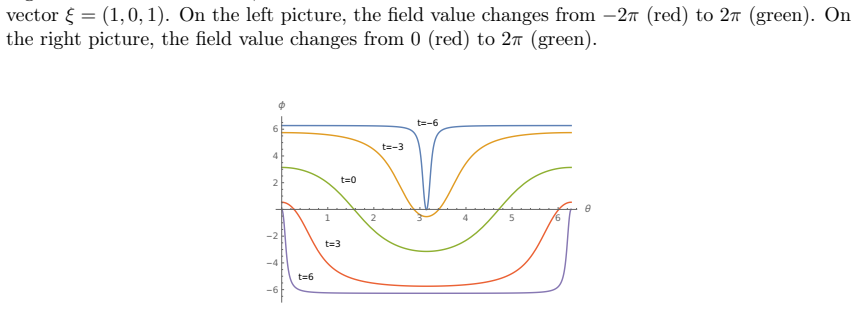
We find infinitely many soliton-like solutions in a deformation of the sine-Gordon theory in $(d+1)$-dimensional $AdS_{d+1}$ (anti-de Sitter) spacetime for $d \geq 2$, as well as single solitonic solutions in $dS_{d+1}$ (de Sitter) and $\mathrm{H}{d+1}$ (Lobachevsky) spaces for $d \geq 1$ and in $AdS_2$. We also find a deformation of the kink solution in scalar field theory with a polynomial potential in $AdS_2$. The deformation of the sine-Gordon theory strikingly resembles the bosonic part of the flat-space supersymmetric sine-Gordon theory. In the infinite radius limit, single soliton solutions reduce to solitons in flat space. Meanwhile, the multisoliton solution of $AdS{d+1}$, $d\geq 2$ for certain values of the parameters reduces in the same limit to a single soliton solution boosted in the normal direction. However, there are also multisoliton solutions in $AdS_{d+1}$, $d \geq 2$ that do not have a flat space limit.
Editorial analysis
A structured set of objections, weighed in public.
Referee Report
Summary. This manuscript investigates solitonic solutions in various curved spacetimes (AdS, dS, and Lobachevsky) within the framework of a 'deformed' sine-Gordon theory. The authors utilize Beltrami coordinates to facilitate a transformation that maps solutions of the flat (1+1)-dimensional sine-Gordon equation to solutions in higher-dimensional curved backgrounds. For $d \geq 2$, the authors claim the existence of an infinite family of multisoliton-like solutions, some of which lack a flat-space limit. The paper also discusses a similar mapping for polynomial potentials in $AdS_2$ and draws a parallel between their deformed potential and the bosonic sector of supersymmetric sine-Gordon theory.
Significance. The work provides a mathematically elegant method for generating exact solutions in curved spacetimes, which is generally a difficult task. The connection established between the deformation required for separability and the structure of supersymmetric sine-Gordon models (Section 2.3) is particularly noteworthy. If the solutions are physically robust, they could offer new insights into the behavior of topological defects in cosmological and holographic contexts. The manuscript includes clear derivations and recovers known flat-space limits for $d=1$.
major comments (3)
- [§2.2, Eq. (2.9) and (2.13)] There is a significant concern regarding the finiteness of the energy for the solutions in $AdS_{d+1}$ when $d \geq 2$. In Beltrami coordinates, the volume element scales as $\sqrt{-g} \propto \Omega^{-(d+1)}$. For $d \geq 2$, the parameter $\alpha = (d-1)/2$ is positive. The energy density $T_{00}$ is dominated by the gradient term $g^{rr}(\partial_r \phi)^2$. Using the transformation in Eq. (2.9), the field $\phi$ behaves as $\Omega^\alpha$ near the boundary $\Omega \to 0$. A power-counting analysis suggests the energy integral $E = \int \sqrt{-g} T_{00} d^d x$ diverges as $\int \Omega^{-2} dr$ near the patch boundary $r = 2R$. Since 'solitons' are typically defined as finite-energy configurations, the authors must demonstrate that these solutions are globally well-defined and possess finite total energy, or explicitly discuss the implications of this divergence.
- [§2.1, Eq. (2.6)] The potential $V(\phi)$ is constructed to be explicitly dependent on the coordinate-dependent conformal factor $\Omega$. This implies the theory is spatially inhomogeneous. While the authors characterize this as a 'deformation,' the physical motivation for such a coordinate-dependent potential is not clearly articulated beyond mathematical convenience for separability. The authors should clarify whether this potential can be expressed in a covariant form that does not rely on a specific choice of coordinates, or if it represents a specific background-coupled system.
- [§3, Multi-soliton solutions] The claim of 'infinitely many soliton-like solutions' in $AdS_{d+1}$ for $d \geq 2$ arises from embedding (1+1)D solutions into higher dimensions. In flat space, such a construction typically yields 'soliton walls' or planar defects with infinite total energy in $(d+1)$ dimensions. The manuscript needs to clarify the codimension of these objects and whether they are localized in all spatial dimensions or merely represent lower-dimensional solitons extended along the extra dimensions.
minor comments (3)
- [§1, Introduction] The distinction between the 'deformation' of the potential and the effect of the curved metric is slightly blurred in the introduction. It would be helpful to state earlier that the potential itself is being modified to allow for the mapping.
- [§2.1, Eq. (2.12)] Please check the consistency of the $\alpha$ exponents in the $V(\phi, \Omega)$ expression. A small typo in the powers of $\Omega$ here could affect the scaling arguments in subsequent sections.
- [§3] Regarding the 'no flat space limit' claim: The authors should provide a more intuitive physical explanation for why these solutions exist in curved space but vanish or become singular as $R \to \infty$. Is this a result of the rescaling of the field $\phi$ by $\Omega^\alpha$?
Simulated Author's Rebuttal
We thank the referee for their thoughtful and rigorous evaluation of our manuscript. We appreciate the recognition of the mathematical elegance of the mapping and the significance of the connection to supersymmetric sine-Gordon theory. The referee has identified several critical points regarding the physical interpretation of these solutions—specifically their energy finiteness, the nature of the potential's spatial dependence, and the dimensionality of the defects. We agree that addressing these points is essential for the clarity and physical relevance of the work. In the revised manuscript, we will explicitly characterize the solutions as infinite-energy configurations (soliton walls) and provide a more robust physical justification for the coordinate-dependent deformation of the potential.
read point-by-point responses
-
Referee: [§2.2, Eq. (2.9) and (2.13)] There is a significant concern regarding the finiteness of the energy for the solutions in AdS_{d+1} when d ≥ 2. [...] A power-counting analysis suggests the energy integral E = ∫ √g T_{00} d^dx diverges as ∫ Ω⁻² dr near the patch boundary r = 2R.
Authors: The referee is correct. For d ≥ 2, the total energy of these configurations diverges at the boundary of the Beltrami patch. This is a common feature of 'soliton walls' or planar defects in higher dimensions. Our use of the term 'soliton-like' was intended to denote configurations that preserve the localized profile of the sine-Gordon kink in one dimension, but we acknowledge that the standard definition of a soliton often implies finite total energy. In the revision, we will include a section detailing the energy density behavior and explicitly state that for d ≥ 2, these are infinite-energy configurations. We will discuss them in the context of global defects and energy density per unit transverse volume, which remains well-behaved until the boundary approach. revision: yes
-
Referee: [§2.1, Eq. (2.6)] The potential V(ϕ) is constructed to be explicitly dependent on the coordinate-dependent conformal factor Ω. [...] The authors should clarify whether this potential can be expressed in a covariant form that does not rely on a specific choice of coordinates, or if it represents a specific background-coupled system.
Authors: The potential is indeed spatially inhomogeneous. This 'deformation' can be understood as a specific coupling between the scalar field and the background geometry (or a fixed background scalar field representing the conformal factor Ω). While the mapping relies on Beltrami coordinates for mathematical clarity, the theory can be expressed covariantly by introducing a background scalar field χ that satisfies specific conditions (e.g., related to the distance from a chosen origin or the curvature scale). We will add a discussion in Section 2.1 clarifying that this model does not describe a standard sine-Gordon field on a fixed metric, but rather a field coupled to a 'dilaton-like' background that preserves the integrability of the (1+1)D sector. revision: partial
-
Referee: [§3, Multi-soliton solutions] The claim of 'infinitely many soliton-like solutions' in AdS_{d+1} for d ≥ 2 arises from embedding (1+1)D solutions into higher dimensions. [...] The manuscript needs to clarify the codimension of these objects and whether they are localized in all spatial dimensions.
Authors: The solutions we present are codimension-1 objects. In the (d+1)-dimensional space, they are localized in the radial-like direction r (or the direction associated with the (1+1)D mapping) and are extended (homogeneous) in the remaining d-1 spatial dimensions. They are effectively 'soliton walls' or branes. We will clarify this in Section 3 and the abstract to ensure the reader understands these are not point-like solitons (particles) but extended defects. revision: yes
Circularity Check
AdS soliton solutions derived via an engineered mapping are mathematically self-contained and transparently constructed.
full rationale
The paper presents a derivation of soliton-like solutions in curved spacetimes (AdS, dS, Hyperbolic) by defining a specific 'deformation' of the sine-Gordon potential. This deformation is explicitly engineered to allow for a field transformation that maps the curved-space equations of motion onto the standard, integrable flat-space sine-Gordon equation. This is a standard model-building methodology in theoretical physics rather than circular reasoning. The authors do not claim that their deformed potential is a first-principles derivation from more fundamental physics; instead, they acknowledge it is 'slightly different' from the standard potential and justify its study based on its mathematical properties (integrability) and a post-hoc 'striking resemblance' to the bosonic sector of supersymmetric sine-Gordon theory. The results—including the existence of infinitely many solutions and the discovery of solutions without a flat-space limit—follow directly from the mathematical properties of the transformation and the global geometry of the Beltrami patch. There is no evidence of the 'Self-Definitional' pattern (fitting parameters to data and then predicting that data) as the paper is purely theoretical. The use of self-citations (Ref [4], [23]) is for historical context regarding the authors' previous work on lower-dimensional or different curved backgrounds and does not serve as a load-bearing substitute for the derivations provided. While the physical validity of the solutions (e.g., energy convergence at the AdS boundary) is a point of potential external critique, the logical chain from the chosen action to the resulting solutions is independent and non-circular.
Axiom & Free-Parameter Ledger
free parameters (2)
- R
- beta
axioms (2)
- standard math Beltrami coordinates represent constant curvature manifolds locally and globally for the relevant calculations.
- ad hoc to paper The specific deformed potential V(phi) is the physically relevant extension of the sine-Gordon model to curved space.
Reference graph
Works this paper leans on
-
[1]
Dmitry Krotov and Alexander M. Polyakov. Infrared Sensitivity of Unstable Vacua.Nucl. Phys. B, 849:410–432, 2011.arXiv:1012.2107,doi:10.1016/j.nuclphysb.2011.03.025
-
[2]
E. T. Akhmedov. Lecture notes on interacting quantum fields in de Sitter space.Int. J. Mod. Phys. D, 23:1430001, 2014.arXiv:1309.2557,doi:10.1142/S0218271814300018
- [3]
-
[4]
E. T. Akhmedov, U. Moschella, and F. K. Popov. Characters of different secular effects in various patches of de Sitter space.Phys. Rev. D, 99(8):086009, 2019.arXiv:1901.07293, doi:10.1103/PhysRevD.99.086009
-
[5]
E. T. Akhmedov, I. V. Kochergin, and M. N. Milovanova. Isometry invariance of exact correlation functions in various charts of Minkowski and de Sitter spaces.Phys. Rev. D, 107(10):105015, 2023.arXiv:2210.10119,doi:10.1103/PhysRevD.107.105015
- [6]
- [7]
-
[8]
S. P. Miao, N. C. Tsamis, and R. P. Woodard. Leading Logarithm Quantum Gravity.Uni- verse, 11(7):223, 2025.arXiv:2409.12003,doi:10.3390/universe11070223
-
[9]
Guilherme L. Pimentel and Tom Westerdijk. On Cosmological Correlators at One Loop. 1 2026.arXiv:2601.00952. 16
-
[10]
G. Moreau and J. Serreau. The1/Nexpansion for stochastic fields in de Sitter spacetime. Phys. Rev. D, 102:125015, 2020.arXiv:2004.09157,doi:10.1103/PhysRevD.102.125015
-
[12]
E. T. Akhmedov, A. A. Artemev, and I. V. Kochergin. Interacting quantum fields in various charts of anti–de Sitter spacetime.Phys. Rev. D, 103(4):045009, 2021.arXiv:2011.05035, doi:10.1103/PhysRevD.103.045009
-
[13]
Akhmedov, Ugo Moschella, and Fedor K
Emil T. Akhmedov, Ugo Moschella, and Fedor K. Popov. Ultraviolet phenomena in AdS self- interacting quantum field theory.JHEP, 03:183, 2018.arXiv:1802.02955,doi:10.1007/ JHEP03(2018)183
-
[14]
E. T. Akhmedov and A. V. Sadofyev. Comparative study of loop contributions in AdS and dS.Phys. Lett. B, 712:138–142, 2012.arXiv:1201.3471,doi:10.1016/j.physletb.2012. 04.061
-
[15]
Quantum Fields on Time-Periodic AdS3/Z
Walker Melton, Andrew Strominger, and Tianli Wang. Quantum Fields on Time-Periodic AdS3/Z. 10 2025.arXiv:2510.15036
-
[16]
Loops in Anti–de Sitter Space.Phys
Igor Bertan and Ivo Sachs. Loops in Anti–de Sitter Space.Phys. Rev. Lett., 121(10):101601, 2018.arXiv:1804.01880,doi:10.1103/PhysRevLett.121.101601
-
[17]
Transmission of stationary nonlinear optical pulses in dispersive dielectric fibers
Akira Hasegawa and Frederick Tappert. Transmission of stationary nonlinear optical pulses in dispersive dielectric fibers. i. anomalous dispersion.Applied Physics Letters, 23(3):142–144, 08 1973.arXiv:https://pubs.aip.org/aip/apl/article-pdf/23/3/142/18428001/142_ 1_online.pdf,doi:10.1063/1.1654836
-
[18]
A. C. Scott, F. Y. F. Chu, and D. W. McLaughlin. The Soliton: A New Concept in Applied Science.IEEE Proceedings, 61:1443–1483, September 1973.doi:10.1109/PROC.1973.9296
-
[19]
Gardner, Johm M
Clifford S. Gardner, Johm M. Greene, Martin D. Kruskal, and Robert M. Miura. Method for solving the Korteweg-deVries equation.Phys. Rev. Lett., 19:1095–1097, 1967.doi:10.1103/ PhysRevLett.19.1095
1967
-
[20]
S. N. Vergeles and V. M. Gryanik. Two-Dimensional Quantum Field Theories Having Exact Solutions.Sov. J. Nucl. Phys., 23:704–709, 1976
1976
-
[21]
Alexander B. Zamolodchikov and Alexei B. Zamolodchikov. Factorized s Matrices in Two- Dimensions as the Exact Solutions of Certain Relativistic Quantum Field Models.Annals Phys., 120:253–291, 1979.doi:10.1016/0003-4916(79)90391-9
-
[22]
Exact Solution of the Sine-Gordon Equation for Multiple Collisions of Solitons
Ryogo Hirota. Exact Solution of the Sine-Gordon Equation for Multiple Collisions of Solitons. Journal of the Physical Society of Japan, 33(5):1459–1463, November 1972.doi:10.1143/ JPSJ.33.1459
1972
-
[23]
G. H. Derrick. Comments on nonlinear wave equations as models for elementary particles.J. Math. Phys., 5:1252–1254, 1964.doi:10.1063/1.1704233
-
[24]
Supersymmetric extension of the Sine- Gordon theory with integrable boundary interactions.Phys
Takeo Inami, Satoru Odake, and Yao-Zhong Zhang. Supersymmetric extension of the Sine- Gordon theory with integrable boundary interactions.Phys. Lett. B, 359:118–124, 1995. arXiv:hep-th/9506157,doi:10.1016/0370-2693(95)01072-X
-
[25]
J. Bros, U. Moschella, and J. P. Gazeau. Quantum field theory in the de Sitter universe. Phys. Rev. Lett., 73:1746–1749, 1994.doi:10.1103/PhysRevLett.73.1746. 17
-
[26]
Two point functions and quantum fields in de Sit- ter universe.Rev
Jacques Bros and Ugo Moschella. Two point functions and quantum fields in de Sit- ter universe.Rev. Math. Phys., 8:327–392, 1996.arXiv:gr-qc/9511019,doi:10.1142/ S0129055X96000123
-
[27]
Anti-de Sitter, plane waves and quantum field theory.Phys
Ugo Moschella. Anti-de Sitter, plane waves and quantum field theory.Phys. Lett. B, 871:139979, 2025.arXiv:2509.09257,doi:10.1016/j.physletb.2025.139979
-
[28]
Quantum theory on Lobatchevski spaces.Class
Ugo Moschella and Richard Schaeffer. Quantum theory on Lobatchevski spaces.Class. Quant. Grav., 24:3571–3602, 2007.arXiv:0709.2795,doi:10.1088/0264-9381/24/14/003
-
[29]
Akhmedov.Selected Special Functions for Fundamental Physics
Valeriya Akhmedova and Emil T. Akhmedov.Selected Special Functions for Fundamental Physics. SpringerBriefs in Physics. Springer, 2019.doi:10.1007/978-3-030-35089-5
-
[30]
H., Jedamzik, K., & Pogosian, L
Emil T. Akhmedov and P. V. Buividovich. Interacting Field Theories in de Sitter Space are Non-Unitary.Phys. Rev. D, 78:104005, 2008.arXiv:0808.4106,doi:10.1103/PhysRevD. 78.104005
-
[31]
E. T. Akhmedov and E. T. Musaev. Comments on QED with background electric fields.New J. Phys., 11:103048, 2009.arXiv:0901.0424,doi:10.1088/1367-2630/11/10/103048
-
[32]
Emil T. Akhmedov, P. V. Buividovich, and Douglas A. Singleton. De Sitter space and perpetuum mobile.Phys. Atom. Nucl., 75:525–529, 2012.arXiv:0905.2742,doi:10.1134/ S1063778812040023. 18
discussion (0)
Sign in with ORCID, Apple, or X to comment. Anyone can read and Pith papers without signing in.