Robust d-wave altermagnetism in XCr₂Y₂O (X=K, Rb, Cs; Y=S, Se, Te) family
Pith reviewed 2026-05-21 10:58 UTC · model grok-4.3
The pith
RbCr₂Se₂O is a robust d-wave altermagnetic metal because its C-type and G-type energies differ substantially and stay fixed.
A machine-rendered reading of the paper's core claim, the machinery that carries it, and where it could break.
Core claim
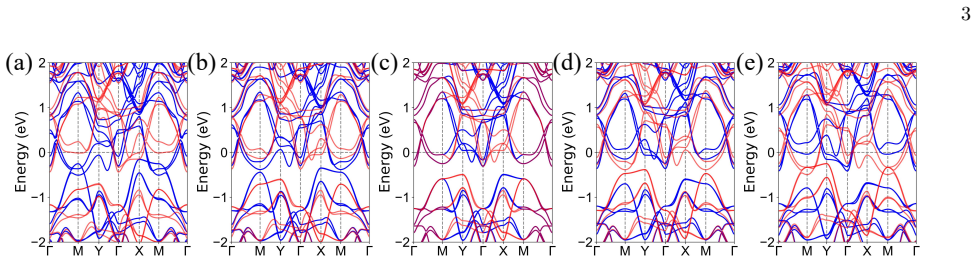
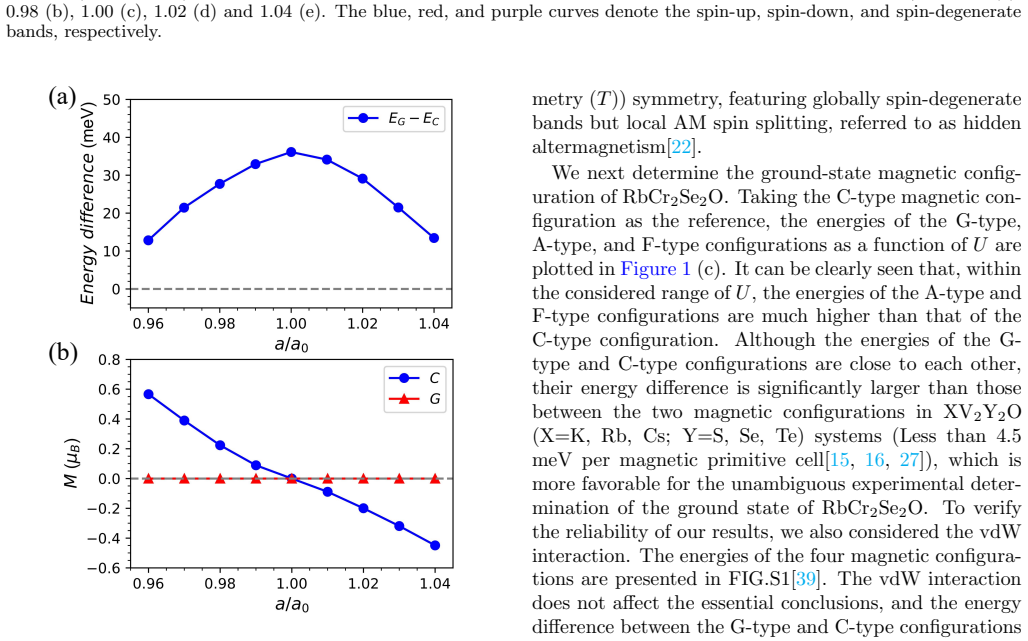
The central claim is that the experimentally synthesized RbCr₂Se₂O is a robust d-wave altermagnetic metal. The energy difference between C-type and G-type configurations is large and independent of electron correlation strength and van der Waals interaction. In-plane uniaxial strain generates a net total magnetic moment via a direct piezomagnetic effect, which is distinct from the behavior of semiconductors that typically require carrier doping in addition to strain. This supplies an experimental strategy for distinguishing the G-type antiferromagnetic configuration, in which the total magnetic moment remains zero under uniaxial strain. The same properties appear across the entire XCr₂Y₂O (X
What carries the argument
The large, correlation- and van-der-Waals-independent energy difference between C-type and G-type antiferromagnetic configurations, which stabilizes d-wave altermagnetism and permits a direct piezomagnetic response to uniaxial strain.
If this is right
- RbCr₂Se₂O supplies a clear, experimentally accessible platform for verifying d-wave altermagnetism.
- Uniaxial strain alone can induce a net magnetic moment in this metallic altermagnet.
- The G-type configuration is identified by the absence of net moment under the same strain.
- The same robust altermagnetic behavior and strain response hold for the full XCr₂Y₂O family.
Where Pith is reading between the lines
- Similar calculations on other layered transition-metal compounds could identify additional members with stable energy separations.
- The direct piezomagnetic response in a metal suggests strain as a doping-free handle for spintronic devices.
- Varying the chalcogen or alkali element may tune the size of the energy gap and the strength of the piezomagnetic coefficient.
Load-bearing premise
The DFT calculations used accurately reflect the true energy differences and magnetic properties without being overly sensitive to the specific choice of exchange-correlation functional or other approximations.
What would settle it
Measuring the actual energy preference between C-type and G-type order in synthesized RbCr₂Se₂O crystals or checking whether uniaxial strain produces a measurable net magnetization without added carriers would directly test the central prediction.
Figures




read the original abstract
The $\mathrm{KV_2Se_2O}$, $\mathrm{Rb_{1-\delta}V_2Te_2O}$ and $\mathrm{Cs_{1-\delta}V_2Te_2O}$ are experimentally confirmed to adopt either C-type or G-type antiferromagnetic configuration, corresponding to apparent or hidden altermagnetism. However, their nearly degenerate energies lead to inconsistent experimental assignments between the two antiferromagnetic configurations. Here, we predict that the experimentally synthesized $\mathrm{RbCr_2Se_2O}$ is a robust $d$-wave altermagnetic metal, since the energy difference between C-type and G-type configurations is large, which is independent of electron correlation strength and van der Waals interaction. Upon applying in-plane uniaxial strain, $\mathrm{RbCr_2Se_2O}$ can generate a net total magnetic moment via a direct piezomagnetic effect, which is distinct from semiconductor that typically requires carrier doping in addition to strain. This provides an experimental strategy for distinguishing the G-type antiferromagnetic configuration, in which the total magnetic moment remains zero under uniaxial strain. Our work presents an isostructural $d$-wave altermagnetic $\mathrm{RbCr_2Se_2O}$ analogous to $\mathrm{KV_2Se_2O}$, $\mathrm{Rb_{1-\delta}V_2Te_2O}$ and $\mathrm{Cs_{1-\delta}V_2Te_2O}$, which can facilitate further experimental verification. Furthermore, these results are universal across materials of this family $\mathrm{XCr_2Y_2O}$ (X=K, Rb, Cs; Y=S, Se, Te), thus expanding the family of altermagnets.
Editorial analysis
A structured set of objections, weighed in public.
Referee Report
Summary. The manuscript predicts that RbCr₂Se₂O (and the broader XCr₂Y₂O family with X = K, Rb, Cs and Y = S, Se, Te) realizes robust d-wave altermagnetism. It asserts that the energy difference between C-type and G-type antiferromagnetic configurations is large and remains stable independent of electron correlation strength U and van der Waals corrections, enabling a direct piezomagnetic response under in-plane uniaxial strain that generates a net moment without doping; this is contrasted with the nearly degenerate C/G energies in the experimentally known V-based analogs.
Significance. If the robustness claim holds, the work usefully enlarges the set of candidate d-wave altermagnets and supplies a concrete, doping-free experimental handle (strain-induced moment) for distinguishing G-type order. The isostructural mapping to known compounds is a clear strength for guiding synthesis and verification.
major comments (2)
- [Abstract and Results] Abstract and Results section: the central robustness claim—that the C-type versus G-type energy difference is large and sign-stable independent of correlation strength and vdW interactions—is load-bearing for the entire narrative, yet the manuscript reports only a single functional plus fixed U (with optional vdW) without the required parameter sweeps. A dense grid of U (0–6 eV) on Cr d-states, multiple vdW schemes, and at least one hybrid functional is needed to establish that no crossing or collapse occurs; without these data the “robust” qualifier and the piezomagnetic distinction cannot be taken as demonstrated.
- [Methods and Results] Methods and Results: the assertion of independence from vdW corrections is stated but not quantified across schemes (D3, optB88, etc.). Because the compounds are layered, even modest changes in interlayer spacing can alter the relative stability of C- and G-type order; explicit comparison tables or figures for at least two vdW functionals are required.
minor comments (2)
- [Introduction] Notation: the distinction between “apparent” and “hidden” altermagnetism should be defined explicitly on first use rather than assumed from prior literature.
- [Results] Figure clarity: strain-dependent moment plots would benefit from error bars or convergence checks with respect to k-point density and plane-wave cutoff.
Simulated Author's Rebuttal
We thank the referee for the careful reading and constructive comments, which have helped clarify the presentation of our results. We address each major comment below and have revised the manuscript to incorporate additional calculations where needed.
read point-by-point responses
-
Referee: [Abstract and Results] Abstract and Results section: the central robustness claim—that the C-type versus G-type energy difference is large and sign-stable independent of correlation strength and vdW interactions—is load-bearing for the entire narrative, yet the manuscript reports only a single functional plus fixed U (with optional vdW) without the required parameter sweeps. A dense grid of U (0–6 eV) on Cr d-states, multiple vdW schemes, and at least one hybrid functional is needed to establish that no crossing or collapse occurs; without these data the “robust” qualifier and the piezomagnetic distinction cannot be taken as demonstrated.
Authors: We agree that a more comprehensive parameter study strengthens the robustness claim. We have now performed additional calculations with a dense grid of U values (0–6 eV) on the Cr d-states using the same PBE+U framework. The C–G energy difference remains positive and large (∼25 meV per formula unit) with no sign change or collapse across the full range. We have also added HSE06 hybrid-functional results, which confirm the same ordering. These data are included as a new figure and table in the revised Results section and Supplementary Material. revision: yes
-
Referee: [Methods and Results] Methods and Results: the assertion of independence from vdW corrections is stated but not quantified across schemes (D3, optB88, etc.). Because the compounds are layered, even modest changes in interlayer spacing can alter the relative stability of C- and G-type order; explicit comparison tables or figures for at least two vdW functionals are required.
Authors: We acknowledge that explicit quantification across vdW schemes is necessary. In the revised manuscript we have added a comparison table showing the C–G energy difference obtained with DFT-D3 and optB88-vdW functionals (in addition to the original settings). The difference varies by less than 8 % and the sign remains stable; the corresponding interlayer spacings are also reported. A short discussion of these results has been inserted in the Methods and Results sections. revision: yes
Circularity Check
No significant circularity; derivation is self-contained in DFT computations
full rationale
The paper derives its central claims from direct DFT total-energy comparisons between C-type and G-type AFM configurations across the XCr₂Y₂O family, followed by explicit strain-response calculations for the piezomagnetic moment. These quantities are obtained from the Kohn-Sham Hamiltonian under standard approximations (exchange-correlation functional, Hubbard U, vdW corrections) rather than being fitted to the target conclusion or defined in terms of one another. The assertion of independence from U and vdW is presented as an outcome of parameter variation within the same computational framework, not as a self-referential premise or imported uniqueness theorem. No load-bearing self-citations, ansatzes smuggled via prior work, or renaming of known results appear in the derivation chain; the results remain falsifiable against external benchmarks such as future experiments or higher-level methods.
Axiom & Free-Parameter Ledger
free parameters (1)
- Electron correlation strength (U)
axioms (1)
- domain assumption Density functional theory can reliably predict magnetic energy differences in these layered compounds.
Lean theorems connected to this paper
-
IndisputableMonolith/Cost/FunctionalEquation.leanwashburn_uniqueness_aczel unclear?
unclearRelation between the paper passage and the cited Recognition theorem.
the energy difference between C-type and G-type configurations is large, which is independent of electron correlation strength and van der Waals interaction
What do these tags mean?
- matches
- The paper's claim is directly supported by a theorem in the formal canon.
- supports
- The theorem supports part of the paper's argument, but the paper may add assumptions or extra steps.
- extends
- The paper goes beyond the formal theorem; the theorem is a base layer rather than the whole result.
- uses
- The paper appears to rely on the theorem as machinery.
- contradicts
- The paper's claim conflicts with a theorem or certificate in the canon.
- unclear
- Pith found a possible connection, but the passage is too broad, indirect, or ambiguous to say the theorem truly supports the claim.
Reference graph
Works this paper leans on
-
[1]
L. ˘Smejkal, J. Sinova and T. Jungwirth, Beyond conven- tional ferromagnetism and antiferromagnetism: A phase with nonrelativistic spin and crystal rotation symmetry, Phys. Rev. X12, 031042 (2022)
work page 2022
-
[2]
Mazin, Altermagnetism-a new punch line of fundamen- tal magnetism, Phys
I. Mazin, Altermagnetism-a new punch line of fundamen- tal magnetism, Phys. Rev. X12, 040002 (2022)
work page 2022
-
[3]
L. Bai, W. Feng, S. Liu, L. ˘Smejkal, Y. Mokrousov, and Y. Yao, Altermagnetism: Exploring New Frontiers in Magnetism and Spintronics, Adv. Funct. Mater. 2409327 (2024)
work page 2024
-
[4]
H.-Y. Ma, M. L. Hu, N. N. Li, J. P. Liu, W. Yao, J. F. Jia and J. W. Liu, Multifunctional antiferromagnetic ma- terials with giant piezomagnetism and noncollinear spin current, Nat. Commun.12, 2846 (2021)
work page 2021
-
[5]
Y. Liu, J. Yu and C. C. Liu, Twisted Magnetic Van der Waals Bilayers: An Ideal Platform for Altermagnetism, Phys. Rev. Lett.133, 206702 (2024)
work page 2024
-
[6]
X. Chen, D. Wang, L. Y. Li and B. Sanyal, Giant spin- splitting and tunable spin-momentum locked transport in room temperature collinear antiferromagnetic semimetal- lic CrO monolayer, Appl. Phys. Lett.123, 022402 (2023)
work page 2023
-
[7]
B. Pan, P. Zhou, P. Lyu, H. Xiao, X. Yang, and L. Sun, General stacking theory for altermagnetism in bi- layer systems, Phys. Rev. Lett.133, 166701 (2024)
work page 2024
-
[8]
H. Bai, L. Han, X. Y. Feng, Y. J. Zhou, R. X. Su, Q. Wang, L. Y. Liao, W. X. Zhu, X. Z. Chen, F. Pan, X. L. Fan, and C. Song, Observation of spin splitting torque in 6 a collinear antiferromagnet RuO 2, Phys. Rev. Lett.128, 197202 (2022)
work page 2022
-
[9]
S. Lee, S. Lee, S. Jung, J. Jung, D. Kim, Y. Lee, B. Seok, J. Kim, B. G. Park, L. Smejkal, C. J. Kang, and C. Kim, Broken Kramers degeneracy in altermagnetic MnTe, Phys. Rev. Lett.132, 036702 (2024)
work page 2024
-
[10]
G. Yang, Z. Li, S. Yang, J. Li, H. Zheng, W. Zhu, Z. Pan, Y. Xu, S. Cao, W. Zhao, A. Jana, J. Zhang, M. Ye, Y. Song, L. H. Hu, L. Yang, J. Fujii, I. Vobornik, M. Shi, H. Yuan, Y. Zhang, Y. Xu, and Y. Liu, Three-dimensional mapping of the altermagnetic spin splitting in CrSb, Nat Commun16, 1442 (2025)
work page 2025
-
[11]
Z. Zhou, X. Cheng, M. Hu, R. Chu, H. Bai, L. Han, J. Liu, F. Pan and C. Song, Manipulation of the altermag- netic order in CrSb via crystal symmetry, Nature638, 645 (2025)
work page 2025
-
[12]
J. Ding, Z. Jiang, X. Chen, Z. Tao, Z. Liu, T. Li, J. Liu, J. Sun and J. Cheng, Large Band Splitting ing-Wave Altermagnet CrSb, Phys. Rev. Lett.133, 206401 (2024)
work page 2024
- [13]
-
[14]
F. Zhang X. Cheng, Z. Yin, C. Liu, L. Deng, Y. Qiao, Z. Shi, S. Zhang, J. Lin, Z. Liu, M. Ye, Y. Huang, X. Meng, C. Zhang, T. Okuda, K. Shimada, S. Cui, Y. Zhao, G.- H. Cao, S. Qiao, J. Liu and C. Chen, Crystal-symmetry- paired spin-valley locking in a layered room-temperature metallic altermagnet candidate, Nature Phys.21, 760 (2025)
work page 2025
-
[15]
G. Yang, R. Chen, C. Liu et al., Observation of hid- den altermagnetism in Cs 1−δV2Te2O, arXiv:2512.00972 (2025)
work page internal anchor Pith review Pith/arXiv arXiv 2025
-
[16]
C.-C. Liu, J. Li, J.-Y. Liu, J.-Y. Lu, H.-X. Li, Y. Liu and G.-H. Cao, Physical properties and first-principles calculations of an altermagnet candidate Cs 1−δV2Te2O, Phys. Rev. B112, 224439 (2025)
work page 2025
-
[17]
Y. Sun, Y. Huang, J. Cheng et al., Antiferromagnetic structure of KV 2Se2O: A neutron diffraction study, Phys. Rev. B112, 184416 (2025)
work page 2025
-
[18]
J.-X. Xiong, X. Zhang, L.-D. Yuan and A. Zunger, Mat- ter with apparent and hidden spin physics, Matter doi: 10.1016/j.matt.2026.102674 (2026)
-
[19]
S. Guan, J. X. Xiong, Z. Wang, and J. W. Luo, Progress of hidden spin polarization in inversion-symmetric crys- tals, Sci. China-Phys. Mech. Astron.65, 237301 (2022)
work page 2022
-
[20]
L. D. Yuan, X. Zhang, C. M. Acosta and A. Zunger, Uncovering spin-orbit coupling-independent hidden spin polarization of energy bands in antiferromagnets, Nat. Commun.14, 5301 (2023)
work page 2023
- [21]
- [22]
-
[23]
S. D. Guo, Hidden fully-compensated ferrimagnetism, Phys. Chem. Chem. Phys.28, 2188 (2026)
work page 2026
-
[24]
J. Matsuda, H. Watanabe and R. Arita, Multiferroic Collinear Antiferromagnets with Hidden Altermagnetic Spin Splitting, Phys. Rev. Lett.134, 226703 (2025)
work page 2025
- [25]
-
[26]
Q. N. Meier, A. Carta, C. Ederer and A. Cano, Net and Compensated Altermagnetism from Staggered Orbital Order: Layer-Dependent Spin Splitting in Srn+1CrnO3n+1, Phys. Rev. Lett.136, 116705 (2026)
work page 2026
-
[27]
B. Thapa, P.-H. Chang, K. Belashchenko and I. I. Mazin, Is altermagnetism in vanadium oxychalcogenides a lost cause?, arXiv:2602.18672 (2026)
- [28]
-
[29]
R. Xu, Y. Gao and J. Liu, Chemical design of monolayer altermagnets, Natl. Sci. Rev.13, nwaf528 (2026)
work page 2026
-
[30]
X. Sun, P. Chen, X. Wen and H. Chen, Synthesis, Struc- ture, and Physical Properties of RbCr 2Se2O, Crystals 16, 56 (2026)
work page 2026
-
[31]
P. Hohenberg and W. Kohn, Inhomogeneous Electron Gas, Phys. Rev.136, B864 (1964)
work page 1964
-
[32]
W. Kohn and L. J. Sham, Self-Consistent Equations In- cluding Exchange and Correlation Effects, Phys. Rev. 140, A1133 (1965)
work page 1965
-
[33]
Kresse, Ab initio molecular dynamics for liquid met- als, J
G. Kresse, Ab initio molecular dynamics for liquid met- als, J. Non-Cryst. Solids193, 222 (1995)
work page 1995
-
[34]
G. Kresse and J. Furthm¨uller, Efficiency of ab-initio total energy calculations for metals and semiconductors using a plane-wave basis set, Comput. Mater. Sci. 6,15(1996)
work page 1996
-
[35]
G. Kresse and D. Joubert, From ultrasoft pseudopoten- tials to the projector augmented-wave method, Phys. Rev. B59, 1758 (1999)
work page 1999
-
[36]
J. P. Perdew, K. Burke and M. Ernzerhof, Generalized gradient approximation made simple, Phys. Rev. Lett. 77, 3865 (1996)
work page 1996
-
[37]
S. L. Dudarev, G. A. Botton, S. Y. Savrasov, C. J. Humphreys, and A. P. Sutton, Electron-energy-loss spec- tra and the structural stability of nickel oxide: An LSDA+U study, Phys. Rev. B57, 1505 (1998)
work page 1998
- [38]
-
[39]
See Supplemental Material at [] for the associated energy differences of magnetic configurations, band structures and lattice parameters
discussion (0)
Sign in with ORCID, Apple, or X to comment. Anyone can read and Pith papers without signing in.