Properties of multi-qubit variational quantum states representing weighted graphs and their computing with quantum programming
Pith reviewed 2026-05-13 22:21 UTC · model grok-4.3
The pith
Single-layer RX and RZZ circuits produce quantum states whose entanglement and correlations are fixed by local edge weights of the represented graph.
A machine-rendered reading of the paper's core claim, the machinery that carries it, and where it could break.
Core claim
In the general case of quantum graph states of arbitrary structure the geometric measure of entanglement and the quantum correlators are related to the edge-weight structure around the corresponding vertices in the graph (edge weights incident to the vertices and vertex weights associated with their closed neighborhoods). In the special case of unweighted graphs these quantities are determined by the degrees of the corresponding vertices.
What carries the argument
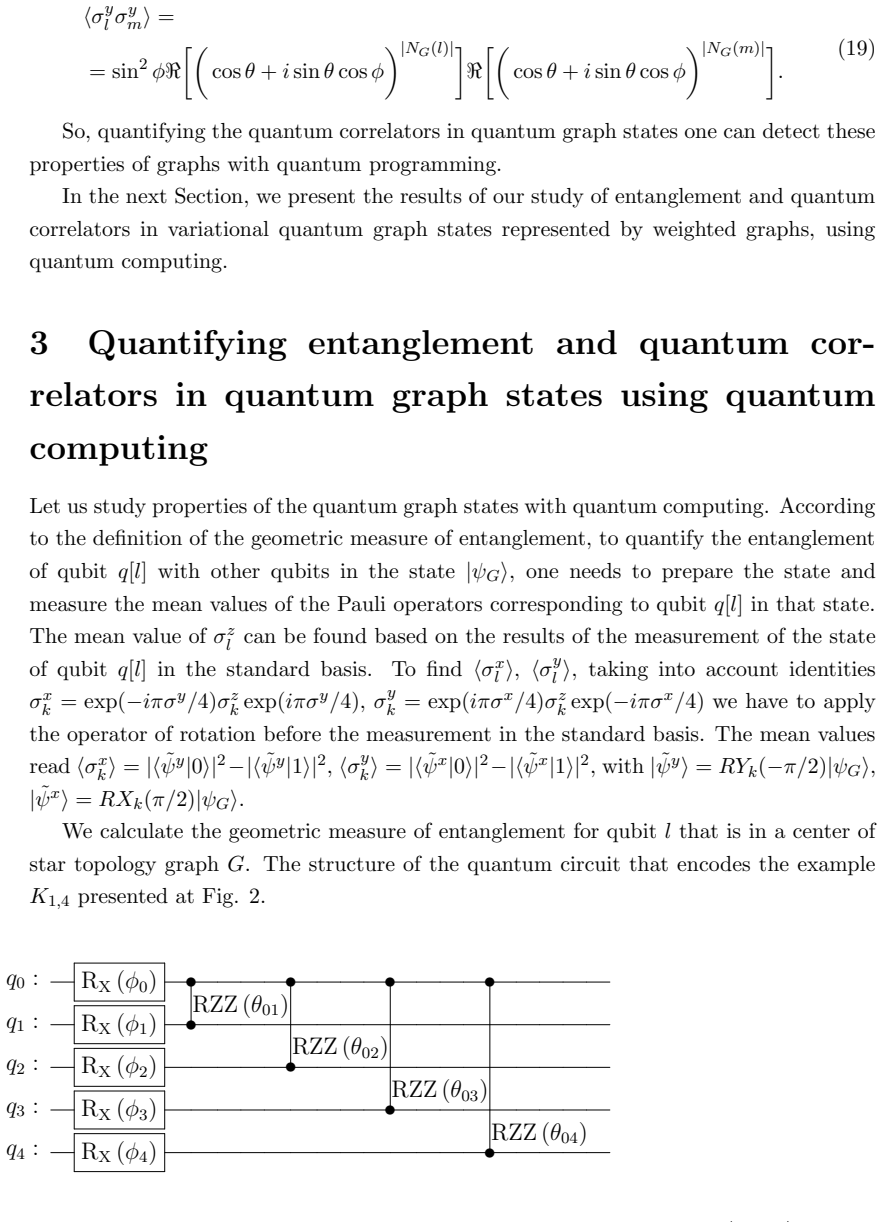
The single-layer variational circuit of RX rotation gates on each qubit and RZZ entangling gates on each edge, which directly prepares the quantum state that encodes the weighted graph.
If this is right
- The geometric entanglement of any such state can be read off from the local weight structure of the graph without state tomography.
- Quantum correlators between any pair of qubits are fixed by the weight of the edge connecting their vertices and by the weights of neighboring edges.
- Classical properties of weighted graphs become accessible by preparing the corresponding quantum states and measuring entanglement or correlators on a quantum processor.
- For unweighted graphs the entanglement of a vertex is a direct function of its degree in the graph.
Where Pith is reading between the lines
- The same circuit construction could be used to estimate global graph invariants by summing local entanglement measures obtained from a single run.
- Adding deeper layers of the same gate set might allow the encoding of higher-order graph features such as triangles or cycles while preserving the analytic link to entanglement.
- Because the formulas depend only on local neighborhoods, they remain valid even when the graph is embedded on a lattice or other hardware topology.
Load-bearing premise
The single-layer RX plus RZZ circuit is assumed to produce exactly the intended weighted-graph quantum state without additional layers or correction gates.
What would settle it
Prepare the variational state for a small weighted graph on actual quantum hardware, perform full tomography to extract the geometric entanglement measure, and test whether the numerical value equals the closed-form expression obtained from the incident edge weights.
Figures




read the original abstract
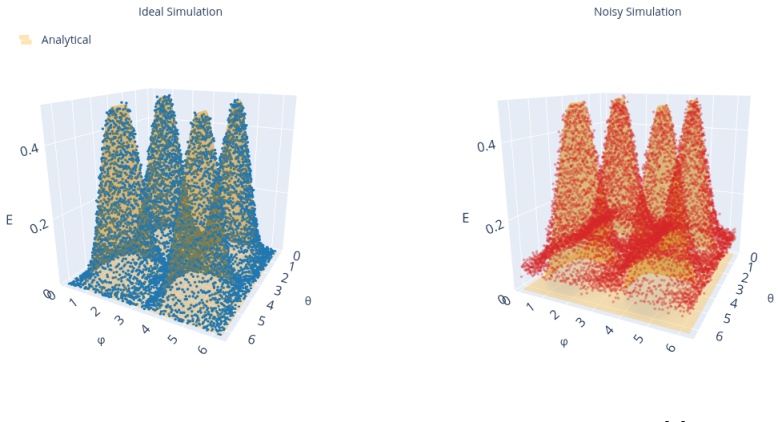
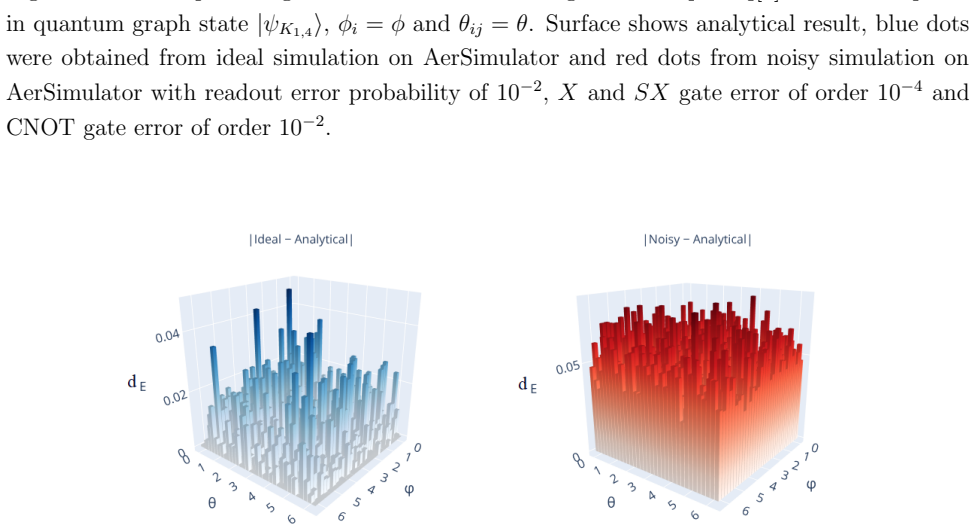
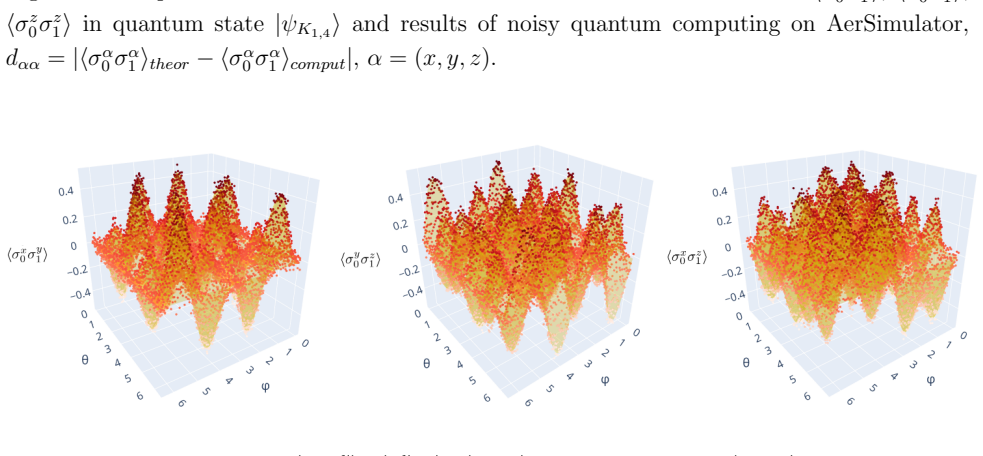
We study multi-qubit variational quantum states that can be considered as vertex- and edge-weighted graph. These states are constructed as single-layer variational circuits with $RX$ rotations and $RZZ$ entangling gates, corresponding to graphs of arbitrary structure. In general case of quantum graph states of arbitrary structure we derive the geometric measure of entanglement and evaluate quantum correlators. It is shown that these quantities are related to the edge-weight structure around the corresponding vertices in the graph (i.e., edge weights incident to the vertices and vertex weights associated with their closed neighborhoods). In the special case of quantum states representing unweighted graphs, these quantities are related to the degrees of the corresponding vertices in the graph. As an example, we analyze the state associated with the star graph $K_{1,4}$ using noisy quantum computing on the AerSimulator. The results are in good agreement with theoretical predictions. These findings demonstrate a connection between graph structure and quantum properties, enabling the study of properties of classical graphs via quantum computing.
Editorial analysis
A structured set of objections, weighed in public.
Referee Report
Summary. The manuscript studies multi-qubit variational quantum states constructed as single-layer circuits with RX rotations on vertices and RZZ entangling gates on edges, interpreted as representing arbitrary vertex- and edge-weighted graphs. In the general case, analytic expressions are derived for the geometric measure of entanglement and quantum correlators, which are shown to depend on the edge weights incident to each vertex and the vertex weights of its closed neighborhood. For unweighted graphs these quantities reduce to functions of vertex degrees. A numerical example for the star graph K_{1,4} is simulated noisily on the AerSimulator and reported to agree with the derived formulas.
Significance. If the derivations hold, the work would establish an explicit mapping from classical weighted-graph structure to quantum entanglement measures and correlators, offering a route to study graph properties via variational quantum circuits. The single-layer ansatz and the provision of a noisy simulation example add practical value, though the impact would be strengthened by broader validation across graph families.
major comments (2)
- [General case derivation] The central derivations of the geometric measure of entanglement and correlators (general case section) are performed directly on the output state of the single-layer RX+RZZ circuit. The manuscript does not demonstrate that this ansatz produces a state whose entanglement properties are identical to those of an arbitrary weighted-graph state; any unaccounted multi-qubit phases arising from general edge weights would render the reported closed-form relations to incident edge weights and closed-neighborhood vertex weights invalid.
- [Numerical example] The numerical validation is restricted to the star graph K_{1,4} under a specific noise model on AerSimulator. This single-topology check does not probe the arbitrary-structure claim and therefore provides only weak support for the general expressions relating entanglement measures to edge-weight structure.
minor comments (2)
- The abstract and introduction use the phrase 'quantum graph states' without explicitly distinguishing the variational circuit output from exact graph states; a clarifying sentence would improve precision.
- Notation for closed neighborhoods and the precise mapping from graph weights to circuit parameters (angles) should be defined in a dedicated preliminary section before the derivations.
Simulated Author's Rebuttal
We thank the referee for the careful reading and constructive comments. We address each major comment below.
read point-by-point responses
-
Referee: The central derivations of the geometric measure of entanglement and correlators (general case section) are performed directly on the output state of the single-layer RX+RZZ circuit. The manuscript does not demonstrate that this ansatz produces a state whose entanglement properties are identical to those of an arbitrary weighted-graph state; any unaccounted multi-qubit phases arising from general edge weights would render the reported closed-form relations to incident edge weights and closed-neighborhood vertex weights invalid.
Authors: The manuscript defines the variational quantum states representing weighted graphs precisely via the single-layer RX+RZZ circuit ansatz, with parameters corresponding to vertex and edge weights. The derivations are obtained by direct analytic computation on the explicit output state of this circuit. All RZZ gates commute (being diagonal in the Z basis), so the total unitary is ordering-independent and all phases from general edge weights are fully included in the state vector. The closed-form relations therefore hold for the states produced by the ansatz. We do not claim equivalence to states defined by some other construction; the reported expressions are valid for this variational representation. revision: no
-
Referee: The numerical validation is restricted to the star graph K_{1,4} under a specific noise model on AerSimulator. This single-topology check does not probe the arbitrary-structure claim and therefore provides only weak support for the general expressions relating entanglement measures to edge-weight structure.
Authors: We agree that the numerical example is limited to a single topology and serves primarily as an illustration of noisy simulation on AerSimulator rather than comprehensive validation. The primary support for the general expressions remains the analytic derivations. We will revise the text to clarify the illustrative scope of the numerical results. revision: partial
Circularity Check
No circularity: derivations are explicit calculations from the defined single-layer circuit state
full rationale
The paper defines the multi-qubit states explicitly as the output of a single-layer RX+RZZ variational circuit whose parameters are set by the graph's vertex and edge weights. All claimed relations (geometric entanglement measure and correlators expressed in terms of incident edge weights and closed-neighborhood vertex weights) are obtained by direct algebraic expansion of the resulting state vector or density matrix. This is ordinary derivation from the circuit definition rather than any reduction of a prediction to a fitted input or self-citation. The star-graph AerSimulator check is an independent numerical verification for one topology and does not serve as the sole support for the general formulas. No self-citation chains, uniqueness theorems, or ansatzes smuggled via prior work appear in the provided text. The central claims therefore remain self-contained against the circuit definition.
Axiom & Free-Parameter Ledger
axioms (1)
- standard math Standard quantum mechanics and the circuit model with RX and RZZ gates
Reference graph
Works this paper leans on
-
[1]
Quantum cryptography based on bell’s theorem,
A. K. Ekert, “Quantum cryptography based on bell’s theorem,”Phys. Rev. Lett., vol. 67, pp. 661–663, Aug 1991
work page 1991
-
[2]
Teleporting an unknown quantum state via dual classical and einstein-podolsky- rosen channels,
C. H. Bennett, G. Brassard, C. Cr´ epeau, R. Jozsa, A. Peres, and W. K. Wootters, “Teleporting an unknown quantum state via dual classical and einstein-podolsky- rosen channels,”Phys. Rev. Lett., vol. 70, pp. 1895–1899, Mar 1993
work page 1993
-
[3]
On the role of entanglement in quantum-computational speed-up,
R. Jozsa and N. Linden, “On the role of entanglement in quantum-computational speed-up,”Proceedings of the Royal Society A: Mathematical, Physical and Engi- neering Sciences, vol. 459, pp. 2011–2032, 08 2003
work page 2011
-
[4]
R. Horodecki, P. Horodecki, M. Horodecki, and K. Horodecki, “Quantum entangle- ment,”Rev. Mod. Phys., vol. 81, pp. 865–942, Jun 2009
work page 2009
-
[5]
16-qubit ibm universal quantum computer can be fully entangled,
Y. Wang, Y. Li, Z.-q. Yin, and B. Zeng, “16-qubit ibm universal quantum computer can be fully entangled,”npj Quantum Information, vol. 4, p. 46, Sep 2018
work page 2018
-
[6]
Observation of entangled states of a fully controlled 20-qubit system,
N. Friis, O. Marty, C. Maier, C. Hempel, M. Holz¨ apfel, P. Jurcevic, M. B. Plenio, M. Huber, C. Roos, R. Blatt, and B. Lanyon, “Observation of entangled states of a fully controlled 20-qubit system,”Phys. Rev. X, vol. 8, p. 021012, Apr 2018
work page 2018
-
[7]
A. Shimony, “Degree of entanglement,”Annals of the New York Academy of Sciences, vol. 755, pp. 675–679, 1995
work page 1995
-
[8]
A. Frydryszak, M. I. Samar, and V. M. Tkachuk, “Quantifying geometric measure of entanglement by mean value of spin and spin correlations with application to physical systems,”European Physical Journal D, vol. 71, p. 233, 2017
work page 2017
-
[9]
Detecting entanglement by the mean value of spin on a quantum computer,
A. Kuzmak and V. Tkachuk, “Detecting entanglement by the mean value of spin on a quantum computer,”Physics Letters A, vol. 384, p. 126579, Aug. 2020
work page 2020
-
[10]
Kh. P. Gnatenko and N. A. Susulovska, “Geometric measure of entanglement of multi-qubit graph states and its detection on a quantum computer,”Europhysics Letters, vol. 136, p. 40003, Nov. 2021
work page 2021
-
[11]
Kh. P. Gnatenko, “Entanglement of multi-qubit states representing directed networks and its detection with quantum computing,”Physics Letters A, vol. 521, p. 129815, Oct. 2024
work page 2024
-
[12]
O. G¨ uhne and G. T´ oth, “Entanglement detection,”Physics Reports, vol. 474, no. 1, pp. 1–75, 2009. 12
work page 2009
-
[13]
Multipartite entanglement and geometry of quantum states,
A. Vesperini, “Multipartite entanglement and geometry of quantum states,”Annals of Physics, vol. 457, p. 169406, 2023
work page 2023
-
[14]
Barren plateaus in quantum neural network training landscapes,
J. R. McClean, S. Boixo, V. N. Smelyanskiy, R. Babbush, and H. Neven, “Barren plateaus in quantum neural network training landscapes,”Nature Communications, vol. 9, no. 1, p. 4812, 2018
work page 2018
-
[15]
S. Sim, P. D. Johnson, and A. Aspuru-Guzik, “Expressibility and entangling capa- bility of parameterized quantum circuits for hybrid quantum-classical algorithms,” Advanced Quantum Technologies, vol. 2, no. 12, p. 1900070, 2019
work page 2019
-
[16]
Cost function dependent barren plateaus in shallow parametrized quantum circuits,
M. Cerezo, A. Sone, T. Volkoff, L. Cincio, and P. J. Coles, “Cost function dependent barren plateaus in shallow parametrized quantum circuits,”Nature Communications, vol. 12, no. 1, p. 1791, 2021
work page 2021
-
[17]
T. Hubregtsen, J. Pichlmeier, P. Stecher, and K. Bertels, “Evaluation of parameter- ized quantum circuits: on the relation between classification accuracy, expressibility, and entangling capability,”Quantum Machine Intelligence, vol. 3, no. 9, 2021
work page 2021
-
[18]
R. Raussendorf and H. J. Briegel, “A one-way quantum computer,”Phys. Rev. Lett., vol. 86, pp. 5188–5191, May 2001
work page 2001
-
[19]
Graph states for quantum secret sharing,
D. Markham and B. C. Sanders, “Graph states for quantum secret sharing,”Phys. Rev. A, vol. 78, p. 042309, Oct 2008
work page 2008
-
[20]
Studies of properties of bipartite graphs with quantum program- ming,
Kh. P. Gnatenko, “Studies of properties of bipartite graphs with quantum program- ming,”Physics Letters A, vol. 566, p. 131191, 2026. 7 pages
work page 2026
-
[21]
Variational m-partite geometric entanglement algorithm,
V. Azimi-Mousolou and P. Singh, “Variational m-partite geometric entanglement algorithm,”arXiv preprint arXiv:2503.20056, 2025. 13
discussion (0)
Sign in with ORCID, Apple, or X to comment. Anyone can read and Pith papers without signing in.