Parameter-Efficient Fine-Tuning of Machine-Learning Interatomic Potentials for Phonon and Thermal Properties
Pith reviewed 2026-05-13 22:05 UTC · model grok-4.3
The pith
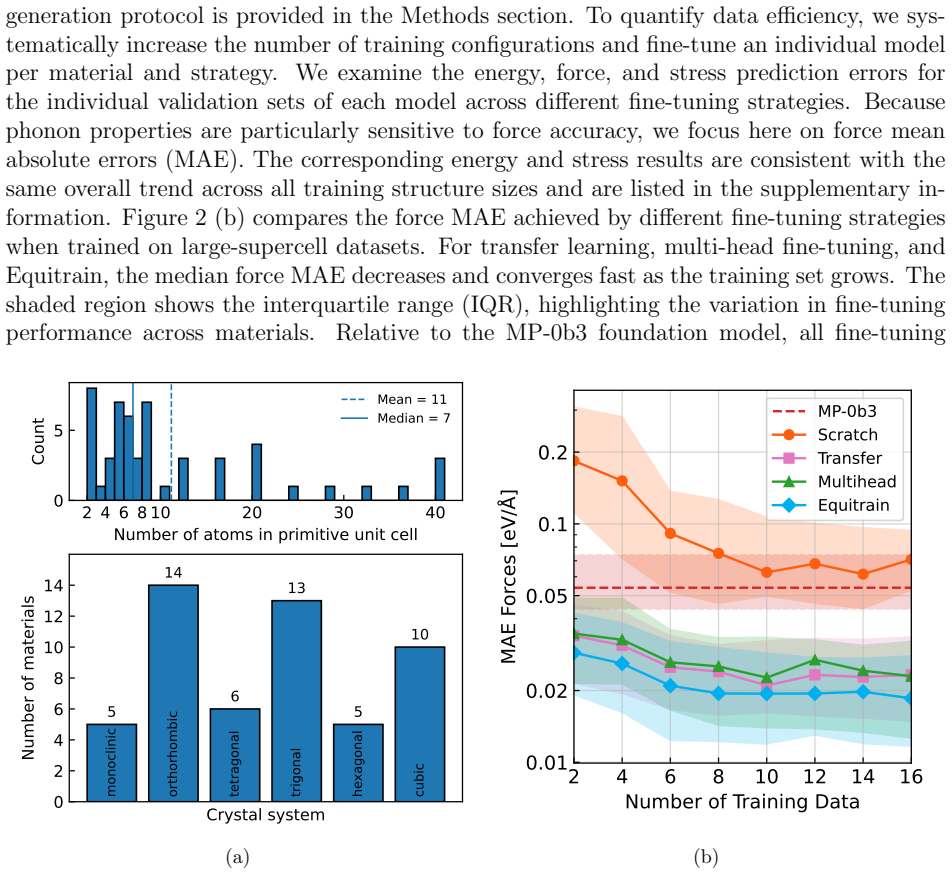
Fine-tuning pretrained interatomic potentials with as few as 10 structures improves phonon and thermal predictions across 53 materials.
A machine-rendered reading of the paper's core claim, the machinery that carries it, and where it could break.
Core claim
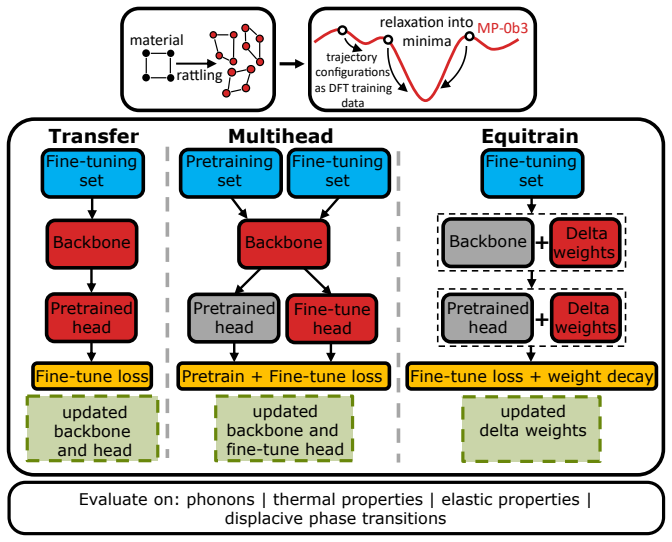
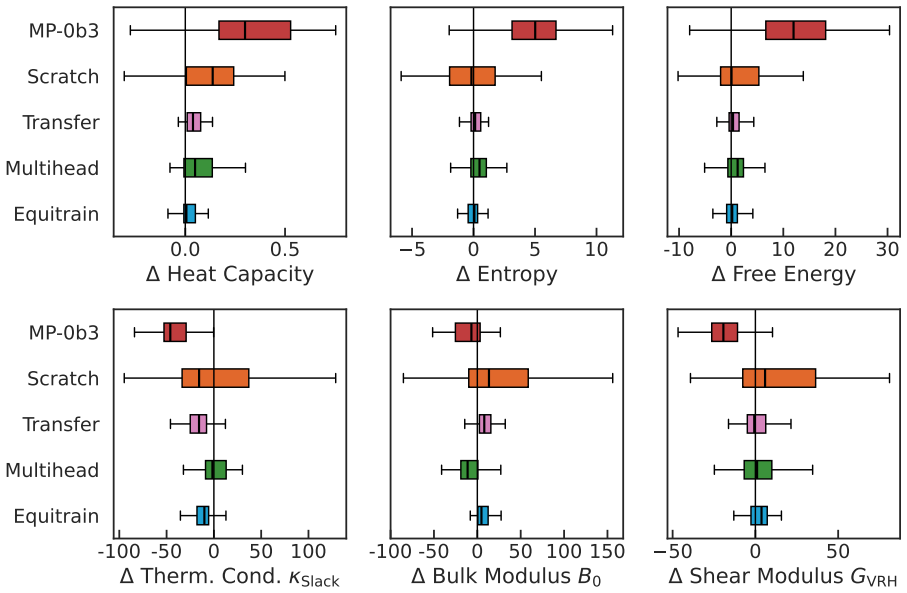
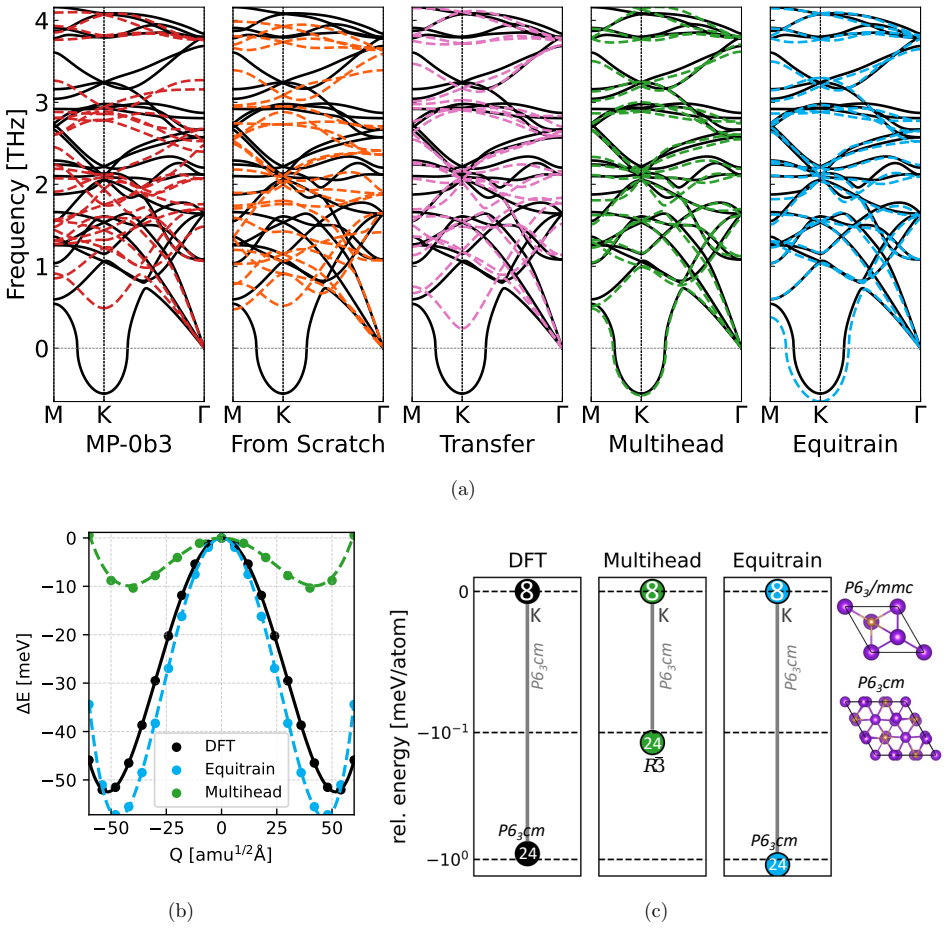
Fine-tuning strategies applied to pretrained machine-learning interatomic potentials, including the introduced Equitrain framework that uses LoRA-based adaptation, produce accurate predictions of harmonic phonon band structures, thermal properties, and potential energy surfaces along imaginary modes. These improvements occur with minimal extra training data and consistently exceed the performance of both the underlying pretrained models and models trained from scratch across 53 materials systems.
What carries the argument
Equitrain, a parameter-efficient fine-tuning framework implementing LoRA-based adaptation to adjust pretrained interatomic potential models for new material systems.
If this is right
- Phonon and thermal predictions become feasible for many materials using only tiny amounts of target data.
- Equitrain outperforms other fine-tuning strategies and full retraining from scratch in overall accuracy.
- Fine-tuned models retain broad applicability without evident degradation on unrelated properties.
- The same adaptation pattern works across a wide variety of 53 tested materials systems.
Where Pith is reading between the lines
- The approach could cut the cost of creating material-specific potentials by reusing large pretrained models.
- Similar fine-tuning might extend to other simulation targets such as defect formation or diffusion rates.
- Coupling the method with active learning could reduce the required extra structures even further.
- It may enable faster screening of candidate materials for thermal management applications.
Load-bearing premise
A very small number of additional training structures suffice to produce substantial, generalizable improvements in phonon predictions without overfitting or degrading performance on other properties across diverse materials.
What would settle it
Testing a pretrained model fine-tuned on only 10 new structures and finding no gain, or a loss, in phonon frequency accuracy or thermal conductivity predictions on held-out materials.
Figures

read the original abstract
Machine-learning interatomic potentials are widely used as computationally efficient surrogates for density functional theory in atomistic simulations, enabling large-scale, long-time modeling of materials systems. We investigate how different fine-tuning strategies influence the prediction of harmonic phonon band structures, thermal properties, and the potential energy surface along imaginary phonon modes. We achieve substantial accuracy improvements with minimal additional data, with as few as 10 additional training structures already yielding significant gains. In addition to existing approaches, we introduce Equitrain, a finetuning framework that implements LoRA-based adaptation. Across 53 materials systems, we show that fine-tuned models consistently outperform both the underlying pretrained model and models trained from scratch. Equitrain achieves the best overall performance, and our results demonstrate that fine-tuning enables accurate phonon predictions.
Editorial analysis
A structured set of objections, weighed in public.
Referee Report
Summary. The manuscript investigates parameter-efficient fine-tuning strategies for machine-learning interatomic potentials (MLIPs) to improve predictions of harmonic phonon band structures, thermal properties, and the potential energy surface along imaginary phonon modes. It introduces Equitrain, a LoRA-based adaptation framework, and reports that fine-tuning with as few as 10 additional structures yields consistent outperformance over both the pretrained model and models trained from scratch across 53 materials systems.
Significance. If the quantitative results and validation protocols hold under scrutiny, the work would be significant for materials modeling: it shows that minimal targeted data can adapt general MLIPs for phonon-relevant properties without full retraining, which is computationally valuable for exploring thermal transport and dynamical stability in diverse materials. The empirical comparison of fine-tuning methods, including the new Equitrain approach, provides a practical contribution if supported by rigorous error metrics and generalization tests.
major comments (2)
- [Abstract] Abstract: the central claim of consistent outperformance and substantial gains with as few as 10 structures is load-bearing but unsupported by any quantitative error metrics (e.g., MAE or RMSE on phonon frequencies), baseline model specifications, or data-selection criteria; without these, it is impossible to evaluate whether the reported improvements are generalizable or artifactual.
- [Results] Results section (phonon and thermal property comparisons): the assertion that fine-tuning on 10 structures produces generalizable improvements in second-derivative quantities (phonon frequencies and imaginary-mode energies) requires explicit evidence of held-out validation sets and checks against overfitting; phonon predictions depend on PES curvature, and small datasets chosen without active learning or mode-specific sampling commonly overfit local minima without improving global behavior.
minor comments (2)
- [Methods] Methods: provide the precise rank and scaling hyperparameters used in the LoRA adaptation for Equitrain, and clarify how the fine-tuning loss weights phonon-related terms versus total energy.
- [Figures] Figure captions: ensure all performance plots include error bars, the exact number of test structures per material, and a clear legend distinguishing pretrained, from-scratch, and fine-tuned variants.
Simulated Author's Rebuttal
We thank the referee for the constructive and detailed feedback. We address each major comment below and have revised the manuscript to strengthen the presentation of quantitative results and validation protocols.
read point-by-point responses
-
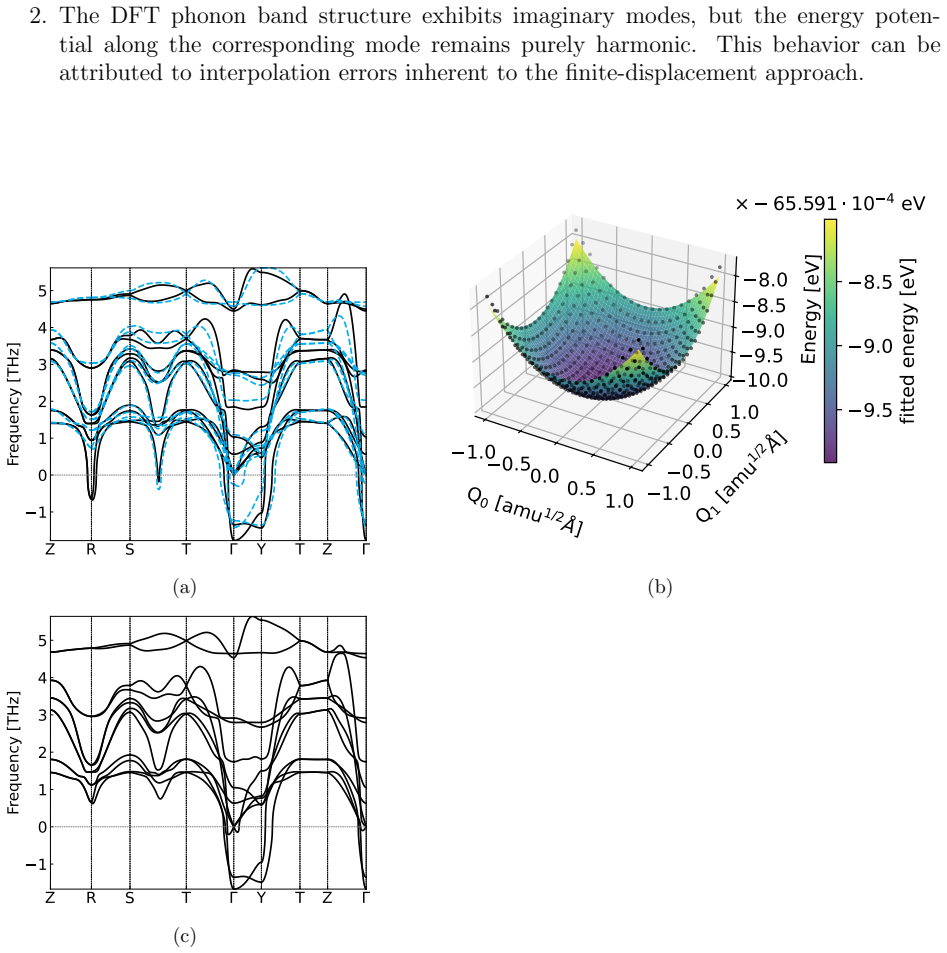
Referee: [Abstract] Abstract: the central claim of consistent outperformance and substantial gains with as few as 10 structures is load-bearing but unsupported by any quantitative error metrics (e.g., MAE or RMSE on phonon frequencies), baseline model specifications, or data-selection criteria; without these, it is impossible to evaluate whether the reported improvements are generalizable or artifactual.
Authors: We agree that the abstract should include concrete metrics to support the claims. In the revised version we have added representative MAE/RMSE values for phonon frequencies (e.g., average MAE reduction from 1.8 THz to 0.6 THz with 10 structures) together with the baseline model specification (pretrained MACE-MP-0) and data-selection protocol (uniform random sampling from DFT-relaxed supercells). The main text already contains full tables and figures with these metrics across all 53 systems; the abstract update makes the key numbers immediately visible. revision: yes
-
Referee: [Results] Results section (phonon and thermal property comparisons): the assertion that fine-tuning on 10 structures produces generalizable improvements in second-derivative quantities (phonon frequencies and imaginary-mode energies) requires explicit evidence of held-out validation sets and checks against overfitting; phonon predictions depend on PES curvature, and small datasets chosen without active learning or mode-specific sampling commonly overfit local minima without improving global behavior.
Authors: We have added an explicit description of the held-out test-set protocol: 20 % of the DFT structures per material were reserved and never seen during fine-tuning. We report phonon-frequency MAE and imaginary-mode energy errors on this test set, showing consistent improvement with the 10-structure fine-tuning. To address overfitting concerns we include (i) learning curves demonstrating that test-set error continues to decrease up to 10 structures without subsequent rise, and (ii) direct comparison against models trained from scratch on the same 10 structures, which exhibit higher test errors. While active learning or mode-specific sampling was not employed, the uniform sampling combined with the held-out evaluation and the scratch-trained baseline already provides evidence that the gains reflect improved global PES curvature rather than local overfitting. Additional phonon-dispersion plots on unseen supercells have been added to the supplementary information. revision: partial
Circularity Check
No circularity in empirical fine-tuning benchmark
full rationale
The paper is an empirical study comparing fine-tuning strategies (including the introduced Equitrain LoRA-based method) for pretrained ML interatomic potentials on phonon and thermal properties across 53 materials. Central claims rest on direct performance metrics versus pretrained baselines and from-scratch models using small additional datasets, with no derivation chain, equations, or fitted quantities that reduce by construction to the inputs. No self-citations, uniqueness theorems, or ansatzes are invoked as load-bearing steps; the work is self-contained as a benchmark evaluation without any of the enumerated circularity patterns.
Axiom & Free-Parameter Ledger
axioms (1)
- domain assumption Pretrained ML interatomic potentials contain transferable knowledge that can be efficiently adapted for phonon properties using limited new data
Forward citations
Cited by 1 Pith paper
-
Universal Interatomic Potentials as Configuration-Space Generators for One-Shot and Iterative Fine-Tuning of Ab Initio-Accurate Material-Specific Models
Universal MLIPs serve as configuration generators whose DFT-relabeled subsamples enable one-shot or iterative training of material-specific MLIPs that recover accurate reactive energy profiles with 600-2000 DFT calculations.
Reference graph
Works this paper leans on
-
[1]
A foundation model for atomistic materials chemistry
Ilyes Batatia et al. “A foundation model for atomistic materials chemistry”. In:The Journal of Chemical Physics163.18 (2025)
work page 2025
-
[2]
Machine learned potential for high-throughput phonon calcu- lations of metal—organic frameworks
Alin Marin Elena et al. “Machine learned potential for high-throughput phonon calcu- lations of metal—organic frameworks”. In:npj Computational Materials11.1 (2025), p. 125
work page 2025
-
[3]
Accelerating high-throughput phonon calculations via machine learn- ing universal potentials
Huiju Lee et al. “Accelerating high-throughput phonon calculations via machine learn- ing universal potentials”. In:Materials Today Physics53 (2025), p. 101688
work page 2025
-
[4]
Universal machine learning interatomic potentials are ready for phonons
Antoine Loew et al. “Universal machine learning interatomic potentials are ready for phonons”. In:npj Computational Materials11.1 (2025), p. 178
work page 2025
-
[5]
Fine-tuning foundation models of materials interatomic potentials with frozen transfer learning
Mariia Radova et al. “Fine-tuning foundation models of materials interatomic potentials with frozen transfer learning”. In:npj Computational Materials11.1 (2025), p. 237
work page 2025
-
[6]
Systematic softening in universal machine learning interatomic potentials
Bowen Deng et al. “Systematic softening in universal machine learning interatomic potentials”. In:npj Computational Materials11.1 (2025), p. 9
work page 2025
-
[7]
Catastrophic interference in connectionist net- works: The sequential learning problem
Michael McCloskey and Neal J Cohen. “Catastrophic interference in connectionist net- works: The sequential learning problem”. In:Psychology of learning and motivation. Vol. 24. Elsevier, 1989, pp. 109–165
work page 1989
-
[8]
MACE: Higher order equivariant message passing neural networks for fast and accurate force fields
Ilyes Batatia et al. “MACE: Higher order equivariant message passing neural networks for fast and accurate force fields”. In:Advances in neural information processing systems 35 (2022), pp. 11423–11436
work page 2022
-
[9]
Lora: Low-rank adaptation of large language models
Edward J Hu et al. “Lora: Low-rank adaptation of large language models.” In:ICLR 1.2 (2022), p. 3
work page 2022
-
[10]
2025.url:https://github.com/BAMeScience/equitrain
Philipp Benner.Equitrain. 2025.url:https://github.com/BAMeScience/equitrain
work page 2025
-
[11]
Atsushi Togo et al. “Implementation strategies in phonopy and phono3py”. In:J. Phys. Condens. Matter35.35 (2023), p. 353001.doi:10.1088/1361-648X/acd831
-
[12]
Atsushi Togo. “First-principles Phonon Calculations with Phonopy and Phono3py”. In:J. Phys. Soc. Jpn.92.1 (2023), p. 012001.doi:10.7566/JPSJ.92.012001
-
[13]
The Hiphive Package for the ex- traction of high-order force constants by machine learning
Fredrik Eriksson, Erik Fransson, and Paul Erhart. “The Hiphive Package for the ex- traction of high-order force constants by machine learning”. In:Advanced Theory and Simulations2.5 (2019), p. 1800184
work page 2019
-
[14]
The design space of E (3)-equivariant atom-centred interatomic potentials
Ilyes Batatia et al. “The design space of E (3)-equivariant atom-centred interatomic potentials”. In:Nature Machine Intelligence7.1 (2025), pp. 56–67
work page 2025
-
[15]
Updates in phase change materials for thermoelectric devices: Status and challenges
Raunak Pandey et al. “Updates in phase change materials for thermoelectric devices: Status and challenges”. In:Materialia21 (2022), p. 101357
work page 2022
-
[16]
Anubhav Jain et al. “Commentary: The Materials Project: A materials genome ap- proach to accelerating materials innovation”. In:APL materials1.1 (2013)
work page 2013
-
[17]
Accelerated data-driven materials science with the Materials Project
Matthew K Horton et al. “Accelerated data-driven materials science with the Materials Project”. In:Nature Materials24.10 (2025), pp. 1522–1532. 19
work page 2025
-
[18]
Nonmetallic crystals with high thermal conductivity
Glen A Slack. “Nonmetallic crystals with high thermal conductivity”. In:Journal of Physics and Chemistry of Solids34.2 (1973), pp. 321–335
work page 1973
-
[19]
Lattice thermal conductivity evalu- ated using elastic properties
Tiantian Jia, Gang Chen, and Yongsheng Zhang. “Lattice thermal conductivity evalu- ated using elastic properties”. In:Physical Review B95.15 (2017), p. 155206
work page 2017
-
[20]
Atomate2: Modular workflows for materials science
Alex M Ganose et al. “Atomate2: Modular workflows for materials science”. In:Digital Discovery(2025)
work page 2025
-
[21]
The physical significance of imaginary phonon modes in crys- tals
Ioanna Pallikara et al. “The physical significance of imaginary phonon modes in crys- tals”. In:Electronic Structure4.3 (2022), p. 033002
work page 2022
-
[22]
Evolution of crystal structures in metallic elements
Atsushi Togo and Isao Tanaka. “Evolution of crystal structures in metallic elements”. In:Physical Review B—Condensed Matter and Materials Physics87.18 (2013), p. 184104
work page 2013
-
[23]
Anharmonicity in the high-temperature C mcm phase of SnSe: Soft modes and three-phonon interactions
Jonathan M Skelton et al. “Anharmonicity in the high-temperature C mcm phase of SnSe: Soft modes and three-phonon interactions”. In:Physical Review Letters117.7 (2016), p. 075502
work page 2016
-
[24]
Phonon collapse and second-order phase transition in thermo- electric SnSe
Unai Aseginolaza et al. “Phonon collapse and second-order phase transition in thermo- electric SnSe”. In:Physical Review Letters122.7 (2019), p. 075901
work page 2019
-
[25]
Ab initio molecular dynamics for liquid metals
Georg Kresse and J¨ urgen Hafner. “Ab initio molecular dynamics for liquid metals”. In: Physical review B47.1 (1993), p. 558
work page 1993
-
[26]
Efficient iterative schemes for ab initio total- energy calculations using a plane-wave basis set
Georg Kresse and J¨ urgen Furthm¨ uller. “Efficient iterative schemes for ab initio total- energy calculations using a plane-wave basis set”. In:Physical review B54.16 (1996), p. 11169
work page 1996
-
[27]
Georg Kresse and J¨ urgen Furthm¨ uller. “Efficiency of ab-initio total energy calcula- tions for metals and semiconductors using a plane-wave basis set”. In:Computational materials science6.1 (1996), pp. 15–50
work page 1996
-
[28]
Generalized gradient approximation made simple
John P Perdew. “Generalized gradient approximation made simple”. In:Phys. Rev. Lett.77 (1997), p. 3868
work page 1997
-
[29]
Blöchl, Projector augmented-wave method, Phys
P. E. Bl¨ ochl. “Projector Augmented-Wave Method”. In:Phys. Rev. B50.24 (Dec. 1994), pp. 17953–17979.issn: DOI: 10.1103/PhysRevB.50.17953
-
[30]
From Ultrasoft Pseudopotentials to the Projector Augmented- Wave Method
G. Kresse and D. Joubert. “From Ultrasoft Pseudopotentials to the Projector Augmented- Wave Method”. In:Phys. Rev. B59.3 (Jan. 1999), pp. 1758–1775.doi:10 . 1103 / PhysRevB.59.1758
work page 1999
-
[31]
Projector-based efficient estimation of force constants
Atsuto Seko and Atsushi Togo. “Projector-based efficient estimation of force constants”. In:arXiv preprint arXiv:2403.03588(2024)
-
[32]
Finite elastic strain of cubic crystals
Francis Birch. “Finite elastic strain of cubic crystals”. In:Physical review71.11 (1947), p. 809
work page 1947
-
[33]
Structural relaxation made simple
Erik Bitzek et al. “Structural relaxation made simple”. In:Physical Review Letters 97.17 (2006), p. 170201
work page 2006
-
[34]
Explicit inductive bias for transfer learning with convolutional networks
LI Xuhong, Yves Grandvalet, and Franck Davoine. “Explicit inductive bias for transfer learning with convolutional networks”. In:International conference on machine learn- ing. PMLR. 2018, pp. 2825–2834. 20
work page 2018
-
[35]
Lora vs full fine-tuning: An illusion of equivalence.arXiv preprint arXiv:2410.21228, 2024
Reece Shuttleworth et al. “Lora vs full fine-tuning: An illusion of equivalence”. In: arXiv preprint arXiv:2410.21228(2024)
-
[36]
Spglib: a software library for crys- tal symmetry search
Kohei Shinohara Atsushi Togo and Isao Tanaka. “Spglib: a software library for crys- tal symmetry search”. In:Sci. Technol. Adv. Mater., Meth.4.1 (2024), pp. 2384822– 2384836.doi:10.1080/27660400.2024.2384822.url:https://doi.org/10.1080/ 27660400.2024.2384822
work page doi:10.1080/27660400.2024.2384822.url:https://doi.org/10.1080/ 2024
-
[37]
Ilyes Batatia et al. “Cross learning between electronic structure theories for unifying molecular, surface, and inorganic crystal foundation force fields”. In:arXiv preprint arXiv:2510.25380(2025)
-
[38]
Janosh Riebesell et al.Pymatviz: visualization toolkit for materials informatics. Ver- sion 0.8.2. 10.5281/zenodo.7486816 - https://github.com/janosh/pymatviz. Oct. 1, 2022. doi:10.5281/zenodo.7486816.url:https://github.com/janosh/pymatviz(vis- ited on 01/01/2023)
-
[39]
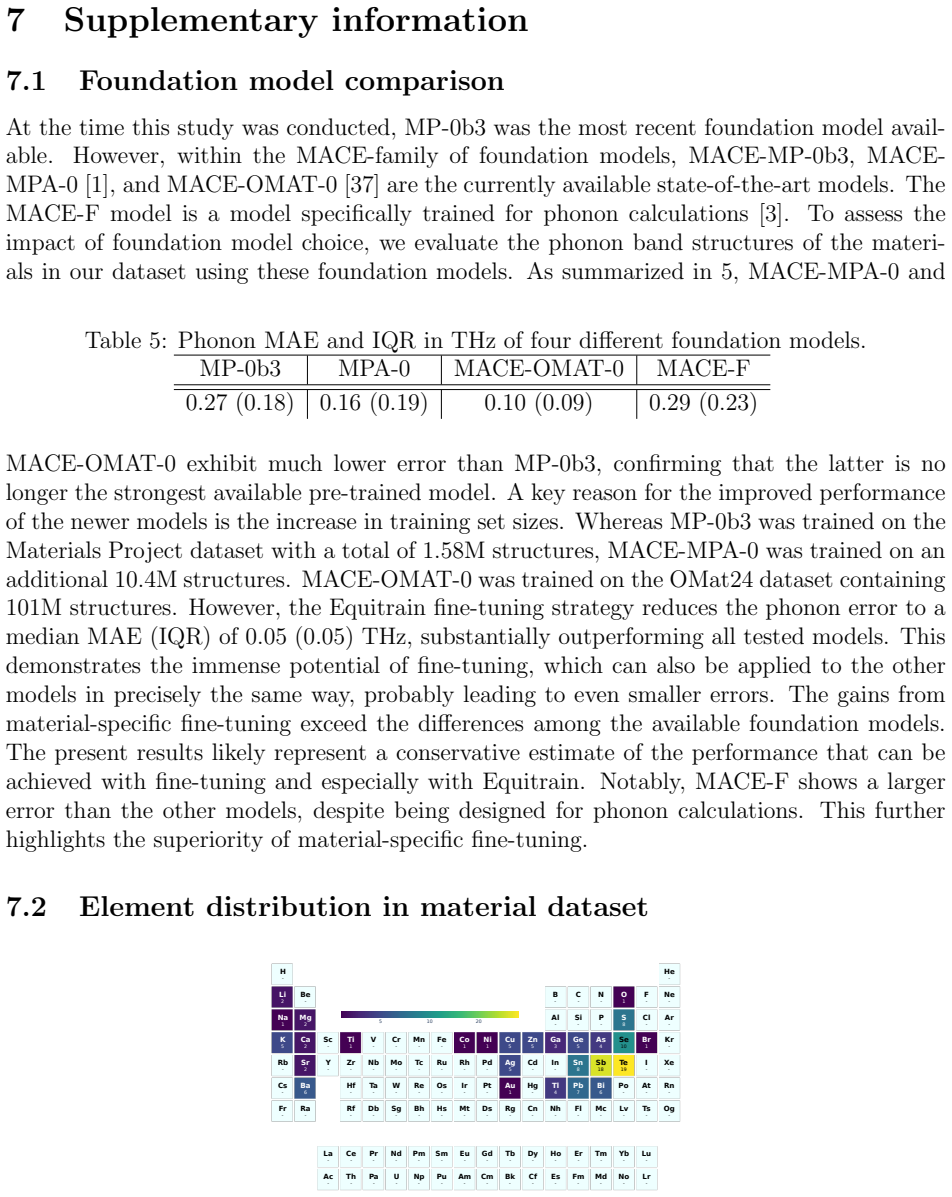
M Hebbache and M Zemzemi. “Ab initio study of high-pressure behavior of a low compressibility metal and a hard material: Osmium and diamond”. In:Physical Review B—Condensed Matter and Materials Physics70.22 (2004), p. 224107. 21 7 Supplementary information 7.1 Foundation model comparison At the time this study was conducted, MP-0b3 was the most recent fou...
work page 2004
-
[40]
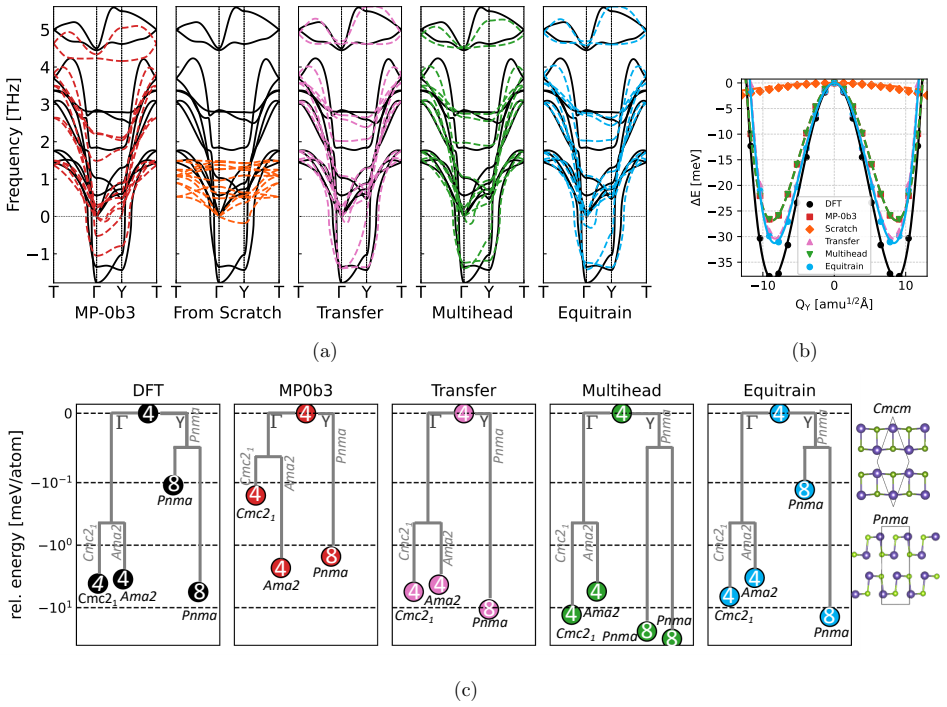
DFT and ML predict identical phase transition pathways. The shapes of the energy potential and the relaxed structure obtained at the energy minimum are consistent between the two methods. 25
-
[41]
This behavior can be attributed to interpolation errors inherent to the finite-displacement approach
The DFT phonon band structure exhibits imaginary modes, but the energy poten- tial along the corresponding mode remains purely harmonic. This behavior can be attributed to interpolation errors inherent to the finite-displacement approach. Z R S T Y T Z 1 0 1 2 3 4 5 Frequency [THz] (a) 1.0 0.5 0.0 0.5 1.0Q0 [amu1/2Å] 1.0 0.5 0.0 0.5 1.0 Q1 [amu1/2 Å] 10.0...
-
[42]
As in scenario 2, DFT exhibits imaginary modes due to interpolation errors. However, the ML model captures an anharmonic potential and relaxes to the same primitive unit cell with same space group, differing only by slightly adjusted lattice parameters. It should be noted here that the energy potential is not correctly represented by the ML model, as a mi...
-
[43]
Both DFT and ML models exhibit imaginary modes, but the ML model follows an incorrect transition pathway and relaxes into a different space group than obtained from DFT. An example for this is the transition pathway of K 3Sb in the Multihead Model, which was discussed in the main part in 3.5. For each material, the set of final phases,S M L, is compared t...
discussion (0)
Sign in with ORCID, Apple, or X to comment. Anyone can read and Pith papers without signing in.