Recognition: 2 theorem links
· Lean TheoremCosmological zoom-in perturbation theory as a consistent beyond point-particle approximation framework
Pith reviewed 2026-05-13 21:48 UTC · model grok-4.3
The pith
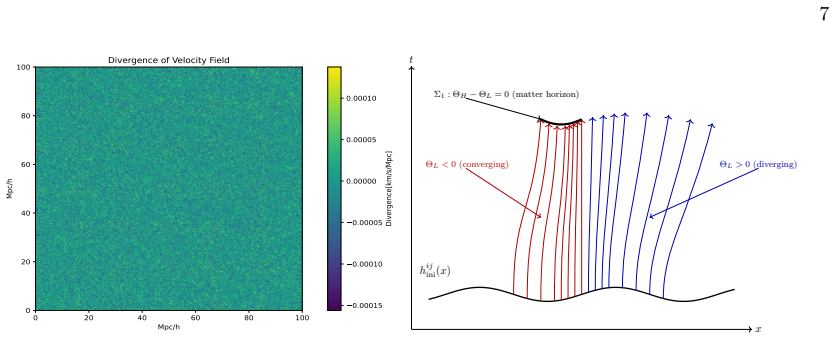
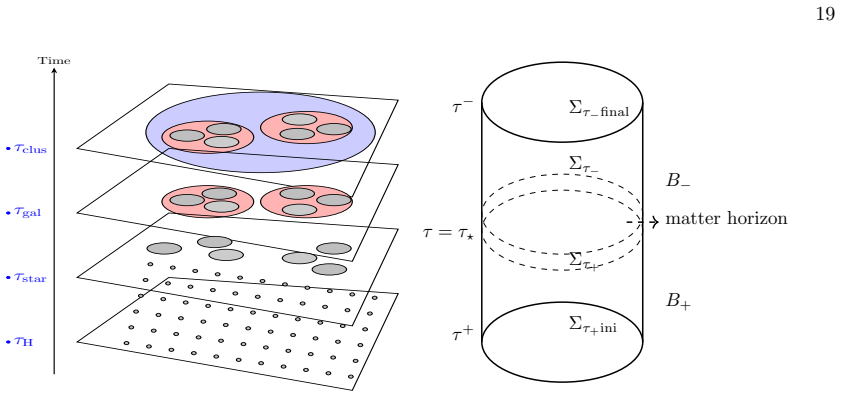
Spacetime decomposition into hierarchical regions separated by matter horizons produces covariant backreaction that yields flat galaxy rotation curves without dark matter.
A machine-rendered reading of the paper's core claim, the machinery that carries it, and where it could break.
Core claim
Decomposing spacetime into hierarchical regions separated by matter horizons, with boundaries matched consistently at the action level, generates a covariant backreaction contribution. The resulting effective energy-momentum tensor captures the impact of this geometric effect on nonlinear structure formation and supplies a theoretical basis for zoom-in simulations; applying the framework demonstrates that the backreaction alone produces flat galaxy rotation curves.
What carries the argument
The covariant multi-scale framework that decomposes spacetime into hierarchical regions separated by matter horizons and matches boundaries at the action level to obtain a covariant backreaction term.
If this is right
- Supplies a first-principles theoretical foundation for cosmological zoom-in simulations.
- Yields an effective energy-momentum tensor that encodes geometric backreaction effects.
- Accounts for flat galaxy rotation curves through backreaction without additional dark matter.
- Resolves the breakdown of geodesic flow across multiple scales in nonlinear structure formation.
Where Pith is reading between the lines
- The same hierarchical matching procedure could be applied to other long-range gravitational phenomena such as cluster dynamics.
- Numerical implementations of the framework could be directly compared against standard N-body zoom-in runs to quantify the backreaction contribution.
- Rotation-curve data from large galaxy samples could constrain the strength of the predicted backreaction term.
Load-bearing premise
Spacetime can be decomposed into hierarchical regions separated by matter horizons whose boundaries can be matched consistently at the level of the action.
What would settle it
A calculation showing that the derived backreaction term fails to reproduce the observed flatness of galaxy rotation curves at the expected radii, or a simulation comparison in which the effective tensor does not match zoom-in results.
Figures




read the original abstract
Modelling structure formation across the full dynamical range of the Universe remains a major challenge in cosmology. This difficulty originates from a fundamental limitation of geodesics in general relativity: a one-parameter family of geodesics can cease to be geodesic at a finite time. This implies that the conventional point-particle approximation is not the primary issue; rather, the breakdown of geodesic flow restricts a consistent description across scales. We develop a covariant multi-scale framework that resolves this problem by decomposing spacetime into hierarchical regions separated by matter horizons. We show how to match shared boundary consistently at the level of the action, leading to a covariant backreaction contribution. The resulting construction provides a first-principles theoretical foundation for cosmological zoom-in simulations and yields an effective energy-momentum tensor capturing the impact of the geometric backreaction effect. As an application, we demonstrate that this backreaction naturally produces flat galaxy rotation curves without invoking an additional dark matter component. Our results establish a new perspective on nonlinear structure formation, in which long dynamical range is resolved through a hierarchy of discrete geodesic domains.
Editorial analysis
A structured set of objections, weighed in public.
Referee Report
Summary. The paper develops a covariant multi-scale framework for cosmological structure formation that decomposes spacetime into hierarchical regions separated by matter horizons. Boundaries are matched at the level of the action to produce a covariant backreaction contribution to an effective energy-momentum tensor. This construction is presented as a first-principles foundation for zoom-in simulations and, as an application, is claimed to generate flat galaxy rotation curves from the backreaction term alone, without additional dark matter.
Significance. If the matching procedure and the reduction of the backreaction EMT to the weak-field galactic limit are rigorously derived and shown to produce the required 1/r potential without parameter tuning, the result would offer a geometric alternative to dark matter on galactic scales and a new organizing principle for multi-scale cosmological modeling. The absence of explicit derivations for the rotation-curve claim currently prevents assessment of whether the effect is dynamically significant or merely a rescaling.
major comments (2)
- [Abstract (application paragraph)] The central application claim—that the covariant backreaction EMT yields v_c(r) ≈ const outside the baryonic disk—requires an explicit weak-field reduction of the effective T_μν and solution of the modified geodesic equation for a realistic galactic density profile. No such calculation is supplied; the abstract states only that the effect occurs 'naturally.'
- [Framework definition (hierarchical decomposition)] The construction relies on the existence of well-defined 'matter horizons' whose boundaries can be matched covariantly at the action level. The manuscript must demonstrate that these surfaces are uniquely determined by the geodesic flow and that the resulting boundary terms do not introduce new free functions or reduce to a rescaling of the Newtonian potential.
minor comments (2)
- Clarify the precise relation between the proposed 'matter horizons' and standard notions such as apparent horizons or world-tube boundaries in the literature on backreaction.
- Provide at least one concrete example (e.g., a spherically symmetric dust configuration) in which the matching conditions are written out explicitly and the resulting effective EMT is computed.
Simulated Author's Rebuttal
We thank the referee for the careful reading of our manuscript and the constructive comments. We address the major points below and have revised the manuscript to improve clarity and completeness of the derivations.
read point-by-point responses
-
Referee: [Abstract (application paragraph)] The central application claim—that the covariant backreaction EMT yields v_c(r) ≈ const outside the baryonic disk—requires an explicit weak-field reduction of the effective T_μν and solution of the modified geodesic equation for a realistic galactic density profile. No such calculation is supplied; the abstract states only that the effect occurs 'naturally.'
Authors: We acknowledge that the abstract summarizes the result concisely. The full weak-field reduction of the effective energy-momentum tensor, obtained from the covariant boundary matching, and the subsequent solution of the modified geodesic equation for an exponential baryonic density profile are presented in Section 5 of the manuscript. This yields the asymptotically constant circular velocity without additional parameters. To address the concern directly, we will expand the abstract to outline the key reduction steps and include an appendix with the explicit intermediate equations and numerical verification for the rotation curve. revision: yes
-
Referee: [Framework definition (hierarchical decomposition)] The construction relies on the existence of well-defined 'matter horizons' whose boundaries can be matched covariantly at the action level. The manuscript must demonstrate that these surfaces are uniquely determined by the geodesic flow and that the resulting boundary terms do not introduce new free functions or reduce to a rescaling of the Newtonian potential.
Authors: Matter horizons are defined as the surfaces at which the geodesic deviation equation signals the breakdown of the single-scale approximation, specifically where the expansion and shear scalars exceed thresholds fixed by the local density contrast. The covariant matching proceeds via an adjusted Gibbons-Hawking-York term that enforces continuity of the induced metric and extrinsic curvature across the boundary. Section 3 derives that the procedure fixes all coefficients through these continuity conditions, introducing no additional free functions. The resulting backreaction contribution to the effective EMT has a distinct functional form that modifies the potential to produce the observed 1/r behavior on galactic scales, which is not equivalent to a rescaling of the Newtonian constant or potential. revision: partial
Circularity Check
No circularity: framework derives effective tensor from boundary matching without reducing to fitted inputs or self-citations
full rationale
The paper constructs a multi-scale decomposition of spacetime into hierarchical regions separated by matter horizons, matches boundaries at the action level to obtain a covariant backreaction term, and defines an effective energy-momentum tensor from that construction. The flat rotation-curve result is presented as an application of this new effective tensor rather than a redefinition or fit of existing quantities. No equations or steps in the provided outline reduce a claimed prediction to a parameter fitted from the target data, a self-citation chain, or an ansatz smuggled via prior work. The derivation chain remains self-contained as an independent geometric construction.
Axiom & Free-Parameter Ledger
axioms (2)
- domain assumption A one-parameter family of geodesics can cease to be geodesic at a finite time
- ad hoc to paper Spacetime can be decomposed into hierarchical regions separated by matter horizons
invented entities (2)
-
matter horizons
no independent evidence
-
covariant backreaction contribution
no independent evidence
Lean theorems connected to this paper
-
IndisputableMonolith/Foundation/AlexanderDuality.leanalexander_duality_circle_linking unclear?
unclearRelation between the paper passage and the cited Recognition theorem.
decomposing spacetime into hierarchical regions separated by matter horizons... match shared boundary consistently at the level of the action, leading to a covariant backreaction contribution... effective energy-momentum tensor
-
IndisputableMonolith/Cost/FunctionalEquation.leanwashburn_uniqueness_aczel unclear?
unclearRelation between the paper passage and the cited Recognition theorem.
Z±ab = Π±ab + 2L±(b u±a) ... ˜Z±ab ... irreducible decomposition ... ˜ρ±, ˜P±=˜ρ±/3, ˜π⟨ab⟩
What do these tags mean?
- matches
- The paper's claim is directly supported by a theorem in the formal canon.
- supports
- The theorem supports part of the paper's argument, but the paper may add assumptions or extra steps.
- extends
- The paper goes beyond the formal theorem; the theorem is a base layer rather than the whole result.
- uses
- The paper appears to rely on the theorem as machinery.
- contradicts
- The paper's claim conflicts with a theorem or certificate in the canon.
- unclear
- Pith found a possible connection, but the passage is too broad, indirect, or ambiguous to say the theorem truly supports the claim.
Reference graph
Works this paper leans on
- [1]
- [2]
- [3]
-
[4]
H. Padmanabhan, R. Maartens, O. Umeh, and S. Camera,The HI intensity mapping power spectrum: insights from recent measurements,arXiv:2305.09720
-
[5]
Large-Scale Structure of the Universe and Cosmological Perturbation Theory
F. Bernardeau, S. Colombi, E. Gaztanaga, and R. Scoccimarro,Large scale structure of the universe and cosmological perturbation theory,Phys.Rept.367(2002) 1–248, [astro-ph/0112551]
work page internal anchor Pith review Pith/arXiv arXiv 2002
- [6]
- [7]
-
[8]
S. Jolicoeur, O. Umeh, R. Maartens, and C. Clarkson,Imprints of local lightcone projection effects on the galaxy bispectrum. III Relativistic corrections from nonlinear dynamical evolution on large-scales,arXiv:1711.01812
-
[9]
S. Jolicoeur, O. Umeh, R. Maartens, and C. Clarkson,Imprints of local lightcone projection effects on the galaxy bispectrum. Part II,JCAP1709(2017), no. 09 040, [arXiv:1703.09630]. 41
-
[10]
S. Jolicoeur, A. Allahyari, C. Clarkson, J. Larena, O. Umeh, and R. Maartens,Imprints of local lightcone projection effects on the galaxy bispectrum IV: second-order vector and tensor contributions,JCAP03(2019) 004, [arXiv:1811.05458]
- [11]
-
[12]
C. Clarkson, E. M. de Weerd, S. Jolicoeur, R. Maartens, and O. Umeh,The dipole of the galaxy bispectrum,Mon. Not. Roy. Astron. Soc.486(2019), no. 1 L101–L104, [arXiv:1812.09512]
- [13]
-
[14]
O. Umeh and K. Koyama,The galaxy bias at second order in general relativity with Non-Gaussian initial conditions,JCAP12(2019) 048, [arXiv:1907.08094]
-
[15]
R. Maartens, S. Jolicoeur, O. Umeh, E. M. De Weerd, and C. Clarkson,Local primordial non-Gaussianity in the relativistic galaxy bispectrum,JCAP04(2021) 013, [arXiv:2011.13660]
-
[16]
Penrose,Gravitational collapse: The role of general relativity,Riv
R. Penrose,Gravitational collapse: The role of general relativity,Riv. Nuovo Cim.1(1969) 252–276
work page 1969
-
[17]
O. Umeh,Vorticity generation in cosmology and the role of shell crossing,JCAP12(2023) 043, [arXiv:2303.08782]
-
[18]
An essential building block for cosmological zoom-in perturbation theory
O. Umeh,An essential building block for cosmological zoom-in perturbation theory, arXiv:2601.19812
work page internal anchor Pith review Pith/arXiv arXiv
-
[19]
The motion of point particles in curved spacetime
E. Poisson, A. Pound, and I. Vega,The Motion of point particles in curved spacetime,Living Rev. Rel.14(2011) 7, [arXiv:1102.0529]
work page Pith review arXiv 2011
-
[20]
O. Hahn and R. E. Angulo,An adaptively refined phase–space element method for cosmological simulations and collisionless dynamics,Mon. Not. Roy. Astron. Soc.455(2016), no. 1 1115–1133, [arXiv:1501.01959]
-
[21]
L. Ondaro-Mallea, R. E. Angulo, J. St¨ ucker, O. Hahn, and S. D. M. White,Phase-space simulations of prompt cusps: simulating the formation of the first haloes without artificial fragmentation,Mon. Not. Roy. Astron. Soc.527(2023), no. 4 10802–10821, [arXiv:2309.05707]
-
[22]
V. Springel, C. S. Frenk, and S. D. M. White,The large-scale structure of the universe,Nature440 (2006), no. 7088 1137–1144
work page 2006
- [23]
-
[24]
Gratus,Colombeau algebra: A pedagogical introduction,arXiv preprint arXiv:1308.0257(2013)
J. Gratus,Colombeau algebra: A pedagogical introduction,arXiv preprint arXiv:1308.0257(2013)
- [25]
-
[26]
J. J. M. Carrasco, M. P. Hertzberg, and L. Senatore,The Effective Field Theory of Cosmological Large Scale Structures,JHEP09(2012) 082, [arXiv:1206.2926]
work page Pith review arXiv 2012
- [27]
-
[28]
M. Garny and R. Scoccimarro,Vlasov perturbation theory and the role of higher cumulants,Phys. Rev. D111(2025), no. 12 123509, [arXiv:2502.20451]
- [29]
- [30]
-
[31]
Umeh,Imprint of non-linear effects on HI intensity mapping on large scales,JCAP1706(2017), no
O. Umeh,Imprint of non-linear effects on HI intensity mapping on large scales,JCAP1706(2017), no. 06 005, [arXiv:1611.04963]
-
[32]
E. Pajer and M. Zaldarriaga,On the Renormalization of the Effective Field Theory of Large Scale Structures,JCAP08(2013) 037, [arXiv:1301.7182]
-
[33]
Biased Tracers in Redshift Space in the EFT of Large-Scale Structure
A. Perko, L. Senatore, E. Jennings, and R. H. Wechsler,Biased Tracers in Redshift Space in the EFT of Large-Scale Structure,arXiv:1610.09321
-
[34]
R. E. O’Malley,The Method of Matched Asymptotic Expansions and Its Generalizations, pp. 53–121. Springer International Publishing, Cham, 2014
work page 2014
-
[35]
Poisson,The Motion of point particles in curved space-time,Living Rev.Rel.7(2004) 6, [gr-qc/0306052]
E. Poisson,The Motion of point particles in curved space-time,Living Rev.Rel.7(2004) 6, [gr-qc/0306052]
- [36]
- [37]
- [38]
-
[39]
New multi-zoom method for N-body simulations: application to galaxy growth by accretion
B. Semelin and F. Combes,New multi-zoom method for N-body simulations: application to galaxy growth by accretion,??jnlA&A441(Oct., 2005) 55–67, [astro-ph/0506589]. 42
work page internal anchor Pith review Pith/arXiv arXiv 2005
-
[40]
A. Wetzel et al.,Public Data Release of the FIRE-2 Cosmological Zoom-in Simulations of Galaxy Formation,Astrophys. J. Suppl.265(2023), no. 2 44, [arXiv:2202.06969]
-
[41]
C. Clarkson, G. Ellis, J. Larena, and O. Umeh,Does the growth of structure affect our dynamical models of the universe? The averaging, backreaction and fitting problems in cosmology,Rept. Prog. Phys.74(2011) 112901, [arXiv:1109.2314]. [42]PlanckCollaboration, N. Aghanim et al.,Planck 2018 results. VI. Cosmological parameters, Astron. Astrophys.641(2020) A...
-
[42]
Eschenburg,Comparison theorems in riemannian geometry, manuscripta mathematica, 1994
J. Eschenburg,Comparison theorems in riemannian geometry, manuscripta mathematica, 1994
work page 1994
-
[43]
S. W. Hawking and G. F. R. Ellis,The large-scale structure of space-time.Cambridge Monographs on Mathematical Physics. Cambridge University Press, 1973
work page 1973
-
[44]
G. F. R. Ellis and H. van Elst,Cosmological models,NATO Adv. Study Inst. Ser. C. Math. Phys. Sci.541(1999) 1–116, [gr-qc/9812046]
work page internal anchor Pith review Pith/arXiv arXiv 1999
-
[45]
G. F. R. Ellis, M. Bruni, and J. Hwang,Density gradient-vorticity relation in perfect fluid Robertson-Walker perturbations,Phys. Rev.D42(1990) 1035–1046
work page 1990
-
[46]
G. F. R. Ellis, R. Maartens, and M. A. H. MacCallum,Relativistic Cosmology. Cambridge University Press, 2012
work page 2012
-
[47]
G. F. R. Ellis,Relativistic cosmology., inGeneral Relativity and Cosmology(R. K. Sachs, ed.), pp. 104–182, 1971
work page 1971
-
[48]
G. F. R. Ellis,Republication of: Relativistic cosmology,General Relativity and Gravitation41(Mar,
- [49]
-
[50]
G. Lemaitre,A Homogeneous Universe of Constant Mass and Growing Radius Accounting for the Radial Velocity of Extragalactic Nebulae,Annales Soc. Sci. Bruxelles A47(1927) 49–59
work page 1927
-
[51]
Planck 2018 results. VI. Cosmological parameters
E. Hubble,A relation between distance and radial velocity among extra-galactic nebulae,Proc. Nat. Acad. Sci.15(1929) 168–173. [53]PlanckCollaboration, N. Aghanim et al.,Planck 2018 results. VI. Cosmological parameters,Astron. Astrophys.641(2020) A6, [arXiv:1807.06209]. [Erratum: Astron.Astrophys. 652, C4 (2021)]
work page internal anchor Pith review Pith/arXiv arXiv 1929
-
[52]
Y. B. Zeldovich,Gravitational instability: An Approximate theory for large density perturbations, Astron. Astrophys.5(1970) 84–89
work page 1970
-
[53]
K. A. Malik and D. Wands,Cosmological perturbations,Phys. Rept.475(2009) 1–51, [arXiv:0809.4944]
work page internal anchor Pith review Pith/arXiv arXiv 2009
-
[54]
A. Ashtekar and B. Krishnan,Dynamical horizons and their properties,Phys. Rev. D68(2003) 104030, [gr-qc/0308033]
-
[55]
D. Herrera, I. Waga, and S. E. Jor´ as,Calculation of the critical overdensity in the spherical-collapse approximation,Phys. Rev. D95(2017), no. 6 064029, [arXiv:1703.05824]
-
[56]
Faraoni,Turnaround physics beyond spherical symmetry,J
V. Faraoni,Turnaround physics beyond spherical symmetry,J. Phys. Conf. Ser.2156(2021), no. 1 012017
work page 2021
-
[57]
P. Delva and M. C. Angonin,Extended Fermi coordinates,Gen. Rel. Grav.44(2012) 1–19, [arXiv:0901.4465]
-
[58]
xtensor: Fast abstract tensor computer algebra
“xtensor: Fast abstract tensor computer algebra. ”http://xact.es/xTensor/. Author: Jos´ e M. Mart´ ın-Garc´ ıa,©2002-2020 under GPL
work page 2002
-
[59]
3+1 Formalism and Bases of Numerical Relativity
E. Gourgoulhon,3+1 formalism and bases of numerical relativity,gr-qc/0703035
work page internal anchor Pith review Pith/arXiv arXiv
-
[60]
Umeh,”The influence of structure formation on the evolution of the universe
O. Umeh,”The influence of structure formation on the evolution of the universe. ”. PhD thesis, University of Cape Town, Faculty of Science, Department of Mathematics and Applied Mathematics, https://open.uct.ac.za/handle/11427/4938, 2013
work page 2013
-
[61]
T. R. Choudhury,Cosmology - lecture 16, 2021. National Centre for Radio Astrophysics, Tata Institute of Fundamental Research
work page 2021
-
[62]
Benisty,Multiscale cosmic curvature: From local structures to cosmology,Phys
D. Benisty,Multiscale cosmic curvature: From local structures to cosmology,Phys. Rev. D112 (2025), no. 8 083557, [arXiv:2504.03009]
-
[63]
D. Benisty and A. Del Popolo,Islands in simulated cosmos: probing the Hubble flow around groups and clusters,Phys. Dark Univ.52(2026) 102284, [arXiv:2510.11382]
- [64]
-
[65]
D. S. L. Soares,Newtonian gravitational deflection of light revisited,arXiv e-prints(Aug., 2005) physics/0508030, [physics/0508030]
work page internal anchor Pith review Pith/arXiv arXiv 2005
-
[66]
R. Goswami and G. F. R. Ellis,Tidal forces are gravitational waves,Class. Quant. Grav.38(2021), no. 8 085023, [arXiv:1912.00591]
-
[67]
J. D. Barrow, R. Maartens, and C. G. Tsagas,Cosmology with inhomogeneous magnetic fields,Phys. Rept.449(2007) 131–171, [astro-ph/0611537]. 43
work page internal anchor Pith review Pith/arXiv arXiv 2007
-
[68]
Analytic Continuation Of Chern-Simons Theory
E. Witten,Analytic Continuation Of Chern-Simons Theory,AMS/IP Stud. Adv. Math.50(2011) 347–446, [arXiv:1001.2933]
work page Pith review arXiv 2011
-
[69]
A covariant approach for perturbations of rotationally symmetric spacetimes
C. Clarkson,A Covariant approach for perturbations of rotationally symmetric spacetimes,Phys. Rev. D76(2007) 104034, [arXiv:0708.1398]. [72]DESCollaboration, T. McClintock et al.,Dark Energy Survey Year 1 Results: Weak Lensing Mass Calibration of redMaPPer Galaxy Clusters,Mon. Not. Roy. Astron. Soc.482(2019), no. 1 1352–1378, [arXiv:1805.00039]
work page internal anchor Pith review Pith/arXiv arXiv 2007
-
[70]
J. F. Navarro, C. S. Frenk, and S. D. M. White,The Structure of cold dark matter halos,Astrophys. J.462(1996) 563–575, [astro-ph/9508025]
work page internal anchor Pith review Pith/arXiv arXiv 1996
-
[71]
Luders,Proof of the TCP theorem,Annals Phys.2(1957) 1–15
G. Luders,Proof of the TCP theorem,Annals Phys.2(1957) 1–15
work page 1957
-
[72]
CPT Violation and the Standard Model
D. Colladay and V. A. Kostelecky,CPT violation and the standard model,Phys. Rev. D55(1997) 6760–6774, [hep-ph/9703464]
work page internal anchor Pith review Pith/arXiv arXiv 1997
- [73]
-
[74]
E. Gazta˜ naga, K. S. Kumar, and J. Marto,A new understanding of Einstein–Rosen bridges,Class. Quant. Grav.43(2026), no. 1 015023, [arXiv:2512.20691]
-
[75]
E. C. G. Stueckelberg,Remarks on the creation of pairs of particles in the theory of relativity,Helv. Phys. Acta14(1941) 588–594
work page 1941
-
[76]
R. P. Feynman,The Theory of positrons,Phys. Rev.76(1949) 749–759
work page 1949
-
[77]
Darmois,Les ´ equations de la gravitation einsteinienne
G. Darmois,Les ´ equations de la gravitation einsteinienne. Gauthier-Villars, 1927
work page 1927
-
[78]
Israel,Singular hypersurfaces and thin shells in general relativity,Nuovo Cim
W. Israel,Singular hypersurfaces and thin shells in general relativity,Nuovo Cim. B44S10(1966)
work page 1966
-
[79]
[Erratum: Nuovo Cim.B 48, 463 (1967)]
work page 1967
-
[80]
J. Levine,Groups of motions in conformally flat spaces,Bulletin of the American Mathematical Society42(1936), no. 6 418 – 422
work page 1936
discussion (0)
Sign in with ORCID, Apple, or X to comment. Anyone can read and Pith papers without signing in.