Recognition: 1 theorem link
· Lean TheoremVarieties of electrically charged physical states in SU(2)timesU(1) lattice gauge Higgs theory
Pith reviewed 2026-05-13 22:00 UTC · model grok-4.3
The pith
New dressing constructions create distinct electrically charged states in SU(2)×U(1) lattice gauge Higgs theory.
A machine-rendered reading of the paper's core claim, the machinery that carries it, and where it could break.
Core claim
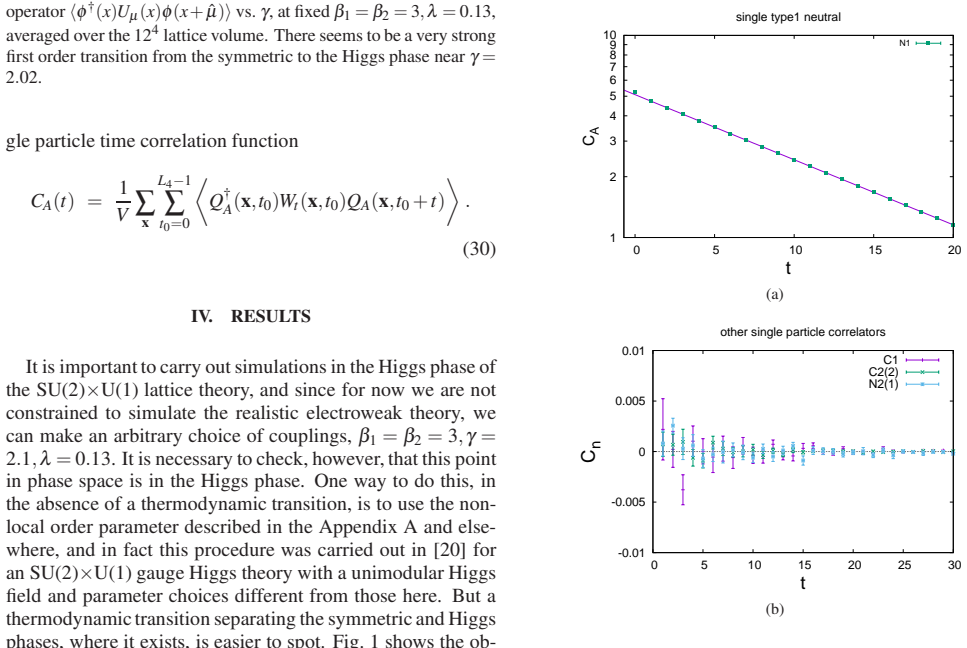
In quenched SU(2)×U(1) gauge Higgs theory coupled to a static vector-like fermion, new gauge-invariant electrically charged states are obtained by dressing the static source in ways orthogonal to earlier constructions. Lattice study of the charged fermion propagators shows the existence of at least two particle states with different masses in the charged spectrum.
What carries the argument
New dressing constructions for the static fermion source using dynamical gauge and Higgs fields to form locally gauge-invariant charged operators orthogonal to prior constructions.
If this is right
- The neutral static fermion is much lighter than any of the charged fermion states.
- At least two particle states with different masses exist in the charged particle spectrum.
- These charged states arise from distinct ways of dressing the static source with dynamical fields.
- Physical charged states in lattice electroweak theories can be constructed in multiple inequivalent ways.
Where Pith is reading between the lines
- If these states are distinct, lattice studies of the electroweak spectrum must include all orthogonal dressings to capture the full particle content.
- Similar varieties of dressed states could appear in other gauge-Higgs models when static sources are introduced.
- The mass gap between neutral and charged states may affect how confinement and the Higgs mechanism are modeled together on the lattice.
Load-bearing premise
The newly described dressing constructions produce distinct physical states that are orthogonal to previous ones and whose masses can be extracted reliably from lattice correlators without significant contamination.
What would settle it
A lattice calculation in which the new dressed operators show large overlap with previous constructions or yield only a single mass value for the charged states.
Figures



read the original abstract
We consider a quenched SU(2)$\times$U(1) gauge Higgs theory on the lattice, coupled to a static vector-like fermion which, in this case, is in the same gauge group representation as the Higgs field. Physical (i.e. locally gauge invariant) electrically charged and electrically neutral states of matter particles in the electroweak theory were described decades ago, but those constructions do not exhaust all the possibilities, and new types of electrically charged/neutral states, orthogonal to former constructions, are described here. The difference has to do with how the static source, which by itself does not create a physical state, is dressed by dynamical fields. We find that, unsurprisingly, the neutral static fermion is much lighter than any of the charged fermion states. But a lattice study of the propagation of the charged fermion states indicates the existence of (at least) two particle states with different masses in charged particle spectrum.
Editorial analysis
A structured set of objections, weighed in public.
Referee Report
Summary. The paper examines varieties of electrically charged and neutral physical states in quenched SU(2)×U(1) lattice gauge-Higgs theory with a static vector-like fermion in the same representation as the Higgs. It constructs new gauge-invariant dressings for the static source that are claimed to be orthogonal to earlier constructions, and reports lattice measurements of charged-fermion propagators indicating at least two distinct masses in the charged sector (with the neutral state being substantially lighter).
Significance. If the new dressings are demonstrably orthogonal and the extracted masses are free of significant operator overlap or excited-state contamination, the result would enlarge the known spectrum of gauge-invariant states in gauge-Higgs models and could affect interpretations of charged excitations in lattice electroweak studies. The work supplies an explicit theoretical classification of dressings together with numerical evidence; the latter, however, requires quantitative validation of orthogonality and fit stability before the two-mass claim can be regarded as robust.
major comments (3)
- [Lattice results / charged fermion propagators] Lattice results section (charged correlators): the manuscript reports two distinct masses but provides no overlap matrix elements between the new dressing operators and the earlier gauge-invariant constructions. Without these numbers it is impossible to confirm that the observed splitting is not an artifact of residual overlap with previously studied states.
- [Lattice results / charged fermion propagators] Lattice results section (mass extraction): no details are given on the fitting procedure (single- versus multi-exponential fits), the choice of fit windows, or stability under variations in source/sink smearing. The effective-mass plateaus or variational eigenvalues must be shown to be stable before the claim of two separate particles can be accepted.
- [Lattice results / charged fermion propagators] Lattice results section (error analysis): the abstract and surrounding text give no quantitative information on statistical errors, autocorrelation times, or the number of configurations used. These omissions make it impossible to assess whether the reported mass difference is statistically significant.
minor comments (2)
- [Theoretical constructions] Notation for the new dressing operators should be introduced with an explicit equation number and compared term-by-term with the older constructions to make the orthogonality claim easier to verify.
- [Lattice setup] The manuscript should include a brief table listing the lattice volumes, β values, Higgs hopping parameter, and fermion mass used in the simulations.
Simulated Author's Rebuttal
We thank the referee for the careful reading of our manuscript and for the constructive comments. We address each major comment below and will revise the manuscript accordingly to strengthen the presentation of our results.
read point-by-point responses
-
Referee: [Lattice results / charged fermion propagators] Lattice results section (charged correlators): the manuscript reports two distinct masses but provides no overlap matrix elements between the new dressing operators and the earlier gauge-invariant constructions. Without these numbers it is impossible to confirm that the observed splitting is not an artifact of residual overlap with previously studied states.
Authors: We agree that quantitative overlap matrix elements are needed to rigorously establish orthogonality. In the revised manuscript we will compute and report the overlap matrix elements between the new dressing operators and the earlier gauge-invariant constructions, thereby providing direct numerical confirmation that the observed mass splitting is not due to residual overlap. revision: yes
-
Referee: [Lattice results / charged fermion propagators] Lattice results section (mass extraction): no details are given on the fitting procedure (single- versus multi-exponential fits), the choice of fit windows, or stability under variations in source/sink smearing. The effective-mass plateaus or variational eigenvalues must be shown to be stable before the claim of two separate particles can be accepted.
Authors: We acknowledge the omission of these technical details. The revised manuscript will include a complete description of the fitting procedure (specifying single- versus multi-exponential fits), the chosen fit windows, and explicit demonstrations of stability under variations in source/sink smearing, together with the corresponding effective-mass plateaus and variational eigenvalues. revision: yes
-
Referee: [Lattice results / charged fermion propagators] Lattice results section (error analysis): the abstract and surrounding text give no quantitative information on statistical errors, autocorrelation times, or the number of configurations used. These omissions make it impossible to assess whether the reported mass difference is statistically significant.
Authors: We will add the missing quantitative information on the statistical analysis, including the number of configurations, estimates of statistical errors, and autocorrelation times, so that the statistical significance of the reported mass difference can be properly evaluated. revision: yes
Circularity Check
No circularity: masses extracted from independent lattice correlators of new dressings
full rationale
The paper defines new gauge-invariant dressing operators for charged fermion states, asserts they are orthogonal to prior constructions, and then reports numerical lattice results for their propagators yielding at least two distinct masses. These mass values are obtained directly from measured correlators on the quenched SU(2)×U(1) ensemble; they do not reduce by construction to the input definitions, fitted parameters, or self-citations. The central claim remains a falsifiable numerical observation rather than a tautology or self-referential fit.
Axiom & Free-Parameter Ledger
axioms (1)
- domain assumption Lattice discretization faithfully approximates the continuum SU(2)×U(1) gauge-Higgs theory in the quenched limit.
Lean theorems connected to this paper
-
IndisputableMonolith/Foundation/RealityFromDistinction.leanreality_from_one_distinction unclearWe consider a quenched SU(2)×U(1) gauge Higgs theory on the lattice, coupled to a static vector-like fermion... time correlators... generalized eigenvalue method
Reference graph
Works this paper leans on
-
[1]
for a gauge which avoids the Gribov problem. For our construction of charged states we require pseu- domatter fields ρ n(x;V ) which are functionals of the U(1) field V alone, transforming covariantly via the U(1) subgroup, and also pseudomatter fields ξ n(x; ˜U) which are functionals of the ˜U = UV field, transforming covariantly under the full SU(2)× U(1) g...
-
[2]
which proposes to look for particle spectra of this type by other means. It was noted earlier that time correlation functions such as CAA(t) generally converge to the exponential falloff of the lowest state with the quantum numbers of the initial and fi- nal states. The exception is for states whose overlap with th e ground state is very small, and therefo...
- [3]
- [4]
- [5]
- [6]
-
[7]
P . Guo, A. P . Szczepaniak, G. Galata, A. V assallo, and E. S an- topinto, Phys. Rev. D 77, 056005 (2008), arXiv:0707.3156
work page internal anchor Pith review Pith/arXiv arXiv 2008
-
[8]
V . Bornyakov, G. Schierholz, and T. Streuer, Nucl. Phys. B Proc. Suppl. 106, 676 (2002), arXiv:hep-lat/0111018
- [9]
-
[10]
R. Thorngren, J. Preskill, and L. Fidkowski, (2026), arXiv:2601.04304
-
[11]
J. Greensite and K. Matsuyama, Phys. Rev. D 101, 054508 (2020), arXiv:2001.03068
-
[12]
J. Greensite and K. Matsuyama, Symmetry 14, 177 (2022), arXiv:2112.06421
-
[13]
P . A. M. Dirac, Can. J. Phys. 33, 650 (1955)
work page 1955
-
[14]
R. E. Shrock, Nucl. Phys. B 267, 301 (1986)
work page 1986
-
[15]
M. A. Zubkov and A. I. V eselov, JHEP 12, 109 (2008), arXiv:0804.0140
work page internal anchor Pith review Pith/arXiv arXiv 2008
- [16]
-
[17]
Ravera, Lecture Notes on Symmetry Reduction via the Dressing Field Method, 2026, arXiv:2603.29505
L. Ravera, Lecture Notes on Symmetry Reduction via the Dressing Field Method, 2026, arXiv:2603.29505
-
[18]
J. Greensite and H. Y . Yau, Phys. Rev. D 109, 034502 (2024), arXiv:2310.01354
- [19]
- [20]
-
[21]
On the generalized eigenvalue method for energies and matrix elements in lattice field theory
B. Blossier, M. Della Morte, G. von Hippel, T. Mendes, an d R. Sommer, JHEP 04, 094 (2009), arXiv:0902.1265
work page internal anchor Pith review Pith/arXiv arXiv 2009
-
[22]
S. Gangwani, J. Greensite, and A. Oualla, Phys. Rev. D 109, 054504 (2024), arXiv:2312.02117
-
[23]
J. Greensite, Phys. Rev. D 102, 054504 (2020), arXiv:2007.11616
-
[24]
K. Matsuyama, Phys. Rev. D 103, 074508 (2021), arXiv:2012.13991
-
[25]
J. Greensite and K. Matsuyama, Phys. Rev. B 106, 174508 (2022), arXiv:2208.09114
-
[26]
S. Martins, P . Jenny, A. Maas, and G. Wieland, Weak and Higgs physics from the lattice, 2026, arXiv:2603.12882
- [27]
-
[28]
S. F. Edwards and P . W. Anderson, Journal of Physics F: Me tal Physics 5, 965 (1975)
work page 1975
- [29]
-
[30]
B. All´ es, O. Borisenko, and A. Papa, Phys. Rev. D 112, 094509 (2025), arXiv:2510.00697
-
[31]
B. All´ es, O. Borisenko, and A. Papa, Phys. Rev. D 111, 014509 (2025), arXiv:2410.02045
-
[32]
J. Greensite and K. Matsuyama, Phys. Rev. D96, 094510 (2017), arXiv:1708.08979
-
[33]
R. V erresen, U. Borla, A. Vishwanath, S. Moroz, and R. Th orn- gren, (2022), arXiv:2211.01376
-
[34]
R. Thorngren, T. Rakovszky, R. V erresen, and A. Vishwan ath, (2023), arXiv:2303.08136
- [35]
- [36]
-
[37]
E. H. Fradkin and S. H. Shenker, Phys.Rev. D19, 3682 (1979)
work page 1979
- [38]
discussion (0)
Sign in with ORCID, Apple, or X to comment. Anyone can read and Pith papers without signing in.