Recognition: 1 theorem link
· Lean TheoremEnhanced Sampling Techniques for Lattice Gauge Theory
Pith reviewed 2026-05-13 21:57 UTC · model grok-4.3
The pith
Metadynamics with bias potentials reduces autocorrelation times for topological charge in lattice gauge theories.
A machine-rendered reading of the paper's core claim, the machinery that carries it, and where it could break.
Core claim
With appropriately constructed bias potentials, metadynamics and related enhanced sampling techniques can mitigate topological freezing and significantly reduce the integrated autocorrelation times of the topological charge and associated observables in four-dimensional SU(N) gauge theories with periodic boundary conditions.
What carries the argument
bias potentials that flatten the topological charge distribution to accelerate sector transitions
If this is right
- Integrated autocorrelation times for the topological charge drop by a large factor once the bias potential is active.
- Bias potentials learned on modest volumes can be transferred to production runs at larger volumes.
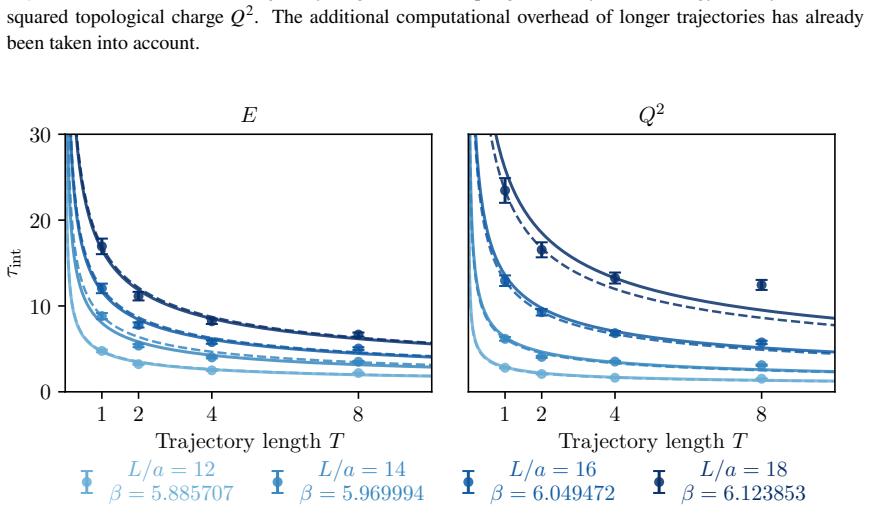
- Longer HMC trajectories and related algorithmic tweaks provide an orthogonal improvement that can be combined with the bias method.
- The same bias construction applies to both QCD and pure SU(N) gauge theories.
- Faster sampling of topological sectors makes observables that depend on topology accessible at volumes where conventional runs freeze.
Where Pith is reading between the lines
- If extrapolation of bias potentials succeeds, the computational cost of generating independent topological samples scales much more favorably with volume than with standard algorithms.
- The method could be combined with other volume-independent sampling strategies such as parallel tempering in the gauge coupling.
- Successful reuse of small-volume biases would allow systematic studies of theta dependence at physical volumes without prohibitive autocorrelation.
Load-bearing premise
Bias potentials constructed on small volumes or during short runs can be extrapolated or reused on large volumes without introducing uncontrolled systematic errors.
What would settle it
A direct comparison in which the histogram of topological charge obtained with an extrapolated bias potential deviates from the histogram obtained in an unbiased long run on the same large volume.
Figures


read the original abstract
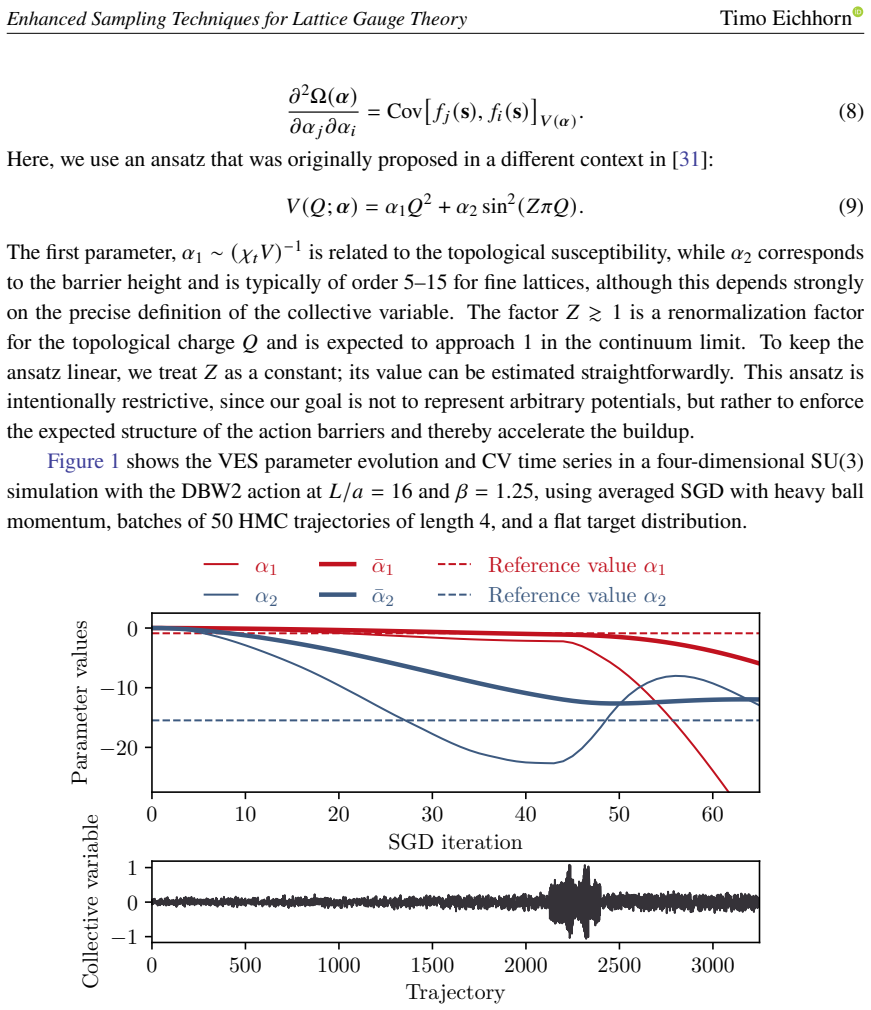
In theories with topological sectors, such as lattice QCD and four-dimensional SU(N) gauge theories with periodic boundary conditions, conventional update algorithms suffer from topological freezing due to large action barriers separating distinct sectors. With appropriately constructed bias potentials, Metadynamics and related enhanced sampling techniques can mitigate this problem and significantly reduce the integrated autocorrelation times of the topological charge and associated observables. We test strategies to accelerate the buildup of bias potentials and the possibility of extrapolating potentials from small to large volumes. We also investigate the effectiveness of orthogonal algorithmic improvements, such as longer HMC trajectories and HMC variants, which may benefit conventional simulations as well.
Editorial analysis
A structured set of objections, weighed in public.
Referee Report
Summary. The manuscript investigates the application of Metadynamics and related enhanced sampling techniques to lattice gauge theories with topological sectors, where conventional algorithms suffer from topological freezing. It claims that appropriately constructed bias potentials can mitigate this issue and significantly reduce integrated autocorrelation times for the topological charge and associated observables. The authors test strategies for accelerating bias potential buildup, extrapolating potentials from small to large volumes, and orthogonal improvements such as longer HMC trajectories and HMC variants.
Significance. If the extrapolation and reweighting procedures preserve the correct equilibrium ensemble without uncontrolled systematics, the work could enable more efficient simulations of topological observables on larger volumes in lattice QCD and SU(N) gauge theories, addressing a persistent barrier in the field. The empirical testing of established enhanced-sampling algorithms on a well-known lattice problem is a methodological strength.
major comments (1)
- [volume extrapolation section] Volume extrapolation tests: the manuscript examines extrapolation of bias potentials from small to large volumes but reports no explicit cross-validation, such as direct comparison of reweighted topological charge histograms or plaquette expectation values against independent, unbiased HMC runs performed on the same large volume. This validation is required to confirm that the target equilibrium distribution is recovered and that reported reductions in autocorrelation times are not artifacts of potential mismatch.
minor comments (1)
- [Abstract] The abstract states that the techniques 'significantly reduce' autocorrelation times yet supplies no numerical values, error estimates, or baseline comparisons, which weakens the reader's ability to gauge the practical improvement.
Simulated Author's Rebuttal
We thank the referee for their careful reading of the manuscript and for highlighting the need for stronger validation of the volume-extrapolation procedure. We address this point below and have revised the manuscript to include the requested cross-checks on volumes where they are computationally feasible.
read point-by-point responses
-
Referee: [volume extrapolation section] Volume extrapolation tests: the manuscript examines extrapolation of bias potentials from small to large volumes but reports no explicit cross-validation, such as direct comparison of reweighted topological charge histograms or plaquette expectation values against independent, unbiased HMC runs performed on the same large volume. This validation is required to confirm that the target equilibrium distribution is recovered and that reported reductions in autocorrelation times are not artifacts of potential mismatch.
Authors: We agree that direct cross-validation against unbiased HMC on the target large volumes would provide the strongest confirmation. In the original submission we presented consistency checks based on plaquette values and the convergence of the bias potential with volume, but we did not include explicit histogram comparisons on the largest volumes. We have now added such comparisons for all volumes where unbiased HMC runs could be completed within available resources. On these intermediate volumes the reweighted topological-charge histograms and plaquette expectation values agree with the direct HMC results within statistical errors. For the very largest volumes, where topological freezing renders unbiased sampling impractical, we have added a quantitative discussion of the residual extrapolation uncertainty and demonstrate that the bias potential approaches a volume-independent limiting form. These additions are included in the revised Section on volume extrapolation and in a new appendix containing the histogram overlays. revision: yes
Circularity Check
No circularity: empirical testing of external algorithms on lattice observables
full rationale
The manuscript reports numerical experiments applying Metadynamics and related bias-potential methods to mitigate topological freezing in lattice gauge theories. All reported improvements are measured directly from autocorrelation times and histogram comparisons on the simulated ensembles; no equation or central claim is obtained by fitting a parameter to a subset of the same data and then relabeling the fit as a prediction, nor does any load-bearing step reduce to a self-citation whose content is itself unverified. The extrapolation tests from small to large volumes are presented as empirical checks rather than derivations, leaving the overall chain self-contained against external benchmarks.
Axiom & Free-Parameter Ledger
axioms (1)
- domain assumption Lattice gauge theories with periodic boundary conditions possess topological sectors separated by large action barriers that cause conventional Monte Carlo updates to freeze.
Reference graph
Works this paper leans on
-
[1]
B. Alles, G. Boyd, M. D’Elia, A. Di Giacomo and E. Vicari,Hybrid Monte Carlo and topological modes of full QCD,Phys. Lett. B389(1996) 107 [hep-lat/9607049]. [2]RBC Collaborationcollaboration,Chiral properties of domain wall fermions with improved gauge actions,Nucl. Phys. B Proc. Suppl.106(2002) 721 [hep-lat/0110074]. 8 Enhanced Sampling Techniques for La...
-
[2]
T.A. DeGrand, A. Hasenfratz and T.G. Kovacs,Improving the chiral properties of lattice fermions,Phys. Rev. D67(2003) 054501 [hep-lat/0211006]. [4]RBC Collaborationcollaboration,Calculation of weak matrix elements in domain wall QCD with the DBW2 gauge action,Nucl. Phys. B Proc. Suppl.119(2003) 362 [hep-lat/0211013]
-
[3]
Aoki et al.,The Kaon B-parameter from quenched domain-wall QCD,Phys
Y. Aoki et al.,The Kaon B-parameter from quenched domain-wall QCD,Phys. Rev. D73 (2006) 094507 [hep-lat/0508011]
-
[4]
Investigating the critical slowing down of QCD simulations
S. Schaefer, R. Sommer and F. Virotta,Investigating the critical slowing down of QCD simulations,PoSLAT2009(2010) 032 [0910.1465]. [7]ALPHA Collaborationcollaboration,Critical slowing down and error analysis in lattice QCD simulations,Nucl. Phys. B845(2011) 93 [1009.5228]
work page internal anchor Pith review arXiv 2010
-
[5]
G. Kanwar and O. Vega,Spectral Diffusion for Sampling onSU(𝑁),2512.19877
-
[6]
C. Bonanno, A. Bulgarelli, E. Cellini, A. Nada, D. Panfalone, D. Vadacchino et al.,A scalable flow-based approach to mitigate topological freezing,2601.20708
-
[7]
A. Matsumoto, M. Hirasawa, J. Nishimura and A. Yosprakob,Phase diagram of 4D SU(3) Yang-Mills theory at𝜃=𝜋via imaginary theta simulations,2603.09604
-
[8]
S. Singh and L. Funcke,Normalizing-flow-based density of states for (1+1)D U(1) lattice gauge theory with a𝜃-term,2603.12501
-
[9]
Finkenrath,Review on Algorithms for dynamical fermions,PoSLATTICE2022(2023) 227 [2402.11704]
J. Finkenrath,Review on Algorithms for dynamical fermions,PoSLATTICE2022(2023) 227 [2402.11704]
-
[10]
Kanwar,Flow-based sampling for lattice field theories,PoSLATTICE2023(2024) 114 [2401.01297]
G. Kanwar,Flow-based sampling for lattice field theories,PoSLATTICE2023(2024) 114 [2401.01297]
-
[11]
Boyle,Advances in algorithms for solvers and gauge generation,PoSLATTICE2023 (2024) 122 [2401.16620]
P.A. Boyle,Advances in algorithms for solvers and gauge generation,PoSLATTICE2023 (2024) 122 [2401.16620]
-
[12]
Finkenrath,Future trends in lattice QCD simulations,PoSEuroPLEx2023(2024) 009
J. Finkenrath,Future trends in lattice QCD simulations,PoSEuroPLEx2023(2024) 009
work page 2024
-
[13]
Trivializing maps, the Wilson flow and the HMC algorithm
M. Luscher,Trivializing maps, the Wilson flow and the HMC algorithm,Commun. Math. Phys.293(2010) 899 [0907.5491]
work page internal anchor Pith review Pith/arXiv arXiv 2010
-
[14]
M.S. Albergo, G. Kanwar and P.E. Shanahan,Flow-based generative models for Markov chain Monte Carlo in lattice field theory,Phys. Rev. D100(2019) 034515 [1904.12072]
- [15]
-
[16]
Hasenbusch,Fighting topological freezing in the two-dimensional𝐶𝑃𝑁−1 model,Phys
M. Hasenbusch,Fighting topological freezing in the two-dimensional𝐶𝑃𝑁−1 model,Phys. Rev. D96(2017) 054504 [1706.04443]
-
[17]
C. Bonanno, G. Clemente, M. D’Elia, L. Maio and L. Parente,Full QCD with milder topological freezing,JHEP08(2024) 236 [2404.14151]
-
[18]
T. Eichhorn, G. Fuwa, C. Hoelbling and L. Varnhorst,Parallel tempered metadynamics: Overcoming potential barriers without surfing or tunneling,Phys. Rev. D109(2024) 114504 [2307.04742]
-
[19]
T. Eichhorn, G. Fuwa, C. Hoelbling and L. Varnhorst,Parallel Tempered Metadynamics,PoS LATTICE2024(2025) 61 [2503.09747]
-
[20]
S. Duane, A.D. Kennedy, B.J. Pendleton and D. Roweth,Hybrid Monte Carlo,Phys. Lett. B 195(1987) 216. 9 Enhanced Sampling Techniques for Lattice Gauge TheoryTimo Eichhorn
work page 1987
-
[21]
Analytic Smearing of SU(3) Link Variables in Lattice QCD
C. Morningstar and M.J. Peardon,Analytic smearing of SU(3) link variables in lattice QCD, Phys. Rev. D69(2004) 054501 [hep-lat/0311018]
work page internal anchor Pith review Pith/arXiv arXiv 2004
-
[22]
Instantons from over-improved cooling
M. Garcia Perez, A. Gonzalez-Arroyo, J.R. Snippe and P. van Baal,Instantons from over - improved cooling,Nucl. Phys. B413(1994) 535 [hep-lat/9309009]
work page internal anchor Pith review Pith/arXiv arXiv 1994
-
[23]
Topology of the SU(2) vacuum: a lattice study using improved cooling
P. de Forcrand, M. Garcia Perez and I.-O. Stamatescu,Topology of the SU(2) vacuum: A Lattice study using improved cooling,Nucl. Phys. B499(1997) 409 [hep-lat/9701012]
work page internal anchor Pith review Pith/arXiv arXiv 1997
-
[24]
Y. Tanizaki, A. Tomiya and H. Watanabe,Lattice gradient flows (de-)stabilizing topological sectors,JHEP04(2025) 123 [2411.14812]
- [25]
-
[26]
A. Laio and M. Parrinello,Escaping free-energy minima,Proc. Natl. Acad. Sci.99(2002) 12562
work page 2002
-
[27]
O. Valsson and M. Parrinello,Variational approach to enhanced sampling and free energy calculations,Phys. Rev. Lett.113(2014) 090601
work page 2014
- [28]
-
[29]
P. Raiteri, A. Laio, F.L. Gervasio, C. Micheletti and M. Parrinello,Efficient reconstruction of complex free energy landscapes by multiple walkers metadynamics,J. Phys. Chem. B110 (2006) 3533
work page 2006
-
[30]
Topological susceptibility and excess kurtosis in SU(3) Yang-Mills theory
S. Durr and G. Fuwa,Topological susceptibility and excess kurtosis in SU(3) Yang-Mills theory,Phys. Rev. D113(2026) 054508 [2501.08217]
work page internal anchor Pith review Pith/arXiv arXiv 2026
-
[31]
Cost of the Generalised Hybrid Monte Carlo Algorithm for Free Field Theory
A.D. Kennedy and B. Pendleton,Cost of the generalized hybrid Monte Carlo algorithm for free field theory,Nucl. Phys. B607(2001) 456 [hep-lat/0008020]
work page internal anchor Pith review Pith/arXiv arXiv 2001
-
[32]
Exploring the HMC trajectory-length dependence of autocorrelation times in lattice QCD
H.B. Meyer, H. Simma, R. Sommer, M. Della Morte, O. Witzel and U. Wolff,Exploring the HMC trajectory-length dependence of autocorrelation times in lattice QCD,Comput. Phys. Commun.176(2007) 91 [hep-lat/0606004]
work page internal anchor Pith review Pith/arXiv arXiv 2007
- [33]
-
[34]
S. Yamamoto, P. Boyle, T. Izubuchi, L. Jin, C. Lehner and N. Matsumoto,Improvement in Autocorrelation Times Measured by the Master-Field Technique using Field Transformation HMC in 2+1 Domain Wall Fermion Simulations,PoSLATTICE2024(2025) 034 [2502.05452]. [38]ALPHA Collaborationcollaboration,Monte Carlo errors with less errors,Comput. Phys. Commun.156(200...
-
[35]
M.D. Hoffman, A. Gelman et al.,The no-u-turn sampler: adaptively setting path lengths in hamiltonian monte carlo.,J. Mach. Learn. Res.15(2014) 1593
work page 2014
-
[36]
Betancourt,Identifying the optimal integration time in hamiltonian monte carlo, 1601.00225
M. Betancourt,Identifying the optimal integration time in hamiltonian monte carlo, 1601.00225
-
[37]
A. Nishimura and D. Dunson,Recycling intermediate steps to improve hamiltonian monte carlo,Bayesian Analysis15(2020)
work page 2020
-
[38]
S. Vishwanath and H. Tak,Repelling-attracting hamiltonian monte carlo,2403.04607. 10
discussion (0)
Sign in with ORCID, Apple, or X to comment. Anyone can read and Pith papers without signing in.