Recognition: 2 theorem links
· Lean TheoremMachine Learning Interatomic Potentials for Million-Atom Simulations of Multicomponent Alloys
Pith reviewed 2026-05-13 21:21 UTC · model grok-4.3
The pith
GRACE potentials train more efficiently with slightly better accuracy than NEP for multicomponent alloys, while NEP runs about sixty times faster for million-atom simulations.
A machine-rendered reading of the paper's core claim, the machinery that carries it, and where it could break.
Core claim
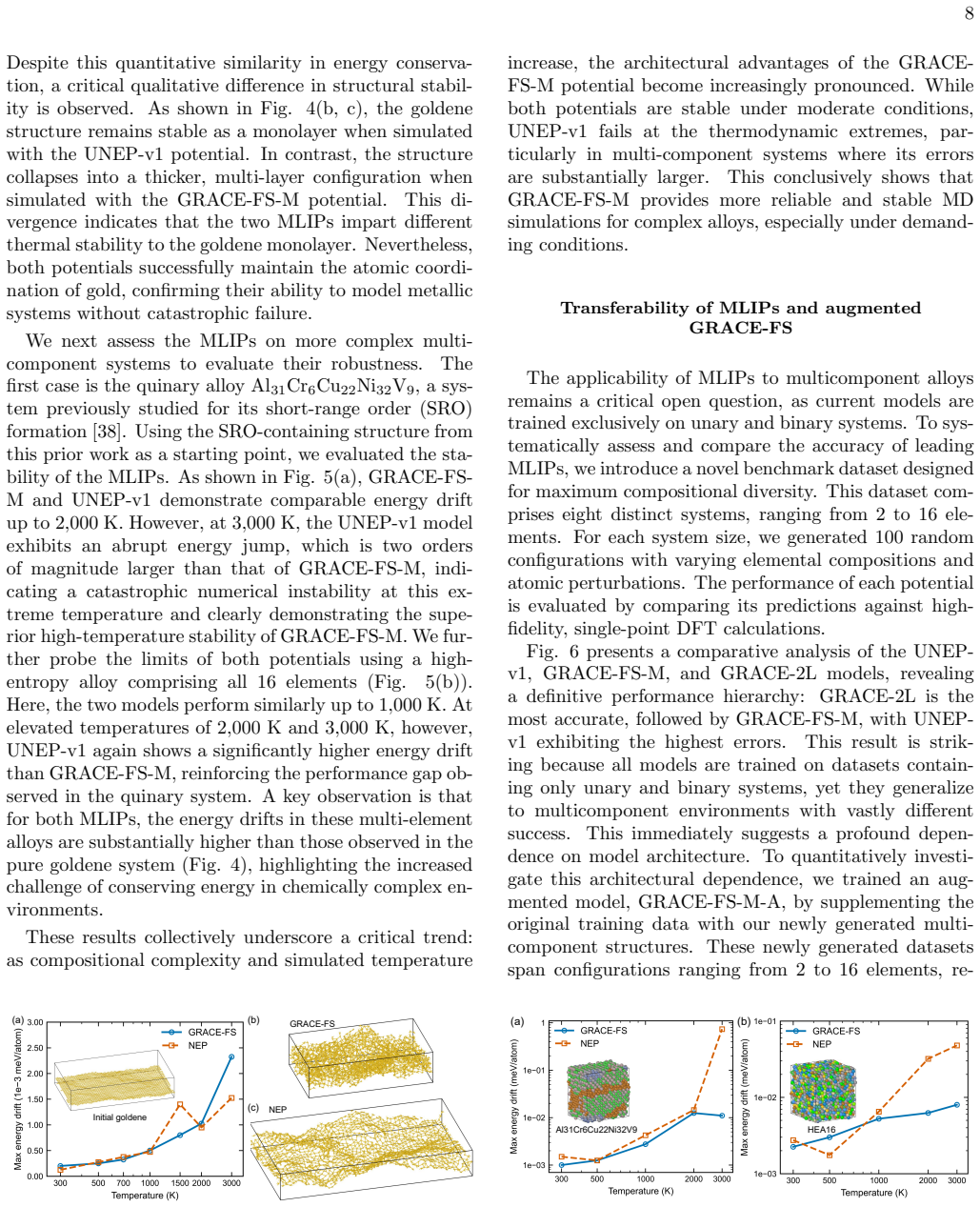
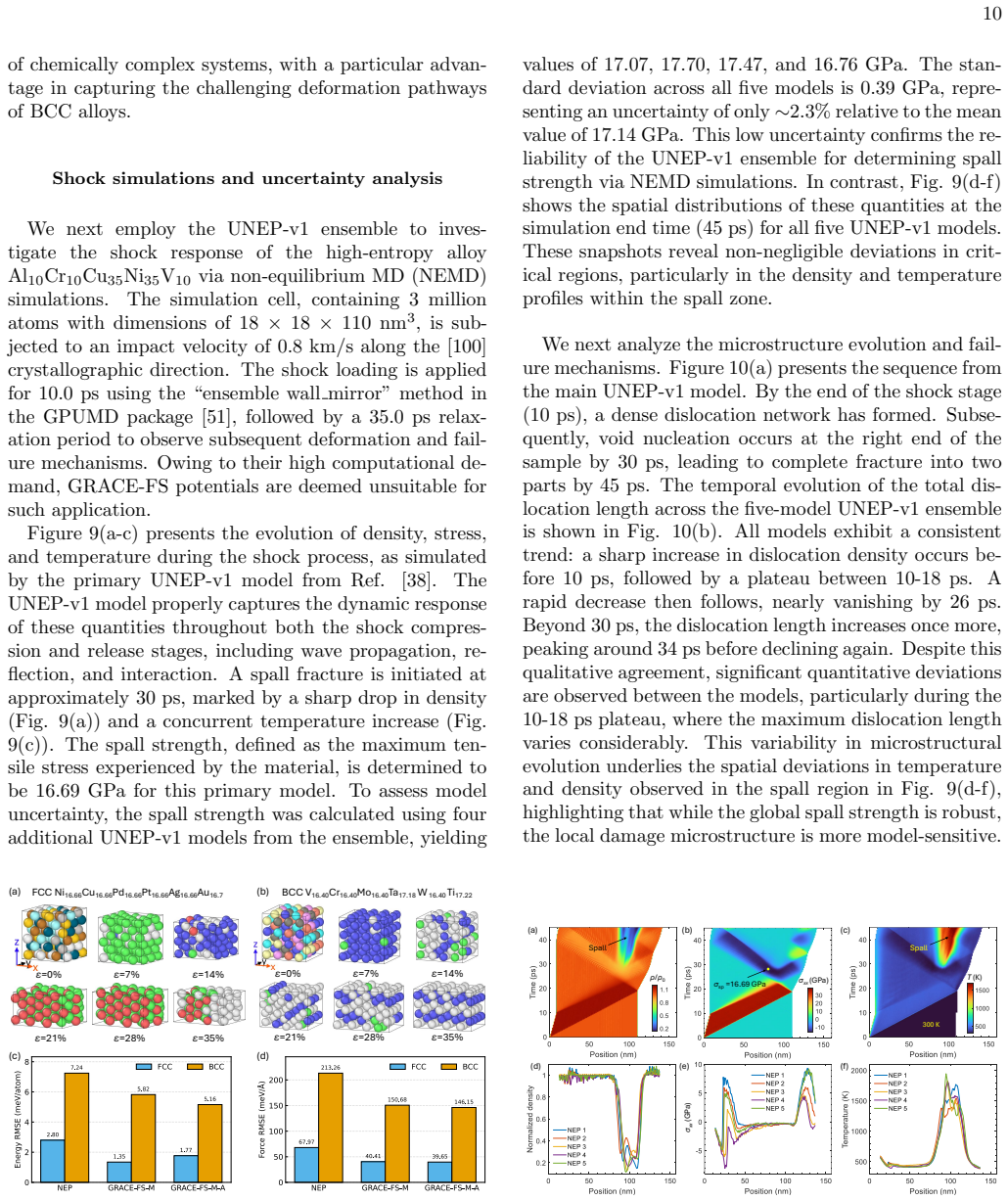
GRACE potential with Finnis-Sinclair type shows substantially higher training efficiency and consistently, though only slightly, better accuracy for mechanical properties, thermal stability, and chemical extrapolation. In contrast, NEP achieves an approximately 60-fold higher inference speed, making it attractive for million-atom molecular dynamics simulations. Ensemble-based uncertainty quantification correlates robustly with model error, whereas D-optimality is less reliable, and this combination enables efficient and reliable nonequilibrium simulations of shock propagation.
What carries the argument
The neuroevolution potential (NEP) and graph atomic cluster expansion (GRACE) frameworks for machine learning interatomic potentials, tested head-to-head on training cost, predictive accuracy, and inference speed for alloy systems.
If this is right
- GRACE becomes the practical choice when training data are limited or maximum accuracy on mechanical and thermal properties matters most.
- NEP combined with ensemble uncertainty allows reliable molecular dynamics of shock waves and other extreme conditions in systems too large for slower potentials.
- Ensemble uncertainty estimates can be used directly to flag regions of high error during large-scale runs without extra computational overhead.
- The speed-accuracy trade-off guides framework selection depending on whether the simulation prioritizes system size or precision on new chemistries.
Where Pith is reading between the lines
- NEP's inference advantage could extend simulations to alloy systems with even higher numbers of atoms or more dynamic processes than those demonstrated here.
- The reliability of ensemble uncertainty might transfer to other machine learning potentials for alloys, providing a general route to trustworthy extrapolation.
- Future work could test whether the same training-versus-speed pattern appears when the same frameworks are applied to non-metallic multicomponent materials.
Load-bearing premise
The performance differences between the two frameworks hold for the specific set of sixteen metals and alloy compositions tested.
What would settle it
Finding that GRACE loses its training or accuracy edge or that NEP loses its speed advantage when applied to a new set of alloy compositions or properties outside the studied group would challenge the central comparison.
Figures




read the original abstract
Machine learning interatomic potentials (MLIPs) with broad chemical flexibility are important for atomistic simulations of compositionally complex materials such as high-entropy alloys. Here, we study two state-of-the-art MLIP frameworks, the neuroevolution potential (NEP) and the graph atomic cluster expansion (GRACE), for 16 elemental metals and multicomponent alloys. GRACE potential with Finnis-Sinclair type shows substantially higher training efficiency and consistently, though only slightly, better accuracy for mechanical properties, thermal stability, and chemical extrapolation. In contrast, NEP achieves an approximately 60-fold higher inference speed, making it attractive for million-atom molecular dynamics simulations. We further examine uncertainty quantification strategies and find that ensemble-based uncertainty correlates robustly with model error, whereas D-optimality is less reliable for the systems considered here. Large-scale nonequilibrium molecular dynamics simulations of shock propagation further show that NEP, combined with ensemble-based uncertainty quantification, enables efficient and reliable simulations under extreme dynamic conditions.
Editorial analysis
A structured set of objections, weighed in public.
Referee Report
Summary. The manuscript compares the neuroevolution potential (NEP) and graph atomic cluster expansion (GRACE) frameworks for machine learning interatomic potentials across 16 elemental metals and multicomponent alloys. GRACE (Finnis-Sinclair type) is reported to offer higher training efficiency and marginally better accuracy for mechanical properties, thermal stability, and chemical extrapolation, while NEP provides an approximately 60-fold inference speedup that makes it suitable for million-atom molecular dynamics. The work also assesses uncertainty quantification, finding ensemble-based methods more reliable than D-optimality, and demonstrates nonequilibrium shock propagation simulations using NEP with ensemble UQ.
Significance. If the performance trade-offs and large-system applicability hold, the paper offers practical guidance for selecting MLIPs in simulations of high-entropy alloys and other compositionally complex materials. Strengths include the multi-system empirical comparisons, explicit evaluation of uncertainty quantification strategies, and the execution of million-atom nonequilibrium MD simulations under extreme conditions. These elements address real needs in the field for scalable and reliable atomistic modeling.
major comments (1)
- [Inference timing and large-scale MD sections] The central claim that NEP's ~60-fold inference advantage makes it attractive specifically for million-atom MD simulations requires explicit support. The manuscript does not state the system sizes used for the timing benchmarks, nor confirm that identical LAMMPS interfaces, neighbor-list implementations, and cutoff settings were employed for both models. Because inference costs shift toward neighbor-list construction, domain decomposition, and MPI communication at large N, timings measured on small cells may not translate directly, weakening the practical recommendation for million-atom shock simulations.
minor comments (2)
- [Abstract] The abstract summarizes results without providing details on the specific datasets, training protocols, validation metrics, or statistical significance of the reported accuracy differences, which limits immediate assessment of the strength of the comparative claims.
- [Results and figures] Ensure that all tables and figures reporting accuracy metrics explicitly label the 16 metals and the alloy compositions tested, and include error bars or standard deviations where ensemble methods are compared.
Simulated Author's Rebuttal
We thank the referee for the careful and constructive review of our manuscript. We address the major comment below and will revise the manuscript accordingly to provide the requested details and strengthen the discussion of large-scale applicability.
read point-by-point responses
-
Referee: [Inference timing and large-scale MD sections] The central claim that NEP's ~60-fold inference advantage makes it attractive specifically for million-atom MD simulations requires explicit support. The manuscript does not state the system sizes used for the timing benchmarks, nor confirm that identical LAMMPS interfaces, neighbor-list implementations, and cutoff settings were employed for both models. Because inference costs shift toward neighbor-list construction, domain decomposition, and MPI communication at large N, timings measured on small cells may not translate directly, weakening the practical recommendation for million-atom shock simulations.
Authors: We agree that the manuscript should provide explicit details on the timing benchmarks to support the inference-speed claim. In the revised version we will state the exact system sizes used for the benchmarks, confirm that both NEP and GRACE employed identical LAMMPS interfaces, neighbor-list implementations, and cutoff radii, and add a short discussion of how per-atom inference costs compare with neighbor-list and communication overhead at large N. We note that the million-atom nonequilibrium shock simulations were successfully performed with NEP (and ensemble UQ), providing direct empirical evidence of its practicality at that scale; we will reference these results when discussing the translation of small-cell timings to large-system performance. revision: yes
Circularity Check
No circularity in empirical MLIP comparisons
full rationale
The paper reports direct training, validation, and benchmarking of two independent MLIP frameworks (NEP and GRACE) across 16 metals and alloys. All central claims—training efficiency, accuracy on mechanical/thermal/chemical tasks, inference speed, and ensemble uncertainty correlation—are obtained from standard held-out testing and timing measurements on the trained models. No step defines a quantity in terms of itself, renames a fitted parameter as a prediction, or reduces a result to a self-citation chain. The ~60-fold speed claim is a measured benchmark, not a derived quantity forced by prior equations. The work is self-contained against external benchmarks and falsifiable via independent retraining or timing runs.
Axiom & Free-Parameter Ledger
free parameters (1)
- NEP and GRACE model parameters
axioms (1)
- domain assumption MLIPs trained on elemental and alloy data can extrapolate to multicomponent systems
Lean theorems connected to this paper
-
IndisputableMonolith/Cost/FunctionalEquation.leanwashburn_uniqueness_aczel unclearGRACE potential with Finnis-Sinclair type shows substantially higher training efficiency... NEP achieves an approximately 60-fold higher inference speed, making it attractive for million-atom molecular dynamics simulations.
-
IndisputableMonolith/Foundation/RealityFromDistinction.leanreality_from_one_distinction unclearWe employ the GRACE-FS framework to train MLIP models... NEP4 architecture implemented in the GPUMD package
Reference graph
Works this paper leans on
- [1]
-
[2]
K. Ito, T. Yokoi, K. Hyodo, and H. Mori, Machine learn- ing interatomic potential with dft accuracy for general grain boundaries inα-fe, npj Computational Materials 10, 10.1038/s41524-024-01451-y (2024)
-
[3]
J.-P. Du, P. Yu, S. Shinzato, F.-S. Meng, Y. Sato, Y. Li, Y. Fan, and S. Ogata, Chemical domain structure and its formation kinetics in crconi medium-entropy alloy, Acta Materialia240, 118314 (2022)
work page 2022
-
[4]
H. Meng, Y. Liu, H. Yu, L. Zhuang, and Y. Chu, Machine-learning-potential-driven prediction of high- entropy ceramics with ultra-high melting points, Cell Re- ports Physical Science6, 102449 (2025)
work page 2025
-
[5]
F.-S. Meng, J.-P. Du, S. Shinzato, H. Mori, P. Yu, K. Matsubara, N. Ishikawa, and S. Ogata, General- purpose neural network interatomic potential for the α-iron and hydrogen binary system: Toward atomic- scale understanding of hydrogen embrittlement, Physical Review Materials5, 10.1103/physrevmaterials.5.113606 (2021)
-
[6]
F.-S. Meng, S. Shinzato, S. Zhang, K. Matsubara, J.-P. Du, P. Yu, W.-T. Geng, and S. Ogata, A highly transfer- able and efficient machine learning interatomic potentials study ofα-Fe–C binary system, Acta Materialia281, 120408 (2024)
work page 2024
-
[7]
K. Ito, T. Otaki, T. Yokoi, K. Hyodo, and H. Mori, Ma- chine learning interatomic potential reveals hydrogen em- brittlement origins at general grain boundaries inα-iron, Communications Materials7, 10.1038/s43246-025-01042- 4 (2025)
-
[8]
Cosmological baryon and lepto n number in the presence of electroweak fermion number violation,
J. Behler and M. Parrinello, Generalized neural-network representation of high-dimensional potential-energy sur- faces, Physical Review Letters98, 10.1103/phys- revlett.98.146401 (2007)
-
[9]
A. P. Bart´ ok, M. C. Payne, R. Kondor, and G. Cs´ anyi, Gaussian approximation potentials: The accuracy of quantum mechanics, without the electrons, Physi- cal Review Letters104, 10.1103/physrevlett.104.136403 (2010)
-
[10]
L. Zhang, G. Cs´ anyi, E. van der Giessen, and F. Maresca, Atomistic fracture in bcc iron revealed by active learning of gaussian approximation potential, npj Computational Materials9, 10.1038/s41524-023-01174-6 (2023)
-
[11]
I. S. Novikov, K. Gubaev, E. V. Podryabinkin, and A. V. Shapeev, The mlip package: moment tensor potentials with mpi and active learning, Machine Learning: Science and Technology2, 025002 (2021)
work page 2021
-
[12]
L. Zhang, J. Han, H. Wang, R. Car, and W. E, Deep potential molecular dynamics: A scalable model with the accuracy of quantum mechanics, Physical Review Letters 120, 10.1103/physrevlett.120.143001 (2018)
-
[13]
R. Drautz, Atomic cluster expansion for accurate and transferable interatomic potentials, Physical Review B 99, 014104 (2019)
work page 2019
-
[14]
X.-y. Meng, L. Zhang, H.-y. Wang, and L.-h. Dai, Atom- istic mechanism underlying shock-induced phase transi- tion in hfnbtatizr energetic high-entropy alloy, Energetic Materials Frontiers6, 103–111 (2025)
work page 2025
-
[15]
B. Deng, P. Zhong, K. Jun, J. Riebesell, K. Han, C. J. Bartel, and G. Ceder, Chgnet as a pretrained universal neural network potential for charge-informed atomistic modelling, Nature Machine Intelligence5, 1031 (2023)
work page 2023
- [16]
-
[17]
Y. Park, J. Kim, S. Hwang, and S. Han, Scalable parallel algorithm for graph neural network interatomic poten- tials in molecular dynamics simulations, J. Chem. Theory Comput.20, 4857 (2024)
work page 2024
-
[18]
M. Neumann, J. Gin, B. Rhodes, S. Bennett, Z. Li, H. Choubisa, A. Hussey, and J. Godwin, Orb: A fast, scalable neural network potential, arXiv preprint arXiv:2410.22570 (2024)
-
[19]
D. Wines and K. Choudhary, Chips-ff: Evaluating uni- versal machine learning force fields for material proper- ties, ACS Materials Letters7, 2105–2114 (2025). 13
work page 2025
-
[20]
B. M. Wood, M. Dzamba, X. Fu, M. Gao, M. Shuaibi, L. Barroso-Luque, K. Abdelmaqsoud, V. Gharakhanyan, J. R. Kitchin, D. S. Levine, K. Michel, A. Sriram, T. Co- hen, A. Das, A. Rizvi, S. J. Sahoo, Z. W. Ulissi, and C. L. Zitnick, Uma: A family of universal models for atoms (2026), arXiv:2506.23971 [cs.LG]
-
[21]
Z. Fan, Z. Zeng, C. Zhang, Y. Wang, K. Song, H. Dong, Y. Chen, and T. Ala-Nissila, Neuroevolution machine learning potentials: Combining high accuracy and low cost in atomistic simulations and application to heat transport, Physical Review B104, 104309 (2021)
work page 2021
-
[22]
K. Xu, H. Bu, S. Pan, E. Lindgren, Y. Wu, Y. Wang, J. Liu, K. Song, B. Xu, Y. Li, T. Hainer, L. Svens- son, J. Wiktor, R. Zhao, H. Huang, C. Qian, S. Zhang, Z. Zeng, B. Zhang, B. Tang, Y. Xiao, Z. Yan, J. Shi, Z. Liang, J. Wang, T. Liang, S. Cao, Y. Wang, P. Ying, N. Xu, C. Chen, Y. Zhang, Z. Chen, X. Wu, W. Jiang, E. Berger, Y. Li, S. Chen, A. J. Gabouri...
-
[23]
H. Dong, Y. Shi, P. Ying, K. Xu, T. Liang, Y. Wang, Z. Zeng, X. Wu, W. Zhou, S. Xiong,et al., Molecular dynamics simulations of heat transport using machine- learned potentials: A mini-review and tutorial on gpumd with neuroevolution potentials, Journal of Ap- plied Physics135(2024)
work page 2024
-
[24]
P. Ying, W. Zhou, L. Svensson, E. Berger, E. Frans- son, F. Eriksson, K. Xu, T. Liang, J. Xu, B. Song,et al., Highly efficient path-integral molecular dynamics simula- tions with gpumd using neuroevolution potentials: Case studies on thermal properties of materials, The Journal of Chemical Physics162(2025)
work page 2025
-
[25]
T. Liang, K. Xu, E. Lindgren, Z. Chen, R. Zhao, J. Liu, E. Berger, B. Tang, B. Zhang, Y. Wang, K. Song, P. Ying, N. Xu, H. Dong, S. Chen, P. Erhart, Z. Fan, T. Ala- Nissila, and J. Xu, Nep89: Universal neuroevolution po- tential for inorganic and organic materials across 89 ele- ments (2025)
work page 2025
-
[26]
A. Bochkarev, Y. Lysogorskiy, and R. Drautz, Graph atomic cluster expansion for semilocal interactions be- yond equivariant message passing, Phys. Rev. X14, 021036 (2024)
work page 2024
-
[27]
Barroso-Luque et al., Open Materials 2024 (OMat24) Inorganic Materials Dataset and Models
L. Barroso-Luque, M. Shuaibi, X. Fu, B. M. Wood, M. Dzamba, M. Gao, A. Rizvi, C. L. Zitnick, and Z. W. Ulissi, Open materials 2024 (omat24) inorganic materi- als dataset and models (2024), arXiv:2410.12771 [cond- mat.mtrl-sci]
-
[28]
J. Schmidt, N. Hoffmann, H. Wang, P. Borlido, P. J. M. A. Carri¸ co, T. F. T. Cerqueira, S. Botti, and M. A. L. Marques, Machine-learning-assisted determination of the global zero-temperature phase diagram of materials, Ad- vanced Materials35, 10.1002/adma.202210788 (2023)
-
[29]
Y. Lysogorskiy, A. Bochkarev, and R. Drautz, Graph atomic cluster expansion for foundational machine learn- ing interatomic potentials, npj Computational Materials 10.1038/s41524-026-01979-1 (2026)
-
[30]
A. P. Thompson, H. M. Aktulga, R. Berger, D. S. Bolin- tineanu, W. M. Brown, P. S. Crozier, P. J. in ’t Veld, A. Kohlmeyer, S. G. Moore, T. D. Nguyen, R. Shan, M. J. Stevens, J. Tranchida, C. Trott, and S. J. Plimpton, LAMMPS - a flexible simulation tool for particle-based materials modeling at the atomic, meso, and continuum scales, Comp. Phys. Comm.271,...
work page 2022
-
[31]
S. Zhao, G. M. Stocks, and Y. Zhang, Stacking fault en- ergies of face-centered cubic concentrated solid solution alloys, Acta Materialia134, 334 (2017)
work page 2017
-
[32]
X. Chen, Q. Wang, Z. Cheng, M. Zhu, H. Zhou, P. Jiang, L. Zhou, Q. Xue, F. Yuan, J. Zhu,et al., Direct observa- tion of chemical short-range order in a medium-entropy alloy, Nature592, 712 (2021)
work page 2021
-
[33]
P. Cao, Maximum strength and dislocation patterning in multi–principal element alloys, Science advances8, eabq7433 (2022)
work page 2022
-
[34]
S. K. Nemani, M. Torkamanzadeh, B. C. Wyatt, V. Presser, and B. Anasori, Functional two-dimensional high-entropy materials, Communications Materials4, 16 (2023)
work page 2023
-
[35]
R.-Z. Zhang and M. J. Reece, Review of high entropy ce- ramics: design, synthesis, structure and properties, Jour- nal of Materials Chemistry A7, 22148 (2019)
work page 2019
-
[36]
X. Zhou, J. Marian, F. Zhou, and V. V. Bulatov, Probing multi-dimensional composition spaces in search of strong metallic alloys, npj Computational Materials (2026)
work page 2026
-
[37]
L. A. Zepeda-Ruiz, A. Stukowski, T. Oppelstrup, and V. V. Bulatov, Probing the limits of metal plasticity with molecular dynamics simulations, Nature550, 492 (2017)
work page 2017
-
[38]
K. Song, R. Zhao, J. Liu, Y. Wang, E. Lindgren, Y. Wang, S. Chen, K. Xu, T. Liang, P. Ying,et al., General-purpose machine-learned potential for 16 ele- mental metals and their alloys, Nature Communications 15, 10208 (2024)
work page 2024
-
[39]
G. Kresse and J. Furthm¨ uller, Efficient iterative schemes forab initiototal-energy calculations using a plane-wave basis set, Physical Review B54, 11169–11186 (1996)
work page 1996
-
[40]
J. P. Perdew, K. Burke, and M. Ernzerhof, Generalized gradient approximation made simple, Physical Review Letters77, 3865–3868 (1996)
work page 1996
-
[41]
P. E. Bl¨ ochl, Projector augmented-wave method, Physi- cal Review B50, 17953–17979 (1994)
work page 1994
-
[42]
V. Wang, N. Xu, J.-C. Liu, G. Tang, and W.-T. Geng, Vaspkit: A user-friendly interface facilitating high- throughput computing and analysis using vasp code, Computer Physics Communications267, 108033 (2021)
work page 2021
-
[43]
Fan, Dataset for UNEP-v1, 10.5281/zenodo.11533864 (2024)
Z. Fan, Dataset for UNEP-v1, 10.5281/zenodo.11533864 (2024)
-
[44]
J. F. Ziegler and J. P. Biersack, The stopping and range of ions in matter, inTreatise on Heavy-Ion Science: Vol- ume 6: Astrophysics, Chemistry, and Condensed Mat- ter, edited by D. A. Bromley (Springer US, Boston, MA,
-
[45]
Y. Lysogorskiy, A. Bochkarev, M. Mrovec, and R. Drautz, Active learning strategies for atomic cluster expansion models, Physical Review Materials7, 043801 (2023)
work page 2023
-
[46]
E. V. Podryabinkin and A. V. Shapeev, Active learning of linearly parametrized interatomic potentials, Compu- tational Materials Science140, 171 (2017). [47]https://github.com/psn417/nep_extrapolation
work page 2017
-
[47]
A. Stukowski, Visualization and analysis of atomistic simulation data with ovito–the open visualization tool, Modelling and Simulation in Materials Science and En- gineering18, 015012 (2009). 14
work page 2009
- [48]
-
[49]
N. Leimeroth, L. C. Erhard, K. Albe, and J. Rohrer, Machine-learning interatomic potentials from a users per- spective: a comparison of accuracy, speed and data ef- ficiency, Modelling and Simulation in Materials Science and Engineering33, 065012 (2025)
work page 2025
-
[50]
S. Pan, J. Shi, Z. Liang, C. Liu, J. Wang, Y. Wang, H.-T. Wang, D. Xing, and J. Sun, Shock compression pathways to pyrite silica from machine learning simulations, Phys- ical Review B110, 10.1103/physrevb.110.224101 (2024)
- [51]
- [52]
discussion (0)
Sign in with ORCID, Apple, or X to comment. Anyone can read and Pith papers without signing in.