Recognition: 2 theorem links
· Lean TheoremFemtoscopy of Strange Baryons in Heavy-ion Collisions at RHIC-STAR
Pith reviewed 2026-05-13 20:51 UTC · model grok-4.3
The pith
Femtoscopy of strange baryon pairs at RHIC reveals attractive p-xi interactions and a p-omega bound state.
A machine-rendered reading of the paper's core claim, the machinery that carries it, and where it could break.
Core claim
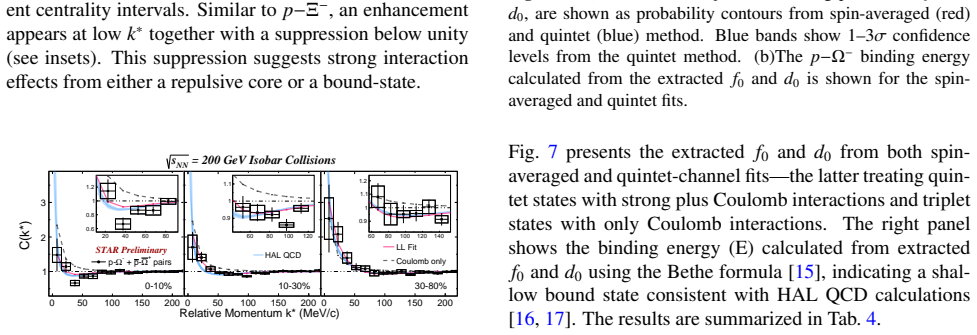
Using femtoscopic correlations measured by STAR in Ru+Ru, Zr+Zr, and Au+Au collisions, the analysis extracts centrality-dependent source sizes and scattering parameters for pΞ and pΩ pairs via the Lednický-Lyuboshitz approach; the results establish an attractive interaction in pΞ pairs and the presence of a bound state in pΩ pairs.
What carries the argument
Lednický-Lyuboshitz formalism applied to measured two-particle correlation functions to extract source radii and scattering lengths for strange baryon pairs.
If this is right
- Source sizes extracted for pΞ and pΩ pairs decrease with increasing collision centrality.
- Scattering parameters for pΞ pairs are consistent with net attraction.
- Scattering parameters for pΩ pairs are consistent with the existence of a bound state.
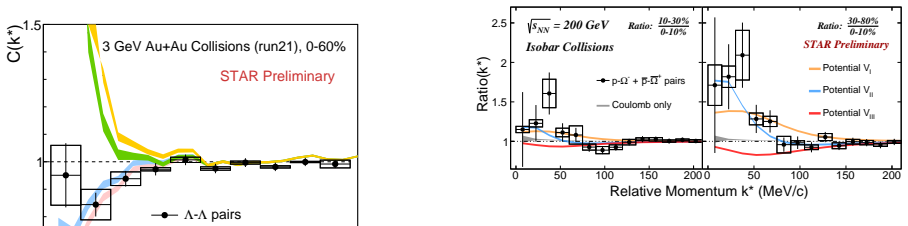
- The same dataset also yields ΛΛ correlation functions whose interaction parameters remain to be extracted in detail.
Where Pith is reading between the lines
- The extracted pΩ bound-state parameters could be compared directly with lattice-QCD calculations of the two-baryon potential.
- Evidence for a pΩ bound state suggests possible multi-strange hypernuclear states that could be searched for in the same collision systems.
- Repeating the femtoscopy analysis at LHC energies would test whether the centrality dependence and interaction strengths persist at higher temperatures and densities.
Load-bearing premise
The Lednický-Lyuboshitz formalism accurately captures the measured correlation functions without significant contamination from resonance feed-down, non-Gaussian sources, or other final-state effects.
What would settle it
A higher-statistics measurement of the pΩ correlation function at low relative momentum that fits a repulsive or non-interacting model better than a bound-state model, or shows no low-momentum enhancement, would falsify the bound-state claim.
Figures





read the original abstract
Studying the final state interactions and finding possible bound states is helpful for understanding the strong interactions and comprehending the equation-of-state (EoS) of the nuclear matter. In these proceedings, we present recent femtoscopy results of \pXi{}, \LaLa{}, \pOm{} femtoscopic correlations with high statistics Isobar (Ru+Ru, Zr+Zr) and Au+Au collisions measured by the STAR experiment. For the \pXi{} and \pOm{} pairs, the centrality dependence of source size and the scattering parameters are extracted with the Lednick\'y-Lyuboshitz approach. The results show that there is an attractive interaction in \pXi{} pairs and a bound state in \pOm{} pairs.
Editorial analysis
A structured set of objections, weighed in public.
Referee Report
Summary. The manuscript presents femtoscopy measurements of pΞ, ΛΛ, and pΩ correlation functions in Isobar (Ru+Ru, Zr+Zr) and Au+Au collisions at RHIC-STAR. Using the Lednický-Lyuboshitz formalism, it extracts centrality-dependent source radii and scattering parameters (scattering length and effective range) for pΞ and pΩ pairs, concluding an attractive interaction for pΞ and the presence of a bound state for pΩ based on the location of the scattering amplitude pole.
Significance. If the model assumptions are validated, the results would supply rare experimental constraints on hyperon-nucleon interactions at low relative momentum, with the pΩ bound-state indication potentially informing hypernuclear structure and the high-density equation of state. The centrality dependence of the source size also offers a consistency check with other femtoscopic observables.
major comments (2)
- [Lednický-Lyuboshitz analysis and results] The central claim of a pΩ bound state rests on the fitted scattering length a0 and effective range r0 placing a pole on the positive imaginary axis, yet the manuscript reports neither the numerical values of these parameters (with uncertainties) nor the fit quality (χ²/dof) for the pΩ correlation functions. Without these, the bound-state interpretation cannot be quantitatively assessed.
- [Analysis method] The Lednický-Lyuboshitz extraction assumes a purely Gaussian source and negligible resonance feed-down (e.g., from Σ* or Ξ* decays). No systematic variation of source shape, feed-down fractions, or additional final-state effects is presented to quantify the resulting bias on a0 and r0 for the pΩ system, which is load-bearing for the bound-state conclusion.
minor comments (2)
- [Abstract] The abstract states that parameters are extracted but does not quote even the central values; including them would improve readability.
- [Figures] Figure captions should explicitly state the k* range used for the fits and whether Coulomb and strong interactions are both included in the model.
Simulated Author's Rebuttal
We thank the referee for the careful and constructive review of our manuscript. The comments identify important gaps in the presentation of quantitative results and systematic studies that we will address in revision. Point-by-point responses follow.
read point-by-point responses
-
Referee: [Lednický-Lyuboshitz analysis and results] The central claim of a pΩ bound state rests on the fitted scattering length a0 and effective range r0 placing a pole on the positive imaginary axis, yet the manuscript reports neither the numerical values of these parameters (with uncertainties) nor the fit quality (χ²/dof) for the pΩ correlation functions. Without these, the bound-state interpretation cannot be quantitatively assessed.
Authors: We agree that the numerical values of a0 and r0 (with uncertainties) and the χ²/dof must be reported to allow quantitative assessment of the pole position and bound-state claim. These parameters were extracted from the Lednický-Lyuboshitz fits to the measured pΩ correlation functions but were omitted from the proceedings due to space constraints. In the revised manuscript we will add a table (or explicit text) listing the fitted a0, r0, uncertainties, χ²/dof, and the resulting pole location for each centrality class. revision: yes
-
Referee: [Analysis method] The Lednický-Lyuboshitz extraction assumes a purely Gaussian source and negligible resonance feed-down (e.g., from Σ* or Ξ* decays). No systematic variation of source shape, feed-down fractions, or additional final-state effects is presented to quantify the resulting bias on a0 and r0 for the pΩ system, which is load-bearing for the bound-state conclusion.
Authors: We acknowledge that the current manuscript does not display systematic variations of the source shape or feed-down fractions. The analysis adopts a Gaussian source consistent with prior STAR femtoscopy results and estimates feed-down contributions to be small for the selected pΩ pairs. In the revision we will add an explicit section (or appendix) presenting the systematic studies performed: variations of source shape (Gaussian vs. exponential or Lévy), changes in feed-down fractions within estimated ranges, and assessment of other final-state effects. The resulting shifts in a0 and r0 will be quantified and shown to leave the bound-state conclusion intact within uncertainties. revision: yes
Circularity Check
No circularity: direct application of established Lednický-Lyuboshitz formalism to data
full rationale
The paper applies the pre-existing Lednický-Lyuboshitz model to fit measured correlation functions and extract source radii plus scattering parameters (a0, r0) for pΞ and pΩ pairs. No derivation step reduces by construction to a fitted quantity, no self-citation is load-bearing for the central claim, and the model itself is treated as an external input rather than derived or redefined within the work. The analysis is therefore self-contained against external benchmarks.
Axiom & Free-Parameter Ledger
free parameters (1)
- scattering length and effective range parameters
axioms (1)
- domain assumption The particle emission source is Gaussian and the correlation function is fully described by the Lednický-Lyuboshitz final-state interaction model.
Lean theorems connected to this paper
-
IndisputableMonolith/Cost/FunctionalEquation.leanwashburn_uniqueness_aczel unclearThe correlation function is parameterized using the Lednický-Lyuboshitz (LL) model, which considers a static spherical Gaussian source under a smoothness approximation, convoluted with an S-wave function.
-
IndisputableMonolith/Foundation/AbsoluteFloorClosure.leanreality_from_one_distinction unclearFor the p−Ξ− and p−Ω− pairs, the centrality dependence of source size and the scattering parameters are extracted with the Lednický-Lyuboshitz approach.
Reference graph
Works this paper leans on
-
[1]
Jinhui Chen et al, Nucl. Sci. Tech.35, 12, 214 (2024)
work page 2024
-
[2]
Xiaofeng Luo et al, Nucl. Sci. Tech.28, 8, 112 (2017)
work page 2017
-
[3]
Xiaofeng Luo et al,Properties of QCD Matter at High Baryon Density(Springer, 2022)
work page 2022
-
[4]
Glendenning, N. K. et al, Phys. Rev. C58, 1298-1305 (1998)
work page 1998
- [5]
-
[6]
R.L.Jaffe, Phys. Rev. Lett.38, 195 (1977), Phys. Rev. Lett.38, 617 (1977)
work page 1977
-
[7]
Goldman et al, Phys. Rev. Lett.59, 627 (1987)
work page 1987
-
[8]
R.Lednicky, V .L.Lyuboshitz, Sov. J. Nucl. Phys.35, 770 (1982)
work page 1982
-
[9]
Pratt, S., Phys. Rev. C56, 1095 (1997)
work page 1997
-
[10]
Kamiya, Y et al, Phys. Rev. C105, 014915 (2022)
work page 2022
-
[11]
Sasaki, Kenji et al, Nucl. Phys. A998, 121737 (2020)
work page 2020
-
[12]
P. M. M. Maessen et al, Phys. Rev. C40, 2226 (1989)
work page 1989
-
[13]
M. M. Nagels et al, Phys. Rev. D20, 1633 (1979)
work page 1979
-
[14]
M. M. Nagels et al, Phys. Rev. D15, 2547 (1977)
work page 1977
-
[15]
Macêdo-Lima, Mathias et al, Rev. Bras. Ens. Fis.45, e20230079 (2023)
work page 2023
-
[16]
Etminan et al, Nucl. Phys. A928, 89–98 (2014)
work page 2014
-
[17]
Morita et al, Phys. Rev. C101, 015201 (2020)
work page 2020
discussion (0)
Sign in with ORCID, Apple, or X to comment. Anyone can read and Pith papers without signing in.