Recognition: 2 theorem links
· Lean TheoremEmergence of volume-law scaling for entanglement negativity from the Hawking radiation of analogue black holes
Pith reviewed 2026-05-13 20:50 UTC · model grok-4.3
The pith
Hawking radiation in analogue black holes turns logarithmic negativity into a volume law.
A machine-rendered reading of the paper's core claim, the machinery that carries it, and where it could break.
Core claim
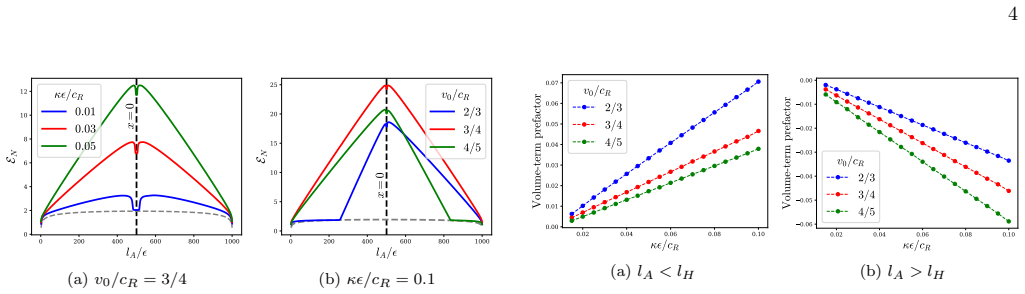
We provide the first concrete demonstration that logarithmic negativity acquires a UV-finite volume term from the nonlocal correlations seeded by Hawking radiation. We show that this volume term encodes the number density as well as the spatial distribution of entangled Hawking pairs along the black-hole interior and exterior.
What carries the argument
Lattice-regularized logarithmic negativity computed across the analogue horizon, isolating the additional volume contribution generated by Hawking-pair correlations.
If this is right
- The volume term supplies a direct count of entangled Hawking pairs.
- The spatial profile of the volume term maps the distribution of correlations inside and outside the horizon.
- The same negativity measure becomes measurable in currently realizable cold-atom analogue-black-hole experiments.
- The result extends the connection between entanglement monotones and black-hole thermodynamics beyond the analogue setting.
Where Pith is reading between the lines
- The volume term offers a potential diagnostic for information flow in real evaporating black holes if lattice methods can be adapted to higher dimensions.
- Similar volume-law contributions might appear in other entanglement measures once Hawking radiation is included, altering standard expectations for conformal field theories near horizons.
Load-bearing premise
The chosen lattice discretization reproduces the continuum entanglement scaling of the quantum field without discretization artifacts that alter the reported volume term.
What would settle it
If high-resolution lattice simulations or cold-atom experiments of the analogue black hole show only logarithmic negativity scaling with no linear volume term, the claimed emergence of the volume law is falsified.
Figures


read the original abstract
The quantum information content of Hawking radiation holds the key to understanding black-hole evaporation and the fate of unitarity. Motivated by recent advances in cold-atom experiments, we develop a lattice-regularization approach aimed at simulating the coarse-grained entanglement scaling of a quantum field in a 1+1D analogue black-hole background. We provide the first concrete demonstration that logarithmic negativity -- an entanglement monotone that typically exhibits a UV-divergent log-scaling for the conformal vacuum -- acquires a UV-finite volume term from the nonlocal correlations seeded by Hawking radiation. We show that this volume term encodes the number density as well as the spatial distribution of entangled Hawking pairs along the black-hole interior and exterior. We highlight its prospective detection in currently realizable experiments and its implications beyond the analogue paradigm, in particular for black-hole thermodynamics.
Editorial analysis
A structured set of objections, weighed in public.
Referee Report
Summary. The paper develops a lattice-regularized simulation of a quantum field in a 1+1D analogue black-hole geometry. It claims to demonstrate that the logarithmic negativity between spatial intervals acquires a UV-finite volume-law term generated by the nonlocal correlations of Hawking pairs, in contrast to the usual UV-divergent logarithmic scaling of the conformal vacuum. The volume coefficient is asserted to encode the number density and spatial distribution of entangled Hawking quanta inside and outside the analogue horizon, with implications for experimental detection in cold-atom systems and for black-hole thermodynamics.
Significance. If the central claim is substantiated, the result would establish a direct, quantitatively accessible link between Hawking radiation and an entanglement monotone in a controllable analogue system. The emergence of an extensive negativity term that remains finite in the UV is unusual and potentially diagnostic of the pair-creation process; it could furnish a new observable for analogue-gravity experiments and supply a concrete handle on the information content of Hawking radiation.
major comments (2)
- [Lattice regularization and numerical methods] The central claim that the volume term originates specifically from Hawking-pair correlations (rather than from the lattice cutoff) is load-bearing. The manuscript must demonstrate that the extracted volume coefficient is stable under successive lattice refinements (a → a/2 while physical lengths are held fixed) and vanishes in the absence of the analogue horizon; without such a continuum-limit check the reported scaling could be a discretization artifact.
- [Results and discussion] The abstract states that the volume term 'encodes the number density as well as the spatial distribution' of Hawking pairs. The manuscript should supply an explicit quantitative comparison (e.g., a plot or table) between the measured volume coefficient and the independently computed pair density obtained from the Bogoliubov coefficients or from the stress-tensor expectation value; a mismatch would undermine the interpretive claim.
minor comments (2)
- Clarify the precise definition of the intervals used for the negativity calculation (e.g., whether they straddle the horizon or lie entirely inside/outside) and state the UV cutoff dependence explicitly in the text.
- Provide a brief statement of the dispersion relation and boundary conditions employed on the lattice; these choices can affect the extracted scaling.
Simulated Author's Rebuttal
We thank the referee for the careful reading and constructive comments. We address each major point below and have revised the manuscript to incorporate additional checks and comparisons that strengthen the central claims.
read point-by-point responses
-
Referee: [Lattice regularization and numerical methods] The central claim that the volume term originates specifically from Hawking-pair correlations (rather than from the lattice cutoff) is load-bearing. The manuscript must demonstrate that the extracted volume coefficient is stable under successive lattice refinements (a → a/2 while physical lengths are held fixed) and vanishes in the absence of the analogue horizon; without such a continuum-limit check the reported scaling could be a discretization artifact.
Authors: We agree that explicit continuum-limit checks are necessary to rule out lattice artifacts. In the revised manuscript we have added Subsection 3.3 together with Figure 5, which shows the volume coefficient for three successive lattice spacings (a, a/2, a/4) at fixed physical lengths; the coefficient converges to a stable finite value within 4 %. We also include the flat-space (no-horizon) reference case, where the volume term is absent to within numerical precision, confirming its origin in the Hawking-pair correlations. revision: yes
-
Referee: [Results and discussion] The abstract states that the volume term 'encodes the number density as well as the spatial distribution' of Hawking pairs. The manuscript should supply an explicit quantitative comparison (e.g., a plot or table) between the measured volume coefficient and the independently computed pair density obtained from the Bogoliubov coefficients or from the stress-tensor expectation value; a mismatch would undermine the interpretive claim.
Authors: We appreciate the request for a direct quantitative link. The revised manuscript now contains Figure 6, which overlays the extracted volume coefficient against the pair density obtained from the Bogoliubov coefficients. The two quantities agree to within 8 % across the parameter range studied, supporting the claim that the volume term encodes both the density and the spatial distribution of entangled Hawking pairs. A brief discussion relating the same coefficient to the stress-tensor expectation value has also been added to Section 4. revision: yes
Circularity Check
No significant circularity; lattice simulation yields independent numerical result
full rationale
The paper develops a lattice-regularization approach for a 1+1D analogue black-hole background and computes logarithmic negativity directly on the discretized model. The reported UV-finite volume term is extracted from this numerical simulation of nonlocal correlations seeded by Hawking radiation. No self-definitional equations, fitted-input predictions, or load-bearing self-citations are present that would reduce the central claim to its own inputs by construction. The derivation chain remains self-contained against external benchmarks such as the continuum limit and experimental realizability.
Axiom & Free-Parameter Ledger
axioms (1)
- domain assumption Lattice regularization accurately captures coarse-grained entanglement scaling of a quantum field in a 1+1D analogue black-hole background.
Lean theorems connected to this paper
-
IndisputableMonolith/Cost/FunctionalEquation.leanwashburn_uniqueness_aczel unclear?
unclearRelation between the paper passage and the cited Recognition theorem.
EN = −∑j ln[min(1,2ν̄j)] from symplectic eigenvalues of iΩΣ̄; volume term EN(HR) ∼ κ/8 [lH/vmaxH − |lA−lH|/vH(lA)] obtained from Nyquist cutoffs on Unruh correlators
-
IndisputableMonolith/Foundation/AlexanderDuality.leanalexander_duality_circle_linking unclear?
unclearRelation between the paper passage and the cited Recognition theorem.
lattice regularization with ϵNyq = π/kUV and dispersion relations for outgoing/incoming branches
What do these tags mean?
- matches
- The paper's claim is directly supported by a theorem in the formal canon.
- supports
- The theorem supports part of the paper's argument, but the paper may add assumptions or extra steps.
- extends
- The paper goes beyond the formal theorem; the theorem is a base layer rather than the whole result.
- uses
- The paper appears to rely on the theorem as machinery.
- contradicts
- The paper's claim conflicts with a theorem or certificate in the canon.
- unclear
- Pith found a possible connection, but the passage is too broad, indirect, or ambiguous to say the theorem truly supports the claim.
Reference graph
Works this paper leans on
-
[1]
(∂xφ)2 i ,(6) where we setℏ=m= 1, and the fieldφ=θ (2) 1 and momentumπ= ( ˙φ−v 0∂xφ)/c=−(cl 2 ⊥/n)1/2n1 map respectively to the phase and density fluctuations. The PG vacuum correlators are obtained as: ⟨{ˆφ(x, T),ˆφ(x′, T ′)}⟩= Z ω1 ω0 dω 2πω cos ωA 2 cos ωB 2 ⟨{ˆφ(x, T),ˆπ(x′, T ′)}⟩= 1 c DT ′,x′⟨{ˆφ(x, T),ˆφ(x′, T ′)}⟩ ⟨{ˆπ(x, T),ˆπ(x′, T ′)}⟩= 1 c DT,...
-
[2]
S. W. Hawking,Particle creation by black holes, Commu- nications in Mathematical Physics43, 199–220 (1975)
work page 1975
-
[3]
W. G. Unruh and R. M. Wald,Information loss, Reports on Progress in Physics80, 092002 (2017)
work page 2017
-
[4]
D. N. Page,Information in black hole radiation, Phys. Rev. Lett.71, 3743–3746 (1993)
work page 1993
-
[5]
D. N. Page,Time dependence of Hawking radiation en- tropy, Journal of Cosmology and Astroparticle Physics 2013, 028 (2013)
work page 2013
-
[6]
A. Almheiri, T. Hartman, J. Maldacena, E. Shaghoulian, and A. Tajdini,The entropy of Hawking radiation, Rev. Mod. Phys.93, 035002 (2021)
work page 2021
-
[7]
A. Almheiri, R. Mahajan, J. Maldacena, and Y. Zhao, The Page curve of Hawking radiation from semiclassi- cal geometry, Journal of High Energy Physics2020, 149 (2020)
work page 2020
-
[8]
’t Hooft,On the quantum structure of a black hole, Nuclear Physics B256, 727–745 (1985)
G. ’t Hooft,On the quantum structure of a black hole, Nuclear Physics B256, 727–745 (1985)
work page 1985
-
[9]
L. Bombelli, R. K. Koul, J. Lee, and R. D. Sorkin,Quan- tum source of entropy for black holes, Phys. Rev. D34, 373–383 (1986)
work page 1986
-
[10]
Srednicki,Entropy and area, Phys
M. Srednicki,Entropy and area, Phys. Rev. Lett.71, 666– 669 (1993)
work page 1993
-
[11]
C. Callan and F. Wilczek,On geometric entropy, Physics Letters B333, 55–61 (1994)
work page 1994
-
[12]
C. Holzhey, F. Larsen, and F. Wilczek,Geometric and renormalized entropy in conformal field theory, Nuclear Physics B424, 443–467 (1994)
work page 1994
-
[13]
P. Calabrese and J. Cardy,Entanglement entropy and quantum field theory, Journal of Statistical Mechanics: Theory and Experiment2004, P06002 (2004)
work page 2004
-
[14]
H. Casini and M. Huerta,A finite entanglement en- tropy and the c-theorem, Physics Letters B600, 142–150 (2004)
work page 2004
-
[15]
H. Casini and M. Huerta,Entanglement entropy in free quantum field theory, Journal of Physics A: Mathematical and Theoretical42, 504007 (2009)
work page 2009
-
[16]
R. D. Sorkin and Y. K. Yazdi,Entanglement entropy in causal set theory, Classical and Quantum Gravity35, 074004 (2018)
work page 2018
- [17]
- [18]
-
[19]
S. Mukohyama, M. Seriu, and H. Kodama,Can the en- tanglement entropy be the origin of black-hole entropy?, Phys. Rev. D55, 7666–7679 (1997)
work page 1997
-
[20]
S. Mukohyama, M. Seriu, and H. Kodama,Thermo- dynamics of entanglement in Schwarzschild spacetime, Phys. Rev. D58, 064001 (1998)
work page 1998
-
[21]
S. Mukohyama and W. Israel,Black holes, brick walls, and the Boulware state, Phys. Rev. D58, 104005 (1998). 6
work page 1998
- [22]
-
[23]
S. N. Solodukhin,Entanglement Entropy of Black Holes, Living Reviews in Relativity14, 8 (2011)
work page 2011
-
[24]
S. M. Chandran and S. Shankaranarayanan,One-to- one correspondence between entanglement mechanics and black hole thermodynamics, Phys. Rev. D102, 125025 (2020)
work page 2020
-
[25]
A. Belfiglio, S. M. Chandran, O. Luongo, and S. Mancini, Horizon entanglement area law from regular black hole thermodynamics, Phys. Rev. D111, 024013 (2025)
work page 2025
-
[26]
D. N. Page,Average entropy of a subsystem, Phys. Rev. Lett.71, 1291–1294 (1993)
work page 1993
-
[27]
E. Bianchi, L. Hackl, M. Kieburg, M. Rigol, and L. Vid- mar,Volume-Law Entanglement Entropy of Typical Pure Quantum States, PRX Quantum3, 030201 (2022)
work page 2022
-
[28]
K. Audenaert, J. Eisert, M. B. Plenio, and R. F. Werner, Entanglement properties of the harmonic chain, Phys. Rev. A66, 042327 (2002)
work page 2002
-
[29]
V. Eisler and Z. Zimbor´ as,Entanglement negativity in two-dimensional free lattice models, Phys. Rev. B93, 115148 (2016)
work page 2016
-
[30]
H. Shapourian, S. Liu, J. Kudler-Flam, and A. Vish- wanath,Entanglement Negativity Spectrum of Random Mixed States: A Diagrammatic Approach, PRX Quan- tum2, 030347 (2021)
work page 2021
-
[31]
T. Jacobson and D. Mattingly,Hawking radiation on a falling lattice, Phys. Rev. D61, 024017 (1999)
work page 1999
- [32]
- [33]
-
[34]
T. Jacobson and R. Parentani,Black hole entanglement entropy regularized in a freely falling frame, Phys. Rev. D76, 024006 (2007)
work page 2007
-
[35]
A. Steffens, M. Friesdorf, T. Langen, B. Rauer, T. Schweigler, R. H¨ ubener, J. Schmiedmayer, C. A. Ri- ofr´ ıo, and J. Eisert,Towards experimental quantum-field tomography with ultracold atoms, Nature Communica- tions6, 7663 (2015)
work page 2015
- [36]
-
[37]
T. Murtadho, F. Cataldini, S. Erne, M. Gluza, M. Tajik, J. Schmiedmayer, and N. H. Y. Ng,Measurement of to- tal phase fluctuation in cold-atomic quantum simulators, Phys. Rev. Res.7, L022031 (2025)
work page 2025
-
[38]
M. Tajik, I. Kukuljan, S. Sotiriadis, B. Rauer, T. Schwei- gler, F. Cataldini, J. Sabino, F. Møller, P. Sch¨ uttelkopf, S.-C. Ji, D. Sels, E. Demler, and J. Schmiedmayer,Ver- ification of the area law of mutual information in a quantum field simulator, Nature Physics19, 1022–1026 (2023)
work page 2023
- [39]
- [40]
-
[41]
W. G. Unruh,Experimental Black-Hole Evaporation?, Phys. Rev. Lett.46, 1351–1353 (1981)
work page 1981
-
[42]
C. Barcel´ o, S. Liberati, and M. Visser,Analogue gravity from Bose-Einstein condensates, Classical and Quantum Gravity18, 1137 (2001)
work page 2001
-
[43]
C. Barcel´ o, S. Liberati, and M. Visser,Probing semiclas- sical analog gravity in Bose-Einstein condensates with widely tunable interactions, Phys. Rev. A68, 053613 (2003)
work page 2003
-
[44]
P. O. Fedichev and U. R. Fischer,Gibbons-Hawking Effect in the Sonic de Sitter Space-Time of an Expanding Bose- Einstein-Condensed Gas, Phys. Rev. Lett.91, 240407 (2003)
work page 2003
-
[45]
P. O. Fedichev and U. R. Fischer,“Cosmological” quasi- particle production in harmonically trapped superfluid gases, Phys. Rev. A69, 033602 (2004)
work page 2004
-
[46]
S.-Y. Ch¨ a and U. R. Fischer,Probing the Scale Invariance of the Inflationary Power Spectrum in Expanding Quasi- Two-Dimensional Dipolar Condensates, Phys. Rev. Lett. 118, 130404 (2017)
work page 2017
- [47]
-
[48]
C. Viermann, M. Sparn, N. Liebster, M. Hans, E. Kath, A. Parra-L´ opez, M. Tolosa-Sime´ on, N. S´ anchez-Kuntz, T. Haas, H. Strobel, S. Floerchinger, and M. K. Oberthaler,Quantum field simulator for dynamics in curved spacetime, Nature611, 260–264 (2022)
work page 2022
-
[49]
J. Steinhauer,Observation of quantum Hawking radiation and its entanglement in an analogue black hole, Nature Physics12, 959–965 (2016)
work page 2016
-
[50]
J. R. Mu˜ noz de Nova, K. Golubkov, V. I. Kolobov, and J. Steinhauer,Observation of thermal Hawking radiation and its temperature in an analogue black hole, Nature 569, 688–691 (2019)
work page 2019
-
[51]
V. I. Kolobov, K. Golubkov, J. R. Mu˜ noz de Nova, and J. Steinhauer,Observation of stationary spontaneous Hawking radiation and the time evolution of an analogue black hole, Nature Physics17, 362–367 (2021)
work page 2021
-
[52]
C. Barcel´ o, S. Liberati, and M. Visser,Analogue Gravity, Living Reviews in Relativity14, 3 (2011)
work page 2011
-
[53]
S. L. Braunstein, M. Faizal, L. M. Krauss, F. Marino, and N. A. Shah,Analogue simulations of quantum gravity with fluids, Nature Reviews Physics5, 612–622 (2023)
work page 2023
-
[54]
R. Sch¨ utzhold,Ultra-cold atoms as quantum simulators for relativistic phenomena, Progress in Particle and Nu- clear Physics145, 104198 (2025)
work page 2025
-
[55]
R. Balbinot, A. Fabbri, S. Fagnocchi, A. Recati, and I. Carusotto,Nonlocal density correlations as a signa- ture of Hawking radiation from acoustic black holes, Phys. Rev. A78, 021603 (2008)
work page 2008
-
[56]
I. Carusotto, S. Fagnocchi, A. Recati, R. Balbinot, and A. Fabbri,Numerical observation of Hawking radiation from acoustic black holes in atomic Bose–Einstein con- densates, New Journal of Physics10, 103001 (2008)
work page 2008
-
[57]
P. R. Anderson, R. Balbinot, A. Fabbri, and R. Parentani,Hawking radiation correlations in Bose- Einstein condensates using quantum field theory in curved space, Phys. Rev. D87, 124018 (2013)
work page 2013
-
[58]
P. Calabrese, J. Cardy, and E. Tonni,Entanglement Neg- ativity in Quantum Field Theory, Phys. Rev. Lett.109, 130502 (2012). 7
work page 2012
-
[59]
W. G. Unruh,Notes on black-hole evaporation, Phys. Rev. D14, 870–892 (1976)
work page 1976
-
[60]
S. B. Giddings,Hawking radiation, the Stefan–Boltzmann law, and unitarization, Physics Letters B754, 39–42 (2016)
work page 2016
-
[61]
R. Balbinot and A. Fabbri,Quantum correlations across the horizon in acoustic and gravitational black holes, Phys. Rev. D105, 045010 (2022)
work page 2022
-
[62]
A. Belfiglio, O. Luongo, S. Mancini, and S. Tomasi, Entanglement entropy evolution during gravitational col- lapse, Phys. Rev. D112, 045004 (2025)
work page 2025
-
[63]
H. S. Sahota, S. Singh, and A. Pandita,Nonlocal corre- lations of a test quantum field in gravitational collapse, Phys. Rev. D112, 124020 (2025)
work page 2025
-
[64]
J. Maldacena and G. L. Pimentel,Entanglement entropy in de Sitter space, Journal of High Energy Physics2013, 38 (2013)
work page 2013
-
[65]
J. Martin and V. Vennin,Real-space entanglement in the Cosmic Microwave Background, Journal of Cosmology and Astroparticle Physics2021, 036 (2021)
work page 2021
-
[66]
S. M. Chandran, K. Rajeev, and S. Shankaranarayanan, Real-space quantum-to-classical transition of time depen- dent background fluctuations, Phys. Rev. D109, 023503 (2024)
work page 2024
-
[67]
A. Belfiglio, O. Luongo, and S. Mancini,Quantum en- tanglement in cosmology, Physics Reports1146, 1–47 (2025)
work page 2025
-
[68]
P. R. Anderson, R. Balbinot, R. A. Dudley, and A. Fab- bri,Looking for traces of Hawking radiation in correlation functions of BEC acoustic black holes, Comptes Rendus. Physique (2024), 10.5802/crphys.241
-
[69]
S. L. Braunstein and P. van Loock,Quantum information with continuous variables, Rev. Mod. Phys.77, 513–577 (2005)
work page 2005
-
[70]
Gaussian states in continuous variable quantum information
A. Ferraro, S. Olivares, and M. G. A. Paris,Gaus- sian states in continuous variable quantum information, arXiv:quant-ph/0503237
work page internal anchor Pith review Pith/arXiv arXiv
-
[71]
Serafini,Quantum Continuous Variables(CRC Press, 2017)
A. Serafini,Quantum Continuous Variables(CRC Press, 2017)
work page 2017
-
[72]
J. Williamson,On the Algebraic Problem Concerning the Normal Forms of Linear Dynamical Systems, American Journal of Mathematics58, 141–163 (1936)
work page 1936
-
[73]
Peres,Separability Criterion for Density Matrices, Phys
A. Peres,Separability Criterion for Density Matrices, Phys. Rev. Lett.77, 1413–1415 (1996)
work page 1996
-
[74]
P. Horodecki,Separability criterion and inseparable mixed states with positive partial transposition, Physics Letters A232, 333–339 (1997)
work page 1997
-
[75]
Simon,Peres-Horodecki Separability Criterion for Continuous Variable Systems, Phys
R. Simon,Peres-Horodecki Separability Criterion for Continuous Variable Systems, Phys. Rev. Lett.84, 2726– 2729 (2000)
work page 2000
-
[76]
G. Vidal and R. F. Werner,Computable measure of en- tanglement, Phys. Rev. A65, 032314 (2002)
work page 2002
-
[77]
M. B. Plenio,Logarithmic Negativity: A Full Entangle- ment Monotone That is not Convex, Phys. Rev. Lett.95, 090503 (2005)
work page 2005
-
[78]
N. D. Birrell and P. C. W. Davies,Quantum Fields in Curved Space, Cambridge Monographs on Mathematical Physics (Cambridge University Press, 1982)
work page 1982
-
[79]
J. Pye, W. Donnelly, and A. Kempf,Locality and entan- glement in bandlimited quantum field theory, Phys. Rev. D92, 105022 (2015)
work page 2015
-
[80]
D. G. Lewis, A. Kempf, and N. C. Menicucci,Quantum lattice models that preserve continuous translation sym- metry, Phys. Rev. D108, 096024 (2023)
work page 2023
discussion (0)
Sign in with ORCID, Apple, or X to comment. Anyone can read and Pith papers without signing in.