Recognition: 1 theorem link
· Lean TheoremAxial gravitational perturbations and echo-like signals of a hairy black hole from gravitational decoupling
Pith reviewed 2026-05-13 20:46 UTC · model grok-4.3
The pith
The axial potential of a hairy black hole develops a double-peak structure that produces echo-like signals dynamically from its geometry.
A machine-rendered reading of the paper's core claim, the machinery that carries it, and where it could break.
Core claim
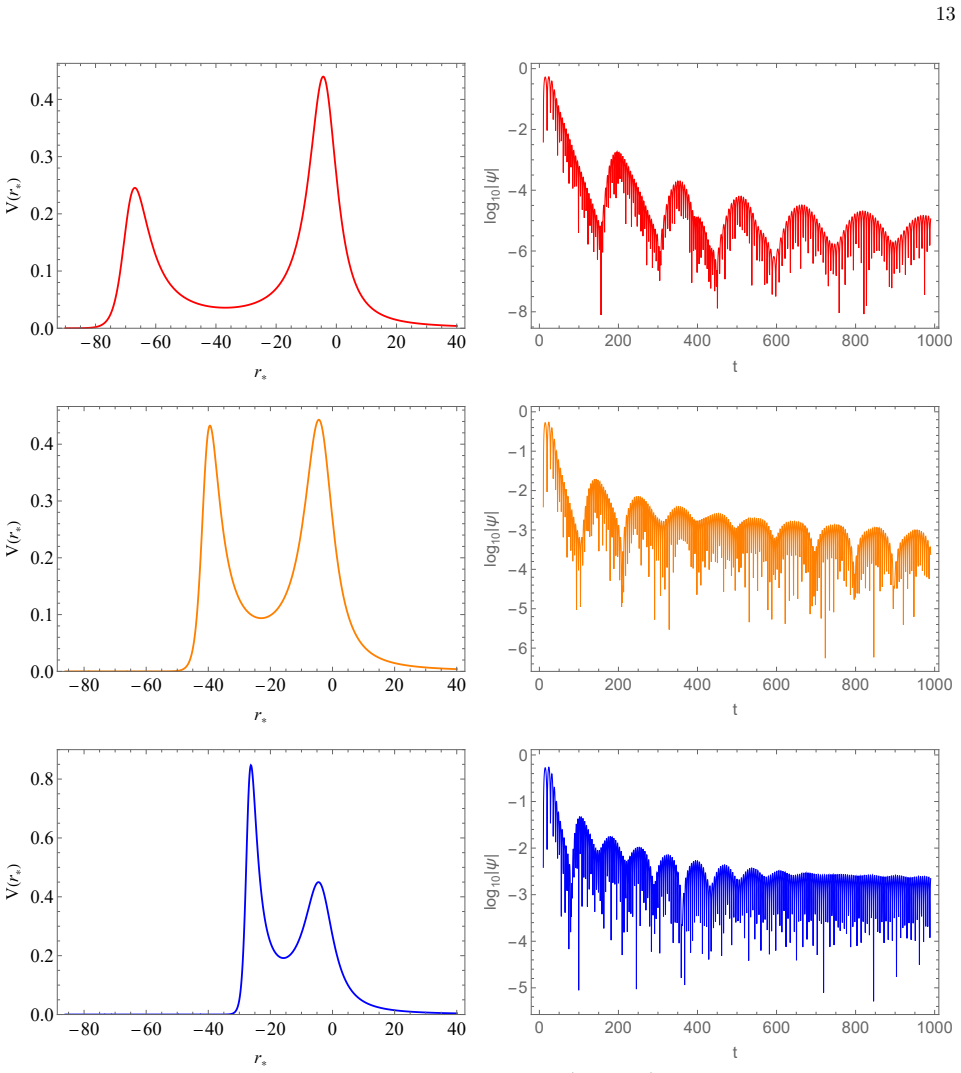
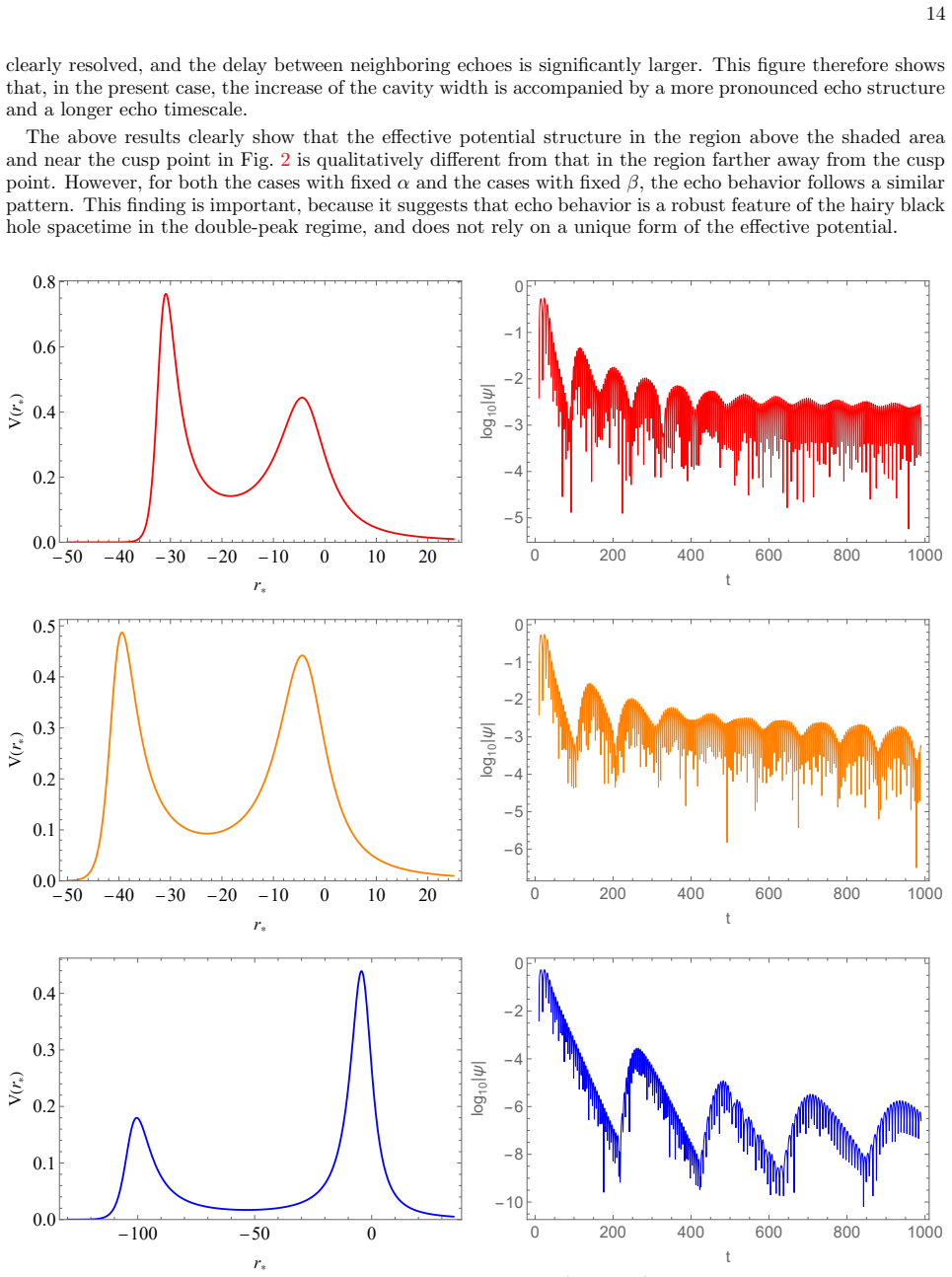
In the spacetime of the hairy black hole obtained via gravitational decoupling, the axial gravitational perturbations obey a Schrödinger-like master equation whose effective potential develops a double-peak structure for suitable parameter values. This structure forms a trapping cavity that supports echo-like late-time waveforms. The delayed pulses arise dynamically from the geometry of the effective potential without the need to impose near-horizon reflectivity by hand. The parameter region exhibiting echoes does not necessarily coincide with the region in which the weak energy condition holds everywhere outside the event horizon.
What carries the argument
The effective potential for axial (odd-parity) perturbations, which develops a double-peak structure that supports a trapping cavity.
If this is right
- The quasinormal-mode spectrum contains modes whose time-domain evolution produces echo-like late-time signals.
- Echo signals can serve as a probe of black-hole hair in gravitational-wave ringdown observations.
- The region of parameter space that supports echoes must be distinguished from the region where the weak energy condition holds everywhere outside the horizon when assessing physical viability.
Where Pith is reading between the lines
- Detection of such echoes in real gravitational-wave data would indicate a deviation from the Kerr geometry even if the hair violates energy conditions in some exterior regions.
- The double-peak mechanism may appear in other non-Kerr solutions whenever the effective potential splits into two barriers.
- Extending the time-domain simulations to include rotation or higher multipoles would test whether the echo signals remain robust.
Load-bearing premise
The hairy black hole solution constructed via gravitational decoupling remains a physically acceptable background in the parameter region where the double-peak potential and echoes appear, even when the weak energy condition is violated outside the horizon.
What would settle it
A time-domain integration of the axial master equation that shows no delayed echo pulses when the potential lacks the double-peak structure, or conversely shows clear echoes precisely when the double peak is present.
Figures


read the original abstract
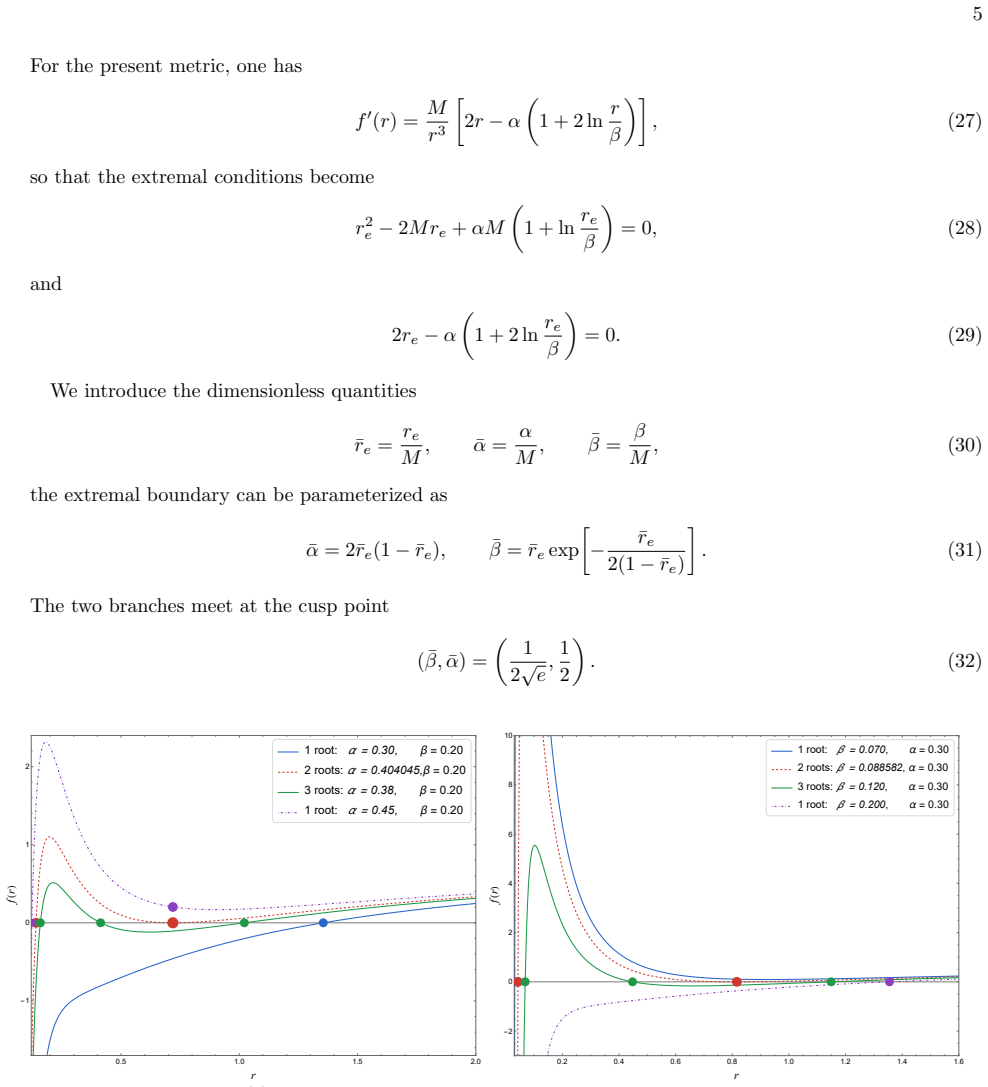
We study axial gravitational perturbations of a hairy black hole constructed in the framework of gravitational decoupling and investigate the geometric origin of echo-like late-time signals in this spacetime. We derive the odd-parity master equation and the corresponding effective potential, and we compute the quasinormal-mode spectrum by using frequency-domain and time-domain methods. We show that, in a suitable region of parameter space, the axial potential develops a double-peak structure that supports a trapping cavity and gives rise to echo-like late-time waveforms. Rather than imposing near-horizon reflectivity by hand, the delayed pulses therefore arise dynamically from the geometry of the effective potential. We also clarify that the parameter region exhibiting echoes need not coincide with the region in which the weak energy condition is satisfied everywhere outside the event horizon, and this distinction must be taken into account when interpreting the physical status of the solution. Our results provide a useful framework for probing black-hole hair through gravitational-wave ringdown and for exploring possible observational departures from the standard no-hair paradigm.
Editorial analysis
A structured set of objections, weighed in public.
Referee Report
Summary. The manuscript examines axial gravitational perturbations of a hairy black hole constructed via gravitational decoupling. It derives the odd-parity master equation and the associated effective potential, computes the quasinormal-mode spectrum using both frequency-domain and time-domain methods, and shows that for suitable values of the decoupling parameter the potential develops a double-peak structure supporting a trapping cavity. This geometry produces echo-like late-time waveforms dynamically, without hand-imposed near-horizon reflectivity. The authors explicitly separate the echo-producing parameter window from the region in which the weak energy condition holds everywhere outside the horizon.
Significance. If the central results hold, the work supplies a concrete, parameter-controlled example of how black-hole hair can generate observable ringdown deviations in the form of echoes that arise purely from the geometry of the effective potential. The dual frequency- and time-domain analysis, together with the explicit acknowledgment that echo signals need not coincide with weak-energy-condition compliance, strengthens the paper’s utility as a framework for testing the no-hair paradigm with gravitational-wave data.
minor comments (3)
- [§3] §3 (or equivalent section presenting the master equation): the explicit form of the effective potential V(r) should be written out in full, including the dependence on the decoupling parameter, to allow direct verification of the double-peak structure.
- [Time-domain analysis] Time-domain section: convergence tests with respect to grid spacing and outer-boundary location should be reported (or referenced) to substantiate the late-time echo signals.
- [Figures] Figure captions: the range of the decoupling parameter used in each panel should be stated explicitly so that readers can map the plotted waveforms to the claimed echo window.
Simulated Author's Rebuttal
We thank the referee for the positive and constructive assessment of our manuscript. We appreciate the recognition that our work provides a concrete, parameter-controlled example of echo-like signals arising dynamically from the effective potential geometry, together with the explicit separation from the weak-energy-condition region. We have prepared a revised version addressing the minor revision recommendation.
Circularity Check
No significant circularity; derivation is self-contained
full rationale
The paper derives the odd-parity master equation and effective potential directly from the given hairy black-hole metric obtained via gravitational decoupling. The double-peak structure, trapping cavity, and resulting echo-like late-time signals are computed from this potential for selected decoupling parameters, without fitting any parameters to target waveforms or imposing near-horizon reflectivity by hand. No load-bearing steps rely on self-citations, uniqueness theorems imported from prior author work, or ansatzes smuggled via citation; the explicit separation of the echo-producing parameter window from the region satisfying the weak energy condition is stated outright. The central claim therefore follows from the geometry and standard perturbation theory without reducing to its inputs by construction.
Axiom & Free-Parameter Ledger
free parameters (1)
- hair/decoupling parameter
axioms (1)
- domain assumption The gravitational decoupling procedure yields a valid exact solution of the Einstein equations with hair.
Reference graph
Works this paper leans on
-
[1]
B. P. Abbottet al.(LIGO Scientific, Virgo), Phys. Rev. Lett.116, 061102 (2016), arXiv:1602.03837 [gr-qc]
work page internal anchor Pith review Pith/arXiv arXiv 2016
-
[2]
B. P. Abbottet al.(LIGO Scientific, Virgo), Phys. Rev. Lett.119, 161101 (2017), arXiv:1710.05832 [gr-qc]
work page internal anchor Pith review Pith/arXiv arXiv 2017
-
[3]
Abbottet al.(KAGRA, VIRGO, LIGO Scientific), Astrophys
R. Abbottet al.(KAGRA, VIRGO, LIGO Scientific), Astrophys. J. Suppl.267, 29 (2023), arXiv:2302.03676 [gr-qc]
- [4]
-
[5]
Quasinormal modes of black holes and black branes
E. Berti, V. Cardoso, and A. O. Starinets, Class. Quant. Grav.26, 163001 (2009), arXiv:0905.2975 [gr-qc]
work page internal anchor Pith review Pith/arXiv arXiv 2009
-
[6]
R. A. Konoplya and A. Zhidenko, Rev. Mod. Phys.83, 793 (2011), arXiv:1102.4014 [gr-qc]
work page internal anchor Pith review Pith/arXiv arXiv 2011
-
[7]
Inspiral, merger and ring-down of equal-mass black-hole binaries
A. Buonanno, G. B. Cook, and F. Pretorius, Phys. Rev. D75, 124018 (2007), arXiv:gr-qc/0610122
work page internal anchor Pith review Pith/arXiv arXiv 2007
-
[8]
V. Cardoso, E. Franzin, and P. Pani, Phys. Rev. Lett.116, 171101 (2016), [Erratum: Phys.Rev.Lett. 117, 089902 (2016)], arXiv:1602.07309 [gr-qc]
-
[9]
Can environmental effects spoil precision gravitational-wave astrophysics?
E. Barausse, V. Cardoso, and P. Pani, Phys. Rev. D89, 104059 (2014), arXiv:1404.7149 [gr-qc]
work page Pith review arXiv 2014
-
[10]
Universal Bound on Dynamical Relaxation Times and Black-Hole Quasinormal Ringing
S. Hod, Phys. Rev. D75, 064013 (2007), arXiv:gr-qc/0611004
work page internal anchor Pith review Pith/arXiv arXiv 2007
-
[11]
The physical interpretation of the spectrum of black hole quasinormal modes
M. Maggiore, Phys. Rev. Lett.100, 141301 (2008), arXiv:0711.3145 [gr-qc]. 16
work page internal anchor Pith review Pith/arXiv arXiv 2008
-
[12]
Black Hole Spectroscopy: Testing General Relativity through Gravitational Wave Observations
O. Dreyer, B. J. Kelly, B. Krishnan, L. S. Finn, D. Garrison, and R. Lopez-Aleman, Class. Quant. Grav.21, 787 (2004), arXiv:gr-qc/0309007
work page internal anchor Pith review Pith/arXiv arXiv 2004
-
[13]
M. Giesler, M. Isi, M. A. Scheel, and S. Teukolsky, Phys. Rev. X9, 041060 (2019), arXiv:1903.08284 [gr-qc]
-
[14]
Ringdown overtones, black hole spectroscopy, and no-hair theorem tests,
S. Bhagwat, X. J. Forteza, P. Pani, and V. Ferrari, Phys. Rev. D101, 044033 (2020), arXiv:1910.08708 [gr-qc]
-
[15]
P. K. Kovtun and A. O. Starinets, Phys. Rev. D72, 086009 (2005), arXiv:hep-th/0506184
work page internal anchor Pith review Pith/arXiv arXiv 2005
- [16]
- [17]
- [18]
- [19]
- [20]
-
[21]
R. A. Konoplya, A. Zhidenko, and A. F. Zinhailo, Class. Quant. Grav.36, 155002 (2019), arXiv:1904.10333 [gr-qc]
work page Pith review arXiv 2019
- [22]
- [23]
- [24]
-
[25]
V. Cardoso and J. P. S. Lemos, Phys. Rev. D64, 084017 (2001), arXiv:gr-qc/0105103
work page internal anchor Pith review Pith/arXiv arXiv 2001
-
[26]
B. Wang, C.-Y. Lin, and C. Molina, Phys. Rev. D70, 064025 (2004), arXiv:hep-th/0407024
-
[27]
R. G. Daghigh and M. D. Green, Class. Quant. Grav.26, 125017 (2009), arXiv:0808.1596 [gr-qc]
work page internal anchor Pith review Pith/arXiv arXiv 2009
-
[28]
A. Zhidenko, Class. Quant. Grav.21, 273 (2004), arXiv:gr-qc/0307012
-
[29]
S. Lepe and J. Saavedra, Phys. Lett. B617, 174 (2005), arXiv:gr-qc/0410074
-
[30]
A. Zhidenko, Class. Quant. Grav.23, 3155 (2006), arXiv:gr-qc/0510039
-
[31]
Quasinormal Modes of Bardeen Black Hole: Scalar Perturbations
S. Fernando and J. Correa, Phys. Rev. D86, 064039 (2012), arXiv:1208.5442 [gr-qc]
work page Pith review arXiv 2012
-
[32]
B. Toshmatov, A. Abdujabbarov, Z. Stuchl´ ık, and B. Ahmedov, Phys. Rev. D91, 083008 (2015), arXiv:1503.05737 [gr-qc]
- [33]
- [34]
-
[35]
´A. Rinc´ on and G. Panotopoulos, Phys. Rev. D97, 024027 (2018), arXiv:1801.03248 [hep-th]
-
[36]
P. Pani and V. Cardoso, Phys. Rev. D79, 084031 (2009), arXiv:0902.1569 [gr-qc]
work page internal anchor Pith review Pith/arXiv arXiv 2009
- [37]
- [38]
- [39]
- [40]
- [41]
- [42]
- [43]
-
[44]
M. Okyay and A. ¨Ovg¨ un, JCAP01, 009 (2022), arXiv:2108.07766 [gr-qc]
- [45]
-
[46]
Z.-H. Yang, Y.-H. Lei, X.-M. Kuang, and B. Wang, Eur. Phys. J. C85, 100 (2025), arXiv:2408.07418 [gr-qc]
-
[47]
W.-L. Qian, G.-R. Li, R. G. Daghigh, S. Randow, and R.-H. Yue, Phys. Rev. D111, 024047 (2025), arXiv:2409.17026 [gr-qc]
- [48]
-
[49]
S.-H. Xiong, Y.-Z. Li, X.-M. Kuang, and J. Matyjasek, Eur. Phys. J. C85, 1143 (2025), arXiv:2508.03270 [gr-qc]
-
[50]
Z.-H. Yang, L.-B. Wu, X.-M. Kuang, and W.-L. Qian, Phys. Rev. D113, 044072 (2026), arXiv:2510.02033 [gr-qc]
-
[51]
J. Ovalle, Phys. Rev. D95, 104019 (2017), arXiv:1704.05899 [gr-qc]
- [52]
- [53]
- [54]
-
[55]
Z.-H. Yang, C. Xu, X.-M. Kuang, B. Wang, and R.-H. Yue, Phys. Lett. B853, 138688 (2024)
work page 2024
- [56]
- [57]
- [58]
- [59]
-
[60]
A. Jansen, Eur. Phys. J. Plus132, 546 (2017), arXiv:1709.09178 [gr-qc]
- [61]
-
[62]
Quasinormal modes of black holes. The improved semianalytic approach
J. Matyjasek and M. Opala, Phys. Rev. D96, 024011 (2017), arXiv:1704.00361 [gr-qc]
work page Pith review arXiv 2017
-
[63]
Late-Time Behavior of Stellar Collapse and Explosions: I. Linearized Perturbations
C. Gundlach, R. H. Price, and J. Pullin, Phys. Rev. D49, 883 (1994), arXiv:gr-qc/9307009
work page internal anchor Pith review Pith/arXiv arXiv 1994
discussion (0)
Sign in with ORCID, Apple, or X to comment. Anyone can read and Pith papers without signing in.